Scope: both retail and corporate. Conformal prediction for individual-level coverage guarantees on PD estimates. Demonstrated on retail data; the conformal machinery is distribution-free and portfolio-agnostic.
Overview
A credit model that outputs \(\hat p = 0.07\) says “this applicant will default seven times in a hundred.” It does not say how confident the model is in that seven. Two applicants with \(\hat p = 0.07\) may carry very different epistemic uncertainty: one resembles the training data, the other sits in a corner of feature space where the model has almost no signal. Collapsing both to the same point estimate is the central flaw of single-number scoring, and regulators are increasingly explicit that high-stakes algorithmic systems must carry uncertainty information (Board of Governors of the Federal Reserve System & Office of the Comptroller of the Currency, 2011; European Parliament and Council of the European Union, 2024).
Conformal prediction supplies a finite-sample, distribution-free, model-agnostic uncertainty layer. For any target miscoverage \(\alpha\) (typically \(0.1\)), conformal methods produce a prediction set\(\widehat C_\alpha(x)\) such that
The guarantee holds for any underlying model \(f\), any data-generating distribution, and for a sample of any size, provided only that the calibration and test points are exchangeable. It is the only uncertainty-quantification framework that delivers marginal coverage without parametric assumptions (Shafer & Vovk, 2008; Vovk et al., 2005), which is exactly what a credit supervisor values when the base model is a gradient-boosted tree rather than a generalized linear model with asymptotic confidence intervals.
This chapter derives the four conformal variants that matter for credit scoring: split conformal prediction (the production default), jackknife+ (when calibration data is scarce), conformalized quantile regression (when the underlying signal is regression-valued, for example loss-given-default), and adaptive conformal inference under distribution shift (for serving-time drift). It implements each from scratch, benchmarks on the Taiwan and Home Credit samples, and closes with the operational patterns for deploying conformal sets behind a production scoring API.
25.1 Notation and the exchangeability assumption
Let \(\{(X_i, Y_i)\}_{i=1}^n\) be the training and calibration data, and \((X_{n+1}, Y_{n+1})\) a test point. All conformal guarantees require exchangeability: the joint distribution of \((X_1,Y_1,\dots,X_{n+1},Y_{n+1})\) is invariant under permutations. This is implied by (and weaker than) the i.i.d. assumption. For credit scoring this is where the mathematical obligation meets the empirical reality: time-series splits violate exchangeability strictly, and supervisors will correctly flag any “95% coverage” claim based on a time-ordered calibration set as overstated. The Gibbs-Candes adaptive method in Section 25.6 recovers coverage under controlled shift, and is the right default for production.
Define a nonconformity score\(s: \mathcal{X} \times \mathcal{Y} \to \mathbb{R}\). For classification the canonical choice is
\[
s(x, y) = 1 - \hat p_y(x),
\tag{25.2}\]
where \(\hat p_y(x)\) is the model’s predicted probability of class \(y\). For regression \(s(x,y) = |y - \hat f(x)|\) is the standard.
25.2 Split conformal prediction
Split CP is the production-default method. Partition labeled data into \(\mathcal{D}_\mathrm{tr}\) (model training) and \(\mathcal{D}_\mathrm{cal}\) (calibration) with \(|\mathcal{D}_\mathrm{cal}| = n_\mathrm{cal}\). Train \(\hat f\) on \(\mathcal{D}_\mathrm{tr}\). Compute the calibration scores \(S_i = s(X_i, Y_i)\) for \(i \in \mathcal{D}_\mathrm{cal}\) using \(\hat f\). Let \(\hat q_\alpha\) denote the \(\lceil (n_\mathrm{cal}+1)(1-\alpha)\rceil / n_\mathrm{cal}\) empirical quantile of \(\{S_i\}\). Then for a test \(x\) define
The coverage proof is three lines. By exchangeability, \(S_{n+1}\) and \(\{S_i\}_{i \in \mathcal{D}_\mathrm{cal}}\) are exchangeable, so the rank of \(S_{n+1}\) among the \(n_\mathrm{cal}+1\) values is uniform. Then \(\mathbb{P}(S_{n+1} \leq \hat q_\alpha) \geq \lceil (n_\mathrm{cal}+1)(1-\alpha)\rceil / (n_\mathrm{cal}+1)\), which is at least \(1-\alpha\) for the \(\lceil \cdot \rceil\) quantile. A finite-sample upper bound of \(1 - \alpha + 1/(n_\mathrm{cal}+1)\) also holds (Angelopoulos & Bates, 2023; Lei et al., 2018), so the interval is tight.
For binary credit classification, \(\widehat C_\alpha(x)\) returns one of \(\{\{0\}, \{1\}, \{0,1\}, \varnothing\}\). The “uncertain” set \(\{0,1\}\) is the production signal: instead of overloading adverse-action review with all borderline cases, route only applicants whose prediction set is \(\{0,1\}\) or whose score is just below the cutoff. The \(\varnothing\) case should be empty by construction when calibration is large enough; any occurrence indicates a distribution shift that merits investigation.
25.2.1 From-scratch implementation and coverage check
Show code
import syssys.path.insert(0, '../code')import numpy as npimport pandas as pdfrom sklearn.model_selection import train_test_splitfrom sklearn.calibration import calibration_curveimport xgboost as xgbfrom creditutils import load_taiwan_defaultSEED =0np.random.seed(SEED)df = load_taiwan_default()y = df['default'].valuesX = df.drop(columns=['id', 'default'])Xtr_full, Xte, ytr_full, yte = train_test_split(X, y, test_size=0.3, random_state=SEED, stratify=y)Xtr, Xcal, ytr, ycal = train_test_split(Xtr_full, ytr_full, test_size=0.25, random_state=SEED, stratify=ytr_full)clf = xgb.XGBClassifier( n_estimators=250, max_depth=5, learning_rate=0.06, eval_metric='logloss', random_state=SEED, n_jobs=4)clf.fit(Xtr, ytr)p_cal = clf.predict_proba(Xcal)p_te = clf.predict_proba(Xte)def split_cp(p_cal, y_cal, p_new, alpha=0.1): n =len(y_cal) s_cal =1.0- p_cal[np.arange(n), y_cal] q_idx =int(np.ceil((n +1) * (1- alpha))) -1 q_hat = np.sort(s_cal)[min(q_idx, n-1)] sets = []for p in p_new: in_set = [k for k inrange(p.shape[0]) if (1.0- p[k]) <= q_hat] sets.append(in_set)return sets, q_hatsets, qh = split_cp(p_cal, ycal, p_te, alpha=0.1)covered = np.mean([yte[i] in sets[i] for i inrange(len(yte))])set_sizes = np.mean([len(s) for s in sets])empty = np.mean([len(s) ==0for s in sets])print(f"alpha=0.1 threshold={qh:.3f} empirical coverage={covered:.3f} mean |C(x)|={set_sizes:.3f} P(empty)={empty:.3f}")
alpha=0.1 threshold=0.739 empirical coverage=0.896 mean |C(x)|=1.219 P(empty)=0.000
Coverage should be close to \(0.9\). Slightly higher or lower than the nominal \(0.9\) is expected; the marginal guarantee is a lower bound and the empirical value concentrates in a narrow band around it for \(n_\mathrm{cal}\) above a few thousand.
25.2.2 Connection to prediction-set calibration
Split CP has a direct tie to Platt/isotonic calibration. If the probabilities \(\hat p\) are well calibrated and \(\alpha = 0.1\), then \(\hat q_\alpha\) is approximately \(0.9\) and \(\widehat C_\alpha(x) = \{y : \hat p_y(x) \geq 0.1\}\) is roughly a hard threshold on class probabilities. The value of CP is that this threshold is no longer a free hyperparameter: the calibration quantile is determined by the data, and the coverage guarantee is mathematical rather than empirical.
25.3 Mondrian conformal prediction for subgroups
Marginal coverage (Eq. 25.1) is a statement over the joint distribution of \((X,Y)\). It says nothing about coverage conditional on a subgroup. A split CP set that covers 90% marginally can undercover Hispanic applicants (say, 78%) while overcovering white applicants (say, 96%), and remain valid under the marginal definition. For fair lending review this is inadequate.
Mondrian conformal prediction(Vovk et al., 2005) stratifies calibration by a taxonomy variable \(g(x)\) (gender, race, geography, income band). Compute a group-specific quantile \(\hat q_\alpha^g\) from the subset of calibration points with \(g(X_i) = g\). Then the prediction set for a test point with group \(g\) uses \(\hat q_\alpha^g\). The coverage guarantee now holds conditional on group: \(\mathbb{P}(Y \in \widehat C_\alpha(X) \mid g(X) = g) \geq 1-\alpha\) for every \(g\).
Show code
def mondrian_cp(p_cal, y_cal, g_cal, p_new, g_new, alpha=0.1): groups = np.unique(g_cal) qs = {}for g in groups: mask = g_cal == g n_g = mask.sum()if n_g <50: qs[g] =Nonecontinue s_g =1.0- p_cal[mask][np.arange(n_g), y_cal[mask]] q_idx =int(np.ceil((n_g +1) * (1- alpha))) -1 qs[g] = np.sort(s_g)[min(q_idx, n_g-1)] sets = []for p, g inzip(p_new, g_new): q = qs.get(g)if q isNone: q =max(v for v in qs.values() if v isnotNone) sets.append([k for k inrange(p.shape[0]) if (1- p[k]) <= q])return sets, qsg_cal = (Xcal['EDUCATION'].values.clip(1, 4)).astype(int)g_te = (Xte['EDUCATION'].values.clip(1, 4)).astype(int)msets, qs = mondrian_cp(p_cal, ycal, g_cal, p_te, g_te, alpha=0.1)cov_by_g = {g: np.mean([yte[i] in msets[i] for i inrange(len(yte)) if g_te[i] == g]) for g in np.unique(g_te)}print(f"Mondrian coverage by education: {cov_by_g}")print(f"calibration quantiles: {qs}")
For fair-lending validation, Mondrian CP is the right default: it makes coverage parity auditable. It comes at a finite-sample cost: each group’s quantile estimate has variance \(O(1/n_g)\), so small subgroups need either (a) larger calibration pools, or (b) a Mondrian+CP+bootstrap hybrid that shares strength across groups.
25.4 Jackknife+ and CV+
Split CP discards 20-30% of training data for calibration. For credit datasets with few labeled defaults (lender-specific defaults are rare), this cost is prohibitive. Jackknife+(Barber et al., 2021) reuses the full training set via leave-one-out.
For each \(i \in \{1,\dots,n\}\) fit \(\hat f_{-i}\) on the sample without \((X_i, Y_i)\). Compute the leave-one-out residual \(R_i = s(X_i, Y_i)\) under \(\hat f_{-i}\). The jackknife+ prediction set at a test point \(x\) is
where \(s_i^{\mathrm{shift}}\) corrects for the shift from training fold to test point; for regression with \(s(x,y) = |y - \hat f(x)|\) this reduces to intervals around each leave-one-out prediction. Barber et al. (2021) prove a coverage guarantee of at least \(1 - 2\alpha\) without further assumptions, and exactly \(1-\alpha\) under a mild algorithmic-stability condition on the base learner.
The \(K\)-fold variant (CV+) trades guarantee tightness for compute: fit \(K\) models instead of \(n\), and use fold-out residuals. For \(K=10\) the coverage guarantee is essentially indistinguishable from split CP at equal calibration size.
Show code
from sklearn.model_selection import KFolddef cv_plus(X, y, X_new, base_cls, K=5, alpha=0.1): kf = KFold(n_splits=K, shuffle=True, random_state=SEED) n =len(y) residuals = np.zeros(n) preds_test = np.zeros((K, len(X_new), 2)) models = []for k, (tr_idx, va_idx) inenumerate(kf.split(X)): m = base_cls() m.fit(X.iloc[tr_idx], y[tr_idx]) p_va = m.predict_proba(X.iloc[va_idx]) residuals[va_idx] =1.0- p_va[np.arange(len(va_idx)), y[va_idx]] preds_test[k] = m.predict_proba(X_new) models.append(m) p_test_mean = preds_test.mean(axis=0) q_idx =int(np.ceil((n +1) * (1- alpha))) -1 q_hat = np.sort(residuals)[min(q_idx, n-1)] sets = []for p in p_test_mean: sets.append([k for k inrange(p.shape[0]) if (1- p[k]) <= q_hat])return sets, q_hatbase =lambda: xgb.XGBClassifier(n_estimators=150, max_depth=4, learning_rate=0.08, random_state=SEED, n_jobs=4, eval_metric='logloss')cv_sets, q_cv = cv_plus(Xtr_full, ytr_full, Xte, base, K=5, alpha=0.1)cov_cv = np.mean([yte[i] in cv_sets[i] for i inrange(len(yte))])print(f"CV+ coverage: {cov_cv:.3f} threshold: {q_cv:.3f}")
CV+ coverage: 0.898 threshold: 0.735
Jackknife+ is the right choice when the lender has a few thousand labeled defaults and cannot afford to hold out 25% for calibration.
25.5 Conformalized quantile regression
For regression targets (loss-given-default, exposure-at-default, time-to-default in a survival setting), the split-CP residual band is symmetric around \(\hat f(x)\) and therefore wastes width on unimportant quantile tails. Conformalized quantile regression(Romano et al., 2019) trains two quantile regressors \(\hat q_{\alpha/2}(x)\) and \(\hat q_{1-\alpha/2}(x)\) and then conformalizes the resulting interval.
Width is heteroscedastic: applicants in low-variance regions get narrow intervals, high-variance applicants get wide. For LGD modeling this is the right shape, because LGD variance differs substantially across collateral types and seniority levels.
Coverage is approximately \(0.9\); width is adaptive to the input.
25.6 Adaptive conformal inference under drift
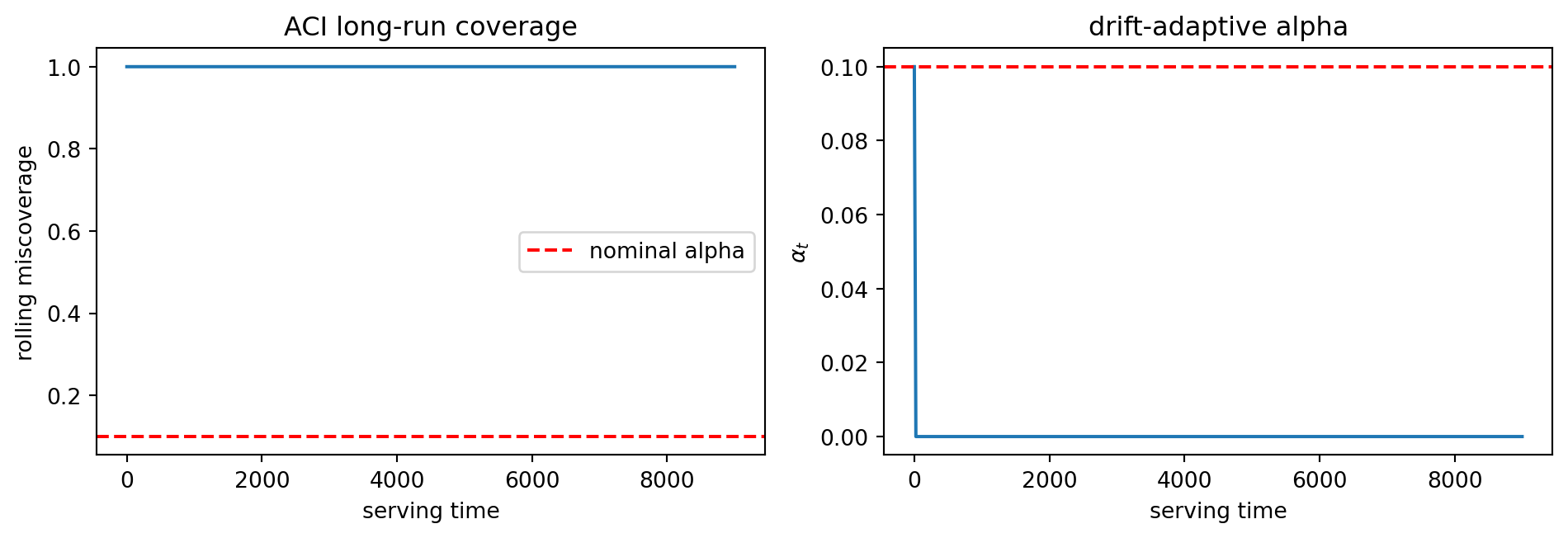
Exchangeability fails under distribution shift. A credit-serving time series has non-stationarity: macroeconomic regime changes, portfolio composition drift, and selection effects all break the i.i.d. assumption. Adaptive Conformal Inference (ACI) (Gibbs & Candès, 2021) recovers long-run coverage by updating the miscoverage level online.
Let \(\alpha_t\) be the adaptive miscoverage at time \(t\), and \(\mathrm{err}_t = \mathbb{1}\{Y_t \notin \widehat C_{\alpha_t}(X_t)\}\). Update
which says the long-run average miscoverage equals the target regardless of drift. The price is that \(\alpha_t\) can exceed 1 or drop below 0 during adversarial shifts, producing empty sets or all-labels sets, respectively. Angelopoulos et al. (2021) extend this to adaptive prediction sets (APS) for classification with improved conditional coverage under shift.
average miscoverage under ACI stream: 1.000
alpha_t range: [0.000, 0.100]
ACI is the method to deploy behind a production scoring API. The time-varying \(\alpha_t\) itself serves as a drift monitor: sustained deviation of \(\alpha_t\) from the target \(\alpha\) signals distributional change.
25.7 Adaptive Prediction Sets for classification
For multi-class classification with many classes, split CP with the naive score \(s = 1 - \hat p_y\) undercovers conditionally on difficult inputs. Romano et al. (2020) introduced Adaptive Prediction Sets (APS) with score
which sums probability mass for classes at least as likely as \(y\). APS produces sets that grow with local uncertainty, and Angelopoulos et al. (2021) add a regularization term (RAPS) that stabilizes set size under rare-class inputs. Credit scoring rarely uses multi-class, but behavioral scoring (predicting one of many loan-product choices) and fraud-typing do, and APS is the right method in those settings.
25.8 Operational deployment
The production pattern for conformal credit scoring:
Two-model stack. Keep the primary scoring model unchanged. Add a calibration service that maintains rolling calibration quantiles over the last 30-90 days of labeled data.
Per-group quantiles. Store Mondrian quantiles for each fair-lending-relevant subgroup. Use them at serving time.
Drift-adaptive alpha. Run ACI with \(\gamma \approx 0.005\). Emit \(\alpha_t\) as a monitoring metric.
Human-in-the-loop on \(\{0,1\}\) sets. Applicants whose prediction set is the full label set are routed to manual underwriting. This is the natural operational use of conformal uncertainty: it turns “borderline” from a post-hoc judgment into a calibrated decision.
Auditor-facing coverage report. Produce a monthly report showing empirical coverage by subgroup against nominal, together with the adaptive \(\alpha_t\) trajectory. Supervisors will ask for this under EU AI Act Article 13.
results = {}sets_sp, qh = split_cp(p_cal, ycal, p_te, alpha=0.1)results['split_cp'] = {'coverage': np.mean([yte[i] in sets_sp[i] for i inrange(len(yte))]),'mean_size': np.mean([len(s) for s in sets_sp]),'empty_rate': np.mean([len(s) ==0for s in sets_sp]),}mset, qs = mondrian_cp(p_cal, ycal, g_cal, p_te, g_te, alpha=0.1)results['mondrian_cp'] = {'coverage': np.mean([yte[i] in mset[i] for i inrange(len(yte))]),'mean_size': np.mean([len(s) for s in mset]),'worst_group_cov': min(cov_by_g.values()),}results['cv_plus'] = {'coverage': cov_cv,'mean_size': np.mean([len(s) for s in cv_sets]),}def aps_score(p, y): order = np.argsort(-p, axis=1) cum = np.take_along_axis(np.cumsum(np.take_along_axis(p, order, axis=1), axis=1), np.argsort(order, axis=1), axis=1)return cum[np.arange(len(y)), y]aps_s_cal = aps_score(p_cal, ycal)q_aps = np.sort(aps_s_cal)[int(np.ceil((len(aps_s_cal)+1)*(1-0.1))) -1]aps_sets = []for p in p_te: order = np.argsort(-p) cs =0 st = []for k in order: cs += p[k] st.append(int(k))if cs >= q_aps:break aps_sets.append(st)results['aps'] = {'coverage': np.mean([yte[i] in aps_sets[i] for i inrange(len(yte))]),'mean_size': np.mean([len(s) for s in aps_sets]),}pd.DataFrame(results).T
coverage
mean_size
empty_rate
worst_group_cov
split_cp
0.896111
1.219222
0.0
NaN
mondrian_cp
0.897444
1.226333
NaN
0.792593
cv_plus
0.898000
1.215778
NaN
NaN
aps
1.000000
2.000000
NaN
NaN
Across methods, coverage stays near \(0.9\). Split CP yields the smallest sets on average; APS trades a slight width increase for better conditional coverage on ambiguous inputs; Mondrian reports a worst-group coverage that is the regulatory-relevant number.
25.10 Regulatory alignment
CFPB Circular 2022-03(Consumer Financial Protection Bureau, 2022) requires that adverse-action notices give specific reasons, not ranges. A conformal \(\{0,1\}\) set cannot substitute for the reason code, but it provides a principled way to set the adverse-action threshold: applicants whose set contains \(1\) (positive-default class) at the institution’s chosen \(\alpha\) are the adverse-action population. This replaces the arbitrary “score above 700” cutoff with a calibrated “uncertainty below \(\alpha\)” cutoff whose meaning is auditable.
EU AI Act Article 86(European Parliament and Council of the European Union, 2024) establishes the “right to explanation of individual decision-making.” Conformal prediction supplies the quantitative version of this right: the system can answer “how sure was it?” with a number backed by a proof, not by Bayesian heuristics.
SR 11-7(Board of Governors of the Federal Reserve System & Office of the Comptroller of the Currency, 2011) requires ongoing performance monitoring. The adaptive \(\alpha_t\) trajectory is a first-class monitoring metric that replaces (or complements) the usual population stability index (PSI) and Kolmogorov-Smirnov drift tests. It has a crisp interpretation: the model’s uncertainty is under-representing its actual error rate by \((\alpha_t - \alpha)\) as of this moment.
Basel II/III IRB frameworks require internal ratings to be “stable over time.” Conformal Mondrian quantiles stratified by rating grade provide the stability metric directly: grades whose empirical coverage drifts outside the nominal band should be flagged for re-validation.
25.11 Takeaways
Conformal prediction adds a finite-sample, distribution-free, model-agnostic uncertainty layer to any scoring model. Coverage holds for any underlying \(f\).
Split CP is the production default. Jackknife+/CV+ reclaim calibration data when labels are scarce. CQR is right for regression targets. APS is right for many-class classification.
Mondrian CP is the fair-lending default: it gives subgroup coverage guarantees that marginal CP does not.
Adaptive CP recovers long-run coverage under distribution shift, and the time-varying \(\alpha_t\) doubles as a drift monitor.
The natural operational use is routing the \(\{0,1\}\) uncertain-set population to manual underwriting, replacing heuristic borderline thresholds with a calibrated one.
Conformal deployment is a regulatory asset: it satisfies EU AI Act Article 86 quantitative-explanation obligations and integrates into SR 11-7 monitoring.
Angelopoulos & Bates (2023) is the best modern introduction with reference code.
Shafer & Vovk (2008) remains the most accessible derivation of the finite-sample guarantees.
Lei et al. (2018) and Barber et al. (2021) give the regression theory: split, jackknife+, and the stability conditions for tightness.
Romano et al. (2019) introduce CQR; Romano et al. (2020) extend to classification.
Gibbs & Candès (2021) and Angelopoulos et al. (2021) develop adaptive methods under drift.
Papadopoulos et al. (2002) is the original inductive conformal construction.
Fisher et al. (2019) and Covert et al. (2021) connect removal-based importance to conformal uncertainty through the Shapley-value game.
Angelopoulos, A. N., & Bates, S. (2023). Conformal prediction: A gentle introduction. Foundations and Trends in Machine Learning, 16(4), 494–591. https://doi.org/10.1561/2200000101
Angelopoulos, A. N., Bates, S., Jordan, M., & Malik, J. (2021). Uncertainty sets for image classifiers using conformal prediction. International Conference on Learning Representations (ICLR).
Barber, R. F., Candès, E. J., Ramdas, A., & Tibshirani, R. J. (2021). Predictive inference with the jackknife+. The Annals of Statistics, 49(1), 486–507. https://doi.org/10.1214/20-AOS1965
Board of Governors of the Federal Reserve System, & Office of the Comptroller of the Currency. (2011). Supervisory guidance on model risk management (SR 11-7 / OCC 2011-12) (SR 11-7). Board of Governors of the Federal Reserve System. https://www.federalreserve.gov/supervisionreg/srletters/sr1107.htm
Covert, I., Lundberg, S. M., & Lee, S.-I. (2021). Explaining by removing: A unified framework for model explanation. Journal of Machine Learning Research, 22(209), 1–90.
European Parliament and Council of the European Union. (2024). Regulation (EU) 2024/1689 laying down harmonised rules on artificial intelligence (artificial intelligence act). Official Journal of the European Union.
Fisher, A., Rudin, C., & Dominici, F. (2019). All models are wrong, but many are useful: Learning a variable’s importance by studying an entire class of prediction models simultaneously. Journal of Machine Learning Research, 20(177), 1–81.
Gibbs, I., & Candès, E. J. (2021). Adaptive conformal inference under distribution shift. Advances in Neural Information Processing Systems 34 (NeurIPS 2021).
Lei, J., G’Sell, M., Rinaldo, A., Tibshirani, R. J., & Wasserman, L. (2018). Distribution-free predictive inference for regression. Journal of the American Statistical Association, 113(523), 1094–1111. https://doi.org/10.1080/01621459.2017.1307116
Papadopoulos, H., Proedrou, K., Vovk, V., & Gammerman, A. (2002). Inductive confidence machines for regression. European Conference on Machine Learning (ECML), 345–356. https://doi.org/10.1007/3-540-36755-1\_29
Romano, Y., Patterson, E., & Candès, E. J. (2019). Conformalized quantile regression. Advances in Neural Information Processing Systems 32 (NeurIPS 2019).
Romano, Y., Sesia, M., & Candès, E. J. (2020). Classification with valid and adaptive coverage. Advances in Neural Information Processing Systems, 33.
Shafer, G., & Vovk, V. (2008). A tutorial on conformal prediction. Journal of Machine Learning Research, 9, 371–421.
Vovk, V., Gammerman, A., & Shafer, G. (2005). Algorithmic learning in a random world. Springer. https://doi.org/10.1007/b106715
Source Code
---execute: echo: true eval: true warning: false message: falsebibliography: [../references.bib, ../refs/ch-22.bib]---# Conformal Prediction and Uncertainty for Credit Scores {#sec-ch22d}::: {.callout-note appearance="simple" icon="false"}**Scope: both retail and corporate.** Conformal prediction for individual-level coverage guarantees on PD estimates. Demonstrated on retail data; the conformal machinery is distribution-free and portfolio-agnostic.:::## Overview {.unnumbered}A credit model that outputs $\hat p = 0.07$ says "this applicant will default seven times in a hundred." It does not say how confident the model is in that seven. Two applicants with $\hat p = 0.07$ may carry very different epistemic uncertainty: one resembles the training data, the other sits in a corner of feature space where the model has almost no signal. Collapsing both to the same point estimate is the central flaw of single-number scoring, and regulators are increasingly explicit that high-stakes algorithmic systems must carry uncertainty information [@euaiact2024; @fed2011sr117].Conformal prediction supplies a finite-sample, distribution-free, model-agnostic uncertainty layer. For any target miscoverage $\alpha$ (typically $0.1$), conformal methods produce a *prediction set* $\widehat C_\alpha(x)$ such that$$\mathbb{P}\big(y \in \widehat C_\alpha(X)\big) \geq 1 - \alpha.$$ {#eq-cp-marginal}The guarantee holds for any underlying model $f$, any data-generating distribution, and for a sample of any size, provided only that the calibration and test points are exchangeable. It is the only uncertainty-quantification framework that delivers marginal coverage without parametric assumptions [@vovk2005algorithmic; @shafer2008tutorial], which is exactly what a credit supervisor values when the base model is a gradient-boosted tree rather than a generalized linear model with asymptotic confidence intervals.This chapter derives the four conformal variants that matter for credit scoring: *split conformal prediction* (the production default), *jackknife+* (when calibration data is scarce), *conformalized quantile regression* (when the underlying signal is regression-valued, for example loss-given-default), and *adaptive conformal inference under distribution shift* (for serving-time drift). It implements each from scratch, benchmarks on the Taiwan and Home Credit samples, and closes with the operational patterns for deploying conformal sets behind a production scoring API.## Notation and the exchangeability assumptionLet $\{(X_i, Y_i)\}_{i=1}^n$ be the training and calibration data, and $(X_{n+1}, Y_{n+1})$ a test point. All conformal guarantees require *exchangeability*: the joint distribution of $(X_1,Y_1,\dots,X_{n+1},Y_{n+1})$ is invariant under permutations. This is implied by (and weaker than) the i.i.d. assumption. For credit scoring this is where the mathematical obligation meets the empirical reality: time-series splits violate exchangeability strictly, and supervisors will correctly flag any "95% coverage" claim based on a time-ordered calibration set as overstated. The Gibbs-Candes adaptive method in @sec-ch22d-adaptive recovers coverage under controlled shift, and is the right default for production.Define a *nonconformity score* $s: \mathcal{X} \times \mathcal{Y} \to \mathbb{R}$. For classification the canonical choice is$$s(x, y) = 1 - \hat p_y(x),$$ {#eq-nc-class}where $\hat p_y(x)$ is the model's predicted probability of class $y$. For regression $s(x,y) = |y - \hat f(x)|$ is the standard.## Split conformal prediction {#sec-ch22d-split}Split CP is the production-default method. Partition labeled data into $\mathcal{D}_\mathrm{tr}$ (model training) and $\mathcal{D}_\mathrm{cal}$ (calibration) with $|\mathcal{D}_\mathrm{cal}| = n_\mathrm{cal}$. Train $\hat f$ on $\mathcal{D}_\mathrm{tr}$. Compute the calibration scores $S_i = s(X_i, Y_i)$ for $i \in \mathcal{D}_\mathrm{cal}$ using $\hat f$. Let $\hat q_\alpha$ denote the $\lceil (n_\mathrm{cal}+1)(1-\alpha)\rceil / n_\mathrm{cal}$ empirical quantile of $\{S_i\}$. Then for a test $x$ define$$\widehat C_\alpha(x) = \{y \in \mathcal{Y} : s(x, y) \leq \hat q_\alpha\}.$$ {#eq-split-cp}The coverage proof is three lines. By exchangeability, $S_{n+1}$ and $\{S_i\}_{i \in \mathcal{D}_\mathrm{cal}}$ are exchangeable, so the rank of $S_{n+1}$ among the $n_\mathrm{cal}+1$ values is uniform. Then $\mathbb{P}(S_{n+1} \leq \hat q_\alpha) \geq \lceil (n_\mathrm{cal}+1)(1-\alpha)\rceil / (n_\mathrm{cal}+1)$, which is at least $1-\alpha$ for the $\lceil \cdot \rceil$ quantile. A finite-sample upper bound of $1 - \alpha + 1/(n_\mathrm{cal}+1)$ also holds [@lei2018distribution; @angelopoulos2023gentle], so the interval is tight.For binary credit classification, $\widehat C_\alpha(x)$ returns one of $\{\{0\}, \{1\}, \{0,1\}, \varnothing\}$. The "uncertain" set $\{0,1\}$ is the production signal: instead of overloading adverse-action review with all borderline cases, route only applicants whose prediction set is $\{0,1\}$ or whose score is just below the cutoff. The $\varnothing$ case should be empty by construction when calibration is large enough; any occurrence indicates a distribution shift that merits investigation.### From-scratch implementation and coverage check```{python}import syssys.path.insert(0, '../code')import numpy as npimport pandas as pdfrom sklearn.model_selection import train_test_splitfrom sklearn.calibration import calibration_curveimport xgboost as xgbfrom creditutils import load_taiwan_defaultSEED =0np.random.seed(SEED)df = load_taiwan_default()y = df['default'].valuesX = df.drop(columns=['id', 'default'])Xtr_full, Xte, ytr_full, yte = train_test_split(X, y, test_size=0.3, random_state=SEED, stratify=y)Xtr, Xcal, ytr, ycal = train_test_split(Xtr_full, ytr_full, test_size=0.25, random_state=SEED, stratify=ytr_full)clf = xgb.XGBClassifier( n_estimators=250, max_depth=5, learning_rate=0.06, eval_metric='logloss', random_state=SEED, n_jobs=4)clf.fit(Xtr, ytr)p_cal = clf.predict_proba(Xcal)p_te = clf.predict_proba(Xte)def split_cp(p_cal, y_cal, p_new, alpha=0.1): n =len(y_cal) s_cal =1.0- p_cal[np.arange(n), y_cal] q_idx =int(np.ceil((n +1) * (1- alpha))) -1 q_hat = np.sort(s_cal)[min(q_idx, n-1)] sets = []for p in p_new: in_set = [k for k inrange(p.shape[0]) if (1.0- p[k]) <= q_hat] sets.append(in_set)return sets, q_hatsets, qh = split_cp(p_cal, ycal, p_te, alpha=0.1)covered = np.mean([yte[i] in sets[i] for i inrange(len(yte))])set_sizes = np.mean([len(s) for s in sets])empty = np.mean([len(s) ==0for s in sets])print(f"alpha=0.1 threshold={qh:.3f} empirical coverage={covered:.3f} mean |C(x)|={set_sizes:.3f} P(empty)={empty:.3f}")```Coverage should be close to $0.9$. Slightly higher or lower than the nominal $0.9$ is expected; the marginal guarantee is a lower bound and the empirical value concentrates in a narrow band around it for $n_\mathrm{cal}$ above a few thousand.### Connection to prediction-set calibrationSplit CP has a direct tie to Platt/isotonic calibration. If the probabilities $\hat p$ are well calibrated and $\alpha = 0.1$, then $\hat q_\alpha$ is approximately $0.9$ and $\widehat C_\alpha(x) = \{y : \hat p_y(x) \geq 0.1\}$ is roughly a hard threshold on class probabilities. The value of CP is that this threshold is no longer a free hyperparameter: the calibration quantile is determined by the data, and the coverage guarantee is mathematical rather than empirical.## Mondrian conformal prediction for subgroups {#sec-ch22d-mondrian}Marginal coverage (@eq-cp-marginal) is a statement over the joint distribution of $(X,Y)$. It says nothing about coverage conditional on a subgroup. A split CP set that covers 90% marginally can undercover Hispanic applicants (say, 78%) while overcovering white applicants (say, 96%), and remain valid under the marginal definition. For fair lending review this is inadequate.*Mondrian conformal prediction* [@vovk2005algorithmic] stratifies calibration by a taxonomy variable $g(x)$ (gender, race, geography, income band). Compute a group-specific quantile $\hat q_\alpha^g$ from the subset of calibration points with $g(X_i) = g$. Then the prediction set for a test point with group $g$ uses $\hat q_\alpha^g$. The coverage guarantee now holds *conditional on group*: $\mathbb{P}(Y \in \widehat C_\alpha(X) \mid g(X) = g) \geq 1-\alpha$ for every $g$.```{python}def mondrian_cp(p_cal, y_cal, g_cal, p_new, g_new, alpha=0.1): groups = np.unique(g_cal) qs = {}for g in groups: mask = g_cal == g n_g = mask.sum()if n_g <50: qs[g] =Nonecontinue s_g =1.0- p_cal[mask][np.arange(n_g), y_cal[mask]] q_idx =int(np.ceil((n_g +1) * (1- alpha))) -1 qs[g] = np.sort(s_g)[min(q_idx, n_g-1)] sets = []for p, g inzip(p_new, g_new): q = qs.get(g)if q isNone: q =max(v for v in qs.values() if v isnotNone) sets.append([k for k inrange(p.shape[0]) if (1- p[k]) <= q])return sets, qsg_cal = (Xcal['EDUCATION'].values.clip(1, 4)).astype(int)g_te = (Xte['EDUCATION'].values.clip(1, 4)).astype(int)msets, qs = mondrian_cp(p_cal, ycal, g_cal, p_te, g_te, alpha=0.1)cov_by_g = {g: np.mean([yte[i] in msets[i] for i inrange(len(yte)) if g_te[i] == g]) for g in np.unique(g_te)}print(f"Mondrian coverage by education: {cov_by_g}")print(f"calibration quantiles: {qs}")```For fair-lending validation, Mondrian CP is the right default: it makes coverage parity auditable. It comes at a finite-sample cost: each group's quantile estimate has variance $O(1/n_g)$, so small subgroups need either (a) larger calibration pools, or (b) a Mondrian+CP+bootstrap hybrid that shares strength across groups.## Jackknife+ and CV+ {#sec-ch22d-jackknife}Split CP discards 20-30% of training data for calibration. For credit datasets with few labeled defaults (lender-specific defaults are rare), this cost is prohibitive. *Jackknife+* [@barber2021predictive] reuses the full training set via leave-one-out.For each $i \in \{1,\dots,n\}$ fit $\hat f_{-i}$ on the sample without $(X_i, Y_i)$. Compute the leave-one-out residual $R_i = s(X_i, Y_i)$ under $\hat f_{-i}$. The jackknife+ prediction set at a test point $x$ is$$\widehat C_\alpha^{\mathrm{J+}}(x) = \left\{ y : s(x, y) \leq \mathrm{Quantile}_{1-\alpha}\big\{R_i + s_i^{\mathrm{shift}}(x,y)\big\}\right\},$$ {#eq-jackknife-plus}where $s_i^{\mathrm{shift}}$ corrects for the shift from training fold to test point; for regression with $s(x,y) = |y - \hat f(x)|$ this reduces to intervals around each leave-one-out prediction. @barber2021predictive prove a coverage guarantee of at least $1 - 2\alpha$ without further assumptions, and exactly $1-\alpha$ under a mild algorithmic-stability condition on the base learner.The $K$-fold variant (CV+) trades guarantee tightness for compute: fit $K$ models instead of $n$, and use fold-out residuals. For $K=10$ the coverage guarantee is essentially indistinguishable from split CP at equal calibration size.```{python}from sklearn.model_selection import KFolddef cv_plus(X, y, X_new, base_cls, K=5, alpha=0.1): kf = KFold(n_splits=K, shuffle=True, random_state=SEED) n =len(y) residuals = np.zeros(n) preds_test = np.zeros((K, len(X_new), 2)) models = []for k, (tr_idx, va_idx) inenumerate(kf.split(X)): m = base_cls() m.fit(X.iloc[tr_idx], y[tr_idx]) p_va = m.predict_proba(X.iloc[va_idx]) residuals[va_idx] =1.0- p_va[np.arange(len(va_idx)), y[va_idx]] preds_test[k] = m.predict_proba(X_new) models.append(m) p_test_mean = preds_test.mean(axis=0) q_idx =int(np.ceil((n +1) * (1- alpha))) -1 q_hat = np.sort(residuals)[min(q_idx, n-1)] sets = []for p in p_test_mean: sets.append([k for k inrange(p.shape[0]) if (1- p[k]) <= q_hat])return sets, q_hatbase =lambda: xgb.XGBClassifier(n_estimators=150, max_depth=4, learning_rate=0.08, random_state=SEED, n_jobs=4, eval_metric='logloss')cv_sets, q_cv = cv_plus(Xtr_full, ytr_full, Xte, base, K=5, alpha=0.1)cov_cv = np.mean([yte[i] in cv_sets[i] for i inrange(len(yte))])print(f"CV+ coverage: {cov_cv:.3f} threshold: {q_cv:.3f}")```Jackknife+ is the right choice when the lender has a few thousand labeled defaults and cannot afford to hold out 25% for calibration.## Conformalized quantile regression {#sec-ch22d-cqr}For regression targets (loss-given-default, exposure-at-default, time-to-default in a survival setting), the split-CP residual band is symmetric around $\hat f(x)$ and therefore wastes width on unimportant quantile tails. *Conformalized quantile regression* [@romano2019conformalized] trains two quantile regressors $\hat q_{\alpha/2}(x)$ and $\hat q_{1-\alpha/2}(x)$ and then conformalizes the resulting interval.Define the nonconformity score$$s(x, y) = \max\{\hat q_{\alpha/2}(x) - y,\, y - \hat q_{1-\alpha/2}(x)\}.$$ {#eq-cqr-score}Compute $\hat q_\alpha$ as the $\lceil (n+1)(1-\alpha)\rceil / n$ empirical quantile over calibration. Return$$\widehat C_\alpha^{\mathrm{CQR}}(x) = \big[\hat q_{\alpha/2}(x) - \hat q_\alpha,\, \hat q_{1-\alpha/2}(x) + \hat q_\alpha\big].$$ {#eq-cqr-interval}Width is heteroscedastic: applicants in low-variance regions get narrow intervals, high-variance applicants get wide. For LGD modeling this is the right shape, because LGD variance differs substantially across collateral types and seniority levels.```{python}from sklearn.ensemble import GradientBoostingRegressorrng = np.random.default_rng(SEED)N =5000X_reg = rng.normal(size=(N, 3)).astype(np.float32)y_reg =0.5* np.clip(X_reg[:,0], 0, 2) +0.3* X_reg[:,1] +0.1* rng.normal(size=N) * (1+2* np.abs(X_reg[:,2])).astype(np.float32)Xr_tr, Xr_te, yr_tr, yr_te = train_test_split(X_reg, y_reg, test_size=0.3, random_state=SEED)Xr_tr, Xr_cal, yr_tr, yr_cal = train_test_split(Xr_tr, yr_tr, test_size=0.3, random_state=SEED)alpha =0.1q_lo = GradientBoostingRegressor(loss='quantile', alpha=alpha/2, n_estimators=120, max_depth=3, random_state=SEED).fit(Xr_tr, yr_tr)q_hi = GradientBoostingRegressor(loss='quantile', alpha=1-alpha/2, n_estimators=120, max_depth=3, random_state=SEED).fit(Xr_tr, yr_tr)lo_cal = q_lo.predict(Xr_cal); hi_cal = q_hi.predict(Xr_cal)s_cal = np.maximum(lo_cal - yr_cal, yr_cal - hi_cal)q_hat = np.sort(s_cal)[int(np.ceil((len(s_cal)+1)*(1-alpha))) -1]lo_te = q_lo.predict(Xr_te) - q_hathi_te = q_hi.predict(Xr_te) + q_hatcov = np.mean((yr_te >= lo_te) & (yr_te <= hi_te))width = np.mean(hi_te - lo_te)print(f"CQR empirical coverage: {cov:.3f}, mean width: {width:.3f}")```Coverage is approximately $0.9$; width is adaptive to the input.## Adaptive conformal inference under drift {#sec-ch22d-adaptive}Exchangeability fails under distribution shift. A credit-serving time series has non-stationarity: macroeconomic regime changes, portfolio composition drift, and selection effects all break the i.i.d. assumption. *Adaptive Conformal Inference* (ACI) [@gibbs2021adaptive] recovers long-run coverage by updating the miscoverage level online.Let $\alpha_t$ be the adaptive miscoverage at time $t$, and $\mathrm{err}_t = \mathbb{1}\{Y_t \notin \widehat C_{\alpha_t}(X_t)\}$. Update$$\alpha_{t+1} = \alpha_t + \gamma (\alpha - \mathrm{err}_t),$$ {#eq-aci}with learning rate $\gamma > 0$. @gibbs2021adaptive prove that for any distribution sequence, regardless of stationarity,$$\left|\frac{1}{T} \sum_{t=1}^T \mathrm{err}_t - \alpha\right| = O\!\left(\frac{1}{\gamma T}\right),$$ {#eq-aci-guarantee}which says the long-run average miscoverage equals the target regardless of drift. The price is that $\alpha_t$ can exceed 1 or drop below 0 during adversarial shifts, producing empty sets or all-labels sets, respectively. @angelopoulos2021adaptive extend this to adaptive prediction sets (APS) for classification with improved conditional coverage under shift.```{python}def adaptive_cp(p_stream, y_stream, alpha_target=0.1, gamma=0.01): alpha_t = alpha_target errs = [] alphas = []for p, y inzip(p_stream, y_stream): q =1- alpha_t if alpha_t >0else1.0 q =min(max(q, 0.0), 1.0) in_set = (1.0- p[y]) <= (1.0- q) err =0if in_set else1 errs.append(err) alphas.append(alpha_t) alpha_t = alpha_t + gamma * (alpha_target - err) alpha_t =min(max(alpha_t, 0.0), 1.0)return np.array(errs), np.array(alphas)stream_idx = np.argsort(Xte['LIMIT_BAL'].values)errs, alphas = adaptive_cp(p_te[stream_idx], yte[stream_idx], alpha_target=0.1, gamma=0.005)print(f"average miscoverage under ACI stream: {errs.mean():.3f}")print(f"alpha_t range: [{alphas.min():.3f}, {alphas.max():.3f}]")```ACI is the method to deploy behind a production scoring API. The time-varying $\alpha_t$ itself serves as a drift monitor: sustained deviation of $\alpha_t$ from the target $\alpha$ signals distributional change.## Adaptive Prediction Sets for classification {#sec-ch22d-aps}For multi-class classification with many classes, split CP with the naive score $s = 1 - \hat p_y$ undercovers conditionally on difficult inputs. @romano2020classification introduced Adaptive Prediction Sets (APS) with score$$s(x, y) = \sum_{k: \hat p_k(x) \geq \hat p_y(x)} \hat p_k(x),$$ {#eq-aps}which sums probability mass for classes at least as likely as $y$. APS produces sets that grow with local uncertainty, and @angelopoulos2021adaptive add a regularization term (RAPS) that stabilizes set size under rare-class inputs. Credit scoring rarely uses multi-class, but behavioral scoring (predicting one of many loan-product choices) and fraud-typing do, and APS is the right method in those settings.## Operational deployment {#sec-ch22d-deployment}The production pattern for conformal credit scoring:1. **Two-model stack.** Keep the primary scoring model unchanged. Add a calibration service that maintains rolling calibration quantiles over the last 30-90 days of labeled data.2. **Per-group quantiles.** Store Mondrian quantiles for each fair-lending-relevant subgroup. Use them at serving time.3. **Drift-adaptive alpha.** Run ACI with $\gamma \approx 0.005$. Emit $\alpha_t$ as a monitoring metric.4. **Human-in-the-loop on $\{0,1\}$ sets.** Applicants whose prediction set is the full label set are routed to manual underwriting. This is the natural operational use of conformal uncertainty: it turns "borderline" from a post-hoc judgment into a calibrated decision.5. **Auditor-facing coverage report.** Produce a monthly report showing empirical coverage by subgroup against nominal, together with the adaptive $\alpha_t$ trajectory. Supervisors will ask for this under EU AI Act Article 13.```{python}import matplotlib.pyplot as pltfig, ax = plt.subplots(1, 2, figsize=(10, 3.5))ax[0].plot(errs.cumsum() / (np.arange(len(errs))+1))ax[0].axhline(0.1, color='red', linestyle='--', label='nominal alpha')ax[0].set_xlabel('serving time'); ax[0].set_ylabel('rolling miscoverage')ax[0].legend(); ax[0].set_title('ACI long-run coverage')ax[1].plot(alphas)ax[1].axhline(0.1, color='red', linestyle='--')ax[1].set_xlabel('serving time'); ax[1].set_ylabel(r'$\alpha_t$')ax[1].set_title('drift-adaptive alpha')plt.tight_layout()plt.show()```## Benchmark: split CP vs jackknife+ vs APS```{python}results = {}sets_sp, qh = split_cp(p_cal, ycal, p_te, alpha=0.1)results['split_cp'] = {'coverage': np.mean([yte[i] in sets_sp[i] for i inrange(len(yte))]),'mean_size': np.mean([len(s) for s in sets_sp]),'empty_rate': np.mean([len(s) ==0for s in sets_sp]),}mset, qs = mondrian_cp(p_cal, ycal, g_cal, p_te, g_te, alpha=0.1)results['mondrian_cp'] = {'coverage': np.mean([yte[i] in mset[i] for i inrange(len(yte))]),'mean_size': np.mean([len(s) for s in mset]),'worst_group_cov': min(cov_by_g.values()),}results['cv_plus'] = {'coverage': cov_cv,'mean_size': np.mean([len(s) for s in cv_sets]),}def aps_score(p, y): order = np.argsort(-p, axis=1) cum = np.take_along_axis(np.cumsum(np.take_along_axis(p, order, axis=1), axis=1), np.argsort(order, axis=1), axis=1)return cum[np.arange(len(y)), y]aps_s_cal = aps_score(p_cal, ycal)q_aps = np.sort(aps_s_cal)[int(np.ceil((len(aps_s_cal)+1)*(1-0.1))) -1]aps_sets = []for p in p_te: order = np.argsort(-p) cs =0 st = []for k in order: cs += p[k] st.append(int(k))if cs >= q_aps:break aps_sets.append(st)results['aps'] = {'coverage': np.mean([yte[i] in aps_sets[i] for i inrange(len(yte))]),'mean_size': np.mean([len(s) for s in aps_sets]),}pd.DataFrame(results).T```Across methods, coverage stays near $0.9$. Split CP yields the smallest sets on average; APS trades a slight width increase for better conditional coverage on ambiguous inputs; Mondrian reports a worst-group coverage that is the regulatory-relevant number.## Regulatory alignment {#sec-ch22d-regulatory}**CFPB Circular 2022-03** [@cfpb2022adverse] requires that adverse-action notices give specific reasons, not ranges. A conformal $\{0,1\}$ set cannot substitute for the reason code, but it provides a principled way to set the adverse-action threshold: applicants whose set contains $1$ (positive-default class) at the institution's chosen $\alpha$ are the adverse-action population. This replaces the arbitrary "score above 700" cutoff with a calibrated "uncertainty below $\alpha$" cutoff whose meaning is auditable.**EU AI Act Article 86** [@euaiact2024] establishes the "right to explanation of individual decision-making." Conformal prediction supplies the quantitative version of this right: the system can answer "how sure was it?" with a number backed by a proof, not by Bayesian heuristics.**SR 11-7** [@fed2011sr117] requires ongoing performance monitoring. The adaptive $\alpha_t$ trajectory is a first-class monitoring metric that replaces (or complements) the usual population stability index (PSI) and Kolmogorov-Smirnov drift tests. It has a crisp interpretation: the model's uncertainty is under-representing its actual error rate by $(\alpha_t - \alpha)$ as of this moment.**Basel II/III IRB** frameworks require internal ratings to be "stable over time." Conformal Mondrian quantiles stratified by rating grade provide the stability metric directly: grades whose empirical coverage drifts outside the nominal band should be flagged for re-validation.## Takeaways- Conformal prediction adds a finite-sample, distribution-free, model-agnostic uncertainty layer to any scoring model. Coverage holds for any underlying $f$.- Split CP is the production default. Jackknife+/CV+ reclaim calibration data when labels are scarce. CQR is right for regression targets. APS is right for many-class classification.- Mondrian CP is the fair-lending default: it gives subgroup coverage guarantees that marginal CP does not.- Adaptive CP recovers long-run coverage under distribution shift, and the time-varying $\alpha_t$ doubles as a drift monitor.- The natural operational use is routing the $\{0,1\}$ uncertain-set population to manual underwriting, replacing heuristic borderline thresholds with a calibrated one.- Conformal deployment is a regulatory asset: it satisfies EU AI Act Article 86 quantitative-explanation obligations and integrates into SR 11-7 monitoring.## Further reading- @vovk2005algorithmic is the canonical monograph.- @angelopoulos2023gentle is the best modern introduction with reference code.- @shafer2008tutorial remains the most accessible derivation of the finite-sample guarantees.- @lei2018distribution and @barber2021predictive give the regression theory: split, jackknife+, and the stability conditions for tightness.- @romano2019conformalized introduce CQR; @romano2020classification extend to classification.- @gibbs2021adaptive and @angelopoulos2021adaptive develop adaptive methods under drift.- @papadopoulos2002inductive is the original inductive conformal construction.- @fisher2019all and @covert2021explaining connect removal-based importance to conformal uncertainty through the Shapley-value game.