15 Work, Jobs, and Leadership
Beginning in late 2010, a large Chinese travel agency ran an unusual experiment. Call-centre employees who volunteered to work from home were randomly assigned either to do so or to stay in the office. The home workers became more productive and quit less often, yet a large share of them later chose to come back to the office, citing isolation (Bloom et al. 2015). Around the same time, managers everywhere were asking related questions. Why does one team thrive under a demanding manager while another burns out? Why do employees accept a pay cut with grace in one plant and retaliate in another? Why is the chief executive paid several times more than the vice presidents who report to her, even when their jobs look similar?
These puzzles share a theme: the design of work and of the relationships around it shapes what people do, feel, and contribute. This chapter assembles the theories that organizational psychologists and personnel economists use to explain those effects. We start with the job itself (the job characteristics model, job demands-resources theory, conservation of resources theory, and affective events theory). We then turn to leadership (leader-member exchange, transformational leadership, and path-goal theory) and to the employment relationship (psychological contracts, organizational justice, organizational commitment, and person-environment fit). We close with two economic theories of investment and rewards: human capital theory and tournament theory. Together they form the analytical core of human resource management, people analytics, and leadership development (Table 15.1).
| Theory | Core question | Level of analysis | Key source |
|---|---|---|---|
| Job characteristics model | Which features of a job make it motivating? | Individual / job | Hackman & Oldham (1976) |
| Job demands-resources | What drives burnout and engagement? | Individual / job | Demerouti et al. (2001) |
| Conservation of resources | Why is resource loss so stressful? | Individual | Hobfoll (1989) |
| Affective events theory | How do daily events shape feelings and behaviour at work? | Individual (within person) | Weiss & Cropanzano (1996) |
| Leader-member exchange | Why do leaders build different relationships with different followers? | Dyad | Graen & Uhl-Bien (1995) |
| Transformational leadership | How do leaders inspire performance beyond expectations? | Individual / group | Bass (1985) |
| Path-goal theory | Which leader behaviour fits which situation? | Dyad / group | House (1971) |
| Psychological contract | What do employees believe they were promised? | Individual / dyad | Rousseau (1989) |
| Organizational justice | When do people judge decisions and treatment as fair? | Individual / organization | Colquitt et al. (2001) |
| Organizational commitment | What binds employees to an organization? | Individual | Meyer & Allen (1991) |
| Person-environment fit | Does the match between person and setting matter? | Individual / organization | Kristof (1996) |
| Human capital theory | Who should pay for skills, and which skills? | Individual / firm | Becker (1964) |
| Tournament theory | Why do pay gaps widen up the hierarchy? | Firm / labour market | Lazear & Rosen (1981) |
15.1 Job Characteristics Model
Core claim. Jobs that offer skill variety, task identity, task significance, autonomy, and feedback produce three critical psychological states, and these states raise internal work motivation, satisfaction, and performance, especially for people who want to grow at work.
Origins. Organizational psychology. Hackman and Oldham (1975) developed the Job Diagnostic Survey, Hackman and Oldham (1976) stated and tested the model, and Hackman and Oldham (1980) applied it to the practice of work redesign.
Level of analysis. The individual job holder and the job.
Key constructs. Core job dimensions, experienced meaningfulness, experienced responsibility, knowledge of results, internal work motivation, growth need strength, motivating potential score.
Boundary conditions. Strongest for employees with high growth need strength and adequate knowledge and skill. Weaker when pay, security, or supervision are so poor that they dominate attention.
Related theories. Self-determination theory (Section 19.6), Job demands-resources, Goal-setting theory (Section 19.4), Social information processing (Section 14.10).
15.1.1 Origins and intellectual history
Twentieth-century industrial engineering had a clear answer to the question of how to design a job: break it into the smallest possible units, standardise them, and remove discretion. The assembly line embodied this logic and delivered large productivity gains, but it also delivered boredom, absenteeism, and turnover. Herzberg’s two-factor theory (Herzberg, Mausner, and Snyderman 1959) and the human relations movement had already argued that the content of work matters for motivation. What was missing was a precise, measurable account of which job features matter and why.
Hackman and Oldham (1975) supplied the measure, the Job Diagnostic Survey (JDS), and Hackman and Oldham (1976) supplied the theory. Their model specified a small set of objective job features, a set of psychological states through which those features work, and an individual difference that conditions the whole chain. The resulting job characteristics model (JCM) became the dominant framework for job design for three decades and remains the starting point for modern work design research (S. K. Parker 2014).
15.1.2 Core logic and propositions
The model links five core job dimensions to three critical psychological states (Table 15.2). Skill variety, task identity (completing a whole, identifiable piece of work), and task significance (impact on other people) jointly create experienced meaningfulness. Autonomy creates experienced responsibility for outcomes. Feedback from the job itself creates knowledge of results. When all three states are present, people feel good when they perform well, and this self-generated reward sustains internal work motivation (Hackman and Oldham 1976).
| Core dimension | Definition | Psychological state | Low-scoring example | Redesign lever |
|---|---|---|---|---|
| Skill variety | Range of activities and skills the job requires | Meaningfulness | Single repetitive assembly step | Job enlargement, rotation |
| Task identity | Completing a whole, visible piece of work | Meaningfulness | Processing one field of a form | Natural work units, case ownership |
| Task significance | Impact of the work on other people | Meaningfulness | Back-office task with no visible user | Contact with beneficiaries |
| Autonomy | Discretion over scheduling and methods | Responsibility | Scripted call handling | Vertical loading, self-managing teams |
| Feedback | Direct information about performance from the work itself | Knowledge of results | Quality checked by a later department | Open feedback channels, dashboards |
The original propositions can be stated as follows:
- P1 (Dimensions to states). Variety, identity, and significance raise experienced meaningfulness. Autonomy raises experienced responsibility. Feedback raises knowledge of results.
- P2 (States to outcomes). The three states jointly raise internal motivation, growth satisfaction, general satisfaction, and work quality, and reduce absenteeism and turnover.
- P3 (Moderation). These relationships are stronger for employees high in growth need strength, the desire for challenge and personal development. In the later formulation, knowledge and skill and satisfaction with the work context were added as moderators (Hackman and Oldham 1980).
Because the model argues that all three psychological states must be present, Hackman and Oldham proposed a motivating potential score (MPS) that combines the dimensions multiplicatively:
\[ \text{MPS} = \frac{\text{Skill variety} + \text{Task identity} + \text{Task significance}}{3} \times \text{Autonomy} \times \text{Feedback} \]
The formula averages the three meaningfulness dimensions, so a weakness in one can be offset by strength in another, but it multiplies autonomy and feedback, so a job with no autonomy or no feedback has a motivating potential close to zero no matter how varied it is.
15.1.3 Mechanism
Figure 15.1 shows the job characteristics model.
Figure 15.1: The job characteristics model. Core job dimensions create critical psychological states that drive motivation and performance. Growth need strength, knowledge and skill, and context satisfaction moderate the chain. Adapted from Hackman and Oldham (1976, 1980).
Figure 15.2 shows why the multiplicative formula matters. Consider four stylised jobs. The additive index (the simple mean of the five dimensions) ranks the scripted call-centre job as moderately enriched because it scores well on feedback and significance. The MPS ranks it near the bottom because autonomy is almost absent. Whether the multiplicative form is correct is an empirical question, and the evidence on it is discussed below.
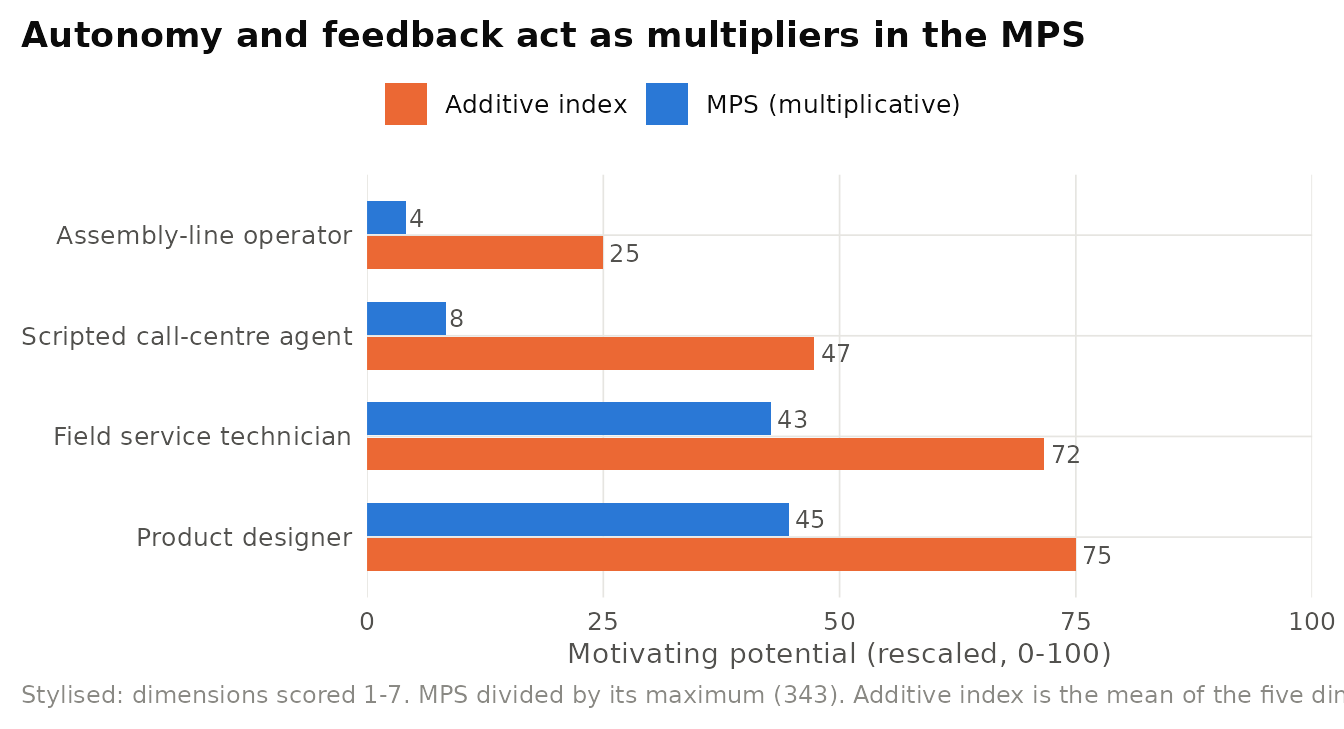
Figure 15.2: Illustrative comparison of the multiplicative motivating potential score (MPS) and a simple additive index for four stylised jobs. Both indices are rescaled to a 0-100 range. Jobs that lack autonomy are penalised far more heavily by the MPS. Stylised scores, not empirical data.
15.1.4 Evidence and extensions
The JCM generated hundreds of studies. An early meta-analysis found reasonable support for links between the core dimensions and psychological outcomes such as satisfaction and internal motivation, weaker links to behavioural outcomes such as performance and absenteeism, and little advantage for the multiplicative MPS over simpler additive combinations (Fried and Ferris 1987). The psychological states received partial support as mediators.
The most comprehensive later synthesis, by Humphrey, Nahrgang, and Morgeson (2007), broadened the model in two ways. First, it confirmed that the motivational characteristics of the JCM relate to satisfaction, motivation, and performance, with experienced meaningfulness carrying much of the effect. Second, it showed that social characteristics (interdependence, social support, feedback from others) and work context explain additional variance in attitudes beyond the classic five dimensions. The Work Design Questionnaire was developed to measure this wider set of task, knowledge, social, and contextual features (Morgeson and Humphrey 2006).
Two further extensions changed how the field thinks about jobs. A. M. Grant (2008) showed experimentally that connecting employees with the people who benefit from their work, for instance letting fundraising callers learn how scholarships changed recipients’ lives, raised persistence and performance. This made task significance a relational, designable feature rather than a fixed property of a job. Wrzesniewski and Dutton (2001) introduced job crafting, the idea that employees actively reshape the task, relational, and cognitive boundaries of their own jobs. Work design is therefore not only something managers do to employees. It is also something employees do for themselves (S. K. Parker 2014).
How objective are job characteristics? The JCM treats job characteristics as features of the work, but most studies measure them with incumbents’ perceptions gathered in the same survey as satisfaction and motivation. Critics in the social information processing (Section 14.10) tradition argued that perceptions of a job are partly constructed from coworkers’ cues, and that satisfied workers may simply describe their jobs more favourably. Common-method variance therefore inflates many correlations. Studies that use independent raters, objective job data (such as occupational databases), or field experiments that change jobs provide more credible estimates, and those effects are generally smaller, especially for performance. A second dispute concerns the MPS itself: the evidence offers little reason to prefer the multiplicative formula to a simple average (Fried and Ferris 1987).
15.1.5 Applications in business
Job redesign on the assembly line. In 1974 Volvo opened an assembly plant at Kalmar, Sweden, organised around work teams that assembled larger portions of each car instead of performing short, repetitive cycles on a conventional moving line. The design applied JCM principles directly: larger work units raised task identity and variety, and team responsibility for scheduling and quality raised autonomy. Volvo later went further at its Uddevalla plant. Both plants were closed in the 1990s, and analysts still disagree about whether their productivity record vindicated or undermined the approach. The lasting lesson is that enrichment interacts with technology and volume: the same design that motivates in low-volume, high-variety production may be uneconomic on a high-volume line.
Illustrative scenario: redesigning a claims-processing unit. An insurer organises claims processing by function: one clerk verifies policy data, another assesses damage, a third approves payment. Customers wait, and clerks report low motivation. A JCM-based redesign assigns each adjuster a portfolio of whole claims (task identity), gives authority to approve payments below a threshold (autonomy), and shows each adjuster weekly data on cycle time and customer ratings for their own cases (feedback). The model predicts the largest gains among adjusters high in growth need strength, and it warns that adjusters lacking assessment skills will experience the redesign as overload. Training must therefore precede enrichment.
15.1.6 Using the theory in research
Sample hypotheses.
- H1. Autonomy is positively related to proactive behaviour, and the relationship is mediated by experienced responsibility.
- H2. The positive effect of task significance on performance is stronger when employees have direct contact with beneficiaries.
- H3. Job enrichment raises internal motivation more for employees high in growth need strength than for those low in growth need strength.
Validated scales. Job Diagnostic Survey (Hackman and Oldham 1975). Work Design Questionnaire covering task, knowledge, social, and contextual characteristics (Morgeson and Humphrey 2006).
Designs. Field experiments or quasi-experiments around job redesign programmes. Multi-source designs pairing incumbent reports with supervisor or expert ratings of job features. Linking occupational databases to employee survey or administrative outcome data. Diary studies of job crafting.
Contexts. Call centres, healthcare, manufacturing teams, platform and gig work, algorithmically managed jobs.
Treating perceived job characteristics as objective causes. When job features, motivation, and satisfaction come from the same respondent at the same time, a correlation between them says little about the effect of redesign. Use independent sources for job characteristics, exploit changes in jobs over time, and be cautious about the MPS, which adds measurement error without clear predictive gain.
15.2 Job Demands-Resources Theory
Core claim. Every job has demands that cost energy and resources that help achieve goals. High demands drive a health-impairment process that leads to burnout, and plentiful resources drive a motivational process that leads to engagement. Resources also buffer the strain caused by demands.
Origins. Occupational health psychology. Demerouti et al. (2001) introduced the model as an account of burnout. Bakker and Demerouti (2007) extended it to engagement, and Bakker and Demerouti (2017) restated it as a theory.
Level of analysis. Individual employee within a job, increasingly studied at team and day level.
Key constructs. Job demands, job resources, personal resources, exhaustion, disengagement, burnout, work engagement, buffering, job crafting.
Boundary conditions. Demands and resources are defined by their function, so the same feature (for example, time pressure) may act as a challenge in one setting and a hindrance in another.
Related theories. Job characteristics model, Conservation of resources, Self-determination theory (Section 19.6), Broaden-and-build theory (Section 25.1).
15.2.1 Origins and intellectual history
Before JD-R, two research traditions dominated the study of job stress. The demand-control model argued that strain arises when high job demands meet low decision latitude (Karasek 1979). Burnout research, led by Christina Maslach, described a syndrome of exhaustion, cynicism, and reduced efficacy common in human-service jobs (Maslach, Schaufeli, and Leiter 2001). Both traditions were productive but narrow: they named only a few demands and a single resource (control), and they focused on ill health rather than on positive states.
Demerouti et al. (2001) proposed a more general model. Any job, they argued, can be described with two broad categories. Job demands are physical, psychological, social, or organizational aspects of the job that require sustained effort and therefore carry physiological or psychological costs. Job resources are aspects that help achieve work goals, reduce demands and their costs, or stimulate growth. In their study, demands were primarily related to exhaustion, while a lack of resources was primarily related to disengagement. The generality of the model, which lets researchers choose the demands and resources relevant to a given occupation, is a major reason for its spread.
15.2.2 Core logic and propositions
Bakker and Demerouti (2007) and Bakker and Demerouti (2017) summarise the theory in a small set of propositions:
- P1 (Two categories). Job characteristics can be classified as demands or resources.
- P2 (Health impairment). Chronic high demands exhaust mental and physical energy and lead to burnout and health problems.
- P3 (Motivation). Job resources foster work engagement and, through it, performance and retention.
- P4 (Buffering). Resources weaken the effect of demands on strain.
- P5 (Boosting). Resources matter most for motivation when demands are high, because resources become salient when they are needed to cope.
- P6 (Personal resources and crafting). Optimism, self-efficacy (Section 21.5), and similar personal resources work like job resources. Engaged employees craft their jobs to gain resources, while exhausted employees may undermine themselves and create more demands, producing reciprocal spirals.
Schaufeli and Bakker (2004) tested the dual-process (Section 23.6) structure with structural equation models in several samples: burnout mediated the link between demands and health problems, and engagement mediated the link between resources and turnover intentions (Figure 15.3).
Figure 15.3: The dual processes of job demands-resources theory. Demands drive burnout through a health-impairment process. Resources drive engagement through a motivational process. Dashed arrows show buffering and the reciprocal effect of engagement on resources through job crafting. Adapted from Bakker and Demerouti (2007, 2017).
Figure 15.4 illustrates the buffering proposition with simulated data. Burnout rises with demands for everyone, but the slope is much steeper for employees with few resources.
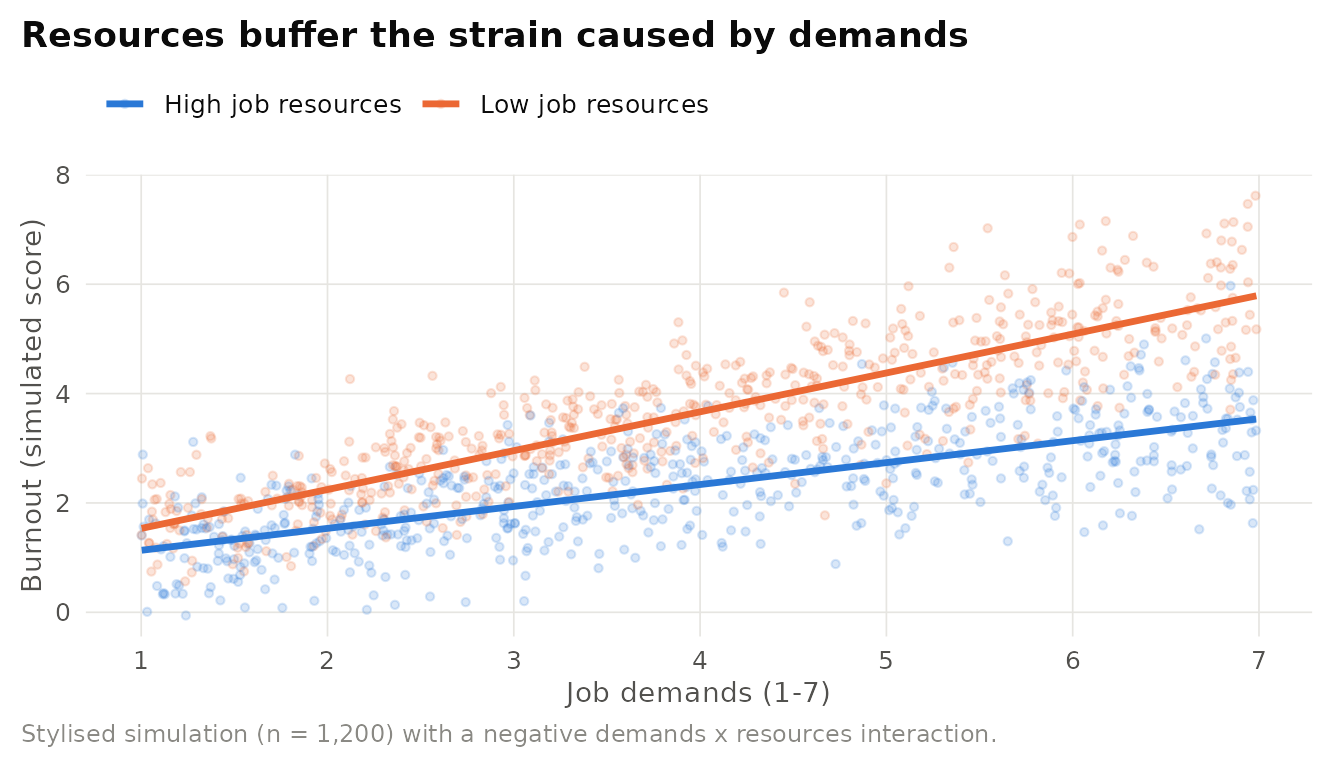
Figure 15.4: Illustrative simulation of the buffering hypothesis. Burnout rises with job demands, but the slope is flatter for employees with high job resources. Simulated data, not empirical estimates.
Table 15.3 lists typical demands and resources studied in different occupations, which shows how the model’s open-ended categories are adapted to context.
| Occupation | Typical job demands | Typical job resources | Likely outcome if unbalanced |
|---|---|---|---|
| Nursing | Emotional demands, shift work, patient load | Team support, autonomy in care decisions | Exhaustion, absence, exit from profession |
| Software engineering | Deadline pressure, on-call interruptions | Autonomy, learning opportunities, clear priorities | Cynicism, reduced code quality |
| Retail and hospitality | Customer hostility, emotional labour, irregular hours | Supervisor support, predictable scheduling | Turnover, service failures |
| Teaching | Classroom disruption, administrative load | Collegial support, professional discretion | Burnout, early career exit |
| Remote knowledge work | Blurred boundaries, communication overload | Schedule control, manager check-ins, peer contact | Isolation, overwork |
15.2.3 Evidence and extensions
The dual-process structure is well supported across countries and occupations (Schaufeli and Bakker 2004, Bakker and Demerouti 2017). The most important refinement concerns demands. LePine, Podsakoff, and LePine (2005) distinguished challenge stressors (workload, responsibility, time urgency) from hindrance stressors (red tape, role ambiguity, politics) and showed meta-analytically that challenge stressors relate positively to motivation and performance while hindrance stressors relate negatively. E. R. Crawford, LePine, and Rich (2010) integrated this distinction into JD-R: challenge demands were positively related to engagement, hindrance demands negatively, and both were positively related to burnout. A job can therefore be both energising and exhausting.
Evidence on the interaction propositions is more mixed. Buffering and boosting effects appear in many studies, but they are typically small and are sensitive to how demands and resources are matched. Day-level diary studies show that engagement and exhaustion fluctuate within persons, which has moved JD-R toward dynamic, within-person tests (Bakker and Demerouti 2017).
Is JD-R a theory or a heuristic? Because almost any job feature can be labelled a demand or a resource, critics argue that JD-R is too flexible to be falsified: a feature that predicts burnout becomes a demand, one that predicts engagement becomes a resource. The challenge-hindrance distinction sharpens predictions but also concedes that the same feature can play either role. Defenders reply that the theory specifies distinct processes, mediators, and interactions that can fail empirically, and that Bakker and Demerouti (2017) added reciprocal and personal-resource propositions that are testable. Researchers should therefore classify demands and resources before seeing the data and justify the classification from the occupation’s work processes.
15.2.4 Applications in business
Burnout and remote work (conceptual application). Remote and hybrid work change both sides of the JD-R ledger. They typically add resources, notably schedule control and fewer commuting demands, and meta-analytic evidence links telecommuting to higher perceived autonomy and lower work-family conflict (Gajendran and Harrison 2007). They can also remove resources (informal peer support, spontaneous feedback) and add demands (communication overload, blurred boundaries between work and home). The randomized experiment at the travel agency described in the chapter opening illustrates both sides: home work raised performance and reduced quits, but isolation led many employees to return (Bloom et al. 2015). A JD-R audit of a hybrid policy therefore asks which resources are lost when people are apart and how to replace them (structured check-ins, team days, clear availability norms), rather than treating remote work as uniformly good or bad.
Illustrative scenario: an engagement survey that measures the wrong thing. A retailer’s annual engagement survey shows falling scores in distribution centres. Leadership responds with recognition programmes, a pure resource intervention. A JD-R diagnosis separates demands from resources and finds the real driver: a new scheduling algorithm that raised unpredictability, a hindrance demand. Resources cannot fully offset a hindrance demand that is cheap to remove. The more effective intervention restores advance notice of shifts and only then invests in recognition.
15.2.5 Using the theory in research
Sample hypotheses.
- H1. Workload is positively related to emotional exhaustion, and the relationship is weaker for employees who report high supervisor support.
- H2. Hindrance demands are negatively related to engagement, whereas challenge demands are positively related to engagement.
- H3. Day-level engagement predicts next-day job crafting, which in turn increases job resources.
Validated scales. Maslach Burnout Inventory (Maslach, Schaufeli, and Leiter 2001). Oldenburg Burnout Inventory, which measures exhaustion and disengagement (Demerouti et al. 2001). Utrecht Work Engagement Scale, short form (Schaufeli, Bakker, and Salanova 2006).
Designs. Multi-wave panels with cross-lagged models. Daily diary studies with multilevel models that separate within-person from between-person effects. Intervention studies (workload reduction, job crafting training). Linking survey data to sickness absence and turnover records.
Contexts. Healthcare, education, call centres, hybrid work, platform work.
Labelling variables after the fact. Post hoc classification of a feature as a demand or resource, chosen to fit the results, makes JD-R unfalsifiable. Specify classifications in advance, distinguish challenge from hindrance demands, and test the interaction propositions with adequately powered designs rather than reporting only main effects.
15.3 Conservation of Resources Theory
Core claim. People strive to obtain, retain, and protect what they value. Stress occurs when resources are threatened, lost, or not regained after investment, and resource loss weighs more heavily than equivalent gain.
Origins. Stress psychology. Hobfoll (1989), reviewed for organizational research by Halbesleben et al. (2014) and Hobfoll et al. (2018).
Level of analysis. Individual, with extensions to teams and organizations.
Key constructs. Resources (objects, conditions, personal characteristics, energies), resource loss, resource investment, loss spirals, gain spirals, resource caravans.
Boundary conditions. What counts as a resource depends on a person’s goals and culture, so predictions require careful specification of the resource in question.
Related theories. Job demands-resources, Loss aversion (Section 24.4), Prospect theory (Section 24.2).
Hobfoll (1989) proposed conservation of resources (COR) theory as an alternative to appraisal-based models of stress. He defined resources broadly: objects (a home, tools), conditions (tenure, a good marriage), personal characteristics (self-esteem, skills), and energies (time, money, knowledge). Stress follows when these are threatened or lost, or when people invest resources and fail to obtain a return.
Two principles give the theory its distinctive predictions. The primacy of loss states that resource loss is disproportionately more salient than resource gain, a parallel to loss aversion (Section 24.4) in decision research. The resource investment principle states that people must invest resources to protect against loss, recover from it, and gain new resources. From these follow the corollaries that people with more resources are less vulnerable to loss and better able to gain, and that loss and gain both tend to cumulate in spirals (Hobfoll et al. 2018). The later formulation also adds a desperation principle: when resources are outstretched or exhausted, people may switch to defensive, sometimes seemingly irrational, behaviour to preserve what is left (Figure 15.5).
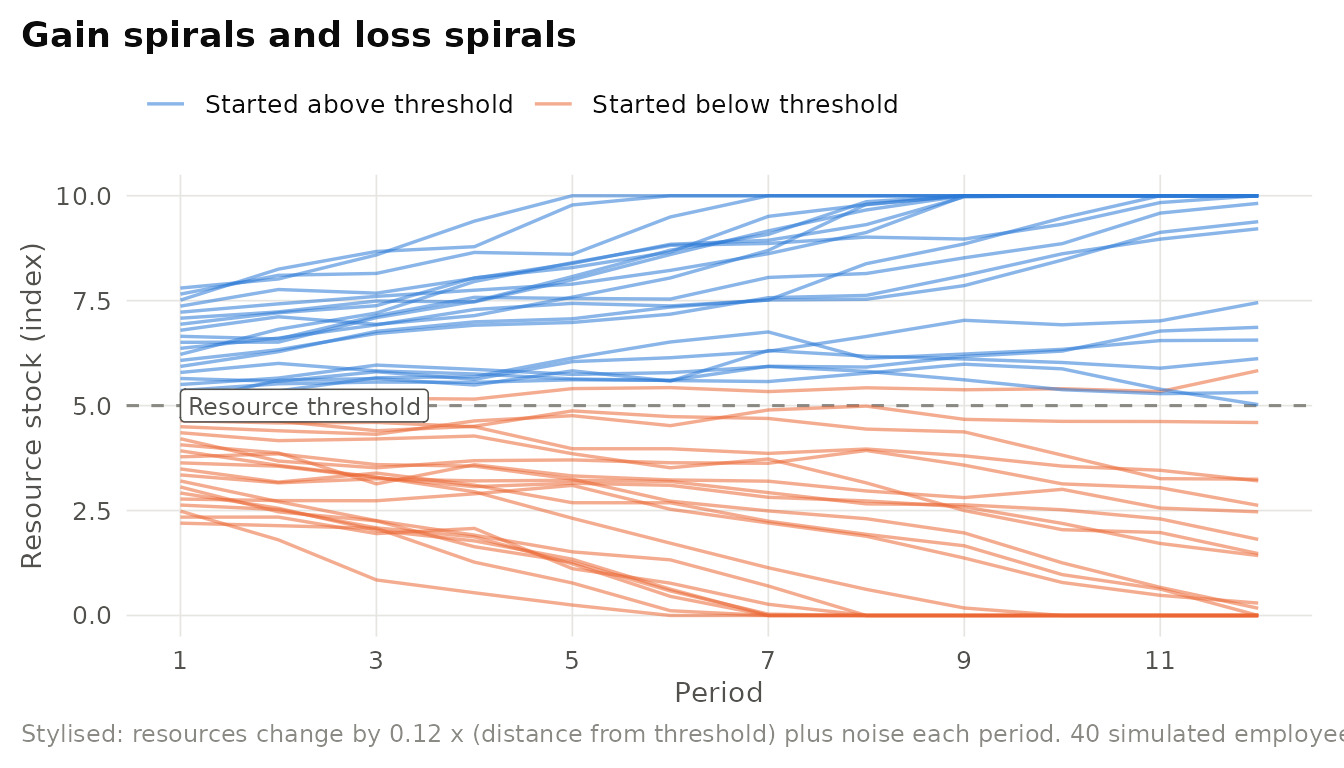
Figure 15.5: Illustrative simulation of resource spirals. Employees above a resource threshold tend to accumulate resources (gain spirals), while those below it tend to lose them (loss spirals), because both loss and gain are self-reinforcing. Simulated trajectories, not empirical data.
COR has become one of the most cited theories in organizational behaviour, used to explain burnout, work-family conflict, the effects of abusive supervision, and why employees withhold discretionary effort when they feel depleted (Halbesleben et al. 2014). Its breadth is also its main weakness. Halbesleben et al. (2014) observe that almost anything has been called a resource, and they propose defining a resource as anything an individual perceives as helping attain his or her goals. That definition improves coherence but makes resources subjective and goal-dependent, which complicates measurement.
Illustrative scenario: protecting resources during a reorganization. A bank merges two operations teams. COR predicts that the threat of losing valued conditions (a known role, a trusted manager, seniority) will produce stress before any loss occurs, and that employees who already have fewer resources (new hires, those caring for family members) will be most vulnerable to a loss spiral. Practical responses follow from the theory: announce what will not change, protect key resources such as schedule predictability during the transition, and target support at the employees with the thinnest resource reserves.
15.4 Affective Events Theory
Core claim. Discrete events at work trigger emotional reactions. These reactions drive immediate, affect-driven behaviours and, accumulated over time, shape attitudes such as job satisfaction, which in turn drive considered, judgment-driven behaviours.
Origins. Organizational psychology. Weiss and Cropanzano (1996).
Level of analysis. Individual, with emphasis on within-person variation over time.
Key constructs. Work environment features, work events (hassles and uplifts), affective reactions (moods and emotions), affective dispositions, work attitudes, affect-driven behaviour, judgment-driven behaviour.
Boundary conditions. Most useful for explaining short-term fluctuations and spontaneous behaviours. Less informative for stable, between-person differences in attitudes.
Related theories. Appraisal theory (Section 25.5), Affect circumplex (Section 25.3), Broaden-and-build theory (Section 25.1).
For decades, job satisfaction research treated satisfaction as an emotional state and studied it as a stable, between-person attitude explained by stable job features. Weiss and Cropanzano (1996) argued that this conflated two different things. Job satisfaction is an evaluative judgment about one’s job. Emotions and moods are affective experiences that occur in response to events, fluctuate within a day, and have their own consequences. Affective events theory (AET) places the event at the centre of the analysis (Figure 15.6).
Figure 15.6: Affective events theory. Features of the work environment make some events more likely. Events trigger affective reactions, moderated by dispositions. Affect drives spontaneous behaviour directly and, through attitudes, judgment-driven behaviour. Adapted from Weiss and Cropanzano (1996).
AET makes three contributions. First, it distinguishes affect-driven behaviours, such as helping a colleague in a good mood or snapping at a customer after an insult, from judgment-driven behaviours, such as deciding to quit, which follow from considered attitudes. Second, it implies that the pattern of events over time, not only the average job, shapes satisfaction. Third, it requires methods that capture within-person dynamics. Weiss, Nicholas, and Daus (1999) showed that mood and beliefs about the job independently predict satisfaction, and experience sampling studies found that a substantial share of the variance in mood and job satisfaction lies within persons over time (Ilies and Judge 2002).
Service work and the management of events. In front-line service jobs, a small number of hostile customer interactions can dominate an employee’s day. AET suggests that managers can influence affect by changing the frequency of negative events (better routing of difficult calls, clear escalation paths) and by providing recovery opportunities after them (short breaks, supervisor debriefs), not only by improving average pay or job content. Because affect-driven behaviour is immediate, the timing of support matters: help offered shortly after an incident prevents spillover into the next customer interaction.
15.5 Leader-Member Exchange
Core claim. Leaders develop relationships of different quality with different followers. High-quality exchanges, built on trust, respect, and mutual obligation, lead to better performance, attitudes, and retention than low-quality exchanges limited to the formal employment contract.
Origins. Organizational psychology. The vertical dyad linkage studies of Dansereau, Graen, and Haga (1975), consolidated as leader-member exchange (LMX) theory by Graen and Uhl-Bien (1995).
Level of analysis. The leader-follower dyad, with extensions to the differentiation of relationships within teams.
Key constructs. LMX quality, role making, leadership making (stranger, acquaintance, partnership), LMX differentiation, in-group and out-group.
Boundary conditions. Assumes leaders have discretion over resources, assignments, and latitude. Effects of differentiation depend on whether team members see it as fair.
Related theories. Social exchange theory (Section 9.1), Transformational leadership, Organizational justice, Psychological safety (Section 14.8).
15.5.1 Origins and intellectual history
Most early leadership theories assumed an average leadership style: a leader behaves in roughly the same way toward everyone, and that style can be described by averaging subordinates’ ratings. Dansereau, Graen, and Haga (1975) challenged this assumption with a longitudinal study of managers and their direct reports. They found that managers formed distinct relationships with different subordinates within the first months: some became trusted assistants with latitude and influence, others were managed through formal authority. They called this the vertical dyad linkage approach, and it implied that the proper unit of analysis is the dyad, not the leader.
Graen and Uhl-Bien (1995) reviewed twenty-five years of subsequent work and described the theory’s evolution in four stages: discovering differentiated dyads, linking exchange quality to outcomes, describing how partnerships are built (leadership making), and aggregating dyads to the group and network levels. They argued that leaders should aim to offer every follower the opportunity to develop a high-quality relationship rather than accept a fixed in-group and out-group.
15.5.2 Core logic and propositions
LMX is an application of social exchange theory (Section 9.1) to the leader-follower relationship (Cropanzano and Mitchell 2005). Leaders control resources that followers value: interesting assignments, information, support, discretion, and advocacy. Followers can offer effort beyond the formal role, loyalty, and expertise. When early exchanges go well, each side extends more, and the relationship moves through three stages: stranger (formal, contractual exchange), acquaintance (testing and limited reciprocity), and mature partnership (high trust, mutual influence, and obligation) (Graen and Uhl-Bien 1995).
- P1 (Differentiation). Leaders form relationships of varying quality with members of the same unit.
- P2 (Outcomes). Higher LMX quality is associated with higher performance, satisfaction, commitment, and lower turnover intentions.
- P3 (Reciprocity). LMX develops through reciprocal exchange, with early interactions and perceived similarity shaping its trajectory.
- P4 (Team context). Within a team, large differences in LMX quality can harm cooperation and fairness perceptions unless differentiation is seen as based on contribution.
15.5.3 Evidence and extensions
C. R. Gerstner and Day (1997) meta-analysed the early literature. LMX was associated with supervisor-rated performance, satisfaction with the supervisor, overall satisfaction, organizational commitment, role clarity, and lower turnover intentions, but not reliably with actual turnover. Two construct issues stood out: leaders’ and members’ ratings of the same relationship agreed only moderately, and correlations were stronger when outcomes were reported by the same person who rated LMX. Dulebohn et al. (2012) extended the synthesis to antecedents: follower characteristics (competence, conscientiousness), leader characteristics (expectations of the follower, transformational behaviour), and interpersonal factors (perceived similarity, liking) all predict LMX quality.
Measurement has evolved with the theory. The seven-item LMX-7 treats exchange quality as a single dimension (Graen and Uhl-Bien 1995), whereas the multidimensional LMX-MDM separates affect, loyalty, contribution, and professional respect (Liden and Maslyn 1998). More recent work studies LMX differentiation at the team level and relative LMX, a member’s standing compared with teammates, which links the theory to social comparison (Section 22.1).
Is LMX a cause or a consequence of performance? Leaders form better relationships with followers who are already competent, and high performers receive more resources. Cross-sectional correlations between LMX and performance therefore confound the effect of the relationship with the selection of high performers into good relationships. The disagreement between leader and member ratings adds a further problem: if two parties see the same relationship differently, which view is “the” relationship? Longitudinal designs, dyadic models that use both reports, and instruments for early relationship formation are needed to separate the mechanisms (Antonakis et al. 2010).
15.5.4 Applications in business
Illustrative scenario: LMX in team management. A newly promoted engineering manager inherits eight engineers. Within weeks, she relies heavily on two senior engineers for design decisions and status updates, while the others receive assignments by ticket. LMX theory predicts that the two will become more committed and influential and that the remaining six may disengage, especially if they see the split as favouritism. Practical steps drawn from the leadership-making stage model include offering every team member a stretch assignment early (an opening move in the exchange), holding regular one-to-one meetings with all reports, and making the criteria for access to high-visibility work explicit so that differentiation is seen as earned. Monitoring the spread of relationship quality, not just its average, becomes part of the manager’s dashboard.
15.5.5 Using the theory in research
Sample hypotheses.
- H1. LMX quality is positively related to organizational citizenship behaviour, and the relationship is mediated by felt obligation.
- H2. LMX differentiation within teams is negatively related to team coordination when team members perceive differentiation as unfair.
- H3. Relative LMX (a member’s LMX compared with the team mean) predicts self-efficacy beyond the member’s absolute LMX.
Validated scales. LMX-7 (Graen and Uhl-Bien 1995). LMX-MDM (Liden and Maslyn 1998).
Designs. Dyadic data from both leaders and members analysed with dyadic or multilevel models. Longitudinal studies of newly formed dyads. Team-level designs with polynomial regression for relative standing. Field experiments in leader training that encourage equal opportunities for exchange.
Contexts. New-hire onboarding, matrix organizations, remote teams, sales territories.
Ignoring reverse causality and same-source bias. A survey that asks employees to rate both their relationship with the manager and their own engagement will almost always find a strong correlation. Use supervisor- or record-based outcomes, measure LMX before outcomes, and model the possibility that performance shapes the relationship.
15.6 Transformational Leadership
Core claim. Transformational leaders raise followers’ motivation and performance beyond what exchange-based incentives achieve by articulating an inspiring vision, serving as role models, stimulating new thinking, and attending to individual needs.
Origins. Political science and organizational psychology. J. M. Burns (1978) distinguished transforming from transactional political leadership. B. M. Bass (1985) operationalised the distinction for organizations.
Level of analysis. Individual leader and followers, with group-level extensions.
Key constructs. Idealised influence (charisma), inspirational motivation, intellectual stimulation, individualised consideration, contingent reward, management by exception, laissez-faire leadership.
Boundary conditions. Effects are thought to be stronger in uncertain or crisis conditions and when followers identify with the collective. Measurement problems limit what current evidence can show (see the debate below).
Related theories. Leader-member exchange, Path-goal theory, Social identity theory (Section 22.2), Upper echelons theory (Section 6.4).
15.6.1 Origins and intellectual history
J. M. Burns (1978), a political historian, contrasted two kinds of leaders. Transactional leaders exchange one thing for another: jobs for votes, subsidies for contributions. Transforming leaders engage followers so that both are raised to higher levels of motivation and morality. B. M. Bass (1985) brought the idea into organizational psychology and, unlike Burns, treated transformational and transactional leadership as complementary rather than opposite ends of a single continuum. A leader can do both, and transformational behaviour adds to the effect of transactional leadership, an idea known as the augmentation effect. Elaborated by Bass and colleagues into what they called the “full range” model of leadership, this framework became the most researched approach to leadership of the following three decades.
15.6.2 Core logic and propositions
The full-range model distinguishes three families of behaviour (Table 15.4 compares them with the other leadership theories in this chapter):
- Transformational: idealised influence (acting as a role model who inspires trust and identification), inspirational motivation (articulating an appealing vision), intellectual stimulation (challenging assumptions and encouraging creativity), and individualised consideration (coaching and attending to each follower’s needs).
- Transactional: contingent reward (clarifying expectations and rewarding their achievement) and management by exception (monitoring and correcting deviations, either actively or passively).
- Laissez-faire: the avoidance of leadership responsibilities.
The theory’s central proposition is that transformational behaviours change followers’ values, self-concepts, and identification with the collective, so that they pursue collective goals for intrinsic reasons rather than for rewards alone.
| Feature | Leader-member exchange | Transformational leadership | Path-goal theory |
|---|---|---|---|
| Focal unit | Leader-follower dyad | Leader and followers as a group | Leader, follower, and task |
| Core mechanism | Reciprocal social exchange | Identification and value change | Expectancy: clarifying paths and raising valences |
| Key behaviours | Offering latitude, support, and challenging assignments | Vision, role modelling, stimulation, consideration | Directive, supportive, participative, achievement-oriented |
| Contingency view | Weak: quality varies by relationship | Weak: broadly effective | Strong: best behaviour depends on task and follower |
| Main measure | LMX-7, LMX-MDM | Multifactor Leadership Questionnaire | Leader behaviour scales |
| Main critique | Reverse causality, rater disagreement | Conflates behaviour with effects | Mixed tests, many untested propositions |
15.6.3 Evidence and extensions
The quantitative evidence is large. Judge and Piccolo (2004) meta-analysed studies of the full range model and found that transformational leadership was strongly related to follower satisfaction, motivation, and rated leader effectiveness. Contingent reward, a transactional behaviour, showed overall validities of a similar size and was in some settings as predictive as transformational leadership, while laissez-faire leadership was negatively related to outcomes. The authors also found that the relative validity of the dimensions differed across settings and that transformational and contingent reward leadership were highly correlated, which made their unique effects hard to separate.
Experimental evidence is thinner but exists. In a small field experiment, Barling, Weber, and Kelloway (1996) trained bank branch managers in transformational leadership and found improvements in subordinates’ perceptions of their managers, in subordinates’ organizational commitment, and in branch-level financial outcomes compared with an untrained control group. The study is often cited because it combines random assignment with objective outcomes, but its sample was small.
Back to the drawing board? Knippenberg and Sitkin (2013) published a sweeping critique of charismatic-transformational leadership research. They argued, first, that the construct lacks an independent definition: it is defined largely by its effects (followers who are inspired and perform beyond expectations), which makes the link between leadership and outcomes partly tautological. Second, the theory does not explain why these four particular dimensions belong together or how each produces its effects. Third, the dominant measures, especially the Multifactor Leadership Questionnaire, ask followers to rate behaviours in terms that already include positive outcomes, and the proposed dimensional structure is often not reproduced empirically. They recommended abandoning the umbrella construct and studying specific, well-defined leader behaviours and their mechanisms. A related methodological critique notes that follower ratings of leadership are endogenous to performance, liking, and attributions, so most observational estimates are biased (Antonakis et al. 2010). Defenders point to experimental studies like Barling, Weber, and Kelloway (1996) and argue that refinement, not abandonment, is the appropriate response. The debate is not settled, but it has raised the standard of evidence expected of leadership research.
15.6.4 Applications in business
Leadership development programmes. Transformational leadership is the intellectual backbone of many corporate leadership development curricula, which teach managers to communicate a vision, coach individuals, and encourage challenge to the status quo. The evidence suggests three design principles. First, do not neglect transactional basics: clear goals and contingent recognition are consistently effective (Judge and Piccolo 2004). Second, evaluate programmes with outcomes that are not rated by the same followers who rate the leader, as Barling, Weber, and Kelloway (1996) did with branch financial data. Third, teach specific behaviours (how to give developmental feedback, how to frame change around shared values) rather than an abstract “inspirational style”, in line with Knippenberg and Sitkin (2013).
15.6.5 Using the theory in research
Sample hypotheses.
- H1. Leaders’ intellectual stimulation is positively related to team creativity, and the relationship is mediated by psychological safety.
- H2. Contingent reward leadership explains variance in follower performance beyond transformational leadership in routine production settings.
- H3. Training in vision communication increases objectively measured unit performance relative to a control group.
Validated scales. The Multifactor Leadership Questionnaire, developed from B. M. Bass (1985), remains the most common instrument, but users should report evidence on its factor structure in their sample and consider behaviour-specific alternatives.
Designs. Randomised leadership training with objective outcomes. Laboratory experiments that manipulate a specific leader behaviour (for example, a vision speech). Designs that address endogeneity, such as instrumental variables or exogenous leader turnover (Antonakis et al. 2010).
Contexts. Organizational change and turnaround, start-ups, military and public-service organizations, healthcare teams.
Measuring leadership with outcomes. Items such as “my leader motivates me to do more than I expected” fold the dependent variable into the independent variable. Use behaviour-specific measures, separate sources, and designs that can support causal claims before concluding that a leader’s style caused performance.
15.7 Path-Goal Theory
Core claim. Effective leaders increase followers’ motivation by clarifying the paths to work goals, removing obstacles, and making goal attainment more rewarding. The behaviour that does this best depends on the task and the follower.
Origins. Organizational psychology. House (1971), reformulated in House (1996).
Level of analysis. Leader-follower dyad and work group.
Key constructs. Directive, supportive, participative, and achievement-oriented leader behaviour, task structure, follower ability, locus of control, expectancies, valences.
Boundary conditions. Leader behaviour matters only where the situation does not already provide clarity and rewards, that is, where there are few substitutes for leadership (S. Kerr and Jermier 1978).
Related theories. Expectancy theory (Section 19.2), Transformational leadership, Goal-setting theory (Section 19.4).
House (1971) built path-goal theory directly on expectancy theory (Section 19.2) (Vroom 1964). Followers are motivated when they believe effort leads to performance and performance leads to valued rewards. The leader’s job is to strengthen both links: clarify what effective performance requires, remove roadblocks, provide support, and tie rewards to goal attainment. Because these needs vary, the theory is explicitly contingent. Directive leadership helps when tasks are ambiguous and followers inexperienced, but is redundant or even irritating when tasks are routine and well understood. Supportive leadership helps most when tasks are stressful, boring, or dangerous. Participative leadership suits followers who want control, and achievement-oriented leadership suits complex tasks where high standards and confidence in followers raise expectancies (Figure 15.7).
Figure 15.7: Path-goal theory. Leader behaviour affects follower expectancies and valences, which drive motivation and performance. Task and follower characteristics determine which behaviour is effective. Adapted from House (1971, 1996).
The evidence is mixed. A meta-analysis by Wofford and Liska (1993) found support for some propositions and not for others, and noted that many tests used weak designs and measures. House (1996) acknowledged these limitations and reformulated the theory around a broader set of leader behaviours, including work facilitation, interaction facilitation, group-oriented decision processes, representation and networking, and value-based behaviour, while retaining the core idea that leaders compensate for what the environment does not provide. A related line of work on substitutes for leadership argued that professional training, intrinsically satisfying tasks, and formalised procedures can make some leader behaviours unnecessary (S. Kerr and Jermier 1978). Path-goal theory’s lasting contribution is less any single prediction than the principle that leadership style should be matched to the motivational deficits of a specific situation.
Illustrative scenario: one manager, two teams. A regional operations manager oversees a newly formed analytics team working on ill-defined problems and a mature payroll team running a stable, highly regulated process. Path-goal theory predicts that directive behaviour (clear problem definitions, milestones, and methods) will raise the analytics team’s expectancies, while the same behaviour would be redundant for payroll. The payroll team, facing repetitive work and deadline stress at month end, benefits more from supportive behaviour and from removing obstacles such as late data from other departments. The prescription is not a single best style but a deliberate diagnosis of what each team lacks.
15.8 Psychological Contract Theory
Core claim. Employees hold beliefs about the reciprocal promises that bind them and their employer. When they perceive that the organization has broken those promises, they react with feelings of violation and reduced trust, commitment, and effort, even if no written agreement was breached.
Origins. Organizational behaviour. Rousseau (1989) reconceptualised the psychological contract as an individual-level belief, extended in Rousseau (1995). S. L. Robinson and Rousseau (1994) and Morrison and Robinson (1997) developed the theory of breach and violation.
Level of analysis. Individual employee, in relation to the organization and its agents.
Key constructs. Perceived promises, transactional and relational contracts, breach, violation, reneging, incongruence.
Boundary conditions. Applies where employment involves promises that are implicit, long-term, or incompletely specified. Contract content varies with career stage, labour market, and national employment norms.
Related theories. Social exchange theory (Section 9.1), Organizational justice, Organizational commitment.
15.8.1 Core logic
Earlier writers used “psychological contract” loosely to describe unwritten expectations between employees and employers. Rousseau (1989) gave the concept a precise meaning: an individual’s belief about the terms of a reciprocal exchange with another party, grounded in a perceived promise. Because it is a belief, two employees in the same job can hold different contracts, and the organization, which consists of many agents (recruiters, managers, HR policies), cannot simply read off what it has promised. Rousseau (1995) distinguished transactional contracts, which are specific, short-term, and largely monetary, from relational contracts, which are open-ended and include loyalty, support, and development. Later typologies add balanced and transitional forms (Table 15.5).
| Feature | Transactional contract | Relational contract |
|---|---|---|
| Time frame | Short-term, specified duration | Open-ended, long-term |
| Content | Pay for defined performance | Pay plus loyalty, development, security |
| Specificity | Explicit and narrow | Implicit and broad |
| Typical setting | Contract and gig work, fixed-term projects | Career employment, internal labour markets |
| Typical reaction to breach | Renegotiation or exit | Felt betrayal, withdrawal of discretionary effort |
| Employer lever | Clear terms and prompt payment | Consistent signals from managers and policies |
Morrison and Robinson (1997) separated two reactions that earlier work had merged. Breach is the cognitive perception that the organization has failed to fulfil one or more obligations. Violation is the emotional experience of anger and betrayal that may follow. Breach can arise from reneging, when agents knowingly fail to keep a promise, or from incongruence, when the two parties understood the promise differently. Whether breach turns into violation depends on how the employee interprets it, especially on attributions of intent and perceptions of fairness.
15.8.2 Evidence
The landmark longitudinal study by S. L. Robinson and Rousseau (1994) surveyed graduates of a master of business administration programme when they took up new jobs and again two years later. More than half reported that their employer had violated the psychological contract, which led the authors to describe violation as the norm rather than the exception. Violation was associated with lower trust, satisfaction, and intentions to remain. A follow-up longitudinal study confirmed that breach and violation are distinct, and that the step from one to the other depends on attributions of reneging and perceived unfairness (S. L. Robinson and Morrison 2000). The meta-analysis by H. Zhao et al. (2007) found that breach is related to feelings of violation and mistrust, to lower job satisfaction and organizational commitment, to higher turnover intentions, and to reduced citizenship behaviour and in-role performance, with affective reactions mediating many of these links.
Whose contract? Because the psychological contract exists in the employee’s mind, critics question whether “contract” is the right metaphor: a contract normally requires mutual agreement, and the organization is not a single party that can hold beliefs. Measurement adds a second problem. Many studies ask employees directly how well promises have been fulfilled, which mixes perceived promises, perceived delivery, and evaluation in a single item. Designs that measure promises at entry and fulfilment later, or that compare employee and manager views, are more informative.
Illustrative scenario: return-to-office policies as contract change. A software firm hired many employees during a period when remote work was described in recruiting conversations as permanent. Two years later, it mandates four office days per week. Legally, nothing has been breached, since the employment contracts never mentioned location. Psychological contract theory predicts that employees who perceived a promise will experience breach, and those who attribute it to reneging will experience violation and withdraw discretionary effort or leave. The theory suggests three mitigations: acknowledge the change explicitly as a change, explain the reasons (to shift attributions from reneging to necessity), and offer something in exchange, such as transition time or flexible days, so that the reciprocal balance is restored.
15.9 Organizational Justice
Core claim. Employees evaluate not only what they receive (distributive justice) but also how decisions are made (procedural justice) and how they are treated and informed (interactional justice). Each form of fairness has distinct effects on attitudes and behaviour.
Origins. Social psychology and organizational behaviour. Equity theory (Section 19.3) (J. S. Adams 1965), procedural justice in legal settings (J. Thibaut and Walker 1975), allocation procedures (Leventhal 1980), and interactional justice (Bies and Moag 1986). Integrated by Colquitt (2001) and Colquitt et al. (2001).
Level of analysis. Individual perceptions of organizational decisions, with extensions to team justice climate.
Key constructs. Distributive, procedural, interpersonal, and informational justice, voice, fair process effect.
Boundary conditions. The weight of procedural justice is greatest when outcomes are unfavourable or uncertain. Reactions to voice vary with cultural values such as power distance (Brockner et al. 2001).
Related theories. Equity theory (Section 19.3), Psychological contract, Social exchange theory (Section 9.1), Leader-member exchange.
15.9.1 Origins and intellectual history
Justice research began with outcomes. Equity theory (Section 19.3) proposed that people compare their ratio of outcomes to inputs with that of others and feel distress when the ratios differ (J. S. Adams 1965). This is distributive justice. J. Thibaut and Walker (1975) shifted attention to process. Studying legal dispute resolution, they found that people’s satisfaction depended heavily on process control, the opportunity to present their case, even when they had no control over the final decision. This became known as the voice effect. Leventhal (1980) extended procedural justice to organizational allocation decisions and proposed six rules that make procedures fair. Bies and Moag (1986) added interactional justice: the quality of interpersonal treatment people receive when procedures are enacted, including truthfulness, justification, respect, and propriety.
15.9.2 Core logic and propositions
Table 15.6 summarises the four dimensions that most researchers now use, following the construct validation by Colquitt (2001), which showed that separating interactional justice into interpersonal and informational components fit the data better than three-factor alternatives.
| Dimension | Focal question | Fairness criteria | Key source |
|---|---|---|---|
| Distributive | Are outcomes fair given contributions? | Equity (also equality or need in some settings) | Adams (1965) |
| Procedural | Is the decision process fair? | Voice, consistency, bias suppression, accuracy, correctability, representation, ethicality | Thibaut & Walker (1975), Leventhal (1980) |
| Interpersonal | Was I treated with dignity and respect? | Respect, propriety | Bies & Moag (1986) |
| Informational | Was the decision explained truthfully and adequately? | Truthfulness, justification, timeliness | Bies & Moag (1986) |
The theory’s main propositions are:
- P1 (Distinctiveness). The justice dimensions are related but distinct, and each explains unique variance in outcomes (Colquitt et al. 2001).
- P2 (Targets). Procedural justice is most strongly tied to evaluations of the organization and its systems, while interpersonal and informational justice are most strongly tied to evaluations of the decision agent, typically the supervisor.
- P3 (Fair process effect). Fair procedures and treatment soften negative reactions to unfavourable outcomes. Procedural justice matters most when outcomes are poor (Brockner and Wiesenfeld 1996).
- P4 (Behaviour). Perceived injustice leads to withdrawal, reduced citizenship, and retaliation, while justice fosters trust, commitment, and cooperation.
Figure 15.8 sketches the interaction behind P3.
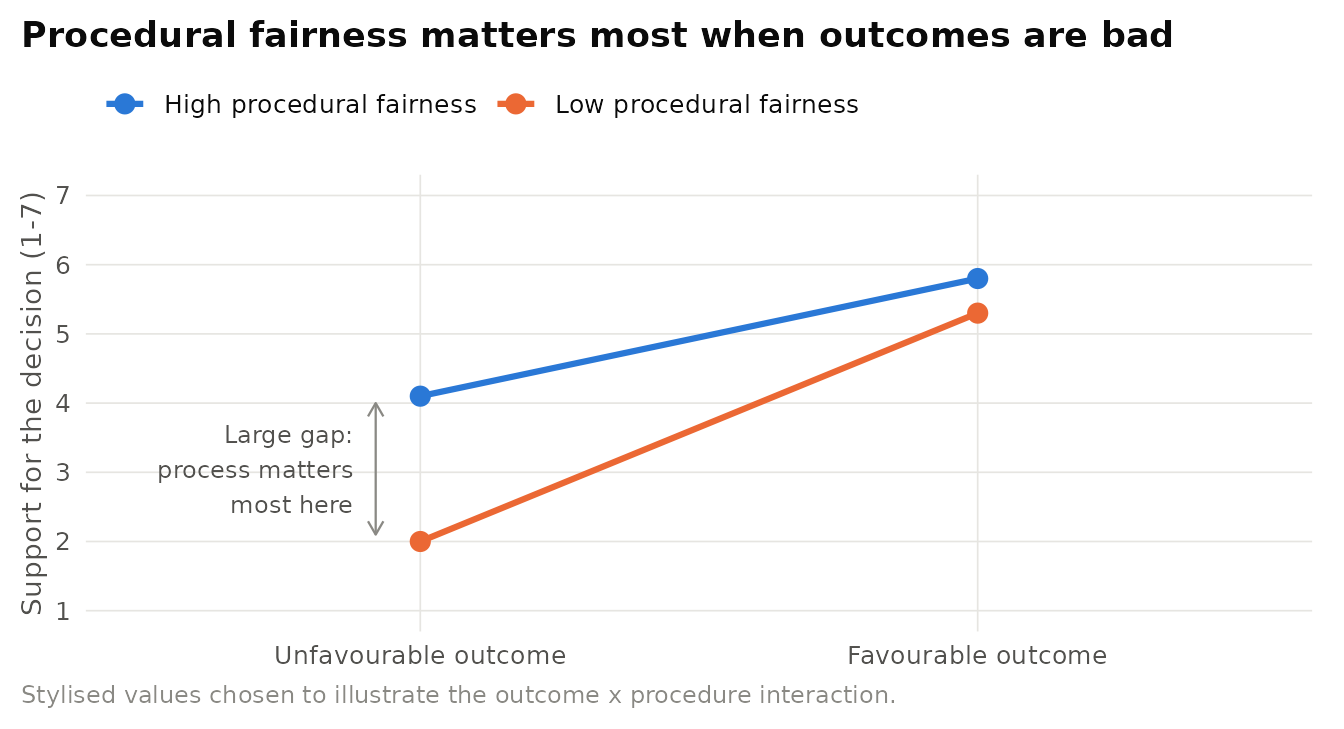
Figure 15.8: Stylised fair process effect. When outcomes are favourable, procedures matter little. When outcomes are unfavourable, fair procedures and treatment greatly reduce negative reactions. Pattern consistent with the interaction reviewed by Brockner and Wiesenfeld (1996). Not empirical data.
15.9.3 Evidence and extensions
The meta-analysis by Colquitt et al. (2001) integrated twenty-five years of research. It found that the justice dimensions are strongly correlated but distinguishable, that procedural justice predicts a wide range of attitudes and behaviours, and that interpersonal and informational justice add explanatory power beyond procedural and distributive justice. Two field studies became classics. In a manufacturing company that imposed a temporary pay cut, Greenberg (1990) found that employee theft rose in the affected plants, and that it rose much less in the plant where management explained the cut thoroughly and with expressed regret. In a study of terminated employees, Lind et al. (2000) found that how fairly people felt they had been treated at the time of termination was a strong predictor of whether they filed wrongful-termination claims. Both studies show that the manner of an unfavourable decision has economic consequences.
How many dimensions, and is fairness one judgment? The four-factor structure is well supported psychometrically, but the dimensions are highly correlated and often have similar effects. Some researchers therefore argue for an overall justice judgment that people form quickly and then use as a heuristic, with the specific dimensions as its inputs. A second debate concerns the boundary between interactional and procedural justice: if a respectful explanation is part of the procedure, is it a separate dimension? Cultural research adds a third: the voice effect is weaker in high power-distance settings, where employees expect less say in decisions (Brockner et al. 2001).
15.9.4 Applications in business
Layoffs and procedural justice. Layoffs are the clearest test of the fair process effect: the outcome is unfavourable by definition, for victims and often for survivors. The research above suggests a practical checklist. Use consistent, pre-announced criteria (consistency and bias suppression). Give employees a way to correct errors in the data used for selection (correctability). Explain the business reasons candidly and early (informational justice). Deliver the news in person, privately, and with respect, never by mass e-mail (interpersonal justice). Provide fair severance and outplacement support (distributive justice). The evidence that poor treatment at termination predicts legal claims (Lind et al. 2000) and that explanations reduce retaliation (Greenberg 1990) means these steps reduce legal and operational risk as well as human cost. Survivors watch how departing colleagues are treated and update their own trust and commitment accordingly (Brockner and Wiesenfeld 1996).
15.9.5 Using the theory in research
Sample hypotheses.
- H1. Informational justice during an organizational change is positively related to change acceptance, and the effect is stronger when the change is unfavourable to the employee.
- H2. Interpersonal justice from the supervisor predicts supervisor-directed citizenship behaviour more strongly than procedural justice does.
- H3. Team justice climate moderates the relationship between individual justice perceptions and team commitment.
Validated scales. Colquitt’s four-dimension organizational justice measure (Colquitt 2001).
Designs. Vignette and laboratory experiments manipulating outcome and process independently. Field quasi-experiments around layoffs, pay changes, or appraisal system redesign. Multilevel designs for justice climate. Archival data on grievances and legal claims.
Contexts. Performance appraisal, pay decisions, downsizing, algorithmic management, promotion systems.
Treating fairness as an outcome only. Many organizations evaluate decisions solely by asking whether outcomes are defensible. Justice research shows that process and treatment often matter as much, especially when the outcome is bad. In research, the parallel mistake is to measure a single global fairness item and attribute effects to a specific dimension.
15.10 Organizational Commitment
Core claim. Commitment to an organization is a psychological state with three components: a desire to stay (affective commitment), a perceived need to stay because of the costs of leaving (continuance commitment), and a felt obligation to stay (normative commitment). Each has different antecedents and consequences.
Origins. Organizational psychology. J. P. Meyer and Allen (1991), with measures in N. J. Allen and Meyer (1990).
Level of analysis. Individual employee.
Key constructs. Affective, continuance, and normative commitment, commitment profiles, side bets, perceived alternatives.
Boundary conditions. Developed in North American samples with conventional employment. Normative commitment may operate differently in more collectivist cultures.
Related theories. Psychological contract, Social identity theory (Section 22.2), Escalation of commitment (Section 14.2).
Earlier research on commitment had followed separate threads: some scholars saw commitment as emotional attachment, others as the accumulation of investments (side bets) that would be lost on leaving, and still others as a moral duty. J. P. Meyer and Allen (1991) argued that these were not competing definitions but distinct components of commitment that can coexist in the same person in different strengths. All three tie an employee to the organization, but they do so for different reasons and should therefore have different effects on behaviour beyond staying (Table 15.7).
| Component | Mindset | Typical antecedents | Relation to performance and citizenship |
|---|---|---|---|
| Affective | I want to stay | Supportive leadership, justice, meaningful work | Positive |
| Continuance | I need to stay | Investments that would be lost, few alternatives | Weak or negative |
| Normative | I ought to stay | Socialization, reciprocity for benefits received | Positive, weaker than affective |
The meta-analysis by J. P. Meyer et al. (2002) supported this differentiation. All three components were negatively related to turnover intentions and turnover. Affective commitment had the strongest and most favourable correlations with attendance, performance, and citizenship behaviour, and the strongest negative correlation with stress and work-family conflict. Continuance commitment was unrelated or negatively related to these desirable outcomes. Normative commitment correlated highly with affective commitment, which has fuelled a long debate about whether it is a separate construct. Critics also note that continuance commitment appears to combine two facets, high personal sacrifice and lack of alternatives, which behave differently.
Illustrative scenario: the golden handcuffs problem. A technology firm relies heavily on deferred equity that vests over four years to retain engineers. Retention is high, but engagement surveys show low enthusiasm among long-tenured staff. The three-component model diagnoses the problem: deferred pay builds continuance commitment, which keeps people in place without raising effort or citizenship. Building affective commitment requires different levers, such as meaningful work, fair treatment, and development, and the firm may prefer moderate voluntary turnover among people who stay only because they need to.
15.11 Person-Environment Fit
Core claim. Attitudes and behaviour depend on the compatibility between characteristics of the person and characteristics of the work environment. Good fit promotes satisfaction, commitment, and retention.
Origins. Interactional psychology, systematised for organizations by Kristof (1996) and synthesised by Kristof-Brown, Zimmerman, and Johnson (2005).
Level of analysis. Individual in relation to job, group, supervisor, and organization.
Key constructs. Person-job, person-organization, person-group, and person-supervisor fit, supplementary and complementary fit, needs-supplies and demands-abilities fit, perceived and actual fit.
Boundary conditions. Fit effects are stronger for attitudes than for performance. Strong emphasis on fit can reduce diversity and adaptability.
Related theories. Attraction-selection-attrition (Section 14.9), Organizational culture (Section 14.6), Job characteristics model.
Fit is an old idea, but Kristof (1996) brought conceptual order to it. She distinguished supplementary fit, when a person is similar to others in the environment (for example, sharing the organization’s values), from complementary fit, when a person or environment supplies what the other lacks. Complementary fit has two forms: needs-supplies fit, when the job provides what the person wants, and demands-abilities fit, when the person has what the job requires. Fit can also be assessed at different levels of the environment, as Table 15.8 shows. Fit theory connects naturally to the attraction-selection-attrition (Section 14.9) framework, which argues that organizations become more homogeneous as similar people are attracted, selected, and retained (Schneider 1987).
| Type of fit | Compatibility between | Strongest outcomes in meta-analysis | HR practice |
|---|---|---|---|
| Person-job | Abilities and job demands, needs and job supplies | Job satisfaction, organizational commitment | Job analysis, skills testing |
| Person-organization | Values and organizational culture | Organizational commitment, turnover intentions | Values-based interviewing, realistic previews |
| Person-group | Person and coworkers | Coworker satisfaction, group cohesion | Team-based selection |
| Person-supervisor | Person and supervisor values or personality | Satisfaction with supervisor | Manager involvement in hiring |
The meta-analysis by Kristof-Brown, Zimmerman, and Johnson (2005) found that person-job fit was strongly related to job satisfaction and that person-organization fit was strongly related to organizational commitment, with weaker relationships to performance. These findings justify the widespread use of fit in hiring, but they come with two caveats. First, perceived fit (asking people how well they fit) produces much stronger correlations than fit calculated from separate measures of person and environment, partly because perceptions are contaminated by satisfaction (Cable and DeRue 2002). Second, fit computed as a difference score conceals which component drives the effect. Edwards and Parry (1993) showed how polynomial regression and response surface analysis can test fit hypotheses without these problems.
“Culture fit” in hiring. Many firms screen candidates for culture fit, and the evidence that person-organization fit predicts commitment supports the practice. Yet fit theory also explains its risks. When interviewers judge fit intuitively, they tend to reward similarity to themselves, which can exclude candidates who would add complementary skills and can narrow the diversity of perspectives in the firm, an outcome predicted by the attraction-selection-attrition cycle (Schneider 1987). A disciplined application specifies the values that matter, assesses them with structured questions, and balances supplementary fit on core values with complementary fit on skills.
15.12 Human Capital Theory
Core claim. Skills and knowledge are a form of capital: people and firms invest in them, bearing costs today for returns later. Who pays for training depends on whether the skills are general (valuable to many employers) or firm-specific (valuable mainly to the current employer).
Origins. Labour economics. G. S. Becker (1962) and G. S. Becker (1964), with the empirical earnings function of Mincer (1974).
Level of analysis. Individual worker and firm, with extensions to the firm’s stock of human capital as a strategic resource.
Key constructs. General human capital, firm-specific human capital, returns to schooling and experience, training investment, hold-up.
Boundary conditions. The classic predictions assume competitive labour markets. Frictions, wage compression, and information asymmetries change who pays for training (Acemoglu and Pischke 1999).
Related theories. Signaling theory (Section 8.2), Resource-based theory (Section 4.1), Knowledge-based view (Section 4.3), Efficiency wages (Section 17.5).
15.12.1 Origins and core logic
G. S. Becker (1962) and G. S. Becker (1964) treated education and training as investments that raise future productivity and earnings. The theory’s most influential organizational prediction concerns on-the-job training. General training raises a worker’s productivity equally at many firms. In a competitive labour market, a firm that paid for it would see the worker poached or would have to pay the worker their higher market value, so the firm cannot recover its investment. The worker therefore pays, typically by accepting lower wages during training. Firm-specific training raises productivity only at the current employer. The worker’s outside wage does not rise, so neither party can fully appropriate the returns alone, and the efficient arrangement is for firm and worker to share the costs and the returns. Sharing gives both parties a stake in continuing the relationship, which predicts lower quit and layoff rates for workers with firm-specific skills.
Mincer (1974) turned the theory into an empirical workhorse, the Mincer earnings equation, which regresses log earnings on years of schooling and a quadratic in labour market experience:
\[ \ln w_i = \beta_0 + \beta_1 S_i + \beta_2 X_i + \beta_3 X_i^2 + \varepsilon_i \]
where \(S_i\) is schooling and \(X_i\) is experience. The coefficient \(\beta_1\) is interpreted as an approximate rate of return to a year of schooling (Table 15.9).
| Dimension | General human capital | Firm-specific human capital |
|---|---|---|
| Definition | Raises productivity at many employers | Raises productivity mainly at the current employer |
| Examples | Literacy, programming languages, accounting standards | Proprietary systems, internal routines, client relationships |
| Who pays (competitive market) | Worker, through lower training wages | Shared between firm and worker |
| Who captures returns | Worker | Shared, which binds both parties |
| Strategic value to the firm | Low: available in the labour market | High: hard to imitate, but creates hold-up risk |
| Typical HR practice | Tuition support with repayment clauses | Internal academies, mentoring, job rotation |
15.12.2 Evidence and extensions
The theory has been refined in three directions. First, Acemoglu and Pischke (1999) showed that when labour markets have frictions, such as search costs, information asymmetries about worker skill, or institutions that compress wages, firms can profit from paying for general training, because they capture part of the returns. This explains why many employers fund training that is partly general, as in firm-sponsored apprenticeship systems. Second, Lazear (2009) proposed a skill-weights view: every individual skill may be general, but each firm uses a particular combination of skills, which makes a worker’s skill bundle partly specific to the firm. Third, strategy scholars linked firm-specific human capital to sustainable advantage, while warning that human assets can walk out the door and bargain for the rents they create (Coff 1997).
The strategic payoff has been tested directly. The meta-analysis by Crook et al. (2011) found a positive relationship between human capital and firm performance, which was stronger when the human capital was firm-specific and therefore harder for rivals to acquire. The theory also faces a long-standing rival: signaling theory (Section 8.2) argues that education may raise wages because it reveals pre-existing ability rather than because it creates productivity (Spence 1973).
Human capital or signaling? Both theories predict that more educated workers earn more, so the earnings premium alone cannot discriminate between them. Human capital theory predicts that each year of schooling adds productivity, while signaling theory predicts extra returns to completing a credential (“sheepskin effects”) and declining returns as employers learn workers’ true ability over time. Research using compulsory schooling laws, twins, and employer learning models generally finds that a substantial part of the return reflects real productivity gains, but that signaling also plays a role. For managers, the practical implication is that credentials are informative but incomplete evidence of skill.
Illustrative scenario: a training investment decision. A logistics company is deciding whether to fund a certification in supply-chain analytics for 50 planners. The certification is general: competitors value it. Human capital theory predicts that, without safeguards, the company will lose some trained planners to rivals and capture little return. The company has three options consistent with the theory. It can share costs (employees contribute time or accept a repayment agreement if they leave within a defined period). It can bundle the general certification with firm-specific training on its own planning systems, raising the specific component and the value of staying. Or it can rely on labour market frictions, such as a strong employer reputation and internal promotion prospects, that make trained employees less likely to leave (Acemoglu and Pischke 1999). A simple decision rule follows: fund general training fully only when expected retention multiplied by the productivity gain exceeds the cost.
15.13 Tournament Theory
Core claim. When pay depends on relative rank rather than absolute output, the size of the prize gap between ranks motivates effort. Large pay jumps at the top of a hierarchy can therefore be efficient incentives for those competing for promotion, not rewards for the winner’s own marginal product.
Origins. Personnel economics. Lazear and Rosen (1981), reviewed for management by Connelly et al. (2014).
Level of analysis. Contestants within a firm or market, and the firm’s pay structure.
Key constructs. Rank-order pay, prize spread, noise (luck), number of contestants, sabotage, pay dispersion.
Boundary conditions. Works best when relative performance is easier to observe than absolute output and when contestants are similar in ability. Weakens or backfires when cooperation is essential or sabotage is possible.
Related theories. Agency theory (Section 6.1), Equity theory (Section 19.3), Upper echelons theory (Section 6.4), Matthew effect (Section 30.8).
15.13.1 Core logic and propositions
Lazear and Rosen (1981) asked why compensation is often based on rank: vice presidents compete for one chief executive position, associates for partnership, salespeople for a single President’s Club. Their answer is that rank-order contracts can provide efficient incentives when output is costly to measure precisely but ordinal comparisons are cheap. In a tournament, the winner receives a prize fixed in advance, so the incentive to work depends on the spread between the winner’s and loser’s prizes and on how much effort raises the probability of winning.
In a simple two-player tournament, output equals effort plus random noise, and each contestant chooses effort \(e\) to maximise expected prize minus cost \(c(e)\). In a symmetric equilibrium, the first-order condition is
\[ \Delta W \cdot g(0) = c'(e^*) \]
where \(\Delta W\) is the prize spread and \(g(0)\) is the density of the difference in the two players’ noise terms at zero. Effort rises with the spread and falls as noise rises, because a noisier contest makes effort matter less for winning. Figure 15.9 plots this relationship.
- P1 (Spread). Effort increases with the spread between prizes.
- P2 (Noise). For a given spread, effort falls as luck becomes more important, so firms must offer larger spreads in noisier settings.
- P3 (Hierarchy). Because the top prize must motivate all who compete for it, pay jumps grow larger at higher levels of the hierarchy.
- P4 (Costs). Large spreads encourage sabotage, collusion, and excessive risk taking, and they can undermine cooperation (Lazear 1989).
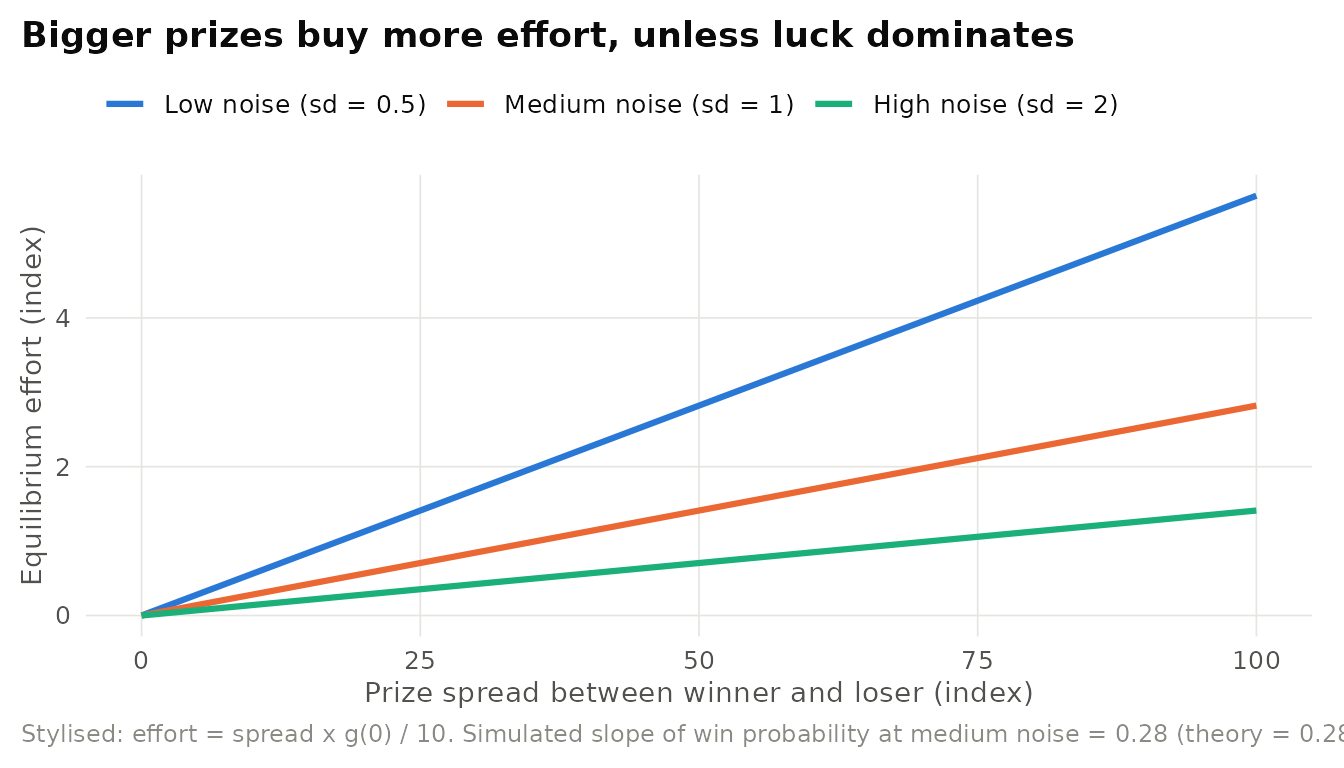
Figure 15.9: Stylised tournament model. Equilibrium effort rises linearly with the prize spread, but the slope is flatter when outcomes are noisier. Contestants with quadratic effort costs and normally distributed noise. Analytical solution of the Lazear-Rosen first-order condition, not empirical data.
15.13.2 Evidence and extensions
Sport offers clean tests because prize structures are public and performance is measured precisely. R. G. Ehrenberg and Bognanno (1990) found that professional golfers’ scores were better in tournaments with larger total prizes and when the marginal return to improving one’s rank was higher. B. E. Becker and Huselid (1992) found that larger prize spreads in professional auto racing were associated with better individual performance and also with riskier driving, illustrating both the incentive effect and the risk-taking cost.
In corporations, Main, O’Reilly, and Wade (1993) found that executive pay rises sharply with hierarchical level, consistent with tournament logic, and Kale, Reis, and Venkateswaran (2009) found that the pay gap between a chief executive and the next tier of executives was positively related to firm performance, as the theory predicts if the gap motivates the executives who compete for the top job. The broader review by Connelly et al. (2014) documents support for incentive effects alongside substantial evidence of costs: sabotage, reduced helping, unethical behaviour, and lower collaboration in tasks that require interdependence. These costs echo equity theory (Section 19.3) and justice research, which predict that large, unexplained pay gaps can be perceived as unfair by those who lose.
Tournament incentives or managerial power? A competing explanation for large chief executive pay premiums is that powerful executives influence their own pay, so the gap reflects bargaining power rather than optimal incentives for those below. The two explanations predict different patterns: tournament theory predicts that the gap should matter for the vice presidents’ effort and should weaken when the next chief executive is likely to be hired externally, while the power explanation predicts that the gap should track governance weakness. Studies that exploit succession events and board composition help to separate the two (Connelly et al. 2014).
CEO pay tournaments and the pay-ratio disclosure. Since 2018, US public companies have disclosed the ratio of chief executive pay to the pay of the median employee, under a rule the Securities and Exchange Commission adopted to implement the Dodd-Frank Act. Tournament theory helps boards interpret their numbers. A large gap between the chief executive and the senior team can motivate senior executives if they realistically expect to compete for the top job, which is more likely when the firm has a credible internal succession process. If the board routinely hires chief executives from outside, the prize is out of reach for insiders and the gap buys little effort while signalling inequity. The same logic applies lower in the organization: forced-ranking systems and winner-take-all sales contests raise effort when tasks are independent and lucky outcomes are rare, but they damage cooperation in interdependent teams (Connelly et al. 2014).
Sample hypotheses.
- H1. The pay gap between the chief executive and the next tier of executives is positively related to firm performance when internal succession is likely, and unrelated when external succession is likely.
- H2. Larger prize spreads in internal sales contests increase individual sales but reduce help given to colleagues.
- H3. The incentive effect of prize spread is weaker in contests with higher outcome variance.
Measures. Pay gaps between hierarchical levels from proxy statements. Number of contestants (for example, the number of vice presidents). Succession type. Performance variance.
Designs. Panel data on executive compensation with firm fixed effects. Natural experiments in sport, sales contests, and innovation contests. Laboratory tournaments that vary spread, noise, and the opportunity to sabotage.
Contexts. Executive compensation, professional services partnerships, sales organizations, innovation challenges, promotion systems.
Ignoring the losers. Tournament effects are often evaluated by looking at the winner. The theory’s incentive effect operates on the contestants who do not win, and its costs (sabotage, exit, reduced cooperation) also fall mostly on them. Evaluate a tournament by the behaviour of the whole field.
15.14 Chapter Summary
- Job design shapes motivation: autonomy, feedback, and meaningful work raise internal motivation, although the multiplicative MPS adds little over a simple average (Hackman and Oldham 1976, Humphrey, Nahrgang, and Morgeson 2007).
- Job demands-resources theory explains burnout and engagement as two processes, one driven by demands and one by resources, with resources buffering strain (Bakker and Demerouti 2007). Conservation of resources theory adds that loss weighs more than gain and that resources spiral (Hobfoll 1989).
- Affective events theory shifts attention to daily events and within-person emotional dynamics, separating affect-driven from judgment-driven behaviour (Weiss and Cropanzano 1996).
- Leadership theories differ in their unit and mechanism: LMX focuses on dyadic exchange (Graen and Uhl-Bien 1995), transformational leadership on inspiration and identification, with serious measurement critiques (Knippenberg and Sitkin 2013), and path-goal theory on matching behaviour to the situation (House 1971).
- The employment relationship rests on beliefs about promises (psychological contracts), perceptions of justice, and the commitment and fit that result (Rousseau 1989, Colquitt et al. 2001, J. P. Meyer and Allen 1991, Kristof 1996).
- Human capital theory explains who should pay for training and why firm-specific skills bind employer and employee (G. S. Becker 1964). Tournament theory explains why pay jumps grow up the hierarchy and when they backfire (Lazear and Rosen 1981).
Table 15.10 presents the comparison of the chapter’s theories.
| Theory | Key mechanism | Signature prediction | Typical business use |
|---|---|---|---|
| Job characteristics model | Psychological states from job features | Enriched jobs raise internal motivation | Job redesign |
| Job demands-resources | Health impairment and motivation processes | Resources buffer the strain of demands | Burnout prevention, engagement surveys |
| Conservation of resources | Primacy of loss, resource spirals | Loss of resources is disproportionately stressful | Change management, well-being support |
| Affective events theory | Events trigger emotions that drive behaviour | Daily events predict daily behaviour | Service work design, recovery breaks |
| Leader-member exchange | Dyadic social exchange | High-quality relationships raise performance | Manager training, onboarding |
| Transformational leadership | Identification and value change | Inspiration adds to transactional effects | Leadership development |
| Path-goal theory | Clarifying paths, raising valences | Best style depends on task and follower | Situational coaching |
| Psychological contract | Beliefs about reciprocal promises | Perceived breach reduces trust and effort | Change communication, employer branding |
| Organizational justice | Fairness of outcomes, process, treatment | Fair process softens bad outcomes | Layoffs, appraisal, pay decisions |
| Organizational commitment | Desire, need, obligation | Affective commitment predicts effort, not just staying | Retention strategy |
| Person-environment fit | Congruence of person and setting | Fit predicts satisfaction and commitment | Selection, culture fit |
| Human capital theory | Investment in skills | Workers pay for general, share firm-specific training | Training investment |
| Tournament theory | Rank-order prizes | Effort rises with prize spread | Executive pay, promotion systems |
15.15 Discussion Questions
- The job characteristics model and job demands-resources theory both treat autonomy as beneficial. Under what conditions might autonomy act as a demand rather than a resource? Formulate a testable hypothesis.
- Design a study that could separate the effect of leader-member exchange on performance from the effect of performance on leader-member exchange.
- Evaluate the critique of transformational leadership by van Knippenberg and Sitkin (2013). Which of its arguments would a well-designed field experiment answer, and which would it not?
- A firm must close one of three plants. Using organizational justice and psychological contract theory, draft a communication and implementation plan, and explain how you would measure its effects on survivors.
- Human capital theory predicts that workers pay for general training. Why do many employers nonetheless fund degrees and certifications? Which extension of the theory best explains your answer?
- A board is considering widening the pay gap between its chief executive and the senior team. Using tournament theory, list the conditions under which this will raise performance and the evidence you would need to see first.
15.16 Further Reading
- Hackman and Oldham (1980): the classic book-length treatment of job design, still useful for its practical diagnosis of jobs.
- Humphrey, Nahrgang, and Morgeson (2007): the best quantitative synthesis of work design research, extending the job characteristics model to social and contextual features.
- Bakker and Demerouti (2017): a concise statement of job demands-resources theory, including reciprocal and personal-resource extensions.
- Halbesleben et al. (2014): a critical review of what counts as a resource in conservation of resources theory.
- Graen and Uhl-Bien (1995): the authors’ own account of how LMX theory developed and where it should go.
- Knippenberg and Sitkin (2013): an essential critique for anyone planning research on charismatic or transformational leadership.
- Colquitt et al. (2001): the meta-analysis that organised the organizational justice literature around four dimensions.
- Connelly et al. (2014): a thorough review of tournament theory across economics, management, and sport.