14 Organizations, Teams, and Decision Processes
On the night of 27 January 1986, engineers at a NASA contractor argued against launching the space shuttle Challenger in record cold. The next morning the shuttle broke apart 73 seconds after lift-off. Seventeen years later, a piece of insulating foam struck the wing of Columbia during launch, engineers asked for better imagery of the damage, and the request went nowhere. The official investigation concluded that NASA’s organizational culture and decision processes were as much a cause of the second accident as the foam itself (Columbia Accident Investigation Board 2003). Both tragedies involved talented people, abundant data, and formal review procedures. Neither can be explained by individual incompetence. They are failures of organizing: of how groups notice problems, interpret ambiguous signals, learn from the past, and decide whether to speak up or press on.
This chapter assembles the theories that explain how decisions are actually made inside organizations and teams, as opposed to how they should be made in a textbook. We begin with two accounts of decision processes that depart sharply from rational choice: the garbage can model and escalation of commitment. We then turn to how organizations accumulate and create knowledge (organizational learning and knowledge creation), to the shared self-understandings and values that steer behaviour (organizational identity, organizational culture, and paradox theory), to the interpersonal climate of teams (psychological safety), to how the composition and social context of the workforce shape attitudes (attraction-selection-attrition and social information processing), and finally to sensemaking, the process through which people construct the situations they then act upon. Together these theories form the core of the behavioural and interpretive tradition in organization theory, a tradition that starts from the observation that organizations are boundedly rational, socially constructed, and path dependent (Cyert and March 1963, Weick 1979) (Table 14.1).
| Theory | Core question | Level of analysis | Key source |
|---|---|---|---|
| Garbage can model | How are choices made when goals, technology, and participation are all unclear? | Organization | Cohen, March & Olsen (1972) |
| Escalation of commitment | Why do decision makers keep investing in failing courses of action? | Individual / group / organization | Staw (1976) |
| Organizational learning | How do organizations encode experience into routines, and when do they question them? | Organization | Argyris & Schön (1978), Levitt & March (1988) |
| Knowledge creation | How is new knowledge created through conversion of tacit and explicit knowledge? | Individual to organization | Nonaka (1994) |
| Organizational identity | Who are we as an organization, and how does that shape action? | Organization | Albert & Whetten (1985) |
| Organizational culture | What shared assumptions and values guide behaviour? | Organization / group | Schein (2010) |
| Paradox theory | How can organizations sustain contradictory demands over time? | Individual / organization | Smith & Lewis (2011) |
| Psychological safety | When do team members feel safe to speak up, admit errors, and learn? | Team | Edmondson (1999) |
| Attraction-selection-attrition | Why do organizations become homogeneous over time? | Individual / organization | Schneider (1987) |
| Social information processing | How do social cues shape job attitudes? | Individual / workgroup | Salancik & Pfeffer (1978) |
| Sensemaking | How do people construct meaning from ambiguous events and act on it? | Individual / group / organization | Weick (1995) |
14.1 Garbage Can Model
Core claim. In “organized anarchies”, decisions are not the output of a sequence that runs from problem to analysis to choice. They emerge when independent streams of problems, solutions, participants, and choice opportunities happen to meet. Timing and access, not intention, explain much of what gets decided.
Origins. Organization theory and public administration. M. D. Cohen, March, and Olsen (1972), extending the behavioural theory of Cyert and March (1963). Applied to public policy by Kingdon (1984).
Level of analysis. Organization (universities, government agencies, professional firms, new ventures), and policy systems.
Key constructs. Problematic preferences, unclear technology, fluid participation, problem stream, solution stream, participant stream, choice opportunities, decision by resolution, oversight, and flight, load, access structure.
Boundary conditions. Strongest when goals are inconsistent or ill-defined, cause-effect knowledge is weak, and attention is scarce and shifting. Weaker in tightly coupled, well-understood operational settings.
Related theories. Behavioral theory of the firm (Section 11.7), Attention-based view (Section 11.8), Bounded rationality (Section 23.1), Sensemaking.
14.1.1 Origins and core logic
M. D. Cohen, March, and Olsen (1972) began with an empirical observation about universities. Their goals are multiple and contested (problematic preferences), nobody fully understands how teaching or research produce results (unclear technology), and faculty, students, and administrators drift in and out of decisions depending on their other commitments (fluid participation). The authors called such settings organized anarchies and argued that standard models of choice, which assume that problems precede and motivate solutions, describe them poorly.
Instead, an organization can be viewed as a collection of choices looking for problems, issues and feelings looking for decision situations in which they might be aired, solutions looking for issues to which they might be the answer, and decision makers looking for work. Four relatively independent streams flow through the organization. A choice opportunity, such as a budget meeting, a hiring committee, or a strategic review, is the “garbage can” into which participants dump whatever problems and solutions are currently active. What comes out depends on the mix in the can at that moment.
The authors formalized the argument in a computer simulation and identified three ways in which choices are made:
- Resolution. A choice resolves the problems attached to it, the classic rational pattern.
- Oversight. A choice is made quickly, before problems attach to it, so it resolves nothing that was not already settled.
- Flight. Problems attach to a choice, but the choice is delayed until the problems leave for another, more attractive choice opportunity. The choice is then made without resolving them.
A central result of the simulation was that resolution is not the dominant style of decision making except when the load on the system is light. Under heavy load, oversight and flight dominate, important problems are more likely to remain unresolved, and decision makers spend much of their time on the same problems in different arenas (M. D. Cohen, March, and Olsen 1972).
14.1.2 Mechanism
Figure 14.1 shows the garbage can model: four loosely coupled streams meet in choice opportunities.
Figure 14.1: The garbage can model: four loosely coupled streams meet in choice opportunities. Whether a choice resolves problems depends on timing, load, and access rules rather than on a planned problem-solving sequence. Based on Cohen, March & Olsen (1972).
The garbage can model does not claim that organizations are irrational. It claims that temporal coincidence matters. A solution championed by a powerful participant can wait years for a problem to which it can be attached, and a problem that arrives when attention is elsewhere may be ignored even if it is severe. Kingdon (1984) adapted this idea to public policy as the multiple streams framework: a policy change becomes likely when a problem stream, a policy (solution) stream, and a political stream converge during a brief policy window, often with help from a policy entrepreneur who couples them (Table 14.2).
| Classic rational sequence | Garbage can account | Managerial implication |
|---|---|---|
| Problems are identified, then solutions are sought | Solutions often exist first and search for problems | Track which solutions are being promoted, not only which problems exist |
| Goals are clear and stable | Preferences are discovered through action | Expect goals to be rationalised after the fact |
| Participants are fixed | Participation depends on time, energy, and other arenas | Agenda and attendance shape outcomes as much as arguments |
| Choices resolve problems | Many choices are made by oversight or flight | Audit whether decisions actually closed the issues they were meant to address |
| Timing is incidental | Timing and coincidence are central | Prepare solutions in advance and act when windows open |
14.1.3 Evidence and extensions
The original article was a thought experiment illustrated by simulation, and its empirical support comes mostly from qualitative studies of universities, public agencies, and policy making. Kingdon’s interview-based study of United States federal policy agendas is the most influential application (Kingdon 1984). The model also influenced work on attention allocation and organizational routines, including the attention-based view (Section 11.8).
Does the simulation match the theory? Bendor, Moe, and Shotts (2001) offered the sharpest critique. They argued that the computer model implements a far more structured organization than the verbal theory describes (for example, access rules and energy loads are fixed by design), that individual agency disappears from the model, and that several of the verbal claims do not follow from the simulation. Defenders reply that the garbage can is best read as a sensitizing metaphor about loose coupling and timing, not as a precise predictive model. A second limitation is falsifiability: almost any decision outcome can be narrated as the product of colliding streams, so researchers need to specify ex ante which stream configurations should produce which outcomes.
14.1.4 Applications in business
Illustrative scenario: the technology looking for a problem. A retailer’s analytics team has built a sophisticated recommendation engine. No business unit asked for it. For two years it is presented at quarterly planning meetings without adoption. Then a sharp drop in online conversion coincides with a new chief digital officer’s arrival and an open budget cycle. Within weeks the engine is funded as “the answer” to conversion, although nobody has diagnosed why conversion fell. The garbage can lens explains the timing and warns about the risk: the problem may not be the one the solution solves. A practical response is to separate the window (the moment of attention) from the diagnosis by requiring a short root-cause analysis before any solution already in the pipeline is attached to a newly salient problem.
Sample hypotheses.
- H1. The probability that a pre-existing internal proposal is adopted rises sharply in periods following an exogenous performance shock, independent of the proposal’s fit with the shock.
- H2. Under high decision load (many concurrent choice opportunities), a larger share of decisions will be recorded without resolution of the issues raised in meeting minutes.
Designs and data. Meeting minutes and board agendas coded for problems, solutions, and attendance. Event-history models of proposal adoption. Agent-based simulation that explicitly varies access structures. Policy-agenda datasets for public-sector applications.
Using the garbage can as an all-purpose excuse. Calling a decision process a “garbage can” explains nothing unless the analyst shows that the streams were in fact independent and that timing, rather than deliberate choice, determined the outcome. The model is a description of particular conditions (organized anarchy and high load), not a general claim that organizations are chaotic.
14.2 Escalation of Commitment
Core claim. Decision makers who are responsible for a course of action tend to continue, and even increase, investment in it after receiving negative feedback, beyond the point that a forward-looking analysis would justify.
Origins. Organizational behaviour and social psychology. Staw (1976), with the theoretical framework of Staw (1981). The related sunk cost effect was documented by Arkes and Blumer (1985).
Level of analysis. Individual, group, and organization (projects, product lines, acquisitions, public programmes).
Key constructs. Sunk costs, personal responsibility, self-justification, negative feedback, project completion, framing of losses, public commitment, de-escalation.
Boundary conditions. Requires a prior decision, ambiguous or negative feedback, and an opportunity to reinvest. Effects are weaker when decision makers are not responsible for the initial choice, when the cost of continuation is salient, and when exit is institutionally easy.
Related theories. Cognitive dissonance (Section 21.1), Prospect theory (Section 23.3), Mental accounting (Section 23.5), Agency theory (Section 6.1), Real options (Section 11.6), Groupthink (Section 30.6).
14.2.1 Origins and intellectual history
The title of Staw’s 1976 article, “Knee-deep in the big muddy”, alludes to a Vietnam-era protest song, and the war itself, in which the United States government repeatedly increased its commitment in the face of discouraging results, was a motivating example. Staw (1976) tested the underlying idea in a role-playing experiment. Business students acting as a corporate financial officer allocated research and development funds to one of two divisions, then learned how the division had performed, then allocated a second round of funds. Participants who had personally chosen the initial division and then learned it had performed poorly allocated significantly more money to it in the second round than participants who had not made the original choice. Responsibility for a losing decision produced more, not less, investment in it.
Staw (1981) interpreted the finding through self-justification: people are motivated to demonstrate, to themselves and others, that an earlier decision was correct. Reinvesting keeps open the possibility that the decision will be vindicated. Admitting failure closes it. Four years later, Arkes and Blumer (1985) documented the closely related sunk cost effect, the tendency to continue an endeavour once an investment of money, effort, or time has been made. In one of their field studies, theatre patrons who had been randomly assigned to pay full price for season tickets attended more performances in the first part of the season than patrons who had received discounts, although the money was spent either way.
The biologist Richard Dawkins and a colleague had independently named the error the Concorde fallacy, after the Anglo-French supersonic airliner whose development continued despite mounting evidence that it would not be a commercial success (Dawkins and Carlisle 1976). Arkes and Ayton (1999) reviewed the animal and human evidence and argued that the effect is distinctively human, rooted in an overgeneralised rule against wasting resources.
14.2.2 Core logic and propositions
Escalation is an error only relative to a normative benchmark. In rational choice, past costs are sunk: they cannot be recovered whatever one does next, so they should not influence a forward-looking decision. The right question is always whether the incremental cost of continuing is justified by the incremental expected value. Escalation occurs when sunk costs, prior commitments, or identity concerns enter that comparison. Building on Staw (1981), Brockner (1992), and the meta-analysis of Sleesman et al. (2012), the theory can be summarised in propositions:
- P1 (Responsibility). Decision makers who are personally responsible for an initial decision escalate more after negative feedback than decision makers who inherit it.
- P2 (Sunk costs). The larger the prior investment, the greater the willingness to continue, holding forward-looking prospects constant.
- P3 (Loss framing). Because continuing offers a chance to avoid a certain loss, decision makers in the loss domain take the risky option of continuation, consistent with prospect theory (Section 23.3).
- P4 (Completion). Willingness to continue rises as a project approaches completion, even when the remaining cost exceeds the remaining value.
- P5 (Structural and social binding). Public commitment, political support, and institutionalised projects make exit costly for the organization, even after individual decision makers have lost confidence.
Figure 14.2 illustrates the economic logic with a stylised project. The value of completion is fixed. Each quarter, the estimate of the cost still required to finish rises. A forward-looking decision maker exits once the remaining cost exceeds the remaining value. An escalating decision maker, anchored on what has already been spent, continues long after that point.
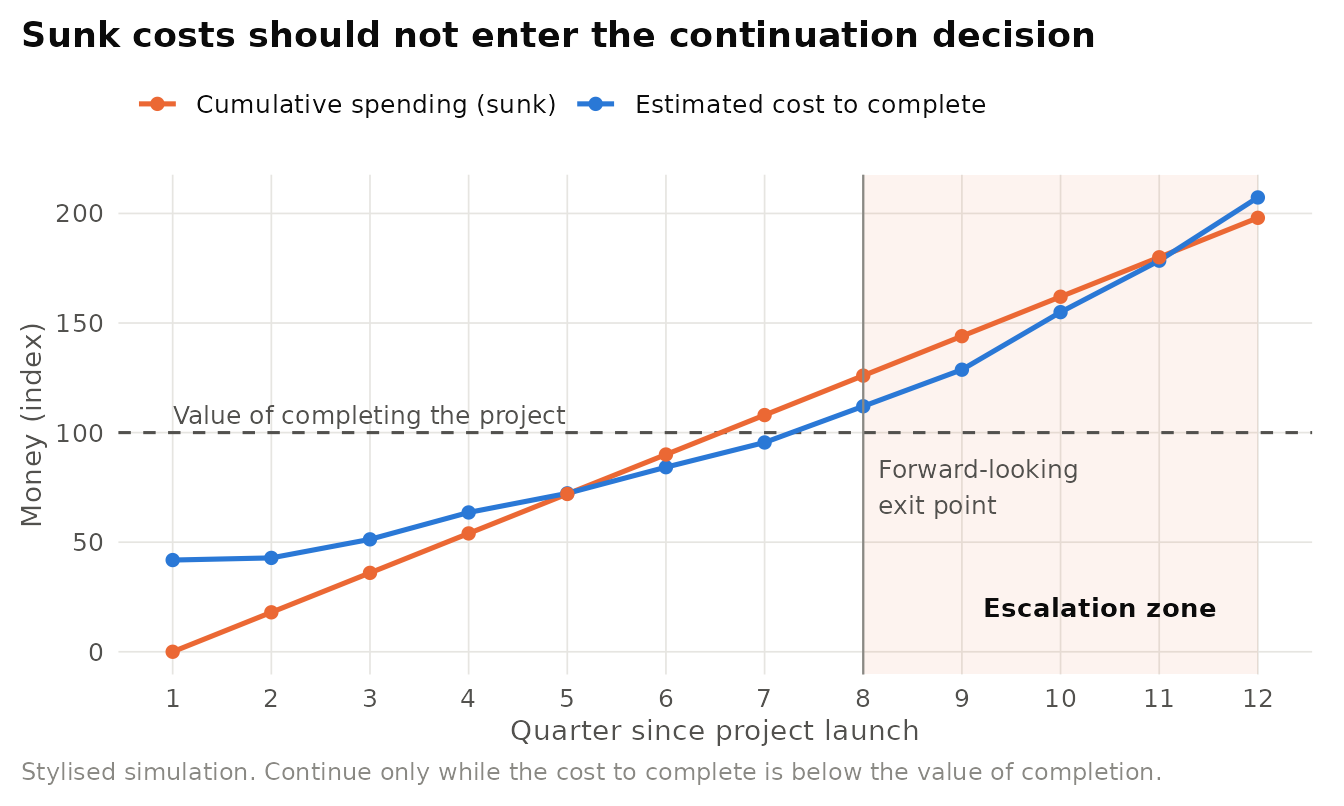
Figure 14.2: Stylised escalation of commitment. The rational exit point is where the estimated cost to complete first exceeds the value of completion. Funds spent after that point (shaded) represent escalation. Illustrative numbers only.
14.2.3 Determinants of escalation
J. Ross and Staw (1993) organized the many determinants of escalation into four classes, a framework that later reviews retained (Sleesman et al. 2012, 2018) (Table 14.3).
| Class of determinant | Examples | Theoretical root | De-escalation lever |
|---|---|---|---|
| Project | Ambiguous feedback, large payoff on completion, long time horizons, closeness to completion | Expected value, information economics | Pre-set milestones and kill criteria tied to forward-looking value |
| Psychological | Personal responsibility, self-justification, loss framing, sunk cost reasoning | Dissonance, prospect theory | Rotate decision makers and separate initial and continuation decisions |
| Social | Public commitment, face-saving, norms of consistency for leaders | Impression management | Reward accurate early reporting of bad news |
| Structural | Political coalitions, institutionalised projects, side bets, sunk investments in people and assets | Institutional theory, resource dependence | Independent review boards and staged funding |
14.2.4 Evidence and extensions
The phenomenon is well supported. Sleesman et al. (2012) meta-analysed escalation research and confirmed that sunk costs, personal responsibility, and project-related factors such as proximity to completion predict continued commitment, while showing that effect sizes vary considerably across settings. Field studies trace escalation in nuclear power, information systems, banking, and professional sports. J. Ross and Staw (1993) reconstructed the history of the Shoreham nuclear power plant on Long Island, whose cost estimates rose from tens of millions to billions of dollars over two decades, and which was completed but never entered commercial operation. They showed how project, psychological, social, and structural forces dominated at different stages: early commitment was driven by projected economics, later commitment by political and structural binding. In information systems, Keil, Mann, and Rai (2000) surveyed audit professionals about runaway software projects and compared four explanations (self-justification, prospect theory (Chapter 24), agency theory, and approach-avoidance theory), finding that several of them contributed to explaining escalation.
Error or rational persistence? Not every decision to continue is escalation. Persistence can be rational when feedback is noisy, when early losses are expected in innovation, or when reputational benefits of consistency are real. Critics note that many laboratory designs make it impossible to tell whether participants are biased or are updating sensibly on ambiguous information. Case labels can also oversimplify. The Concorde programme was governed by an Anglo-French intergovernmental agreement that made unilateral cancellation diplomatically costly, a structural rather than a purely psychological driver of continuation. The theoretical frontier, reviewed by Sleesman et al. (2018), is a multilevel account that separates individual biases from team and organizational forces and studies de-escalation as a process in its own right.
14.2.5 Applications in business
Large IT programmes. Enterprise software and public-sector IT projects are the modern home of escalation research because they combine long horizons, ambiguous progress measures, and highly visible sponsors. The United Kingdom’s National Programme for IT in the National Health Service, launched in 2002 and dismantled in 2011 after sustained criticism from parliamentary committees and the National Audit Office, is a widely discussed public example. Research on such projects (Keil, Mann, and Rai 2000) suggests three practical safeguards: stage-gated funding that requires a fresh forward-looking business case at each gate, separation of roles so that the sponsor who initiated a project does not alone decide whether it continues, and pre-registered kill criteria written when the project is launched and the sponsor’s ego is not yet invested.
Venture capital and real options. Venture investors explicitly structure funding in stages, so that each round is a new decision about the incremental investment. In principle, staging converts a single large commitment into a sequence of real options (Section 11.6). In practice, escalation can reappear through follow-on investments made to protect earlier positions. Many funds therefore have partners other than the original sponsor evaluate follow-on rounds.
14.2.6 Using the theory in research
Sample hypotheses.
- H1. Executives who championed an acquisition will be less likely to divest the acquired unit after poor performance than successor executives, controlling for unit performance.
- H2. The positive effect of cumulative project spending on continuation will be weaker when funding is staged and continuation decisions are made by an independent committee.
- H3. Proximity to completion will increase continuation more strongly when progress is measured by spending than when it is measured by delivered functionality.
Designs. The classic two-stage allocation experiment (Staw 1976) remains the workhorse. Field designs exploit executive turnover as a shift in personal responsibility, compare initiators and successors, or use project-level data from IT portfolios, pharmaceutical pipelines, and sports drafts.
Measures. Additional resources allocated after negative feedback, time to project termination, responsibility (initiator versus successor), sunk cost magnitude, and proximity to completion.
Labelling every failed persistence as bias. Escalation is defined relative to a forward-looking benchmark. To claim escalation, researchers and managers need to show that the information available at the time implied that continuation had negative incremental expected value. Hindsight makes this look easier than it was. Conversely, managers who quote “sunk costs are sunk” to kill every struggling innovation project risk the opposite error of premature abandonment.
14.3 Organizational Learning
Core claim. Organizations learn by encoding inferences from experience into routines that guide behaviour. Most learning refines existing routines (single-loop), while deeper learning questions the goals and assumptions behind them (double-loop).
Origins. Organization theory and the behavioural theory of the firm. Argyris and Schön (1978), B. Levitt and March (1988), G. P. Huber (1991), and the learning-curve tradition summarised by Argote and Epple (1990).
Level of analysis. Organization, with links to teams and individuals.
Key constructs. Routines, single-loop and double-loop learning, theories in use versus espoused theories, knowledge acquisition, information distribution, interpretation, organizational memory, learning curves, knowledge depreciation and transfer, competency traps, superstitious learning.
Boundary conditions. Learning requires feedback that can be observed and attributed. Learning is weaker when experience is rare, outcomes are noisy, or cause and effect are separated in time.
Related theories. Exploration and exploitation (Section 5.3), Absorptive capacity (Section 5.2), Dynamic capabilities (Section 5.1), Behavioral theory of the firm (Section 11.7), Psychological safety.
14.3.1 Origins and intellectual history
Three intellectual lines converge in organizational learning theory. The first is the behavioural theory of the firm, in which organizations adapt their goals, attention, and search rules in response to experience (Cyert and March 1963). The second is the action-science tradition of Argyris and Schön (1978), which focused on the gap between what managers say they believe and what their behaviour reveals. The third is the economics and engineering literature on learning curves, dating back to the observation that the labour required to build an airframe falls predictably as cumulative production rises (Wright 1936).
B. Levitt and March (1988) synthesised the first line in an influential review. Organizational learning, they argued, is routine-based, history-dependent, and target-oriented. Organizations encode inferences from history into routines (rules, procedures, technologies, conventions) that persist even as personnel change. Routines are adjusted when performance falls short of aspirations. G. P. Huber (1991) then mapped four constructs that organize the field: knowledge acquisition, information distribution, information interpretation, and organizational memory. Fiol and Lyles (1985) distinguished lower-level learning, which adjusts behaviour within existing rules, from higher-level learning, which changes the rules themselves.
14.3.2 Core logic: single-loop and double-loop learning
Argyris (1976) and Argyris and Schön (1978) distinguished two kinds of learning. In single-loop learning, an organization detects an error and corrects it by changing its action strategy while leaving its governing values intact, much as a thermostat adjusts heating to hold a set temperature. In double-loop learning, the organization questions the governing variables themselves: it asks whether the target temperature is right. Argyris and Schön also distinguished espoused theories (what people say guides their action) from theories in use (what their behaviour reveals). They argued that defensive routines, designed to avoid embarrassment or threat, systematically block double-loop learning (Figure 14.3).
Figure 14.3: Single-loop and double-loop learning. Single-loop learning changes action strategies to close a gap between consequences and governing variables. Double-loop learning questions the governing variables themselves. Based on Argyris and Schön (1978).
Table 14.4 presents the single-loop versus double-loop learning.
| Feature | Single-loop learning | Double-loop learning |
|---|---|---|
| Question asked | Are we doing things right? | Are we doing the right things? |
| What changes | Action strategies and routines | Goals, norms, and underlying assumptions |
| Typical trigger | Performance below target | Repeated failure, crisis, or new framing |
| Typical method | Process improvement, root-cause fixes | Reframing, strategic review, surfacing assumptions |
| Main obstacle | Weak feedback or poor measurement | Defensive routines that make assumptions undiscussable |
| Related idea | Exploitation | Exploration |
14.3.3 Learning curves: experience, transfer, and forgetting
The quantitative heart of the field is the learning curve: unit cost or labour hours fall as a power function of cumulative output. Wright (1936) observed this regularity in aircraft manufacturing. Argote and Epple (1990) reviewed evidence from many industries and drew three conclusions that transformed the learning curve from an engineering rule of thumb into an organizational theory. First, rates of learning vary dramatically across organizations, even those producing the same product. Second, knowledge depreciates: it decays when production is interrupted or staff turn over. Third, knowledge transfers across units, but imperfectly. Darr, Argote, and Epple (1995) showed these patterns in pizza franchises: stores learned from cumulative experience, knowledge transferred across stores owned by the same franchisee but not across stores with different owners, and acquired knowledge depreciated quickly (Figure 14.4).
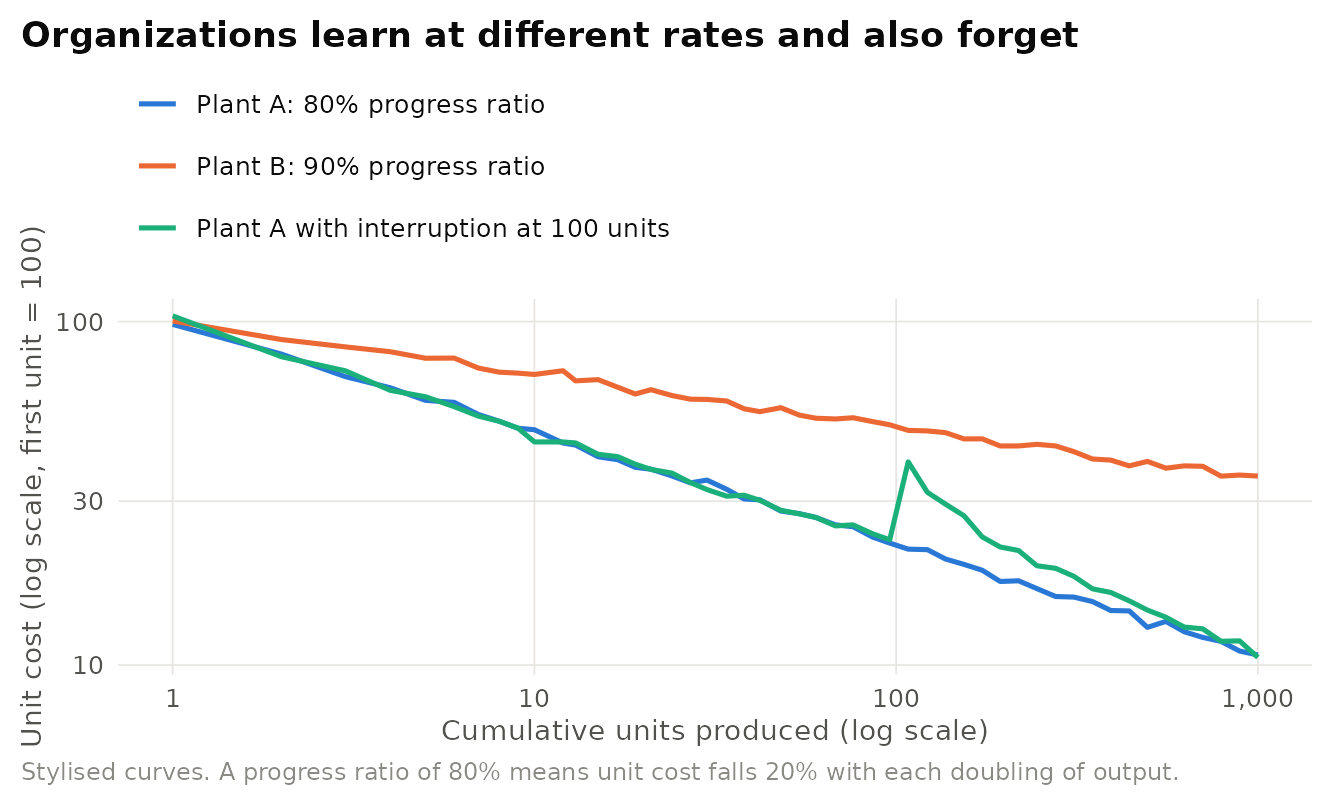
Figure 14.4: Stylised learning curves. Unit cost falls with cumulative output, but organizations learn at different rates, and an interruption causes knowledge to depreciate. Axes are logarithmic, so a constant learning rate appears as a straight line. Illustrative numbers only.
14.3.4 Evidence and extensions
Learning-curve heterogeneity is now well documented in manufacturing, services, and medicine. Pisano, Bohmer, and Edmondson (2001) found large differences across hospitals in how quickly surgical teams improved after adopting a new minimally invasive cardiac procedure, and A. C. Edmondson, Bohmer, and Pisano (2001) traced the differences to team learning practices, including whether team members felt able to speak up. Research on failure shows that organizations often learn more from failures than from successes: in the global orbital launch vehicle industry, Madsen and Desai (2010) found that knowledge from failures was retained longer than knowledge from successes. Haunschild and Sullivan (2002) found that airlines learned more from accidents and incidents with heterogeneous causes, which force broader search. Argote and Miron-Spektor (2011) offer an integrative framework in which experience interacts with organizational context to create knowledge that is embedded in members, tools, and routines.
The dark side of learning. Learning can be myopic. Levinthal and March (1993) argued that organizations overweight the short run, the near neighbourhood, and success, so that learning itself drives out exploration. B. Levitt and March (1988) described competency traps, in which favourable performance with an inferior routine leads the organization to accumulate more experience with it, making a superior routine unattractive to try, and superstitious learning, in which the link between action and outcome is misread. Others question whether “organizations” learn at all, or whether the construct is simply the aggregation of individual learning. Most contemporary scholars locate organizational learning in changes to routines, tools, and transactive memory that persist when individuals leave (Argote and Miron-Spektor 2011).
14.3.5 Applications in business
Toyota and learning as an operating system. The Toyota Production System is widely studied as an organization designed for continuous single-loop learning on the shop floor. Spear and Bowen (1999) argued that its distinctive feature is not any particular tool but a set of tacit rules that make every activity, connection, and flow a structured hypothesis that can be tested. Problems are surfaced immediately (for example, by stopping the line), and countermeasures are developed by the people closest to the work. Taiichi Ohno’s practice of asking “why” repeatedly until a root cause is reached is a disciplined form of problem-oriented search (Ohno 1988). The system also illustrates the limits of transfer: many firms copied visible tools such as kanban cards without the learning routines behind them, and saw smaller gains.
Learning from failure in safety-critical industries. Commercial aviation’s incident reporting systems, which protect reporters who disclose their own near misses, are an institutional design for converting rare and costly failures into shared knowledge. Research on airlines and launch vehicles suggests that such systems work best when they encourage analysis of diverse causes rather than single-cause attributions (Haunschild and Sullivan 2002, Madsen and Desai 2010). Cannon and Edmondson (2005) argue that most organizations fail to learn from failure because of social and technical barriers to identifying, analysing, and deliberately experimenting with failure, and propose a sequence of practices to overcome each barrier.
14.3.6 Using the theory in research
Sample hypotheses.
- H1. Production units with higher rates of team learning behaviour will show steeper learning curves for a newly introduced product.
- H2. Knowledge depreciation (the loss of productivity after a production gap) will be smaller in units with codified routines than in units relying on individual expertise.
- H3. Organizations learn more from failures with heterogeneous causes than from failures with a single dominant cause.
Designs and data. Learning-curve regressions of unit cost or quality on cumulative experience with depreciation parameters (Argote and Epple 1990, Darr, Argote, and Epple 1995). Panel data on accidents, recalls, or surgical outcomes. Ethnographies of routines. Field experiments that vary after-action reviews.
Measures. Cumulative output, progress ratio, depreciation rate, transfer across units, frequency of after-action reviews, changes in codified procedures.
Equating learning with improvement. Organizations can learn the wrong lessons. A measured fall in errors may reflect less reporting rather than fewer errors, and success can teach complacency. Studies should separate changes in knowledge (routines, cognition) from changes in performance and test whether the experience-performance link runs through the proposed knowledge mechanism.
14.4 Knowledge Creation
Core claim. Organizations create new knowledge through a continuous dialogue between tacit and explicit knowledge, captured in four modes of conversion (socialization, externalization, combination, internalization) that spiral from individuals to groups to the whole organization.
Origins. Management and Japanese innovation studies. Nonaka (1994) and Nonaka and Takeuchi (1995), building on Polanyi’s concept of tacit knowledge (Polanyi 1966).
Level of analysis. Individual, group, organization, and interorganizational networks.
Key constructs. Tacit and explicit knowledge, SECI modes, knowledge spiral, redundancy, requisite variety, middle-up-down management.
Boundary conditions. Most relevant for product development and knowledge-intensive work in which much know-how cannot be written down. Cultural and organizational context shapes the ease of socialization.
Related theories. Knowledge-based view (Section 4.3), Absorptive capacity (Section 5.2), Organizational learning.
14.4.1 Core logic
Polanyi (1966) observed that people know more than they can tell. Such tacit knowledge (the feel of a skilled baker’s hands, the judgement of an experienced engineer) is personal, context specific, and hard to formalize. Explicit knowledge can be codified in documents, formulas, and databases. Organizational learning theory tended to treat organizations as processors of information. Nonaka (1994) argued instead that the core of innovation is the creation of new knowledge, and that it happens when tacit and explicit knowledge are converted into one another. The four modes form the SECI model shown in Figure 14.5.
Figure 14.5: The SECI model of knowledge creation. Knowledge moves through four modes of conversion and spirals outward from individuals to groups, the organization, and partners. Based on Nonaka (1994) and Nonaka and Takeuchi (1995).
Table 14.5 presents the four modes of knowledge conversion.
| Mode | Conversion | Typical practices | Business example |
|---|---|---|---|
| Socialization | Tacit to tacit | Apprenticeship, job rotation, site visits, working side by side | A new engineer shadows a senior field technician |
| Externalization | Tacit to explicit | Metaphors, analogies, concept papers, prototypes | A design team turns a customer frustration into a product concept |
| Combination | Explicit to explicit | Reports, specifications, knowledge bases, training manuals | Merging test results into a standard operating procedure |
| Internalization | Explicit to tacit | Simulation, practice, learning by doing | Staff practise a new procedure until it becomes routine |
Nonaka and Takeuchi (1995) illustrated the model with Japanese product development cases. The best-known is the development of an automatic home bread-making machine at Matsushita in the 1980s. Early prototypes produced poor bread, so a software developer trained alongside the head baker at a leading Osaka hotel to absorb his kneading technique (socialization), and the team then translated what she had learned into a design specification for the machine (externalization). The authors also emphasised organizational conditions that enable the spiral, including intention, autonomy, creative chaos, redundancy of information, and requisite variety, and argued for middle-up-down management in which middle managers translate top management’s vision into concepts that front-line teams can work with.
Is tacit knowledge convertible at all? The most persistent critique concerns externalization. Following Polanyi, some scholars argue that tacit knowledge is by definition inexpressible, so it cannot be “converted” into explicit form, only supported or demonstrated. Gourlay (2006) questioned the empirical basis of the model and whether the four modes are distinct processes. Nonaka and Krogh (2009) responded by clarifying that tacit and explicit knowledge lie on a continuum and that conversion is a social process of articulation, not a literal transfer. A second critique is cultural: the model was developed from Japanese cases, and its assumptions about long tenure and dense socialization may not transfer to organizations with high turnover and contractual employment.
Illustrative scenario: capturing field know-how. An industrial equipment company finds that its best service technicians fix faults in half the time of others, but its manuals do not explain why. A knowledge-creation approach would not start with a database. It would pair junior and senior technicians on difficult jobs (socialization), hold structured debriefs in which experts explain their diagnostic hunches through analogies (externalization), consolidate the debriefs into decision trees embedded in the service app (combination), and use simulated faults in training (internalization). The spiral then repeats as the decision trees are tested in the field.
Designs and measures. Survey scales for the four SECI modes, case studies of product development, network analysis of knowledge flows, and studies of knowledge codification and its effects on transfer. Hypotheses typically link the intensity of particular modes to innovation outcomes (for example, that externalization practices predict new product concept quality more strongly than combination practices do).
14.5 Organizational Identity
Core claim. Organizational members share beliefs about what is central, enduring, and distinctive about their organization. These beliefs filter how issues are interpreted, which actions feel legitimate, and how members respond to outside images that conflict with them.
Origins. Organization theory. Albert and Whetten (1985), with major empirical work by Dutton and Dukerich (1991) and the social identity foundation of Ashforth and Mael (1989).
Level of analysis. Organization (collective identity) and individual (organizational identification).
Key constructs. Central, enduring, and distinctive attributes, organizational identification, construed external image, reputation, identity threat, adaptive instability.
Boundary conditions. Identity matters most when issues are ambiguous and when members identify strongly. In loosely coupled or newly formed organizations, identity claims may be weakly shared.
Related theories. Social identity theory (Section 22.2), Organizational culture, Legitimacy (Section 7.3), Optimal distinctiveness (Section 22.3).
14.5.1 Core logic
Albert and Whetten (1985) proposed that an organization’s identity consists of members’ self-referential claims about what is central to the organization, what is enduring about it over time, and what is distinctive compared with similar organizations. Identity questions (“Who are we?”) become salient at critical junctures such as founding, loss of a sustaining resource, mergers, rapid growth, or retrenchment. Whetten (2006) later sharpened the concept, arguing that identity claims are most visible when organizations face “fork in the road” choices that would commit them to one self-definition over another.
At the individual level, Ashforth and Mael (1989) applied social identity theory (Section 22.2) to organizations. Organizational identification is the perception of oneness with or belongingness to an organization. When people identify strongly, the organization’s successes and failures feel personal, which motivates effort and loyalty but also defensiveness when the organization is criticised (Table 14.6).
| Concept | Core question | Whose view | Example measure |
|---|---|---|---|
| Organizational identity | Who do we believe we are? | Members about the organization | Members’ ratings of central, enduring, and distinctive attributes |
| Organizational identification | How much is the organization part of who I am? | Individual member | Identification scale items on oneness with the organization |
| Construed external image | What do outsiders think of us, in our view? | Members about outsiders’ views | Members’ beliefs about how the public sees the firm |
| Reputation | What do outsiders actually think of us? | External stakeholders | Rankings, media tone, stakeholder surveys |
| Organizational culture | How do we do things here, and why? | Members, often tacit | Value profiles, observed practices, underlying assumptions |
14.5.2 Evidence and extensions
Dutton and Dukerich (1991) provided the field’s foundational case study. In the 1980s the Port Authority of New York and New Jersey faced a growing number of homeless people in its bus terminal, train stations, and airports. The agency’s members saw it as a professional, technically excellent transportation organization, not a social service agency, and they initially treated homelessness as a policing and facilities problem. As media coverage and public criticism damaged the agency’s construed external image, members felt the gap between how they saw themselves and how they believed outsiders saw them. That discomfort helped push the agency to reframe the issue and invest in more humane and collaborative responses. Identity and image, the authors argued, act as a mirror that shapes how organizations interpret and respond to issues.
Elsbach and Kramer (1996) found a similar dynamic when Business Week rankings of business schools threatened members’ perceptions of their schools. Members responded by highlighting alternative comparison categories and dimensions on which their school excelled. Gioia, Schultz, and Corley (2000) challenged the assumption that identity is enduring, proposing adaptive instability: identity labels may stay constant while their meanings shift as members reinterpret them in light of changing images. Tripsas (2009) showed how a firm’s identity as a “digital photography company” made it difficult to pursue opportunities that technology made possible but that did not fit that identity, complementing the cognitive account of Polaroid’s difficulties in digital imaging in Tripsas and Gavetti (2000).
Enduring or fluid? The original definition required identity to be enduring, but empirical work repeatedly shows identity claims changing in response to image, strategy, and leadership. Social-actor perspectives treat identity as institutional claims that change slowly. Social-constructionist perspectives treat identity as shared understandings that are continually renegotiated. Whetten (2006) defends a narrower definition to keep the concept distinct from culture and image. A second debate concerns measurement: identity is easily conflated with culture or reputation, and many studies infer identity from self-presentation materials that may be impression management rather than belief.
Identity in strategic change. Firms that redefine their business often discover that identity, not capability, is the binding constraint. When a company that has seen itself as a hardware manufacturer moves to services or software subscriptions, engineers may resist work that feels peripheral to “who we are”. Effective leaders in such transitions tend to reinterpret existing identity labels rather than discard them (for example, moving from “we build the best machines” to “we keep our customers’ operations running”), which is the adaptive instability that Gioia, Schultz, and Corley (2000) describe.
Sample hypotheses.
- H1. Firms whose stated identity claims are inconsistent with a new strategic initiative will adopt it more slowly, controlling for capabilities.
- H2. Negative media coverage that conflicts with members’ identity beliefs will trigger more issue-reframing activity than negative coverage that is consistent with those beliefs.
Designs and data. Longitudinal case studies with interviews and archival documents. Text analysis of letters to shareholders, mission statements, and internal communications. Survey measures of organizational identification. Event studies of identity threats such as rankings or scandals.
Treating the mission statement as the identity. Formal statements are identity claims, often written for external audiences. Identity theory concerns what members actually believe is central and distinctive. Valid studies triangulate official claims with members’ own accounts and with choices made at identity-relevant forks in the road.
14.6 Organizational Culture
Core claim. Organizations develop shared, largely taken-for-granted assumptions, learned as the group solved problems of external adaptation and internal integration. These assumptions are expressed in espoused values and visible artifacts, and they shape behaviour more powerfully than formal structures.
Origins. Organizational psychology and anthropology. Schein (2010) (first edition 1985) and Schein (1990). Quantitative measurement through the Organizational Culture Profile of C. A. O’Reilly, Chatman, and Caldwell (1991).
Level of analysis. Organization and subgroups (functions, units, professions).
Key constructs. Artifacts, espoused beliefs and values, basic underlying assumptions, culture strength (intensity and consensus), culture content, subcultures, person-culture fit.
Boundary conditions. Culture is most consequential where formal controls are incomplete and behaviour cannot be fully specified. Culture strength is valuable in stable environments and can become a liability when the environment shifts.
Related theories. Organizational identity, Attraction-selection-attrition, Hofstede’s cultural dimensions (Section 18.2), Tight and loose cultures (Section 18.7), Institutional theory (Section 7.2).
14.6.1 Core logic: Schein’s three levels
Schein (2010) defines culture as a pattern of shared basic assumptions that a group has learned as it solved its problems of adapting to its environment and integrating its members, which has worked well enough to be considered valid and is therefore taught to new members as the correct way to perceive, think, and feel. The definition has two important implications. Culture is learned history, not management decree, and it is deep: its most important layer is taken for granted and rarely discussed (Figure 14.6).
Figure 14.6: Schein’s three levels of organizational culture. Artifacts are easy to observe but hard to interpret. Basic assumptions are hard to observe but explain the levels above them. Based on Schein (2010).
Because artifacts are ambiguous, an outsider who sees an open-plan office cannot know whether it reflects a belief in egalitarian collaboration or simply a cost reduction. Espoused values may also diverge from the assumptions actually in use, the same gap Argyris and Schön identified between espoused theories and theories in use (Argyris and Schön 1978). Schein therefore argues that culture can be diagnosed only by probing the assumptions that make artifacts and values coherent, usually through iterative interviews with insiders.
14.6.2 Measuring culture: the Organizational Culture Profile
Quantitative research needed a way to compare cultures and to assess fit between people and organizations. C. A. O’Reilly, Chatman, and Caldwell (1991) developed the Organizational Culture Profile (OCP), in which respondents sort 54 value statements according to how characteristic they are of an organization, or how desirable they are to the individual. Comparing the two profiles yields a measure of person-organization fit. Factor analyses revealed dimensions such as innovation, stability, respect for people, outcome orientation, attention to detail, team orientation, and aggressiveness. In the original studies, person-culture fit predicted later job satisfaction, organizational commitment (Section 15.10), and turnover. Chatman and O’Reilly (2016) argue that the field should distinguish clearly between culture content (which norms) and culture strength (how widely shared and intensely held), and should connect culture explicitly to strategy.
14.6.3 Evidence and extensions
The most cited quantitative finding concerns culture strength. Sørensen (2002) showed that firms with strong cultures have more reliable (less variable) performance in relatively stable environments, but that the advantage diminishes in volatile environments, where strong cultures make it harder to detect and respond to change. This finding connects culture to the exploration and exploitation (Section 5.3) tension: strong culture supports exploitation and can impede exploration.
Can culture be managed? Schein treats leaders as the primary creators and embedders of culture, especially founders. Critics from interpretive and critical traditions argue that culture is emergent, contested, and fragmented into subcultures, so that “managing culture” often means managing artifacts and rhetoric rather than assumptions. A related measurement debate concerns whether survey instruments capture culture or only climate (shared perceptions of policies and practices). The current consensus is that both qualitative diagnosis and quantitative profiles are needed, and that norms are best measured by what is rewarded and sanctioned in practice (Chatman and O’Reilly 2016).
14.6.4 Applications in business
Culture integration in mergers. Cultural incompatibility is a common explanation for disappointing mergers. The 1998 combination of Daimler-Benz and Chrysler, announced as a merger of equals, is a frequently cited public example: reports of friction between German and American management styles and decision-making norms accompanied the combined firm’s difficulties, and Daimler sold a majority of Chrysler in 2007. Because many factors affect merger outcomes, case evidence alone cannot isolate culture. R. A. Weber and Camerer (2003) therefore created cultures in the laboratory. Groups developed their own shorthand codes for describing pictures of office scenes, and then two groups were merged. Performance fell after the merger, participants overestimated how well the merged group would perform, and they tended to attribute the decline to members of the other group. The experiment shows that even trivially created cultures generate coordination costs and attribution conflict when combined. Practical implications include culture due diligence before a deal, explicit integration of decision rights and vocabulary, and patience about early performance dips.
Sample hypotheses.
- H1. Acquisitions in which the acquirer’s and target’s culture profiles differ more will show larger post-merger turnover among target executives.
- H2. Culture strength will reduce performance variability more in stable than in volatile industries (Sørensen 2002).
Data and measures. The OCP and its variants, employer review text (analysed with dictionary or embedding methods for culture content), ethnography, interviews probing assumptions, and archival indicators of rewarded behaviour.
Mistaking espoused values for culture. Values posted on walls and websites are espoused values. Culture lives in the assumptions that predict what people do when values conflict or nobody is watching. A study that measures only stated values cannot test claims about culture’s effects on behaviour.
14.7 Paradox Theory
Core claim. Organizations face persistent contradictory yet interrelated demands (for example, exploration and exploitation, control and flexibility, global and local). Sustainable performance comes not from choosing one pole but from accepting the tension and continually attending to both over time, a dynamic equilibrium.
Origins. Organization theory. W. K. Smith and Lewis (2011), building on Lewis (2000) and reviewed by Schad et al. (2016).
Level of analysis. Individual (leaders’ cognition), team, and organization.
Key constructs. Latent and salient tensions, paradox categories (learning, belonging, organizing, performing), acceptance, resolution through splitting and integration, virtuous and vicious cycles, paradoxical cognition.
Boundary conditions. Applies to tensions that are persistent and interdependent. Simple trade-offs that can be resolved once by a choice are dilemmas, not paradoxes.
Related theories. Ambidexterity (Section 5.4), Exploration and exploitation (Section 5.3), Contingency theory (Section 7.6).
Contingency theory asks which pole of a tension fits a given environment. Paradox theory asks how organizations can live with both. W. K. Smith and Lewis (2011) define paradox as contradictory yet interrelated elements that exist simultaneously and persist over time. Such tensions are latent, embedded in organizing, and become salient under conditions of plurality (multiple stakeholders and views), change, and scarcity of resources. Responses that suppress one pole (defensiveness, splitting without reconnection) produce vicious cycles. Responses that combine acceptance of the tension with periodic, iterative resolution produce virtuous cycles and long-term sustainability (Table 14.7).
| Paradox category | Underlying tension | Organizational example |
|---|---|---|
| Learning | Building on the past versus destroying it to create the future | Investing in the core product while cannibalising it with a new platform |
| Belonging | Identity and affiliation: the individual versus the collective, one group versus another | Professional identities of physicians versus hospital-wide standardisation |
| Organizing | Structuring and leading: control versus flexibility, collaboration versus competition | Centralised compliance controls alongside autonomous product teams |
| Performing | Competing goals of different stakeholders | Social mission versus financial returns in a social enterprise |
Theory or vocabulary? Paradox theory has spread rapidly, and Schad et al. (2016) warn that the term is often used loosely for any tension or trade-off. Critics argue that “accept and attend to both” can become unfalsifiable advice. The research frontier focuses on precise constructs (for example, paradoxical cognition and paradox mindset at the individual level), on the conditions under which acceptance improves performance, and on multilevel dynamics of how tensions at one level are managed at another.
Illustrative scenario: the social enterprise. A microfinance organization must serve poor borrowers (social mission) while remaining financially self-sustaining (commercial logic). If leaders let the commercial pole dominate, mission drift follows. If the social pole dominates, the organization runs out of capital. A paradox approach would separate the poles structurally in some respects (distinct metrics and governance reviews for each), integrate them elsewhere (a board that deliberates on both at once), and revisit the balance regularly rather than fixing it once.
Designs and measures. Longitudinal process studies of how leaders oscillate between poles, survey measures of paradox mindset, and comparative cases of hybrid organizations. A testable hypothesis: leaders with higher paradoxical cognition will sustain investment in both exploratory and exploitative projects for longer under resource scarcity.
14.8 Psychological Safety
Core claim. Team members learn, speak up, and report errors when they share a belief that the team is safe for interpersonal risk taking. Psychological safety enables learning behaviour, which in turn improves team performance in uncertain, interdependent work.
Origins. Organizational behaviour. A. Edmondson (1999), drawing on Kahn (1990) and earlier work on organizational change. Reviewed by A. C. Edmondson and Lei (2014) and meta-analysed by Frazier et al. (2017).
Level of analysis. Team (shared climate), with individual-level variants.
Key constructs. Psychological safety, team learning behaviour (asking questions, seeking feedback, discussing errors, experimenting), voice, leader inclusiveness, status differences, accountability.
Boundary conditions. Matters most when work is uncertain, interdependent, and learning-intensive. In routine, independent work, its effects on performance are weaker.
Related theories. Organizational learning, Leader-member exchange (Section 15.5), Spiral of silence (Section 22.8), Groupthink (Section 30.6), Transformational leadership (Section 15.6).
14.8.1 Origins and intellectual history
The research programme started with a puzzle. In a study of hospital nursing units, A. C. Edmondson (1996) expected that better-led, better-functioning units would make fewer medication errors. Instead, they appeared to make more. The explanation was that these units were more willing to report errors, while in units with punitive managers errors went unreported. Detected error rates partly measured the climate for speaking up, not only the underlying frequency of mistakes.
A. Edmondson (1999) developed the construct of team psychological safety, a shared belief that the team is safe for interpersonal risk taking, and distinguished it from trust (which concerns one party’s expectations of another) and from cohesiveness (which can actually suppress dissent). Kahn (1990) had already identified psychological safety as one of three conditions, together with meaningfulness and availability, under which people bring their full selves to work. In a multimethod field study of 51 work teams in a manufacturing company, A. Edmondson (1999) found that psychological safety was associated with team learning behaviour, which in turn was associated with team performance.
14.8.2 Mechanism
Figure 14.7 shows the model of team learning.
Figure 14.7: Model of team learning. Team leader coaching and context support foster psychological safety, which enables learning behaviour and, through it, team performance. Based on Edmondson (1999).
Psychological safety is not the same as low standards. A. C. Edmondson (2018) crosses psychological safety with performance standards to describe four zones (Figure 14.8). High safety with low standards produces a comfort zone. Low safety with high standards produces an anxiety zone, where people work hard but hide problems. The learning zone combines both.
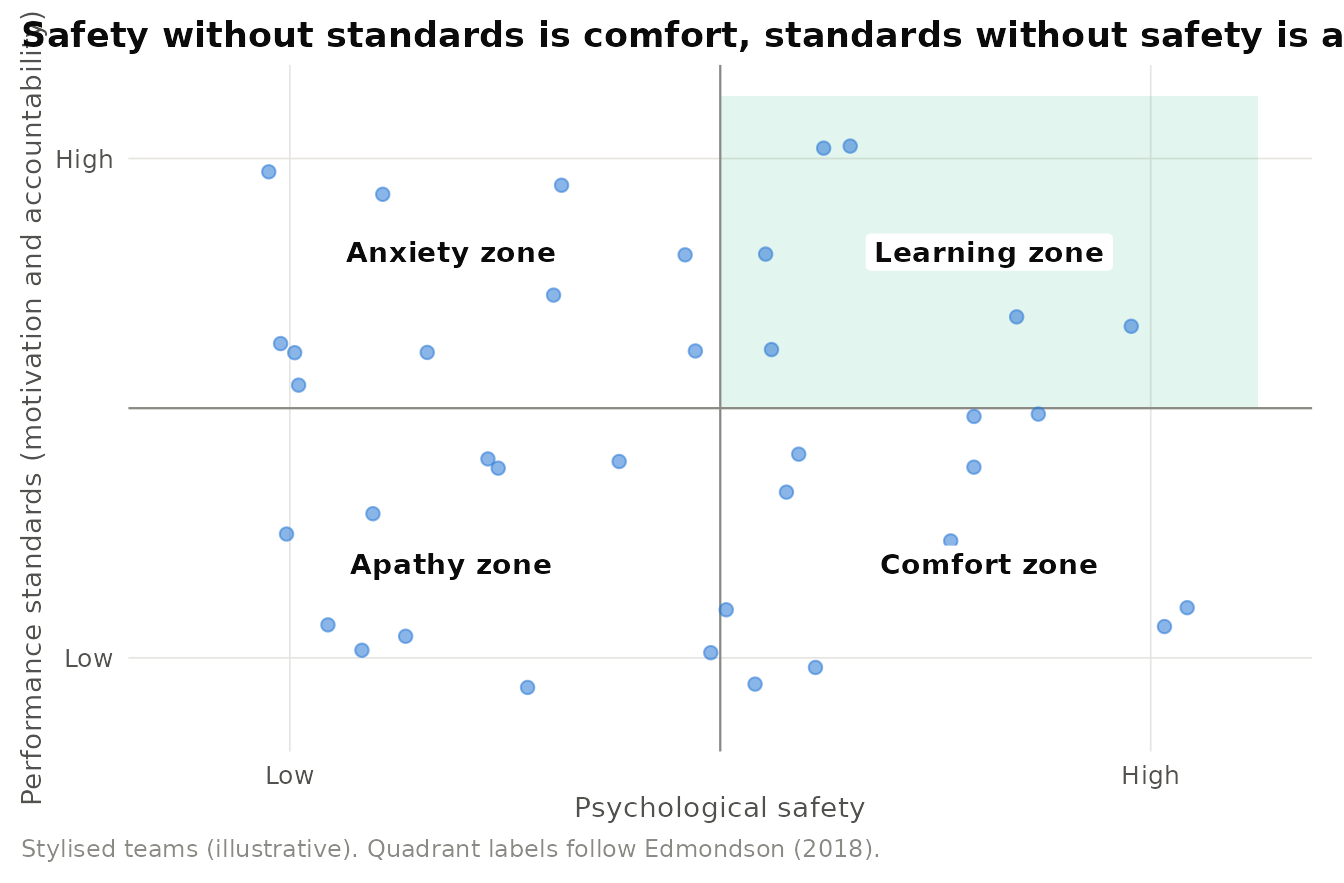
Figure 14.8: Psychological safety and performance standards: four zones. Stylised teams are plotted for illustration. Framework based on Edmondson (2018).
14.8.3 Evidence and extensions
The construct has a large and broadly consistent evidence base. Frazier et al. (2017) meta-analysed research on psychological safety and found it positively related to information sharing, learning behaviour, engagement, and task performance, with supportive leadership and peer relationships among its antecedents. In healthcare, Nembhard and Edmondson (2006) studied neonatal intensive care unit teams and found that lower-status professionals felt less psychologically safe than physicians, but that leader inclusiveness (words and deeds by leaders that invite and appreciate others’ contributions) raised psychological safety and weakened the status gap. A. C. Edmondson, Bohmer, and Pisano (2001) showed that surgical teams that successfully adopted a new cardiac procedure were those whose leaders framed the change as a team learning challenge and made it safe for nurses and technicians to speak up. A. C. Edmondson and Lei (2014) review the construct’s history and its extension from teams to organizations and to topics such as innovation, voice, and safety.
Climate, trait, or fad? Three critiques recur. First, measurement: the standard seven-item scale is a perception measure, and aggregating it to the team level requires evidence of within-team agreement. Second, causality: most studies are cross-sectional, so high-performing teams may feel safe because they perform well. Third, popularization: in practitioner discourse, psychological safety is sometimes equated with comfort or the absence of criticism, which is close to the opposite of the construct. Edmondson’s own framing pairs safety with high standards and candour (A. C. Edmondson 2018).
14.8.4 Applications in business
Hospitals and tech teams. Healthcare offers the clearest evidence that speaking up saves lives and money. Checklists, structured briefings, and practices that let any team member stop a procedure are institutional designs for psychological safety, and the research above shows that leader behaviour determines whether they are used (Nembhard and Edmondson 2006, A. C. Edmondson, Bohmer, and Pisano 2001). In technology, Google’s internal research project on team effectiveness, known as Project Aristotle, became widely publicised in 2015 and 2016. Google reported that psychological safety was the most important of five dynamics that distinguished effective teams, alongside dependability, structure and clarity, meaning, and impact (Duhigg 2016). Blameless post-incident reviews, common in site reliability engineering, apply the same logic: they focus on systemic causes so that engineers disclose what actually happened.
14.8.5 Using the theory in research
Sample hypotheses.
- H1. Team psychological safety will be positively related to the number of near misses reported, controlling for workload.
- H2. Leader inclusiveness will weaken the negative relationship between professional status and individual psychological safety (Nembhard and Edmondson 2006).
- H3. The effect of psychological safety on team performance will be stronger for teams with high task uncertainty.
Measures. Edmondson’s team psychological safety scale aggregated to the team level after checking agreement indices, behavioural measures of voice and error reporting, and observational coding of meetings.
Designs. Multilevel field surveys, longitudinal panels to address reverse causality, and field experiments with leader training or structured debriefs.
Confusing safety with comfort. Psychological safety is about the freedom to take interpersonal risks such as admitting mistakes and challenging ideas, not about being shielded from disagreement or accountability. Interventions that reduce candour in the name of “safety” undermine the mechanism the theory describes.
14.9 Attraction-Selection-Attrition
Core claim. People are attracted to organizations whose members resemble them, are selected by organizations that prefer people who fit, and leave when they do not fit. Over time the cycle makes organizations increasingly homogeneous, and that homogeneity, not formal structure, defines the place.
Origins. Industrial and organizational psychology. Schneider (1987), updated in Schneider, Goldstein, and Smith (1995).
Level of analysis. Individual and organization.
Key constructs. Attraction, selection, attrition, homogeneity, person-organization fit, founder influence.
Boundary conditions. Requires voluntary labour mobility and discretion in selection. Weaker in tight labour markets or under strict diversity mandates.
Related theories. Person-environment fit (Section 15.11), Organizational culture, Homophily (Section 30.2).
Schneider (1987) argued, in a paper titled “The people make the place”, that organizational behaviour should be explained by the characteristics of the people in the organization rather than by structures and technologies alone. Founders’ personalities shape early goals and hiring. Applicants who share those values find the organization attractive. Recruiters select people who seem to fit. Employees who do not fit leave. The homogeneity hypothesis follows: organizations become more homogeneous in personality and values over time. This helps explain why cultures persist (Schneider, Goldstein, and Smith 1995) and links the theory to person-organization fit research (Chatman 1989, Kristof 1996, C. A. O’Reilly, Chatman, and Caldwell 1991). Figure 14.9 simulates the process.
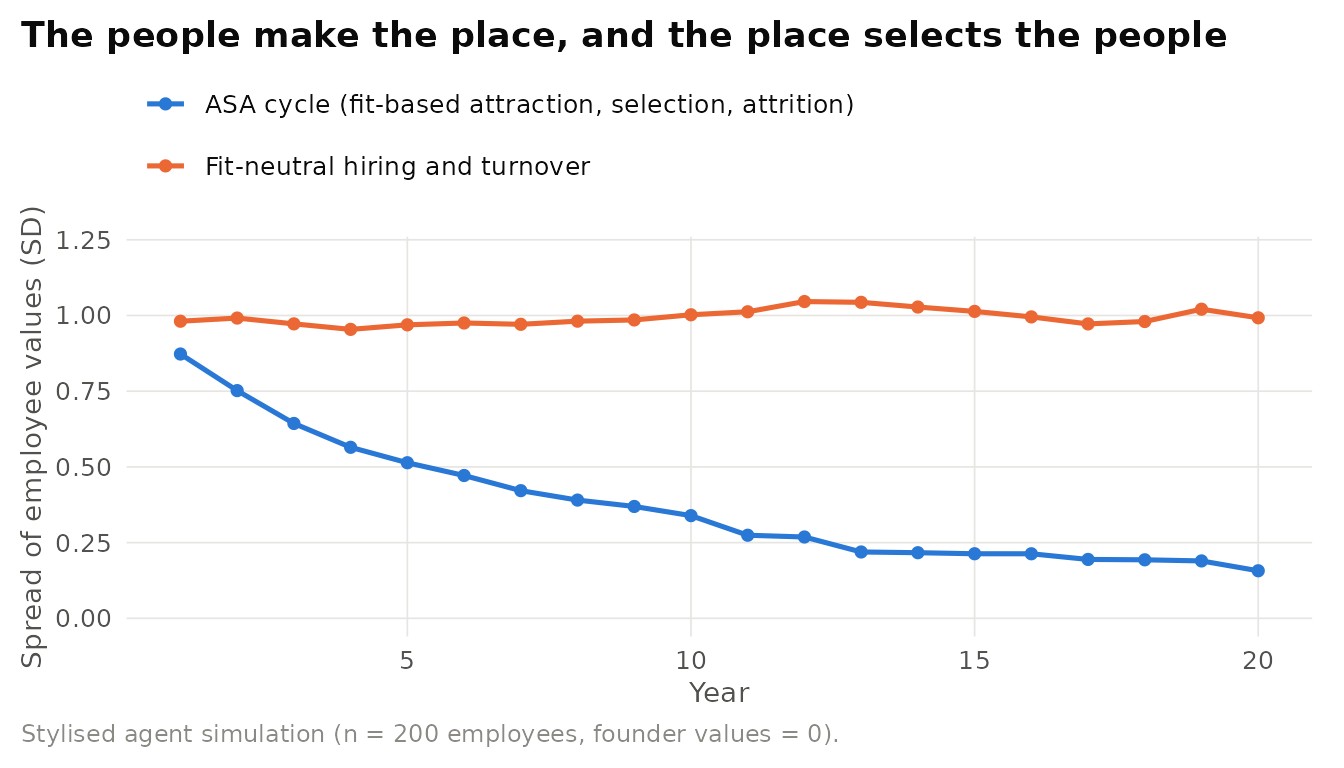
Figure 14.9: Illustrative simulation of the attraction-selection-attrition cycle. Under ASA, applicants and leavers are filtered by distance from the founder’s values and the spread of values shrinks. With fit-neutral hiring, diversity is maintained. Stylised data.
Homogeneity: asset or liability? Homogeneity eases coordination and supports a strong culture, but Schneider himself warned that it can make organizations unable to perceive or adapt to environmental change. Empirical support for organization-level homogeneity in personality is moderate, and critics note that job and occupational requirements also produce similarity. The theory also sits uneasily with diversity goals: “cultural fit” in hiring can become a vehicle for similarity bias.
Hiring for culture fit or culture add. Many technology firms once screened explicitly for “culture fit”, and some have publicly reframed the criterion as “culture add” or values alignment, precisely to avoid the homogenising spiral that ASA predicts. The practical design question is which attributes should be selected for fit (for example, integrity and core values) and which should be deliberately diversified (for example, backgrounds, cognitive styles, and functional expertise).
Designs and measures. Multi-wave data on applicants, hires, and leavers with personality or values measures. Within-organization variance over time as the outcome. A sample hypothesis: the variance of employee values declines with organizational age, and the decline is steeper when founders retain control of hiring.
14.11 Sensemaking
Core claim. People in organizations do not simply perceive an objective environment. When expectations are violated, they extract cues, build plausible stories about what is going on, and act on those stories, and their actions partly create the environment they then interpret.
Origins. Social psychology of organizing. Weick (1979), Weick (1993), and Weick (1995a). Updated by Weick, Sutcliffe, and Obstfeld (2005) and reviewed by Maitlis and Christianson (2014).
Level of analysis. Individual, group, and organization.
Key constructs. Ambiguity and equivocality, triggers, extracted cues, plausibility, enactment, retrospection, identity, sensegiving, sensebreaking, cosmology episodes.
Boundary conditions. Most visible during crises, change, and novel situations, when routine interpretations fail. In stable settings, sensemaking runs in the background of habitual action.
Related theories. Social information processing, Organizational identity, Organizational learning, Attribution theory (Section 21.3).
14.11.1 Origins and core logic
Weick’s organization theory starts with the claim that organizing is the process of reducing equivocality, the existence of multiple, conflicting interpretations (Weick 1979). Sensemaking is the process by which people give meaning to experience. Maitlis and Christianson (2014) define it as the process through which people work to understand issues or events that are novel, ambiguous, confusing, or in some other way violate expectations. In Weick (1995a), Weick described seven properties of sensemaking, summarised in Table 14.8.
| Property | Meaning | Organizational illustration |
|---|---|---|
| Grounded in identity construction | Who I think I am shapes what I notice and how I interpret it | Engineers and managers read the same data through different professional identities |
| Retrospective | Meaning is assigned to events after they have happened | Post-mortems construct the story of a project’s failure |
| Enactive of sensible environments | Action creates part of the environment that is then interpreted | A firm that cuts prices creates the price war it then perceives |
| Social | Sensemaking is shaped by actual, imagined, or implied others | Teams converge on a shared account in meetings |
| Ongoing | Sensemaking never starts or stops, it is interrupted | A sudden outage interrupts routine work and demands interpretation |
| Focused on and by extracted cues | Small, familiar cues are elaborated into larger meanings | One customer complaint is read as a sign of a broader trend |
| Driven by plausibility rather than accuracy | People act on stories that are good enough, not on full information | Managers act on a coherent narrative before all data are in |
Weick, Sutcliffe, and Obstfeld (2005) emphasised that sensemaking is about the interplay of action and interpretation. It answers two questions: what is going on here, and what should I do next? It begins with noticing and bracketing cues from the flow of experience, proceeds through labelling and categorizing, and is completed in action, which generates new cues. Leaders also engage in sensegiving, attempts to influence how others make sense. In their study of a new university president launching strategic change, Gioia and Chittipeddi (1991) showed how the president alternated between understanding the institution (sensemaking) and articulating a vision for it (sensegiving), while stakeholders in turn made sense of his vision and gave feedback (Figure 14.10).
Figure 14.10: The sensemaking cycle. A violated expectation triggers noticing and bracketing of cues, which are interpreted into a plausible account and enacted. Action changes the environment and produces new cues. Based on Weick (1995) and Weick, Sutcliffe and Obstfeld (2005).
14.11.2 Evidence: Mann Gulch and the collapse of sensemaking
Weick (1993) reanalysed the 1949 Mann Gulch fire in Montana, drawing on Norman Maclean’s account, in which thirteen smokejumpers died. The crew had been told to expect a routine fire. As the fire behaved in ways that contradicted that expectation, their shared interpretation and their role structure collapsed together. The foreman told the crew to drop their heavy tools, then lit an escape fire and called on them to join him in the burned area, actions that made little sense within the crew’s framework and that the crew did not follow. Weick called this a cosmology episode: a moment when people suddenly feel that the universe is no longer a rational, orderly system, and lose both the sense of what is happening and the means to rebuild it. He identified sources of resilience, including improvisation, virtual role systems (each person able to mentally simulate the whole group), respectful interaction, and an attitude of wisdom that combines confidence and doubt. Related work on aircraft carrier flight decks introduced collective mind, the heedful interrelating of individual actions that allows complex systems to operate reliably (Weick and Roberts 1993).
Maitlis and Christianson (2014) review a large literature that applies sensemaking to strategic change, crises, innovation, and identity. Their review notes three recurrent features: sensemaking is triggered by violated expectations, it is social and often contested, and it shapes action that alters the environment.
Process richness versus predictive power. Sensemaking studies are mostly qualitative and retrospective, and critics argue that the perspective explains events well after the fact but rarely generates testable predictions. The emphasis on plausibility over accuracy also invites a normative question: when is a plausible but wrong story dangerous? Proponents respond that the theory’s value lies in directing attention to interpretive processes that variance models miss, and recent work has developed more specific constructs (for example, triggers, sensegiving, and prospective sensemaking) that are measurable in field settings.
14.11.3 Applications in business
NASA’s Challenger and Columbia accidents. The two space shuttle losses are among the most thoroughly documented organizational failures, and they illustrate several theories in this chapter at once. In her study of the Challenger launch decision, Vaughan (1996) argued that the disaster resulted not from rule breaking but from the normalization of deviance: over many flights, evidence of erosion in the solid rocket booster O-ring seals was interpreted, step by step and through accepted engineering procedures, as an acceptable risk. Each successful flight with some erosion became evidence that erosion was tolerable, a sensemaking process in which plausibility and precedent outweighed alarm. Starbuck and Milliken (1988) described the same pattern as fine-tuning: past successes encourage organizations to reduce safety margins until something breaks, a form of the superstitious and myopic learning discussed under organizational learning.
After foam debris struck Columbia’s left wing during its January 2003 launch, engineers’ requests for imagery of the wing did not lead to action, and foam strikes, which had occurred on earlier flights without catastrophe, were treated as a maintenance issue rather than a safety-of-flight issue. The Columbia Accident Investigation Board concluded that NASA’s organizational causes were as important as the physical cause and drew explicit parallels with Challenger, including schedule pressure, a culture in which dissenting engineering views struggled to reach decision makers, and the reinterpretation of repeated anomalies as normal (Columbia Accident Investigation Board 2003). Read through this chapter’s theories, the accidents combine normalized interpretations (sensemaking), learning from success (organizational learning), barriers to raising concerns (psychological safety), schedule commitments that made delay costly (escalation), and a strong culture whose assumptions went unexamined (organizational culture).
14.11.4 Using the theory in research
Sample hypotheses.
- H1. Following an unexpected performance shock, top management teams whose members have more heterogeneous functional backgrounds will generate more distinct interpretations of the shock in internal communications.
- H2. Leader sensegiving that links a change initiative to existing identity labels will increase middle managers’ support for the change.
Designs and data. Longitudinal case studies with real-time observation, crisis communications, meeting transcripts and earnings call text, interviews using critical incident techniques, and experimental manipulations of ambiguous cues.
Measures. Coded interpretations (threat or opportunity framing), number and diversity of accounts, timing of convergence on a shared account, and actions taken.
Using sensemaking as a label for any interpretation. Sensemaking is a specific process triggered by interruptions and resolved through action. Studies that simply describe how people interpret events, without tracing triggers, cues, plausibility, and enactment, use the vocabulary without the theory.
14.12 Chapter Summary
- Organizational decisions often depart from the rational sequence. In organized anarchies, choices emerge from the timing of problems, solutions, and participants (M. D. Cohen, March, and Olsen 1972), and once committed, decision makers tend to escalate investments in failing courses of action (Staw 1976, Sleesman et al. 2012).
- Organizational learning encodes experience into routines. Single-loop learning refines them, double-loop learning questions their assumptions, and learning curves vary, depreciate, and transfer imperfectly (Argyris and Schön 1978, B. Levitt and March 1988, Argote and Epple 1990).
- Knowledge creation depends on converting tacit and explicit knowledge through socialization, externalization, combination, and internalization (Nonaka 1994).
- Identity and culture are deep, shared understandings that filter interpretation and action. Identity answers “who are we?”, culture answers “how do we do things here and why?” (Albert and Whetten 1985, Schein 2010).
- Paradox theory argues that persistent tensions should be accepted and managed dynamically rather than resolved once (W. K. Smith and Lewis 2011).
- Psychological safety enables team learning, especially in uncertain, interdependent work, and is distinct from comfort (A. Edmondson 1999).
- ASA and social information processing explain how the composition and social context of the workforce shape attitudes and cultures (Schneider 1987, Salancik and Pfeffer 1978).
- Sensemaking shows how people construct the situations they act on, and how plausible but wrong interpretations can contribute to disaster (Weick 1993, 1995a).
Table 14.9 presents the comparison of the chapter’s theories.
| Theory | Key mechanism | Signature prediction | Typical business use |
|---|---|---|---|
| Garbage can model | Temporal coincidence of streams | Many choices made by oversight or flight under load | Agenda design, policy windows |
| Escalation of commitment | Self-justification, sunk cost reasoning | Responsible decision makers reinvest after losses | Stage gates, kill criteria, project reviews |
| Organizational learning | Encoding experience into routines | Unit costs fall with experience at varying rates | Continuous improvement, after-action reviews |
| Knowledge creation | Tacit and explicit conversion | Innovation follows the SECI spiral | Product development, knowledge management |
| Organizational identity | Central, enduring, distinctive self-beliefs | Identity-image gaps trigger issue reframing | Strategic change, reputation management |
| Organizational culture | Shared basic assumptions | Strong cultures give reliable performance in stable settings | Merger integration, culture diagnosis |
| Paradox theory | Acceptance plus dynamic resolution | Virtuous cycles sustain contradictory goals | Hybrid organizations, ambidexterity |
| Psychological safety | Freedom to take interpersonal risks | Safety predicts learning behaviour and error reporting | Team leadership, healthcare, incident reviews |
| Attraction-selection-attrition | Fit-based entry and exit | Organizations become homogeneous over time | Hiring strategy, diversity |
| Social information processing | Social cues shape attitudes | Attitudes converge within workgroups | Onboarding, remote work |
| Sensemaking | Plausible stories enacted in action | Interruptions trigger interpretation and action cycles | Crisis management, change leadership |
14.13 Discussion Questions
- Choose a recent major decision in an organization you know. Reconstruct it once as a rational sequence and once as a garbage can process. Which account fits the evidence better, and what evidence would discriminate between them?
- Design a governance process for a multi-year IT programme that minimizes escalation of commitment without causing premature abandonment of promising but slow projects.
- Single-loop learning made Toyota’s shop floor exceptionally productive. Under what conditions might the same strength impede double-loop learning?
- How would you distinguish empirically between organizational identity and organizational culture in a study of a post-merger integration?
- A hospital reports a sharp rise in recorded medication errors after a new nurse manager arrives. Using psychological safety theory, propose two competing explanations and a research design to test them.
- Revisit the Challenger and Columbia accidents. Which theory in this chapter best explains each accident, and what single organizational change would each theory recommend?
14.14 Further Reading
- M. D. Cohen, March, and Olsen (1972): the original garbage can article, still the most provocative statement of decision making under ambiguity.
- Staw (1981) and Sleesman et al. (2012): the classic theoretical framing of escalation and the meta-analytic synthesis of its determinants.
- B. Levitt and March (1988) and Argote and Miron-Spektor (2011): two complementary reviews of organizational learning, one behavioural, one focused on experience and knowledge.
- Nonaka (1994): the canonical statement of knowledge-creation theory and the SECI model.
- Schein (2010): the standard treatment of culture’s levels and of leaders’ roles in creating and changing culture.
- A. Edmondson (1999) and A. C. Edmondson and Lei (2014): the founding study and the authoritative review of psychological safety.
- Weick (1993): a short, vivid analysis of how sensemaking and organization collapse together, and how resilience can be built.
- Vaughan (1996): a landmark organizational analysis of the Challenger decision and the normalization of deviance.
14.10 Social Information Processing
Core claim. Job attitudes and perceptions of tasks are not simple reactions to objective job features. They are constructed from social information: what coworkers say, how supervisors frame the work, and what people infer from their own past behaviour.
Origins. Organizational behaviour. Salancik and Pfeffer (1978), as a critique of need-satisfaction and job design models.
Level of analysis. Individual within a workgroup.
Key constructs. Social cues, salience of information, commitment and retrospective rationalization, socially constructed task perceptions.
Boundary conditions. Social cues matter most when tasks are ambiguous, when newcomers are socialized, and when sources are credible and similar.
Related theories. Job characteristics model (Section 15.1), Self-perception theory (Section 21.2), Social norms (Section 22.5), Conformity (Section 22.4), Sensemaking.
Salancik and Pfeffer (1978) challenged the dominant view that workers have stable needs and evaluate jobs by how well objective characteristics satisfy those needs. They proposed that the social environment provides cues about which aspects of a job are important and how to evaluate them, and that people also infer their attitudes from their own behaviour. A job is “interesting” partly because colleagues say it is. Griffin (1983) tested the idea in a field experiment in which supervisors provided social cues about task characteristics, and found that social information as well as objective changes in tasks affected workers’ perceptions of their jobs. Thomas and Griffin (1983) reviewed early evidence and concluded that social information has real effects on task perceptions, while objective task characteristics also continue to matter.
Complement or competitor? The theory was framed as an alternative to the job characteristics model, but most researchers now treat the two as complementary: objective features and social cues jointly shape perceptions. Critics also note that SIP is difficult to falsify unless researchers specify which cues should dominate and when.
Onboarding and remote work. New hires form their view of a role in the first weeks, largely from what peers and managers communicate. SIP implies that onboarding buddies, team rituals, and managers’ framing of work as meaningful shape engagement as much as the job design itself. In remote or hybrid settings, fewer informal cues are available, which may make the few explicit cues, such as how leaders talk about the work in meetings, disproportionately influential.
Designs. Field experiments manipulating supervisor or peer cues, network studies of attitude contagion within workgroups, and longitudinal studies of newcomers. A sample hypothesis: newcomers’ job satisfaction will converge toward the average satisfaction of their immediate network contacts, more strongly when the task is ambiguous.