18 Culture and Cross-Cultural Theory
A television advertisement that sells life insurance in Chicago by promising “freedom to live your dream” may leave viewers in Seoul unmoved, while an advertisement that shows three generations protected by the same policy may move them. A junior engineer in Stockholm interrupts her vice-president to point out an error in a slide. An equally competent engineer in a high-hierarchy subsidiary waits until after the meeting, or says nothing at all. A manufacturer that has grown successfully through acquisitions at home chooses a joint venture, not an acquisition, when it enters a market whose business customs it does not understand. In each case the economics of the situation are similar. What differs is the set of shared assumptions that people bring to it.
This chapter introduces the theories that social scientists use to describe and explain such differences. We begin with what “culture” means as a scientific construct and with the methodological traps that accompany it. We then develop Hofstede’s cultural dimensions theory, the most cited framework in international business, and its key derivative, cultural distance. We examine power distance in depth: both Mulder’s power distance reduction theory and the practical problem of voice in hierarchical workplaces. We turn to the psychological level with individualism-collectivism and independent versus interdependent self-construal, then to two rival country-level frameworks, the GLOBE project and Schwartz’s theory of basic values, and finally to cultural tightness-looseness. The chapter closes with the principal critiques of the dimensional approach and with practical guidance on negotiation and multicultural teams (Table 18.1).
| Theory | Core question | Level of analysis | Key source |
|---|---|---|---|
| Hofstede’s cultural dimensions | On which value dimensions do national cultures differ? | Nation | Hofstede (1980, 2001) |
| Cultural distance | How different is a host country from a home country, and does it matter? | Country dyad / firm | Kogut & Singh (1988) |
| Power distance theory | How do people respond to unequal power, and why do some accept it? | Individual / group / nation | Mulder (1977), Hofstede (1980) |
| Self-construal and individualism-collectivism | Is the self defined as separate from or embedded in others? | Individual / nation | Markus & Kitayama (1991), Triandis (1995) |
| GLOBE | How do cultural practices and values shape leadership? | Nation / organization | House et al. (2004) |
| Schwartz’s basic values | What universal structure organizes human values? | Individual / nation | Schwartz (1992) |
| Tightness-looseness | How strong are social norms and how tolerated is deviance? | Nation / state | Gelfand et al. (2011) |
18.1 What Do We Mean by Culture?
Definition 18.1 Culture is a system of shared meanings, values, beliefs, norms, and practices, that is learned, transmitted across generations, and that distinguishes the members of one group from those of another. Hofstede, Hofstede, and Minkov (2010) describe it as the collective programming of the mind: patterns of thinking, feeling, and acting that are acquired early and are largely taken for granted.
Three distinctions organize the cross-cultural literature and recur throughout this chapter.
First, values versus practices. Values are broad preferences for some states of affairs over others (“what should be”). Practices are the observable ways things are done (“what is”). Hofstede’s work concentrates on values. The GLOBE project measures both and finds, provocatively, that they do not always move together (House et al. 2004).
Second, etic versus emic approaches. An etic approach compares cultures on dimensions assumed to be universal, which permits quantification and ranking. An emic approach studies a culture on its own terms, from the inside, using concepts that may not translate. Dimensional theories are etic by design. Their power comes from comparability and their limitations from the same source.
Third, and most important for research design, the level of analysis. Most dimensional frameworks are defined at the national level: they describe how societies differ on average, not how any given person thinks. Inferring individual attitudes from country scores commits the ecological fallacy: the error of assuming that relationships observed among aggregates hold among the individuals who make them up (W. S. Robinson 1950). Hofstede himself repeatedly warned against this use of his scores (Hofstede 2001, 2011). Psychological constructs such as self-construal are defined at the individual level, and the two levels must be linked explicitly, typically with multilevel models.
18.2 Hofstede’s Cultural Dimensions Theory
Core claim. National cultures differ systematically on a small number of value dimensions, power distance, individualism, masculinity, uncertainty avoidance, long-term orientation, and indulgence, and these differences shape institutions, organizations, and behaviour.
Origins. Cross-cultural psychology and organization studies, Hofstede (1980), based on employee attitude surveys at IBM subsidiaries, expanded in Hofstede (2001) and Hofstede, Hofstede, and Minkov (2010), summarised in Hofstede (2011).
Level of analysis. Nation (country-level averages of individual responses).
Key constructs. Power distance, individualism-collectivism, masculinity-femininity, uncertainty avoidance, long- versus short-term orientation, indulgence-restraint, dimension scores (indices).
Boundary conditions. Scores describe central tendencies of national populations, not individuals. They assume that nations are meaningful cultural units and that matched samples isolate national culture from occupation and organization.
Related theories. Power distance theory, GLOBE, Schwartz values, Self-construal, Institutional theory (Section 7.2).
18.2.1 Origins and intellectual history
Geert Hofstede, a Dutch social psychologist working in IBM’s personnel research function, gained access to an unusually large data set: employee attitude questionnaires administered in two rounds, around 1968 and 1972, across IBM’s subsidiaries worldwide, amounting to more than 100,000 questionnaires (Hofstede 1980, 2011). Because respondents worked for the same company, in similar jobs, and were surveyed with the same instrument, Hofstede argued that the remaining systematic differences between subsidiaries could be attributed to national culture. Factor-analysing country means of the work-goal and attitude items, he identified four dimensions, which he related to basic problems every society must solve: how to handle inequality, how tightly to bind the individual to the group, how to divide emotional roles between the genders, and how to deal with an uncertain future.
The model grew in two steps. A fifth dimension, initially called Confucian dynamism and later long-term orientation, emerged from the Chinese Value Survey : an instrument deliberately designed by Chinese scholars to avoid a Western bias in item selection (Hofstede and Bond 1988). A sixth dimension, indulgence versus restraint, was added in the third edition of Cultures and Organizations on the basis of Michael Minkov’s analyses of World Values Survey data, which also supplied re-estimated long-term orientation scores for many more countries (Hofstede, Hofstede, and Minkov 2010).
18.2.2 Core logic and propositions
Table 18.2 summarises the six dimensions.
| Dimension | Societal problem addressed | Low pole | High pole | Workplace illustration |
|---|---|---|---|---|
| Power distance (PDI) | How to handle inequality | Inequality minimised, superiors accessible | Hierarchy accepted as natural and proper | Consultative vs. directive supervision |
| Individualism (IDV) | Bond between individual and group | Collectivism: loyalty to in-groups for protection | Individualism: loose ties, ‘I’ identity | Group vs. individual incentives and feedback |
| Masculinity (MAS) | Distribution of emotional roles | Femininity: caring, quality of life, modesty | Masculinity: achievement, assertiveness, competition | Resolving conflict by compromise vs. by contest |
| Uncertainty avoidance (UAI) | Tolerance of ambiguity | Ambiguity tolerated, few rules | Ambiguity threatening, rules and structure valued | Detailed contracts and procedures |
| Long-term orientation (LTO) | Focus on future vs. present and past | Respect for tradition, quick results | Perseverance, thrift, adaptation | Patient market building vs. quarterly targets |
| Indulgence (IVR) | Gratification of desires | Restraint: gratification regulated by norms | Indulgence: enjoying life and having fun | Attitudes toward leisure and positive emotion at work |
The dimensions are scored as indices, typically on a scale from roughly 0 to 100 (a few countries exceed 100 on some indices). The scores are meaningful only in relative terms: a power distance score of 80 is not “high” in any absolute sense, but it places a country above most others in the sample. Figure 18.1 compares six economically important countries.
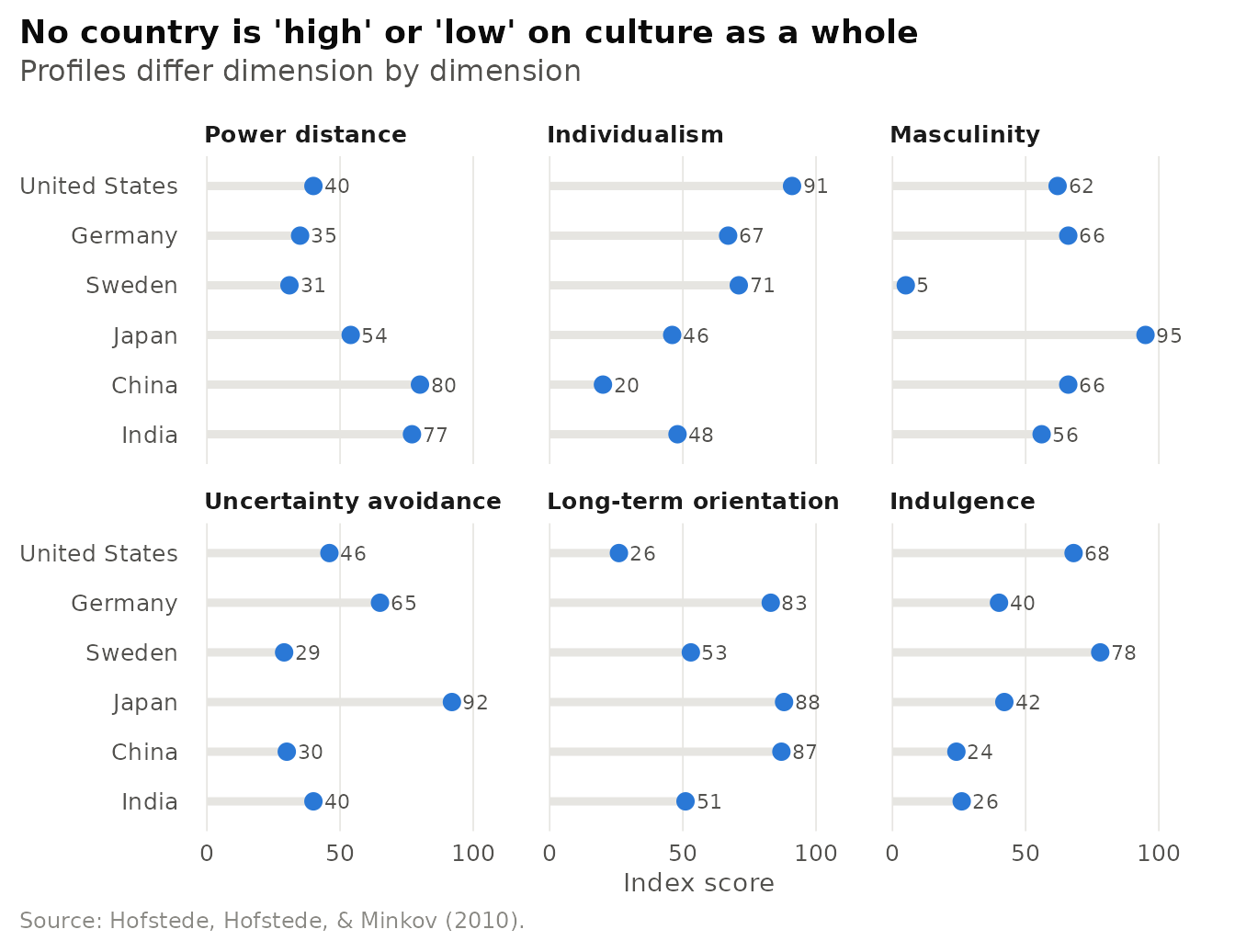
Figure 18.1: Hofstede dimension scores for six countries. Index values as published in Hofstede, Hofstede, and Minkov (2010). Long-term orientation and indulgence scores are the World Values Survey-based estimates introduced in that edition. Scores are relative country positions, not absolute measures.
Several features of the figure are instructive. Japan and Germany, both industrial exporters, differ sharply on individualism. Sweden and Japan, both wealthy, sit at opposite ends of masculinity. China and India share high power distance but differ on long-term orientation. National culture is a profile, not a single position on a “Western-Eastern” continuum.
Hofstede’s theoretical claims can be stated as propositions:
- P1 (Dimensionality). Differences among national cultures can be described parsimoniously by a small number of independent value dimensions.
- P2 (Stability). Countries’ relative positions on these dimensions change slowly, because values are acquired in childhood and reproduced by institutions. Absolute levels may drift as societies modernise (Hofstede 2001).
- P3 (Institutional correlates). Dimension scores covary with national institutions: for example, power distance with centralisation of authority, individualism with national wealth, uncertainty avoidance with the density of rules and laws (Hofstede 2001, Hofstede, Hofstede, and Minkov 2010).
- P4 (Fit). Management practices are more effective when they fit the cultural profile of the setting in which they are used. Imported practices that clash with local values are resisted or reinterpreted.
18.2.3 Evidence and extensions
Hofstede’s framework has been used in thousands of studies across management, marketing, accounting, and psychology. Two systematic reviews summarise what this literature has learned. Kirkman, Lowe, and Gibson (2006) reviewed a quarter-century of empirical work that used the framework. They classified studies into those treating culture as a main effect (culture predicts an outcome) and those treating it as a moderator (culture changes the strength of another relationship), and they documented recurring problems: heavy concentration on individualism-collectivism, frequent use of country as a proxy for culture without measuring values, and inattention to within-country variation.
Taras, Kirkman, and Steel (2010) meta-analysed the relationships between Hofstede’s dimensions, measured at the individual and group levels, and a wide range of organizational outcomes. Their analysis found that cultural values do predict outcomes, but that effects were, overall, modest, and were stronger for attitudes and emotion-laden outcomes (such as organizational commitment (Section 15.10) and team-related attitudes) than for job performance, absenteeism, or turnover. The predictive power of culture also varied across samples, which reinforces the point that culture is one of several influences on behaviour, not a master variable.
A triumph of faith? The sharpest critique is McSweeney (2002), who argues that Hofstede’s identification of national culture rests on questionable assumptions: that IBM employees were representative of their nations. That the occupational and organizational cultures of IBM were uniform across countries, so that national differences could be “isolated” by subtraction. That a survey of attitudes can reveal deep and enduring values, and that nations are the right unit of cultural analysis. Hofstede replied that the IBM matched-sample design was a strength, not a weakness, representativeness matters less than comparability, and that the dimensions have been validated by many later replications with other populations (Hofstede 2001, 2011). The debate is not resolved, but it has changed practice: careful researchers now measure values directly, test for within-country heterogeneity, and treat country scores as one imperfect proxy among several (Kirkman, Lowe, and Gibson 2006, Tung and Verbeke 2010).
18.2.4 Cultural distance
The most influential derivative of Hofstede’s work in strategy is the construct of cultural distance: how different the culture of a foreign market is from that of a firm’s home country. Kogut and Singh (1988) proposed an index that combines the four original dimensions, standardising each by its variance across countries:
\[CD_j \;=\; \frac{1}{4}\sum_{i=1}^{4} \frac{\left(I_{ij}-I_{iu}\right)^2}{V_i},\]
where \(I_{ij}\) is country \(j\)’s score on dimension \(i\), \(I_{iu}\) is the home country’s score (the United States in the original study), and \(V_i\) is the variance of dimension \(i\). Kogut and Singh showed that, for entries into the United States, greater cultural distance, and higher uncertainty avoidance in the investor’s home country, made firms more likely to choose joint ventures or greenfield investments over acquisitions. The intuition is that acquiring an existing firm means managing its culture, which is costly when that culture is unfamiliar. The idea complements the Uppsala internationalization model, in which firms enter “psychically close” markets first and deepen commitment as they learn (Johanson and Vahlne 1977).
Table 18.3 applies the formula to the six countries in Figure 18.1, taking the United States as the home country.
| Country | PDI gap | IDV gap | MAS gap | UAI gap | Kogut-Singh index |
|---|---|---|---|---|---|
| Germany | -5 | -24 | 4 | 19 | 0.41 |
| Sweden | -9 | -20 | -57 | -17 | 1.27 |
| India | 37 | -43 | -6 | -6 | 1.54 |
| Japan | 14 | -45 | 33 | 46 | 2.16 |
| China | 40 | -71 | 4 | -16 | 3.07 |
Is distance the right metaphor? Shenkar (2001) identified several “illusions” in the cultural-distance construct: symmetry (the distance from A to B is assumed equal to that from B to A, although a Swedish firm entering China may face different frictions than a Chinese firm entering Sweden). Stability (distance is treated as fixed, although contact and convergence change it). Linearity (each additional unit of distance is assumed to add the same difficulty). Causality (culture is assumed to be the only source of difference that matters), and discordance (all differences are assumed to create friction, whereas some differences can be complementary). Shenkar called for measures of cultural friction that reflect the actual interaction between the two parties.
18.2.5 Applications in business
Entry mode and the Walmart Germany experience. Walmart entered Germany in the late 1990s by acquiring two domestic hypermarket chains, Wertkauf and Interspar, and withdrew in 2006, selling its stores to Metro. Commentators frequently cite cultural mismatch, for example, the transfer of American service rituals such as store greeters and scripted friendliness, as a contributing factor. A careful reading of the public record suggests a multi-causal story: Walmart also faced a mature, price-competitive discount sector, regulatory constraints on opening hours and pricing, a fragmented store base inherited through acquisition, and difficulties in labour relations. The case is therefore best used to illustrate Kogut and Singh’s logic, acquisition requires managing an inherited organizational and national culture, rather than as proof that culture alone determines success.
Illustrative scenario: choosing an entry mode. A mid-sized German industrial equipment maker wants to enter both the United States and Japan. On the four original dimensions, Japan is more distant from Germany than is the United States on masculinity and uncertainty avoidance, and both differ from Germany on individualism. Applying the cultural-distance logic, the firm might acquire a distributor in the United States, where it can integrate an existing organization with modest cultural friction, but enter Japan through a joint venture with a local partner that already holds relationships with customers and regulators. The theory supplies a hypothesis, not a decision rule: the choice also depends on the availability of acquisition targets, intellectual-property risk, and the firm’s prior international experience.
18.2.6 Using the theory in research
Sample hypotheses.
- H1. The positive effect of individual performance-based pay on employee effort will be weaker in subsidiaries located in more collectivistic countries.
- H2. Cultural distance between acquirer and target countries will be negatively associated with post-acquisition integration speed, and this effect will be weaker when the acquirer has prior experience in the target country.
- H3. Consumers in high uncertainty-avoidance countries will adopt new product categories more slowly, controlling for income and infrastructure.
Measures. Country scores from Hofstede, Hofstede, and Minkov (2010) (cite the edition and note which countries are estimated). Hofstede’s Values Survey Module administered to one’s own sample. Kogut-Singh or Euclidean distance indices. Individual-level value scales when the hypothesis is about individuals.
Designs. Multilevel models with individuals nested in countries. Matched samples across subsidiaries of one multinational. Panel data on entry decisions. Experiments with participants from several countries (with measurement-invariance tests).
Data sources. Firm-level foreign direct investment databases, multinational employee surveys. The World Values Survey and European Social Survey. GLOBE and Schwartz country scores as robustness checks.
The ecological fallacy. Country scores describe nations, not people. It is a misuse of the theory to assume that a particular Japanese manager is high in uncertainty avoidance because Japan’s index is 92, or to correlate country scores with individual behaviour without modelling the two levels separately (W. S. Robinson 1950, Hofstede 2011). Within-country variation on most values is large relative to between-country differences.
18.3 Power Distance Theory
Core claim. People respond actively to unequal power: they try to reduce the distance between themselves and more powerful others and to preserve or increase the distance from less powerful others. Societies differ in how much inequality their members expect and accept.
Origins. Social psychology of power, Mulder (1977) formulated power distance reduction theory, Hofstede (1980) adopted “power distance” as a dimension of national culture.
Level of analysis. Individual and group (Mulder), nation (Hofstede).
Key constructs. Power distance, power distance reduction tendency, acceptance of inequality, centralisation, voice, dependence on superiors.
Boundary conditions. The reduction tendency is strongest when the distance to the more powerful is small and when the less powerful have relevant expertise. Large gaps in expertise can make participation increase inequality.
Related theories. Hofstede, GLOBE, Social exchange theory (Section 9.1), Resource dependence theory (Section 7.1).
18.3.1 Origins: Mulder’s power distance reduction theory
The Dutch social psychologist Mauk Mulder studied power in laboratory groups and organizations, and summarised his program in The Daily Power Game (Mulder 1977). Mulder defined power distance as the degree of inequality in power between a less powerful individual and a more powerful other within the same social system. His theory makes three core claims. First, individuals strive to reduce the power distance between themselves and more powerful others. Second, this tendency is stronger the smaller the distance: people close to the top strive harder to close the gap than people far below, for whom the gap seems unbridgeable. Third, the powerful tend to maintain or increase the distance from those below them.
Mulder’s research carried a counter-intuitive implication for participative management. If the powerful hold much more relevant expertise, giving the less powerful a formal role in decision-making can expose their weaker position and reinforce, rather than reduce, the existing hierarchy. Participation equalises power only when participants bring comparable knowledge (Mulder 1977).
Hofstede borrowed Mulder’s term and moved it to the societal level. In his usage, power distance captures the extent to which the less powerful members of a society’s institutions and organizations expect and accept that power is distributed unequally (Hofstede 2001, Hofstede, Hofstede, and Minkov 2010). The key word is accept: inequality exists everywhere, but cultures differ in whether it is seen as legitimate and natural or as something to be minimised and justified.
18.3.2 Power distance at work
Table 18.4 contrasts typical organizational patterns in low and high power-distance settings.
| Aspect | Lower power distance | Higher power distance |
|---|---|---|
| Meaning of hierarchy | Inequality of roles, established for convenience | Reflects existential inequality between levels |
| Structure | Decentralised, flatter pyramids | Centralised, tall pyramids |
| Subordinates expect | To be consulted | To be told what to do |
| Ideal superior | Resourceful democrat | Benevolent autocrat, ‘good father’ |
| Pay differentials | Narrow range between top and bottom | Wide range |
| Status symbols and privileges | Frowned upon | Normal and popular |
| Disagreeing with the boss | Accepted as part of the job | Seen as disrespectful, raised indirectly if at all |
Power distance has measurable consequences for organizational processes. In cross-national studies, Brockner et al. (2001) found that the beneficial effect of giving employees voice in decisions, a classic procedural-justice mechanism, was weaker in higher power-distance cultures. Where employees do not expect to be consulted, the opportunity to speak up matters less for their reactions to decisions. This does not mean that voice is unimportant in such settings. It means that the psychological meaning of voice, and thus its motivational effect, depends on cultural expectations.
18.3.3 Mechanism: why hierarchy silences
Voice is discretionary, upward communication intended to improve the organization (Morrison 2011). Two beliefs suppress it: that speaking up is risky (it may damage one’s image or relationships) and that it is futile (nothing will change). Power distance raises both. Leaders, in turn, can lower them by being visibly open to input (Detert and Burris 2007) and by building psychological safety: a shared belief that the team is safe for interpersonal risk-taking (A. Edmondson 1999). Figure 18.2 summarises the mechanism.
Figure 18.2: Mechanism linking power distance to employee silence and error persistence. Leader openness, psychological safety, and structured protocols such as crew resource management moderate the path from hierarchy to perceived risk and futility of speaking up.
18.3.4 Applications in business
Crew resource management in aviation. From the late 1970s onward, accident investigations repeatedly identified failures of communication and coordination on the flight deck: junior crew members who noticed a problem but did not challenge the captain effectively. The industry’s response, crew resource management (CRM), trains all crew members in assertive, structured communication, shared situational awareness, and decision-making, and it has evolved through several generations (R. L. Helmreich, Merritt, and Wilhelm 1999). Helmreich and colleagues documented systematic national differences in pilots’ attitudes toward command authority and argued that CRM training must be adapted to national, organizational, and professional cultures rather than exported unchanged (R. L. Helmreich and Merritt 1998). Practical tools include standardised phrasing for escalating concerns and explicit invitations by captains for crew to speak up: design solutions that lower the risk of voice regardless of cultural background.
A contested anecdote. Popular accounts, notably Gladwell (2008), link the accident record of a particular national airline in the 1990s primarily to cultural deference in the cockpit. Aviation-safety specialists have criticised such single-cause narratives: official accident investigations typically identify multiple contributing factors (training, procedures, equipment, fatigue, oversight), and attributing outcomes to national culture alone risks both oversimplification and stereotyping. The defensible lesson is narrower, that hierarchy can suppress voice and that structured communication protocols help, and it applies in any high-hierarchy setting, including hospitals, engineering teams, and financial trading desks.
Illustrative scenario: a “speak-up” program in a high power-distance subsidiary. A multinational’s quality audits reveal that defects in its plant in a high power-distance country are detected late, although line operators often notice them early. Exhortations to “speak up” have little effect. Following the mechanism in Figure 18.2, the plant introduces anonymous defect-reporting kiosks, a daily stand-up in which supervisors must ask each operator a specific question, and recognition for the most valuable early warning. Each tool reduces the perceived risk or futility of voice without asking employees to violate deeply held norms about deference.
18.3.5 Using the theory in research
Sample hypotheses.
- H1. Individual power-distance orientation will weaken the positive effect of participative leadership on employee job satisfaction.
- H2. Leader openness will have a stronger positive effect on employee voice in high power-distance teams than in low power-distance teams (because baseline risk perceptions are higher).
- H3. Consistent with Mulder, employees one level below a decision-maker will engage in more power-reduction attempts (e.g., coalition building) than employees several levels below.
Measures. Individual power-distance orientation scales, voice and silence scales (Morrison 2011), psychological safety (Section 14.8) (A. Edmondson 1999), hierarchical steepness (number of levels, pay ratios).
Designs. Multilevel field surveys, vignette experiments manipulating leader openness, archival data on incident reporting in hospitals or airlines.
Equating high power distance with bad management. Low power distance is not universally superior. Directive leadership can be efficient and legitimate where it is expected, and imposing participative practices without regard to local expectations can create confusion rather than empowerment. The managerial question is how to secure the functions of voice, error detection and learning, in ways that fit the local context.
18.4 Individualism, Collectivism, and Self-Construal
Core claim. Cultures differ in how they define the self. In individualist cultures the self is construed as an autonomous entity defined by internal attributes (independent self-construal). In collectivist cultures it is construed as embedded in relationships and defined by social roles (interdependent self-construal). These construals shape cognition, emotion, and motivation.
Origins. Cultural psychology, H. R. Markus and Kitayama (1991), cross-cultural psychology, Triandis (1995), Hofstede’s individualism dimension (Hofstede 1980).
Level of analysis. Individual (self-construal) and nation (individualism-collectivism).
Key constructs. Independent self-construal, interdependent self-construal, in-group, horizontal versus vertical individualism and collectivism.
Boundary conditions. Both construals exist within every person and can be primed situationally. National averages conceal large individual differences.
Related theories. Hofstede, Regulatory focus (Section 20.1), Social identity theory (Section 22.2), Optimal distinctiveness (Section 22.3).
18.4.1 Core logic
H. R. Markus and Kitayama (1991) argued that much of Western psychology assumed an independent self, bounded, unique, and stable across contexts, and that this assumption does not describe how people in many cultures experience themselves. In an interdependent self, relationships and roles are not external influences on a pre-existing self. They are constitutive of it. The authors traced the consequences across three domains. Cognition: interdependent selves attend more to context and to others’ perspectives. Emotion: they experience and value more “other-focused” emotions, such as sympathy and shame, relative to “ego-focused” ones such as pride and anger. Motivation: they are motivated to fit in, maintain harmony, and meet obligations, rather than primarily to stand out and express inner attributes.
Triandis (1995) developed the cultural counterpart, individualism-collectivism, and added a second axis. Horizontal patterns emphasise equality, vertical patterns accept hierarchy. The result is four types: horizontal individualism (self-reliance without status-seeking, often associated with Scandinavia), vertical individualism (competition and achievement), horizontal collectivism (cooperation among equals), and vertical collectivism (duty and deference within a hierarchical in-group) (Triandis and Gelfand 1998) (Table 18.5).
| Feature | Independent self-construal | Interdependent self-construal |
|---|---|---|
| Definition of self | Separate from social context | Connected with social context |
| Structure | Bounded, unitary, stable | Flexible, variable across roles |
| Important features | Internal, private (abilities, thoughts, feelings) | External, public (status, roles, relationships) |
| Tasks | Be unique, express self, promote own goals | Belong, fit in, promote others’ goals |
| Role of others | Self-evaluation through social comparison | Self-definition through relationships |
| Basis of self-esteem | Ability to express self and validate attributes | Ability to adjust, restrain self, maintain harmony |
| Typical regulatory emphasis | Promotion (gains, aspirations) | Prevention (duties, avoiding losses) |
18.4.2 Evidence and extensions
Self-construal has been measured with self-report scales (Singelis 1994) and manipulated experimentally by priming, which allows causal tests that country comparisons cannot provide. One important link concerns motivation. A. Y. Lee, Aaker, and Gardner (2000) showed that people with a predominantly independent self-construal place more weight on promotion-focused information (gains and aspirations), whereas those with a predominantly interdependent self-construal place more weight on prevention-focused information (losses and obligations). The pattern appeared both in comparisons of North American and East Asian participants and when self-construal was primed within a culture. This connects cultural psychology to regulatory focus theory (Section 20.1), and it explains why the persuasiveness of promotion- versus prevention-framed messages varies across markets (J. L. Aaker and Lee 2001).
How different are individualists and collectivists? Oyserman, Coon, and Kemmelmeier (2002) meta-analysed cross-national comparisons of individualism and collectivism and found that differences were real but smaller and less consistent than often assumed: Americans were not uniformly more individualistic than all other groups, and differences depended heavily on how the constructs were measured. Heine et al. (2002) identified a further methodological trap, the reference-group effect: respondents answer Likert items by comparing themselves with others in their own culture, so a person surrounded by collectivists may rate themselves as relatively individualistic. Finally, Henrich, Heine, and Norenzayan (2010) showed that much behavioural science rests on samples from Western, educated, industrialised, rich, and democratic (WEIRD) societies, which are often outliers rather than typical of humanity. Together these critiques argue for multiple methods, scenario studies, behavioural measures, and priming experiments, rather than cross-national self-report comparisons alone.
18.4.3 Applications in business
Global advertising: standardise or adapt? T. Levitt (1983) famously argued that technology and travel were homogenising consumer preferences, so that global firms should sell standardised products with standardised messages. Research on culture and persuasion suggests a more nuanced conclusion. S.-P. Han and Shavitt (1994) found that advertisements in the United States more often used individualistic appeals (personal benefit, self-improvement) and those in Korea more often used collectivistic appeals (family, group harmony), and that experimentally, culturally matched appeals tended to be more persuasive, particularly for products typically used with others. Combined with the regulatory-focus evidence (A. Y. Lee, Aaker, and Gardner 2000, J. L. Aaker and Lee 2001), the practical rule is standardise the brand’s core promise and visual identity. Adapt the appeal and framing. A financial-services brand might emphasise “achieve your ambitions” (promotion, independent) in one market and “protect those who depend on you” (prevention, interdependent) in another, while keeping the same brand platform.
Collect six print or video advertisements for the same product category, say, cars or insurance, from two countries with different individualism scores. Code each advertisement for (a) individual versus group benefit, (b) promotion versus prevention framing, and (c) direct versus indirect claims. Do the patterns match the predictions of self-construal theory? What alternative explanations (category conventions, regulation, brand positioning) could account for any differences?
18.5 The GLOBE Project
Core claim. Societal and organizational cultures can be described by nine dimensions measured separately as practices (“as is”) and values (“should be”). Cultures hold shared implicit theories of leadership that determine which leader behaviours are seen as effective.
Origins. The Global Leadership and Organizational Behavior Effectiveness (GLOBE) research program, led by Robert House. House et al. (2004).
Level of analysis. Society and organization, leadership perceptions.
Key constructs. Cultural practices, cultural values, culturally endorsed implicit leadership theories (CLTs), societal clusters.
Boundary conditions. Data come from middle managers in three industries (financial services, food processing, telecommunications). Generalisation to other populations is an assumption.
Related theories. Hofstede, Power distance theory, Upper echelons theory (Section 6.4).
18.5.1 Core logic
GLOBE was designed partly to address limitations of Hofstede’s work. A network of researchers in many countries surveyed middle managers in local organizations in 62 societies (House et al. 2004). Two design choices distinguish the project. First, it expanded and refined the dimensions (Table 18.6): for example, it split collectivism into institutional and in-group forms, and split Hofstede’s masculinity into gender egalitarianism and assertiveness. Second, it measured practices and values separately, asking respondents both how things are done in their society and how they should be done.
| GLOBE dimension | What it captures | Closest Hofstede counterpart |
|---|---|---|
| Power distance | Expectation that power is stratified and concentrated at higher levels | Power distance |
| Uncertainty avoidance | Reliance on norms, rules, and procedures to reduce unpredictability | Uncertainty avoidance |
| Institutional collectivism | Encouragement of collective distribution of resources and collective action | Individualism (reversed) |
| In-group collectivism | Pride, loyalty, and cohesiveness in families and organizations | Individualism (reversed) |
| Gender egalitarianism | Minimisation of gender role differences | Masculinity (partly) |
| Assertiveness | Assertiveness, confrontation, and aggressiveness in relationships | Masculinity (partly) |
| Future orientation | Planning, investing in the future, delaying gratification | Long-term orientation (partly) |
| Performance orientation | Encouragement and reward of performance improvement and excellence | No direct counterpart |
| Humane orientation | Encouragement and reward of fairness, altruism, generosity, and care | No direct counterpart |
On leadership, GLOBE identified six broad leadership dimensions: charismatic/ value-based, team-oriented, participative, humane-oriented, autonomous, and self-protective. Charismatic/value-based and team-oriented leadership were broadly endorsed as contributing to outstanding leadership across societies, whereas the endorsement of participative, autonomous, and self-protective leadership varied more with culture (House et al. 2004). The central proposition is that leader effectiveness depends on the match between leader behaviour and the culturally endorsed implicit leadership theory held by followers.
18.5.2 Evidence and extensions
One of GLOBE’s most discussed findings is that, for several dimensions, societies’ practice scores and value scores were negatively correlated across countries. Societies that reported high uncertainty avoidance or high power distance as current practice tended to say they wanted less of it. One interpretation is that values express aspirations formed in reaction to current conditions: a “grass is greener” effect.
What did GLOBE measure? Hofstede (2006) argued that GLOBE’s items, by asking respondents to describe their society or to state what it should be, captured researchers’ categories rather than respondents’ own values, and that the negative practice-value correlations suggest the “should be” items do not measure values in his sense. He reanalysed GLOBE’s data and claimed that they could be reduced to dimensions resembling his own. Javidan et al. (2006) replied that GLOBE’s theory-driven, multi-dimensional approach was more transparent and that practices and values are conceptually distinct constructs whose divergence is a finding, not an artefact. For researchers, the exchange is a reminder that the choice of framework is a measurement decision with substantive consequences. For robustness, many studies now report results using both.
18.5.3 Applications in business
Illustrative scenario: a global leadership competency model. A professional services firm uses a single 360-degree feedback instrument worldwide, with “empowers others and invites dissent” as a core competency. GLOBE’s findings suggest three adjustments. First, retain the competencies that are broadly endorsed, vision, integrity, and team-building, as global standards. Second, treat participative behaviour as a contingent competency whose behavioural indicators are localised (for example, consulting privately before a meeting rather than inviting open dissent during it). Third, interpret ratings relative to local norms, because the same behaviour can be rated differently against different implicit leadership theories.
18.6 Schwartz’s Theory of Basic Values
Core claim. Human values form a universal circular structure: ten basic values, each defined by its motivational goal, are arranged so that adjacent values are compatible and opposing values conflict. Individuals and cultures differ in their priorities, not in the structure.
Origins. Social psychology. S. H. Schwartz (1992), based on surveys in 20 countries. Extended to culture-level value orientations in S. H. Schwartz (1999).
Level of analysis. Individual (basic values) and nation (cultural value orientations).
Key constructs. Ten basic values, four higher-order values (openness to change, conservation, self-enhancement, self-transcendence), compatibility and conflict among values.
Boundary conditions. The structure is a continuum, value boundaries are conventions. Value priorities predict behaviour most strongly when values are activated and relevant to the choice.
Related theories. Hofstede, GLOBE, Self-construal.
18.6.1 Core logic
S. H. Schwartz (1992) defined values as desirable, trans-situational goals that serve as guiding principles in people’s lives. What distinguishes values from one another is the motivational goal they express. Ten such goals were identified (Table 18.7). The theory’s distinctive claim is structural: pursuing any value has psychological, practical, and social consequences that may conflict or be compatible with pursuing others. Achievement and benevolence, for example, can conflict, since pursuing personal success may obstruct actions that enhance the welfare of others. Conformity and tradition are compatible, since both subordinate the self to social expectations.
| Value | Defining motivational goal | Higher-order value |
|---|---|---|
| Self-direction | Independent thought and action: choosing, creating, exploring | Openness to change |
| Stimulation | Excitement, novelty, and challenge in life | Openness to change |
| Hedonism | Pleasure and sensuous gratification for oneself | Openness to change / self-enhancement |
| Achievement | Personal success through demonstrating competence by social standards | Self-enhancement |
| Power | Social status and prestige, control over people and resources | Self-enhancement |
| Security | Safety, harmony, and stability of society, relationships, and self | Conservation |
| Conformity | Restraint of actions likely to upset others or violate social norms | Conservation |
| Tradition | Respect for and acceptance of cultural or religious customs | Conservation |
| Benevolence | Preserving and enhancing the welfare of close others | Self-transcendence |
| Universalism | Understanding, tolerance, and protection of all people and nature | Self-transcendence |
Figure 18.3 draws the circular structure. Two bipolar axes organise the circle: openness to change versus conservation (independence and novelty versus order and resistance to change) and self-enhancement versus self-transcendence (pursuit of one’s own interests versus concern for others).
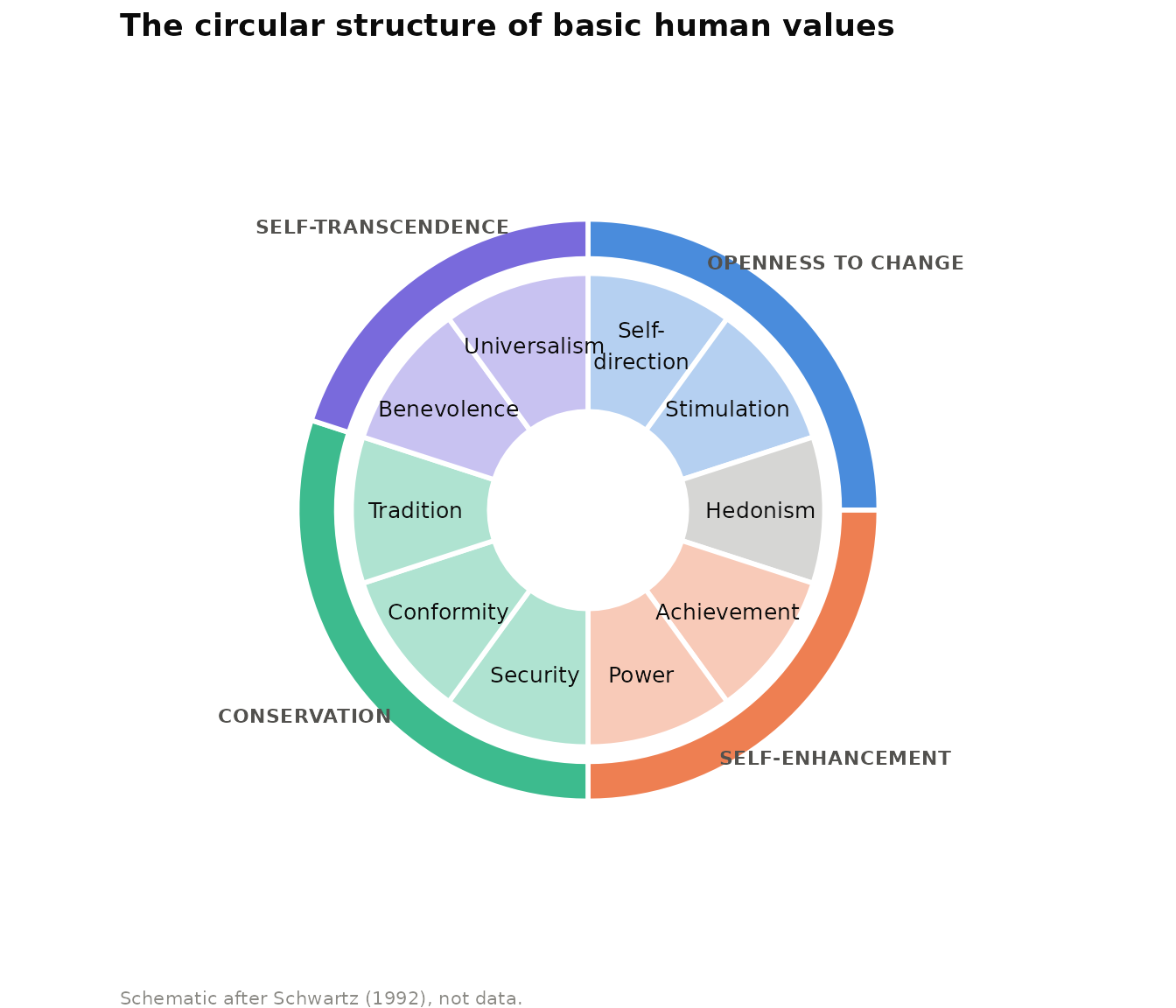
Figure 18.3: Schematic of Schwartz’s (1992) circular value structure. Adjacent values are motivationally compatible, values on opposite sides conflict. The outer ring shows the four higher-order values. Hedonism straddles openness to change and self-enhancement. In Schwartz’s original figure, tradition and conformity share one wedge (tradition on the outside). They are drawn side by side here for legibility.
At the cultural level, S. H. Schwartz (1999) derived seven value orientations organised along three bipolar dimensions that describe how societies resolve basic problems: embeddedness versus autonomy (intellectual and affective), hierarchy versus egalitarianism, and mastery versus harmony. The cultural-level and individual-level structures are related but not identical: a further reminder that levels of analysis (Section 2.6) must be kept distinct.
18.6.2 Evidence and applications
The circular structure has been replicated across many countries and samples, and Schwartz’s instruments are now included in large comparative surveys. Because the theory specifies which values conflict, it yields sharper predictions than lists of independent dimensions: any outcome (for example, willingness to adopt an innovation) should correlate positively with values on one side of the circle and negatively with values on the opposite side, with a sinusoidal pattern of correlations around the circle.
Illustrative scenario: positioning and employer branding with the value circle. A sustainable outdoor-apparel brand targets consumers high in universalism and self-direction. The value circle warns that messages invoking power and status, “be the envy of the trail”, sit on the opposite side and may undermine credibility with the core segment, whereas adjacent values such as benevolence (“gear that lasts, so less ends up in landfill”) and stimulation (“explore further”) reinforce one another. The same logic applies to employer branding: a recruitment message that combines conservation values (security, stability) with openness values (autonomy, novelty) sends mixed motivational signals unless the trade-off is made explicit.
Using Schwartz’s theory in research. Measure values with the Schwartz Value Survey or the Portrait Values Questionnaire. Centre scores within person to capture priorities. Test circumplex predictions with the full set of ten values rather than cherry-picking one. At the country level, use Schwartz’s cultural orientation scores as an alternative to Hofstede for robustness checks.
18.7 Tight and Loose Cultures
Core claim. Cultures differ in the strength of their social norms (Section 22.5) and their tolerance of deviance. Tight cultures have strong norms and sanction deviance. Loose cultures have weaker norms and greater latitude. Tightness is an adaptive response to ecological and historical threats that require coordination.
Origins. Cultural psychology, Gelfand et al. (2011), a 33-nation study building on earlier anthropological ideas, extended to U.S. states in Harrington and Gelfand (2014), popularised in Gelfand (2018).
Level of analysis. Nation, state, organization, and the everyday situation.
Key constructs. Strength of norms, tolerance of deviance, ecological and historical threat, situational constraint, self-regulation.
Boundary conditions. Tightness is distinct from collectivism and power distance. Tightness can be domain-specific (e.g., tight in workplace norms, loose in leisure).
Related theories. Hofstede, Social norms (Section 22.5), Conformity (Section 22.4), Institutional theory (Section 7.2).
18.7.1 Core logic and mechanism
Gelfand et al. (2011) asked respondents in 33 nations how clear and pervasive social norms were in their society and how much deviance was tolerated, and combined the answers into a tightness-looseness score. Tightness was associated with a history of ecological and human-made threats: higher population density, resource scarcity, territorial threats, natural disasters, and pathogen prevalence. The theoretical argument is functional: when threats are severe, groups that coordinate effectively survive, and strong norms are a coordination technology. Tightness then becomes embedded in institutions (more autocratic governance, more media restrictions, stricter punishment), in everyday situations (which permit a narrower range of acceptable behaviour), and in individuals’ psychology (stronger self-monitoring and impulse control) (Figure 18.4).
Figure 18.4: Mechanism of cultural tightness-looseness (after Gelfand et al., 2011). Threats increase the need for coordination, which favours strong norms and low tolerance of deviance. Tightness produces order and predictability but constrains openness and creativity.
The trade-off is central. Tight cultures enjoy more order, synchrony, and self-control. Loose cultures enjoy more openness, tolerance, and creativity, at the cost of more disorganisation. Neither pole is superior in general. Gelfand (2018) argues that extremes on either side carry costs. Within the United States, Harrington and Gelfand (2014) found substantial variation among states, with tighter states concentrated in the South and looser states more often on the coasts, and with tightness again associated with historical threat.
18.7.2 Applications in business
Creativity in global crowdsourcing. Chua, Roth, and Lemoine (2015) studied creative contests on an international crowdsourcing platform, on which clients from many countries post innovation challenges and individuals worldwide submit ideas. They found that cultural tightness shaped success in this global creative work: tight-culture settings were less receptive to creative contributions from culturally distant outsiders. For firms using open innovation (Section 12.6), the implication is that where contributors come from, and where the evaluating client sits, can shape which ideas succeed: independent of idea quality.
Illustrative scenario: post-merger integration. A tight-culture manufacturer, whose plants run on detailed standard operating procedures and strict punctuality, acquires a loose-culture software start-up whose engineers value flexible hours and improvisation. Integration plans that impose the acquirer’s rules wholesale are likely to provoke turnover among the engineers. Plans that leave everything loose may fail to deliver the reliability the acquirer’s customers expect. Tightness-looseness theory suggests a differentiated design: tight where coordination failures are costly (security, safety, release processes) and loose where variation creates value (exploration, prototyping).
Using tightness-looseness in research. Measure tightness with Gelfand et al.’s six-item scale at the individual level and aggregate after testing agreement. Use country or state scores as moderators of norm-related outcomes (compliance, imitation, innovation). Test whether tightness explains variance beyond collectivism and power distance, with which it is correlated but not identical.
18.8 Culture in Practice: Negotiation and Multicultural Teams
Cultural theories earn their place in business education by improving everyday decisions in negotiation, teamwork, and leadership. Three findings stand out.
Negotiation style. Hall (1976) distinguished low-context cultures, in which meaning is carried mainly by explicit words, from high-context cultures, in which much meaning is carried by relationships, setting, and what is left unsaid. Building on this idea, Adair and Brett (2005) analysed the sequences of behaviour in intra- and inter-cultural negotiations and found that negotiators from low-context cultures tended to exchange information directly, through questions and answers about priorities, whereas negotiators from high-context cultures tended to exchange information indirectly, by making and inferring from offers. Both routes can reach integrative agreements. Problems arise when the two styles meet and each side misreads the other. Brett (2007) synthesises such findings into practical advice for negotiating across cultures.
Multicultural teams. Stahl et al. (2010) meta-analysed research on culturally diverse teams and found offsetting effects: cultural diversity was associated with more creativity but also with more conflict and weaker social integration, so its net effect on performance depended on the task and the team context. Diversity is a resource whose value depends on how it is managed.
Voice and hierarchy. As discussed under power distance theory, members from higher power-distance backgrounds may be less likely to challenge leaders openly. Leaders of global teams can design for this by soliciting input asynchronously, rotating the role of devil’s advocate, and explicitly rewarding dissent (Table 18.8).
| Managerial task | Relevant theory | Key risk | Design response |
|---|---|---|---|
| Choosing an entry mode | Cultural distance | Inherited culture of an acquired firm is hard to manage | Joint venture or greenfield where distance is high. Staged commitment |
| Global advertising | Self-construal, regulatory focus | Standardised appeal misfires | Standardise brand core, adapt appeal and framing |
| Cross-cultural negotiation | High/low context | Misreading direct vs. indirect information exchange | Prepare both Q&A and offer-based strategies |
| Leading global teams | GLOBE, power distance | Silence from members who defer to hierarchy | Asynchronous input, structured dissent |
| Post-merger integration | Tightness-looseness | Clash between rule-bound and improvisational units | Tight where coordination is critical, loose elsewhere |
| Global HR practices | Hofstede, Schwartz | Incentives conflict with local values | Localise incentive mix and feedback style |
18.9 Critiques and the Research Frontier
Cross-cultural theory has matured through criticism. Five critiques deserve attention from anyone who uses these frameworks.
- Nation as proxy for culture. Countries contain multiple ethnic, regional, religious, and class cultures. Some cultural regions span several countries (McSweeney 2002, Tung and Verbeke 2010).
- Within-country variation. Individual differences within countries are often larger than differences between country means, which limits what a country score can say about any person or firm (Taras, Kirkman, and Steel 2010).
- Measurement equivalence. Survey items may not mean the same thing across languages, and response styles and reference-group effects can distort comparisons (Heine et al. 2002).
- Change over time. National cultures evolve with economic development, migration, and technology. Relative positions may be more stable than absolute scores, but stability is an empirical question (Hofstede 2001).
- Sample bias. Much evidence comes from WEIRD samples, and frameworks built from managerial or student samples may not generalise (Henrich, Heine, and Norenzayan 2010).
Current research responds to these critiques by combining multiple frameworks (Hofstede, GLOBE, Schwartz, tightness-looseness) as robustness checks, by using multilevel designs, by studying subnational culture (for example, U.S. states or Chinese provinces), and by turning from static “distance” to dynamic processes of cultural friction, learning, and adaptation (Shenkar 2001, Tung and Verbeke 2010).
Culture as residual. A common misuse is to attribute any unexplained cross-country difference to “culture” without measuring cultural variables. Countries also differ in income, institutions, legal systems, and industry structure. A credible cultural explanation measures culture, controls for institutional alternatives, and ideally shows the hypothesised mechanism at the individual level.
18.10 Chapter Summary
- Culture is a system of shared values, norms, and practices. Dimensional theories describe national central tendencies, and applying them to individuals risks the ecological fallacy (W. S. Robinson 1950, Hofstede 2011).
- Hofstede’s six dimensions, power distance, individualism, masculinity, uncertainty avoidance, long-term orientation, and indulgence, remain the most widely used framework, with modest but real predictive validity (Hofstede, Hofstede, and Minkov 2010, Taras, Kirkman, and Steel 2010).
- Cultural distance predicts entry-mode choices (Kogut and Singh 1988), but the construct rests on simplifying assumptions of symmetry, stability, and linearity (Shenkar 2001).
- Power distance shapes whether people speak up. Mulder’s reduction theory and research on voice and psychological safety explain why hierarchy silences and how design can counteract it (Mulder 1977, A. Edmondson 1999, Detert and Burris 2007).
- Independent and interdependent self-construals shape cognition, emotion, and motivation, including promotion versus prevention focus (H. R. Markus and Kitayama 1991, A. Y. Lee, Aaker, and Gardner 2000).
- GLOBE separates practices from values and links culture to implicit leadership theories (House et al. 2004). Schwartz maps values onto a universal circle of compatibility and conflict (S. H. Schwartz 1992).
- Tight cultures trade openness for order. Tightness emerges where threats demand coordination (Gelfand et al. 2011).
Table 18.9 presents the comparison of the chapter’s cultural frameworks.
| Framework | Unit of analysis | Core constructs | Signature prediction | Typical business use |
|---|---|---|---|---|
| Hofstede | Nation | Six value dimensions | Practices that fit national values work better | HR localisation, market segmentation |
| Cultural distance | Country pair | Standardised dimension differences | Distance favours JVs and greenfield over acquisition | Entry mode, M&A integration |
| Power distance theory | Individual / nation | Acceptance of inequality, reduction tendency | Voice is weaker and less valued in high-PD settings | Speak-up programs, safety-critical teams |
| Self-construal | Individual | Independent vs. interdependent self | Matched appeals persuade more | Advertising appeals and framing |
| GLOBE | Society / organization | Nine dimensions, practices vs. values, CLTs | Leader effectiveness depends on endorsed leadership prototypes | Global leadership development |
| Schwartz | Individual / nation | Ten values on a circle | Opposing values have opposite correlations | Positioning, employer branding |
| Tightness-looseness | Nation / state | Norm strength, tolerance of deviance | Tight cultures: order, loose: creativity | Integration design, innovation sourcing |
18.11 Discussion Questions
- Hofstede’s dimensions were derived from employees of a single multinational. Is this a strength (matched samples) or a weakness (unrepresentative samples)? Design a study that could adjudicate between McSweeney’s and Hofstede’s positions.
- A study finds that country-level individualism correlates with per-capita patent counts. What alternative explanations should be ruled out before concluding that individualism causes innovation? What individual-level evidence would strengthen the causal claim?
- Using the Kogut-Singh formula, compute the cultural distance between two countries of your choice. Then apply Shenkar’s critique: in what ways might the experienced friction differ from the index?
- A U.S. hospital chain is opening a facility staffed largely by clinicians trained in high power-distance settings. Drawing on Mulder, Edmondson, and the CRM literature, propose three practices to protect patient safety.
- GLOBE finds that practices and values are often negatively correlated across societies. Offer two theoretical explanations and describe the data you would need to distinguish them.
- When should a global brand standardise its advertising, and when should it adapt? Formulate a testable hypothesis that integrates self-construal and product category.
18.12 Further Reading
- Hofstede (2011): a concise, freely available overview of the six-dimension model by its author, including its history and intended uses.
- Hofstede, Hofstede, and Minkov (2010): the most complete statement of the model, with country scores and extensive discussion of implications for organizations.
- McSweeney (2002): the most forceful critique of Hofstede’s methodology. Essential for understanding the framework’s limits.
- Taras, Kirkman, and Steel (2010): a meta-analysis that quantifies how well cultural values predict organizational outcomes.
- H. R. Markus and Kitayama (1991): the classic statement of independent and interdependent self-construal and its psychological consequences.
- House et al. (2004): the GLOBE study. Read alongside Hofstede (2006) and Javidan et al. (2006) for the debate it sparked.
- S. H. Schwartz (1992): the foundational paper on the circular structure of values.
- Gelfand et al. (2011): a short, influential article introducing tightness-looseness at the national level.