19 Motivation
A coffee shop hands out loyalty cards: buy ten coffees, get one free. Customers who are one stamp away from the reward return noticeably sooner than customers who have just started a new card. A sales organization raises its quarterly quota and sees a burst of effort, and, in the final week of the quarter, a burst of deals that are pulled forward, discounted, or quietly booked in ways that violate policy. A volunteer organization begins paying a small stipend and finds that volunteers work less than before. A basketball team that trails by a single point at half-time goes on to win more often than one that leads by a point. Each of these puzzles is about motivation: the forces that determine the direction, intensity, and persistence of effort.
This chapter develops the major theories that explain such patterns. After a brief contrast between content and process theories, we examine expectancy theory, which treats motivation as a product of beliefs about effort, performance, and rewards. Equity theory, which explains how social comparison of rewards produces fairness judgements and behaviour. Goal-setting theory, the most practically influential theory of work motivation, together with the debate about its side effects. The goal-gradient hypothesis, which explains why effort accelerates as a goal approaches. Self-determination theory, which distinguishes autonomous from controlled motivation and explains when rewards backfire, and the striking finding that losing can lead to winning. The theories apply as readily to customers in a loyalty program as to employees under a sales plan, and the chapter draws its examples from both (Table 19.1).
| Theory | Core question | Level of analysis | Key source |
|---|---|---|---|
| Need theories (Maslow, Herzberg) | What needs or job factors energise behaviour? | Individual | Maslow (1943), Herzberg et al. (1959) |
| Expectancy theory | How do beliefs about effort, performance, and rewards combine into motivation? | Individual | Vroom (1964) |
| Equity theory | How do people judge and respond to the fairness of their rewards? | Individual / dyad | Adams (1963, 1965) |
| Goal-setting theory | Why do specific, difficult goals raise performance? | Individual / team | Locke & Latham (1990, 2002) |
| Goal-gradient hypothesis | Why does effort accelerate as a goal approaches? | Individual | Hull (1932), Kivetz et al. (2006) |
| Self-determination theory | When is motivation autonomous, and when do rewards undermine it? | Individual | Deci & Ryan (1985), Ryan & Deci (2000) |
| Losing leads to winning | Why can being slightly behind increase success? | Individual / team | Berger & Pope (2011) |
19.1 Content and Process Theories
Definition 19.1 Motivation is the set of psychological processes that direct, energise, and sustain goal-directed behaviour. Researchers typically distinguish its direction (which activity a person chooses), intensity (how much effort is exerted), and persistence (how long effort is sustained) (Latham and Pinder 2005, Kanfer, Frese, and Johnson 2017).
Early theories of work motivation asked what motivates people. These content theories identify needs or job characteristics that energise behaviour. Maslow (1943) proposed a hierarchy of needs, physiological, safety, love and belonging, esteem, and self-actualisation, in which higher needs become motivating only once lower needs are reasonably satisfied. The hierarchy is intuitively appealing and remains popular in management education, but empirical tests have found little support for a strict ordering of needs or for the claim that satisfying one level activates the next (Wahba and Bridwell 1976).
Herzberg, Mausner, and Snyderman (1959) interviewed engineers and accountants about episodes in which they had felt exceptionally good or bad about their jobs. The two kinds of episode involved different factors. Hygiene factors, pay, supervision, working conditions, company policy, were associated with dissatisfaction when they were poor. Motivators, achievement, recognition, responsibility, the work itself, advancement, were associated with satisfaction when present. The resulting two-factor theory has been criticised on methodological grounds, notably that people tend to attribute good experiences to themselves and bad experiences to the environment, but its practical message endured: removing sources of dissatisfaction does not by itself create motivation.
Later process theories asked how motivation arises and changes: how people form beliefs about effort and reward, compare their outcomes with others’, set and pursue goals, and internalise the reasons for acting. Most of this chapter concerns process theories, which yield sharper, testable predictions (Table 19.2).
| Feature | Content theories | Process theories |
|---|---|---|
| Central question | What motivates people? | How is motivated behaviour initiated, directed, and sustained? |
| Core constructs | Needs, motives, job factors | Expectancies, valences, comparisons, goals, regulation |
| Exemplars | Maslow’s hierarchy, Herzberg’s two-factor theory | Expectancy, equity, goal-setting, self-determination theories |
| Typical managerial implication | Identify and satisfy important needs | Design beliefs, comparisons, goals, and incentives |
| Empirical status | Mixed, strict hierarchies poorly supported | Generally stronger, with well-specified boundary conditions |
19.2 Expectancy Theory
Core claim. People are motivated to exert effort when they believe that effort will lead to performance (expectancy), that performance will lead to outcomes (instrumentality), and that those outcomes are valued (valence). The three beliefs combine multiplicatively.
Origins. Industrial-organizational psychology, Vroom (1964), extended by L. W. Porter and Lawler (1968).
Level of analysis. Individual (choices among levels of effort or courses of action).
Key constructs. Expectancy (E), instrumentality (I), valence (V), motivational force, effort, performance.
Boundary conditions. Assumes deliberate, calculative choice. Predicts better for choices among alternatives within a person than for differences between people. Less suited to habitual or impulsive behaviour.
Related theories. Goal-setting theory, Self-determination theory, Agency theory (Section 6.1), Prospect theory (Chapter 24).
19.2.1 Origins and core logic
Vroom (1964) brought the logic of subjective expected utility into work psychology. A worker considering how hard to try asks, in effect, three questions. If I try harder, will I perform better? (expectancy, a subjective probability between 0 and 1). If I perform better, will I be rewarded? (instrumentality, the perceived link between performance and outcomes). Do I care about the rewards? (valence, the anticipated satisfaction from outcomes, which can be positive or negative). In its simplest form:
\[\text{Motivational force} \;=\; E \times \sum_{k} \left(I_k \times V_k\right),\]
where the sum runs over the outcomes \(k\) (pay, recognition, promotion, effort costs) that performance may produce. The multiplicative form carries the theory’s most important prediction: if any component is close to zero, motivation is close to zero, no matter how large the others are. A generous bonus (high valence) does not motivate a salesperson who believes the quota is unattainable (low expectancy) or who suspects that bonuses are awarded by favouritism (low instrumentality).
L. W. Porter and Lawler (1968) extended the model by adding that effort translates into performance only when ability and role clarity are present, and that the satisfaction produced by rewards depends on whether they are perceived as equitable: a bridge to equity theory.
19.2.2 Mechanism
Figure 19.1 visualises the multiplicative logic. Motivation is high only in the corner of the space where expectancy and valence are both high, and the whole surface shrinks when instrumentality is weak.
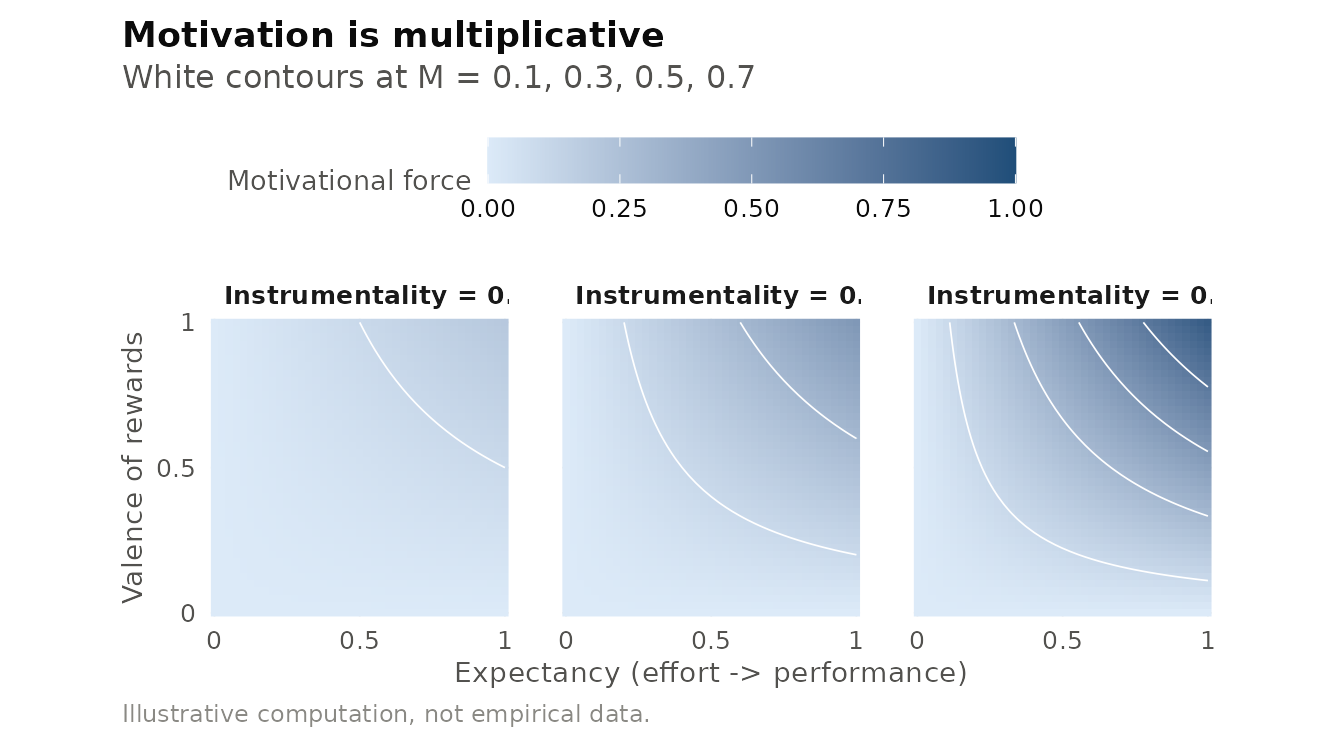
Figure 19.1: Illustrative motivational force under the multiplicative expectancy model (M = E x I x V). Each panel fixes instrumentality at a different level. Motivation is high only when all three components are high. A near-zero value on any component collapses motivation.
Table 19.3 translates each component into managerial levers and research measures.
| Component | Belief in question | What lowers it | Managerial levers | Example measure |
|---|---|---|---|---|
| Expectancy (E) | Effort -> performance | Unrealistic targets, lack of skill, tools, or authority | Training, resources, attainable goals, self-efficacy building | Subjective probability of reaching a target with high vs. normal effort |
| Instrumentality (I) | Performance -> outcomes | Opaque or discretionary rewards, caps, favouritism | Transparent pay-for-performance rules, credible commitments | Perceived link between performance and pay or promotion |
| Valence (V) | Value of outcomes | Rewards that do not match preferences | Cafeteria-style rewards, recognition, meaningful work | Rated attractiveness of each outcome |
19.2.3 Evidence and extensions
Van Eerde and Thierry (1996) meta-analysed tests of Vroom’s models. Each component, valence, instrumentality, and expectancy, was related to work criteria such as performance, effort, intention, preference, and choice, but the multiplicative combination did not generally predict better than the components entered separately or additively. Effects were also larger in within-subject designs, which compare a person’s choices across alternatives, than in between-subject designs, which compare people. The second finding fits Vroom’s original intent: the theory models how an individual chooses among options, not why one person is more motivated than another.
The expectancy component has a close cousin in Bandura’s concept of self-efficacy (Section 21.5): the belief that one can execute the behaviours required to produce an outcome (Bandura 1977). Self-efficacy has become one of the most robust predictors of effort and persistence, and it is a central moderator in goal-setting theory. Steel and König (2006) integrated expectancy and valence with time discounting in temporal motivation theory, which explains procrastination as the result of rewards that are valued but distant.
19.2.4 Applications in business
Sales quotas and the shape of incentive plans. Sales compensation is the purest field laboratory for expectancy theory, because the links between effort, performance (bookings), and pay are explicit. Research on nonlinear plans, quotas with lump-sum bonuses, shows that salespeople respond strategically to where they stand relative to the threshold. Oyer (1998) documented that sales across many industries are higher at the end of fiscal years, consistent with salespeople timing effort and deals to meet annual targets. Larkin (2014) found that enterprise-software salespeople facing accelerating commission schedules timed and priced deals to maximise their own pay, at a cost to the firm. Chung, Steenburgh, and Sudhir (2014) estimated a dynamic model of salespeople’s responses to a bonus-based plan and concluded that bonuses enhanced sales productivity, with periodic bonuses helping to keep weaker performers on pace and overachievement commissions sustaining the effort of stronger performers who had already reached their quotas. In expectancy terms, a quota that is far out of reach destroys expectancy. A quota already met destroys instrumentality for the rest of the period. Both lower effort.
Using expectancy theory in research.
- H1. Raising a sales quota will increase effort among salespeople whose pre-period performance is close to the new quota and decrease effort among those far below it (an inverted-U in expectancy).
- H2. The effect of bonus size on effort will be stronger when the performance-pay link is transparent (high instrumentality).
Designs. Within-person choice experiments (conjoint designs over effort-reward options). Field data on nonlinear incentive plans exploiting distance to threshold. Structural models of dynamic effort. Measures. Subjective probabilities and ratings for each component. Self-efficacy scales.
Testing a within-person theory between persons. Correlating one person’s average expectancy score with another person’s performance tests a different question from the one Vroom posed. Where possible, measure E, I, and V for several alternatives per person and model choices within individuals (Van Eerde and Thierry 1996).
19.3 Equity Theory
Core claim. People judge the fairness of their outcomes by comparing their ratio of outcomes to inputs with that of a referent other. Unequal ratios create psychological tension, which people reduce by changing inputs, outcomes, perceptions, comparison others, or the relationship itself.
Origins. Social psychology of exchange, J. S. Adams (1963), J. S. Adams (1965), rooted in social exchange theory (Section 9.1) and social comparison theory (Section 22.1).
Level of analysis. Individual and dyad (employee-employer, employee-coworker).
Key constructs. Inputs, outcomes, referent other, under-reward and over-reward inequity, distributive justice, equity sensitivity.
Boundary conditions. Requires a salient comparison other and comparable inputs and outcomes. Reactions to over-reward are weaker than to under-reward. Individuals differ in equity sensitivity.
Related theories. Social exchange theory (Section 9.1), Social comparison (Section 22.1), Expectancy theory.
19.3.1 Core logic
J. S. Adams (1963) proposed that people evaluate an exchange relationship by comparing two ratios:
\[\frac{O_p}{I_p} \quad \text{versus} \quad \frac{O_o}{I_o},\]
where \(O\) denotes perceived outcomes (pay, recognition, status, interesting assignments), \(I\) denotes perceived inputs (effort, skill, education, seniority, time), \(p\) is the person, and \(o\) is the comparison other. Equity exists when the ratios are equal, not when outcomes are equal. A senior engineer who earns more than a junior colleague perceives no inequity if the difference is proportional to differences in inputs.
When the ratios differ, the person experiences inequity: under-reward inequity (one’s own ratio is lower) produces anger and resentment, whereas over-reward inequity (one’s own ratio is higher) produces guilt, although the threshold for noticing over-reward is typically higher. Because the tension is unpleasant, people act to restore equity. J. S. Adams (1965) catalogued the available responses (Table 19.4).
| Response | Under-reward example | Over-reward example | Organizational consequence |
|---|---|---|---|
| Alter own inputs | Reduce effort, withdraw extra-role behaviour | Work harder or longer | Productivity and citizenship behaviour change |
| Alter own outcomes | Request a raise, take resources (including theft) | Decline a perk (rare) | Pay negotiations, deviance |
| Cognitively distort own inputs or outcomes | ‘My job is less demanding than I thought’ | ‘I really do contribute more’ | Attitudes adjust without behaviour change |
| Act on or distort the other | Pressure the other to work harder, belittle their inputs | Encourage the other to do less | Team conflict, norm enforcement |
| Change the comparison other | Compare with a worse-off group instead | Compare with a better-paid group | Shifts in reference groups |
| Leave the field | Absenteeism, quitting, transfer | Rare | Turnover |
19.3.2 Mechanism
Figure 19.2 shows the causal chain. Two moderators are especially important. First, equity sensitivity: some people (“benevolents”) tolerate under-reward, others (“entitleds”) prefer over-reward, and others (“equity sensitives”) follow Adams’ predictions closely (Huseman, Hatfield, and Miles 1987). Second, interactional justice: honest, respectful explanations of how outcomes were decided reduce the intensity of reactions to the same distributive outcome (Greenberg 1990, Colquitt et al. 2001).
Figure 19.2: Mechanism of equity theory. Comparing one’s own outcome/input ratio with a referent’s creates perceived inequity, which produces distress (anger or guilt) and motivates restoration. Equity sensitivity and the adequacy of explanations moderate the process.
19.3.3 Evidence and extensions
The most cited field demonstration is Greenberg (1990). In a manufacturing company, two plants experienced a temporary pay cut, while a third plant did not. Employee theft rose in the plants with the pay cut and fell back when normal pay resumed. Crucially, theft rose much less in the plant where management explained the pay cut thoroughly and with expressions of regret than in the plant that received a brief, impersonal explanation. Theft, in equity terms, was a way of restoring outcomes. The explanation reduced the perceived unfairness of the same pay cut.
Equity theory evolved into the broader field of organizational justice (Section 15.9). In addition to distributive justice (fairness of outcomes, the domain of equity theory), researchers identified procedural justice, fairness of the process, including the opportunity for voice (J. Thibaut and Walker 1975), and interactional justice, which Colquitt et al. (2001) showed is best split into interpersonal and informational components. Their meta-analysis supported four distinct but correlated forms of justice with partly different consequences (Table 19.5).
| Justice dimension | Fairness of … | Typical criteria | Managerial lever |
|---|---|---|---|
| Distributive | Outcomes | Equity (proportional to inputs), equality, need | Pay structure, bonus allocation |
| Procedural | Decision processes | Voice, consistency, bias suppression, accuracy, correctability | Transparent criteria, appeal mechanisms |
| Interpersonal | Treatment by decision-makers | Dignity, respect, propriety | Manager training, respectful delivery |
| Informational | Explanations | Truthfulness, adequacy, timeliness of explanations | Explaining pay decisions and cuts |
19.3.4 Applications in business
Pay transparency and fairness. Pay transparency laws and policies make referent outcomes visible. Card et al. (2012) exploited a natural experiment: after a newspaper launched a searchable website of University of California employees’ salaries, researchers informed a random subset of employees about the site. Employees whose pay was below the median for their unit and occupation reported lower job satisfaction and greater intention to look for a new job. Those above the median showed no corresponding increase in satisfaction. The asymmetry is exactly what equity theory predicts: under-reward hurts more than over-reward helps. For firms adopting pay transparency, the lesson is that the inputs side of the ratio must also be visible and credible, published pay bands, clear criteria for progression, and explanations for differences, or transparency will mainly reveal perceived inequities.
Using equity theory in research.
- H1. Disclosure of peer salaries will reduce satisfaction among below-median employees more than it increases satisfaction among above-median employees.
- H2. The negative effect of a pay cut on discretionary effort will be weaker when the cut is accompanied by an adequate explanation.
Measures. Colquitt’s justice scales, equity sensitivity instrument (Huseman, Hatfield, and Miles 1987), behavioural outcomes such as turnover, absenteeism, and shrinkage. Designs. Natural experiments in disclosure, field experiments on explanations, laboratory games with manipulated referent outcomes.
Assuming the referent. Researchers and managers often assume that employees compare themselves with the obvious peer group. Equity theory makes the choice of referent a variable, and people may compare with former colleagues, friends in other firms, or their own past outcomes. Measure the referent or manipulate it, do not assume it.
19.4 Goal-Setting Theory
Core claim. Specific, difficult goals lead to higher performance than easy goals, vague goals, or exhortations to “do your best”, provided that people are committed to the goal, have the ability to reach it, and receive feedback.
Origins. Industrial-organizational psychology, Locke and Latham (1990), summarised in Locke and Latham (2002).
Level of analysis. Individual, team, and organization.
Key constructs. Goal specificity, goal difficulty, goal commitment, feedback, task complexity, self-efficacy, learning versus performance goals.
Boundary conditions. Effects weaken for complex tasks where people lack strategies, when commitment is low, and when goals conflict. Poorly designed goals produce side effects.
Related theories. Expectancy theory, Goal gradient, Prospect theory (Chapter 24), Self-regulation (Chapter 20).
19.4.1 Core logic and propositions
Goal-setting theory was built inductively from hundreds of laboratory and field studies. Locke and Latham (2002) summarise its core propositions:
- P1 (Difficulty). Performance increases with goal difficulty, up to the limits of ability, provided the person remains committed.
- P2 (Specificity). Specific, difficult goals produce higher performance than vague “do your best” goals, because vague goals allow a wide range of acceptable performance.
- P3 (Mechanisms). Goals affect performance through four mechanisms: they direct attention to goal-relevant activities, energise effort, prolong persistence, and prompt the discovery and use of task strategies.
- P4 (Moderators). Goal effects are stronger when commitment is high (goals are important and self-efficacy is high), when feedback shows progress, and when tasks are simple. For complex tasks, learning goals can outperform performance goals.
Figure 19.3 sketches the basic relationship.
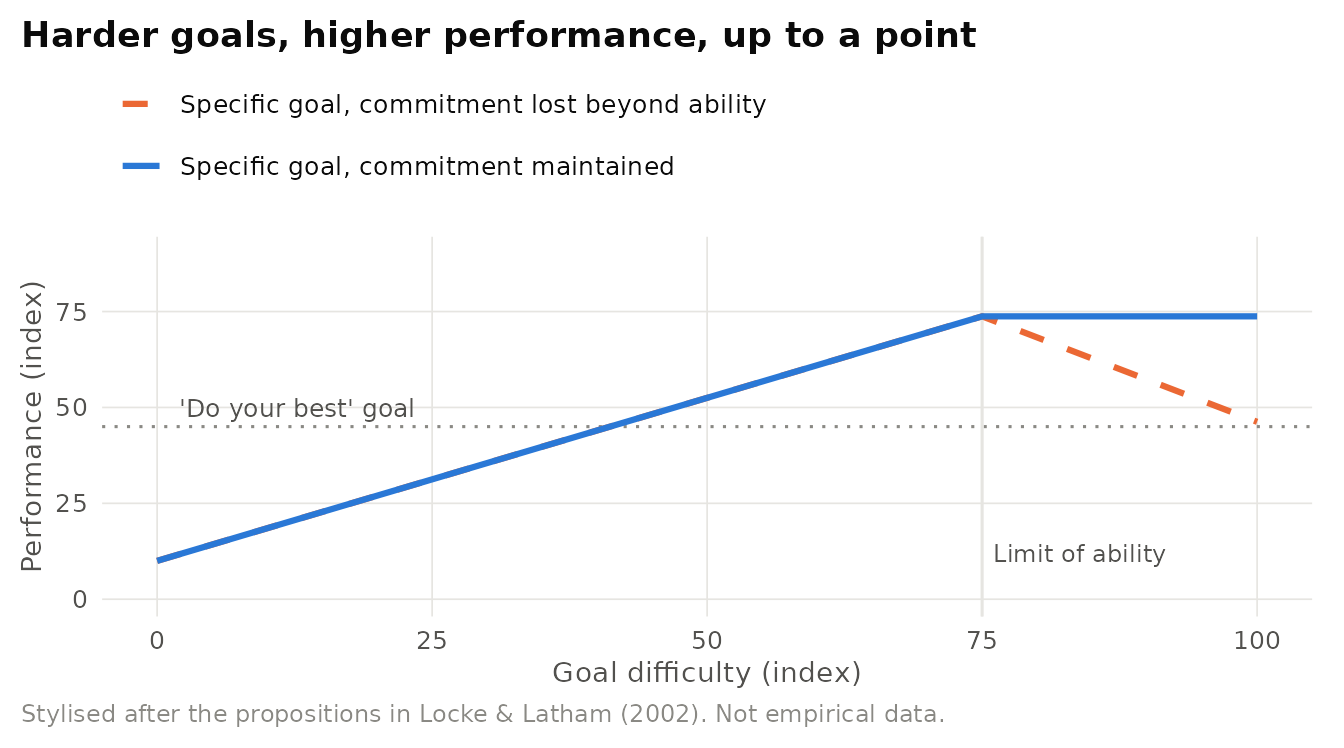
Figure 19.3: Stylised goal-difficulty function. Performance rises with goal difficulty up to the limit of ability. Beyond that point, performance plateaus when commitment holds and falls when people abandon an impossible goal. A vague ‘do your best’ goal produces moderate performance.
Goals also act as reference points. Heath, Larrick, and Wu (1999) showed that goals divide outcomes into gains and losses: falling short of a goal feels like a loss, and, consistent with prospect theory (Chapter 24) (Kahneman and Tversky 1979), the marginal value of effort is greatest near the goal. This reference-point view explains why goals motivate even without external rewards and foreshadows both the goal-gradient and the losing-leads-to-winning phenomena discussed below. Field data confirm reference-point effects in performance: professional golfers putt more accurately for par than for an otherwise comparable birdie (Pope and Schweitzer 2011), and marathon finishing times bunch just ahead of round-number targets such as four hours (E. J. Allen et al. 2017) (Table 19.6).
| Moderator | How it changes the goal effect | Design implication |
|---|---|---|
| Goal commitment | Effects require commitment, increased by importance and self-efficacy | Explain why the goal matters, build confidence, consider participation |
| Feedback | Allows people to track progress and adjust effort or strategy | Provide frequent, specific progress information |
| Task complexity | Effects smaller on complex tasks requiring new strategies | Use learning goals (e.g., ‘identify five new approaches’) on novel tasks |
| Ability | Performance plateaus at the limit of ability | Calibrate difficulty to capability, train |
| Goal conflict | Multiple goals compete for attention | Prioritise, avoid incompatible targets |
19.4.2 Evidence and the “goals gone wild” debate
The evidence base for goal-setting theory is among the largest in organizational psychology, and its effects have been replicated across tasks, countries, and levels from individuals to organizations (Locke and Latham 1990, 2002). The theory’s very success, however, provoked a debate about its side effects.
Goals gone wild? Ordóñez et al. (2009) argued that goal setting had been “overprescribed” and that specific, challenging goals have systematic side effects: they narrow attention so that unrewarded dimensions of performance (quality, safety, learning) are neglected. They encourage riskier behaviour, they can crowd out intrinsic motivation, and, most seriously, they motivate unethical behaviour. They drew on organizational cases, including Sears’ auto-repair centres and the Ford Pinto, and on experimental evidence. In one such experiment, Schweitzer, Ordóñez, and Douma (2004) found that people with unmet specific goals were more likely to overstate their performance than people told to do their best, and that the tendency was strongest when they fell just short of the goal. Locke and Latham (2009) replied that the critics relied heavily on anecdotes, that the side effects are well known and are addressed within goal-setting theory, and that the remedy is better goal setting, appropriate difficulty, multiple goals that include quality and ethics, and monitoring, not abandoning goals. The productive synthesis is that goals are powerful and therefore need the same governance as any powerful incentive.
19.4.3 Applications in business
Wells Fargo’s cross-selling targets. Wells Fargo’s retail bank long promoted an aggressive cross-selling strategy, summarised internally by the slogan “Eight is great”, a goal of eight products per household. In September 2016, the Consumer Financial Protection Bureau, the Office of the Comptroller of the Currency, and the Los Angeles City Attorney announced settlements totalling $185 million over the opening of accounts that customers had not authorised. The regulators’ analysis found that employees may have opened roughly 1.5 million deposit accounts and submitted roughly 565,000 credit-card applications without customers’ consent. The bank had dismissed about 5,300 employees over several years for related misconduct. Subsequent reviews identified a far larger number of potentially unauthorised accounts, and in 2020 the bank agreed to pay $3 billion to resolve criminal and civil investigations by the U.S. Department of Justice and the Securities and Exchange Commission. A report commissioned by the bank’s independent directors in 2017 attributed the misconduct to a sales culture and performance-management system built around high, specific product targets. In the vocabulary of this chapter, the case combines the conditions that Ordóñez et al. (2009) and Schweitzer, Ordóñez, and Douma (2004) identified: difficult, specific, and highly monitored goals. Narrow measurement (accounts opened rather than accounts used). Pressure that intensified as employees approached their targets, and weak controls against gaming.
Using goal-setting theory in research.
- H1. Specific, difficult goals will increase output quantity but reduce quality when quality is not included in the goal.
- H2. The probability of misreporting will be highest for employees who end a period just below their goal.
- H3. Learning goals will outperform performance goals on novel, complex tasks.
Designs. Randomised goal assignments in the lab or field. Regression discontinuity around goal thresholds. Bunching estimators for outcomes near round-number goals (E. J. Allen et al. 2017). Measures. Goal difficulty and specificity, commitment scales, objective performance, audit data on misreporting.
Measuring what is easy rather than what matters. Goals direct attention to whatever is measured. A goal defined on a proxy (accounts opened, calls handled, tickets closed) will be pursued at the expense of the underlying objective (customer value, problem resolution). Pair quantity goals with quality and integrity metrics, and audit the behaviours that the goal makes tempting.
19.5 The Goal-Gradient Hypothesis
Core claim. The tendency to approach a goal increases with proximity to the goal: effort accelerates as the reward draws near.
Origins. Behaviourist learning theory. Hull (1932) and Hull (1934) on rats running toward food. J. S. Brown (1948) on gradients of approach and avoidance. Revived in consumer research by Kivetz, Urminsky, and Zheng (2006).
Level of analysis. Individual (animals, consumers, employees).
Key constructs. Goal distance, perceived progress, effort acceleration, illusionary (endowed) progress, post-reward resetting.
Boundary conditions. Effects depend on perceived rather than actual progress. Motivation can sag in the middle of a goal. In competition, being far behind can trigger quitting.
Related theories. Goal-setting theory, Losing leads to winning, Prospect theory (Chapter 24).
19.5.1 Origins and core logic
Hull (1932) formulated the goal-gradient hypothesis to explain maze learning: responses closer to the reward are reinforced more strongly, so animals move faster as they approach the goal. Hull (1934) measured rats’ running speed along a straight alley and found that they ran faster as they neared the food. J. S. Brown (1948) showed that gradients of approach (and of avoidance) were steeper when the animal’s motivation was stronger.
Seven decades later, Kivetz, Urminsky, and Zheng (2006) asked whether the same principle governs human consumers in reward programs. In a field study at a university café that used a “buy ten, get one free” coffee card, customers purchased coffee more frequently as they approached the free coffee. In an online music-rating program that rewarded participants after a given number of ratings, participants visited more often and rated more songs per visit as they neared the reward. After earning a reward, purchase rates fell back: a post-reward resetting of motivation. The researchers also documented illusionary goal progress: a 12-stamp card pre-stamped with two stamps was completed faster than a 10-stamp card with no pre-stamps, although both required ten purchases.
Figure 19.4 shows the pattern in stylised form.
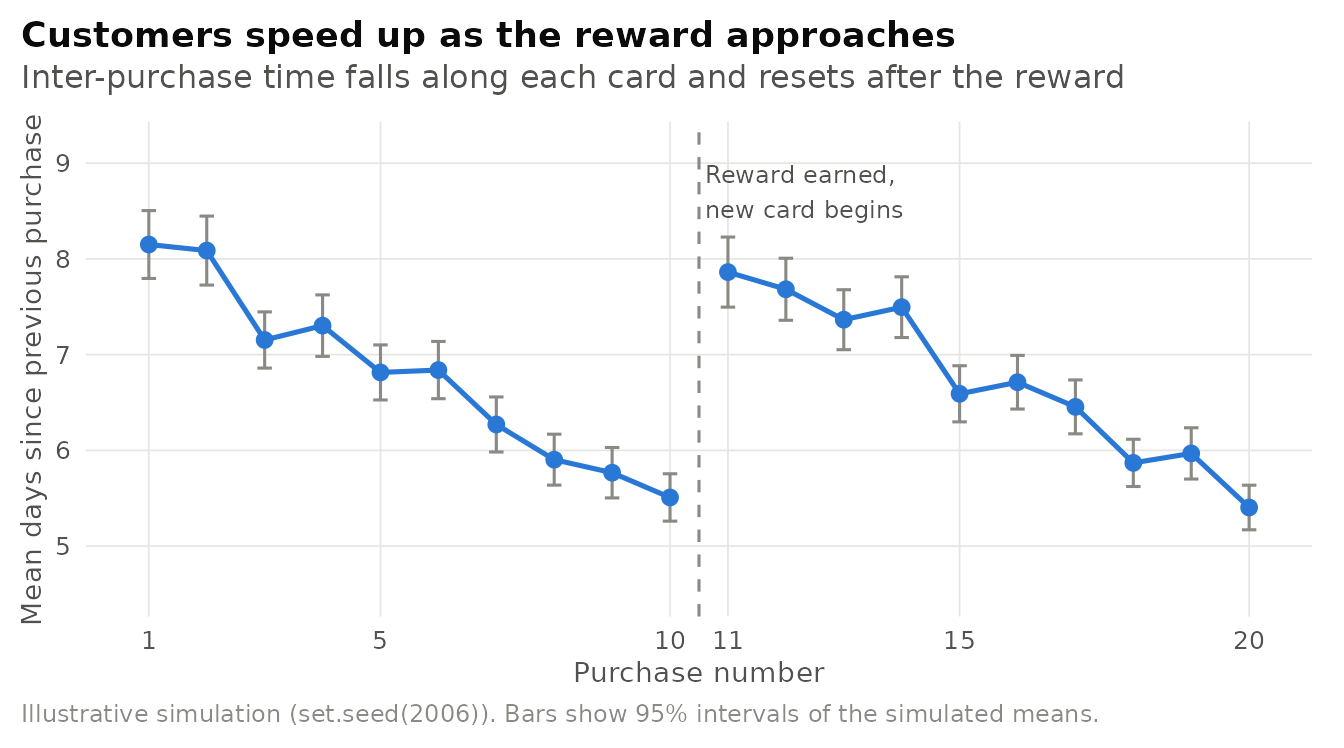
Figure 19.4: Illustrative goal-gradient pattern in a ‘buy ten, get one free’ program: the interval between purchases shortens as customers approach the reward and resets after the reward is earned. Simulated data (500 customers) constructed to mirror the qualitative pattern reported by Kivetz, Urminsky, and Zheng (2006).
19.5.2 Mechanism and extensions
Why does proximity motivate? Three explanations complement one another. In Hull’s behaviourist account, actions closer to the reward are more strongly reinforced. In a cognitive account, each action produces a larger proportional reduction in the remaining distance as the goal approaches, the last stamp eliminates 100% of the remaining distance, the first only 10%, so the perceived marginal impact of effort rises. In a reference-point account, falling just short of a goal is experienced as a loss (Heath, Larrick, and Wu 1999).
The perceived-progress mechanism explains the endowed progress effect. Nunes and Drèze (2006) gave car-wash customers loyalty cards that required eight purchases for a free wash. For half the customers the card had eight spaces. For the other half it had ten spaces with two already stamped. Customers given the “endowed” cards completed them substantially more often and faster, although both groups needed the same eight purchases. Progress that is framed as already under way appears to increase commitment to finishing.
Motivation is not always monotonic in progress. Bonezzi, Brendl, and De Angelis (2011) showed that motivation can be “stuck in the middle”: people focus on progress made so far (to-date) near the start and on what remains (to-go) near the end, and both frames produce their largest marginal effects at the extremes, so motivation sags mid-way. Koo and Fishbach (2008) found that whether emphasising accomplished or remaining actions increases motivation depends on commitment: emphasising what has been accomplished helps when commitment is uncertain, and emphasising what remains helps when commitment is already high.
Competition modifies the gradient further. Fershtman and Gneezy (2011) studied tournaments in which the stakes were raised and found that higher stakes increased effort among those still in contention but also led more participants to quit. And Dai et al. (2018) showed that high expectations can make favoured competitors more likely to quit when they fall behind: quitting provides a face-saving excuse that protects the inference of high ability.
19.5.3 Applications in business
Loyalty programs and gamification. The goal gradient is built into the architecture of modern loyalty and engagement systems: punch cards and stamp cards, points thresholds for status tiers, progress bars on profile completion, and streaks in learning apps. The research suggests five design principles. (1) Make progress visible: the gradient depends on perceived distance. (2) Endow initial progress: start customers part-way along the card, as in Nunes and Drèze (2006). (3) Shorten the middle: break long goals into sub-goals to avoid the mid-point slump (Bonezzi, Brendl, and De Angelis 2011). (4) Plan for the reset: after a reward, offer an immediate new goal so that resetting does not become attrition (Kivetz, Urminsky, and Zheng 2006). (5) Beware of competitive leaderboards: those far from the top may disengage (Fershtman and Gneezy 2011).
Design two versions of a loyalty card for a local bakery: a standard ten-stamp card and an endowed-progress card. Specify how you would randomise cards across customers, what outcome you would measure (completion rate, time to completion, post-reward return), and how you would distinguish a goal-gradient effect from seasonal variation in purchases.
19.6 Self-Determination Theory
Core claim. Motivation varies not only in amount but in type. Autonomous motivation, acting from interest or personally endorsed values, produces better persistence, performance on complex tasks, and well-being than controlled motivation driven by rewards, punishments, or guilt. Satisfying the needs for autonomy, competence, and relatedness fosters autonomous motivation.
Origins. Social psychology, Deci and Ryan (1985), R. M. Ryan and Deci (2000), applied to work by Gagné and Deci (2005).
Level of analysis. Individual (with social-contextual antecedents).
Key constructs. Intrinsic motivation, extrinsic motivation, internalisation, external, introjected, identified, and integrated regulation, basic psychological needs, undermining (crowding-out) effect.
Boundary conditions. Undermining effects apply to tasks that are initially interesting. Rewards perceived as informational rather than controlling can support motivation.
Related theories. Expectancy theory, Goal-setting theory, Agency theory (Section 6.1).
19.6.1 Core logic
Deci and Ryan (1985) distinguished intrinsic motivation, doing an activity for its inherent satisfaction, from extrinsic motivation: doing it for a separable outcome. Self-determination theory refines the second category. Extrinsic motivation can be more or less internalised, ranging from external regulation (acting to obtain rewards or avoid punishment), through introjected regulation (acting to avoid guilt or to maintain self-esteem), to identified regulation (acting because one personally values the outcome) and integrated regulation (the value is fully assimilated into one’s sense of self) (R. M. Ryan and Deci 2000). The theory groups external and introjected regulation as controlled motivation, and identified, integrated, and intrinsic regulation as autonomous motivation (Figure 19.5).
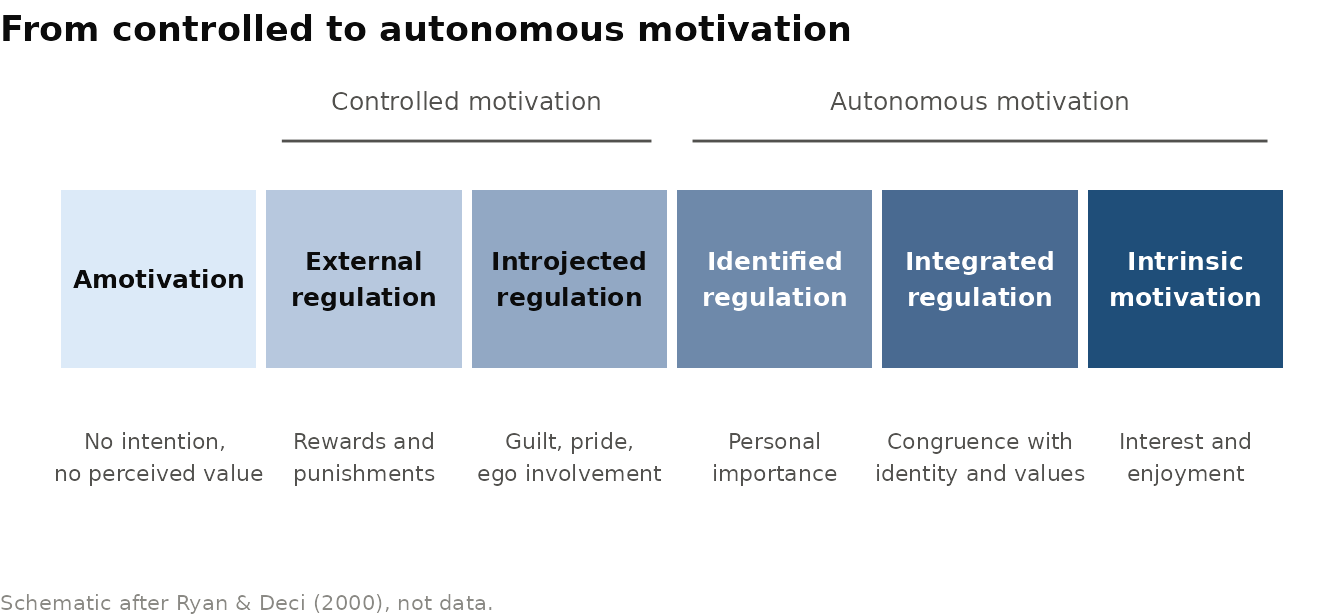
Figure 19.5: The self-determination continuum (after Ryan & Deci, 2000). Forms of motivation are ordered by the degree to which regulation is experienced as autonomous. External and introjected regulation are ‘controlled’, identified, integrated, and intrinsic regulation are ‘autonomous’.
Social contexts move people along this continuum by supporting or thwarting three basic psychological needs: autonomy (experiencing one’s behaviour as self-endorsed), competence (feeling effective), and relatedness (feeling connected to others) (R. M. Ryan and Deci 2000). At work, autonomy-supportive supervision, acknowledging employees’ perspectives, offering choice, and explaining the rationale for requests, is associated with more autonomous motivation, better performance on complex tasks, and higher well-being (Gagné and Deci 2005).
19.6.2 Mechanism: when rewards backfire
The most provocative prediction of self-determination theory is the undermining effect: tangible rewards can reduce intrinsic motivation for an activity that was initially interesting. In a classic study, Lepper, Greene, and Nisbett (1973) found that preschool children who drew with markers in order to receive an expected “good player” award later spent less free time drawing than children who had not been offered the award. Self-determination theory explains the effect through the functional significance of the reward: a reward experienced as controlling shifts the perceived locus of causality from “I do this because I enjoy it” to “I do this for the reward” and thwarts autonomy. A reward experienced as informational conveys competence and need not undermine motivation (Figure 19.6).
Figure 19.6: Mechanism of motivation crowding. Whether an extrinsic reward undermines or supports intrinsic motivation depends on whether it is experienced as controlling or informational, which in turn depends on reward type and contingency, and on whether the reward reframes the situation from a social to a market exchange.
19.6.3 Evidence and extensions
Deci, Koestner, and Ryan (1999) meta-analysed experiments on rewards and intrinsic motivation, measured by free-choice persistence and self-reported interest. Tangible rewards that were expected and contingent on doing, completing, or performing a task undermined intrinsic motivation for interesting tasks. Unexpected tangible rewards and verbal rewards (positive feedback) did not, and verbal rewards tended to enhance it.
Economists documented parallel phenomena under the label motivation crowding (Frey and Jegen 2001). Gneezy and Rustichini (2000b) found that paying participants a small piece rate for answering IQ-test questions produced lower performance than paying nothing, whereas a larger piece rate raised performance above the small-payment level. Similarly, students collecting charitable donations collected less when offered a small commission than when offered nothing. Hence the title: “pay enough or don’t pay at all”. In a field experiment at Israeli day-care centres, Gneezy and Rustichini (2000a) found that introducing a modest fine for parents who collected their children late increased late arrivals, and the higher level persisted after the fine was removed. The fine appears to have converted a moral obligation into a price that parents were willing to pay.
How general is crowding out? Cameron and Pierce (1994) meta-analysed many of the same experiments and concluded that rewards had little overall detrimental effect on intrinsic motivation, prompting a long-running exchange about which studies to include and how to classify reward conditions. Deci, Koestner, and Ryan (1999) was in part a response. A later synthesis by Cerasoli, Nicklin, and Ford (2014) suggests a reconciliation: intrinsic motivation predicted performance, especially its quality, while extrinsic incentives better predicted performance quantity. The two jointly predicted performance, and the role of intrinsic motivation was weaker when incentives were directly tied to performance. The practical conclusion is not that incentives are harmful, but that their design, contingency, framing, and the type of task, determines whether they complement or crowd out intrinsic motivation.
19.6.4 Applications in business
Intrinsic motivation in knowledge work. Amabile (1996) argued that intrinsic motivation is conducive to creativity, whereas controlling extrinsic constraints , close monitoring, evaluation emphasised for its own sake, rewards contingent on narrow outputs, tend to undermine it, and that informational feedback and recognition can support it. For managers of engineers, designers, analysts, and researchers, self-determination theory implies several practices: give teams meaningful choice over how they meet goals. Frame metrics as feedback rather than surveillance. Use recognition and development opportunities that signal competence, and avoid piece-rate incentives for open-ended creative work, where contingent tangible rewards are most likely to crowd out interest (Gagné and Deci 2005, Deci, Koestner, and Ryan 1999). Pay still matters, as a fair, predictable base that removes concern about money, consistent with equity theory, but it is a poor tool for stimulating curiosity.
Using self-determination theory in research.
- H1. Performance-contingent bonuses will increase output quantity but reduce the novelty of solutions in open-ended design tasks.
- H2. The negative effect of contingent rewards on persistence will be weaker when rewards are framed as feedback about competence.
- H3. Introducing small payments for prosocial behaviour will reduce participation relative to no payment (crowding out), but larger payments will increase it.
Measures. Free-choice persistence, Work Extrinsic and Intrinsic Motivation or Motivation at Work scales, basic need satisfaction scales. Designs. Randomised reward framing, field experiments with payment levels (Gneezy and Rustichini 2000b), panel data following changes in incentive regimes.
Treating “intrinsic versus extrinsic” as a zero-sum dichotomy. Most work behaviour is extrinsically motivated in some sense, yet it can still be highly autonomous (identified or integrated). The relevant question is usually not whether to use incentives, but how to design them so that employees experience them as fair and informational rather than controlling.
19.7 Losing Leads to Winning
Core claim. Being slightly behind a competitor or a reference point can increase effort enough to raise the probability of eventual success.
Origins. Behavioural economics and psychology. Berger and Pope (2011), building on reference-dependent preferences (Section 24.5) (Kahneman and Tversky 1979) and goals as reference points (Heath, Larrick, and Wu 1999).
Level of analysis. Individual and team in competitive settings.
Key constructs. Reference point, distance from the reference point, motivational effort, competitive feedback.
Boundary conditions. Applies only when the deficit is small. Large deficits reduce perceived attainability and can trigger quitting. Requires that effort can still affect the outcome.
Related theories. Goal gradient, Goal-setting theory, Prospect theory (Chapter 24), Social comparison (Section 22.1).
19.7.1 Core logic and evidence
Berger and Pope (2011) analysed a large archive of professional and college basketball games. Being ahead at half-time naturally predicts winning, but the relationship was not smooth near zero: teams that were behind by a single point at half-time won more often than teams that were ahead by a single point. To isolate the mechanism, the authors ran laboratory experiments in which participants competed on an effortful task and received manipulated feedback at a break. Participants told that they were slightly behind their opponent exerted more effort than those told that they were tied or slightly ahead.
The explanation combines two ideas from this chapter. First, the tie acts as a salient reference point. Trailing by a little places a team in the domain of losses, where the value function is steepest and the motivation to close the gap is strongest (Kahneman and Tversky 1979, Heath, Larrick, and Wu 1999). Second, a small deficit preserves expectancy: catching up is clearly feasible. A large deficit preserves the loss frame but destroys expectancy, which is why the effect should, and in the data does, appear only for small margins. Figure 19.7 shows the pattern in stylised form.
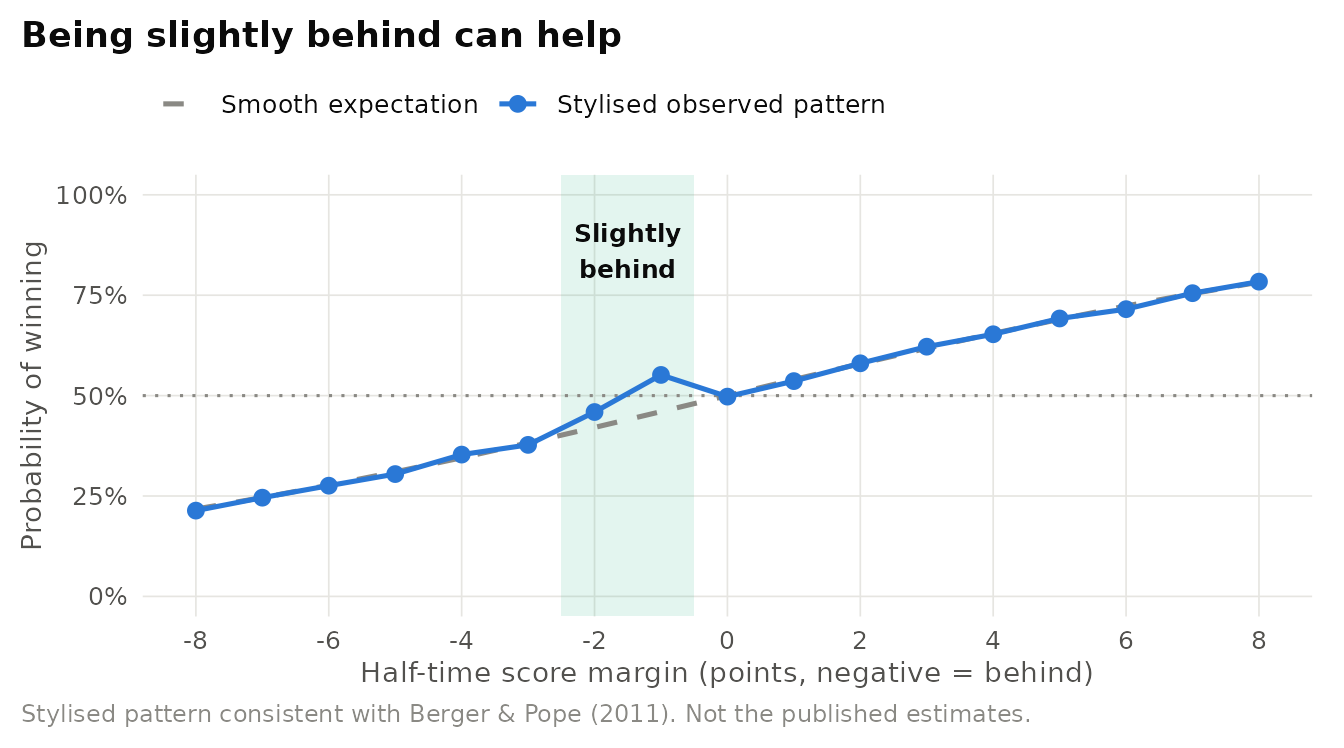
Figure 19.7: Stylised illustration of the ‘losing leads to winning’ pattern reported by Berger and Pope (2011): win probability generally rises with the half-time margin, but teams slightly behind win more often than a smooth trend predicts. Values are illustrative, not the published estimates.
How robust is the effect? The basketball pattern is a discontinuity at a single point in a noisy outcome, and such patterns invite scrutiny about specification and generalisability. The laboratory evidence strengthens the causal story by manipulating feedback directly, and the broader literature on reference points (Pope and Schweitzer 2011, E. J. Allen et al. 2017) supports the mechanism. At the same time, competitive settings differ: in tournaments with high stakes, falling behind can induce quitting rather than effort (Fershtman and Gneezy 2011), and favourites who fall behind may withdraw effort to protect their image (Dai et al. 2018). The theory therefore predicts a narrow band in which deficits motivate, bounded on one side by complacency and on the other by discouragement.
19.7.2 Applications in business
Illustrative scenario: designing sales contests and progress feedback. A regional sales director runs a monthly contest between branches. A conventional leaderboard shows every branch its rank. The losing-leads-to-winning logic suggests a different design: give each branch feedback relative to a near competitor (“you are 3% behind the Riverside branch”) rather than to the leader, reset contests frequently so that most branches are within reach at the mid-point, and avoid displaying large deficits that invite quitting. The same logic applies to fundraising thermometers, fitness apps that compare users with similar peers, and internal hackathons that publish interim standings.
Using the theory in research.
- H1. Teams or individuals slightly behind at an interim checkpoint will exert more subsequent effort than those slightly ahead. The effect will reverse for large deficits.
- H2. The effect will be stronger when interim standings are salient and when effort can still affect outcomes.
Designs. Regression discontinuity at interim ties in sports, sales contests, or crowdfunding, laboratory experiments manipulating interim feedback, field experiments randomising peer-comparison feedback. Outcomes. Effort measures (activity counts, time on task) and final success.
19.8 Integrating the Theories
The theories in this chapter are complementary rather than rival. Expectancy theory explains the calculus of effort. Goal-setting theory explains how specific targets focus that calculus. The goal gradient and losing-leads-to-winning phenomena show how the calculus changes with distance from a reference point. Equity theory adds that rewards are judged relative to others, and self-determination theory warns that the type of motivation matters as much as its quantity. A well-designed incentive system, for customers or employees, attends to all five: attainable goals (expectancy), credible links between performance and reward (instrumentality), fair comparisons (equity), progress visibility (gradient), and autonomy-supportive framing (self-determination).
19.9 Chapter Summary
- Content theories (Maslow, Herzberg) ask what motivates. Process theories ask how motivation works and generally have stronger empirical support (Wahba and Bridwell 1976, Latham and Pinder 2005).
- Expectancy theory treats motivation as E x I x V. A weak link anywhere collapses motivation, although meta-analytic evidence favours the components more than their exact multiplicative combination (Vroom 1964, Van Eerde and Thierry 1996).
- Equity theory explains reactions to the ratio of outcomes to inputs relative to a referent. Under-reward provokes withdrawal and even theft, mitigated by adequate explanations (J. S. Adams 1965, Greenberg 1990, Colquitt et al. 2001).
- Specific, difficult goals raise performance through direction, effort, persistence, and strategy (Locke and Latham 2002), but poorly governed goals can motivate narrow focus and misconduct (Ordóñez et al. 2009, Schweitzer, Ordóñez, and Douma 2004).
- Effort accelerates near goals, in rats, coffee buyers, and online raters, and perceived progress can be engineered (Hull 1932, Kivetz, Urminsky, and Zheng 2006, Nunes and Drèze 2006).
- Self-determination theory distinguishes autonomous from controlled motivation. Expected, contingent tangible rewards can crowd out intrinsic motivation, and small payments or fines can backfire (R. M. Ryan and Deci 2000, Deci, Koestner, and Ryan 1999, Gneezy and Rustichini 2000b, 2000a).
- Being slightly behind can increase effort and success, within a narrow band bounded by complacency and discouragement (Berger and Pope 2011).
Table 19.7 presents the comparison of the chapter’s motivation theories.
| Theory | Key mechanism | Signature prediction | Main boundary condition | Typical business use |
|---|---|---|---|---|
| Expectancy theory | Beliefs about effort, performance, and rewards | A near-zero component collapses motivation | Calculative choice, within-person | Quota and bonus design |
| Equity theory | Social comparison of outcome/input ratios | Under-reward triggers withdrawal or restitution | Salient referent, equity sensitivity | Pay transparency, pay-cut communication |
| Goal-setting theory | Direction, effort, persistence, strategy | Specific difficult goals beat ‘do your best’ | Commitment, feedback, task complexity | Performance management, OKRs |
| Goal gradient | Perceived progress and marginal impact | Effort accelerates near the goal | Perceived not actual distance, competition | Loyalty programs, gamification |
| Self-determination theory | Need satisfaction, internalisation | Controlling rewards undermine interest | Initially interesting tasks | Knowledge-work incentives, volunteering |
| Losing leads to winning | Reference point plus attainability | Small deficits raise success | Only for small deficits | Contests, peer-comparison feedback |
19.10 Discussion Questions
- Vroom’s model is multiplicative, but meta-analytic evidence suggests that additive combinations predict as well. What does this imply about how people actually combine expectancy, instrumentality, and valence? Design an experiment that distinguishes the two models.
- A firm is about to publish salary bands internally. Using equity theory and the organizational-justice literature, predict which employees will react most negatively and propose three steps to mitigate those reactions.
- Was the Wells Fargo cross-selling scandal a failure of goal setting or a failure of goal governance? Use the exchange between Ordóñez et al. and Locke and Latham to build your argument.
- Kivetz et al. found that customers accelerate as they approach a reward and slow down after it. How would you redesign a coffee-shop loyalty program to exploit the first finding and counteract the second?
- When are monetary incentives likely to crowd out intrinsic motivation, and when are they likely to crowd it in? Formulate a hypothesis that specifies the moderating conditions.
- Under what conditions would you expect “losing leads to winning” to fail in a business setting such as a sales contest or a start-up competition? How would you test your prediction?
19.11 Further Reading
- Latham and Pinder (2005): an authoritative review of work-motivation theory and evidence at the turn of the century.
- Vroom (1964): the founding statement of expectancy theory. Read with Van Eerde and Thierry (1996) for the empirical record.
- J. S. Adams (1965): the definitive presentation of equity theory and the responses to inequity. Pair with Greenberg (1990) for a vivid field test.
- Locke and Latham (2002): a concise synthesis of 35 years of goal-setting research. Read with Ordóñez et al. (2009) and Locke and Latham (2009) for the debate on side effects.
- Kivetz, Urminsky, and Zheng (2006): the modern demonstration that the goal gradient governs consumer behaviour in reward programs.
- R. M. Ryan and Deci (2000): the clearest short introduction to self-determination theory. See Deci, Koestner, and Ryan (1999) for the evidence on rewards and intrinsic motivation.
- Gneezy and Rustichini (2000b) and Gneezy and Rustichini (2000a): two short, influential papers showing when incentives backfire.
- Berger and Pope (2011): an elegant combination of field and laboratory evidence that being slightly behind can increase success.