32 Theory Atlas
The Theory Atlas collects every entry in the book in one place. Use it to look up a theory’s core claim, find theories that operate through the same mechanism, or locate candidates for a research question. In the online edition the table is searchable, sortable, and filterable. Each theory name links to its full entry.
32.1 Searchable atlas
The searchable table below lists every entry in the book.
The atlas is also available as a plain CSV file,
data/theory-atlas.csv,
for use in teaching materials, literature reviews, or your own analyses.
32.2 Theories by mechanism
Theories that share a mechanism are natural competitors or complements. Figure 32.1 counts the entries by dominant mechanism and part of the book.
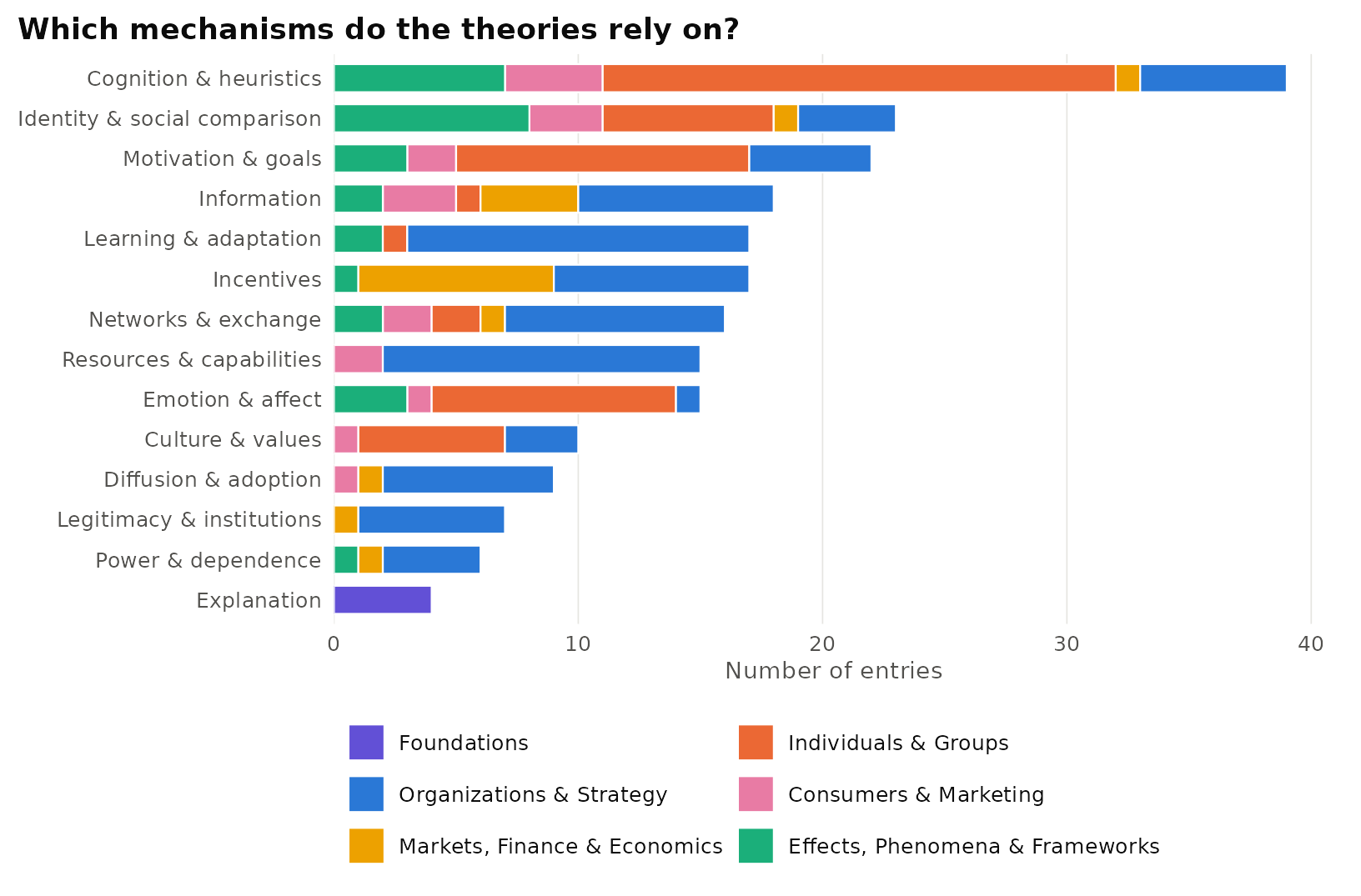
Figure 32.1: Entries in the book by dominant mechanism, stacked by part of the book.
Table 32.1 presents the mechanism families used in the atlas.
| Mechanism | What drives behaviour | Entries | Examples |
|---|---|---|---|
| Cognition & heuristics | Limited attention, mental shortcuts, and representation | 39 | Upper echelons theory, Attention-based view, Effectuation, Escalation of commitment |
| Identity & social comparison | Who people think they are and how they compare with others | 23 | Identity signaling, Attraction-selection-attrition, Organizational identity, Organizational justice |
| Motivation & goals | Goals, expectations, rewards, and self-regulation | 22 | Stewardship theory, Theory of planned behavior, Job characteristics model, Organizational commitment (three-component model) |
| Information | What actors know, can observe, or can infer from others’ actions | 18 | Costly signaling, Countersignaling, Information asymmetry, Screening theory |
| Incentives | Payoffs, contracts, and the costs of transacting | 17 | Agency theory, Transaction cost economics, Creating shared value, Competitive dynamics |
| Learning & adaptation | Search, experimentation, selection, and reconfiguration | 17 | Absorptive capacity, Dynamic capabilities, Exploration vs. exploitation, Organizational ambidexterity |
| Networks & exchange | Relationships, reciprocity, and positions in social structure | 16 | Commitment-trust theory, Social capital, Social exchange theory, Strength of weak ties |
| Emotion & affect | Feelings, arousal, and their influence on judgment | 15 | Affective events theory, Social facilitation, Feelings-as-information theory, Loss aversion |
| Resources & capabilities | Heterogeneous, hard-to-imitate assets and routines | 15 | Knowledge-based view, Market-based assets, Resource-advantage theory, Resource-based view |
| Culture & values | Shared values and norms that differ across societies | 10 | Organizational culture, Person-environment fit, Transformational leadership, GLOBE |
| Diffusion & adoption | Spread of practices and technologies through social systems | 9 | Bass diffusion model, Diffusion of innovations, Information systems success model, Task-technology fit |
| Legitimacy & institutions | Taken-for-granted rules, norms, and social approval | 7 | Corporate social responsibility pyramid, Institutional theory, Legitimacy, Liability of newness |
| Power & dependence | Control over resources that others need | 6 | Resource dependence theory, Stakeholder theory, Network exchange theory, Structure-conduct-performance |
| Explanation | Meta-theoretical tools for building and testing theory | 4 | Levels of analysis, Theory building blocks, Mediation and moderation, Replication crisis |
32.3 Glossary
Table 32.2 presents the glossary of recurring terms.
| Term | Definition |
|---|---|
| Adverse selection | A hidden-information problem in which the parties most eager to transact are those the other side would least want to transact with. |
| Boundary condition | A limit on the who, where, and when to which a theory’s predictions apply. |
| Construct | An abstract concept (e.g., trust, legitimacy) that a theory relates to other concepts. Measured imperfectly by variables. |
| Countersignaling | Deliberately not sending a signal because other information already separates the sender from low types. |
| Descriptive norm | Perception of what most people actually do. |
| Dynamic capability | A firm’s ability to integrate, build, and reconfigure competences to address changing environments. |
| Equilibrium (pooling) | An outcome in which different types take the same action, so the action reveals nothing. |
| Equilibrium (separating) | An outcome in which different types take different actions, so the action reveals type. |
| HARKing | Hypothesizing after the results are known: presenting post hoc hypotheses as if they were a priori. |
| Injunctive norm | Perception of what most people approve or disapprove of. |
| Isomorphism | The tendency of organizations in a field to become similar in structure and practice. |
| Level of analysis | The unit (individual, dyad, group, firm, market) at which a construct or theory is defined. |
| Loss aversion | The tendency for losses to loom larger than gains of the same size. |
| Mechanism | The process through which a cause produces an effect. The ‘why’ of a theory. |
| Mediator | A variable that transmits the effect of an independent variable to a dependent variable. |
| Moderator | A variable that changes the strength or direction of a relationship. |
| Moral hazard | A hidden-action problem in which one party changes behaviour after a contract because the other cannot observe it. |
| Nomological network | The web of theoretical relationships in which a construct is embedded, used to establish construct validity. |
| Proposition | A statement of relationship between constructs. A hypothesis is its testable counterpart in terms of variables. |
| Reference point | The benchmark against which outcomes are coded as gains or losses. |
| Regulatory fit | The increased value people experience when the manner of goal pursuit matches their regulatory orientation. |
| Signal | An observable action chosen by an informed party that conveys information about an unobservable characteristic. |
| Social capital | Resources embedded in, and accessible through, social relationships. |
| Structural hole | A gap between two contacts who are not connected to each other, which a broker can span. |
| VRIO | Valuable, rare, inimitable, organized: the conditions for a resource to yield sustained competitive advantage. |