25 Emotion and Well-Being
Why do customers rate a long service encounter favourably if it ends well, yet forget an otherwise excellent stay because of a rude check-out? Why does the thrill of a new car fade within months, while the memory of a family trip keeps paying dividends for years? Why are some online articles shared thousands of times while equally useful ones vanish, and why do angry investors take risks that fearful investors avoid? Each question concerns the role of emotion, the short-lived, object-directed feelings that colour judgment and behaviour, and well-being, the longer-run evaluation of how one’s life is going.
This chapter introduces the theories that explain how emotions arise, what they do, and how they shape and are shaped by economic life. We begin with broaden-and-build theory, which proposes that positive emotions have a distinctive function. We then turn to hedonic adaptation, the tendency of emotional reactions to fade, and to the affect circumplex, which organizes feelings by valence and arousal. Arousal turns out to be central to emotion and virality. Appraisal theories explain why emotions of the same valence, such as fear and anger, have opposite effects on risk taking. We close with the research on money and happiness and the peak-end rule, which links emotion to memory and to the design of customer experiences (Table 25.1).
| Theory | Core question | Level of analysis | Key source |
|---|---|---|---|
| Broaden-and-build theory | What are positive emotions for? | Individual / team | Fredrickson (1998, 2001) |
| Hedonic adaptation | Why do emotional reactions to circumstances fade? | Individual | Brickman & Campbell (1971), Frederick & Loewenstein (1999) |
| Affect circumplex | How are feelings structured? | Individual | Russell (1980) |
| Emotion and virality | Which emotions make content spread? | Individual / network | Berger (2011), Berger & Milkman (2012) |
| Appraisal theory | Why do specific emotions arise, and how do they shape judgment? | Individual | Smith & Ellsworth (1985), Lerner & Keltner (2001) |
| Money and happiness | How do income and spending relate to well-being? | Individual / society | Dunn et al. (2008), Killingsworth et al. (2023) |
| Peak-end rule | How are experiences remembered and evaluated? | Individual | Kahneman et al. (1993) |
Two distinctions recur throughout the chapter. First, affect is the broad term for valenced feeling states. Moods are diffuse and lack a clear object, whereas emotions are brief and directed at something. Second, subjective well-being has an affective component (the balance of positive and negative feelings in daily life) and a cognitive component (life satisfaction, an overall evaluation) (Diener et al. 1999). Findings about one component do not automatically transfer to the other, a point that becomes important when we examine income and happiness.
25.1 Broaden-and-Build Theory
Core claim. Positive emotions broaden people’s momentary thought-action repertoires, and over time this broadening builds durable personal resources (physical, intellectual, social, and psychological) that outlast the emotion itself.
Origins. Positive and emotion psychology, Fredrickson (1998), formalized in Fredrickson (2001).
Level of analysis. Individual, extended to dyads and teams.
Key constructs. Positive emotions (joy, interest, contentment, love, amusement), broadened attention and cognition, durable resources, undoing effect, resilience, upward spirals.
Boundary conditions. Broadening is most consistent for low-approach positive states (amusement, contentment). High-approach positive states such as desire can narrow attention (Gable and Harmon-Jones 2008).
Related theories. Feelings-as-information (Section 23.7), Appraisal theory, Self-determination theory (Section 19.6), Hedonic adaptation.
25.1.1 Origins and intellectual history
Twentieth-century emotion research focused largely on negative emotions, whose functions seemed clear. Fear prepares a person to flee and anger to attack. Such emotions are associated with specific action tendencies that narrow attention and mobilize the body for a particular response. Positive emotions fit this model poorly. Joy and contentment do not prompt any obvious specific action, and their physiological signatures are weak. Fredrickson (1998) proposed that positive emotions have a different kind of function. Rather than narrowing the range of actions, they broaden it, prompting people to play, explore, savour, and integrate. Because these activities build skills, knowledge, and relationships, positive emotions have long-term adaptive value even though their immediate effects are diffuse.
25.1.2 Core logic and propositions
Fredrickson (2001) states the theory in terms of a set of hypotheses:
- P1 (Broaden). Positive emotions broaden the scope of attention and cognition and widen the array of thoughts and actions that come to mind.
- P2 (Build). Through repeated broadening, positive emotions build enduring personal resources: physical (health), intellectual (knowledge, problem-solving skills), social (relationships, support), and psychological (resilience, optimism, sense of purpose).
- P3 (Undo). Positive emotions speed recovery from the cardiovascular after-effects of negative emotions (the undoing hypothesis) (Fredrickson et al. 2000).
- P4 (Resilience). Resilient people use positive emotions to recover from negative experiences (Tugade and Fredrickson 2004).
- P5 (Upward spirals). Resources built through positive emotion increase the likelihood of future positive emotion, creating upward spirals of well-being (Figure 25.1).
Figure 25.1: The broaden-and-build mechanism (after Fredrickson, 2001). Positive emotions broaden momentary thought-action repertoires. Repeated broadening builds durable resources, which in turn increase future positive emotion (an upward spiral). Approach motivation moderates the broadening effect.
25.1.3 Evidence and extensions
The broaden hypothesis has been tested by inducing emotions and measuring the scope of attention and thought. In an early demonstration, people placed in a mild positive mood (for example, by watching a comedy film or receiving a small gift) were more likely to solve problems that require creative, remote associations (Isen, Daubman, and Nowicki 1987). Fredrickson and Branigan (2005) showed participants film clips that elicited amusement, contentment, neutrality, anger, or anxiety. Positive emotions broadened the scope of visual attention, leading participants to match figures on global rather than local features, and increased the number of things participants reported they would like to do in that moment.
Evidence for the build hypothesis is necessarily longitudinal. In a field experiment with working adults, Fredrickson et al. (2008) randomly assigned some participants to learn loving-kindness meditation. Meditation increased daily positive emotions, which over several weeks were associated with gains in personal resources such as mindfulness, purpose in life, and social support. These resources in turn predicted greater life satisfaction and fewer depressive symptoms. On the undoing hypothesis, participants who watched films eliciting contentment or amusement after an anxiety-inducing task showed faster cardiovascular recovery than those who watched neutral or sad films (Fredrickson et al. 2000).
The rise and fall of the “positivity ratio.” In a widely publicized article, Fredrickson and Losada (2005) claimed that individuals and teams flourish when their ratio of positive to negative emotions exceeds a critical value of about 2.9, derived from a nonlinear dynamic model borrowed from fluid dynamics. N. J. L. Brown, Sokal, and Friedman (2013) showed that the mathematical modelling was unfounded: the differential equations were applied without justification, and the claimed critical ratio had no valid derivation. The journal subsequently published a correction withdrawing the modelling element and the specific ratio. In a response, Fredrickson (2013) acknowledged the problems with the mathematics while maintaining that the broader claim (that higher ratios of positive to negative emotion are associated with better outcomes, within bounds) remains supported by other evidence. The episode is a cautionary tale about precise-sounding quantitative claims in applied psychology, and it does not invalidate the experimental evidence for broadening.
A second, more theoretical debate concerns motivational intensity. Gable and Harmon-Jones (2008) found that approach-motivated positive affect, such as the desire evoked by pictures of appetizing desserts, narrowed rather than broadened attention. They argue that the scope of attention depends on motivational intensity rather than valence: low-intensity positive states (contentment, amusement) broaden, while high-intensity positive states (desire, enthusiasm for a goal) focus attention on the goal.
25.1.4 Applications in business
Organizational research had documented links between positive emotion and work outcomes even before broaden-and-build theory was formalized. Employees who expressed more positive emotion at work received more favourable supervisor evaluations, higher pay, and more social support some time later (Staw, Sutton, and Pelled 1994). A meta-analysis of cross-sectional, longitudinal, and experimental studies concluded that frequent positive affect is not only a consequence of success but also a cause of it, in work, relationships, and health (Lyubomirsky, King, and Diener 2005). Laboratory experiments that induced happiness with a short comedy clip found higher productivity on a paid task (Oswald, Proto, and Sgroi 2015).
Positive leadership and employee well-being. Emotions spread within teams. In a laboratory study of groups working on a managerial exercise, a trained confederate who displayed pleasant emotion led group members to experience more positive mood, which improved cooperation and reduced conflict (Barsade 2002). Leaders’ moods have a similar effect: groups whose leaders were in a positive mood showed more positive group affective tone and better coordination, while groups whose leaders were in a negative mood exerted more effort (Sy, Côté, and Saavedra 2005). At the business-unit level, a meta-analysis of Gallup data found that employee satisfaction and engagement were related to customer satisfaction, productivity, profitability, and lower turnover (Harter, Schmidt, and Hayes 2002). Investors appear to underweight these benefits: a portfolio of firms listed among the “100 Best Companies to Work For in America” earned abnormal long-run returns, suggesting that the market did not fully value employee satisfaction (Edmans 2011). Broaden-and-build theory supplies a mechanism: positive emotions broaden cognition and build social resources, both of which matter in knowledge work. The theory also implies a caution: “mandated positivity” that suppresses legitimate negative emotion (for example, about safety or ethics) may undermine the problem detection that negative emotions support.
25.1.5 Using the theory in research
Sample hypotheses.
- H1. Team members’ daily positive affect will predict the number of novel ideas they contribute in subsequent meetings, mediated by breadth of attention.
- H2. The relationship between positive affect and creativity will be weaker for high-approach positive states (e.g., excitement about a bonus) than for low-approach states (e.g., contentment).
- H3. A workplace intervention that increases daily positive emotion will increase perceived social support six months later (build hypothesis).
Designs. Emotion inductions with global-local attention tasks. Experience-sampling studies with lagged models. Randomized field interventions (e.g., gratitude or meditation programmes) with longitudinal follow-up.
Measures. Positive and Negative Affect Schedule [PANAS, Watson, Clark, and Tellegen (1988)], daily emotion checklists, global-local processing tasks, resource measures (social support, resilience), performance and turnover data.
Treating positivity as a target ratio. After the positivity-ratio controversy, researchers and practitioners should avoid prescribing a specific balance of positive to negative emotion. The theory concerns the functions of positive emotions, not a numerical threshold for flourishing.
25.2 Hedonic Adaptation
Core claim. Emotional reactions to stable or repeated circumstances diminish over time, so changes in circumstances, whether good or bad, have smaller and shorter-lived effects on well-being than people expect.
Origins. Adaptation-level theory in perception, applied to happiness by Brickman and Campbell (1971) (“hedonic relativism”, later the “hedonic treadmill”), classic evidence in Brickman, Coates, and Janoff-Bulman (1978), reviewed by Frederick and Loewenstein (1999), revised by Diener, Lucas, and Scollon (2006) and R. E. Lucas (2007).
Level of analysis. Individual.
Key constructs. Adaptation level, set point, hedonic treadmill, desensitization, affective forecasting, incomplete adaptation.
Boundary conditions. Adaptation is faster for material circumstances and slower or incomplete for some events (e.g., disability, unemployment, widowhood). It varies across people and across components of well-being (R. E. Lucas 2007, Luhmann et al. 2012).
Related theories. Broaden-and-build theory, Prospect theory (Chapter 24), Peak-end rule, Social comparison theory (Section 22.1).
25.2.1 Origins and intellectual history
Adaptation-level theory in perception holds that judgments of stimuli (how heavy, how bright, how warm) depend on their relation to a level set by recent experience. Brickman and Campbell (1971) applied this idea to happiness. If people evaluate their circumstances relative to an adaptation level that rises with improvement, then gains in income or comfort produce only temporary increases in happiness. They called this predicament hedonic relativism. The image of a hedonic treadmill, on which people must keep running simply to stay in place, became its popular name.
The most famous early evidence came from Brickman, Coates, and Janoff-Bulman (1978), who compared lottery winners, people paralysed in accidents, and controls. Lottery winners were not reliably happier than controls and reported taking less pleasure in ordinary activities, consistent with a contrast effect against the peak experience of winning. Accident victims reported lower current happiness than controls, but not as low as observers would expect. Although the samples were small, the study became the emblem of adaptation.
Frederick and Loewenstein (1999) defined hedonic adaptation as any process that reduces the affective intensity of a constant or repeated stimulus, and distinguished two forms: shifting adaptation levels, in which the neutral reference point moves toward the current stimulus, and desensitization, in which sensitivity to changes declines. The distinction matters because the former implies that people return to neutral, whereas the latter implies that they merely feel changes less intensely.
25.2.2 From the treadmill to set-point revisions
The strong form of the treadmill (that everyone returns to hedonic neutrality after any event) has not survived empirical scrutiny. Drawing on large panel studies, Diener, Lucas, and Scollon (2006) proposed five revisions, summarized in Table 25.2.
| Revision | Original treadmill assumption | Revised view | Implication |
|---|---|---|---|
|
People adapt back to hedonic neutrality | Most people’s baseline is mildly positive | Average well-being is above the scale midpoint |
|
Everyone has the same set point | Set points vary, partly because of temperament | Personality predicts baseline happiness |
|
Happiness is a single quantity | Components (positive affect, negative affect, life satisfaction) can move in different directions | Measure components separately |
|
Long-run happiness cannot be changed | Well-being can shift durably under some conditions | Policy and interventions can matter |
|
Everyone adapts to the same degree | People differ in whether and how fast they adapt | Average trajectories mask heterogeneity |
Panel data from Germany and the United Kingdom were especially influential. R. E. Lucas et al. (2003) found that, on average, people received a boost in life satisfaction around marriage and then returned toward baseline, while widowhood produced a sharp drop followed by slow and, for many, incomplete recovery. R. E. Lucas (2007) summarized evidence that some events, including disability, unemployment, and divorce, are associated with lasting changes in life satisfaction, and that individual differences in reaction and adaptation are large. A meta-analysis by Luhmann et al. (2012) found that the course of adaptation differs across life events and across affective and cognitive components of well-being. Figure 25.2 illustrates these patterns with stylised data.
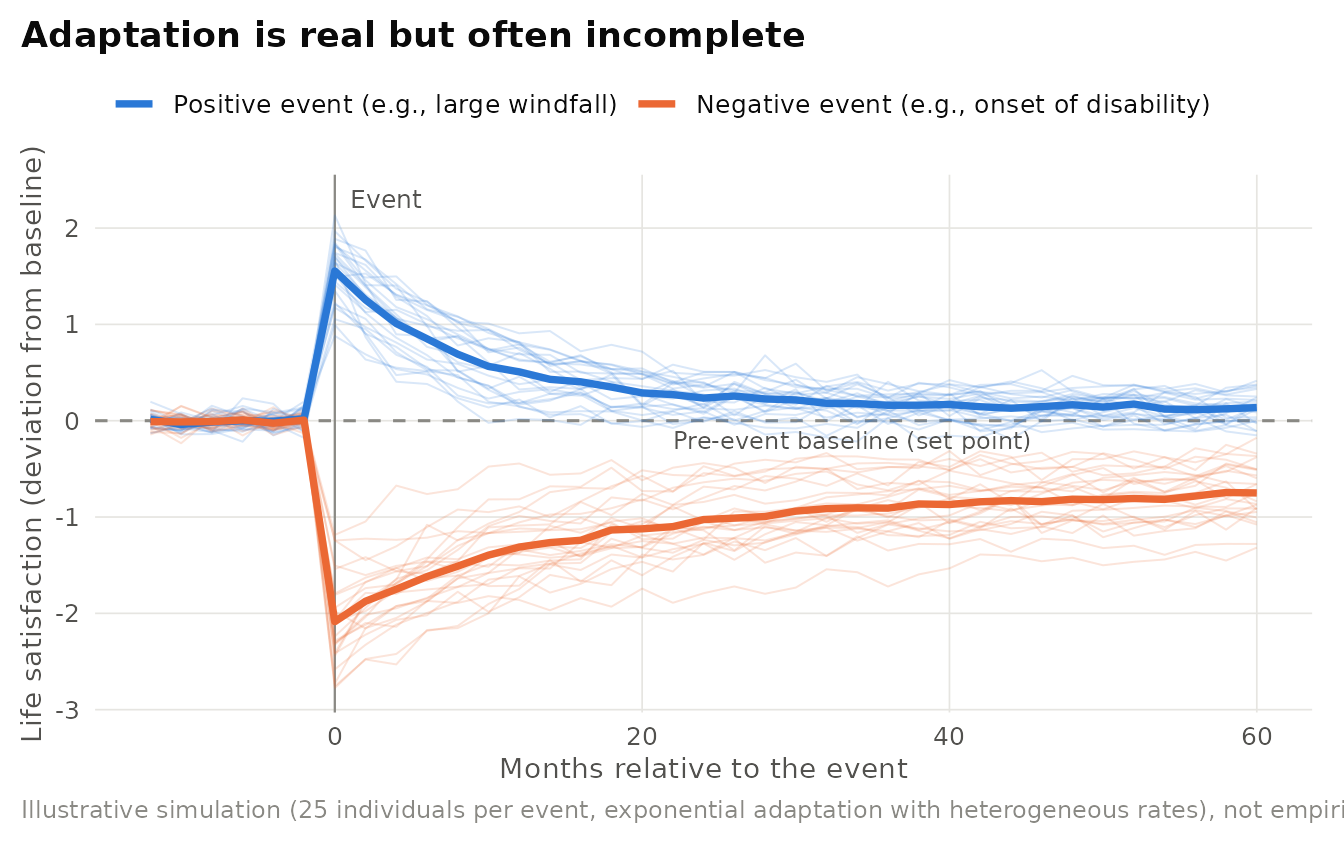
Figure 25.2: Illustrative adaptation trajectories after a positive and a negative life event. Thin lines show simulated individuals with heterogeneous reactions and adaptation rates. Thick lines show the average. Adaptation to the positive event is nearly complete, whereas adaptation to the negative event is partial, consistent with the revised set-point view (Diener et al., 2006, Lucas, 2007).
25.2.3 Can happiness be increased? The “happiness pie” and its critique
If people adapt to circumstances, can deliberate effort make anyone happier in the long run? Lyubomirsky, Sheldon, and Schkade (2005) proposed an influential “architecture of sustainable change”, often summarized as a pie chart: roughly 50 percent of the differences in chronic happiness reflect a genetically determined set point, about 10 percent reflect life circumstances (income, health, marital status), and about 40 percent reflect intentional activities, the things people choose to think and do. Because intentional activities can be varied, they argued, they are less susceptible to adaptation than circumstances and offer the most promising route to sustainable increases in happiness.
Is the 40 percent figure meaningful? N. J. L. Brown and Rohrer (2020) offer a detailed critique of the pie-chart model. First, the 50 percent figure is a heritability estimate, which describes the share of variance in a population associated with genetic differences. It does not imply that half of any individual’s happiness is fixed. Second, the 10 percent figure for circumstances was derived from correlations between selected life circumstances and well-being and is likely to underestimate their influence. Third, the 40 percent for intentional activities was not measured. It is a residual obtained by subtracting the other two figures, so it also absorbs measurement error and everything else not accounted for. Finally, variance components of this kind are not additive when genes and environments interact. The critique does not show that intentional activities are ineffective. It shows that the pie chart cannot quantify how much they matter. Experimental evidence on specific interventions is the appropriate test.
25.2.4 Affective forecasting and adaptation
People not only adapt. They also fail to anticipate that they will adapt. In studies of affective forecasting, people overestimate how long they will be unhappy after negative events such as a romantic breakup or a failed job application, a durability bias that arises partly because they neglect the psychological processes, such as rationalization, that speed recovery (immune neglect) (Gilbert et al. 1998, T. D. Wilson and Gilbert 2005). Forecasting errors matter for decisions: people may overpay to avoid outcomes they would have adapted to and underinvest in experiences whose benefits persist.
The hedonic adaptation prevention model proposes two levers that slow adaptation to positive changes: variety in the experiences a change brings and appreciation of the change, which counteracts rising aspirations (Sheldon and Lyubomirsky 2012).
25.2.5 Applications in business
Hedonic adaptation in subscriptions and retention. Subscription businesses face hedonic adaptation directly: the novelty that drives sign-up fades, and customers reassess whether the service is worth the price. Research suggests two counterintuitive levers. First, interruptions can restore enjoyment. Breaking up a pleasant experience such as a massage made it more enjoyable, whereas breaking up an unpleasant one made it more irritating (L. D. Nelson and Meyvis 2008). Even television programmes were enjoyed more when interrupted by commercials (L. D. Nelson, Meyvis, and Galak 2009). Second, the hedonic adaptation prevention model implies that variety and appreciation sustain satisfaction (Sheldon and Lyubomirsky 2012). Streaming services that rotate their catalogues, meal-kit services that change menus weekly, and loyalty programmes that remind members of accumulated benefits all work against adaptation. Illustrative scenario: a fitness app whose engagement declines after the first two months might test (a) rotating programme “seasons” to add variety, (b) a monthly summary of progress to cultivate appreciation, and (c) planned breaks, measuring retention against a control group.
Inferring adaptation from cross-sectional data. Comparing people who experienced an event years ago with those who did not cannot establish adaptation, because people who experience events differ systematically from those who do not. Adaptation is a within-person process and should be studied with panel data that include pre-event baselines, or with experiments.
25.3 The Affect Circumplex
Core claim. Affective states are not independent categories but points in a two-dimensional space defined by valence (pleasure-displeasure) and arousal (activation-deactivation). Emotion terms fall in a circular order around this space.
Origins. Psychology of emotion, Russell (1980), developed into the theory of core affect in Russell (2003).
Level of analysis. Individual feeling states.
Key constructs. Valence, arousal, core affect, circumplex ordering, positive and negative activation.
Boundary conditions. Captures the felt quality of affect well but not the appraisals and action tendencies that distinguish emotions with similar valence and arousal, such as fear and anger.
Related theories. Emotion and virality, Appraisal theory, Feelings-as-information (Section 23.7).
25.3.1 Core logic
Russell (1980) asked people to sort and rate 28 affect words and analysed the results with several scaling methods. The words consistently fell in a circle around two bipolar dimensions: pleasure versus displeasure (valence) and arousal versus sleepiness (arousal). Excited and delighted lie in the pleasant, high-arousal quadrant. Content and relaxed in the pleasant, low-arousal quadrant. Tense and angry in the unpleasant, high-arousal quadrant, and sad and bored in the unpleasant, low-arousal quadrant (Figure 25.3).
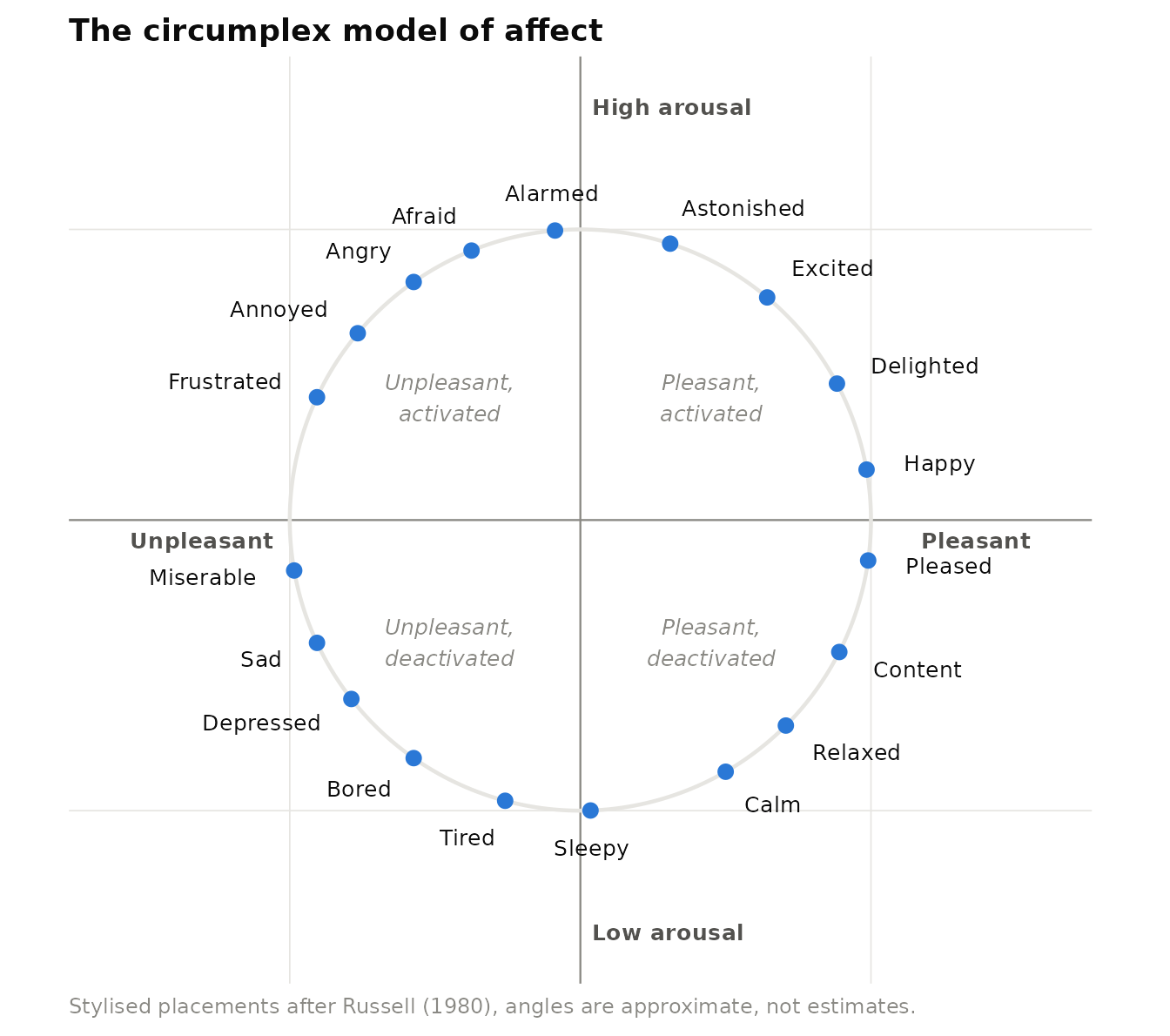
Figure 25.3: The affect circumplex. Emotion terms arranged by valence (horizontal) and arousal (vertical). Positions are approximate and stylised, following the ordering reported by Russell (1980).
Russell (2003) later developed the circumplex into a broader theory. Core affect is a continuously present neurophysiological state, experienced as a blend of pleasure and arousal, that is not necessarily directed at anything. Full-blown emotional episodes (an instance of fear, say) are constructed when core affect is attributed to an object and combined with appraisals, behaviour, and categorization. A related tradition represents affect with two unipolar dimensions, positive affect and negative affect (Watson and Tellegen 1985). Barrett and Russell (1999) argued that the two representations are rotations of the same space: positive and negative activation lie at roughly 45 degrees to the valence and arousal axes.
Dimensions or discrete emotions? Basic emotion theorists hold that a small set of emotions (such as fear, anger, disgust, sadness, happiness, and surprise) are discrete biological programs with distinctive signals and physiology (Ekman 1992). Dimensional theorists counter that such categories are constructed from more basic ingredients and that physiological differences between categories are less consistent than the basic-emotion view implies (Russell 2003). For applied researchers, the choice has practical consequences. Dimensional measures (valence, arousal) are parsimonious and work well for predicting outcomes driven by activation, such as sharing. Discrete measures are needed when emotions of similar valence and arousal have different effects, as fear and anger do on risk taking.
Measuring affect in business research. Self-report scales such as the PANAS (Watson, Clark, and Tellegen 1988) and valence-arousal grids. Experience sampling and the Day Reconstruction Method for affect in daily life (Kahneman et al. 2004). Automated facial-expression coding of video (Teixeira, Wedel, and Pieters 2012). Text-based sentiment and emotion dictionaries for reviews and social media, and physiological indicators (skin conductance for arousal). Validate any automated measure against self-report in the target context before relying on it.
25.5 Appraisal Theory
Core claim. Emotions are elicited by people’s evaluations (appraisals) of what events mean for their well-being. Specific emotions correspond to specific patterns of appraisal, and each emotion in turn carries an appraisal tendency that colours subsequent judgments, even of unrelated targets.
Origins. Emotion psychology, C. A. Smith and Ellsworth (1985), Lazarus (1991), reviewed in Moors et al. (2013), applied to judgment and decision making by Lerner and Keltner (2000) and Lerner and Keltner (2001).
Level of analysis. Individual.
Key constructs. Appraisal dimensions (pleasantness, certainty, control, responsibility, anticipated effort, attention), core relational themes, appraisal tendencies, incidental vs. integral emotion.
Boundary conditions. Appraisal tendencies carry over to unrelated judgments mainly when people are unaware of the emotion’s source and when the judgment is related to the emotion’s core appraisals.
Related theories. Affect circumplex, Feelings-as-information (Section 23.7), Prospect theory (Chapter 24), Endowment effect (Section 23.4).
25.5.1 Origins and core logic
The affect circumplex places fear and anger close together: both are unpleasant and high in arousal. Yet they feel different and lead to different behaviour. Appraisal theories explain why. C. A. Smith and Ellsworth (1985) asked people to recall experiences of various emotions and rate them on many candidate appraisal dimensions. Six dimensions, namely pleasantness, anticipated effort, certainty, attentional activity, responsibility (self vs. other), and situational control, were sufficient to distinguish fifteen emotions. Anger, for example, involves the appraisal that someone else is responsible for an unpleasant event and a sense of certainty about what happened. Fear involves uncertainty and the sense that the situation, rather than any person, is in control.
Lazarus (1991) integrated appraisal into a broader cognitive-motivational- relational theory. Each emotion has a core relational theme, a summary of the person-environment relationship that produces it. Anger stems from a demeaning offence against oneself or one’s own. Anxiety from facing an uncertain, existential threat. Sadness from an irrevocable loss. Happiness from making reasonable progress toward a goal. Table 25.4 summarizes appraisal patterns for several emotions that matter in business settings.
| Emotion | Core relational theme (paraphrased from Lazarus, 1991) | Key appraisals | Typical influence on judgment and choice |
|---|---|---|---|
| Anger | A demeaning offence against me or mine | Other-responsible, high certainty, high individual control | Optimistic risk estimates, risk seeking, heuristic processing |
| Fear / anxiety | Facing uncertain threat | Low certainty, situational control | Pessimistic risk estimates, risk aversion |
| Sadness | Experiencing an irrevocable loss | Loss, situational control | Desire to change circumstances, higher buying and lower selling prices |
| Disgust | Being too close to something offensive | Contamination, urge to expel | Desire to get rid of things, lower buying and selling prices |
| Happiness | Making reasonable progress toward a goal | Pleasant, high certainty, low effort | Optimistic risk estimates, heuristic processing |
| Pride | Enhancement of identity by taking credit for an achievement | Self-responsible, pleasant | Persistence, self-reward |
25.5.2 The appraisal-tendency framework
Lerner and Keltner (2000) proposed that each emotion activates a cognitive predisposition to appraise future events in line with the appraisals that produced the emotion. Because fear is associated with uncertainty and lack of control, fear should increase perceived risk. Because anger is associated with certainty and individual control, anger should reduce it. Lerner and Keltner (2001) confirmed these predictions: dispositionally fearful people made pessimistic risk estimates and risk-averse choices, whereas angry people made optimistic risk estimates and risk-seeking choices, as did happy people. In a national field experiment conducted shortly after the September 11, 2001 attacks, participants induced to feel anger estimated lower risks of future terrorism than participants induced to feel fear (Lerner et al. 2003). Certainty appraisals also shape processing style: emotions associated with certainty (anger, happiness) promote heuristic processing, whereas emotions associated with uncertainty promote systematic processing (Tiedens and Linton 2001).
Appraisal tendencies extend to economic valuation. Lerner, Small, and Loewenstein (2004) found that incidental disgust reduced both buying and selling prices, eliminating the endowment effect, whereas incidental sadness reversed it, lowering selling prices and raising buying prices, consistent with sadness motivating a change of circumstances. The finding is a striking example of how emotion moderates a phenomenon usually explained by loss aversion (Section 24.4) (see Endowment effect (Section 23.4)). Figure 25.5 summarizes the framework. Lerner et al. (2015) review the broader literature on emotion and decision making, and S. Han, Lerner, and Keltner (2007) apply it to consumer behaviour.
Figure 25.5: The appraisal-tendency framework (after Lerner & Keltner, 2000). Appraisals of an event produce a specific emotion. The emotion carries an appraisal tendency that shapes judgments and choices, including judgments unrelated to the emotion’s source.
25.5.3 Applications in business
Service recovery and crisis communication. Appraisal theory implies that the same service failure can produce different emotions, and therefore different behaviour, depending on how customers appraise responsibility and control. A delayed flight attributed to the airline’s poor planning (other-responsible, controllable) is likely to elicit anger, which motivates complaints, blame, and switching. A delay attributed to weather (situational control) is more likely to elicit frustration or anxiety, which motivates information seeking. Communications that accurately clarify cause and control, and that restore a sense of control (rebooking options, real-time updates), address the appraisals that drive the emotion. In crisis communication, the appraisal-tendency framework suggests that messages that evoke anger at a culprit may reduce perceived risk among the public, whereas messages that evoke fear increase it, a consideration for public-health and safety communicators (Lerner et al. 2003).
Sample hypotheses.
- H1. Customers who attribute a service failure to the firm (vs. to external circumstances) will report more anger and be more likely to post negative reviews, and anger will mediate the effect.
- H2. Incidental fear (vs. anger) induced before a pricing decision will increase willingness to pay for insurance-like product add-ons.
- H3. The effect of incidental emotion on investment risk taking will disappear when participants are made aware of the emotion’s source.
Designs. Emotion inductions (recall tasks, film clips) followed by ostensibly unrelated judgments. Appraisal manipulations (e.g., attribution of responsibility). Field data on emotional events (e.g., sports results, news shocks).
Measures. Discrete emotion self-reports, appraisal ratings, risk estimates, willingness to pay and accept, complaint and switching behaviour.
25.6 Money and Happiness
Does money buy happiness? The answer depends on which component of well-being is measured and on how money is spent. Table 25.5 summarizes the key findings.
| Question | Key study | Finding | Business implication |
|---|---|---|---|
| Does how you spend matter? | Dunn, Aknin & Norton (2008) | Spending on others predicted and (experimentally) caused greater happiness than spending on oneself | Gift, donation, and team-reward programmes |
| Is prosocial spending universal? | Aknin et al. (2013) | Association between prosocial spending and well-being observed across many countries | Prosocial rewards travel across cultures |
| Experiences or things? | Van Boven & Gilovich (2003) | Experiential purchases tend to make people happier than material purchases | Experiential offerings and bundles |
| Why experiences? | Carter & Gilovich (2010), Kumar et al. (2014) | Experiences are less subject to comparison and more pleasurable to anticipate | Market anticipation, reduce comparison shopping |
| Time or things? | Whillans et al. (2017) | Spending to buy time is associated with greater life satisfaction | Time-saving services as well-being products |
| Does income raise emotional well-being? | Kahneman & Deaton (2010) | Life evaluation rose with log income. Emotional well-being levelled off at higher incomes | Distinguish evaluation from experience |
| A plateau? | Killingsworth (2021) | Experienced well-being rose with log income with no plateau | Measurement choices matter |
| Resolution | Killingsworth, Kahneman & Mellers (2023) | A plateau appears only among the least happy minority. For most, happiness keeps rising with income | Heterogeneity across the happiness distribution |
25.6.1 How money is spent
Dunn, Aknin, and Norton (2008) combined three studies. In a national survey, spending on others (gifts and donations) predicted greater happiness, whereas personal spending did not. In a field study, employees who devoted more of a profit-sharing bonus to others reported greater happiness weeks later. In an experiment, participants who were randomly assigned to spend a small windfall on others by the end of the day were happier than those assigned to spend it on themselves, regardless of whether the windfall was $5 or $20. A cross-cultural follow-up found the association between prosocial spending and well-being in many countries (Aknin et al. 2013).
Van Boven and Gilovich (2003) found that experiential purchases (a trip, a concert, a meal) tend to make people happier than material purchases (clothing, jewellery, gadgets). Later work identified reasons: experiences are less easily compared with forgone alternatives (Carter and Gilovich 2010), are more pleasurable to anticipate (Kumar, Killingsworth, and Gilovich 2014), are more central to identity, and are more often shared with others (Gilovich, Kumar, and Jampol 2015). Spending money to buy time, for example on services that eliminate disliked chores, is also associated with greater well-being (Whillans et al. 2017).
25.6.2 How much money: an adversarial collaboration
Kahneman and Deaton (2010) analysed more than 450,000 responses to a daily survey of US residents and distinguished life evaluation (where respondents placed their life on a ladder from worst to best possible) from emotional well-being (reports of positive and negative emotions experienced the previous day). Life evaluation rose steadily with the logarithm of income. Emotional well-being also rose with income, but beyond an annual household income of about $75,000 there was no further progress. The $75,000 “plateau” became one of the most widely cited numbers in happiness research.
Killingsworth (2021) challenged the plateau. Using more than a million experience-sampling reports from tens of thousands of employed US adults, collected through a smartphone app, he found that experienced well-being rose linearly with log income with no sign of levelling off. The two findings appeared to conflict.
Rather than trading critiques, Kahneman and Killingsworth undertook an adversarial collaboration with Barbara Mellers as arbiter (Killingsworth, Kahneman, and Mellers 2023). They hypothesized that both findings could be true if the relationship between income and happiness differs across the happiness distribution. Re-analysing the experience-sampling data, they found that for the least happy minority of people (roughly the unhappiest fifth), happiness rose with income up to about $100,000 and then plateaued. For the majority, happiness continued to rise with income, and among the happiest it rose even faster above that level. They concluded that the earlier plateau reflected the fact that the 2010 measures of emotional well-being, which asked yes/no questions about the previous day, were most sensitive to differences in unhappiness. The episode is an exemplar of how scientific disagreements can be resolved constructively.
Experiential versus material offerings. Firms increasingly package goods as experiences: car makers offer driving events, retailers host workshops, and banks reward customers with access to concerts rather than merchandise. The research above offers a rationale and some design principles. Experiences are more satisfying when they are anticipated (pre-sell and build anticipation), shared (design for groups), and hard to compare directly with alternatives (create distinctive, non-commoditized experiences). Prosocial spending research suggests that reward programmes that let customers or employees give to others, such as donation options for loyalty points or team celebrations instead of individual merchandise, may produce more happiness per dollar (Dunn, Aknin, and Norton 2008). These are hypotheses to test, not guarantees: most of the evidence concerns individuals’ own spending rather than firm-designed programmes.
25.7 Peak-End Rule
Core claim. Retrospective evaluations of an experience are dominated by the affect at its most intense moment (the peak) and at its end, while its duration is largely neglected.
Origins. Psychology and behavioural economics, Kahneman et al. (1993), Fredrickson and Kahneman (1993), Redelmeier and Kahneman (1996), framed within the distinction between experienced and remembered utility by Kahneman, Wakker, and Sarin (1997).
Level of analysis. Individual memory and evaluation of episodes.
Key constructs. Experienced utility, remembered utility, peak, end, duration neglect.
Boundary conditions. Applies to evaluations of bounded episodes with a clear beginning and end. Duration matters more when it is made salient or is part of the evaluation criterion.
Related theories. Hedonic adaptation, Mental accounting (Section 23.5), Prospect theory (Chapter 24).
25.7.1 Core logic and evidence
Kahneman, Wakker, and Sarin (1997) distinguish experienced utility, the moment-by-moment hedonic quality of an experience, from remembered utility, the retrospective evaluation of the whole episode. Normatively, the total experienced utility of an episode should be the integral of momentary experience over time, so that adding unpleasant time can only make the episode worse. Remembered utility follows different rules.
In the experiment by Kahneman et al. (1993), participants immersed one hand in painfully cold water in two trials. In the short trial, the hand was immersed for 60 seconds. In the long trial, the hand was immersed for the same 60 seconds and then for an additional 30 seconds during which the water was warmed slightly, by about one degree Celsius, which was still unpleasant but less so. The long trial contained strictly more discomfort. Yet when asked which trial they would choose to repeat, most participants chose the long one. Their memories were shaped by the less painful ending, not by the extra duration. Studies of film clips found the same duration neglect in retrospective evaluations of pleasant and unpleasant episodes (Fredrickson and Kahneman 1993).
The rule matters outside the laboratory. Patients’ retrospective evaluations of painful colonoscopies were predicted by peak and end pain, not by the procedure’s duration (Redelmeier and Kahneman 1996). In a randomized trial, extending a colonoscopy with a short, less uncomfortable period at the end led patients to remember the procedure as less unpleasant, and they were more likely to return for follow-up procedures (Redelmeier, Katz, and Kahneman 2003). Figure 25.6 shows stylised profiles of the cold-water design.
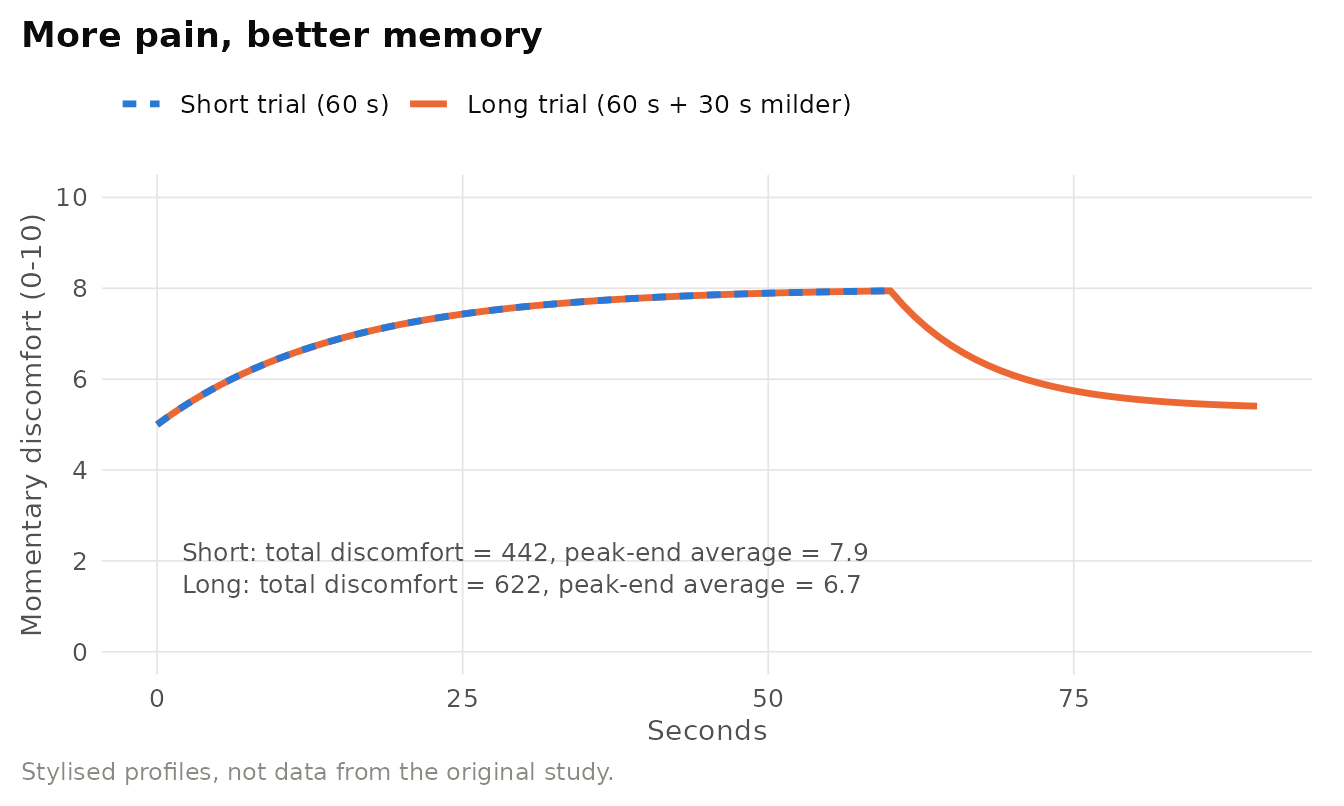
Figure 25.6: Stylised discomfort profiles modelled on the design of Kahneman et al. (1993). The long trial adds 30 seconds of milder discomfort. Total discomfort is higher, but the peak-end average is lower, so the long trial is remembered as less unpleasant.
25.7.2 Applications in business
Designing customer journeys around peaks and ends. The peak-end rule implies that customers’ memories of a service, which drive word of mouth and repurchase, are shaped disproportionately by its best or worst moment and its final moments. Chase and Dasu (2001) drew on this research to propose service design principles: finish strong rather than front-loading the best elements. Get unpleasant elements out of the way early. Segment pleasant experiences and combine unpleasant ones (echoing the hedonic editing principles of Mental accounting (Section 23.5)), and give customers a sense of choice and control. Practical applications include a final personal touch at hotel check-out, a smooth and friendly ending to a support call even after a long wait, and dessert or a small gift at the end of a restaurant meal. Because memories, not moment-by-moment experience, drive future choices, firms should measure both: real-time experience metrics to reduce actual discomfort, and retrospective satisfaction to capture what customers will remember.
Using the peak-end rule to justify a worse experience. The colonoscopy trial added a milder period that improved memory without causing additional harm. Extending an unpleasant service to “end on a high note” may improve retrospective ratings while increasing the total discomfort customers actually experience. Remembered and experienced utility can diverge, and ethical design should not sacrifice the latter to game the former (Kahneman, Wakker, and Sarin 1997).
Map a customer journey you know well (e.g., buying a car, opening a bank account). Rate the emotional intensity of each step and identify its peak and its end. Propose one change that improves the end without lengthening the journey, and one that reduces the worst moment.
25.8 Chapter Summary
- Positive emotions broaden attention and thought and, over time, build personal resources (Fredrickson 2001). The claimed “critical positivity ratio” was retracted after critique (N. J. L. Brown, Sokal, and Friedman 2013), but the experimental evidence for broadening stands.
- Hedonic adaptation is real but incomplete and heterogeneous. Set points are positive, differ across people, and can change (Diener, Lucas, and Scollon 2006, R. E. Lucas 2007). The 50/10/40 “happiness pie” cannot be interpreted as a decomposition of individual happiness (N. J. L. Brown and Rohrer 2020).
- The affect circumplex organizes feelings by valence and arousal (Russell 1980). Arousal, not valence alone, predicts sharing (Berger 2011, Berger and Milkman 2012).
- Appraisal theory explains why emotions of similar valence and arousal, such as fear and anger, have opposite effects on risk perception (C. A. Smith and Ellsworth 1985, Lerner and Keltner 2001).
- How money is spent matters: prosocial and experiential spending are associated with greater happiness (Dunn, Aknin, and Norton 2008, Van Boven and Gilovich 2003). Higher income is associated with greater happiness for most people, with a plateau only among the least happy (Killingsworth, Kahneman, and Mellers 2023).
- The peak-end rule and duration neglect mean that remembered experience diverges from experienced utility (Kahneman et al. 1993, Kahneman, Wakker, and Sarin 1997), with direct implications for customer-journey design.
Table 25.6 presents the comparison of the chapter’s theories.
| Theory | Key mechanism | Signature prediction | Typical business use |
|---|---|---|---|
| Broaden-and-build | Positive emotions broaden cognition and build resources | Positive affect increases creativity and resources over time | Positive leadership, employee well-being programmes |
| Hedonic adaptation | Shifting adaptation level, desensitization | Effects of new circumstances fade | Retention design, variety and interruption |
| Affect circumplex | Valence and arousal structure feelings | Emotions arranged in a circle | Measuring emotional response to products and ads |
| Emotion and virality | Arousal mobilizes action | High-arousal content is shared more | Content marketing, campaign design |
| Appraisal theory | Appraisals elicit emotions with appraisal tendencies | Fear raises and anger lowers perceived risk | Service recovery, crisis communication |
| Money and happiness | Spending patterns and income gradients | Prosocial and experiential spending raise happiness | Reward design, experiential offerings |
| Peak-end rule | Memory summarizes peak and end, duration neglected | Adding a milder ending improves evaluations | Customer-journey and service design |
25.9 Discussion Questions
- Broaden-and-build theory predicts that positive emotions build resources over time. Design a field study in an organization that could test the build hypothesis rather than only the broaden hypothesis.
- The positivity-ratio episode involved a published claim that was later corrected. What features of the original claim should have prompted scepticism, and what lessons does it hold for evaluating applied research?
- Using the revised set-point model, explain why a pay rise and a long commute might have different long-run effects on employee well-being. What data would you need to test your explanation?
- A brand team wants a campaign to “go viral”. Using the arousal × valence framework, evaluate three possible creative concepts and identify the risks of each.
- Fear and anger are both negative, high-arousal emotions. How would you expect customers’ emotions after a data breach to affect their risk perceptions and switching behaviour, and how should the firm’s communication differ depending on which emotion dominates?
- Kahneman and Deaton (2010) and Killingsworth (2021) reached different conclusions about income and emotional well-being. Explain how the adversarial collaboration reconciled them and what it implies for the design of employee compensation and benefits.
25.10 Further Reading
- Fredrickson (2001): the clearest statement of broaden-and-build theory and its hypotheses.
- N. J. L. Brown, Sokal, and Friedman (2013): a forensic critique of the positivity ratio. Essential reading on the misuse of mathematics in psychology.
- Diener, Lucas, and Scollon (2006): the standard reference on revising the hedonic treadmill.
- Russell (1980): the original circumplex model, short and influential.
- Berger and Milkman (2012): a field study of emotion and virality using New York Times articles. A model of combining text analysis with theory.
- Lerner et al. (2015): an authoritative review of emotion and decision making, including the appraisal-tendency framework.
- Killingsworth, Kahneman, and Mellers (2023): a model adversarial collaboration on income and emotional well-being.
- Kahneman, Wakker, and Sarin (1997): the conceptual foundation for distinguishing experienced from remembered utility.