4 Resources and Competitive Advantage
In the 1980s Toyota did something that puzzled Western competitors: it let them in. Executives from rival carmakers toured Toyota’s plants, and in 1984 General Motors and Toyota opened a joint venture in Fremont, California (NUMMI) that put the Toyota Production System inside a GM-staffed factory. The methods were visible, documented, and widely taught. Yet for decades few rivals matched Toyota’s combination of quality and productivity (Womack, Jones, and Roos 1990, Spear and Bowen 1999). Why would a firm give away its playbook, and why did the playbook not travel?
The same puzzle appears across industries. Walmart’s distribution system was described in business school cases for years before rivals approached its cost position. Disney’s characters are known to every child, yet no competitor can simply build a comparable library. Zara’s quick-response supply chain has been analysed in countless articles, yet it remains distinctive. Industry structure cannot explain these differences, because the firms face the same suppliers, customers, and substitutes as their rivals. The explanation must lie inside the firm: in what it owns, what it knows, and how it combines the two.
This chapter develops the family of theories that locate competitive advantage in firm-specific resources. We begin with the resource-based view (RBV), its origins, assumptions, and central propositions, and its best-known diagnostic, the VRIO framework. We then examine the knowledge-based view, which treats knowledge as the most strategically important resource, and the related idea of core competences. Two marketing-born extensions follow: resource-advantage theory, which embeds resources in a dynamic theory of competition, and the market-based assets framework, which links customer and channel relationships to shareholder value. Chapter 5 then asks how firms renew their resources when environments change (Table 4.1).
| Theory | Core question | Level of analysis | Key source |
|---|---|---|---|
| Resource-based view | Why do some firms persistently outperform rivals in the same industry? | Firm | Wernerfelt (1984), Barney (1991) |
| VRIO framework | Which resources can sustain an advantage, and what must the firm do to exploit them? | Resource / firm | Barney (1991), Barney & Hesterly (2012) |
| Knowledge-based view | Why do firms exist, and how do they create value by integrating knowledge? | Firm / team | Kogut & Zander (1992), Grant (1996) |
| Core competences | Which collective skills underpin a firm’s portfolio of businesses? | Corporation | Prahalad & Hamel (1990) |
| Resource-advantage theory | How does competition among heterogeneous firms unfold over time? | Firm / market | Hunt & Morgan (1995), Hunt (2000) |
| Market-based assets | How do customer and channel relationships create shareholder value? | Firm / market | Srivastava, Shervani, & Fahey (1998) |
4.1 The Resource-Based View
Core claim. Firms differ in the bundles of resources and capabilities they control. When a resource is valuable, rare, and costly for rivals to imitate or substitute, and the firm is organized to exploit it, it can yield a sustained competitive advantage and above-normal returns.
Origins. Strategic management, with roots in economics: Penrose (1959) on the firm as a bundle of productive resources, Wernerfelt (1984) on resource position barriers, J. B. Barney (1986) on strategic factor markets, Dierickx and Cool (1989) on asset stock accumulation, Jay Barney (1991) on the conditions for sustained advantage, M. A. Peteraf (1993) on the cornerstones of advantage. J. B. Barney, Ketchen, and Wright (2011) argue that the perspective has matured into a theory, often called resource-based theory (RBT).
Level of analysis. Primarily the firm (business unit). Also the resource, process, and exchange-relationship levels (Kozlenkova, Samaha, and Palmatier 2013, Ray, Barney, and Muhanna 2004).
Key constructs. Resources, capabilities, resource heterogeneity, resource immobility, value, rarity, imitability, substitutability, isolating mechanisms, economic rent, sustained competitive advantage.
Boundary conditions. Strongest where resources are firm-specific and traded in imperfect factor markets. Weaker in markets with rapid, discontinuous change, where the value of today’s resources can evaporate (see Dynamic capabilities (Section 5.1)).
Related theories. VRIO, Knowledge-based view, Resource-advantage theory, Market-based assets, Dynamic capabilities (Section 5.1), Transaction cost economics (Section 6.3), Five forces (Section 31.4).
4.1.1 Origins and intellectual history
The resource-based view emerged as a corrective to the dominant strategy paradigm of the early 1980s. Industrial-organization economics, translated into strategy by Michael E. Porter (1980a), explained profitability through industry structure: firms earn high returns when entry barriers, buyer and supplier power, and rivalry are favourable. That perspective treats firms within an industry as largely similar, or as differing only in the strategies they choose. Yet a recurring empirical observation is that performance differences within industries are large and persistent. Something firm-specific was missing.
The intellectual seed was planted much earlier. Penrose (1959) described the firm as a collection of productive resources organized within an administrative framework, whose growth is driven by the services those resources can render and limited by the managerial capacity to plan and coordinate expansion. Because resources are lumpy and managers learn on the job, firms always carry unused productive services, which create an internal incentive to grow into new activities: an idea that later shaped theories of diversification and of capabilities.
Wernerfelt (1984) coined the phrase “resource-based view of the firm” and proposed analysing firms from the resource side rather than the product side. He introduced resource position barriers, the resource-side analogue of entry barriers: a firm that holds a resource first can make it harder for later holders to catch up. J. B. Barney (1986) added a crucial economic argument. If resources could be bought in competitive strategic factor markets, their price would reflect their expected value and no buyer could earn above-normal returns from them. Superior returns must therefore come from resources that are acquired with better expectations or luck, or, more importantly, that are developed inside the firm rather than bought.
Dierickx and Cool (1989) sharpened that point. Strategic assets are stocks that are accumulated through a stream of flows (investment in R&D, advertising, training) over time. They cannot be bought ready-made. What sustains an advantage is the difficulty rivals face in replicating the accumulation path. The capstone statement came with Jay Barney (1991), who specified the conditions under which resources yield sustained competitive advantage, the VRIN criteria (valuable, rare, imperfectly imitable, non-substitutable), and M. A. Peteraf (1993), who translated the argument into the language of economic rents. Reviews soon followed (Mahoney and Pandian 1992, Amit and Schoemaker 1993, J. Barney and A. Arikan 2001), and by the 2000s the RBV had become the most widely used theory in strategic management and a major lens in marketing (Kozlenkova, Samaha, and Palmatier 2013, J. B. Barney, Ketchen, and Wright 2011).
4.1.2 Resources and capabilities
Definition 4.1 Resources are “tangible and intangible assets firms use to conceive of and implement its strategies” (J. Barney and A. Arikan 2001, 138).
A capability is a special type of resource: an “organizationally embedded non-transferable firm-specific resource whose purpose is to improve the productivity of the other resources possessed by the firm” (Makadok 2001, 389).
The distinction matters. A resource is something the firm has: a patent, a brand, a plant location, a pool of cash. A capability is something the firm can do by deploying and combining resources: designing cars quickly, replenishing stores accurately, launching films globally. Amit and Schoemaker (1993) make the same distinction: resources are stocks of available factors owned or controlled by the firm, and capabilities are the firm’s capacity to deploy them through organizational processes. Capabilities are typically more firm-specific than resources because they are embedded in routines, relationships, and tacit knowledge, and therefore harder to trade or copy.
Makadok (2001) uses the distinction to identify two distinct mechanisms of rent creation. Resource picking generates rents by being better than rivals at identifying and acquiring undervalued resources in factor markets (an argument that follows J. B. Barney (1986)). Capability building generates rents by making the resources the firm already owns more productive. The two mechanisms can be complements or substitutes, and they place different demands on managers: picking rewards superior information and judgement, whereas building rewards organizational design and patience.
Scholars have proposed several classifications of resources. Jay Barney (1991) distinguishes physical, human, and organizational capital. Later textbook treatments add financial capital (J. B. Barney and Hesterly 2012), and Hunt (2000) proposes a seven-category typology that is widely used in marketing. Table 4.2 adopts Hunt’s categories and maps them to typical examples and to their usual degree of imitability.
| Category | What it includes | Business example | Typical ease of imitation |
|---|---|---|---|
| Financial | Cash reserves, access to capital markets, borrowing capacity | A cash-rich firm able to fund acquisitions in a downturn | Easy: money is fungible |
| Physical | Plants, equipment, locations, raw-material access | Distribution centres positioned near clusters of stores | Moderate: can be built, but location may be pre-empted |
| Legal | Patents, trademarks, copyrights, licences, contracts | Copyrighted characters and registered trademarks | Hard while protection lasts |
| Human | Skills, judgement, and experience of individual employees | Experienced animators, engineers, or buyers | Moderate: people can be hired away |
| Organizational | Routines, structures, controls, culture, policies | Shop-floor problem-solving routines | Hard: embedded and tacit |
| Informational | Knowledge about customers, markets, technologies, competitors | Store-level demand data feeding design decisions | Moderate to hard |
| Relational | Relationships with customers, suppliers, partners, regulators | Long-term, high-trust supplier networks | Hard: socially complex and history-dependent |
In marketing, the resources most often studied are intangible: brands, relational assets such as customer and channel relationships, and knowledge about markets (Kozlenkova, Samaha, and Palmatier 2013). Marketing scholars use the RBV to justify investment in marketing activities whose pay-off is long-term rather than immediate, a theme developed further in the section on market-based assets.
4.1.3 Assumptions and core logic
The RBV rests on two assumptions (Jay Barney 1991, M. A. Peteraf and Barney 2003):
- Resource heterogeneity. Firms in the same industry control different bundles of resources and capabilities. As a result, firms are skilled at different activities, and some are more efficient or effective than others.
- Resource immobility. Some resources cannot be traded freely across firms, or can be traded only at high cost. Differences in resource endowments can therefore persist over time.
If both assumptions hold, some firms will possess resources that others find too costly or too difficult to obtain, and these firms can earn a sustained competitive advantage (J. B. Barney and Hesterly 2012). Jay Barney (1991) defines a competitive advantage as implementing a value-creating strategy that is not simultaneously being implemented by current or potential competitors. It is sustained when those competitors are unable to duplicate its benefits. Note that “sustained” refers to resistance to imitation, not to a specific calendar period. An advantage can be sustained and still be destroyed by an unanticipated change in technology or demand.
M. A. Peteraf (1993) translated these ideas into four cornerstones of competitive advantage, each of which is necessary:
- Heterogeneity. Superior resources yield Ricardian rents, returns to scarce, more efficient factors, or monopoly rents.
- Ex post limits to competition. After a firm gains superior position, forces such as imperfect imitability and imperfect substitutability must prevent rivals from competing the rents away.
- Imperfect mobility. Resources that are firm-specific, or whose value depends on co-specialized assets, remain bound to the firm, so the rents stay with it rather than being bid away by the resource owners.
- Ex ante limits to competition. Before the superior position is established, there must have been limited competition for it. Otherwise, the cost of acquiring the position would have offset its rents (J. B. Barney 1986).
The theory’s central propositions can be stated as follows:
- P1 (Value). Resources that enable a firm to conceive or implement strategies that improve efficiency or effectiveness are a source of competitive advantage only if they lower net costs or raise net revenues relative to what would otherwise be possible (J. B. Barney and Arikan 2017).
- P2 (Rarity). Valuable resources held by many competitors produce only competitive parity.
- P3 (Inimitability). Valuable, rare resources produce a sustained advantage only if competitors face a cost disadvantage in obtaining or substituting for them.
- P4 (Organization). The performance consequences of valuable, rare, and inimitable resources depend on whether the firm is organized, through structures, controls, and compensation, to exploit them (J. B. Barney and Hesterly 2012).
- P5 (Accumulation). The most durable advantages arise from resources that must be accumulated over time through internal investment, rather than bought in factor markets (Dierickx and Cool 1989).
4.1.4 Mechanism: asset stock accumulation
Dierickx and Cool (1989) offer a vivid metaphor. A strategic asset is like water in a bathtub: the level (the stock) rises with inflows (investment) and falls with outflows (depreciation, forgetting, obsolescence). Because the stock can be changed only gradually, an incumbent’s lead can persist even when rivals are willing to spend heavily. Several properties of the accumulation process make imitation slow or costly:
- Time compression diseconomies. Doubling the rate of investment does not halve the time needed to build the stock. A crash R&D programme, an intensive brand-building blitz, or a rushed training effort produces less than the same spending spread over time.
- Asset mass efficiencies. Existing stocks make further accumulation easier
: “success breeds success”. A firm with a large base of customers learns more from each new customer. A firm with a deep patent portfolio finds it easier to generate the next invention. - Interconnectedness of asset stocks. Building one stock may require another (a dealer service network makes it easier to build a reputation for reliability). - Asset erosion. Stocks decay without maintenance. Imitators must outrun the incumbent’s own replenishment. - Causal ambiguity. It may not be clear which flows built the stock, so rivals do not know what to copy.
Figure 4.1 illustrates the first two properties. An incumbent invests steadily from year one. An imitator enters in year 15 and spends two and a half times as much each year. A naive projection that ignores accumulation dynamics suggests a quick catch-up. With time compression diseconomies and the incumbent’s mass efficiencies, catch-up takes much longer.
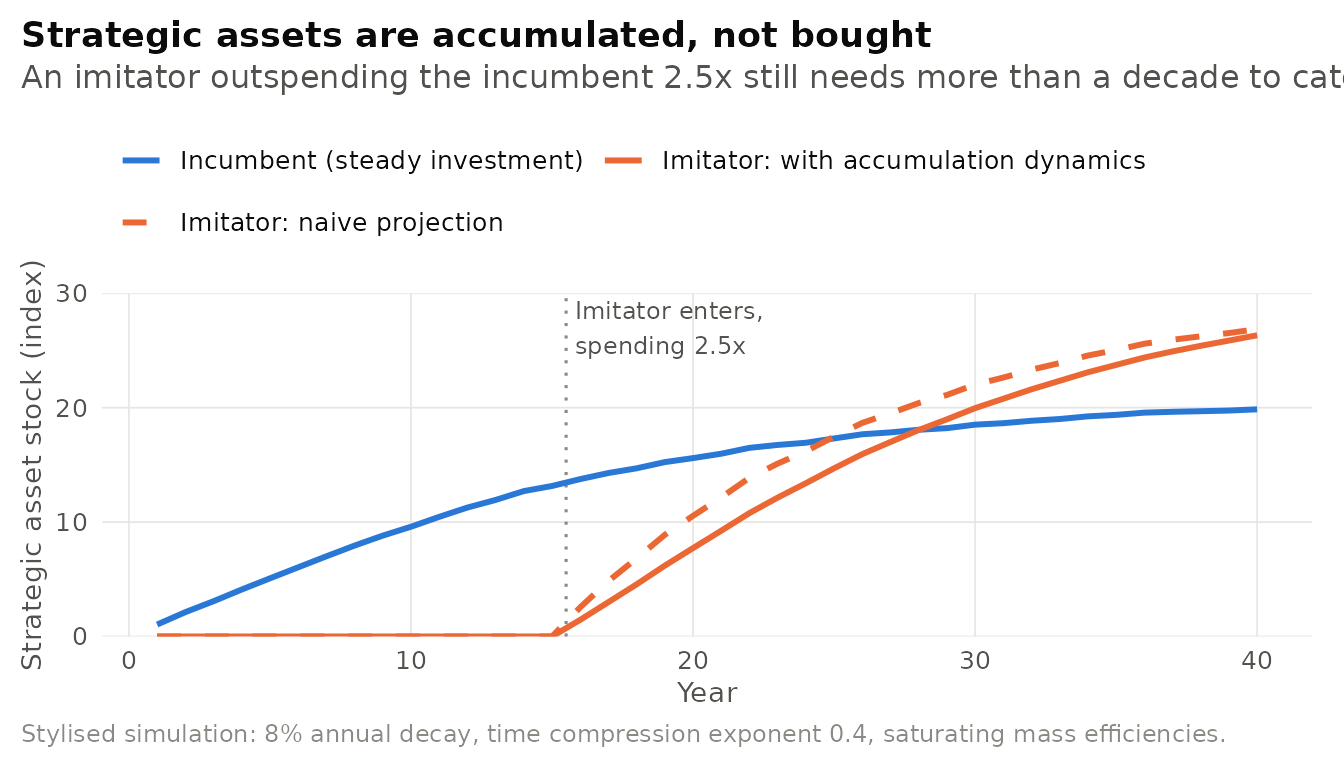
Figure 4.1: Illustrative simulation of asset stock accumulation (Dierickx & Cool, 1989). An imitator that enters late and outspends the incumbent catches up more slowly than a naive projection implies, because accelerated investment runs into time compression diseconomies while the incumbent enjoys asset mass efficiencies.
4.1.5 Isolating mechanisms: why imitation fails
The term isolating mechanisms (Rumelt 1984) describes the forces that protect a firm’s rents from being competed away, much as mobility barriers protect groups of firms within an industry. Lippman and Rumelt (1982) showed formally that uncertain imitability, uncertainty about the causes of a rival’s efficiency, can sustain performance differences in equilibrium even when entry is free: would-be imitators cannot be sure that copying will succeed, so fewer of them try. Jay Barney (1991) identified three reasons why resources may be imperfectly imitable: unique historical conditions (path dependence), causal ambiguity, and social complexity. Reed and DeFillippi (1990) elaborated causal ambiguity, arguing that it arises from the tacitness, complexity, and specificity of the skills and resources underlying an advantage. Table 4.3 summarises the main mechanisms.
| Mechanism | Logic | Key sources | Business illustration |
|---|---|---|---|
| Unique historical conditions (path dependence) | The resource was built along a path that cannot be re-run. Being early or lucky mattered | Barney (1991), Dierickx & Cool (1989) | A character library accumulated over many decades |
| Causal ambiguity | Neither rivals (nor sometimes the firm) know exactly which factors produce the advantage | Lippman & Rumelt (1982), Reed & DeFillippi (1990) | Tacit rules behind a production system that is open to visitors |
| Social complexity | The resource rests on culture, trust, reputation, or relationships that cannot be engineered quickly | Barney (1991) | High-trust, long-term supplier relationships |
| Time compression diseconomies | Accelerated investment yields less than the same investment spread over time | Dierickx & Cool (1989) | Reputation for reliability, scientific know-how |
| Asset mass efficiencies | Existing stocks make further accumulation cheaper | Dierickx & Cool (1989) | A large installed base attracts complementary developers |
| Complementarity and system fit | Value depends on many interlocking activities, copying one element is not enough | Porter (1996), Milgrom & Roberts (1995) | A vertically integrated quick-response supply chain |
| Legal protection | Property rights block direct copying for a period | Teece (1986) | Patents, copyrights, trademarks |
Causal ambiguity has a double edge. The ambiguity that blocks imitators may also prevent the firm from replicating its own success in a new plant, region, or business, and from understanding which resources it should protect. The tension between protecting knowledge from rivals and transferring it internally is a central theme of the knowledge-based view.
4.1.6 Resource orchestration
A common criticism of early RBV work was that it said much about which resources matter but little about what managers do with them. Sirmon, Hitt, and Ireland (2007) responded with a process model of resource management, later broadened under the label resource orchestration. Value is created when managers structure the resource portfolio (acquiring, accumulating, and divesting resources), bundle resources into capabilities (stabilizing, enriching, and pioneering), and leverage those capabilities in the market (mobilizing, coordinating, and deploying them). The model emphasises that the same resources can produce very different outcomes depending on how they are managed, and that the right orchestration depends on environmental uncertainty (Figure 4.2).
Figure 4.2: Resource orchestration: managers structure the resource portfolio, bundle resources into capabilities, and leverage capabilities to create value. Environmental uncertainty conditions each step. Adapted from the process model in Sirmon, Hitt, and Ireland (2007).
4.1.7 Evidence and extensions
Empirical testing of the RBV has been both voluminous and contested. Three contributions anchor the evidence base:
- Systematic review. Newbert (2007) reviewed the empirical RBV literature and found only modest overall support. Support was stronger for studies that examined capabilities and core competences than for those that measured static resource endowments, and he called for designs that test the full causal chain from resource attributes to advantage to performance.
- Meta-analysis. Crook et al. (2008) meta-analysed the resource-performance relationship and found it to be positive and meaningful. Importantly, the relationship was stronger for resources that met the theory’s criteria for strategic resources than for resources in general: evidence that the VRIN attributes matter, not just resource quantity.
- Choice of dependent variable. Ray, Barney, and Muhanna (2004) argued that firm-level performance is too distal: a valuable resource may create advantage in one business process while being offset elsewhere. In a study of customer service in insurance firms, they showed that intangible, socially complex resources predicted process-level performance: a design now widely recommended.
Is the RBV a useful theory? In an influential critique, Priem and Butler (2001) argued that the RBV is close to tautological: if a valuable resource is defined as one that produces advantage, then the statement “valuable resources produce advantage” cannot be false. They further argued that resource value is determined outside the theory, by product-market demand, so the RBV is silent on what makes a resource valuable. That it is largely static, and that it offers few actionable prescriptions. In reply, J. B. Barney (2001) contended that the theory’s propositions are empirically testable because value, rarity, and imitability can be measured independently of performance. He accepted that value is determined by the environment and called for integrating resource-based logic with models of product-market demand. The exchange spurred work on demand-side perspectives, process-level tests (Ray, Barney, and Muhanna 2004), resource management (Sirmon, Hitt, and Ireland 2007), and the dynamic extensions discussed in Chapter 5. A related debate concerns measurement: resources that are causally ambiguous to rivals are, by construction, hard for researchers to observe, which pushes empirical work toward proxies (R&D stocks, advertising stocks, employee tenure) that may not capture the theory’s constructs.
4.1.8 Applications in business
Toyota Production System. Toyota’s production system, just-in-time flow, built-in quality (jidoka), the authority of any worker to stop the line, and continuous improvement (kaizen), has been documented in detail since the 1980s (Ohno 1988, Womack, Jones, and Roos 1990). That it remained hard to imitate is a textbook case of causal ambiguity and social complexity. Spear and Bowen (1999) argued that observers copied the visible tools (kanban cards, andon cords) while missing the tacit rules that govern how work is specified, how people connect, how flow paths are designed, and how improvements are made through structured experimentation. The NUMMI joint venture is a natural illustration: Toyota’s methods worked in a plant staffed largely by former GM workers, yet GM found it difficult to transfer what it learned across its wider organization. A resource that is visible is not necessarily imitable.
Walmart’s logistics system. Walmart grew by locating stores in clusters around its own distribution centres, by moving goods through cross-docking (goods arriving at a distribution centre are transferred to outbound trucks with minimal storage), and by investing early in information systems that linked stores, distribution centres, and suppliers. Stalk, Evans, and Shulman (1992) used the company to argue that advantage comes from business processes rather than individual products. In RBV terms, the advantage rested on complementary physical, informational, and relational resources accumulated over decades: a system that could not be bought in a factor market. The case also illustrates Priem and Butler’s point that value is set by the environment: the rise of e-commerce changed which logistics capabilities matter, forcing even strong incumbents to build new ones.
4.1.9 Using the theory in research
Sample hypotheses.
- H1. Firms with larger accumulated stocks of R&D and advertising will earn more persistent abnormal returns than firms with similar current spending but smaller accumulated stocks (asset stock accumulation).
- H2. The positive effect of a resource on process-level performance will be stronger when the resource is socially complex (e.g., cross-functional relationships) than when it is purchasable (e.g., off-the-shelf software).
- H3. The performance benefit of a valuable, rare resource will be greater when the firm’s compensation and control systems are aligned with its exploitation (the “O” in VRIO).
Designs. Panel data with resource stocks computed from flows (perpetual inventory method). Process-level outcomes as dependent variables (Ray, Barney, and Muhanna 2004). Natural experiments that shock resource value (regulatory change, technology shifts). Multi-level designs that separate resource effects from industry and corporate effects. Qualitative process studies of how resources are built.
Measures. Resource stocks (R&D, advertising, patents, brand equity (Section 27.3)), human-capital indicators (tenure, education, turnover), relational measures (supplier tenure, alliance count), and survey scales of value, rarity, and imitability. (Kozlenkova, Samaha, and Palmatier 2013) tabulate how marketing studies have operationalized these attributes.
Data sources. Compustat and CRSP, patent databases, brand-equity indices, employer-review platforms for culture proxies, industry-specific regulatory filings.
Inferring resource value from performance. The most common misuse of the RBV is to observe a high-performing firm, identify something distinctive about it, and conclude that the distinctive attribute caused the performance. This is the tautology Priem and Butler warned about, compounded by survivor bias: firms that invested in the same attribute and failed are invisible. Measure resource attributes independently of the outcome, include unsuccessful firms, and specify the mechanism linking the resource to customer value or cost.
4.2 The VRIO Framework
Core claim. A resource or capability yields a sustained competitive advantage only if it is Valuable, Rare, costly to Imitate, and the firm is Organized to exploit it.
Origins. Jay Barney (1991) proposed the VRIN criteria (with non-substitutability as the fourth condition). Barney’s later formulation, popularised in his strategy textbook, replaced N with O and absorbed substitutability into imitability (J. B. Barney and Hesterly 2012).
Level of analysis. Individual resource or capability within a firm.
Key constructs. Value, rarity, imitability (including substitution), organization, competitive implication (disadvantage, parity, temporary advantage, sustained advantage).
Boundary conditions. A diagnostic, not a predictive model: assessments are relative to a set of competitors and a period of time, and judgements of value depend on the product-market environment.
Related theories. Resource-based view, Resource-advantage theory, Dynamic capabilities (Section 5.1).
4.2.1 The four questions
Value. Firm resources are valuable if they enable a firm to develop and implement strategies that lower its net costs or raise its net revenues beyond what would have been possible without them (J. B. Barney and Arikan 2017). Value is always relative to a market: the same resource can be valuable in one environment and worthless in another. A large fleet of physical stores was valuable in pre-internet retailing. In some categories it became a cost burden.
Rarity. A resource is rare when it is held by few current or potential competitors. Valuable but common resources, modern accounting systems, standard manufacturing equipment, are necessary to compete but produce only parity. Rarity need not mean uniqueness: a resource held by fewer firms than are needed to generate perfect competition may suffice (Jay Barney 1991).
Imitability. A valuable, rare resource yields only a temporary advantage if rivals can obtain it at no cost disadvantage, either by duplication (building the same resource) or substitution (building a different resource that produces equivalent value). Imitability is reduced by the isolating mechanisms in Table 4.3.
Organization. Finally, firms must be “organized to exploit the full competitive potential of its resources and capabilities” (J. B. Barney and Hesterly 2012, 94). Organization includes formal reporting structures, management control systems, and compensation policies. These are complementary resources: they have limited ability to create advantage on their own but allow the firm to realise the potential of its other resources. A research laboratory that invents a breakthrough technology but whose parent lacks the structures to commercialise it illustrates a resource that fails the O test.
Figure 4.3 presents the framework as a sequential decision flow, and Table 4.4 applies it to firms discussed in this chapter.
Figure 4.3: The VRIO framework as a decision flow. Each ‘no’ answer determines the competitive implication of a resource. Only resources that pass all four tests support a sustained competitive advantage. Based on Barney (1991) and Barney and Hesterly (2012).
| Firm | Resource or capability | V | R | I | O | Competitive implication |
|---|---|---|---|---|---|---|
| Toyota | Production system: problem-solving routines and supplier relations | Yes | Yes | Yes (tacit, socially complex) | Yes | Sustained advantage (historically long-lived) |
| Walmart | Store-cluster logistics and supplier information systems | Yes | Yes | Partly (eroded by new logistics models) | Yes | Long-lived advantage, now contested |
| Disney | Character IP and family-entertainment brand | Yes | Yes | Yes (legal protection, history) | Yes | Sustained advantage |
| Zara (Inditex) | Quick-response design, production, and distribution system | Yes | Yes | Yes (system complementarity) | Yes | Sustained advantage |
| Apple | Integrated hardware, software, and services ecosystem | Yes | Yes | Yes (complementarity, installed base) | Yes | Sustained advantage |
| Illustrative firm A | Off-the-shelf enterprise software | Yes | No |
|
|
Competitive parity |
| Illustrative firm B | Patented technology without commercialisation units | Yes | Yes | Yes | No | Unrealised advantage |
| Illustrative firm C | Legacy plant network in a shrinking channel | No |
|
|
|
Competitive disadvantage |
4.2.2 Complementarity and resource bundles
VRIO is usually applied one resource at a time, but advantage often resides in combinations. Two resources are complements when the return to one is higher in the presence of the other (P. Milgrom and Roberts 1995). In marketing, N. A. Morgan, Slotegraaf, and Vorhies (2009) show that the profit-growth effects of marketing capabilities depend on their interplay with other firm capabilities, and Kozlenkova, Samaha, and Palmatier (2013) highlight complementarity as one of two distinctive features of marketing resources (the other being intangibility). Michael E. Porter (1996) makes the strategic point: when a strategy rests on a system of mutually reinforcing activities, a rival must imitate the entire system to match the outcome, and the probability of copying every element correctly is far lower than the probability of copying any one. Teece (1986) adds that innovators often fail to profit from their innovations when complementary assets, manufacturing, distribution, service, or complementary technologies, are controlled by others.
Apple’s ecosystem complementarity. Apple’s products are rarely the first in their categories, yet the company has captured a large share of industry profits in several of them. A resource-based explanation emphasises complementarity among hardware design, proprietary operating systems, services, and retail. The App Store (opened in 2008) turned the installed base of iPhones into an asset that attracted developers, whose applications in turn raised the value of the device: an asset mass efficiency in Dierickx and Cool’s terms. Apple’s own retail stores (from 2001) and its later in-house processors (Apple silicon, introduced in Macs in 2020) extended control over complementary assets. Each component could, in principle, be imitated. The integrated system is much harder to replicate, which is precisely the logic of ecosystem theories (Jacobides, Cennamo, and Gawer 2018, Teece 1986).
Choose a firm you know well. List five resources or capabilities you believe contribute to its performance. For each, answer the four VRIO questions relative to its two closest rivals and record your confidence in each answer. Then ask: which resources are complements, and would your VRIO verdict change if you assessed the bundle rather than the individual resource?
4.3 The Knowledge-Based View
Core claim. Knowledge is the most strategically significant resource of the firm. Firms exist because they integrate specialized knowledge held by individuals more efficiently than markets can, and their advantage depends on how well they create, integrate, and transfer knowledge.
Origins. Strategy and organization theory, Kogut and Zander (1992) on combinative capabilities, R. M. Grant (1996) on knowledge integration, Nonaka (1994) on knowledge creation, drawing on Polanyi (1966) on tacit knowledge and Penrose (1959).
Level of analysis. Firm, team, individual knowledge holders.
Key constructs. Tacit vs. explicit knowledge, knowledge integration, combinative capabilities, codification, replication, stickiness.
Boundary conditions. Most applicable where production requires integrating specialized, partly tacit knowledge. Less distinctive where knowledge is fully codified and traded in markets.
Related theories. Resource-based view, Absorptive capacity (Section 5.2), Exploration and exploitation (Section 5.3), Transaction cost economics (Section 6.3).
4.3.1 Core logic
The knowledge-based view (KBV) begins with a distinction drawn by Polanyi (1966): much of what people know is tacit, it can be demonstrated but not fully articulated, while some knowledge is explicit and can be codified in documents, formulas, and software. Explicit knowledge is easy to transfer but also easy to leak. Tacit knowledge is hard to transfer within the firm and correspondingly hard for rivals to acquire.
Kogut and Zander (1992) argue that firms are social communities that specialize in the creation and internal transfer of knowledge. Firms do better than markets not because of opportunism (the transaction-cost explanation) but because shared language, identity, and routines allow members to communicate and recombine knowledge efficiently. They call the ability to synthesize and apply current and acquired knowledge a combinative capability. They also identify a fundamental trade-off: codifying knowledge makes it easier to replicate internally (to open a new plant or enter a new country) but also easier for competitors to imitate.
R. M. Grant (1996) builds a theory of the firm on two premises: knowledge is acquired and held by individuals, and efficient production requires integrating many specialists’ knowledge. Because transferring specialized knowledge between people is costly, the firm’s role is to integrate it without requiring everyone to learn what everyone else knows. Grant identifies four integration mechanisms (Table 4.5). Their efficiency depends on the common knowledge members share, the frequency and variability of the task, and the structure that minimises the need for communication.
| Integration mechanism | How it works | Communication burden | Business example |
|---|---|---|---|
| Rules and directives | Specialists’ knowledge is converted into standards, procedures, and instructions others can follow | Low | Clinical protocols, safety standards in a plant |
| Sequencing | Tasks are ordered so each specialist contributes in turn, with minimal interaction | Low to moderate | Stage-gate product development |
| Routines | Recurring, partly tacit patterns of interaction coordinate many people without explicit communication | Moderate (built through repetition) | A pit crew, a restaurant kitchen at peak hours |
| Group problem solving and decision making | Specialists interact face to face to address novel, complex, or high-stakes problems | High | A cross-functional launch team, an incident response war room |
Nonaka (1994) complements this account with a theory of knowledge creation based on conversion between tacit and explicit forms: socialization (tacit to tacit), externalization (tacit to explicit), combination (explicit to explicit), and internalization (explicit to tacit). Organizational knowledge grows as this cycle spirals from individuals to groups to the organization.
Knowledge transfer within firms is harder than it looks. Szulanski (1996) studied the transfer of best practices between units of the same company and found that the main barriers were not motivational but knowledge-related: the recipient’s lack of absorptive capacity, causal ambiguity about why the practice works, and an arduous relationship between source and recipient. He called this internal stickiness. The same features that protect knowledge from imitators therefore impede its replication inside the firm: the KBV restatement of the double edge of causal ambiguity.
4.3.2 Core competences
Writing for managers, Prahalad and Hamel (1990) argued that diversified corporations should be understood not as portfolios of businesses but as portfolios of core competences: the collective learning of the organization, especially how to coordinate diverse production skills and integrate multiple streams of technology. They used the image of a tree: core competences are the roots, core products are the trunk, business units are the branches, and end products are the fruit. Honda’s competence in engines and power trains, they noted, supported businesses from cars to motorcycles to lawn mowers. Canon’s competences in optics, imaging, and microprocessor controls supported cameras, copiers, and printers. A competence is core if it (a) provides potential access to a wide variety of markets, (b) makes a significant contribution to the benefits customers perceive in the end product, and (c) is difficult for competitors to imitate. The concept anticipated the KBV’s emphasis on integration and warned that outsourcing could hollow out the competences on which future products depend. It also has a dark side: competences can harden into core rigidities when markets change (Leonard-Barton 1992), a theme taken up in Chapter 5.
Zara’s knowledge loop. Inditex’s Zara is often analysed as a supply-chain success, but it is equally a case of knowledge integration. Store managers observe what customers ask for, try on, and reject. That information flows to designers and commercial teams at headquarters, who translate it into new designs. A large share of production is sourced close to Spain, which allows small batches to be made and shipped quickly through a centralized distribution system. The result is a fashion offer that is replenished frequently and adapts within a season. In KBV terms, Zara integrates tacit market knowledge (what is selling and why) with design and operations knowledge through routines and co-location rather than through long forecasting cycles. The advantage is hard to imitate because it depends on the combination of proximity sourcing, vertical integration, information flow, and decision rights: a rival that copies any one element without the others gains little.
Equating knowledge with information systems. Many applications of the KBV measure “knowledge management” by investment in databases or intranets. The theory’s argument is the opposite: the knowledge that sustains advantage is largely tacit, socially embedded, and integrated through routines and interaction. Codified repositories are valuable but are also the most imitable form of knowledge. Research designs should capture integration mechanisms and tacitness, not just IT spending.
4.4 Resource-Advantage Theory
Core claim. Competition is a constant, disequilibrium-provoking struggle among firms for comparative advantages in resources that yield marketplace positions of competitive advantage for some market segments and thereby superior financial performance.
Origins. Marketing. Hunt and Morgan (1995), Hunt and Morgan (1996), and the book-length treatment in Hunt (2000, see also Hunt 2007). The theory integrates resource-based strategy with evolutionary and Austrian economics and with heterogeneous-demand theory in marketing.
Level of analysis. Firm and market segment, the economy as an evolving system.
Key constructs. Comparative advantage in resources, relative resource-produced value, relative resource costs, marketplace position, superior financial performance, efficiency and effectiveness advantage.
Boundary conditions. Assumes heterogeneous demand, imperfect information for firms and consumers, and resources that are heterogeneous and imperfectly mobile. Less informative in markets that approximate perfect competition.
Related theories. Resource-based view, Market-based assets, Dynamic capabilities (Section 5.1).
4.4.1 Core logic
Hunt and Morgan (1995) introduced the theory (initially as the “comparative advantage theory of competition”) as an alternative to neoclassical perfect competition, which assumes homogeneous demand, perfect information, and homogeneous, perfectly mobile resources. Resource-advantage (R-A) theory replaces each of these with its opposite. Demand is heterogeneous both across and within industries. Information is imperfect and costly. Firm resources, financial, physical, legal, human, organizational, informational, and relational, are heterogeneous and imperfectly mobile, and the firm’s objective is superior financial performance relative to referents such as rivals or its own past, rather than “maximum” performance that no firm could identify (Hunt 2000).
The causal chain runs from resources to market position to performance. A firm has a comparative advantage in resources when its resources allow it to produce a market offering that some segment perceives as having superior value, or to produce it at lower cost. This translates into a marketplace position, which in turn produces financial performance. Superior performance provides feedback and the means to invest in further resources. Inferior performance signals rivals’ advantages and motivates them to imitate, substitute, or innovate, which is why R-A competition is inherently dynamic and why innovation is endogenous to the theory (Hunt and Morgan 1996).
4.4.2 The marketplace position matrix
The theory’s signature tool is a three-by-three matrix that crosses relative resource-produced value (lower, parity, superior) with relative resource costs (lower, parity, higher). Figure 4.4 redraws it. Three cells yield competitive advantage, corresponding to the three forms of advantage that Hunt (2007) distinguishes: an efficiency advantage (parity value at lower cost), an effectiveness advantage (superior value at parity cost), and an efficiency-effectiveness advantage (superior value at lower cost). Two cells are indeterminate: superior value at higher cost, or lower value at lower cost, may produce advantage or disadvantage depending on how the segment trades off value against price.
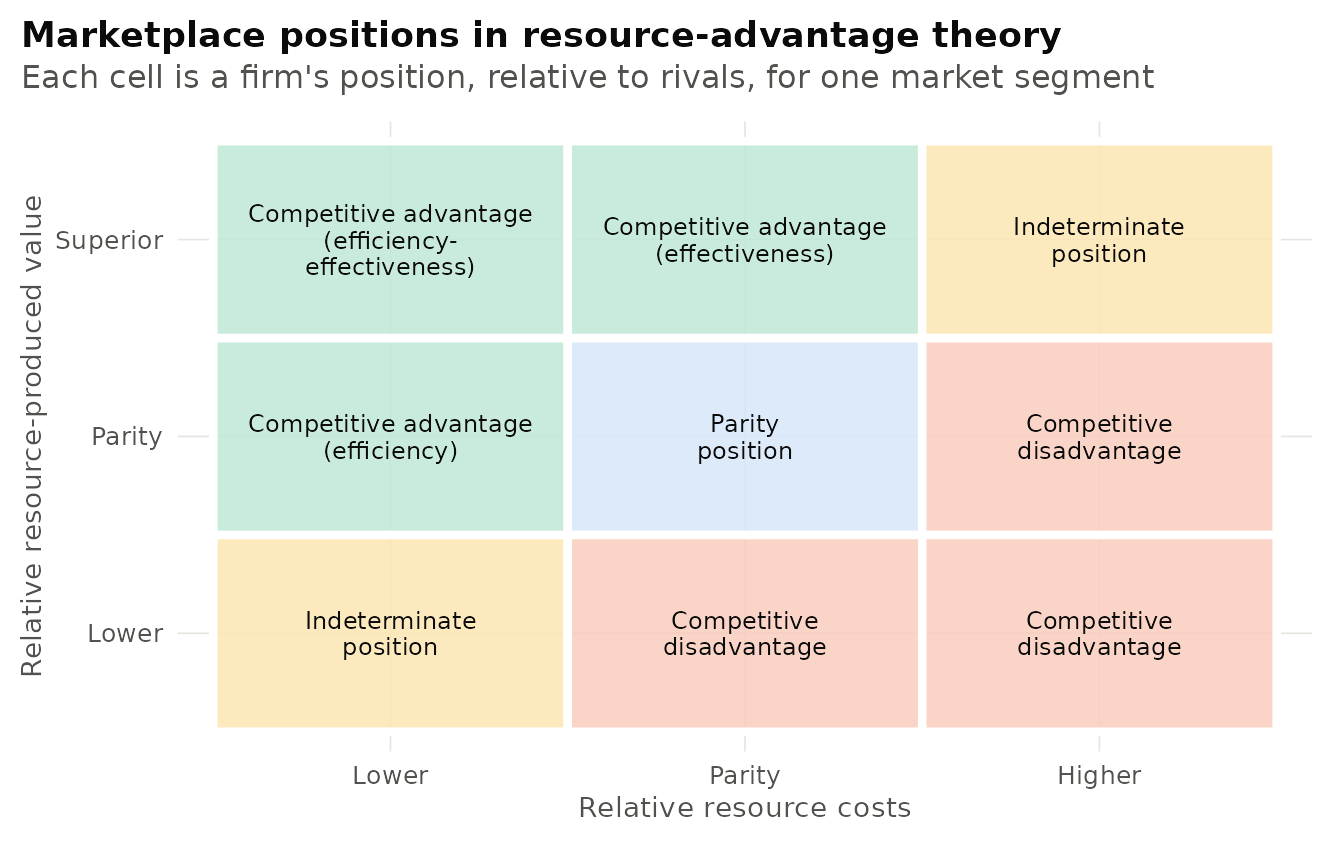
Figure 4.4: The resource-advantage marketplace position matrix. A firm’s position for a given market segment depends on the value its resources produce and the cost of producing it, both relative to rivals. Adapted from Hunt and Morgan (1995). Cell labels for the three advantage types follow Hunt (2007).
R-A theory makes several distinctive predictions. Because demand is heterogeneous, a firm can hold an advantage in one segment and a disadvantage in another with the same resources. The unit of analysis for advantage is therefore the firm-segment pair, not the firm. Because firms seek superior rather than maximum performance and learn through competition, the theory expects proactive innovation (firms seek new resources before being forced to) and reactive innovation (laggards innovate to neutralize rivals’ advantages). And because competition continually upsets positions, sustained advantage is the exception rather than the rule: a view closer to Schumpeter’s creative destruction than to equilibrium economics.
Theory of competition or relabelled RBV? Supporters see R-A theory as a general theory of competition that explains why market economies are productive and dynamic, and that integrates marketing’s concern with segments and value with strategy’s concern with resources (Hunt 2000). Critics have questioned whether its foundational premises add predictive content beyond the RBV and whether the matrix, which classifies positions ex post, can be operationalized ex ante. The theory’s strongest contribution is arguably conceptual: it makes explicit that advantage is defined relative to a segment and to competitors on both value and cost, which the VRIO framework leaves implicit.
Illustrative scenario: one firm, three positions. A regional grocery chain has superior fresh-food sourcing relationships and a cost structure slightly above national discounters. For quality-focused urban shoppers it delivers superior value at higher cost: an indeterminate cell that becomes an advantage because this segment pays a premium. For price-focused family shoppers the same resources produce parity value at higher cost: a disadvantage. For convenience shoppers near its compact stores it offers superior value (location) at parity cost: an effectiveness advantage. The R-A lens tells managers to evaluate resources segment by segment and to direct investment toward segments where the matrix position is favourable.
4.5 Market-Based Assets
Core claim. Customer, channel, and partner relationships and market knowledge are market-based assets that create shareholder value by accelerating, enhancing, and stabilizing cash flows and by raising their residual value.
Origins. Marketing strategy and finance, Srivastava, Shervani, and Fahey (1998), extended to market-based processes and the RBV in Srivastava, Fahey, and Christensen (2001), related to marketing capabilities in Day (1994).
Level of analysis. Firm (and the firm’s relationships with customers, channels, and partners).
Key constructs. Relational market-based assets, intellectual market-based assets, market-based processes, cash-flow acceleration, enhancement, volatility and vulnerability reduction, residual value, shareholder value.
Boundary conditions. Most relevant where customer relationships are durable and repeat purchase or network effects (Section 17.6) matter. Harder to apply where relationships are transactional.
Related theories. Resource-based view, Resource-advantage theory, Signaling theory (Section 8.2), Commitment-trust theory (Section 9.6).
4.5.1 Core logic
Marketing has long struggled to show its value in the language of finance. Srivastava, Shervani, and Fahey (1998) addressed the problem by treating marketing outcomes as assets that sit outside the balance sheet but drive the cash flows investors value. They distinguish two types. Relational market-based assets are the outcomes of the relationships between a firm and its external stakeholders, customers, channels, and strategic partners, including brand equity, customer loyalty, and installed bases. Intellectual market-based assets are the knowledge a firm possesses about its environment: customers’ needs, competitors’ moves, channel economics. Both are typically intangible, are accumulated through investment over time, and are hard to imitate because they are embedded in relationships, which places them squarely within the RBV (Kozlenkova, Samaha, and Palmatier 2013, Srivastava, Fahey, and Christensen 2001).
Market-based assets create value through four routes that map onto the drivers of discounted cash flow (Figure 4.5): they accelerate cash flows (for example, faster adoption of new products among loyal customers), enhance cash flows (price premiums, lower selling and service costs, higher share of wallet), reduce the volatility and vulnerability of cash flows (loyal customers are less sensitive to competitive moves), and increase the residual value of the business (a strong customer base persists beyond the forecast horizon).
Figure 4.5: How market-based assets create shareholder value: relational and intellectual assets improve market performance, which accelerates and enhances cash flows, reduces their volatility and vulnerability, and raises residual value. Adapted from the framework in Srivastava, Shervani, and Fahey (1998).
Day (1994) provides the capability counterpart. Market-driven organizations excel at outside-in capabilities, market sensing and customer linking, that connect internal processes to the market, complemented by inside-out capabilities (such as manufacturing and logistics) and spanning capabilities (such as pricing and new product development) that integrate the two. These capabilities are the processes through which market-based assets are built and leveraged. Table 4.6 summarises the main asset types.
| Type | Asset | Illustrative indicators | Primary cash-flow effect |
|---|---|---|---|
| Relational | Customer relationships and brand equity | Retention, share of wallet, price premium, brand-equity indices | Enhance cash flows, reduce volatility |
| Relational | Installed base and user network | Active users, attach rates of complements | Accelerate adoption of new offerings |
| Relational | Channel relationships | Shelf space, distributor tenure, co-marketing commitments | Accelerate and enhance cash flows |
| Relational | Partner and ecosystem relationships | Alliances, co-branding, developer participation | Enhance cash flows, raise residual value |
| Intellectual | Customer and market knowledge | Segment-level insight, data assets, research capability | Accelerate cash flows via better-targeted launches |
| Intellectual | Competitor and channel knowledge | Intelligence systems, channel economics models | Reduce vulnerability to competitive moves |
Disney’s brand and character franchises. Disney is a canonical example of market-based assets working as a system. Its characters and stories are protected by intellectual property law, but their economic value comes from relationships with audiences built over generations. Those relationships let Disney accelerate cash flows, a new film reaches a large, pre-committed audience, and enhance them by extending each franchise across theme parks, consumer products, and media. Its acquisitions of Pixar (2006), Marvel (2009), and Lucasfilm (2012) added further franchises that could be exploited through the same cross-business system, and its direct-to-consumer streaming service, launched in 2019, turned audience relationships into a subscription relationship. In VRIO terms, the brand-and-IP portfolio is valuable, rare, and protected by both law and history. In market-based-asset terms, its value lies in the durability and leverage of audience relationships.
Sample hypotheses for market-based assets.
- H1. Increases in customer satisfaction or brand equity will be associated with lower volatility of future cash flows, controlling for current profitability.
- H2. Firms with larger installed bases will achieve faster adoption of new product generations than rivals with comparable advertising spending.
- H3. The effect of marketing capabilities on profit growth will be stronger when they are combined with complementary R&D or operations capabilities (N. A. Morgan, Slotegraaf, and Vorhies 2009).
Designs. Event studies and long-horizon stock-return models. Panel models of cash-flow level and volatility. Customer-lifetime-value models linking relational assets to firm value.
4.6 Chapter Summary
- The resource-based view explains persistent performance differences within industries by resource heterogeneity and immobility. Advantage is sustained when valuable, rare resources are costly to imitate or substitute (Jay Barney 1991, M. A. Peteraf 1993).
- Strategic assets are accumulated rather than bought. Time compression diseconomies, asset mass efficiencies, and causal ambiguity protect incumbents (Dierickx and Cool 1989, J. B. Barney 1986).
- VRIO turns the theory into a diagnostic. The “O” reminds managers that resources create value only when structures, controls, and incentives allow them to be exploited (J. B. Barney and Hesterly 2012).
- Advantage often lies in bundles of complementary resources and in how they are orchestrated, not in single assets (P. Milgrom and Roberts 1995, Sirmon, Hitt, and Ireland 2007).
- The knowledge-based view treats knowledge integration as the reason firms exist. Tacitness protects knowledge from rivals but also makes it sticky inside the firm (R. M. Grant 1996, Kogut and Zander 1992, Szulanski 1996).
- Resource-advantage theory embeds resources in a dynamic, segment-specific theory of competition with efficiency and effectiveness advantages (Hunt and Morgan 1995, Hunt 2007).
- Market-based assets connect customer, channel, and partner relationships to shareholder value through the level, timing, risk, and residual value of cash flows (Srivastava, Shervani, and Fahey 1998).
- The empirical record supports the resource-performance link, especially for resources that meet the theory’s criteria, but measurement and tautology remain live concerns (Crook et al. 2008, Newbert 2007, Priem and Butler 2001).
Table 4.7 presents the comparison of the chapter’s theories.
| Theory | Unit of analysis | Source of advantage | Key mechanism | Signature prediction | Typical business use |
|---|---|---|---|---|---|
| Resource-based view | Firm | Heterogeneous, immobile resources | Isolating mechanisms protect rents | Within-industry performance differences persist | Strategy formulation, M&A screening |
| VRIO | Resource | Valuable, rare, inimitable, organized resources | Sequential tests of value and protection | Only VRIO resources sustain advantage | Capability audits, investment prioritization |
| Knowledge-based view | Firm / team | Integration of specialized, tacit knowledge | Integration mechanisms, combinative capabilities | Codification eases replication but invites imitation | Organization design, knowledge transfer |
| Core competences | Corporation | Collective, cross-business skills | Competences feed core products across businesses | Competence-based diversification outperforms | Portfolio and outsourcing decisions |
| Resource-advantage theory | Firm-segment | Comparative advantage in resources | Relative value and relative cost | Positions shift through innovation | Segment-level positioning |
| Market-based assets | Firm-market | Customer, channel, partner relationships, market knowledge | Cash-flow acceleration, enhancement, de-risking | Relational assets raise firm value | Justifying marketing investment to finance |
4.7 Discussion Questions
- Toyota allowed competitors to tour its plants. Using the concepts of causal ambiguity and social complexity, explain why this was not as risky as it appears. Under what conditions would such openness be a strategic mistake?
- Priem and Butler argue that the RBV is tautological. Design a study that tests an RBV hypothesis while measuring resource value independently of performance. What would falsify your hypothesis?
- Choose an industry undergoing technological change (for example, retail banking or automotive). Which resources have shifted from valuable to non-valuable, and which have become newly valuable? What does this imply for the “sustained” in sustained competitive advantage?
- Kogut and Zander describe a trade-off between replication and imitation. How should a multinational franchise business decide how much of its operating know-how to codify?
- Using the resource-advantage matrix, analyse a firm that competes in at least two segments. Is its position the same in each? How should that affect resource investment?
- A chief marketing officer must justify a multi-year investment in customer relationships to a sceptical chief financial officer. Using the market-based assets framework, which cash-flow effects would you measure, and how?
4.8 Further Reading
- Jay Barney (1991): the foundational statement of the conditions for sustained competitive advantage. Still the most cited entry point.
- Dierickx and Cool (1989): a short, elegant paper on why strategic assets must be accumulated, introducing time compression diseconomies and asset mass efficiencies.
- M. A. Peteraf (1993): translates the RBV into the economics of rents through four cornerstones.
- Priem and Butler (2001) and J. B. Barney (2001): read together as the defining debate about the theory’s usefulness and testability.
- Crook et al. (2008): the meta-analytic evidence on strategic resources and performance.
- R. M. Grant (1996): the clearest statement of the knowledge-based theory of the firm.
- Kozlenkova, Samaha, and Palmatier (2013): a review of resource-based theory in marketing, with guidance on operationalizing VRIO attributes.
- Srivastava, Shervani, and Fahey (1998): the market-based assets framework that links marketing to shareholder value.