7 Organizations and Their Environments
Why did hospitals, universities, and city governments across the United States adopt nearly identical administrative structures in the twentieth century, even when those structures did little to improve their work? Why do thousands of suppliers seek the same quality and environmental certifications, why do software developers grumble about app-store commissions yet keep building for the same two platforms, and why did the chief executives of nearly two hundred of America’s largest companies publicly redefine the purpose of the corporation in 2019? None of these questions can be answered by looking inside the firm alone. Each concerns the relationship between an organization and the environment on which it depends: suppliers, customers, regulators, professions, competitors, and the wider society that grants or withholds approval.
This chapter presents the major “open-systems” theories of organizations. Resource dependence theory treats the environment as a set of other organizations that control critical resources, and organizational action as the management of the resulting power relations. Institutional theory treats the environment as a set of rules, norms, and taken-for-granted beliefs, and explains why organizations conform to them, often at the expense of efficiency. Legitimacy is the currency of that institutional environment. Stakeholder theory asks whose interests the organization should and does serve. Organizational ecology shifts the focus from individual adaptation to the selection of whole populations of organizations. Contingency theory, finally, argues that there is no one best way to organize: effective structures fit their environments (Table 7.1).
| Theory | Core question | Level of analysis | Key source |
|---|---|---|---|
| Resource dependence theory | How do organizations manage dependence on others for critical resources? | Organization, dyad, organization set | Pfeffer & Salancik (1978) |
| Institutional theory | Why do organizations in a field become similar, and why do they adopt practices that may not improve efficiency? | Organizational field, organization | Meyer & Rowan (1977), DiMaggio & Powell (1983) |
| Legitimacy | How do organizations gain, maintain, and repair social acceptance? | Organization, audience | Suchman (1995), Deephouse (1999) |
| Stakeholder theory | Whose interests should and do organizations serve? | Organization, stakeholder relationships | Freeman (1984), Donaldson & Preston (1995) |
| Organizational ecology | Why do populations of organizations change through founding and failure rather than adaptation? | Population, community | Hannan & Freeman (1977, 1984) |
| Contingency theory | Which organizational structures fit which environments? | Organization, subunit | Burns & Stalker (1961), Lawrence & Lorsch (1967) |
7.1 Resource Dependence Theory
Core claim. Organizations are not self-sufficient. They depend on other actors for critical resources. Dependence creates power for those who control the resources, and organizations act, through co-optation, alliances, mergers, political action, and leadership choices, to reduce their own dependence and increase others’ dependence on them.
Origins. Organizational sociology. Pfeffer and Salancik (1978, reviewed in Stern 1979), building on the power-dependence theory of Emerson (1962) and the analysis of co-optation by Selznick (1949). Reviewed by Hillman, Withers, and Collins (2009).
Level of analysis. The focal organization and its exchange partners (dyads and the organization set).
Key constructs. Resource importance, discretion over resources, concentration of control (availability of alternatives), dependence, power, power imbalance, mutual dependence, constraint absorption, co-optation.
Boundary conditions. Resources must be critical and not freely available. The focal organization must have some strategic discretion to restructure its dependencies.
Related theories. Social exchange theory (Section 9.1), Network exchange theory (Section 9.2), Agency theory (Section 6.1), Transaction cost economics (Section 6.3), Institutional theory.
7.1.1 Origins and intellectual history
The basic premise of resource dependence theory (RDT) is that external resources, and the actors who control them, shape organizational behaviour. Organizations must acquire inputs such as capital, materials, labour, information, customers, and legitimacy from an environment populated by other organizations. Because resources are power and no organization can survive alone, power and resource dependence are interlocked (Pfeffer and Salancik 1978).
The theory’s micro-foundation comes from Emerson (1962), who defined power in relational terms: the power of actor A over actor B is equal to the dependence of B on A. B’s dependence, in turn, increases with B’s motivational investment in goals that A mediates and decreases with the availability of those goals outside the A-B relationship. Two implications follow. First, power is relational: it is not an attribute of an actor but a property of a relationship, so a firm can be powerful in one relationship and weak in another. Second, power is situational: it changes when the importance of a resource or the availability of alternatives changes, so yesterday’s dominant buyer can become today’s dependent partner.
Pfeffer and Salancik (1978) translated this into a theory of organizations. The dependence of a focal organization on another actor depends on three factors: the importance of the resource (how much of it the organization needs and how critical it is to operations), the other actor’s discretion over the resource’s allocation and use, and the concentration of control over the resource (the extent to which alternative sources exist). Organizations facing such dependence experience external constraint, and managers’ central task is to manage it.
7.1.2 Core logic and propositions
RDT can be summarised in four propositions:
- P1 (Dependence and power). The more an organization depends on another for important, discretionary, and concentrated resources, the more power the other has over it (Emerson 1962, Pfeffer and Salancik 1978).
- P2 (Compliance). Organizations are more likely to comply with the demands of actors on whom they depend.
- P3 (Restructuring). Organizations attempt to reduce dependence and uncertainty by restructuring their exchange relationships: absorbing, co-opting, or diversifying away from powerful actors.
- P4 (Internal power). Subunits and executives who manage the organization’s most critical external dependencies gain power inside the organization.
Emerson (1962) identified four generic balancing operations by which a weaker actor can rebalance a dependent relationship: reduce its motivational investment in what the stronger actor provides (withdrawal). Cultivate alternative sources (extension of the power network). Increase the stronger actor’s dependence on it (for example, by offering status or unique value), and form coalitions that deny the stronger actor its alternatives. Pfeffer and Salancik (1978) and later research mapped these onto organizational tactics (Table 7.2).
| Tactic | How it manages dependence | Business example | Key evidence |
|---|---|---|---|
| Co-optation | Brings representatives of a constraining actor into the organization’s decision structure | Appointing a banker, regulator, or major customer’s executive to the board | Selznick (1949), Pfeffer (1972) |
| Board interlocks | Provide information, advice, access, and legitimacy, signal commitment | Directors who sit on boards of suppliers or financial institutions | Pfeffer (1972), Hillman & Dalziel (2003) |
| Alliances and joint ventures | Partially absorb interdependence while preserving autonomy | Joint development agreements, long-term supply partnerships | Hillman et al. (2009) |
| Mergers and acquisitions | Absorb the constraint completely (vertical, horizontal, or diversifying) | Acquiring a critical supplier, diversifying away from a dominant customer | Casciaro & Piskorski (2005) |
| Political action | Shapes the rules and resources that government controls | Lobbying, political contributions, participation in standard-setting | Hillman et al. (2009) |
| Executive succession | Aligns leadership with the organization’s most critical dependencies | Appointing a CEO with expertise in the firm’s binding constraint | Pfeffer & Salancik (1978) |
| Diversifying sources | Reduces concentration of resource control | Dual or multiple sourcing, multi-homing across platforms or channels | Emerson (1962) |
7.1.3 Mechanism
Figure 7.1 presents the core causal chain, from the characteristics of resources to dependence, power, and organizational response.
Figure 7.1: Mechanism of resource dependence theory: resource importance, the controller’s discretion, and the concentration of control create dependence, which gives power to resource holders and constrains the focal organization. The organization responds by restructuring its dependencies, with managerial discretion moderating its options.
7.1.4 Power imbalance versus mutual dependence
A major theoretical refinement came from Casciaro and Piskorski (2005). In any dyad, each party depends on the other to some degree. Pfeffer and Salancik’s concept of “interdependence” combined two distinct quantities: power imbalance, the difference between the two parties’ dependence on each other, and mutual dependence, the total dependence in the relationship. Casciaro and Piskorski argued that these have opposite effects on constraint absorption, the use of mergers and acquisitions to eliminate a dependence. Mutual dependence makes absorption more attractive to both parties, because both stand to gain from removing the constraint. Power imbalance makes it less likely, because the more powerful party has little reason to give up its advantage and can resist. Their analysis of acquisitions across U.S. industries supported both predictions.
Figure 7.2 illustrates the logic. Moving up the diagonal (both parties more dependent) raises the likelihood of absorption. Moving toward the corners (one party much more dependent than the other) lowers it.
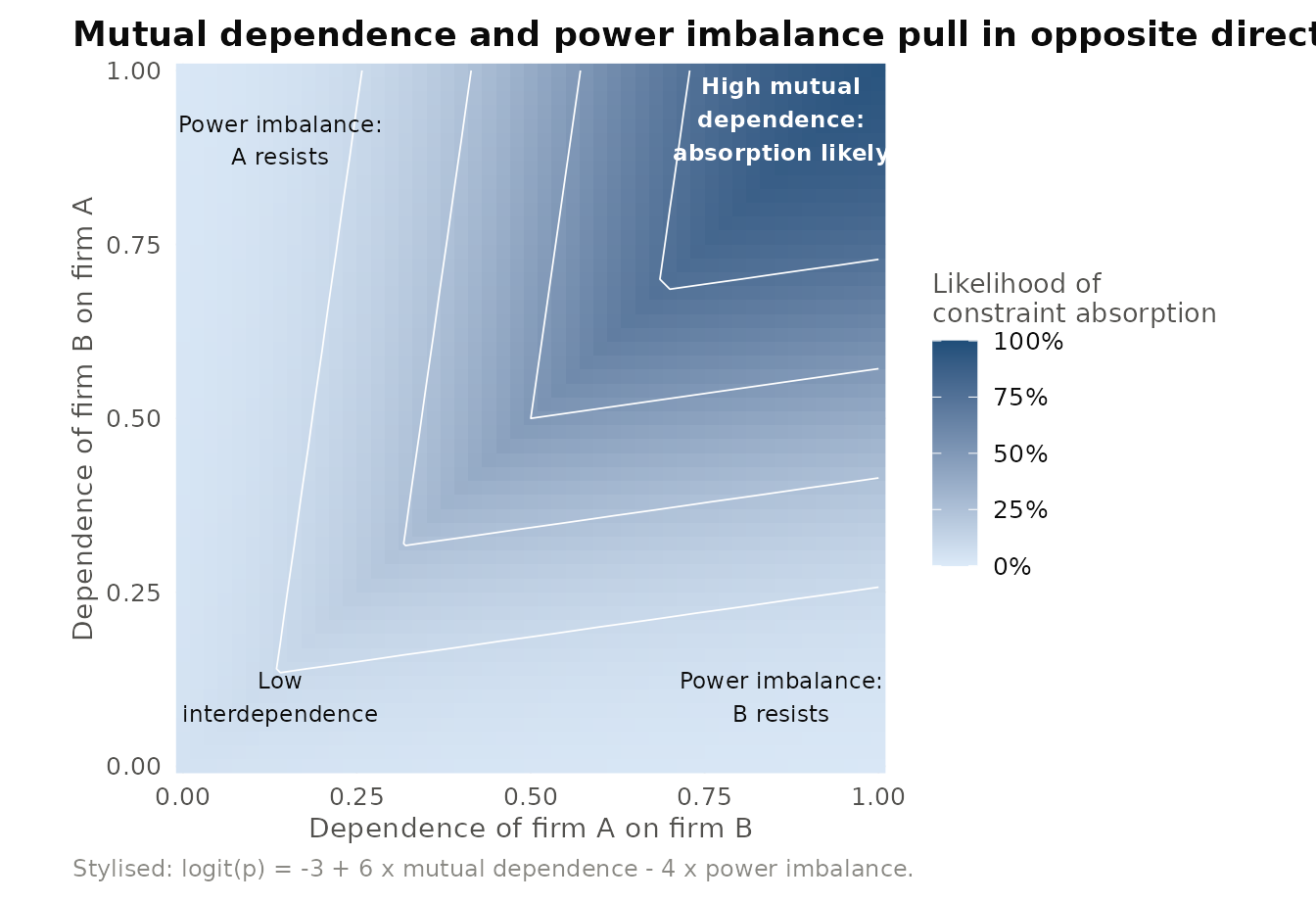
Figure 7.2: Illustrative surface showing the distinct effects of mutual dependence and power imbalance on the likelihood of constraint absorption (e.g., merger). Probability rises with mutual dependence (along the diagonal) and falls with power imbalance (toward the off-diagonal corners), following the argument of Casciaro and Piskorski (2005). Values are stylised.
7.1.5 Evidence and extensions
RDT is among the most-cited theories of organizations, and its evidence base is broad. Pfeffer (1972) found that board size and the composition of boards varied with firms’ need to manage their environments, including their reliance on external capital. Hillman, Withers, and Collins (2009) reviewed research in five areas, mergers and vertical integration, joint ventures and other interorganizational relationships, boards of directors, political action, and executive succession, and concluded that the theory’s predictions are broadly supported, though often tested with loosely specified measures of dependence. A meta-analysis by Drees and Heugens (2013) found that resource dependence is associated with the formation of interorganizational arrangements, and that such arrangements are linked to both organizational autonomy and legitimacy. Hillman and Dalziel (2003) integrated RDT with agency theory by showing that boards both monitor management and provide board capital: the human and social capital (Section 9.5) of directors that supplies resources (see Stewardship theory (Section 6.2)).
Is RDT a theory or a metaphor? RDT’s influence rests partly on its intuitive appeal: everyone recognises that dependence confers power. Critics note that the theory was for many years used more as a general orienting framework than as a source of precise, falsifiable predictions, and that “dependence” was often measured with crude proxies such as industry-level input-output flows. The refinement by Casciaro and Piskorski (2005) shows how much sharper predictions become when constructs are disaggregated. A second debate concerns RDT’s relationship to transaction cost economics (Section 6.3): both predict that firms absorb problematic exchange partners, but TCE emphasises efficiency (economizing on hold-up) while RDT emphasises power and autonomy. Distinguishing them empirically requires measures that separate dependence from asset specificity.
7.1.6 Applications in business
Supplier dependence and dual sourcing. Single sourcing reduces purchasing costs and deepens supplier relationships, but it concentrates control of a critical resource. Two widely reported supply disruptions illustrate the trade-off. In February 1997, a fire at an Aisin Seiki plant that was the main source of a brake-system valve used across Toyota’s vehicles in Japan halted much of Toyota’s domestic assembly. Production resumed within days because a network of group and non-group suppliers rapidly improvised replacement production: a case of dependence buffered by dense relational ties. In March 2000, a fire at a Philips semiconductor plant in New Mexico affected two mobile-phone makers differently: Nokia, which moved quickly to secure alternative supply, was much less affected than Ericsson, which had relied on the plant as a single source for key components. In RDT terms, multiple sourcing reduces the concentration of resource control, and strong relationships increase the supplier’s dependence on the buyer (and thus its willingness to prioritise the buyer in a crisis). Many firms now combine both: a primary partner with deep integration and a qualified second source.
Platform dependence of app developers. Developers of mobile applications depend on two app-store operators for access to most smartphone users, for payment processing, and for discoverability: resources that are important, concentrated, and subject to the platform’s discretion through review guidelines and commission rates. Cutolo and Kenney (2021) describe such firms as platform-dependent entrepreneurs who face pronounced power asymmetries. Platforms can also enter complementors’ markets: F. Zhu and Liu (2018) found that Amazon was more likely to enter product spaces in which third-party sellers had demonstrated strong demand. Developers respond with balancing operations predicted by Emerson: multi-homing across platforms (extending the power network), building direct relationships with customers through web sales and subscriptions (reducing the platform’s discretion), and forming coalitions and pursuing litigation and regulation. Epic Games’ 2020 lawsuits against Apple and Google, filed after its game Fortnite was removed from both stores for offering direct payments, and the European Union’s Digital Markets Act are prominent examples of the coalition and political-action routes.
Sample hypotheses.
- H1. Mutual dependence between two firms increases the likelihood that they form an equity alliance or merge. Power imbalance decreases it.
- H2. Firms that depend more heavily on a single customer are more likely to appoint directors with ties to that customer’s industry.
- H3. Complementors that multi-home across platforms experience smaller performance declines after adverse platform policy changes.
Designs. Dyadic panel data on interorganizational ties (alliances, interlocks, supply relationships). Event studies of exogenous changes in dependence (supplier disasters, platform policy changes). Network analysis of organization sets.
Measures. Dependence (share of sales or purchases with a partner, input-output coefficients, availability of alternatives). Power imbalance and mutual dependence (Casciaro and Piskorski 2005). Tactics (board appointments, alliances, acquisitions, lobbying expenditures).
Measuring dependence without measuring alternatives. Dependence is not the same as transaction volume. A firm that buys most of its inputs from one supplier is not dependent if it could switch cheaply. Measure importance, discretion, and the availability of alternatives, and remember that dependence is two-sided: always ask how dependent the partner is on the focal firm.
7.2 Institutional Theory
Core claim. Organizations conform to the rules, norms, and taken-for-granted beliefs of their institutional environments because conformity brings legitimacy, resources, and survival, even when it does not improve technical efficiency. As a result, organizations in the same field become structurally similar.
Origins. Organizational sociology, J. W. Meyer and Rowan (1977), DiMaggio and Powell (1983), synthesised in Scott (2014), strategic responses by C. Oliver (1991).
Level of analysis. Organizational field (all organizations that constitute a recognized area of institutional life) and the organization.
Key constructs. Institution, organizational field, isomorphism (coercive, mimetic, normative), regulative, normative, and cultural-cognitive pillars, decoupling, legitimacy, strategic response.
Boundary conditions. Strongest where technical performance is hard to measure, goals are ambiguous, and organizations depend on external audiences for resources. Weaker in highly competitive markets with clear performance criteria.
Related theories. Legitimacy, Resource dependence, Social norms (Section 22.5), Conformity (Section 22.4), Diffusion of innovations (Section 10.1).
7.2.1 Origins and core logic
J. W. Meyer and Rowan (1977) challenged the prevailing view that formal organizational structures exist to coordinate and control technical work. Many structures, positions, policies, programmes, and procedures, instead reflect rationalized institutional myths: widely shared beliefs that certain structures are the proper, rational way to organize. Organizations that incorporate these elements gain legitimacy and resources, irrespective of whether the elements improve efficiency. Because institutional rules may conflict with technical demands, organizations often decouple formal structure from actual practice, maintaining ceremonial conformity while work proceeds on a different basis, and relying on a logic of confidence and good faith that discourages close inspection.
DiMaggio and Powell (1983) asked why organizations are so similar. Their answer was institutional isomorphism: once an organizational field is established, suppliers, consumers, regulators, and competitors that constitute a recognized area of activity, powerful forces lead its members to become more alike. They identified three mechanisms (Table 7.3).
| Mechanism | Source | Driving condition | Business example |
|---|---|---|---|
| Coercive isomorphism | Formal and informal pressure from organizations on which the focal organization depends, and from cultural expectations | Resource dependence, legal and regulatory requirements | Suppliers adopting a buyer’s mandated codes of conduct. Firms adopting compliance functions required by law |
| Mimetic isomorphism | Imitation of organizations perceived as successful or legitimate | Uncertainty, ambiguous goals, poorly understood technologies | Copying a leading rival’s organizational structure, AI strategy, or market entry |
| Normative isomorphism | Professionalization: shared education, professional networks, and personnel movement | Reliance on credentials, strong professional associations | Similar HR, marketing, and finance practices spread by MBA programmes, consultancies, and professional bodies |
DiMaggio and Powell also offered testable hypotheses. Among them: the greater an organization’s dependence on another organization, and the more centralized its resource supply, the more similar it will become to that organization. The more uncertain the relationship between means and ends, and the more ambiguous an organization’s goals, the more it will model itself on organizations it perceives as successful, and the greater the reliance on academic credentials and the participation of managers in professional associations, the more similar organizations will become.
7.2.2 Mechanism
Figure 7.3 shows how the three mechanisms produce isomorphism, legitimacy, and survival, and how decoupling can separate adopted structures from practice.
Figure 7.3: Mechanism of institutional theory: coercive, mimetic, and normative pressures lead organizations to adopt institutionalized structures, producing isomorphism and legitimacy and, through legitimacy, access to resources and survival. When institutional and technical demands conflict, adoption may be decoupled from practice.
7.2.3 Scott’s three pillars
Scott (2014) synthesized institutional theory by distinguishing three pillars of institutions, each with a different basis of compliance and legitimacy (Table 7.4). The regulative pillar emphasises rules, monitoring, and sanctions. Actors comply out of expedience. The normative pillar emphasises values and obligations. Actors comply because it is appropriate. The cultural-cognitive pillar emphasises shared conceptions of reality. Actors comply because alternatives are literally unthinkable. Most real institutions combine all three, but the pillars help researchers specify which mechanism they are studying.
| Dimension | Regulative | Normative | Cultural-cognitive |
|---|---|---|---|
| Basis of compliance | Expedience | Social obligation | Taken-for-grantedness, shared understanding |
| Basis of order | Regulative rules | Binding expectations | Constitutive schemas |
| Mechanism | Coercive | Normative | Mimetic |
| Logic | Instrumentality | Appropriateness | Orthodoxy |
| Indicators | Rules, laws, sanctions | Certification, accreditation | Common beliefs, shared logics of action, isomorphism |
| Basis of legitimacy | Legally sanctioned | Morally governed | Comprehensible, recognizable, culturally supported |
| Business example | Data-protection law, financial reporting standards | Professional codes of ethics, industry certification | The assumption that a firm needs a website, a CFO, and a strategy |
7.2.4 Evidence and extensions
The classic empirical demonstration is Tolbert and Zucker (1983)’s study of civil-service reform in U.S. cities. Early adoption was predicted by city characteristics that made the reform technically useful, whereas later adoption was not: once the reform had become legitimated, cities adopted it because it was the accepted way to organize. Where state law mandated the reform, adoption was immediate. The same two-stage pattern, early adoption for technical reasons, later adoption for legitimacy, has been documented for total quality management, where Westphal, Gulati, and Shortell (1997) found that early adopters customized practices to gain efficiency while later adopters conformed to a normative template that conferred legitimacy but fewer efficiency gains. Haveman (1993) showed mimetic isomorphism in market entry: savings-and-loan associations followed large and profitable peers into new markets.
Research has also moved beyond pure conformity. C. Oliver (1991) integrated institutional and resource dependence perspectives by arguing that organizations choose among a range of strategic responses to institutional pressures, from passive acquiescence to active manipulation (Table 7.5). Which response an organization chooses depends on why the pressure is exerted, who exerts it, what the pressure is, how it is exerted, and the context in which it occurs. Bromley and Powell (2012) distinguished policy-practice decoupling (policies adopted but not implemented) from means-ends decoupling (policies implemented but loosely connected to the outcomes they are meant to achieve), arguing that the latter has become more common as audit and evaluation pressures make pure ceremonial adoption harder to sustain.
| Strategy | Tactics | Business example |
|---|---|---|
| Acquiesce | Habit (follow taken-for-granted norms), imitate (mimic institutional models), comply (obey rules) | Adopting a mandated disclosure format without debate |
| Compromise | Balance (reconcile multiple constituents), pacify (placate), bargain (negotiate with stakeholders) | Negotiating phased compliance timelines with a regulator |
| Avoid | Conceal (disguise nonconformity), buffer (loosen attachment), escape (change goals or domain) | Relocating an activity to a less regulated jurisdiction |
| Defy | Dismiss (ignore), challenge (contest), attack (assault the source) | Publicly contesting a proposed industry standard |
| Manipulate | Co-opt (import influential constituents), influence (shape values and criteria), control (dominate) | Leading an industry consortium that writes the standard |
7.2.5 Applications in business
ISO and ESG certification as isomorphism. Management-system certifications such as ISO 9000 (quality) and ISO 14001 (environmental management) spread across tens of thousands of firms worldwide within a few decades. Guler, Guillén, and Macpherson (2002) showed that the international spread of ISO 9000 reflected coercive pressures from states and multinational buyers as well as normative and mimetic pressures transmitted through trade networks among countries. A. A. King, Lenox, and Terlaak (2005) found that firms used ISO 14001 certification in part to communicate unobservable environmental practices to distant buyers: an institutional mechanism that also performs a signaling (Section 8.2) function. The same dynamics are visible in environmental, social, and governance (ESG) reporting frameworks, sustainability ratings, and certifications such as B Corp status. Institutional theory supplies two practical warnings. First, adoption driven by legitimacy rather than technical need is vulnerable to decoupling, so audiences increasingly demand evidence of implementation (Bromley and Powell 2012). Second, when nearly everyone in a field is certified, certification ceases to differentiate and becomes a cost of entry.
Sample hypotheses.
- H1. Late adopters of a management practice will implement it with less customization than early adopters.
- H2. Suppliers whose largest customers require a certification will adopt it earlier (coercive isomorphism), and suppliers in uncertain markets will adopt it after observing peers (mimetic isomorphism).
- H3. Policy-practice decoupling will be lower when third-party audits are frequent and their results public.
Designs. Event-history models of practice adoption. Diffusion models with network or spatial contagion. Comparative case studies of fields. Text analysis of organizational documents to measure field-level logics.
Measures. Adoption timing, prevalence in the field, ties to adopters, professionalization (credentials, association membership), decoupling (gap between stated policy and observed practice or outcomes).
Calling every diffusion process “institutional”. Practices also spread because they work, because of competitive imitation, or because of social learning about quality. To claim an institutional explanation, show that adoption is driven by legitimacy concerns rather than expected efficiency: for example, by showing that predictors of adoption shift from technical to social over time (Tolbert and Zucker 1983), or that adoption is decoupled from implementation.
7.3 Legitimacy
Core claim. Organizations need not only resources but social acceptance. Legitimacy is the generalized perception that an organization’s actions are desirable, proper, or appropriate, and organizations act to gain, maintain, and repair it.
Origins. Institutional and strategic perspectives, Suchman (1995), Aldrich and Fiol (1994) on new industries, Deephouse (1999) on strategic balance.
Level of analysis. Organization or industry as evaluated by audiences.
Key constructs. Pragmatic, moral, and cognitive legitimacy, legitimacy management (gaining, maintaining, repairing), strategic balance, optimal distinctiveness.
Related theories. Institutional theory, Optimal distinctiveness (Section 22.3), Stakeholder theory, Signaling theory (Section 8.2).
7.3.1 Core logic
Suchman (1995) provided the standard definition: legitimacy is “a generalized perception or assumption that the actions of an entity are desirable, proper, or appropriate within some socially constructed system of norms, values, beliefs, and definitions” (Suchman 1995, 574). He also reconciled two traditions. The strategic approach treats legitimacy as an operational resource that managers can extract from the environment through symbolic and substantive action. The institutional approach treats legitimacy as a set of constitutive beliefs that shape organizations from outside. Both views are useful, and managers face the tension between them: legitimacy can be managed, but overt efforts to manage it can themselves look illegitimate.
Suchman distinguished three types of legitimacy (Table 7.6).
| Type | Basis of evaluation | Subtypes | Business example |
|---|---|---|---|
| Pragmatic | Self-interested calculation by the organization’s most immediate audiences | Exchange, influence, dispositional | A supplier is accepted because it reliably delivers value to customers |
| Moral | Normative judgment of whether the activity is the right thing to do | Consequential, procedural, structural, personal | A bank is judged by whether its lending practices are fair and transparent |
| Cognitive | Comprehensibility and taken-for-grantedness | Comprehensibility, taken-for-grantedness | A ride-hailing service becomes an unremarkable part of urban transport |
Cognitive legitimacy is the most powerful and the hardest to manipulate: once an organizational form is taken for granted, alternatives become hard even to imagine. It is also what new industries lack. Aldrich and Fiol (1994) argued that founders of new industries face both cognitive legitimacy deficits (audiences do not understand what the venture is) and sociopolitical deficits (key stakeholders and authorities do not yet accept it), and must build trust, reliability, and collective action (Section 17.2) across firms to overcome them.
7.3.2 Strategic balance and optimal distinctiveness
Deephouse (1999) connected legitimacy to competitive strategy. Competitive theories counsel firms to differentiate in order to reduce rivalry. Institutional theory counsels them to conform in order to be legitimate. His strategic balance theory holds that firms should be “as different as legitimately possible”: moderately differentiated firms avoid both the intense competition faced by conformers and the legitimacy challenges faced by deviants. His study of commercial banks found a curvilinear relationship between strategic similarity and performance consistent with this argument.
The idea parallels, at the firm level, Brewer’s theory of optimal distinctiveness (Section 22.3) at the individual level (Brewer 1991), in which people balance needs for assimilation and differentiation. E. Y. Zhao et al. (2017) extended the argument, proposing that the optimal point is not fixed but depends on the stage of a market category’s development, the audiences evaluating the firm, and the multiple dimensions on which firms can conform or differ.
Legitimacy repair after a scandal. When an organization’s legitimacy is threatened, Suchman’s framework suggests matching the response to the type of legitimacy lost. A product-safety failure damages pragmatic legitimacy (customers no longer trust the exchange) and calls for substantive fixes and guarantees. A misconduct scandal damages moral legitimacy and calls for structural responses, leadership changes, new oversight bodies, independent investigations, that demonstrate that the organization’s procedures have changed. Purely symbolic responses are risky because audiences increasingly test whether policies are implemented, the same pressure that reduces policy-practice decoupling.
Treating legitimacy as reputation or status. Legitimacy concerns whether an organization is acceptable. Reputation concerns how well it is expected to perform. Status concerns its rank in a social hierarchy. A firm can be fully legitimate but have a poor reputation (a reliable but mediocre utility), or be high-status but of contested legitimacy. Define which construct you mean and measure it from the appropriate audience’s perspective.
7.4 Stakeholder Theory
Core claim. Firms create value through relationships with multiple groups, customers, employees, suppliers, communities, financiers, and others, that affect or are affected by the firm. Managing these relationships well is both an ethical obligation and a source of long-run performance.
Origins. Strategic management and business ethics, R. E. Freeman (1984), T. Donaldson and Preston (1995), R. K. Mitchell, Agle, and Wood (1997), reviewed in Parmar et al. (2010).
Level of analysis. The firm and its stakeholder relationships.
Key constructs. Stakeholder, descriptive, instrumental, and normative stakeholder theory, stakeholder salience (power, legitimacy, urgency), shareholder primacy.
Boundary conditions. Instrumental claims depend on stakeholders’ ability to reward or punish firms. Normative claims rest on ethical arguments that cannot be settled by data alone.
Related theories. Resource dependence, Legitimacy, Agency theory (Section 6.1), Social exchange theory (Section 9.1).
7.4.1 Core logic
R. E. Freeman (1984) defined a stakeholder broadly as any group or individual that can affect or is affected by the achievement of an organization’s objectives, and argued that strategic management should systematically account for all such groups rather than treating them as constraints on maximizing shareholder value. The idea was simple to state but generated decades of debate about what kind of theory it was.
T. Donaldson and Preston (1995) clarified the debate by distinguishing three uses of stakeholder theory. Descriptive stakeholder theory claims that firms and managers in fact attend to multiple stakeholders. Instrumental stakeholder theory claims that firms that manage stakeholder relationships well perform better on conventional measures. Normative stakeholder theory claims that stakeholders’ interests have intrinsic value and that managers ought to consider them for their own sake. Donaldson and Preston argued that the three are nested and that the normative core is fundamental. T. M. Jones (1995) developed the instrumental strand most fully, arguing that firms that contract with stakeholders on the basis of mutual trust and cooperation reduce opportunism and monitoring costs and thus gain competitive advantage: a direct challenge to the assumptions of agency theory and TCE.
7.4.2 Stakeholder salience
Not all stakeholders receive equal attention. R. K. Mitchell, Agle, and Wood (1997) proposed that the salience of a stakeholder to managers depends on three attributes: power (the ability to impose its will on the firm), legitimacy (the perceived appropriateness of its relationship and claims), and urgency (the extent to which its claims are time-sensitive and critical). Salience increases with the number of attributes a stakeholder possesses, yielding the typology in Figure 7.4 and Table 7.7.
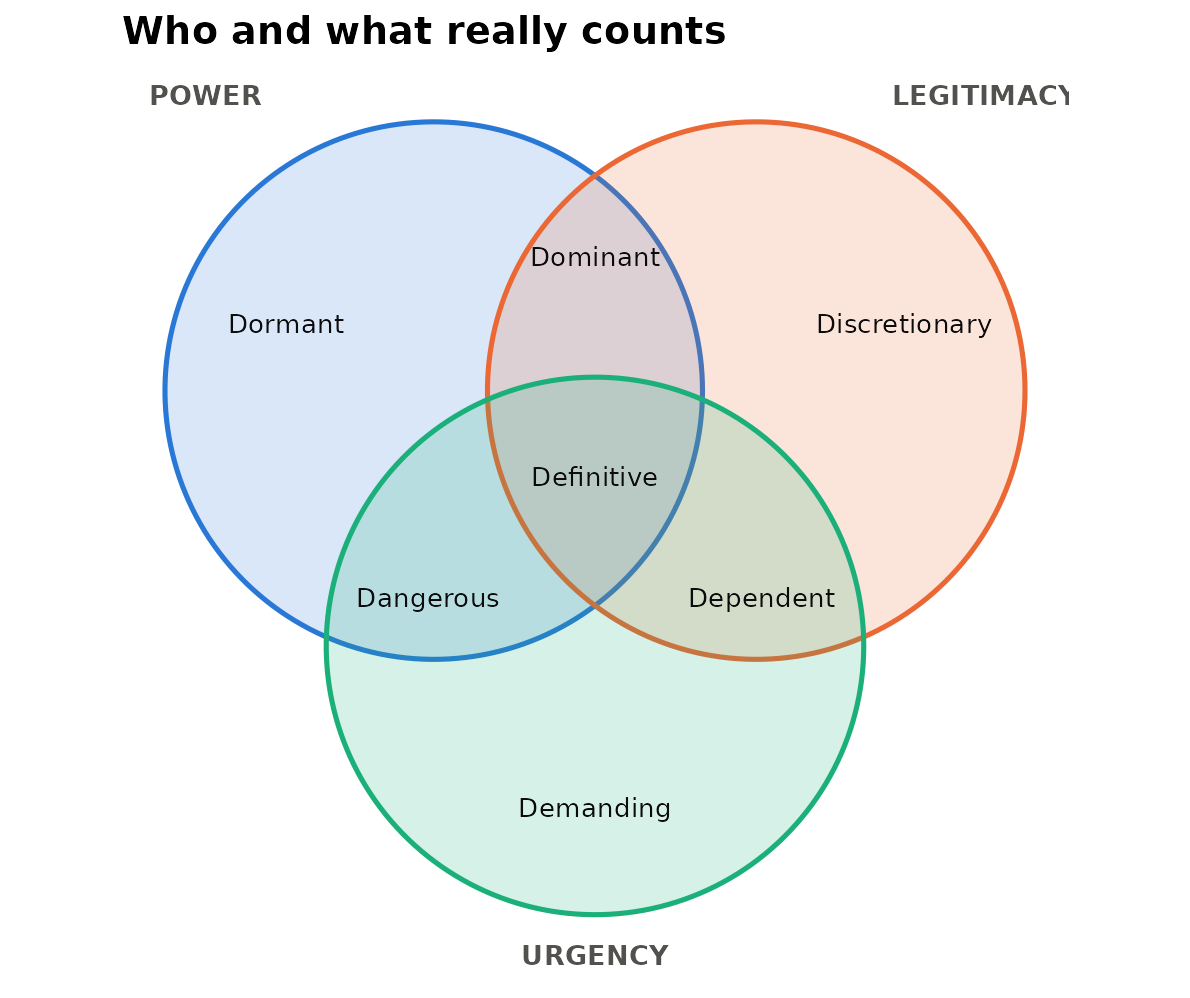
Figure 7.4: Stakeholder salience model, redrawn after Mitchell, Agle, and Wood (1997). Stakeholders possessing one attribute are latent (dormant, discretionary, demanding), two attributes, expectant (dominant, dangerous, dependent), all three, definitive.
| Class | Type | Attributes | Illustrative stakeholder |
|---|---|---|---|
| Latent (low salience) | Dormant | Power | A large investor that has never engaged with management |
| Latent (low salience) | Discretionary | Legitimacy | Beneficiaries of a firm’s philanthropy |
| Latent (low salience) | Demanding | Urgency | A lone activist with a pressing but unsupported claim |
| Expectant (moderate) | Dominant | Power + legitimacy | Major institutional shareholders, key customers |
| Expectant (moderate) | Dangerous | Power + urgency | Groups using coercive tactics such as blockades |
| Expectant (moderate) | Dependent | Legitimacy + urgency | Residents affected by an industrial accident who rely on others to advocate |
| Definitive (high salience) | Definitive | Power + legitimacy + urgency | A dominant shareholder coalition demanding action after a crisis |
The model is dynamic: stakeholders move between classes as they gain or lose attributes. A dependent stakeholder becomes definitive when it acquires power: for instance, when community groups win the support of a regulator or a large investor.
7.5 Organizational Ecology
Core claim. Organizational change occurs mainly through the selection of organizations, founding and failure, rather than through the adaptation of individual organizations, because organizations are subject to strong structural inertia.
Origins. Sociology, Hannan and Freeman (1977), Hannan and Freeman (1984), Hannan and Freeman (1989), density dependence developed in Hannan and Carroll (1992).
Level of analysis. Populations of organizations sharing a common form, and communities of interacting populations.
Key constructs. Organizational form, population, niche (generalist vs. specialist), structural inertia, liability of newness (Section 12.10), density dependence (legitimation and competition), resource partitioning.
Boundary conditions. Applies to populations whose members share a form and draw on common resources. Less informative about the strategic choices of individual firms.
Related theories. Contingency theory, Institutional theory, Exploration and exploitation (Section 5.3), Dynamic capabilities (Section 5.1).
7.5.1 Origins and core logic
Hannan and Freeman (1977) asked a question borrowed from biology: why are there so many kinds of organizations? Most organization theories explained diversity through adaptation: organizations change to fit their environments. Hannan and Freeman argued that adaptation is limited and that environmental fit is achieved largely by selection: organizational forms poorly suited to an environment fail and are replaced by new organizations with better-suited forms.
Hannan and Freeman (1984) explained why adaptation is limited. Modern societies favour organizations that are reliable (able to produce collective products of consistent quality) and accountable (able to document how resources are used). Reliability and accountability require that structures be highly reproducible: that is, inert. Selection therefore favours inertia. Key propositions follow:
- P1 (Inertia). Structural inertia increases with age and, for some features, with size.
- P2 (Core vs. periphery). Inertia is strongest in core features, stated goals, forms of authority, core technology, and marketing strategy, and weaker in peripheral ones.
- P3 (Hazard of change). Attempts to change core features increase the risk of failure in the short run, partly because change resets the organization’s “clock” and exposes it again to the liability of newness (Stinchcombe 1965, J. Freeman, Carroll, and Hannan 1983).
7.5.2 Density dependence
The best-known empirical regularity of organizational ecology is density dependence: the relationship between the number of organizations in a population (its density) and the rates at which organizations are founded and fail (Hannan and Freeman 1989, Hannan and Carroll 1992). Two processes operate. Legitimation, the taken-for-grantedness of the organizational form, rises with density, but at a decreasing rate: the first few organizations do much to establish a form, later ones little. Competition for limited resources also rises with density, but at an increasing rate, because each additional organization competes with all the others. The combination yields an inverted-U relationship between density and founding rates and a U-shaped relationship between density and failure rates (Figure 7.5).
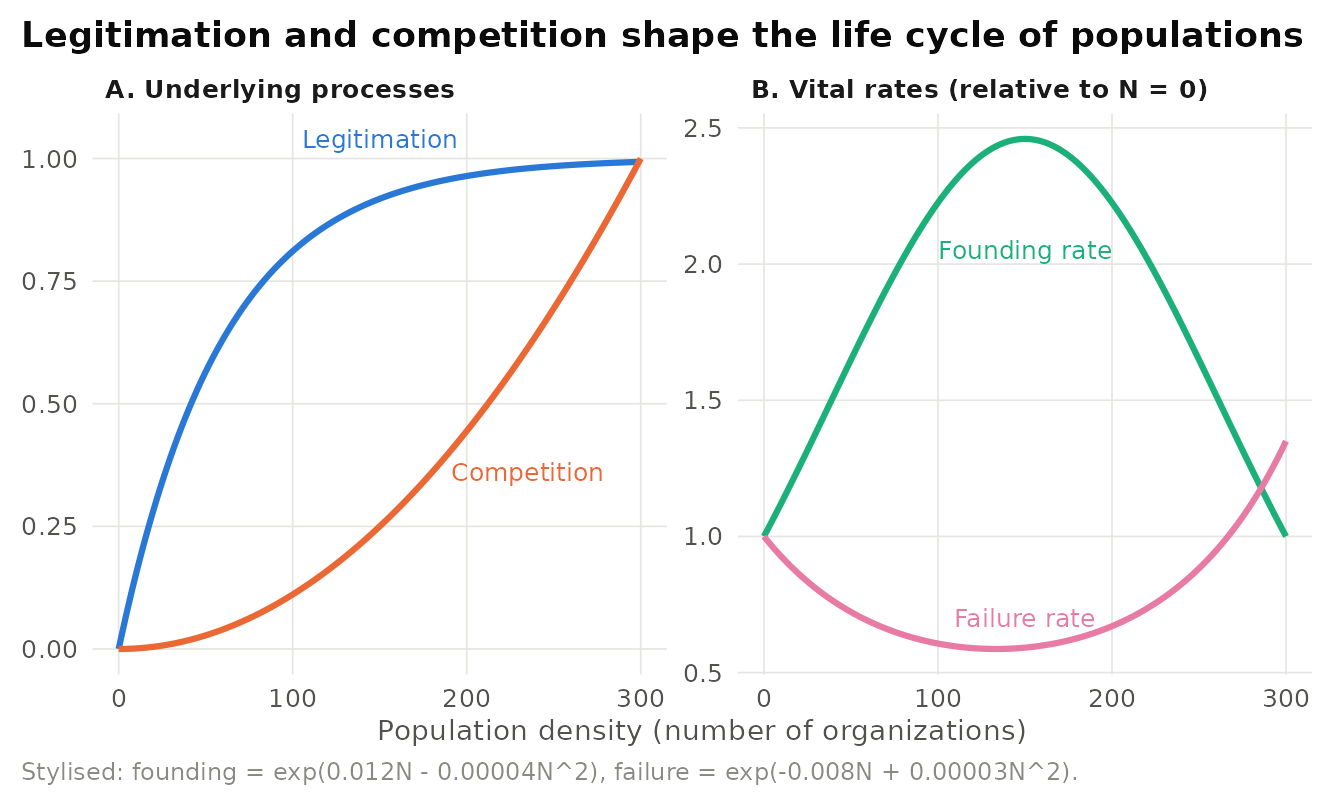
Figure 7.5: Stylised density-dependence model. Left: legitimation rises with density at a decreasing rate while competition rises at an increasing rate. Right: the resulting founding rate is an inverted U and the failure rate a U in population density. Functional forms follow the log-quadratic specification used in density-dependence research. Parameter values are illustrative.
Density dependence has been documented in many populations, including labour unions, newspapers, banks, breweries, and automobile manufacturers (Hannan and Carroll 1992). A related theory, resource partitioning, explains a striking pattern in concentrated markets: as a few large generalists come to dominate the centre of a market, resources at the periphery are freed up for small specialists (G. R. Carroll 1985). G. R. Carroll and Swaminathan (2000) used this logic to explain the rise of microbreweries and brewpubs in the United States: consolidation among mass-production brewers coincided with, and, the theory argues, enabled, a proliferation of specialist producers whose identity as craft producers was valued precisely because it contrasted with the mass producers.
Selection or adaptation? Organizational ecology was a provocation to strategy research, which assumes that managers can adapt their firms. Critics argue that the theory underestimates managerial agency and that many populations show substantial adaptation by incumbents. Ecologists reply that the theory does not deny change, only that change is hazardous and that selection does much of the work at the population level. The debate has become more productive as researchers study when adaptation succeeds, for example, how the timing and sequence of change affect survival, linking ecology to research on dynamic capabilities (Section 5.1). A second critique concerns measurement: density may proxy for many unmeasured processes, and legitimation is rarely measured directly.
Inertia in incumbents facing technological change. Public accounts of incumbents such as Kodak in digital photography and Blockbuster in video rental are often told as stories of managerial blindness. Organizational ecology offers a structural interpretation: both firms had core features, business models, assets, and organizational routines, that were reliable and accountable precisely because they were stable, and changing those features was hazardous. The theory implies two practical lessons. First, core change should be undertaken while resources are abundant, because the hazard of change is highest when the organization is already weak. Second, new forms are often better pursued in separate units, where they face the liability of newness without disrupting the core.
7.6 Contingency Theory
Core claim. There is no one best way to organize. The effectiveness of an organizational structure depends on its fit with contingencies such as environmental uncertainty, technology, size, and strategy.
Origins. Organization theory, T. Burns and Stalker (1961), Woodward (1965), Lawrence and Lorsch (1967), J. D. Thompson (1967), synthesised by L. Donaldson (2001).
Level of analysis. Organization and subunit.
Key constructs. Mechanistic vs. organic structure, environmental uncertainty, differentiation and integration, technology, fit, structural adaptation.
Boundary conditions. Fit is defined relative to a specific contingency. Performance consequences may appear only over time. Managers have some choice in structure.
Related theories. Organizational ecology, Resource dependence, Ambidexterity (Section 5.4), Upper echelons theory (Section 6.4).
7.6.1 Origins and core logic
T. Burns and Stalker (1961) studied firms, many of them Scottish companies attempting to enter the electronics industry, and found two contrasting management systems. Mechanistic organizations have specialized tasks, hierarchical control, vertical communication, and an emphasis on loyalty and obedience. Organic organizations have fluid task definitions, network-like control, lateral communication, and an emphasis on commitment to the task. Neither is superior in general: mechanistic systems suit stable conditions, while organic systems suit changing conditions in which problems cannot be broken down and assigned in advance (Table 7.8).
| Feature | Mechanistic | Organic |
|---|---|---|
| Task definition | Specialized, precisely defined, relatively fixed | Fluid, continually redefined through interaction |
| Coordination and control | Hierarchical, rules and supervision | Network-like, shared commitment to the task |
| Communication | Vertical, instructions and decisions | Lateral, information and advice |
| Location of knowledge | Concentrated at the top | Distributed throughout the organization |
| Basis of commitment | Loyalty and obedience to superiors | Commitment to the task and the organization’s progress |
| Fitting environment | Stable, predictable | Dynamic, uncertain |
| Business example | High-volume assembly, regulated back-office processing | R&D labs, product teams in fast-moving software markets |
Lawrence and Lorsch (1967) extended the argument to subunits. Departments facing different sub-environments, research facing scientific uncertainty, production facing technical stability, sales facing market change, should develop different structures and orientations, a condition they called differentiation. Yet differentiated units must also work together, which requires integration. In their comparative study of firms in industries with different degrees of uncertainty, high-performing firms in uncertain environments achieved both high differentiation and high integration, often through integrating roles and cross-functional teams. Woodward (1965) showed that effective structure also varied with production technology, J. D. Thompson (1967) linked structure to the type of interdependence among units, and Galbraith (1973) reformulated the theory in information-processing terms: the greater the task uncertainty, the more information must be processed, and structures must either reduce the need for information processing or increase the capacity for it.
7.6.2 Fit and performance
The central proposition is that performance depends on the fit between structure and contingencies. Figure 7.6 illustrates the classic interaction: under low environmental dynamism, mechanistic structures outperform organic ones. Under high dynamism, the ranking reverses.
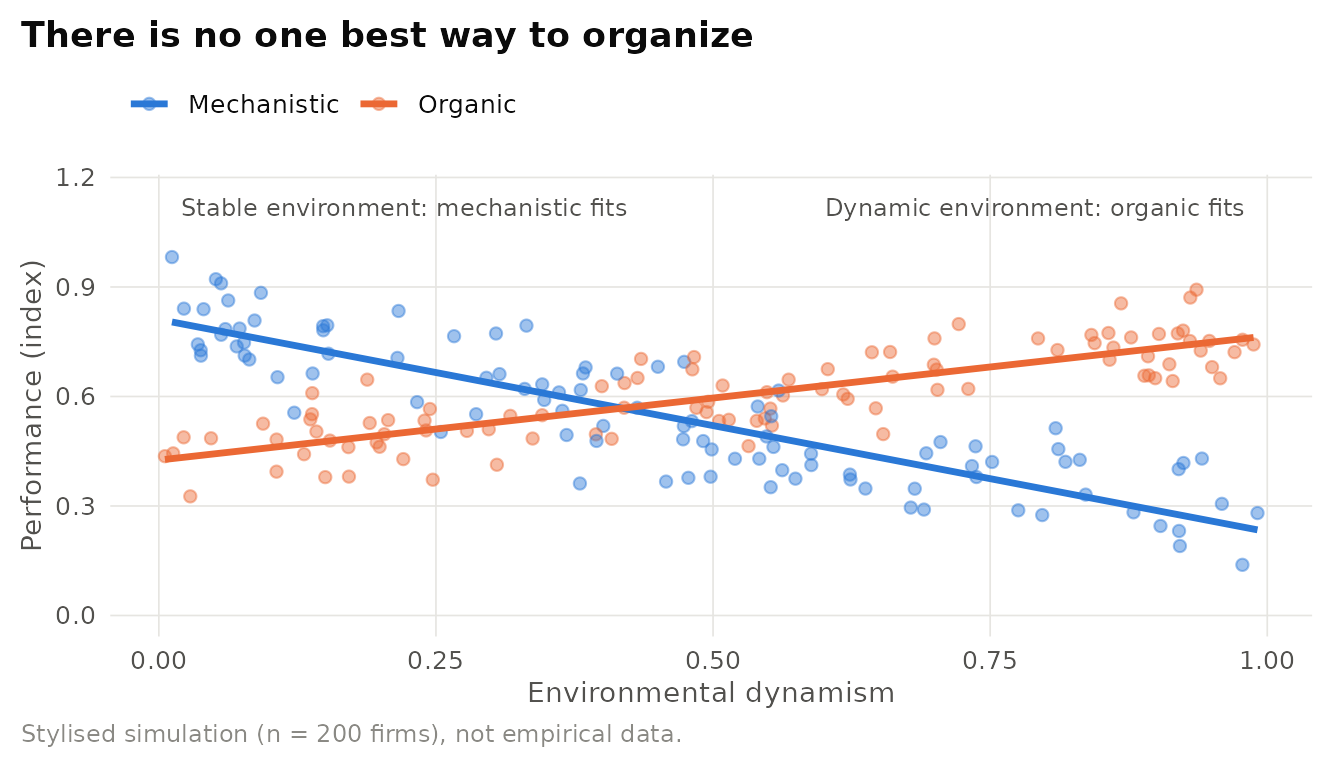
Figure 7.6: Illustrative contingency-fit interaction using simulated firms: mechanistic structures perform better in stable environments and organic structures in dynamic ones. Points are stylised simulated firms, lines are linear fits.
L. Donaldson (2001) proposed that organizations move in and out of fit over time: as contingencies such as size or diversification change, a once-fitting structure becomes a misfit, performance suffers, and the organization eventually adapts its structure to regain fit. This structural adaptation model gives contingency theory a dynamic form.
Determinism and strategic choice. Early contingency theory was criticized for implying that environments determine structures. Child (1972) argued that this neglects strategic choice: managers select which environments to operate in, can influence those environments, and may accept some misfit for other goals such as control. Later critiques noted that fit is hard to measure, that multiple contingencies may pull in different directions, and that equally effective configurations may exist for the same contingency (equifinality). Contemporary research on ambidexterity (Section 5.4) can be read as a response: firms facing both stable and dynamic demands build differentiated units and integrate them at the top, Lawrence and Lorsch’s insight applied to exploration and exploitation.
Structuring a firm with two environments. Illustrative scenario: a payments company runs a highly regulated transaction-processing business and a fast-moving consumer app. Contingency theory predicts that the processing unit should be relatively mechanistic, standardized procedures, clear accountability, change control, while the app unit should be organic, with cross-functional teams and rapid iteration. Following Lawrence and Lorsch (1967), the critical design problem is integration: shared platforms, integrating roles such as product-operations liaisons, and senior forums that resolve conflicts between the units’ different time horizons and risk tolerances.
Testing fit with main effects. Contingency theory predicts interactions, not main effects: the effect of structure on performance depends on the contingency. Specify the form of fit (moderation, matching, or configuration), test it with an appropriate model, and measure contingencies independently of structure to avoid circularity.
7.7 Corporate Social Responsibility Pyramid
Core claim. Corporate social responsibility comprises four kinds of societal expectation: economic, legal, ethical, and discretionary (philanthropic). A responsible firm meets all four at once, with economic performance as the foundation on which the others rest.
Origins. Business and society scholarship. A. B. Carroll (1979) defined the four categories as part of a three-dimensional model of corporate social performance. A. B. Carroll (1991) recast them as a pyramid. M. S. Schwartz and Carroll (2003) revised the model as three overlapping domains.
Level of analysis. The firm and the societal expectations it faces.
Key constructs. Economic, legal, ethical, and philanthropic responsibilities, social issues, social responsiveness (reaction, defense, accommodation, proaction), corporate social performance.
Boundary conditions. The content of each layer depends on the institutional context: what is a legal duty in one country may be voluntary in another. The ordering describes logical foundations, not a sequence in which firms should fulfil the layers.
Related theories. Stakeholder theory, Legitimacy, Institutional theory, Creating shared value.
7.7.1 Core logic
Debates about corporate social responsibility (CSR) in the 1960s and 1970s often treated profit and responsibility as opposites. A. B. Carroll (1979) proposed a definition that included both: the social responsibility of business encompasses the economic, legal, ethical, and discretionary expectations that society holds of organizations at a given point in time. Economic responsibilities come first because society expects business to produce goods and services and to sell them at a profit. Legal responsibilities reflect society’s codified expectations. Ethical responsibilities cover behaviour that society expects but has not written into law. Discretionary responsibilities are voluntary contributions that society values but does not demand. Carroll embedded these categories in a three-dimensional model that also specified the social issues a firm faces (such as consumerism, the environment, discrimination, and product and occupational safety) and its philosophy of responsiveness, ranging from reaction and defense to accommodation and proaction.
A. B. Carroll (1991) presented the four categories as a pyramid, shown in Figure 7.7, and renamed the top layer philanthropic. The pyramid conveys that the economic layer is the foundation on which the others rest, and that philanthropy, although desired by society, is less important than the other three. Carroll stressed that the layers are not sequential: the responsible firm strives to make a profit, obey the law, be ethical, and be a good corporate citizen simultaneously. The pyramid also links CSR to Stakeholder theory: each layer can be read against the expectations of specific stakeholders.
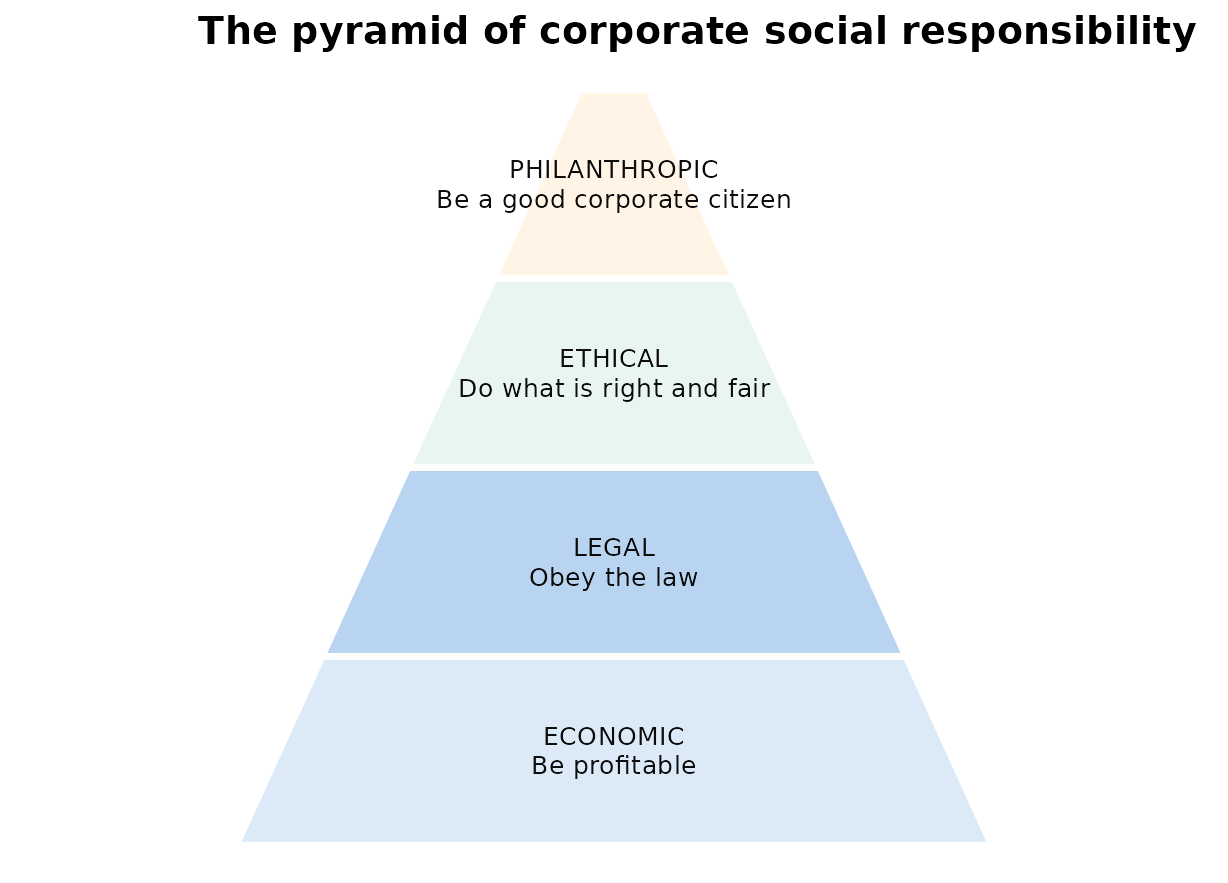
Figure 7.7: Carroll’s pyramid of corporate social responsibility, redrawn after Carroll (1991). Layers indicate logical foundations, not a sequence: the responsible firm meets all four expectations at once.
Table 7.9 summarizes each layer with examples. The examples show that the same issue can fall in different layers depending on whether it is codified in law.
| Responsibility | Societal expectation | Illustrative practices | Typical failure |
|---|---|---|---|
| Economic | Produce valued goods and services at a profit | Efficient operations, sustained returns, employment | Insolvency, value destruction for investors and employees |
| Legal | Operate within the law and regulation | Compliance programmes, product safety standards, accurate disclosure | Fraud, regulatory violations, cheating on emissions or safety tests |
| Ethical | Do what is right and fair beyond legal minimums | Fair supplier terms, honest marketing, respect for human rights in supply chains | Exploitative but legal practices, deceptive framing |
| Philanthropic | Contribute voluntarily to community well-being | Donations, employee volunteering, product donation programmes | Philanthropy used to offset or distract from harm |
7.7.2 Evidence and extensions
Aupperle, Carroll, and Hatfield (1985) developed a forced-choice instrument to measure managers’ orientation toward the four categories. Their respondents weighted the domains in roughly the order Carroll proposed, from economic to discretionary, and the study found no significant relationship between social orientation and profitability. M. S. Schwartz and Carroll (2003) argued that the pyramid’s geometry invites misreading, as if the top layers mattered less or could wait until the base was secure. They proposed a three-domain model of overlapping economic, legal, and ethical circles, folding philanthropy into the ethical and economic domains, so that activities can be classified by the combinations of motives they serve. Matten and Moon (2008) argued that the meaning of CSR varies across institutional settings. In much of continental Europe, responsibilities that U.S. firms address through voluntary explicit CSR policies are handled through implicit CSR embedded in law, collective agreements, and national institutions. The layers of the pyramid are therefore not fixed: the boundary between “legal” and “ethical” or “philanthropic” shifts with the institutional context, a point that connects the pyramid to Institutional theory.
Philanthropy and legal failure at two ends of the pyramid. In 1987 Merck announced that it would donate its river-blindness drug Mectizan (ivermectin) to affected communities for as long as needed, a widely cited example of the philanthropic layer that builds on the economic and ethical capabilities of the firm. At the other extreme, in September 2015 the U.S. Environmental Protection Agency issued a notice of violation alleging that Volkswagen had installed software in diesel cars to defeat emissions tests. The episode shows how a failure in the legal and ethical layers can overwhelm a firm’s other CSR activities: no volume of philanthropy or sustainability reporting offsets deliberate violation of the law. In pyramid terms, the upper layers are credible only when the lower ones are secure.
Sample hypotheses. H1. Firms whose CSR disclosures emphasise philanthropic over legal and ethical responsibilities will experience larger reputational penalties after misconduct is revealed. H2. The share of CSR activities that firms present as voluntary will be higher in liberal than in coordinated market economies (Matten and Moon 2008).
Designs and measures. Content analysis of CSR reports coded into Carroll’s categories or the three-domain model. Forced-choice surveys of managerial orientation (Aupperle, Carroll, and Hatfield 1985). Cross-country comparisons that hold industry constant.
7.8 Creating Shared Value
Core claim. Firms can create economic value in ways that also create value for society by addressing social needs and challenges. Such shared value should be integral to strategy and profit-making rather than a separate CSR activity.
Origins. Strategy. Michael E. Porter and Kramer (2006) distinguished responsive from strategic CSR. Michael E. Porter and Kramer (2011) introduced the concept of creating shared value (CSV). Crane et al. (2014) offered the most prominent critique.
Level of analysis. The firm, its value chain, and its local competitive context.
Key constructs. Shared value, responsive versus strategic CSR, inside-out and outside-in linkages, reconceiving products and markets, redefining productivity in the value chain, local cluster development.
Boundary conditions. Applies where social problems impose costs on the firm or represent unmet demand. Does not resolve cases in which social and economic goals genuinely conflict.
Related theories. Stakeholder theory, Corporate social responsibility pyramid, Resource-based theory (Section 4.1), Legitimacy.
7.8.1 Core logic
Michael E. Porter and Kramer (2006) argued that much CSR was fragmented and disconnected from strategy: firms responded to external pressure with philanthropy and reporting that were unrelated to their businesses. They distinguished responsive CSR, acting as a good citizen and mitigating harm from value-chain activities, from strategic CSR, which selects a small number of social issues where the firm can make a distinctive contribution that also strengthens its competitive position. Their analysis linked business and society in two directions. Inside-out linkages run from the firm’s value chain to society (for example, emissions, labour practices, or product safety). Outside-in linkages run from social conditions to the firm’s competitive context (for example, the skills of the local workforce or the quality of local suppliers and infrastructure).
Michael E. Porter and Kramer (2011) generalized the argument into the concept of creating shared value: policies and operating practices that enhance a firm’s competitiveness while simultaneously advancing economic and social conditions in the communities where it operates. They identified three routes. Firms can reconceive products and markets to meet social needs, such as health, nutrition, or financial inclusion. They can redefine productivity in the value chain, for instance by reducing energy use, waste, and logistics costs, or by improving the productivity of suppliers. And they can enable local cluster development by strengthening the suppliers, institutions, and infrastructure around their operations. Porter and Kramer presented CSV as a successor to CSR and contrasted the two, as in Table 7.10.
| Dimension | Conventional CSR (as characterized by Porter and Kramer) | Creating shared value | Objection raised by Crane et al. (2014) |
|---|---|---|---|
| Core idea | Doing good, citizenship, philanthropy | Joint economic and social value relative to cost | Repackages long-standing ideas from CSR and stakeholder research |
| Relation to profit | Separate from or a cost to profit | Integral to profit and competitiveness | Overlooks genuine trade-offs between social and economic goals |
| Driver | External pressure and reputation | Company-specific strategy | Assumes firms already comply with laws and ethical norms |
| Budget and scope | Limited CSR budget | Whole company budget and value chain | Retains a narrow, firm-centred view of the corporation’s role in society |
Figure 7.8 locates CSV relative to other activities. Shared value occupies the upper-right region, where an activity raises both economic and social value. The concept’s critics focus on the lower-right region, where activities are profitable but socially harmful, and on the large set of situations in which no option lies in the upper right.
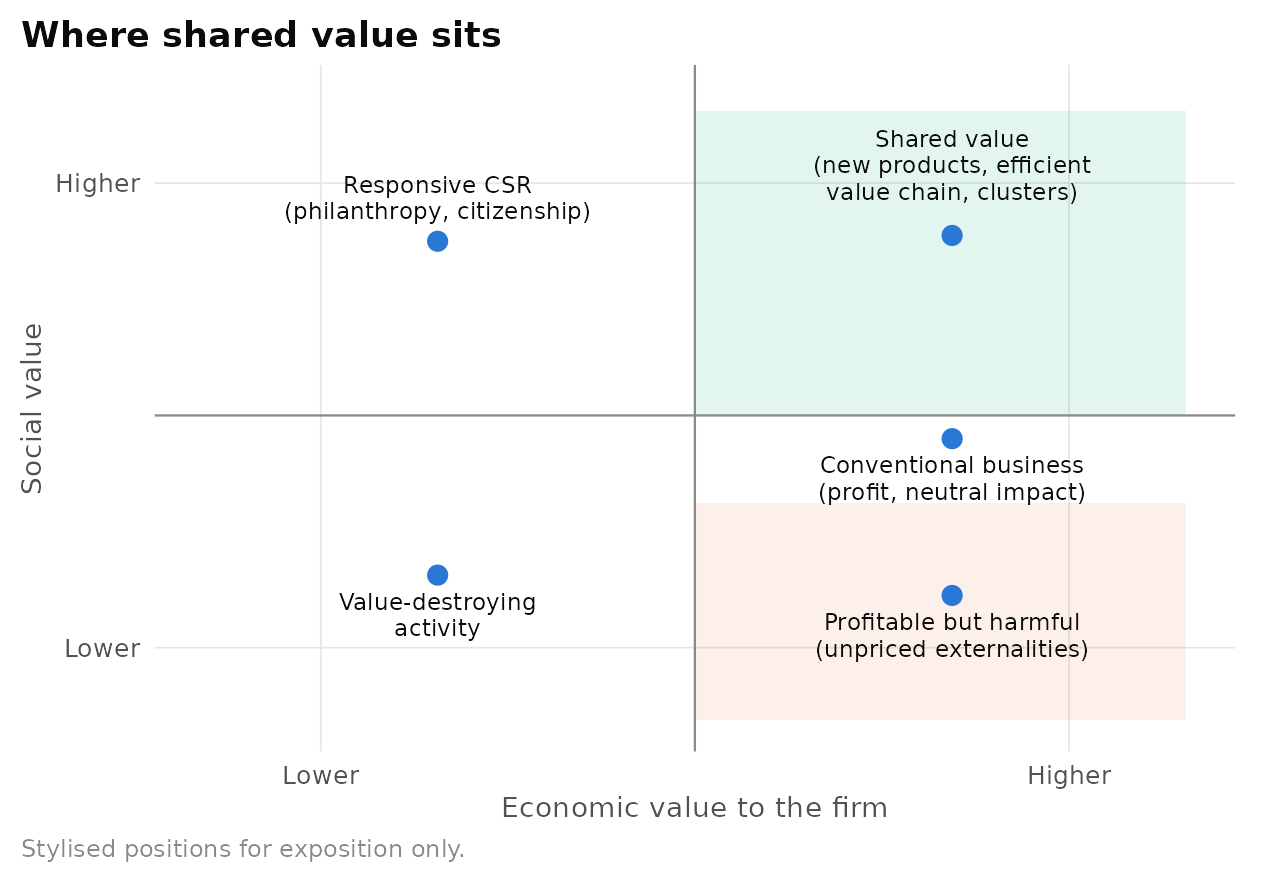
Figure 7.8: Stylised map of corporate activities by economic value to the firm and social value. Creating shared value targets the upper-right region. Positions are illustrative, not measured.
7.8.2 Evidence and critique
Porter and Kramer illustrate the concept with company examples, among them Nestlé’s work with dairy farmers in India, where investment in collection, refrigeration, and veterinary support raised farmers’ output and secured the company’s milk supply (Michael E. Porter and Kramer 2006). Nestlé subsequently adopted “Creating Shared Value” as the organizing label for its corporate responsibility reporting. The concept spread quickly among managers and consultancies, but systematic evidence that CSV initiatives outperform conventional CSR is limited, partly because “shared value” is usually identified after the fact from successful cases.
Is shared value new, and is it enough? Crane et al. (2014) praised CSV for elevating social goals to the level of strategy, but raised four objections. It is unoriginal, presenting ideas long developed in stakeholder and CSR research as new. It ignores the tensions between social and economic goals, focusing on win-win cases when many decisions involve real trade-offs. It is naive about compliance, assuming that firms already obey the law and meet ethical standards. And it rests on a shallow conception of the corporation’s role in society, leaving the profit motive and corporate power unexamined. In the terms of Carroll’s pyramid, CSV concentrates on the economic layer and treats the legal and ethical layers as given. Defenders reply that CSV is a strategic tool, not a complete theory of corporate responsibility, and that its value lies in mobilizing operating budgets rather than philanthropic ones.
Illustrative scenario: a food company’s sourcing programme. A packaged-food company sources a key ingredient from smallholder farmers whose low yields and inconsistent quality raise its costs. A CSV programme would invest in agronomic training, shared processing facilities, and guaranteed purchase contracts, improving farmers’ incomes while lowering the company’s input costs and supply risk. The critique of Crane et al. (2014) suggests the questions to ask before calling it shared value: Are farmers’ gains measured independently, or only through the company’s own reporting? What happens when market prices fall and the company’s interest diverges from the farmers’? Does the programme coexist with practices, such as aggressive marketing of unhealthy products, that destroy social value elsewhere?
Sample hypotheses. H1. Social initiatives embedded in a firm’s value chain will persist longer through budget cuts than philanthropic initiatives of similar size. H2. The financial returns to CSV initiatives will be larger when the targeted social problem directly raises the firm’s operating costs.
Designs and measures. Program evaluation with independent measurement of social outcomes (randomized or staggered roll-outs of supplier programmes). Panel studies linking value-chain sustainability investments to cost and revenue outcomes. Text analysis of how firms label initiatives (CSR, CSV, ESG) and whether labels predict substantive differences.
7.9 Chapter Summary
- Resource dependence theory: dependence on others for important, discretionary, and concentrated resources confers power on them. Power is relational and situational, and organizations restructure dependencies through co-optation, alliances, mergers, and political action (Pfeffer and Salancik 1978, Emerson 1962).
- Power imbalance and mutual dependence have opposite effects on constraint absorption (Casciaro and Piskorski 2005).
- Institutional theory: organizations adopt rationalized structures to gain legitimacy, producing coercive, mimetic, and normative isomorphism and, often, decoupling (J. W. Meyer and Rowan 1977, DiMaggio and Powell 1983, Scott 2014).
- Organizations respond to institutional pressures strategically, from acquiescence to manipulation (C. Oliver 1991).
- Legitimacy can be pragmatic, moral, or cognitive (Suchman 1995). Firms benefit from being as different as legitimately possible (Deephouse 1999).
- Stakeholder theory has descriptive, instrumental, and normative versions (T. Donaldson and Preston 1995). Salience depends on power, legitimacy, and urgency (R. K. Mitchell, Agle, and Wood 1997). The shareholder-stakeholder debate remains unresolved.
- Organizational ecology: structural inertia makes selection a central driver of change. Density dependence reflects legitimation and competition (Hannan and Freeman 1984, Hannan and Carroll 1992).
- Contingency theory: effective structures fit their environments, mechanistic for stable, organic for dynamic conditions (T. Burns and Stalker 1961, Lawrence and Lorsch 1967).
Table 7.11 presents the comparison of the chapter’s theories.
| Theory | View of the environment | Key mechanism | Signature prediction | Typical business use |
|---|---|---|---|---|
| Resource dependence | Other organizations controlling critical resources | Power from dependence, restructuring of exchange | Firms co-opt or absorb actors on whom they depend | Supplier strategy, board design, alliances, platform strategy |
| Institutional theory | Rules, norms, and shared beliefs in a field | Coercive, mimetic, and normative isomorphism | Organizations in a field converge, adoption may be decoupled | Certification, compliance, practice adoption, ESG reporting |
| Legitimacy | Audiences evaluating social acceptability | Pragmatic, moral, and cognitive evaluation | Moderate differentiation outperforms extremes | Positioning, crisis management, new-category creation |
| Stakeholder theory | Groups that affect or are affected by the firm | Salience, trust-based contracting | Salient stakeholders receive attention, trust lowers costs | Corporate purpose, stakeholder mapping, CSR strategy |
| Organizational ecology | Resource niches supporting populations | Selection under structural inertia | Founding and failure depend on density, core change is hazardous | Industry evolution, entry timing, incumbent renewal |
| Contingency theory | Uncertainty, technology, and size as contingencies | Fit between structure and contingency | Organic structures outperform in dynamic settings | Organizational design, unit structure, integration roles |
| CSR pyramid | Society holding economic, legal, ethical, and philanthropic expectations | Layered societal expectations of business | Upper layers are credible only when lower layers are met | CSR strategy, compliance, philanthropy design |
| Creating shared value | Social needs as conditions of competitiveness | Joint creation of economic and social value | Value-chain social investments raise profits | Sourcing, product innovation, cluster development |
7.10 Discussion Questions
- Resource dependence theory and transaction cost economics both predict that firms absorb problematic exchange partners. Design a study that could distinguish a power-based from an efficiency-based explanation of a vertical acquisition.
- Choose a practice that has diffused widely in your industry (for example, agile methods, ESG reports, or AI governance policies). Which of the three isomorphic mechanisms best explains its spread? What evidence would show decoupling?
- Apply Suchman’s three types of legitimacy to a new industry such as autonomous vehicles or cultivated meat. Which type is the binding constraint today, and what collective strategies could build it?
- Map the stakeholders of a firm facing a controversial decision using the salience model. How would the map change if one dependent stakeholder gained power?
- Does the 2019 Business Roundtable statement represent a change in corporate behaviour or in corporate rhetoric? What data would you collect to find out?
- A large incumbent is considering a radical change to its core business model. What do organizational ecology and contingency theory each advise, and where do they conflict?
7.11 Further Reading
- Pfeffer and Salancik (1978): the founding statement of resource dependence theory. Still the best source for its full argument.
- Casciaro and Piskorski (2005): a model of how disaggregating a core construct sharpens a theory’s predictions.
- Hillman, Withers, and Collins (2009): a concise review of three decades of resource dependence research.
- DiMaggio and Powell (1983): the classic statement of institutional isomorphism and its testable hypotheses.
- Suchman (1995): the standard framework for analyzing and managing legitimacy.
- R. K. Mitchell, Agle, and Wood (1997): the stakeholder salience model and typology.
- Hannan and Freeman (1984): the theory of structural inertia and why change is hazardous.
- Lawrence and Lorsch (1967): the foundational study of differentiation, integration, and fit.