26 Persuasion and Communication
Why does a car manufacturer fill its print advertisements with fuel-economy figures, crash-test ratings, and warranty terms, while a chewing-gum brand runs a thirty-second spot with a catchy jingle and a famous face? Why does a sponsored post from an influencer persuade some followers and irritate others, and why does the word “#ad” sometimes change how the very same message is received? Why do some stories spread through social networks within hours while carefully produced corporate content goes unseen? And why can a single choice of words, “95% fat free” rather than “5% fat”, “lives saved” rather than “lives lost”, reverse what people prefer?
Each puzzle concerns how messages change minds, and each has been addressed by a distinct theoretical tradition. Social psychology contributed dual-process (Section 23.6) models of persuasion, which explain when people scrutinise arguments and when they rely on cues. Consumer research added the persuasion knowledge model, which treats audiences as active agents who recognise and cope with influence attempts. Marketing and sociology developed theories of word of mouth and social transmission, which ask why people pass information on. Mass-communication research produced agenda setting, framing, and uses and gratifications, which explain what media make salient, how they package issues, and why audiences choose the media they do. This chapter develops each tradition, shows how they connect, and translates them into hypotheses and managerial practice (Table 26.1).
| Theory | Core question | Level of analysis | Key source |
|---|---|---|---|
| Elaboration likelihood model | When do arguments, rather than cues, change attitudes? | Individual | Petty & Cacioppo (1986) |
| Heuristic-systematic model | How do heuristic and systematic processing combine? | Individual | Chaiken (1980) |
| Persuasion knowledge model | How do targets recognise and cope with influence attempts? | Individual / dyad | Friestad & Wright (1994) |
| Social transmission (word of mouth) | Why do people share, and what gets shared? | Individual / network | Berger (2014) |
| Two-step flow | How does media influence travel through interpersonal ties? | Network / community | Katz & Lazarsfeld (1955) |
| Undirected communication (microblogging) | Why broadcast to no one in particular? | Individual | Buechel & Berger (2017) |
| Agenda setting | How do media shape what the public thinks is important? | Society / public | McCombs & Shaw (1972) |
| Framing | How does the packaging of information change judgment? | Individual / society | Tversky & Kahneman (1981), Entman (1993) |
| Uses and gratifications | Why do audiences choose the media they do? | Individual | Katz, Blumler & Gurevitch (1973) |
Two organising ideas recur throughout. First, receivers are not passive. The earliest research on mass communication imagined messages as injections whose effects could be read off their content. Each theory in this chapter replaces that image with an active audience: one that decides how much effort to invest (dual-process models), interprets the sender’s motives (persuasion knowledge), selects and passes on content for its own reasons (social transmission, uses and gratifications), and constructs meaning from the frames it encounters. Second, effects are conditional. None of these theories predicts that a message will work everywhere. Each specifies the moderators, involvement, accessibility of motives, emotional arousal, issue obtrusiveness, audience goals, that determine when it will.
26.1 The Elaboration Likelihood Model
Core claim. Attitudes can change through two qualitatively different routes. When people are motivated and able to think about a message, persuasion depends on the quality of its arguments (the central route). When motivation or ability is low, persuasion depends on simple cues such as source attractiveness or the number of arguments (the peripheral route).
Origins. Social psychology. Petty and Cacioppo (1986), building on the Yale communication programme (Hovland, Janis, and Kelley 1953) and cognitive-response research. First tested in an advertising context by Petty, Cacioppo, and Schumann (1983).
Level of analysis. Individual message recipient.
Key constructs. Elaboration likelihood, motivation (personal relevance, involvement, need for cognition), ability (distraction, repetition, prior knowledge), argument quality, peripheral cues, attitude strength.
Boundary conditions. Assumes recipients hold or form an attitude toward a definable object. Applies most directly to message-based influence. Predictions about route depend on accurately measuring or manipulating elaboration rather than inferring it from outcomes.
Related theories. Heuristic-systematic model, Persuasion knowledge model, Dual-process theory (Section 23.6), Processing fluency (Section 23.8), Mere exposure (Section 29.1).
26.1.1 Origins and intellectual history
The Yale Communication Research Program after the Second World War organised persuasion research around the question “who says what to whom with what effect”, and studied source credibility, message order, fear appeals, and audience characteristics as separate variables (Hovland, Janis, and Kelley 1953). The programme produced a large body of findings but also a frustrating pattern: the same variable, an expert source, a long message, a fear appeal, sometimes increased persuasion, sometimes had no effect, and sometimes backfired. By the 1970s, the field lacked a framework for predicting which outcome would occur.
Petty and Cacioppo (1986) proposed that the inconsistencies arose because researchers had not taken into account how much recipients were thinking. They defined elaboration as the extent to which a person thinks about the issue-relevant arguments contained in a message, and argued that elaboration likelihood varies along a continuum. At the high end, people scrutinise arguments, generate their own favourable or unfavourable thoughts, and integrate those thoughts into an attitude. At the low end, people form attitudes by applying simple inferences, “experts are usually right”, “if so many arguments are offered, the position must be sound”, or through affective associations. Variables such as source expertise therefore have different effects at different levels of elaboration.
26.1.2 Core logic and propositions
The model can be summarised in a set of propositions that correspond closely to the postulates set out by Petty and Cacioppo (1986):
- P1 (Correctness motive). People are motivated to hold correct attitudes, but the amount of effort they are willing or able to devote to evaluating a message varies with individual and situational factors.
- P2 (Elaboration continuum). Elaboration varies continuously from low to high. The two “routes” describe the endpoints of this continuum rather than two discrete boxes.
- P3 (Trade-off). As elaboration increases, the impact of argument quality on attitudes increases and the impact of peripheral cues decreases.
- P4 (Multiple roles). A single variable can affect persuasion in different ways: it can serve as an argument, act as a peripheral cue, influence the amount of elaboration, or bias the direction of elaboration.
- P5 (Attitude strength). Attitudes formed or changed through the central route are more persistent over time, more resistant to counter-persuasion, and more predictive of behaviour than attitudes changed through the peripheral route.
Definition 26.1 Argument quality is defined empirically in ELM research: strong arguments are those that, when people are instructed to think about them, elicit predominantly favourable thoughts. Weak arguments elicit predominantly unfavourable thoughts. Peripheral cues are features of the persuasion context that allow an attitude judgment without scrutiny of the issue-relevant merits: source attractiveness, celebrity, the sheer number of arguments, audience applause.
26.1.3 Mechanism
Figure 26.1 traces the two routes. Motivation and ability act as gatekeepers. If both are present, the recipient processes the arguments and the valence of the resulting thoughts drives attitude change. If either is missing, the recipient looks for a peripheral cue. Note the dashed path in the figure: when no cue is present, or when cognitive processing produces no net change, the person retains the initial attitude.
Figure 26.1: The elaboration likelihood model. Motivation and ability determine whether a message is processed centrally (argument scrutiny, enduring attitude change) or peripherally (cue-based, temporary change). Adapted from the logic in Petty and Cacioppo (1986).
The signature prediction of the model is an interaction between elaboration and message features. The best-known demonstration is Petty, Cacioppo, and Schumann (1983), who showed participants a magazine advertisement for a disposable razor. Involvement was manipulated by telling some participants that the product would soon be available in their area and that they would later choose among razor brands (high involvement), and telling others the product would not be available locally (low involvement). The advertisement contained either strong or weak arguments and was endorsed either by famous athletes or by ordinary citizens. Argument quality had a much larger effect on attitudes under high involvement, whereas the celebrity endorsement mattered more under low involvement. An earlier study had found the same pattern for argument quality versus source expertise in a policy context: students evaluating a proposal to introduce comprehensive examinations either at their own university next year (high relevance) or at some later date (Petty, Cacioppo, and Goldman 1981).
Figure 26.2 illustrates the crossover logic with simulated data. The two panels are mirror images: the factor that matters most under high involvement (argument quality) matters least under low involvement, and vice versa for the peripheral cue.
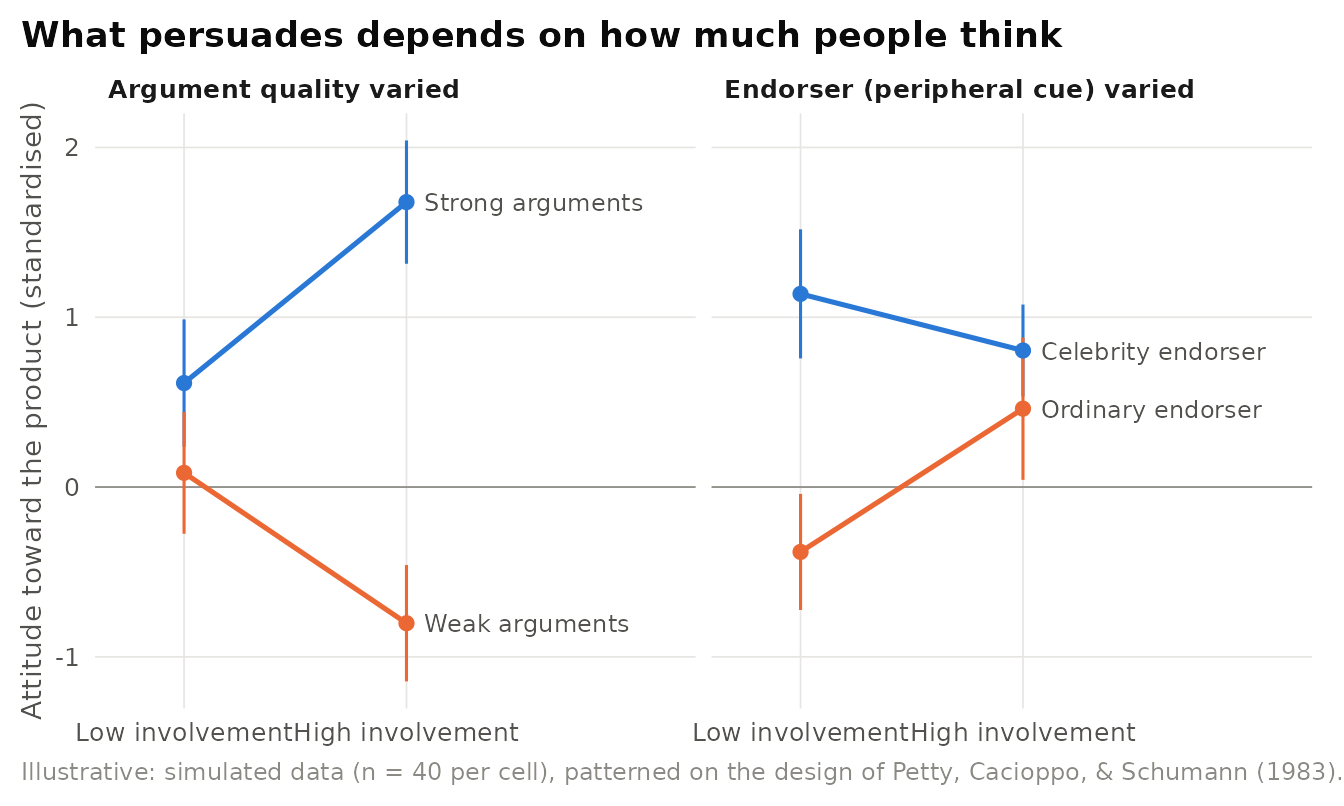
Figure 26.2: Illustrative simulation of the ELM interaction. Under high involvement, argument quality drives attitudes and the endorser matters little. Under low involvement, the pattern reverses. Points are cell means with 95% confidence intervals. Data are simulated, not empirical.
26.1.4 The heuristic-systematic model
The ELM’s closest relative is the heuristic-systematic model (HSM), developed by Chaiken (1980) and elaborated in Eagly and Chaiken (1993). Systematic processing is a comprehensive, analytic treatment of judgment-relevant information. Heuristic processing applies simple decision rules (“experts can be trusted”, “consensus implies correctness”) that are stored in memory and cued by the situation. In her original experiments, Chaiken manipulated recipients’ issue involvement together with the likability of the communicator and the number of arguments in the message. Communicator likability mattered more when involvement was low, whereas the content of the arguments carried more weight when involvement was high (Chaiken 1980).
The two models are often treated as interchangeable, but they differ in emphasis. The HSM’s sufficiency principle holds that people exert as much effort as needed to reach a desired level of judgmental confidence, and its co-occurrence assumption holds that the two modes can operate simultaneously: heuristic cues can add to systematic processing, be attenuated by it, or bias it by shaping how ambiguous arguments are interpreted. Table 26.2 compares the models.
| Feature | Elaboration likelihood model | Heuristic-systematic model |
|---|---|---|
| Key source | Petty & Cacioppo (1986) | Chaiken (1980), Eagly & Chaiken (1993) |
| Low-effort mode | Peripheral route: any cue-based process (heuristics, affect, conditioning) | Heuristic processing: application of stored decision rules |
| High-effort mode | Central route: scrutiny of issue-relevant arguments | Systematic processing: comprehensive analysis of information |
| Relation between modes | Trade-off: cue impact falls as elaboration rises | Co-occurrence: modes can add, attenuate, or bias one another |
| What drives effort | Motivation and ability | Sufficiency principle: gap between actual and desired confidence |
| Motives considered | Primarily accuracy (correct attitudes) | Accuracy, defence, and impression motives |
| Signature concept | Multiple roles of a single variable | Biased systematic processing |
| Typical managerial reading | Match creative strategy to involvement | Use cues that also shape how arguments are read |
26.1.5 Evidence and extensions
The dual-process framework is among the most heavily tested in social psychology. Several lines of evidence stand out:
- Involvement. A meta-analysis by B. T. Johnson and Eagly (1989) found that the type of involvement matters. Outcome-relevant involvement (the issue has consequences for one’s goals) interacts with argument quality in the way the ELM predicts, whereas value-relevant involvement (the issue engages core values) tends to reduce persuasion regardless of argument quality, because people defend their existing positions.
- Individual differences. People high in need for cognition, a stable tendency to engage in and enjoy effortful thinking, are more influenced by argument quality and less by peripheral cues (Cacioppo and Petty 1982).
- Multiple roles. The same variable can play different roles. An attractive endorser is a peripheral cue for a low-involvement snack, but an argument for a beauty product whose benefit is appearance. Under moderate elaboration, a surprising source can increase scrutiny itself (Petty and Cacioppo 1986).
- Attitude strength. Central-route attitudes are more durable and better predictors of behaviour, which is why the quality of the attitude, not only its valence, matters for long-run outcomes such as repeat purchase.
One route or two? Kruglanski and Thompson (1999) argued in their unimodel that cues and arguments are not processed by different routes at all: both are “evidence” from which people draw conclusions, and the apparent dual-route pattern arises because studies typically present cues briefly and early and arguments at length and later. When cue information is made as lengthy and complex as argument information, the unimodel predicts that it, too, will matter most under high elaboration. Defenders of the dual-process view reply that the ELM was always defined in terms of the process (scrutiny of merits versus simple inference) rather than the content type, and that the multiple-roles postulate already anticipates a cue acting as an argument. The debate remains instructive for researchers: claims about “route” must be supported by process evidence, thought listings, argument-quality manipulations, response latencies, rather than inferred from which variable happened to predict attitudes.
26.1.6 Applications in business
The ELM translates directly into decisions about creative strategy, media selection, and sales communication. The core managerial question is not “which message is best?” but “how much will this audience be thinking when it encounters the message?”
Ad creative for high- versus low-involvement categories. Categories differ systematically in the elaboration they invite. A buyer comparing mortgages, enterprise software, or family cars faces significant financial and performance risk. The buyer is motivated to scrutinise claims and often has time to do so. Communication in these categories typically leads with verifiable arguments, specifications, total cost of ownership, independent ratings, case studies, and supplies them in formats that support processing (comparison tables, configurators, white papers). By contrast, a shopper choosing chewing gum, soft drinks, or snacks is rarely motivated to read argument-heavy copy. Advertising in these categories leans on cues that operate with minimal thought: celebrity and likeable characters, music, humour, brand repetition, and packaging that is easy to recognise at shelf. The ELM also explains why the same category can require both approaches. A first-time buyer of a smartphone may be highly involved, whereas a loyal repeat buyer is not. Brands therefore pair detailed launch communications with simpler reminder advertising.
26.1.7 Using the theory in research
Sample hypotheses.
- H1. The effect of argument strength on brand attitude will be stronger when purchase is imminent (high outcome-relevant involvement) than when it is distant.
- H2. The effect of influencer popularity on purchase intention will be stronger for low-priced than for high-priced products.
- H3. Attitudes formed after argument-rich advertising will predict repeat purchase better than equally favourable attitudes formed after cue-based advertising.
Designs. Factorial experiments that cross argument quality with a motivation or ability manipulation (relevance, distraction, time pressure). Field experiments that vary creative executions across audiences with different involvement. Thought-listing protocols to measure elaboration directly.
Measures. Thought listing and cognitive-response coding, need for cognition scale (Cacioppo and Petty 1982), attitude strength (certainty, accessibility, resistance to counter-messages), recall of arguments versus cues.
Contexts. Advertising pretesting, health communication, sales presentations, online reviews (review content as arguments, star ratings as cues), and recommendation interfaces.
Inferring the route from the result. A common misuse is to observe that a cue predicted attitudes and conclude that people “used the peripheral route”, or that argument quality predicted attitudes and conclude that they “used the central route”. This is circular. Route should be established independently, by manipulating motivation or ability, or by measuring elaboration, and the theory’s evidence is the interaction between elaboration and message features, not a main effect of either.
26.2 The Persuasion Knowledge Model
Core claim. Consumers develop knowledge about persuasion, what marketers and other agents are trying to do, how their tactics work, and how to respond, and use that knowledge to interpret and cope with influence attempts. Recognising a behaviour as a persuasion tactic can change its meaning and its effect.
Origins. Consumer research, Friestad and Wright (1994), tested and extended by M. C. Campbell and Kirmani (2000).
Level of analysis. Individual target and dyad (target and persuasion agent).
Key constructs. Target, agent, persuasion attempt, persuasion episode, persuasion knowledge, agent knowledge, topic knowledge, coping behaviour, change-of-meaning principle, accessibility of ulterior motives, cognitive capacity.
Boundary conditions. Persuasion knowledge must be available (learned) and accessible (activated) at the moment of exposure, and the target must have the capacity to apply it. Children, novices, and distracted consumers use it less.
Related theories. Elaboration likelihood model, Signaling theory (Section 8.2), Heuristics and biases (Section 23.2).
26.2.1 Core logic
Friestad and Wright (1994) reframed persuasion from the target’s point of view. Earlier theories asked how a message changes an attitude. The persuasion knowledge model (PKM) asks how ordinary people make sense of the fact that someone is trying to influence them. Over a lifetime, consumers acquire folk theories about advertising, selling, negotiation, and social influence: why agents do what they do, which tactics are fair, and which signal manipulation. These beliefs form persuasion knowledge, one of three knowledge structures that targets bring to an encounter (Table 26.3).
| Knowledge structure | What it contains | Example question the target asks | Business illustration |
|---|---|---|---|
| Persuasion knowledge | Beliefs about agents’ goals and tactics, their effectiveness, and their appropriateness | “Why is this salesperson complimenting me?” | Recognising scarcity claims as a pressure tactic |
| Agent knowledge | Beliefs about the specific agent’s traits, competence, and goals | “Is this brand trustworthy?” | Prior experience with a retailer’s return policy |
| Topic knowledge | Beliefs about the product, issue, or service being promoted | “Do these specifications make sense?” | An engineer evaluating a component supplier’s claims |
Two ideas carry most of the model’s predictive power. The first is the change-of-meaning principle: once a target recognises an agent’s action as a persuasion tactic, the action can acquire a different meaning. Flattery that seemed sincere becomes ingratiation, a “limited-time offer” becomes a pressure tactic, a glowing product mention becomes advertising. The second idea is that targets are coping, not merely reacting. Their goal is to manage the episode in a way that serves their own interests, sometimes resisting, sometimes accepting the message while discounting the source, sometimes enjoying a clever tactic for what it is.
26.2.2 Mechanism
Persuasion knowledge does not operate automatically. M. C. Campbell and Kirmani (2000) showed that its use depends on the accessibility of the agent’s ulterior motive and on the target’s cognitive capacity. In their studies, consumers who encountered a salesperson’s flattery were more likely to infer an ulterior motive when the motive was highly accessible, for example, when the flattery came before a purchase decision rather than after, and cognitively busy targets were less likely to draw on persuasion knowledge unless the motive was highly salient. Observers, who had spare capacity, were more likely than the targets themselves to see the tactic for what it was. Figure 26.3 summarises the mechanism.
Figure 26.3: Mechanism of the persuasion knowledge model. An agent’s tactic leads to persuasion-motive inference only when persuasion knowledge is accessible and the target has capacity to use it. Recognition changes the tactic’s meaning and shapes coping.
The PKM and the ELM are complementary. Persuasion knowledge can be thought of as one of the things people think about when they elaborate. A highly involved target may scrutinise not only the arguments but also the agent’s motives. Recognising a manipulative intent can then produce counter-arguments and resistance. Conversely, the PKM explains why peripheral cues sometimes fail: a celebrity endorsement that is recognised as purchased may stop working as a cue of quality and start working as a cue of persuasive intent.
26.2.3 Evidence and extensions
The model has been used to study advertising literacy among children and adolescents, covert marketing, product placement, native advertising, sales interactions, and corporate social responsibility claims. A recurring finding is that recognising persuasive intent is not uniformly harmful to the persuader. When a tactic is judged appropriate, an honest disclosure, a transparent comparison, recognition can increase perceived fairness and trust. When a tactic is judged inappropriate, a hidden payment, a deceptive claim, recognition produces discounting and a lasting penalty to agent knowledge (“this brand tries to trick people”). The model therefore predicts asymmetric long-run consequences: the short-run gains from covert tactics must be weighed against the costs incurred when they are discovered.
Influencer marketing and sponsorship disclosure. Influencer content is persuasive in part because it looks like ordinary peer communication rather than advertising. The PKM predicts that disclosing the commercial relationship, “#ad”, “paid partnership”, “sponsored”, activates persuasion knowledge, increasing the likelihood that followers recognise the post as advertising. Regulators have taken the same view: the US Federal Trade Commission’s guidance on endorsements requires that material connections between endorsers and brands be disclosed clearly and conspicuously, and major platforms provide built-in paid-partnership labels. For brands, the managerial question is not whether to disclose (that is a legal obligation in many jurisdictions) but how to design partnerships that survive disclosure. The model’s answer is fit and appropriateness: when the influencer plausibly uses and values the product, the persuasion motive is seen as compatible with the influencer’s genuine opinion. When the fit is poor, disclosure highlights the payment and invites discounting. Several practical rules follow: choose creators whose prior content demonstrates authentic topic knowledge, allow them to express qualified opinions, and avoid scripts that read as advertising copy.
Sample hypotheses.
- H1. Sponsorship disclosure increases recognition of advertising, and this recognition mediates a decrease in source trustworthiness.
- H2. The negative effect of disclosure on brand attitude is attenuated when influencer-product fit is high.
- H3. Cognitive load reduces the effect of an inappropriate sales tactic on perceived manipulative intent (M. C. Campbell and Kirmani 2000).
Measures. Advertising recognition, inferences of manipulative intent, perceived appropriateness of tactics, source trustworthiness, resistance (counter-arguing, sharing intentions).
Designs. Between-subject experiments varying disclosure presence, wording, and position. Field experiments with platform disclosure labels. Eye tracking to measure whether disclosures are noticed.
Assuming persuasion knowledge is always activated. Many studies equate the presence of a disclosure with activation of persuasion knowledge. Disclosures that are small, late, or buried in hashtags may not be noticed. Measure recognition directly, and remember that knowledge must be both available and accessible, and the target must have capacity to use it.
26.4 Microblogging and Undirected Communication
Core claim. Microblogging, status updates, posts, and short messages broadcast to one’s network, is valuable precisely because it is undirected: it lets people reach out and invite social interaction without imposing communication on any particular person.
Origins. Consumer psychology, Buechel and Berger (2018).
Level of analysis. Individual communicator.
Key constructs. Directed versus undirected communication, social apprehension, fear of rejection, social connection.
Boundary conditions. Most relevant where people have a choice between directed channels (messages, calls) and undirected ones (public posts), and where the audience is a loose network rather than a close dyad.
Related theories. Social transmission, Uses and gratifications, Social comparison theory (Section 22.1).
Directed communication, a phone call, a direct message, an email to a specific person, carries an implicit demand: the recipient is expected to respond. For people who worry about being rejected or about imposing on others, that demand creates a barrier to reaching out. Buechel and Berger (2018) argue that undirected communication removes the barrier. A status update is addressed to no one in particular. Whoever responds does so voluntarily, so the poster can seek interaction without the risk of a specific person declining it. Their studies suggest that socially apprehensive individuals, those who are anxious about communicating with others and concerned about rejection, find undirected communication particularly attractive.
The insight complements the broader transmission literature. Barasch and Berger (2014) showed that audience size changes what people share. Buechel and Berger (2018) show that directness changes whether some people communicate at all. Research on why people post on microblogging platforms also distinguishes intrinsic motives (enjoyment of posting) from image-related motives (the status of having an audience). Toubia and Stephen (2013) found evidence that image-related utility plays a substantial role for many non-commercial users.
Community design and customer voice. Brands that host customer communities often find that a small share of members post while most only read. Undirected communication research suggests one reason and one remedy. Directed requests (“Ask an expert”, “Message our team”) may deter socially apprehensive customers, whereas low-stakes undirected formats, open threads, reactions, “share your setup” posts, let them participate without making a specific demand on anyone. The same logic applies inside organisations: enterprise social platforms can surface questions from employees who would hesitate to email a senior colleague directly. Designers should pair such formats with norms that make responses likely, because an undirected post that receives no response can itself feel like rejection.
26.5 Agenda Setting
Core claim. The news media may not tell people what to think, but they are highly influential in telling people what to think about: the issues that receive the most coverage come to be seen by the public as the most important.
Origins. Political communication, McCombs and Shaw (1972), building on B. C. Cohen (1963) and on the voter studies of Lazarsfeld, Berelson, and Gaudet (1944), extended to priming by S. Iyengar and Kinder (1987).
Level of analysis. Society and public opinion (aggregate issue salience). Individual (issue importance judgments).
Key constructs. Media agenda, public agenda, issue salience, obtrusive versus unobtrusive issues, need for orientation, attribute (second-level) agenda setting, priming.
Boundary conditions. Strongest for unobtrusive issues that people cannot observe directly (foreign policy, macroeconomic trends) and among people with a high need for orientation. Weaker for issues experienced first-hand. Fragmented and personalised media environments complicate the notion of a single media agenda.
Related theories. Framing, Spiral of silence (Section 22.8), Pack journalism (Section 30.7), Availability heuristic (Section 23.2).
26.5.1 Core logic and evidence
B. C. Cohen (1963) observed that the press may often fail to tell people what to think but is remarkably successful in telling them what to think about. McCombs and Shaw (1972) turned this observation into a testable hypothesis. During the 1968 US presidential campaign, they surveyed undecided voters in Chapel Hill, North Carolina, about which issues they considered most important, and content-analysed the news media those voters used. The rank order of issues on the media agenda corresponded closely to the rank order on the voters’ agenda. Because undecided voters lacked strong partisan filters, they were a sensible population in which to look for media influence.
The correlational design left open the direction of causality: do media follow the public or lead it?and later work used time-series designs and experiments to address the question. S. Iyengar and Kinder (1987) manipulated the content of television news broadcasts that participants watched over several days and found that issues emphasised in the broadcasts became more important to viewers. They also documented priming: issues that were made salient became more heavily weighted in viewers’ evaluations of the president. Agenda setting therefore has two consequences: it shapes which issues people think are important, and it shapes which criteria people use to evaluate leaders, firms, and products.
Later research distinguished first-level agenda setting (salience of objects such as issues or candidates) from attribute or second-level agenda setting (salience of particular attributes of those objects). Attribute agenda setting overlaps with framing, and Scheufele and Tewksbury (2007) argue that agenda setting and priming rest on accessibility, making some considerations easier to retrieve, whereas framing rests on applicability: the fit between a frame and how an issue is interpreted. Table 26.6 summarises the distinction.
| Media effect | What media change | Psychological mechanism | Classic study | Business analogue |
|---|---|---|---|---|
| Agenda setting | Perceived importance of issues | Accessibility (salience) | McCombs & Shaw (1972) | Which attributes buyers consider at all |
| Priming | Criteria used to evaluate actors | Accessibility of evaluative standards | Iyengar & Kinder (1987) | Which attribute dominates brand evaluation |
| Framing | Interpretation of an issue | Applicability of an interpretive schema | Entman (1993), Tversky & Kahneman (1981) | How a price, risk, or crisis is understood |
Issue salience and corporate communication. Agenda setting implies that firms compete not only on positions but on which issues are discussed at all. A manufacturer whose products excel on safety benefits when safety dominates media coverage of its category, while a rival that leads on price benefits when affordability dominates. Corporate communication functions therefore track media agendas, invest in research and data releases that journalists cover, and time announcements around the news cycle. The priming corollary is equally important: during a public debate about data privacy, consumers may weight privacy more heavily when evaluating a technology brand, even if their underlying preferences have not changed. Firms whose reputations rest on an attribute that becomes salient should expect amplified effects: positive or negative.
Equating coverage with persuasion. Agenda setting is about salience, not about direction of opinion. Heavy coverage of an issue can raise its importance while leaving attitudes toward it unchanged, or while polarising them. Research that treats volume of coverage as a measure of favourable influence conflates agenda setting with persuasion.
26.6 Framing Theory
Core claim. The way information is presented, which aspects are emphasised, and whether logically equivalent outcomes are described as gains or losses, systematically changes judgments and choices.
Origins. Two traditions: behavioural decision research on equivalence framing (Tversky and Kahneman 1981, Levin, Schneider, and Gaeth 1998), and communication and sociology research on emphasis framing (Entman 1993).
Level of analysis. Individual (choice and judgment) and societal (public discourse).
Key constructs. Gain versus loss frames, risky-choice, attribute, and goal framing, frame selection and salience, problem definition, causal interpretation, moral evaluation, treatment recommendation.
Boundary conditions. Equivalence-framing effects are strongest when people do not spontaneously translate between frames and when the decision is unfamiliar. Emphasis-framing effects are weaker when audiences hold strong prior attitudes or encounter competing frames.
Related theories. Prospect theory (Chapter 24), Agenda setting, Mental accounting (Section 23.5), Anchoring (Section 29.9).
26.6.1 Equivalence framing
Tversky and Kahneman (1981) presented participants with the “Asian disease problem”. An outbreak is expected to kill 600 people, and participants choose between two programmes. In one version, outcomes are described in terms of lives saved: Programme A will save 200 people for certain, whereas Programme B offers a one-third probability of saving all 600 and a two-thirds probability of saving no one. In a second version, the same outcomes are described in terms of deaths: under Programme C, 400 people will die for certain. Under Programme D, there is a one-third probability that nobody will die and a two-thirds probability that all 600 will die. The programmes are numerically identical across versions, yet preferences reverse (Figure 26.6). In the gain frame most participants chose the certain option. In the loss frame most chose the gamble. The pattern follows from prospect theory (Chapter 24): a value function that is concave for gains and convex for losses produces risk aversion in the domain of gains and risk seeking in the domain of losses.
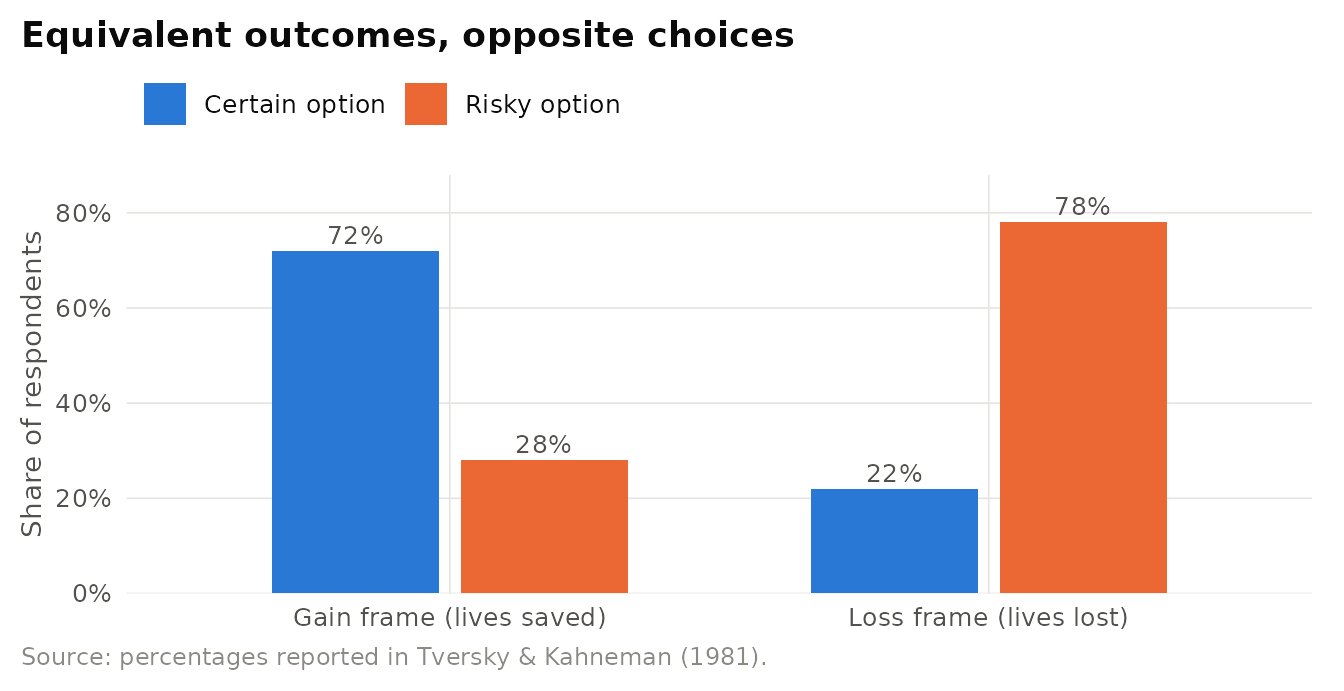
Figure 26.6: The framing of decisions. Percentages choosing the certain versus the risky programme in the Asian disease problem, as reported by Tversky & Kahneman (1981). The gain-frame problem was answered by 152 respondents and the loss-frame problem by 155.
Levin, Schneider, and Gaeth (1998) distinguish three types of equivalence framing that differ in what is framed and in what they affect (Table 26.7). The distinction matters because the types have different mechanisms and different typical effect directions. Attribute framing is the most common in marketing: in a classic study, ground beef described as “75% lean” was rated more favourably than beef described as “25% fat”, and the difference was attenuated, though not eliminated, after participants tasted the meat (Levin and Gaeth 1988).
| Frame type | What is framed | What is affected | Typical effect | Example |
|---|---|---|---|---|
| Risky-choice framing | Outcomes of options with different risk levels | Risk preference | Risk aversion for gains, risk seeking for losses | Asian disease problem |
| Attribute framing | A single attribute of an object | Evaluation of the object | Positive labels yield more favourable evaluations | “75% lean” vs. “25% fat” |
| Goal framing | Consequences of performing or not performing an act | Persuasiveness of an appeal | Loss frames often more persuasive | “You lose X by not insulating” vs. “You gain X by insulating” |
26.6.2 Emphasis framing
In communication research, framing refers less to logically equivalent descriptions and more to selection and emphasis. Entman (1993) defined framing as selecting some aspects of a perceived reality and making them more salient in a communicating text so as to promote a particular problem definition, causal interpretation, moral evaluation, and/or treatment recommendation. A news report about rising fuel prices can frame the issue as a problem of corporate profits, of geopolitical supply, of environmental policy, or of household budgets: each frame highlighting different causes and remedies. Entman’s four functions provide a coding scheme widely used in content analysis: does the text define a problem, diagnose causes, make a moral judgment, and suggest a remedy?
The two traditions are complementary rather than competing. Equivalence framing shows that even logically identical information can change choices. Emphasis framing shows that the selection of which true considerations to foreground shapes interpretation. Both are pervasive in business communication: in pricing (“less than a dollar a day”), in risk communication (“99% success rate” versus “1% failure rate”), and in organisational change (“restructuring for growth” versus “cost cutting”).
26.6.3 Applications in business
Crisis communication and framing. When a crisis threatens a firm’s reputation, stakeholders ask who is responsible. Situational crisis communication theory (Coombs 2007) builds on attribution theory (Section 21.3) to argue that the appropriate response depends on how much responsibility stakeholders attribute to the organisation. Crises in the victim cluster (natural disasters, product tampering by outsiders) attract little attribution of responsibility. Accidental crises (technical errors) attract moderate attribution. Preventable crises (management misconduct, known risks that were ignored) attract strong attribution. Response strategies range from deny (attack the accuser, deny the crisis) through diminish (excuse, justification) to rebuild (compensation, apology). Framing is central: the firm’s first communications shape which cluster stakeholders assign the crisis to. Johnson & Johnson’s response to the 1982 Tylenol poisonings, a nationwide recall and the introduction of tamper-resistant packaging, despite the poisonings having been caused by an outside criminal, is widely taught as a case in which the firm framed itself as acting to protect customers rather than as a defendant. The theory also warns against mismatches: a firm that uses a “victim” frame for a crisis the public perceives as preventable invites further reputational damage.
Sample hypotheses.
- H1. Describing a product attribute in positive terms (“90% success”) will increase evaluations relative to the equivalent negative description (“10% failure”), and the effect will be smaller for experts.
- H2. In crisis communication, rebuild strategies will protect reputation more than deny strategies when stakeholders attribute high responsibility to the firm (Coombs 2007).
- H3. News articles that frame a corporate event using a “moral” frame will generate more negative social-media sentiment than articles using an “economic” frame.
Designs. Randomised framing experiments. Content analysis of news and social-media frames (manual coding or supervised text classification). Event studies of market reactions to differently framed announcements.
Measures. Choice shares, risk preferences, evaluations, frame-coding schemes based on Entman’s four functions, attributions of responsibility.
Calling every message difference a “frame”. If two messages differ in the information they contain, not just in its presentation or emphasis, differences in outcome may reflect information rather than framing. Equivalence-framing designs require logically equivalent descriptions. Emphasis-framing designs should hold facts constant and vary only which considerations are foregrounded.
26.7 Uses and Gratifications
Core claim. Audiences are active and goal-directed: people select media and content to satisfy needs, and the effects of media depend on the gratifications people seek and obtain.
Origins. Mass-communication research, E. Katz, Blumler, and Gurevitch (1973), Blumler and Katz (1974), updated for digital media by Ruggiero (2000).
Level of analysis. Individual audience member.
Key constructs. Social and psychological needs, expectations of media, gratifications sought, gratifications obtained, media choice, functional alternatives (non-media sources of gratification).
Boundary conditions. Assumes people are aware of, and can report, their motives. Habitual and algorithmically curated media use may weaken the assumption of deliberate selection.
Related theories. Self-determination theory (Section 19.6), Microblogging, Social transmission, Technology acceptance model (Section 10.4).
26.7.1 Core logic
Most media-effects theories ask what media do to people. Uses and gratifications reverses the question and asks what people do with media. E. Katz, Blumler, and Gurevitch (1973) summarised the approach in a set of assumptions: the audience is active and its media use is goal-directed. The initiative in linking need gratification to media choice lies with the audience member. Media compete with other sources of need satisfaction. People are sufficiently self-aware to report their interests and motives, and value judgments about the cultural significance of media should be suspended while audience orientations are explored. The approach locates the origin of media effects in the social and psychological needs that generate expectations of media and lead to differential patterns of exposure.
Table 26.8 summarises a typology of gratifications commonly used in the literature, with contemporary business examples. The categories overlap, and the same medium can serve several of them at once.
| Gratification | Underlying need | Traditional media example | Digital and business example |
|---|---|---|---|
| Information / surveillance | Understanding the environment, reducing uncertainty | News bulletins | Product reviews, industry newsletters |
| Personal identity | Reinforcing values, self-understanding | Lifestyle magazines | Following creators who express one’s identity |
| Integration and social interaction | Belonging, conversation material | Watching the same broadcast as friends | Brand communities, group chats, live-streams |
| Entertainment / diversion | Escape, relaxation, emotional release | Television drama | Short-video platforms, mobile games |
| Self-expression and status | Being seen, building an audience | Letters to the editor | Posting reviews, microblogging |
26.7.2 Evidence, extensions, and critique
The approach has proved adaptable. Each new medium, radio, television, the internet, mobile phones, social networks, has been studied by asking which needs it serves and how it competes with older media. Ruggiero (2000) argued that the interactivity, demassification, and asynchroneity of digital media make the active audience assumption more plausible than in the broadcast era, and that uses and gratifications would become more rather than less relevant. Critics have long noted that the approach can be descriptive and individualistic: lists of gratifications proliferate, self-reports of motives may be post-hoc rationalisations, and the theory says less about the content and institutional structure of media than about audience motives. Habitual use and recommendation algorithms also complicate the claim that media choice reflects deliberate goals.
Active audience or captured attention? Uses and gratifications assumes that people choose media to satisfy needs. Critics of engagement-optimised platforms argue that recommendation systems shape the needs they then satisfy, so that what looks like goal-directed choice is partly the product of design. One way to reconcile the views is to distinguish gratifications sought from gratifications obtained: a platform may attract users by promising social connection (gratification sought) while delivering mainly diversion (gratification obtained). Persistent gaps between the two predict dissatisfaction and churn: a testable implication with clear managerial relevance.
Content strategy by gratification. A business-to-business software company publishes a blog, a podcast, and a community forum. Uses and gratifications suggests assessing each channel by the needs it serves rather than by reach alone. The blog might serve information needs (how-to guides), the podcast personal identity and diversion needs (listening to respected practitioners during a commute), and the forum social interaction and self-expression needs (helping peers, building a reputation). Metrics follow from the gratification: search traffic and task completion for information content, completion rates and subscriptions for the podcast, and contribution rates and reciprocal replies for the forum. Content that fails to deliver the gratification its audience seeks, a promotional podcast episode, an unanswered forum post, erodes use even if it is widely distributed.
List the three apps or media you used most yesterday. For each, write down the gratification you sought when you opened it and the gratification you actually obtained. Where they diverge, what design feature of the medium explains the gap, and what would a firm need to change to close it?
26.8 Chapter Summary
- Persuasion depends on how much people think. Under high elaboration, argument quality dominates. Under low elaboration, peripheral cues and heuristics dominate, and the resulting attitudes are weaker (Petty and Cacioppo 1986, Chaiken 1980).
- Audiences recognise and cope with persuasion. The persuasion knowledge model explains why disclosed or recognised tactics can change meaning and lose force, and why appropriate tactics can survive disclosure (Friestad and Wright 1994, M. C. Campbell and Kirmani 2000).
- People share because sharing serves their own functions: impression management, emotion regulation, information, bonding, and persuasion (Berger 2014). High-arousal content travels further (Berger and Milkman 2012).
- Influence flows through people as well as media (E. Katz and Lazarsfeld 1955), but large cascades depend on network susceptibility more than on a few influentials (D. J. Watts and Dodds 2007).
- Undirected communication such as microblogging lets people reach out without imposing on anyone in particular (Buechel and Berger 2018).
- Falsehood spreads farther and faster than truth, driven by human sharing of novel, arousing content (Vosoughi, Roy, and Aral 2018).
- Media shape what people think about (agenda setting) and which criteria they use (priming) (McCombs and Shaw 1972, S. Iyengar and Kinder 1987). Framing shapes how issues and choices are interpreted (Tversky and Kahneman 1981, Entman 1993).
- Uses and gratifications treats audiences as goal-directed and explains media choice by the needs it serves (E. Katz, Blumler, and Gurevitch 1973).
Table 26.9 presents the comparison of the chapter’s theories.
| Theory | Focal actor | Key mechanism | Signature prediction | Typical business use |
|---|---|---|---|---|
| ELM / HSM | Message recipient | Elaboration (motivation x ability) | Arguments matter under high, cues under low involvement | Creative strategy by category involvement |
| Persuasion knowledge model | Target of persuasion | Recognition of persuasive intent, change of meaning | Recognised inappropriate tactics backfire | Influencer disclosure, sales tactics |
| Social transmission | Sharer | Self-serving functions of sharing, arousal | High-arousal, socially valuable content spreads | Shareable content, referral design |
| Two-step flow | Opinion leader | Interpersonal relay of media content | Influence passes through social ties | Seeding and advocacy programmes |
| Undirected communication | Poster | Reaching out without imposition | Socially apprehensive people favour broadcasting | Community and platform design |
| Agenda setting / priming | Public | Accessibility of issues and criteria | Media emphasis predicts issue importance | Issue management, PR timing |
| Framing | Decision maker / public | Reference points, applicability of schemas | Equivalent descriptions change choices | Pricing, risk, and crisis communication |
| Uses and gratifications | Audience member | Need-driven media selection | Media chosen for gratifications sought | Channel strategy and content metrics |
26.9 Discussion Questions
- The ELM predicts that argument-based attitudes are more durable than cue-based attitudes. Design a field experiment for a consumer brand that would test this prediction using purchase data rather than self-reported attitudes.
- A regulator proposes that all influencer posts carry a prominent “Advertisement” label. Using the persuasion knowledge model, predict the effects on followers, influencers, and brands, and identify the conditions under which disclosure would not reduce persuasion.
- Vosoughi, Roy, and Aral (2018) found that falsehood spreads farther than truth. Which functions of word of mouth help explain this pattern, and what platform design changes would follow from each?
- Agenda setting was first documented in an era of a few dominant news outlets. How would you test the theory in a fragmented, algorithmically curated media environment? What is “the media agenda” in that setting?
- Distinguish equivalence framing from emphasis framing. Give one business example of each, and explain how you would design an experiment that isolates the framing effect from an information effect.
- Choose a product category. Using uses and gratifications, identify the dominant gratification sought by its customers and propose a content strategy that serves it. How would you measure whether the gratification is obtained?
26.10 Further Reading
- Petty and Cacioppo (1986): the definitive statement of the elaboration likelihood model, its postulates, and the early evidence.
- Petty, Cacioppo, and Schumann (1983): the canonical advertising experiment showing the involvement × argument quality × peripheral cue pattern.
- Friestad and Wright (1994): the original persuasion knowledge model. Essential for research on disclosure, covert marketing, and sales tactics.
- Berger (2014): a comprehensive review of word of mouth organised around the functions sharing serves.
- Berger and Milkman (2012): an influential empirical study of which content goes viral and why arousal matters.
- Vosoughi, Roy, and Aral (2018): a large-scale analysis of how true and false news spread online.
- Scheufele and Tewksbury (2007): a clear conceptual comparison of agenda setting, priming, and framing.
- E. Katz, Blumler, and Gurevitch (1973): the foundational statement of the uses and gratifications approach.
26.3 Word of Mouth and Social Transmission
Core claim. People share information, opinions, and content because sharing serves their own needs: managing impressions, regulating emotions, acquiring information, bonding with others, and persuading. These motives, together with features of the content and the audience, determine what is shared and how far it spreads.
Origins. Sociology of personal influence (E. Katz and Lazarsfeld 1955), marketing research on word of mouth (Godes and Mayzlin 2004, Chevalier and Mayzlin 2006), synthesised in Berger (2014) and Berger (2013).
Level of analysis. Individual sharer, dyad, and social network.
Key constructs. Word of mouth (WOM), sharer motives, content characteristics (emotional arousal, practical value, social currency), audience size, triggers, opinion leaders, cascades.
Boundary conditions. Predictions about content features assume people choose what to share. Network position, platform algorithms, and paid amplification can dominate content effects in some settings.
Related theories. Emotion and virality (Section 25.4), Diffusion of innovations (Section 10.1), Weak ties (Section 9.3), Identity signaling (Section 8.5), Microblogging.
26.3.1 From mass media to personal influence: the two-step flow
The study of social transmission began with a surprise. When Lazarsfeld and his colleagues studied how voters in Erie County, Ohio, made up their minds during the 1940 US presidential campaign, they expected to find strong direct effects of radio and print media. Instead, they found that many voters reported being influenced by other people, and that ideas often seemed to flow from the media to opinion leaders and from them to less active sections of the population (Lazarsfeld, Berelson, and Gaudet 1944). E. Katz and Lazarsfeld (1955) developed this two-step flow hypothesis in a study of women in Decatur, Illinois, examining influence in marketing, fashion, public affairs, and film-going. Opinion leaders were found at every social level, differed by domain, and were distinguished by greater media exposure and by their social position, not merely by status (Figure 26.4).
Figure 26.4: The two-step flow of communication (Katz & Lazarsfeld, 1955) and its modern revision. Media content reaches opinion leaders, who interpret and relay it through interpersonal ties. Network research suggests that large cascades depend on many easily influenced individuals rather than a few influentials (Watts & Dodds, 2007).
The two-step flow shaped decades of marketing practice, from seeding products with “influentials” to opinion-leader scales in consumer research. Later network research has qualified it. In simulations of influence networks, D. J. Watts and Dodds (2007) found that large cascades were usually driven not by a small number of highly influential people but by a critical mass of easily influenced individuals. Influentials can trigger cascades, but only when the network is ready. The practical implication is that seeding strategy depends on network structure as much as on the identity of the seed.
26.3.2 Why people share
Berger (2014) organises the literature around the functions that word of mouth serves for the sharer. The framework explains why sharing is not a neutral relay of information: what people choose to say reflects what the act of saying it does for them (Table 26.4).
Two further findings shape what spreads. First, audience size matters. Barasch and Berger (2014) showed that people who broadcast to many recipients focus on self-presentation and avoid sharing content that makes them look bad, whereas people who narrowcast to one recipient focus more on the recipient and share more useful content. Second, sharing is intrinsically rewarding: in neuroimaging and behavioural studies, Tamir and Mitchell (2012) found that disclosing information about the self engaged brain regions associated with reward, and that participants were willing to forgo small monetary payments to talk about themselves.
26.3.3 What gets shared: content characteristics
Berger and Milkman (2012) analysed which New York Times articles made the newspaper’s most-emailed list over a three-month period. Controlling for placement and other features, positive content was more likely to be shared than negative content, but emotion was not simply a matter of valence. Content evoking high-arousal emotions, awe, anger, and anxiety, was more likely to be shared, whereas content evoking a low-arousal emotion, sadness, was less likely to be shared. A complementary experiment found that physiological arousal, even arousal induced by an unrelated activity such as jogging in place, increased participants’ willingness to share content (Berger 2011). Figure 26.5 places these emotions in the valence-arousal space.
Figure 26.5: Conceptual map of emotions by valence and arousal, with the direction of their association with sharing reported by Berger & Milkman (2012) and Berger (2011). Positions are illustrative, not measured values.
Content characteristics also determine when sharing happens. Berger and Schwartz (2011) found that products that were more publicly visible and more frequently cued by the environment received more word of mouth, and that interesting products received more immediate but not more ongoing word of mouth. Environmental triggers, cues that bring a product to mind, sustain conversation long after novelty fades.
26.3.4 The STEPPS framework
For practitioners, Berger (2013) synthesised this research into six principles, summarised in Table 26.5. The framework is a checklist rather than a formal theory, but each element maps onto a mechanism with independent empirical support.
Designing shareable content. A consumer-electronics firm wants its product launch to generate organic conversation rather than relying entirely on paid media. Social transmission research suggests several design choices. To create social currency, the launch might offer early access to a limited group, giving those customers something remarkable to report. To create triggers, the firm might tie the product to a recurring context, a commute, a weekly routine, so that it is cued repeatedly after launch. The firm would aim for high-arousal emotion (awe at a capability, amusement in a demonstration) rather than low-arousal contentment. It would make use public through visible design or a shareable output, and package practical value in tips that users would pass on to help friends. Finally, it would embed the brand in a story, the problem a customer solved, rather than adding a logo to unrelated entertainment. The theory also flags risks: content optimised for arousal can attract anger as easily as awe, and broadcast audiences reward self-presentation, so content that makes sharers look foolish will not travel.
26.3.5 Word of mouth and market outcomes
Does word of mouth actually move sales? Field evidence suggests that it does, but in ways that depend on the structure of conversation. Godes and Mayzlin (2004) found that the dispersion of online conversations about television shows across different communities was associated with subsequent ratings, suggesting that conversations that cross social boundaries carry more new information than conversations within one community. Chevalier and Mayzlin (2006) exploited differences in reviews between two online booksellers and found that improvements in a book’s reviews on one site were associated with relative increases in its sales on that site, and that very negative reviews had a larger effect than very positive ones. Both studies illustrate a methodological challenge that recurs throughout this literature: because word of mouth and sales are both driven by product quality, credible identification requires comparison across sites, communities, or time.
26.3.6 Misinformation and the spread of falsehood
Social transmission theory also illuminates why false information spreads. Vosoughi, Roy, and Aral (2018) analysed the diffusion of roughly 126,000 rumour cascades on Twitter from 2006 to 2017, classifying each as true or false using the verdicts of six independent fact-checking organisations. Falsehood diffused significantly farther, faster, deeper, and more broadly than the truth in all categories of information, and the effects were more pronounced for false political news than for other categories. False stories were about 70% more likely to be retweeted than true ones. Two findings bear directly on mechanism. First, false news was more novel than true news, and replies to false stories expressed more surprise and disgust, consistent with the view that novelty and emotional arousal drive sharing. Second, automated accounts (“bots”) accelerated the spread of true and false news at similar rates, implying that the difference was driven by human sharing decisions rather than by bots.
These findings connect directly to the functions of word of mouth. Novel information confers social currency on the sharer. Arousing content is more likely to be passed on, and broadcasting to many followers emphasises self-presentation over careful verification. Correcting misinformation is difficult because of the continued influence effect: retracted information often continues to shape reasoning, especially when no alternative explanation is offered (Lewandowsky et al. 2012). Interventions that shift attention to accuracy at the moment of sharing, for example, asking people to rate the accuracy of an unrelated headline, have been found to improve the quality of news that people subsequently share, including in a field experiment on Twitter (Pennycook et al. 2021).
Sample hypotheses.
Designs. Archival analysis of shares, retweets, and reviews with content coded by text analysis. Field experiments with seeding strategies. Laboratory experiments that manipulate arousal or audience size. Natural experiments created by platform changes.
Measures. Share counts and cascade depth, dispersion of conversation across communities, sentiment and emotion dictionaries, self-reported sharing motives.
Treating virality as a property of content alone. Whether content spreads depends on content features and on network structure, platform ranking, paid seeding, and timing. Studies that correlate content features with share counts without accounting for exposure (how many people saw the content) confound the probability of sharing with the opportunity to share. Normalise by exposure where possible, and treat cascade size as a highly skewed outcome.