13 International Business
In 1997 Walmart, already the largest retailer in the world, entered Germany by acquiring the Wertkauf hypermarket chain and, a year later, the Interspar stores. It brought the formula that had worked at home: everyday low prices, a tightly managed supply chain, extended opening hours where the law allowed, and a distinctive service culture. In 2006 it announced the sale of its 85 German stores to Metro and left the country. Over roughly the same decades IKEA, a furniture retailer from a small town in southern Sweden, moved from Norway to Denmark, Switzerland, Germany, North America, China, and India, and became one of the most recognisable brands in the world. Why did a firm with enormous scale, capital, and operational know-how fail in a large, wealthy, and seemingly similar market, while a firm from a country of a few million people succeeded in dozens of very different ones?
The puzzle is the core of international business (IB) theory. Firms that cross borders face costs that local rivals do not, and they must possess something that offsets those costs. They must decide where to go, how to enter (exporting, licensing, joint ventures, acquisitions, or greenfield subsidiaries), how fast to commit resources, and how much to adapt. This chapter presents six theories that answer these questions. The Uppsala model explains internationalization as a gradual process of learning and commitment. The OLI (eclectic) paradigm explains why firms produce abroad rather than export or license. Internalization theory explains why firms replace cross-border markets with internal hierarchies. The liability of foreignness names the extra costs that foreign firms bear. Institutional voids describe the missing market intermediaries in emerging economies and the strategies they invite. Born globals challenge the gradualist story by internationalizing from inception. Together these theories form the backbone of research on multinational enterprises (MNEs), entry mode, and global strategy, and they draw heavily on Transaction cost economics (Section 6.3), Institutional theory (Section 7.2), and research on Cultural distance and [Hofstede](#hofstede) (Section @ref([hofstede](#hofstede) (Section 18.2))) (Section 18.2) (Table 13.1).
| Theory | Core question | Level of analysis | Key source |
|---|---|---|---|
| Uppsala model | How and in what order do firms internationalize? | Firm, firm-market relationship | Johanson & Vahlne (1977, 2009) |
| OLI paradigm | Why do firms produce abroad rather than export or license? | Firm, country, industry | Dunning (1980, 1988) |
| Internalization theory | Why do firms replace cross-border markets with internal hierarchies? | Transaction, firm | Buckley & Casson (1976), Rugman (1981) |
| Liability of foreignness | What extra costs do foreign firms bear, and how can they overcome them? | Subsidiary, firm | Hymer (1976), Zaheer (1995) |
| Institutional voids | How do missing market institutions shape strategy in emerging economies? | Country, business group, firm | Khanna & Palepu (1997, 2010) |
| Born globals | Why do some new ventures internationalize from inception? | New venture | Oviatt & McDougall (1994), Knight & Cavusgil (2004) |
13.1 Uppsala Model
Core claim. Firms internationalize gradually. Because knowledge of foreign markets is mostly experiential, firms commit resources in small steps, entering psychically close markets first and moving from low-commitment to high-commitment modes as they learn.
Origins. Business studies at Uppsala University. Johanson and Wiedersheim-Paul (1975) documented the pattern in four Swedish firms. Johanson and Vahlne (1977) formalized it as a dynamic model of knowledge and commitment, and Johanson and Vahlne (2009) revised it around business networks.
Level of analysis. The firm and its relationships with particular foreign markets (and, after 2009, with network partners in those markets).
Key constructs. Psychic distance, experiential market knowledge, market commitment, commitment decisions, current activities, establishment chain, network position, liability of outsidership.
Boundary conditions. Strongest when market knowledge is tacit and country-specific, when the firm has limited resources, and when uncertainty about foreign markets is high. Weaker for firms with large resources, highly codified offerings, or managers with prior international experience.
Related theories. Organizational learning (Section 14.3), Absorptive capacity (Section 5.2), Cultural distance and Hofstede (Section 18.2), Born globals, [Real options](#real-options-theory) (Section 11.6) theory (Section 11.6).
13.1.1 Origins and intellectual history
In the early 1970s a group of researchers at Uppsala University studied how Swedish manufacturers had become international. Johanson and Wiedersheim-Paul (1975) traced the histories of four firms, Sandvik, Atlas Copco, Facit, and Volvo, and found two regularities. First, operations in a given country developed along a sequence they called the establishment chain: no regular exports, then exports through independent representatives (agents), then a sales subsidiary, and finally local production. Second, firms entered new markets in order of increasing psychic distance, defined as the factors that prevent or disturb the flow of information between the firm and the market, such as differences in language, education, business practices, culture, and industrial development. Swedish firms typically went to Norway, Denmark, and Finland before Germany or the United Kingdom, and only later to more distant markets.
Johanson and Vahlne (1977) turned these observations into a theory. Their model has two state aspects, market knowledge and market commitment, and two change aspects, commitment decisions and current activities. Knowledge and commitment affect the decisions a firm makes and the activities it performs. Those activities, in turn, generate new experiential knowledge and deepen commitment. The model is therefore a feedback loop rather than a one-shot decision, and it borrows from the behavioural theory of the firm the assumptions of bounded rationality (Section 23.1), problemistic search, and incremental decision making.
Three decades later, Johanson and Vahlne (2009) revised the model in response to research on business networks and on rapidly internationalizing firms. In the revised model, markets are networks of relationships, and the main obstacle to internationalization is not foreignness as such but outsidership: lacking a position in the relevant network. The state variables become knowledge and opportunities and network position. The change variables become relationship commitment decisions and learning, creating, and trust-building.
13.1.2 Core logic and propositions
The engine of the model is the claim that the most important knowledge for operating abroad is experiential. Objective knowledge (market statistics, laws, tariffs) can be bought or taught. Knowledge of how customers decide, how local distributors behave, and which officials matter can mostly be acquired only by doing business in the market. Because experiential knowledge reduces perceived risk, commitment follows knowledge. The core propositions can be stated as follows:
- P1 (Incremental commitment). Additional commitment to a market will be made in small steps, unless the firm has large resources, market conditions are stable and transparent, or it has experience from similar markets (Johanson and Vahlne 1977).
- P2 (Establishment chain). Within a market, operations will tend to move from low-commitment modes (agents) to high-commitment modes (sales and production subsidiaries).
- P3 (Psychic distance sequence). Across markets, entry will tend to proceed from psychically close to psychically distant countries.
- P4 (Network position). After Johanson and Vahlne (2009), internationalization will follow the firm’s relationships: firms enter markets where partners already have positions, and commitment grows as trust and mutual knowledge build.
Table 13.2 describes the establishment chain. Each stage involves more resources and creates more knowledge than the one before.
| Stage | Operating mode | Resource commitment | Knowledge generated | Typical risk |
|---|---|---|---|---|
| 0 | No regular export (sporadic orders) | Negligible | Almost none, information arrives by chance | Lost opportunities |
| 1 | Export through independent agent or distributor | Low: training, samples, margins | Second-hand market information filtered by the agent | Agent opportunism, weak control of positioning |
| 2 | Sales subsidiary | Moderate: staff, office, inventory | Direct customer and competitor knowledge | Fixed costs if the market disappoints |
| 3 | Production subsidiary | High: plant, local suppliers, workforce | Deep knowledge of labour, suppliers, regulation | Sunk investment, exposure to host-country policy |
13.1.3 Mechanism
Figure 13.1 redraws the 1977 model. The loop explains why internationalization tends to be path-dependent: a firm’s current position determines what it can learn next, and what it learns determines what it is willing to commit.
Figure 13.1: The Uppsala internationalization mechanism. Market knowledge and market commitment (state aspects) shape commitment decisions and current activities (change aspects), which generate new experiential knowledge and deepen commitment. Psychic distance slows the loop. Adapted from Johanson and Vahlne (1977).
Figure 13.2 shows the pattern the model predicts for a single firm entering three markets that differ in psychic distance. Entry into the close market comes earlier, and each subsequent step comes sooner, because knowledge accumulates faster where information flows more freely.
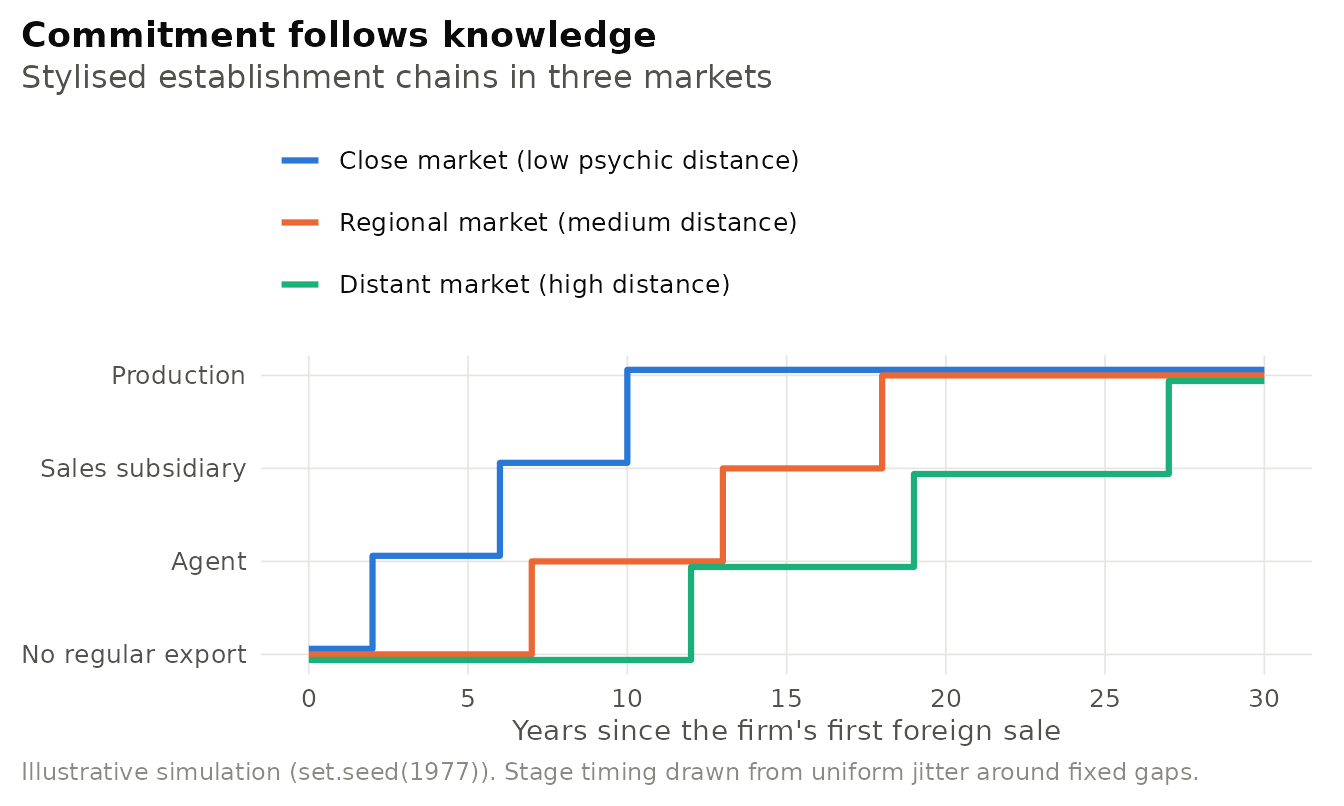
Figure 13.2: Illustrative stylised trajectories of commitment to three foreign markets that differ in psychic distance. Entry to more distant markets is later and each move along the establishment chain takes longer. Simulated data, not empirical.
13.1.4 Evidence and extensions
The model fit the early history of Nordic and other European manufacturers well, and the establishment chain remains a useful description of how many small and medium-sized firms enter markets. Research on entry mode has confirmed that distance matters for how firms enter: Kogut and Singh (1988) found that firms from countries culturally distant from the United States were more likely to enter through joint ventures or greenfield investments than through acquisitions, which require integrating a foreign organization. Ghemawat (2001) broadened psychic distance into four dimensions of CAGE distance: cultural, administrative, geographic, and economic. He argued that firms systematically overestimate the attractiveness of large but distant markets because they ignore these frictions.
The 2009 revision moved the model toward network theory. If markets are webs of relationships, a firm can “jump” to a distant country when a key customer or partner takes it there, and a firm can fail in a close market if it cannot become an insider. This revision reconciles the model with evidence on rapid internationalization and with the view that relationships, not countries, are the unit of learning (Johanson and Vahlne 2009).
Is the Uppsala model a theory of learning or a description of caution? Forsgren (2002) argued that the model rests on a narrow conception of learning. Firms can also acquire knowledge by hiring experienced managers, imitating other firms, acquiring local companies, or searching deliberately, and these routes allow faster and less incremental internationalization than the model predicts. A second critique concerns psychic distance itself. Shenkar (2001) showed that distance measures built from national culture scores carry hidden assumptions of symmetry (the distance from A to B equals that from B to A), stability, linearity, and causality that rarely hold. A third critique is empirical: services, digital, and knowledge-intensive firms often skip stages or enter distant markets first, a pattern taken up in the section on born globals. Defenders reply that the model was never meant to predict a fixed sequence but to explain why commitment follows knowledge, and that the 2009 network version accommodates many of these exceptions.
13.1.5 Applications in business
IKEA’s step-by-step internationalization. IKEA’s expansion illustrates both the establishment chain and the psychic-distance sequence. After opening its first store in Sweden in 1958, the company opened its first foreign store in Norway in 1963 and in Denmark in 1969, both psychically close neighbours. Switzerland (1973) and Germany (1974) followed, then other Western European markets, North America in the 1970s and 1980s, China in 1998, Russia in 2000, and India in 2018. Its experience in Japan shows the cost of moving too far too fast: IKEA entered Japan in the 1970s through a local partnership, withdrew in the 1980s, and returned in 2006 with wholly owned stores after studying Japanese homes and shoppers. In Uppsala terms, the firm’s later commitments rested on knowledge that its first attempt had generated. IKEA also illustrates the model’s limits: its concept is highly standardized (flat-pack products, self-service, a common catalogue), which reduced the amount of country-specific knowledge required and let it expand faster than a firm whose offering had to be rebuilt for each market.
13.1.6 Using the theory in research
Sample hypotheses.
- H1. The greater the psychic distance between the home and host country, the more likely the firm’s first entry mode will be low-commitment (exporting through agents rather than a subsidiary).
- H2. The firm’s prior experience in a host country will increase the likelihood that its next investment there is wholly owned rather than shared.
- H3. The effect of psychic distance on entry timing will be weaker when a key domestic customer is already present in the host market (network position).
Designs. Event-history models of entry timing and mode transitions using firm-country panels. Sequence analysis of entry paths. Comparative case studies of entry and exit.
Measures. Psychic distance (perceptual surveys of managers) versus cultural distance (country scores from Hofstede (2001), combined with the index of Kogut and Singh (1988)). Experiential knowledge (years of operation in the country, number of prior entries in the region). Commitment (mode, assets, employees).
Data sources. Firm annual reports and subsidiary registries, ORBIS and similar ownership databases, export-transaction customs data, government surveys of outward investment.
Confusing psychic distance with cultural distance. Psychic distance is a perception held by managers about information flows, and it can differ across firms from the same country. Substituting a country-level cultural distance index assumes that all managers perceive the same distance and that culture is the only source of it. Measure perceptions where possible, include administrative, geographic, and economic distance (Ghemawat 2001), and do not assume distance is symmetric (Shenkar 2001).
13.2 OLI Paradigm
Core claim. A firm will engage in international production (foreign direct investment) when three conditions hold together: it has ownership advantages over local firms, there are location advantages to using those assets in a foreign country, and there are internalization advantages to exploiting them within the firm rather than through the market.
Origins. International economics. Dunning (1980) proposed the “eclectic theory” as a synthesis of industrial-organization, location, and internalization ideas. Dunning (1988) restated it as a paradigm. It builds on Hymer (1976), Vernon (1966), and Buckley and Casson (1976).
Level of analysis. The firm (ownership and internalization) in its country and industry context (location).
Key constructs. Ownership advantages (asset and transaction advantages), location advantages, internalization advantages, mode of foreign involvement (export, licensing, foreign direct investment).
Boundary conditions. Explains the existence and pattern of foreign production at the level of industries and countries better than the timing of individual decisions. Assumes firms seek to exploit existing advantages abroad rather than acquire new ones.
Related theories. Internalization theory, Transaction cost economics (Section 6.3), Resource-based theory (Section 4.1), Liability of foreignness.
13.2.1 Origins and intellectual history
Before the 1960s, foreign direct investment (FDI) was usually treated as a form of capital movement: capital flowed to countries where returns were higher. Hymer’s 1960 doctoral dissertation, published posthumously as Hymer (1976), overturned this view. Hymer observed that firms investing abroad do so to control operations, not merely to earn interest, and that a foreign firm faces disadvantages relative to local rivals. It must therefore possess some offsetting advantage, such as technology, brands, or scale, rooted in imperfect markets. Vernon (1966) added a dynamic account: products are developed in rich home markets, exported as they mature, and eventually produced abroad when costs dominate.
John Dunning combined these ideas. In Dunning (1980) he argued that no single theory explained international production, and that an “eclectic” approach was needed. The resulting OLI framework (also called the eclectic paradigm) asks three questions, summarised in Table 13.3. Dunning (1988) refined the ownership component by distinguishing asset advantages (proprietary resources such as technology or brands) from transaction advantages (benefits of common governance of a network of assets across countries).
| Advantage | Question it answers | Typical sources | If absent | Closest theory |
|---|---|---|---|---|
| Ownership (O) | Why can this firm compete abroad against locals? | Technology, brands, management know-how, scale, multinational coordination | No basis for foreign activity | Resource-based theory |
| Location (L) | Why produce in this country rather than at home? | Market size, factor costs, trade barriers, natural resources, incentives, clusters | Export from the home base | Trade and location theory |
| Internalization (I) | Why exploit the advantage inside the firm rather than sell it? | Tacit knowledge, risk of dissemination, quality control, weak contract enforcement | License, franchise, or contract | Transaction cost economics |
13.2.2 Core logic and propositions
The paradigm is best read as a decision structure. Each condition is necessary for the next to matter, as Figure 13.3 shows.
Figure 13.3: The OLI paradigm as a decision tree. Only when ownership, location, and internalization advantages are all present does foreign direct investment become the preferred mode. A simplified rendering of Dunning (1980, 1988).
- P1. The greater a firm’s ownership advantages, the greater its propensity to engage in foreign activity of any kind (Dunning 1980).
- P2. Given ownership advantages, foreign production rather than export is more likely when host-country location advantages (market size, trade barriers, lower factor costs) are larger.
- P3. Given O and L advantages, FDI rather than licensing is more likely when markets for the firm’s intangible assets are imperfect: when knowledge is tacit, when licensees could appropriate it, or when quality is hard to specify by contract.
- P4. The configuration of OLI advantages varies systematically by country, industry, and firm, so the pattern of international production differs across these contexts (Dunning 1988).
13.2.3 Evidence and extensions
The paradigm has organized a large empirical literature on the determinants of FDI and on entry-mode choice. Studies typically find that R&D intensity and advertising intensity (proxies for ownership advantages) predict outward FDI, that market size and trade barriers predict location, and that technological intensity predicts a preference for wholly owned subsidiaries over licensing. Later work added strategic asset-seeking investment, in which firms invest abroad to acquire advantages rather than exploit them, a motive that became prominent with acquisitions by emerging-market multinationals.
Paradigm or laundry list? Critics argue that OLI is a classification scheme rather than a theory: almost any investment can be explained after the fact by naming some O, L, and I advantage, so the framework is hard to falsify. Internalization theorists add that ownership advantages are themselves the product of internalization and therefore not an independent condition (Buckley and Casson 2009). A related critique comes from Rugman and Verbeke (2004), who examined the largest MNEs and argued that most derive the bulk of their sales from their home region. If so, the “global” firm implied by location-free ownership advantages is rare, and ownership advantages are often regionally bounded. Dunning’s response was that the paradigm is deliberately a general envelope within which more specific, testable theories can be nested.
13.2.4 Applications in business
Toyota’s move from exporting to American production. Toyota built a strong ownership advantage in its production system, a set of tightly coupled practices for quality, inventory, and continuous improvement. Through the 1970s it served the United States mainly by exporting. In the early 1980s location advantages shifted as trade frictions grew and Japan agreed to limit car exports to the United States. Toyota’s first American production was a joint venture with General Motors, New United Motor Manufacturing, Inc. (NUMMI), in Fremont, California, which began production in 1984. Its own wholly owned plant in Georgetown, Kentucky, began production in 1988. The internalization logic is visible in the sequence: the production system was largely tacit, embedded in routines and supplier relationships, and could not simply be licensed. The joint venture let Toyota learn about American workers and suppliers, and full ownership let it reproduce its system with control.
13.2.5 Using the theory in research
Sample hypotheses.
- H1. Firms with higher R&D intensity will be more likely to serve foreign markets through wholly owned subsidiaries than through licensing.
- H2. Tariff increases in a host country will increase the probability that exporters to that country switch to local production, and more so for firms with strong ownership advantages.
- H3. Emerging-market firms will be more likely than advanced-economy firms to invest in countries with strong technology clusters (asset-seeking FDI).
Designs. Multinomial models of mode choice (export, license, joint venture, wholly owned). Gravity-style models of bilateral FDI. Natural experiments from trade policy shocks.
Measures. Ownership advantages (R&D and advertising intensity, patents). Location advantages (market size, wage levels, tariffs, cluster measures). Internalization advantages (tacitness, intellectual property protection, contract enforcement indices).
Labelling after the fact. Because almost any variable can be called an O, L, or I advantage, the paradigm invites post hoc explanation. State in advance which advantage each variable captures, specify the mode it should predict, and test the interaction implied by the paradigm: internalization advantages should matter only when O and L advantages are present.
13.3 Internalization Theory
Core claim. Multinational enterprises exist because markets for intermediate products, especially knowledge, are imperfect across borders. Firms internalize these markets, replacing arm’s-length contracts with internal hierarchies, up to the point where the marginal benefits of internalization equal its marginal costs.
Origins. International economics. Buckley and Casson (1976), building on Coase (1937) and on Hymer’s analysis of market imperfections (Hymer 1976). Generalized by Rugman (1981) and reviewed in Buckley and Casson (2009).
Level of analysis. The transaction (the cross-border transfer of an intermediate product) and the firm.
Key constructs. Intermediate products (knowledge, components, brands), market imperfection, internalization benefits and costs, dissemination risk, entry-mode control.
Boundary conditions. Applies when the asset being exploited is hard to price, protect, or transfer by contract. When contracts are enforceable and knowledge is codified, licensing and other market modes become efficient.
Related theories. Transaction cost economics (Section 6.3), OLI paradigm, Knowledge-based view (Section 4.3), Profiting from innovation (Section 12.3).
13.3.1 Core logic
Buckley and Casson (1976) argued that modern firms carry out a wide range of activities linked by flows of intermediate products: knowledge, expertise, components, and semi-finished goods. When markets for these products are perfect, firms can buy and sell them at arm’s length. When markets are imperfect, firms gain by bringing the transaction inside the organization. Knowledge is the leading case. A buyer cannot value knowledge without seeing it, but once it has seen it, it need not pay for it. Knowledge is often tacit, so it cannot be fully specified in a contract. A licensee can learn the technology and become a competitor. Each of these problems raises the cost of the market relative to the hierarchy. When the knowledge is used in more than one country, internalization creates a multinational enterprise.
Rugman (1981) argued that internalization is a general theory of the MNE: the multinational is an internal market that substitutes for missing or imperfect external markets. The logic parallels Transaction cost economics (Section 6.3) (Williamson 1985), and E. Anderson and Gatignon (1986) made the connection explicit for entry mode. They classified foreign entry modes by the degree of control they confer and proposed that firms choose higher-control modes when transaction-specific assets are valuable, when the environment is uncertain, and when free-riding by partners is likely, trading control against the resource commitment that control requires. Table 13.4 summarizes the trade-offs.
| Entry mode | Control | Resource commitment | Dissemination risk | Flexibility | Favoured when |
|---|---|---|---|---|---|
| Export (via agent) | Low | Low | Low | High | Small or uncertain market, little local adaptation |
| Licensing or franchising | Low to moderate | Low | High | Moderate | Codified knowledge, strong IP protection, enforceable contracts |
| Joint venture | Shared | Moderate | Moderate | Moderate | Partner holds local knowledge or required permits |
| Acquisition | High | High | Low | Low | Need for speed, existing local assets, low cultural distance |
| Greenfield subsidiary | Full | Highest | Lowest | Lowest | Tacit know-how, need to replicate routines exactly |
13.3.2 Mechanism
Figure 13.4 simulates the core prediction. As the tacitness of the knowledge being transferred rises, the probability that a firm chooses a wholly owned subsidiary over licensing rises, and the curve shifts upward when host-country protection of intellectual property is weak.
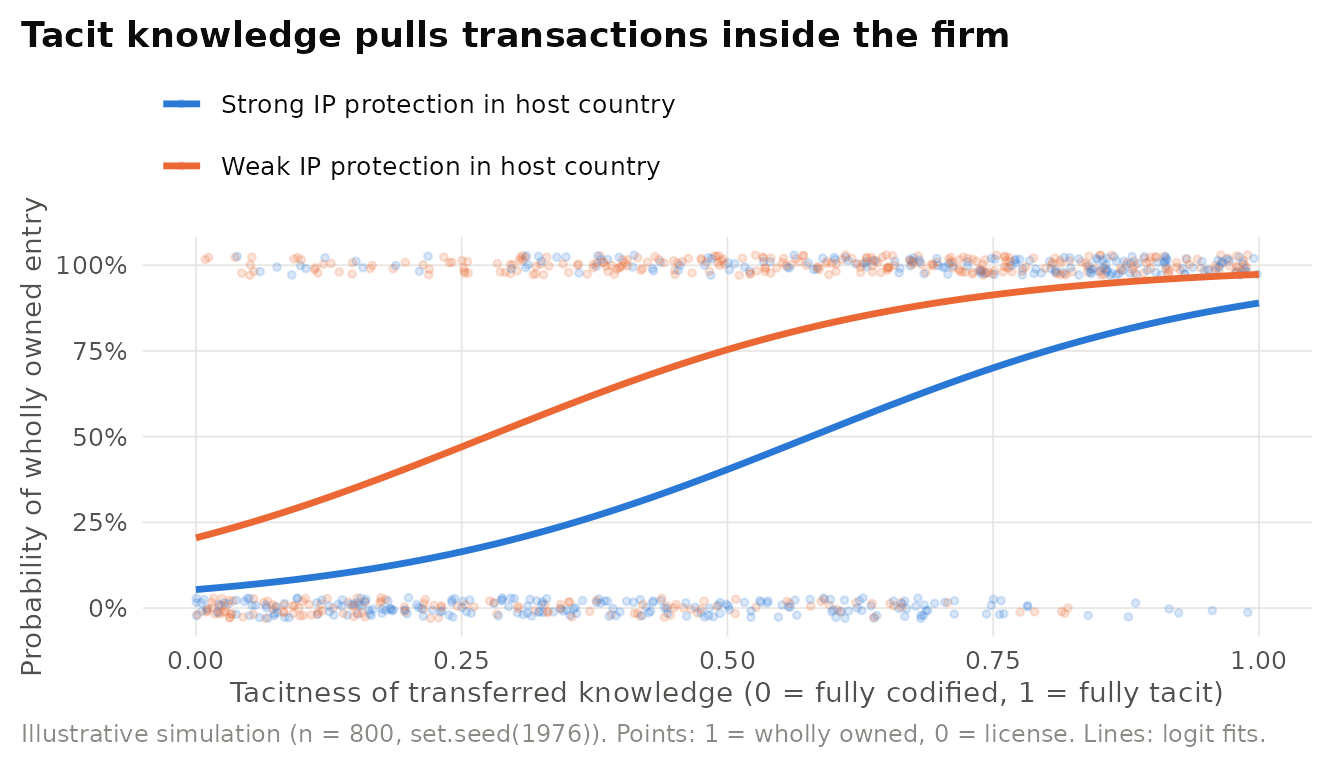
Figure 13.4: Illustrative simulation of internalization logic: the probability of choosing a wholly owned subsidiary rather than licensing rises with the tacitness of the transferred knowledge and is higher where intellectual property protection is weak. Simulated data, not empirical.
13.3.3 Evidence and extensions
Internalization theory underpins much research on entry mode, licensing, and the boundaries of the multinational. Its most important challenge came from the knowledge-based view. Kogut and Zander (1993) argued that MNEs exist not because markets for knowledge fail through opportunism, but because firms are social communities that are especially efficient at transferring knowledge internally. Studying transfers of technology by Swedish firms, they found that the less codifiable and the harder to teach the technology, the more likely it was transferred to a wholly owned subsidiary rather than to a licensee or joint venture. The prediction overlaps with internalization theory, but the mechanism differs: capability rather than market failure.
Market failure or superior knowledge transfer? Transaction-cost versions of internalization theory explain the MNE by the hazards of the market (opportunism, appropriation). Knowledge-based versions explain it by the advantages of the organization (shared codes, routines, identity). The two explanations predict the same mode choice in many settings, which makes them hard to separate empirically. Distinguishing designs exploit cases in which contractual hazards are low but knowledge is tacit, or the reverse. Buckley and Casson (2009) argue that internalization theory can absorb both mechanisms, critics reply that this flexibility weakens its predictive content.
Illustrative scenario: a medical-device maker choosing a mode. A mid-sized European maker of surgical instruments wants to serve a fast-growing Asian market. A local firm offers to license its designs and manufacture them. Internalization theory directs management to three questions. Can the know-how be codified? (Much of the firm’s advantage lies in precision finishing learned on the shop floor, so not fully.) Can contracts protect it? (Patent enforcement in the host country is slow.) Will quality failures damage the global brand? (Yes, surgeons buy on reputation.) All three point toward internalization, perhaps a wholly owned assembly and finishing plant supplied with critical components from home. If the know-how were codified and courts reliable, licensing would preserve capital and flexibility.
Sample hypotheses.
- H1. The tacitness of a firm’s core technology will be positively associated with the probability of wholly owned entry.
- H2. Strengthening of host-country intellectual property protection will increase licensing relative to FDI, especially in industries with codifiable technologies.
Designs. Mode-choice models with measures of knowledge characteristics. Difference-in-differences around intellectual property reforms. Matched comparisons of licensed and internalized transfers of the same technology.
Measures. Codifiability and teachability scales (Kogut and Zander 1993), patent citations and claims, R&D intensity, indices of intellectual property protection and contract enforcement.
13.4 Liability of Foreignness
Core claim. Firms operating abroad incur costs that local firms do not, arising from unfamiliarity, distance, discrimination, and lack of legitimacy (Section @ref(legitimacy (Section 7.3))). These costs put foreign subsidiaries at a disadvantage that they must offset with firm-specific advantages or reduce over time.
Origins. Hymer’s “costs of doing business abroad” (Hymer 1976). Named and tested by Zaheer (1995), with dynamics studied by Zaheer and Mosakowski (1997) and institutional foundations by Kostova and Zaheer (1999).
Level of analysis. The foreign subsidiary relative to comparable local firms.
Key constructs. Costs of doing business abroad, unfamiliarity hazards, discrimination hazards, relational hazards, institutional distance, legitimacy, liability of outsidership.
Boundary conditions. Larger when institutional and cultural distance are high, when products are visible or politically sensitive, and early in the subsidiary’s life. Smaller for firms with strong, transferable advantages or local partners.
Related theories. Legitimacy (Section 7.3), Institutional theory (Section 7.2), Liability of newness (Section 12.10), Uppsala model, Cultural distance and Hofstede (Section 18.2).
13.4.1 Core logic
Hymer (1976) argued that a foreign firm is at a disadvantage relative to local firms because it lacks knowledge of local conditions, may be treated unfavourably by governments, consumers, and suppliers, and bears exchange-rate and communication costs. Zaheer (1995) named these costs the liability of foreignness (LOF) and identified four sources, summarised in Table 13.5.
| Source of liability | Example | Typical mitigation |
|---|---|---|
| Spatial distance | Travel, transport, time-zone coordination, communication | Regional hubs, digital coordination, local decision rights |
| Unfamiliarity with the local environment | Misreading customers, labour law, or supplier norms | Local hires, partners, acquisitions, experiential learning |
| Host-country environment | Lack of legitimacy, economic nationalism, discriminatory treatment by regulators or buyers | Local identity, community engagement, local ownership stakes |
| Home-country environment | Home-country restrictions on what may be sold where, home-country reputation | Compliance structures, distancing from home-country image |
Zaheer’s own evidence came from the currency-trading rooms of banks in New York and Tokyo. Foreign-owned trading rooms showed a disadvantage relative to local ones, and the study suggested that importing the parent’s distinctive organizational capabilities did more to overcome the liability than imitating local practices (Zaheer 1995). Zaheer and Mosakowski (1997) then followed trading rooms worldwide over two decades and found that the survival disadvantage of foreign rooms was concentrated in their early years and diminished over time, consistent with learning. Mezias (2002) found that foreign subsidiaries in the United States faced more adverse labour-lawsuit judgments than domestic firms and identified strategies that reduced the gap, an unusually direct measure of discrimination and unfamiliarity hazards.
Kostova and Zaheer (1999) tied the concept to Institutional theory (Section 7.2). An MNE must gain legitimacy (Section 7.3) in many host environments at once, faces audiences that judge it with stereotypes and limited information, and may be held to different standards from local firms. Its legitimacy is complex because it depends on the institutional distance between home and host and on spillovers from the conduct of other foreign firms. Johanson and Vahlne (2009) extended the argument in a different direction: what hurts the entrant most is not being foreign but being an outsider to local business networks.
13.4.2 Mechanism
Figure 13.5 sketches the dynamic implied by Zaheer and Mosakowski (1997) and the Uppsala model. The foreign entrant starts with a cost disadvantage that shrinks as it learns and builds legitimacy. The shaded area is the cumulative liability the firm’s advantages must cover.
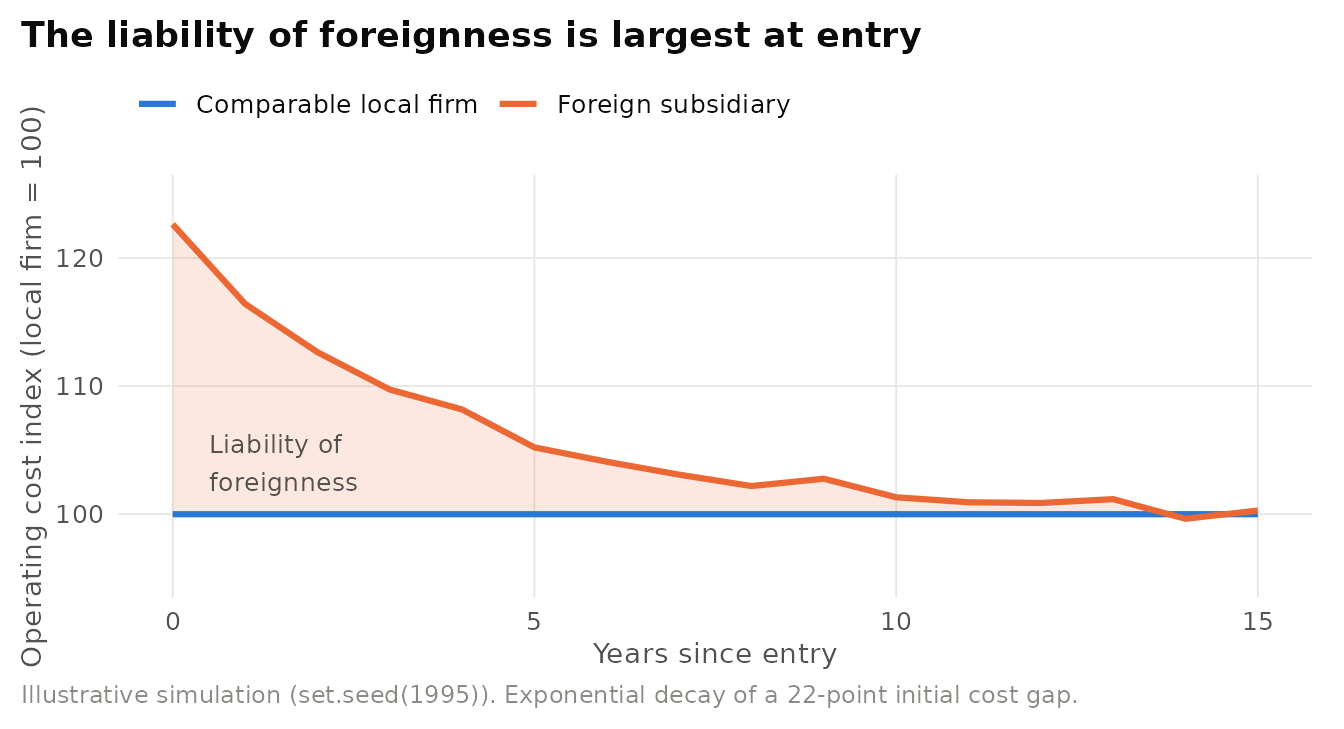
Figure 13.5: Stylised dynamics of the liability of foreignness. A foreign subsidiary’s operating cost disadvantage relative to comparable local firms is largest at entry and declines as the subsidiary learns and gains legitimacy. Simulated values, not empirical.
13.4.3 Applications in business
Walmart in Germany. Walmart’s German venture (1997-2006) is the most frequently cited case of liability of foreignness in retailing. The company entered by acquiring two chains with very different store formats, which complicated integration. Its model of “lean retailing” depended on practices common in the United States: control over large-format sites, flexible labour deployment, and strong bargaining power over suppliers. Christopherson (2007) argues that German institutions constrained these practices: land-use planning limited large out-of-town stores, labour-market institutions such as works councils and collective agreements limited flexible staffing, and the market was already served by efficient hard discounters such as Aldi and Lidl, which blunted the price advantage on which the model relied. Imported management practices also met resistance, and parts of the company’s code of conduct were challenged in German labour courts. In 2006 Walmart sold its 85 German stores to Metro. In LOF terms, the firm suffered unfamiliarity and host-environment hazards, and its ownership advantages proved less transferable than expected because they were embedded in American institutions.
Uber in China. Uber launched in China in 2014 and competed with local ride-hailing firms that merged in 2015 to form Didi Kuaidi (later Didi Chuxing), whose predecessors were backed by Tencent and Alibaba. The local rival was embedded in the dominant payment and messaging ecosystems and in relationships with local governments. Uber’s then chief executive publicly acknowledged heavy losses in the Chinese market, and in August 2016 Uber agreed to sell its China operations to Didi in exchange for a stake in the combined company. The case fits the liability of outsidership of Johanson and Vahlne (2009) as well as classic LOF: Uber’s technology and brand were strong, but it lacked a position in the networks that shaped access to users, payments, and regulators.
Sample hypotheses.
- H1. Foreign subsidiaries will have lower survival rates than comparable local firms, and this gap will decline with subsidiary age.
- H2. The liability of foreignness will be larger when institutional distance between home and host country is greater.
- H3. Subsidiaries that hire local top managers will experience a smaller liability of foreignness in regulatory and legal outcomes.
Designs. Matched comparisons of foreign and domestic firms in the same industry and location. Survival models with time-varying effects. Natural experiments that change the salience of foreignness (for example, diplomatic disputes affecting consumer attitudes toward a home country).
Measures. Performance or survival gaps between foreign and domestic firms, institutional distance indices, regulatory outcomes, media sentiment toward foreign firms.
Attributing every foreign underperformance to foreignness. A foreign subsidiary may underperform because it is new, small, or poorly managed, not because it is foreign. Without a comparison to local firms of similar age and size, a “liability of foreignness” may simply be a liability of newness (Section 12.10). Separate the two by comparing foreign and local entrants of the same vintage.
13.5 Institutional Voids
Core claim. Emerging markets often lack the specialized intermediaries that make markets work in advanced economies: credit-rating agencies, reliable courts, independent auditors, executive search firms, retail distribution, and consumer protection. These institutional voids raise transaction costs, shape which organizational forms succeed (notably diversified business groups), and determine which strategies foreign entrants should use.
Origins. Strategy and international business. Khanna and Palepu (1997) introduced the idea to explain why diversified business groups prosper in emerging markets. Khanna and Palepu (2000) provided evidence from India, and Khanna and Palepu (2010) developed a framework for strategy in emerging markets.
Level of analysis. Country (the institutional context), business group, and firm.
Key constructs. Market intermediaries, product, labour, and capital market voids, business groups, internal markets, void-filling strategies.
Boundary conditions. Strongest where formal market institutions are underdeveloped. As institutions mature, the advantages of internal markets should decline.
Related theories. Institutional theory (Section 7.2), Transaction cost economics (Section 6.3), Liability of foreignness, Signaling theory (Section 8.2).
13.5.1 Core logic
In advanced economies, firms can raise capital from investors who rely on audited accounts and rating agencies, hire managers through executive search firms and business schools, and reach consumers through organized retail and credible advertising. Khanna and Palepu (1997) argued that these intermediaries are often missing or weak in emerging markets, and that the gap changes the logic of corporate strategy. Where external capital, labour, and product markets function poorly, a large diversified business group can replicate them internally: it can allocate capital across affiliates, train and rotate managers, and use its group name as a signal of quality to consumers and partners. Advice to “focus” on core businesses, appropriate where markets work, may therefore be wrong where they do not.
Khanna and Palepu (2000) tested the argument on Indian firms and found that the performance of group affiliates was related to the diversification of the group, with affiliates of the most diversified groups outperforming unaffiliated firms. Khanna and Palepu (2010) turned the concept into a framework for managers. They proposed mapping voids in product, labour, and capital markets and in the political and social system, and identified four strategic choices for firms entering emerging markets: replicate the home business model or adapt it, compete alone or collaborate with local partners, accept the market context or try to change it, and enter, wait, or exit. Firms can also treat voids as business opportunities by filling them, for instance by building distribution, certification, or payment infrastructure (Table 13.6).
| Market | Typical void | Business-group response | Foreign entrant’s options |
|---|---|---|---|
| Capital | Weak disclosure, few credible rating agencies, shallow equity markets | Internal capital market across affiliates | Fund locally through parent, partner with local banks |
| Labour | Few certified managers, limited executive search, weak training | Group training programmes, rotation of managers across affiliates | Build training academies, expatriates, local talent pipelines |
| Product | Little consumer protection, weak quality certification, fragmented retail | Group brand as a quality signal, own distribution | Invest in distribution, use brand and warranty as signals |
| Contracting | Slow courts, uncertain enforcement | Relational contracting within the group | Joint ventures, local partners, arbitration clauses |
| Payments and data | Low banking penetration, little credit history | In-house finance arms | Fill the void as a business (mobile money, credit scoring) |
13.5.2 Mechanism
Figure 13.6 shows the institutional voids raise transaction costs in external markets.
Figure 13.6: Institutional voids raise transaction costs in external markets. Business groups and void-filling firms respond by internalizing or supplying the missing intermediation. As institutions develop, the advantage of internal markets declines (dashed moderator). Based on the argument of Khanna and Palepu (1997, 2010).
13.5.3 Evidence and extensions
The concept has been widely used to explain the prevalence of business groups in Asia and Latin America, the strategies of emerging-market multinationals, and the design of market entry. It has also shaped thinking about market-creating innovation: Safaricom’s M-Pesa, launched in Kenya in 2007, is often cited as a firm filling a financial-services void with mobile money. The framework links naturally to Institutional theory (Section 7.2) (voids are the absence of the regulative and normative pillars that make markets legible) and to Transaction cost economics (Section 6.3) (voids raise the costs of market governance).
Efficiency or entrenchment? The void-filling account treats business groups as efficient responses to market failure. An alternative view holds that groups also reflect political connections, family control, and the expropriation of minority shareholders through transfers among affiliates. Both mechanisms may operate at once, and their balance likely varies with the stage of institutional development. A second debate concerns the term itself: critics note that “voids” are rarely empty. Informal institutions such as kinship networks, reputation, and community enforcement often fill them, and a foreign firm that sees only absence may miss the rules that actually govern exchange.
13.5.4 Applications in business
Tata and Indian business groups. The Tata Group, whose origins go back to the trading business founded by Jamsetji Tata in 1868, is a classic diversified Indian business group, spanning steel, automobiles, information technology services, consumer goods, hotels, and power. Khanna and Palepu’s account suggests why such a structure made sense in India’s earlier institutional environment: the group name served as a signal of trustworthiness where consumer protection and quality certification were weak, group companies trained and rotated managers when external managerial labour markets were thin, and the group could channel capital to new ventures when equity markets were shallow (Khanna and Palepu 1997, 2000). As Indian markets developed, the group used its capabilities to expand abroad through acquisitions such as Tetley (2000), Corus (2007), and Jaguar Land Rover (2008). The case also illustrates the boundary condition: as voids close, the case for broad diversification weakens, and groups face pressure to show that each business can stand on its own.
Sample hypotheses.
- H1. The performance premium of business-group affiliation will be larger in countries and periods with weaker capital-market institutions.
- H2. Pro-market reforms will reduce the performance premium of group affiliation over time.
- H3. Foreign entrants will be more likely to use joint ventures in markets with larger contracting voids.
Designs. Cross-country panels of group-affiliated and independent firms. Difference-in-differences around institutional reforms (for example, securities regulation or bankruptcy law). Case studies of void-filling ventures.
Measures. Group affiliation (from national business-group directories), indices of institutional quality, transfer and related-party transaction data, diversification measures.
13.6 Born Globals
Core claim. Some firms internationalize from or near inception, deriving competitive advantage from resources and sales in multiple countries rather than expanding abroad gradually after building a domestic base.
Origins. International entrepreneurship. Oviatt and McDougall (1994) defined the international new venture and specified the elements needed for it to exist. Knight and Cavusgil (2004) linked born-global firms to innovation and organizational capabilities.
Level of analysis. The new venture and its founders.
Key constructs. International new venture, born global, speed and scope of internationalization, founder international experience, unique resources, international entrepreneurial orientation, digital and network reach.
Boundary conditions. Most common in knowledge-intensive, niche, or digital industries, where offerings are standardized, fixed costs are high, home markets are small, and global networks are accessible.
Related theories. Uppsala model, Effectuation (Section 12.7), Network effects (Section 17.6), Liability of newness (Section 12.10), Dynamic capabilities (Section 5.1).
13.6.1 Core logic
By the early 1990s researchers and consultants had noticed small firms that exported a large share of output within a few years of founding, often to distant markets. Oviatt and McDougall (1994) proposed a theory of the international new venture (INV), defined as a business organization that, from inception, seeks significant competitive advantage from the use of resources and the sale of outputs in multiple countries. They argued that four elements are necessary for an INV to exist: internalization of some transactions, alternative governance structures (such as networks and alliances, because a new firm cannot own many assets), foreign location advantages, and unique resources that are hard to imitate. The theory explicitly builds on internalization theory and the OLI paradigm, but replaces the assumption of a mature firm with that of a resource-poor start-up.
Knight and Cavusgil (2004) asked what makes such firms succeed. Drawing on case and survey data, they argued that born-global firms are characterized by an innovative culture and by knowledge and capabilities, including international entrepreneurial orientation and international marketing orientation, that support early international performance. The constructs tie the born-global phenomenon to the resource-based view and to research on entrepreneurial orientation. Operational definitions vary across studies but usually combine a short time between founding and first foreign sales with a minimum share of foreign sales.
Table 13.7 contrasts the two views, and Figure 13.7 shows their stylised paths.
| Dimension | Uppsala-type firm | Born global |
|---|---|---|
| Starting point | Established domestic business | Global orientation at or near founding |
| Knowledge source | Experiential, accumulated in each market | Founders’ prior experience, networks, codified offerings |
| Market sequence | Psychically close markets first | Lead markets and niches, often distant |
| Entry modes | Agents, then subsidiaries | Digital channels, partners, alliances, lean subsidiaries |
| Key constraint | Market knowledge and risk tolerance | Resources, legitimacy, and managerial bandwidth |
| Typical industries | Manufacturing, industrial goods | Software, digital media, biotechnology, niche high-tech |
| Theoretical anchor | Uppsala model | International entrepreneurship, Effectuation |
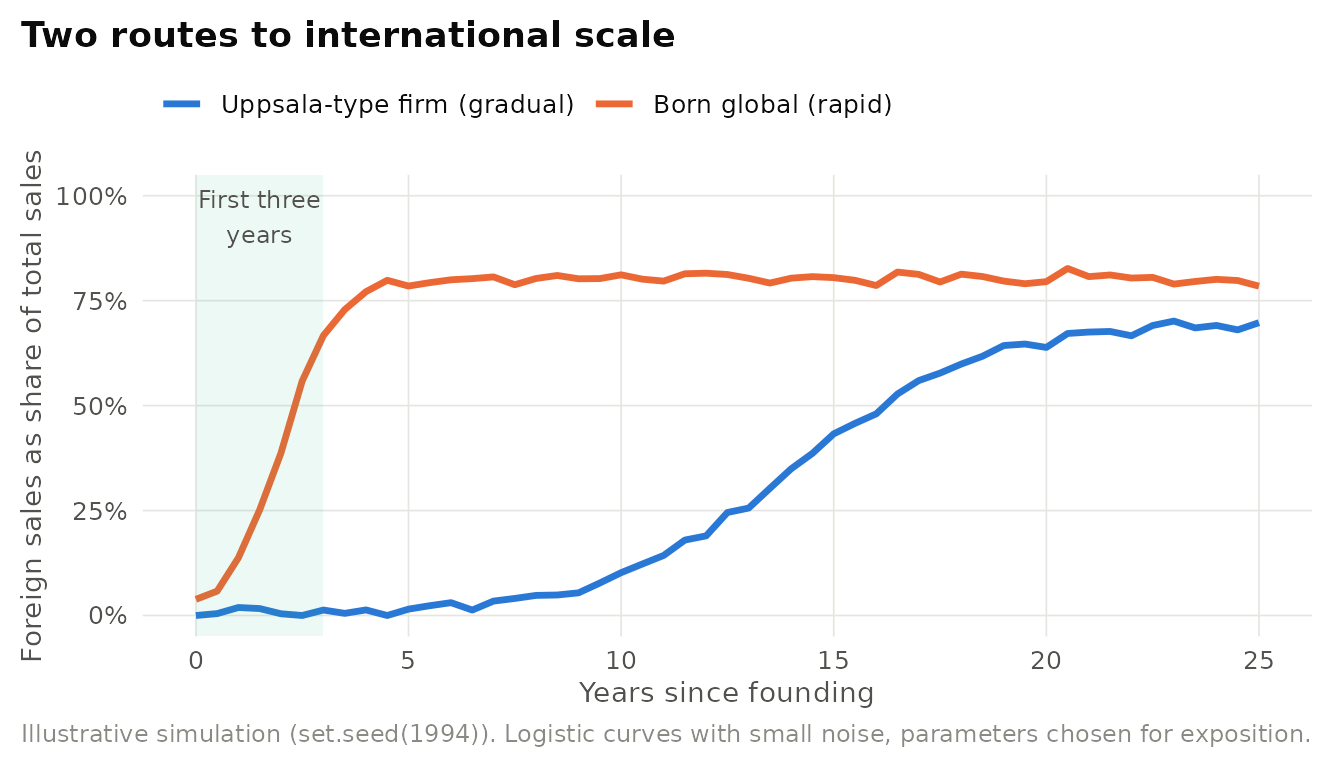
Figure 13.7: Illustrative stylised internationalization paths. An Uppsala-type firm builds a domestic base and raises its foreign sales share gradually. A born global reaches a high foreign share within a few years of founding. Simulated data, not empirical.
13.6.2 Evidence and extensions
Born globals have been documented in many countries, especially small open economies whose home markets are too small to support specialized products. The phenomenon has grown with digital distribution, which lowers the cost of reaching foreign customers and allows a firm to learn about many markets at once from usage data. Research has examined the role of founders’ international experience, the importance of networks and alliances for resource-poor ventures, and the consequences of early internationalization for growth and survival.
Do born globals refute the Uppsala model? Early studies presented born globals as a challenge to gradualism. The Uppsala authors replied that their model concerns learning and commitment, not age at entry: founders who bring experience and networks from previous jobs have already accumulated the knowledge the model emphasises, and the 2009 network version predicts rapid entry where relationships exist (Johanson and Vahlne 2009). Others note that many “born globals” are really “born regionals” that sell mostly within their home region, in line with evidence that even large MNEs are predominantly regional (Rugman and Verbeke 2004). A further concern is survivorship bias: the visible born globals are the successes, while early internationalization may also raise the risk of failure.
13.6.3 Applications in business
Skype and Spotify as born globals. Skype was founded in 2003 by Niklas Zennström and Janus Friis, with software developed by engineers in Estonia. As an internet telephony service distributed by download, it had no physical establishment chain to climb: users anywhere could adopt it, and its value grew with the number of users it could connect. It was acquired by eBay in 2005 and by Microsoft in 2011. Spotify, founded in Stockholm in 2006, launched its music streaming service in 2008 in several European markets at once and entered the United States in 2011. For Spotify the binding constraint was not market knowledge but licensing agreements with record labels and rights organizations in each country, a reminder that born globals still face country-specific institutions. Both cases fit the elements of Oviatt and McDougall (1994): unique, hard-to-imitate resources (software and network effects), alternative governance through partnerships, and location-independent delivery.
Sample hypotheses.
- H1. Founders’ prior international work experience will be positively associated with the speed of a new venture’s first foreign entry.
- H2. The positive effect of early internationalization on growth will be stronger for ventures with codified, digitally delivered offerings.
- H3. Early internationalization will increase the variance of venture outcomes (both rapid growth and failure).
Designs. Longitudinal cohorts of new ventures (for example, from national start-up registers). Survival and growth models with time to first foreign sale as the key variable. Founder-level data on experience and networks.
Measures. Time from founding to first foreign sale, share of foreign sales, number of countries served, founders’ international experience, innovative culture and international entrepreneurial orientation scales (Knight and Cavusgil 2004).
Defining born globals by outcome alone. Studies that classify firms as born global because they succeeded internationally sample on the dependent variable. Define international new ventures by their intent and activity at founding, follow full cohorts including failures, and report how results change across alternative thresholds for speed and foreign sales share.
13.7 Chapter Summary
- The Uppsala model explains internationalization as a loop in which experiential knowledge drives commitment, producing an establishment chain and a psychic-distance sequence. The 2009 revision locates the main barrier in network outsidership (Johanson and Vahlne 1977, 2009).
- The OLI paradigm states that FDI requires ownership, location, and internalization advantages at once. It organizes much research but is criticized as hard to falsify (Dunning 1980, 1988).
- Internalization theory explains the MNE as a response to imperfect markets for knowledge and other intermediate products. The knowledge-based view offers a competing mechanism with similar predictions (Buckley and Casson 1976, Kogut and Zander 1993).
- The liability of foreignness captures the extra costs of operating abroad, from unfamiliarity, discrimination, and lack of legitimacy. It is largest at entry and declines with learning (Zaheer 1995, Zaheer and Mosakowski 1997).
- Institutional voids in emerging markets favour business groups and void-filling strategies and call for strategies tailored to local market institutions (Khanna and Palepu 1997, Khanna and Palepu 2010).
- Born globals internationalize from inception using unique resources, networks, and digital reach, challenging but also extending gradualist accounts (Oviatt and McDougall 1994, Knight and Cavusgil 2004).
Table 13.8 presents the comparison of the chapter’s theories.
| Theory | Unit of analysis | Key mechanism | Signature prediction | Typical business use |
|---|---|---|---|---|
| Uppsala model | Firm-market relationship | Experiential learning drives commitment | Gradual entry, close markets first | Sequencing market entry, pacing investment |
| OLI paradigm | Firm in country and industry context | Joint presence of O, L, I advantages | FDI only when all three hold | Choosing between export, licensing, and FDI |
| Internalization theory | Cross-border transaction | Market failure for intermediate products | Tacit knowledge leads to wholly owned modes | Entry-mode design, licensing decisions |
| Liability of foreignness | Foreign subsidiary versus locals | Unfamiliarity, discrimination, legitimacy deficits | Foreign firms underperform early, gap narrows | Localization, partner choice, legitimacy building |
| Institutional voids | Country and business group | Missing intermediaries raise transaction costs | Groups and void-fillers outperform where voids are large | Emerging-market strategy, partnering, new business models |
| Born globals | New venture | Unique resources, networks, digital reach | Early, rapid, and distant internationalization | Start-up global strategy, founder team design |
13.8 Discussion Questions
- The Uppsala model predicts that firms enter psychically close markets first. Using the CAGE framework, explain why Walmart’s entry into Germany may have been more “distant” than it appeared. What would the model have advised?
- Is the OLI paradigm a theory or a taxonomy? Propose a test of the paradigm that could, in principle, produce disconfirming evidence.
- Internalization theory and the knowledge-based view both predict that tacit knowledge is transferred to wholly owned subsidiaries. Design a study that could distinguish their mechanisms.
- How would you separate a liability of foreignness from a liability of newness in data on foreign entrants? Specify the comparison group and the key variables.
- Choose an emerging market you know. Map its institutional voids in capital, labour, and product markets, and identify one void that a new venture could fill profitably.
- Do digital platforms make the Uppsala model obsolete? Use the Spotify case and the 2009 revision of the model to argue both sides.
13.9 Further Reading
- Johanson and Vahlne (1977): the original Uppsala model. Short and clear, and still the reference point for process theories of internationalization.
- Johanson and Vahlne (2009): the network revision that introduced the liability of outsidership.
- Dunning (1988): the fullest journal statement of the eclectic paradigm and its extensions.
- Buckley and Casson (2009): the authors’ own review of three decades of internalization theory.
- Kogut and Zander (1993): the knowledge-based challenge to market-failure explanations of the MNE.
- Zaheer (1995): the article that named and measured the liability of foreignness.
- Khanna and Palepu (2010): a practical framework for strategy in emerging markets built on institutional voids.
- Oviatt and McDougall (1994): the foundational theory of international new ventures.