6 Governance, Contracts, and Leadership
In 2016, regulators announced that employees at Wells Fargo, then one of the most admired retail banks in the United States, had opened large numbers of deposit and credit-card accounts that customers had never requested. No senior executive had ordered anyone to commit fraud. The bank had instead built an aggressive system of cross-selling targets, branch rankings, and incentive pay, and thousands of employees had responded to that system exactly as it rewarded them to. A few years earlier, scholars had begun asking a related question about the executives at the top of large firms: why do some chief executives pay enormous premiums for acquisitions that destroy their own shareholders’ wealth, and why do boards let them?
Both puzzles are questions about governance: the arrangements by which one party gets another to act on its behalf when their interests, information, and attitudes toward risk differ. This chapter develops four theories that together form the core of organizational economics and strategic leadership research. Agency theory analyses how principals design contracts and monitoring to control self-interested agents. Stewardship theory argues that the agency model of human nature is too narrow and that many managers are better motivated by trust and identification than by incentives. Transaction cost economics asks a more fundamental question, why some transactions are organized inside firms rather than in markets, and answers it with the hazards of specific investment. Upper echelons theory, finally, opens the black box of the executive suite and argues that organizations become reflections of the people who lead them (Table 6.1).
| Theory | Core question | Level of analysis | Key source |
|---|---|---|---|
| Agency theory | How can a principal align a self-interested agent’s actions with its own goals? | Dyad (principal-agent), firm | Jensen & Meckling (1976), Eisenhardt (1989) |
| Stewardship theory | When do managers act as pro-organizational stewards rather than opportunistic agents? | Dyad, firm | Davis, Schoorman & Donaldson (1997) |
| Transaction cost economics | Which transactions should be organized by markets, hybrids, or hierarchies? | Transaction, firm boundary | Coase (1937), Williamson (1975, 1985) |
| Upper echelons theory | How do executives’ experiences, values, and personalities shape strategy and performance? | Executive, top management team, firm | Hambrick & Mason (1984), Hambrick (2007) |
6.1 Agency Theory
Core claim. When a principal delegates work to an agent whose goals differ and whose actions or information the principal cannot fully observe, the agent will not always act in the principal’s interest. Contracts, monitoring, and incentives can reduce, but not eliminate, the resulting agency costs.
Origins. Economics and finance. The formal principal’s problem (S. A. Ross 1973, Holmström 1979), the theory of the firm as a nexus of contracts (Jensen and Meckling 1976), and the separation of ownership and control (Berle and Means 1932, Fama and Jensen 1983). Imported into management by Eisenhardt (1989a).
Level of analysis. Dyad (shareholder-manager, employer-employee, franchisor-franchisee, client-supplier) and the firm as a set of such contracts.
Key constructs. Principal, agent, goal conflict, information asymmetry, moral hazard, adverse selection (Section 8.1), risk preferences, outcome- vs. behaviour-based contracts, monitoring, bonding, residual loss.
Boundary conditions. Goal conflict must be present. The agent’s effort or information must be costly for the principal to observe. Agents are assumed self-interested, boundedly rational, and typically more risk-averse than principals.
Related theories. Information asymmetry (Section 8.1), Screening (Section 8.3), Stewardship theory, Transaction cost economics, Resource dependence (Section 7.1).
6.1.1 Origins and intellectual history
The worry that hired managers might not serve owners is older than modern economics, but it acquired its canonical form when Berle and Means (1932) documented that ownership of large American corporations had become dispersed among thousands of small shareholders, none with enough at stake to supervise management. Control had passed, in practice, to salaried executives. Four decades later, economists supplied the analytical machinery to study the problem.
S. A. Ross (1973) posed the principal’s problem in general terms: a principal must choose a compensation schedule for an agent whose action affects an uncertain payoff, anticipating how the agent will respond. Holmström (1979) showed that when effort is unobservable, a contract that insures a risk-averse agent fully destroys the incentive to work, while a contract that ties pay entirely to output imposes inefficient risk on the agent. He also derived the informativeness principle: any additional measure that carries information about the agent’s action, however noisy, should enter the contract, because conditioning pay on it reduces the risk the agent must bear for a given level of incentive.
Jensen and Meckling (1976) moved the analysis from abstract contracts to the corporation. They defined an agency relationship as a contract under which one or more principals engage an agent to perform a service on their behalf, delegating some decision-making authority. Because the parties are utility maximizers, the agent will not always act in the principal’s best interest, and the divergence generates costs that shape ownership structure, capital structure, and the very boundaries of the firm. Fama (1980) added that the managerial labour market disciplines executives over time, and Fama and Jensen (1983) explained how complex organizations survive despite the separation of ownership and control: they separate decision management (initiating and implementing decisions) from decision control (ratifying and monitoring them), with the board of directors at the apex of the control system.
Eisenhardt (1989a) introduced agency theory to a broad management audience. Her review distinguished two streams that remain useful today. The positivist stream, rooted in finance, identifies situations in which principals and agents are likely to have conflicting goals and describes the governance mechanisms, boards, markets for corporate control, equity ownership, that limit self-serving behaviour, usually in large public corporations. The principal-agent stream is more formal and more general: it asks which contract is most efficient given assumptions about people (self-interest, bounded rationality (Section 23.1), risk aversion), organizations (goal conflict), and information (a purchasable commodity).
6.1.2 Core logic and propositions
Agency theory rests on two conditions. First, there is goal conflict: the agent values leisure, perquisites, empire, or job security in ways the principal does not. Second, there is information asymmetry: the principal cannot costlessly verify what the agent knows or does. Remove either condition and the problem disappears: an agent with identical goals needs no monitoring, and a perfectly observed agent can be paid for the behaviour the principal wants.
Eisenhardt (1989a) separates two problems that arise from these conditions. The agency problem proper arises when goals conflict and the principal cannot verify the agent’s behaviour. It comes in two forms, moral hazard and adverse selection. The problem of risk sharing arises when principal and agent have different attitudes toward risk, so they prefer different actions and different allocations of uncertain outcomes. Table 6.2 summarises these problems with business examples.
| Problem | What goes wrong | Timing | Business example | Typical remedy |
|---|---|---|---|---|
| Moral hazard (hidden action) | Agent shirks or diverts effort once the principal cannot observe it | After contracting | Sales staff push easy products rather than serving customers. Managers consume perquisites | Monitoring, outcome-based pay, performance audits |
| Adverse selection (hidden information) | Agent misrepresents ability or private information when contracting | Before contracting | Candidate overstates skills, supplier understates its costs, manager hides a project’s risks | Screening, probation, credentials, self-selecting contract menus |
| Risk sharing | Principal and agent prefer different risk exposures and different actions | Throughout | Diversified shareholders want risky growth, an undiversified CEO prefers safe diversification | Equity and option grants, deferred pay, risk-adjusted targets |
Because these problems cannot be eliminated without cost, the theory’s central quantity is agency cost. Jensen and Meckling (1976) defined it as the sum of three components, shown in Table 6.3.
| Component | Definition | Who bears it initially | Examples |
|---|---|---|---|
| Monitoring expenditures | Resources the principal spends to observe and constrain the agent | Principal | External audits, board committees, budget controls, performance reviews, surveillance software |
| Bonding expenditures | Resources the agent spends to guarantee that it will not harm the principal (or will compensate if it does) | Agent | Financial reporting commitments, personal guarantees, deferred compensation subject to clawback, covenants |
| Residual loss | The value lost because the agent’s decisions still differ from those that would maximize the principal’s welfare | Principal | Value-destroying acquisitions, under-investment in risky innovation, excessive perquisites |
A key insight is that agency costs are ultimately borne by whoever can be made to bear them in a competitive market. If investors anticipate that an owner-manager who sells equity will consume more perquisites, they price the shares accordingly. The owner therefore has an incentive to commit, ex ante, to monitoring and bonding arrangements that raise the share price (Jensen and Meckling 1976). Governance is not only imposed on managers. Managers often choose it.
The principal-agent stream generates sharper propositions about contract choice. Eisenhardt (1989a) frames the decision as a choice between outcome-based contracts (commissions, bonuses, stock options, profit sharing) and behaviour-based contracts (salaries combined with supervision and evaluation of behaviour). The following propositions summarise her argument:
- P1 (Alignment). When contracts are outcome-based, agents are more likely to act in the principal’s interest.
- P2 (Information). When the principal has information systems that reveal agent behaviour, agents are more likely to act in the principal’s interest, and behaviour-based contracts become more attractive.
- P3 (Uncertainty and risk). Outcome uncertainty, combined with agent risk aversion, favours behaviour-based contracts, because outcome-based pay would load costly risk on the agent.
- P4 (Task characteristics). Programmable tasks (whose appropriate behaviour can be specified in advance) favour behaviour-based contracts. Easily measured outcomes favour outcome-based contracts.
- P5 (Relationship length). In long relationships the principal learns about the agent, so behaviour-based contracts become more feasible (Table 6.4).
| Condition | Favours outcome-based contract | Favours behaviour-based contract |
|---|---|---|
| Information systems (ability to observe behaviour) | Weak | Strong |
| Outcome uncertainty | Low | High |
| Agent risk aversion | Low | High |
| Principal risk aversion | High | Low |
| Goal conflict | High | Low |
| Task programmability | Low (creative, non-routine work) | High (routine, specifiable work) |
| Outcome measurability | High | Low |
| Length of relationship | Short | Long |
6.1.3 Mechanism
Figure 6.1 summarises the causal structure. Goal conflict and information asymmetry jointly create room for opportunism. Governance mechanisms are the levers principals use to narrow that room, at a cost.
Figure 6.1: Mechanism of agency theory: goal conflict and information asymmetry enable agent opportunism (moral hazard, adverse selection), which produces residual loss. Monitoring, incentive alignment, and bonding reduce opportunism but are themselves costly.
The trade-off at the heart of incentive design can be made precise. In the linear model associated with Holmström (1979) and Holmström and Milgrom (1991), an agent’s output equals effort plus noise, pay equals a fixed salary plus a share \(\beta\) of output, and the agent dislikes both effort and risk. A higher pay-for-performance slope \(\beta\) elicits more effort, but it also exposes the agent to more of the noise, for which a risk-averse agent must be compensated through a risk premium. The efficient slope balances the two, and it falls as performance measures become noisier and as agents become more risk-averse. Figure 6.2 plots the components of joint surplus for one parameterisation.
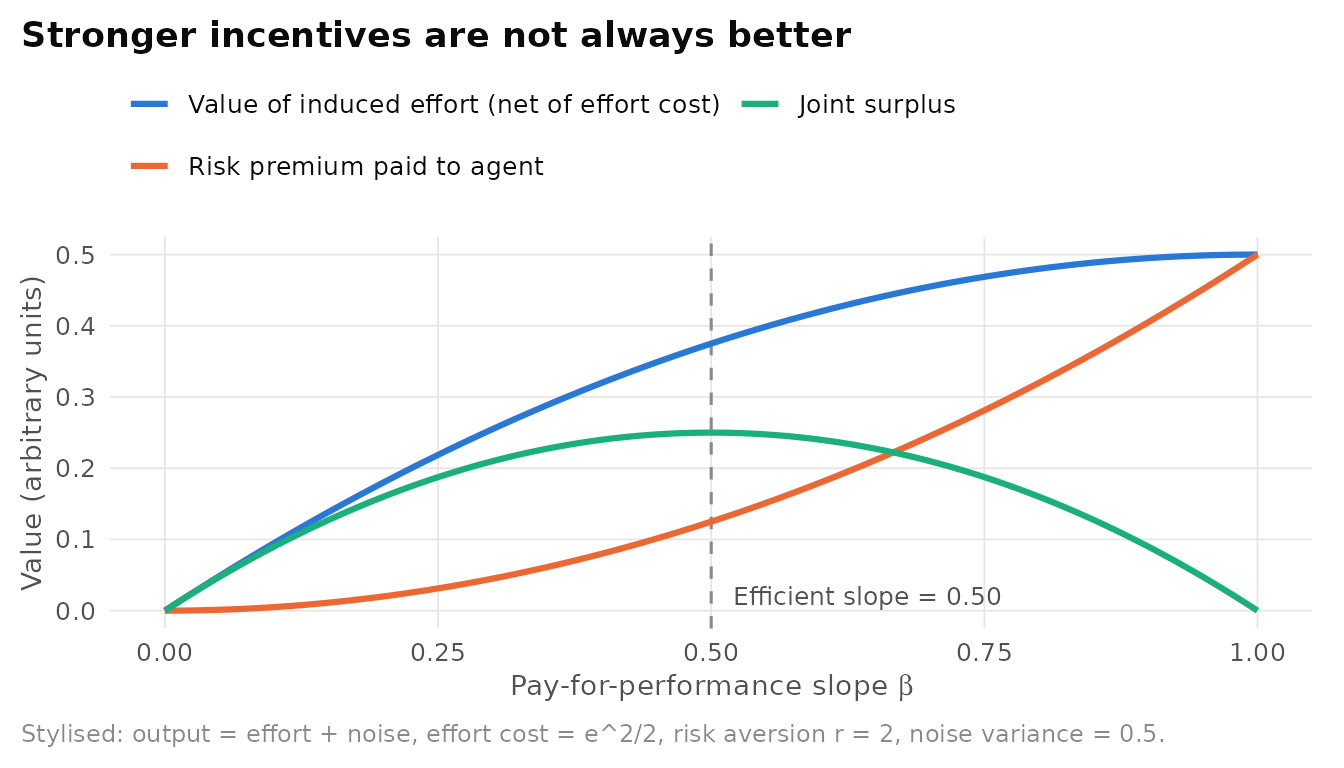
Figure 6.2: Illustrative incentive-intensity trade-off in a stylised linear principal-agent model. Raising the pay-for-performance slope increases the value created by effort but also the risk premium the agent must be paid. Joint surplus peaks at an interior slope (dashed line).
Figure 6.3 generalises the point: the efficient slope \(\beta^* = 1/(1 + r k \sigma^2)\) declines as measurement noise rises, and it declines faster for more risk-averse agents. This is the formal reason why pure commission pay is common in transactional sales, where individual output is easy to measure, and rare for research scientists, whose output is noisy and delayed.
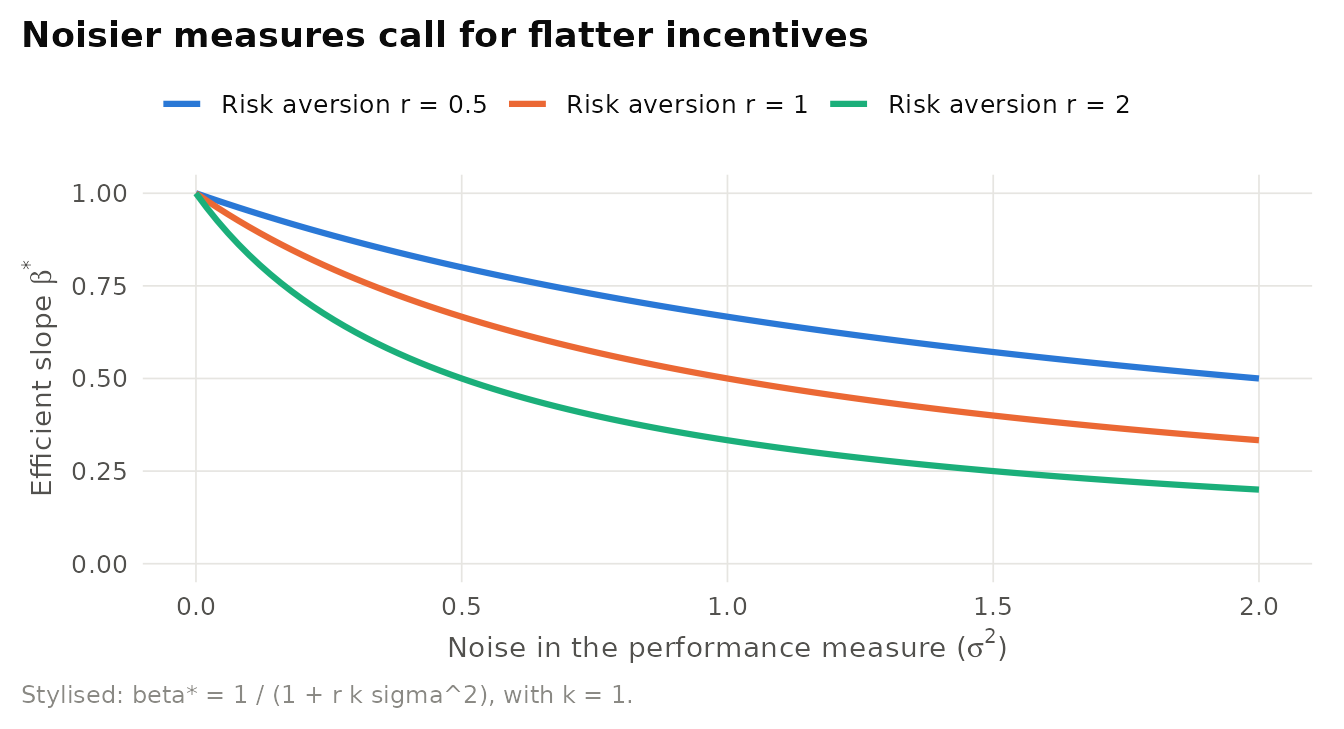
Figure 6.3: Illustrative comparative statics: the efficient pay-for-performance slope falls as performance measures become noisier, and falls faster for more risk-averse agents (stylised linear principal-agent model).
6.1.4 Evidence and extensions
Agency theory has generated one of the largest empirical literatures in management and finance. Several findings recur.
- Pay-performance sensitivity. Jensen and Murphy (1990) estimated that the wealth of chief executives of large U.S. firms changed by only a few dollars for every thousand-dollar change in shareholder wealth, and argued that pay was far less sensitive to performance than agency theory would recommend. The finding helped legitimise the shift toward equity-based compensation in the 1990s.
- Unintended consequences of strong incentives. Incentives tied to stock prices are associated with more aggressive earnings management (Bergstresser and Philippon 2006), and in a large survey many financial executives reported that they would sacrifice long-term economic value, for example, by delaying a positive net-present-value project, to meet short-term earnings targets (Graham, Harvey, and Rajgopal 2005). Lie (2005) showed that share prices tended to fall before and rise after executive option grants, a pattern consistent with grant dates being timed or backdated.
- Multitasking. Holmström and Milgrom (1991) showed that when an agent performs several tasks that differ in measurability, strong incentives on the measurable task draw effort away from the unmeasured ones, so low-powered incentives can be optimal. This formalises the older warning of S. Kerr (1975) against “rewarding A while hoping for B”.
- Boards and monitoring. Meta-analyses find little systematic relationship between board independence or the separation of CEO and chair roles and firm financial performance (Dalton et al. 1998). Reviews of corporate governance conclude that agency theory’s prescriptions are better supported for specific outcomes (e.g., takeover resistance, compensation design) than for overall performance (Daily, Dalton, and Cannella 2003).
- Symbolic adoption. Firms sometimes adopt incentive plans without using them: Westphal and Zajac (1994) found that many companies announced long-term incentive plans for their CEOs but did not actually grant awards under them, while still enjoying a favourable market reaction, an early demonstration that governance can be ceremonial (see Institutional theory (Section 7.2)).
The theory has also been extended in behavioural directions. The behavioural agency model of Wiseman and Gomez-Mejia (1998) combines agency logic with prospect theory (Chapter 24): because executives evaluate outcomes relative to reference points, the same option grant can make an executive more risk-seeking when the firm is below target and more risk-averse when accumulated option wealth is at stake.
Is agency theory a self-fulfilling prophecy? Ghoshal (2005) argued that management education, by teaching that managers are opportunists who must be controlled, has helped create the behaviour it assumes: high-powered incentives and intensive monitoring can crowd out intrinsic motivation and signal distrust, and executives trained in the theory may come to see self-interest as legitimate. Defenders reply that the theory is a model of contracting under risk, not a description of human nature, and that its key predictions, that people respond to incentives, including badly designed ones, are among the best-supported in social science. A second line of critique, L. Bebchuk and Fried (2004)’s managerial power view, accepts agency assumptions but argues that executive pay is itself an agency problem: powerful CEOs influence the boards that set their compensation, so pay packages reflect rent extraction rather than optimal contracting.
6.1.5 Applications in business
Executive stock options and short-termism. During the 1990s, U.S. boards shifted executive pay heavily toward stock options, in part on the agency argument that equity-based pay aligns executives with shareholders (Jensen and Murphy 1990). The results were mixed in ways the theory itself anticipates. Options reward share-price movements over a defined horizon, so they are an outcome-based contract with a noisy, manipulable measure. The 2005-2006 option-backdating revelations, in which grant dates were found to have been selected after the fact at numerous firms, followed academic evidence on suspicious timing (Lie 2005). Evidence linking equity incentives to earnings management (Bergstresser and Philippon 2006) and survey evidence of earnings-driven myopia (Graham, Harvey, and Rajgopal 2005) show the multitasking problem in practice: the measurable outcome (near-term stock price) can crowd out unmeasured long-term investment. Many boards responded by lengthening vesting periods, adding performance conditions and holding requirements, and adopting clawback provisions , in agency terms, combining outcome-based pay with bonding.
Wells Fargo’s sales-practices scandal. In September 2016 the Consumer Financial Protection Bureau, the Office of the Comptroller of the Currency, and the Los Angeles City Attorney announced combined penalties of $185 million against Wells Fargo for sales practices in which employees had opened deposit and credit-card accounts without customers’ authorization. The bank had fired roughly 5,300 employees over several years for related misconduct. Branch employees faced demanding cross-selling targets, and their pay and job security depended on meeting them. In agency terms, the bank used high-powered outcome-based incentives on a metric (accounts opened) that was easy to measure and easy to game, while the outcome it actually valued (profitable, durable customer relationships) was hard to measure, a textbook multitasking failure (Holmström and Milgrom 1991, S. Kerr 1975). The consequences extended well beyond the initial fine: the CEO resigned in 2016, the board clawed back compensation from senior executives, the Federal Reserve imposed a growth restriction on the bank in 2018, and in 2020 the bank agreed to pay $3 billion to resolve criminal and civil investigations by the U.S. Department of Justice and the Securities and Exchange Commission.
Franchising versus company-owned stores. A chain retailer or restaurant group must decide whether each outlet is run by a salaried manager (a behaviour-based contract with monitoring) or by a franchisee who owns the residual profit (an outcome-based contract). Agency theory predicts that franchising will be favoured where monitoring a salaried manager is costly, for example, at outlets far from headquarters, because residual ownership makes the local operator self-monitoring. Brickley and Dark (1987) found exactly this pattern, and Lafontaine (1992) showed that franchising choices are better explained by incentive considerations than by the older idea that franchisors simply need franchisees’ capital (see also Rubin 1978). Franchising creates a second agency problem in the other direction: franchisees may free-ride on the shared brand by cutting quality, which is why franchise contracts include detailed operating standards and inspection rights. McDonald’s, which operates predominantly through franchisees, and Starbucks, which in its home market has relied mainly on company-operated and licensed stores, illustrate two different resolutions of the same trade-off.
6.1.6 Using the theory in research
Sample hypotheses.
- H1. The share of franchised outlets in a chain will increase with the geographic dispersion of outlets from headquarters.
- H2. The positive association between CEO equity incentives and R&D intensity will be weaker when the CEO’s accumulated option wealth is large relative to salary (behavioural agency model).
- H3. Sales commission intensity will be lower for products whose sales cycles are long and whose outcomes are noisy.
Designs. Panel data on compensation and governance (with firm fixed effects). Quasi-experiments from regulatory changes in disclosure, board composition, or takeover law. Field experiments on incentive schemes within firms. Structural models of contracts.
Measures. Pay-performance sensitivity (change in executive wealth per change in firm value), vesting horizon, ownership concentration, board independence and CEO duality, monitoring intensity (audit fees, analyst coverage), outcome measurability (noise in performance metrics).
Data sources. Proxy statements and compensation databases, franchise disclosure documents, personnel records and incentive-plan documents.
Treating every governance variable as a measure of “alignment”. Board independence, CEO ownership, and option grants are often used as proxies for alignment without showing that they change the agent’s behaviour. Such variables are themselves chosen, often by the agents they are supposed to discipline, so they are endogenous. State which agency problem (moral hazard, adverse selection, or risk sharing) a mechanism addresses, show the behavioural channel, and use designs that address selection.
6.2 Stewardship Theory
Core claim. Many managers are not opportunistic agents but stewards whose motives are aligned with the organization’s objectives. For such managers, structures that empower and trust them produce better outcomes than structures that monitor and control them.
Origins. Organization theory and organizational psychology, L. Donaldson and Davis (1991), developed as a theory by J. H. Davis, Schoorman, and Donaldson (1997).
Level of analysis. Dyad (principal-manager) and firm (board and leadership structure).
Key constructs. Steward vs. agent “model of man”, intrinsic motivation, organizational identification, personal vs. institutional power, involvement- vs. control-oriented management philosophy, mutual choice.
Boundary conditions. Both parties must choose a stewardship relationship. Predictions depend on the manager’s motivation and on situational factors such as culture and management philosophy.
Related theories. Agency theory, Self-determination theory (Section 19.6), Social exchange theory (Section 9.1), Power distance (Section 18.3).
6.2.1 Core logic
L. Donaldson and Davis (1991) began with a governance puzzle. Agency theory implies that the roles of chief executive and board chair should be separated, so that the person who manages the firm is not the person who monitors management. Stewardship theory implies the opposite: if the executive is a steward, combining the roles gives a trustworthy leader clear authority and unity of command. Their empirical analysis of CEO duality reported results more consistent with the stewardship prediction than with the agency one.
J. H. Davis, Schoorman, and Donaldson (1997) generalized the argument. The steward derives utility from pro-organizational, collectivist behaviour. Achieving the organization’s goals satisfies the steward’s own higher-order needs for achievement, growth, and recognition. Where agency theory treats the manager as an economic actor who must be controlled, stewardship theory draws on a model of the person as self-actualizing. Table 6.5 contrasts the two.
| Dimension | Agency theory | Stewardship theory |
|---|---|---|
| Model of the person | Economic actor, self-serving | Self-actualizing, collective-serving |
| Motivation | Extrinsic (pay, perquisites, security) | Intrinsic (growth, achievement, affiliation) |
| Identification with organization | Low | High |
| Basis of power | Institutional (position, legitimate, coercive, reward) | Personal (expertise, referent) |
| Management philosophy | Control-oriented | Involvement-oriented |
| Cultural fit | Individualism, high power distance | Collectivism, low power distance |
| Governance prescription | Separate CEO and chair, independent monitoring, outcome-based pay | Empower executives, unify leadership, trust-based relationships |
| Main risk | Agent opportunism | Principal or steward betrayal |
6.2.2 Mechanism: a game of mutual choice
The most influential element of J. H. Davis, Schoorman, and Donaldson (1997) is the idea that the relationship is a mutual choice. The principal chooses whether to treat the manager as an agent (with controls) or as a steward (with trust), and the manager chooses whether to behave as an agent or a steward. Figure 6.4 shows the four outcomes. When both choose stewardship, potential performance is maximized. When both choose agency, costs are minimized but potential is unrealized. The off-diagonal cells are the dangerous ones: a steward-type principal who trusts an opportunistic manager is betrayed, and a steward-type manager who is treated as an agent feels frustrated and may come to behave like one. Because each party is vulnerable to the other’s choice, the structure resembles a prisoner’s dilemma, and the safe mutual-agency outcome is common even when mutual stewardship would be better.
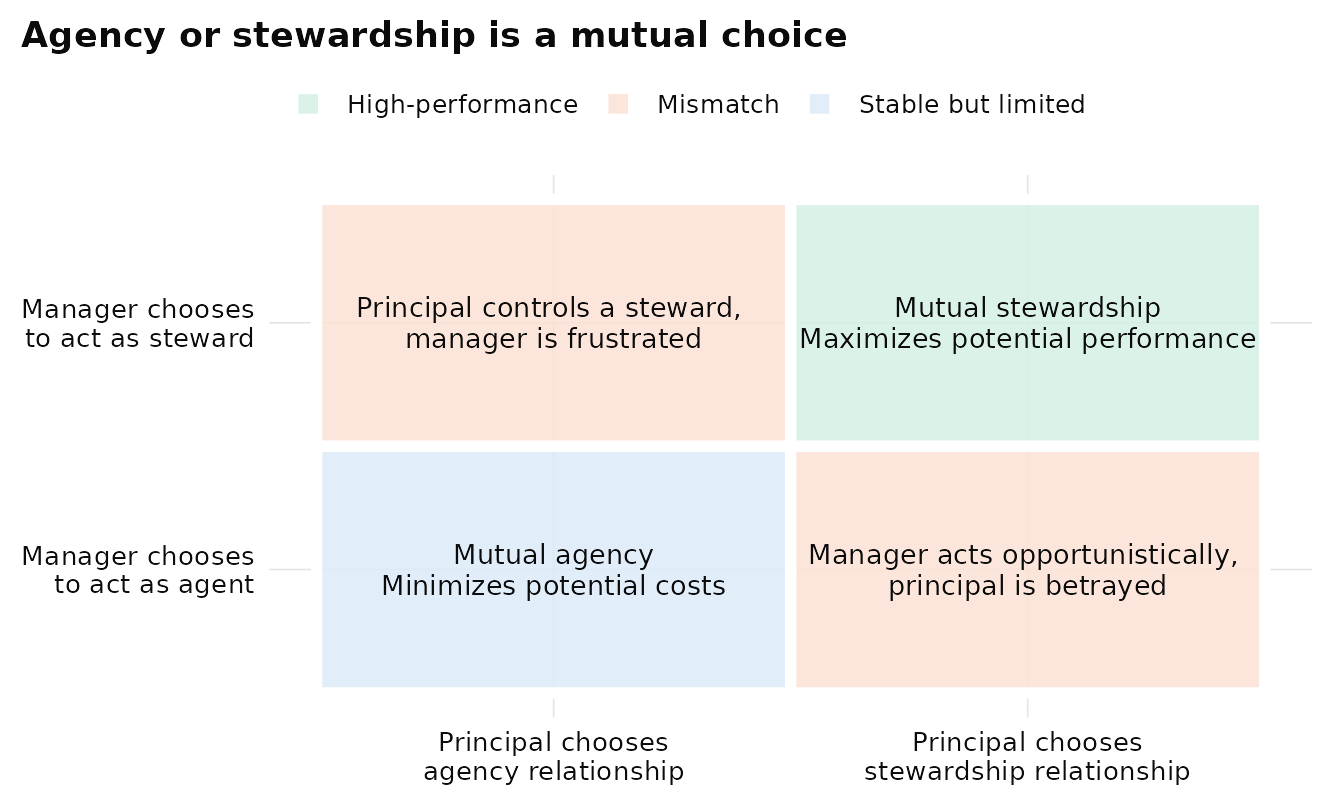
Figure 6.4: The principal-manager choice model, redrawn from the logic of Davis, Schoorman, and Donaldson (1997). Mutual stewardship maximizes potential performance, mutual agency minimizes potential costs, mismatched choices produce betrayal and frustration.
J. H. Davis, Schoorman, and Donaldson (1997) specify the factors that make each choice more likely. On the manager’s side, psychological factors matter: stewards are more intrinsically motivated, identify more strongly with the organization, and rely on personal rather than institutional power. On the principal’s side, situational factors matter: involvement-oriented management philosophies, collectivist cultures, and low power distance make stewardship relationships more likely.
6.2.3 Evidence and applications
Stewardship theory has been especially influential in research on family firms, nonprofit organizations, and boards, where identification with the organization is often high. Its prescriptions are contingent rather than universal: it does not claim that all managers are stewards, only that governance should fit the type of manager and the situation. That contingency is both its strength and its main empirical challenge, because motivation and identification are difficult to observe at the top of large firms.
Board independence and the CEO-chair question. After the accounting scandals of 2001-2002, the Sarbanes-Oxley Act and new stock-exchange listing standards in the United States required majority-independent boards and fully independent audit committees, an explicitly agency-theoretic reform. Many U.K. and European firms had already separated the CEO and chair roles. Yet large U.S. companies have continued to differ in whether they combine the roles, and meta-analytic evidence finds no consistent performance advantage for either structure (Dalton et al. 1998). The stewardship perspective suggests why: the best structure depends on whether the executive is a steward and whether the board can tell. A practical compromise, a combined CEO-chair together with a strong lead independent director, tries to capture the unity-of-command benefits of stewardship while retaining an agency safeguard. Hillman and Dalziel (2003) add that independent directors provide not only monitoring but also board capital, advice, legitimacy (Section @ref(legitimacy (Section 7.3))), and links to external resources, which connects governance to resource dependence theory (Section 7.1).
Using stewardship theory as a post hoc label. Studies sometimes interpret any positive effect of executive autonomy as “support for stewardship theory”. The theory makes a conditional claim: empowerment improves outcomes when managers are stewards. A credible test measures (or plausibly proxies) motivation and identification, for instance, founder or family status, tenure, or survey measures, and shows that the effect of governance structure depends on them.
6.3 Transaction Cost Economics
Core claim. Transactions differ in their attributes, above all in the specificity of the assets they require, and are assigned to governance structures (markets, hybrids, hierarchies) that economize on the costs of contracting, especially the hazards of opportunistic hold-up.
Origins. Economics, Coase (1937) asked why firms exist. Williamson (1975), Williamson (1979), Williamson (1985), and Williamson (1991) built the operational theory. Williamson (1981) introduced it to sociology and organization theory. Williamson shared the 2009 Nobel Memorial Prize in Economic Sciences, and Coase received the prize in 1991.
Level of analysis. The transaction is the unit of analysis. Outcomes are governance choices at the boundary of the firm.
Key constructs. Bounded rationality, opportunism, asset specificity, uncertainty, frequency, hold-up, appropriable quasi-rents, fundamental transformation, discriminating alignment, market, hybrid, and hierarchy.
Boundary conditions. Contracts are incomplete. Some parties are opportunistic some of the time. Courts cannot cheaply enforce all contingencies. Transacting parties can choose among governance alternatives.
Related theories. Agency theory, Resource-based theory (Section 4.1), Resource dependence (Section 7.1), Bounded rationality (Section 23.1).
6.3.1 Origins and intellectual history
Coase (1937) noticed a puzzle at the heart of economics. If markets allocate resources efficiently through prices, why do so many transactions take place inside firms, where they are directed by managerial authority instead? His answer was that using the price mechanism has costs: discovering the relevant prices, negotiating and concluding separate contracts for each exchange, and writing contracts for long periods under uncertainty. Firms exist because, for some transactions, authority is cheaper than repeated contracting. A firm grows until the cost of organizing one more transaction internally equals the cost of buying it in the market.
For decades the argument was admired but rarely used, because it did not say which transactions would be cheaper to organize internally. Williamson (1975) supplied the missing operational content. Drawing on Herbert Simon’s concept of bounded rationality (Section 23.1) and on legal scholarship about contracts, Williamson argued that transaction costs arise from the combination of two behavioural assumptions and three attributes of transactions.
6.3.2 Core logic and propositions
The behavioural assumptions are bounded rationality and opportunism. Bounded rationality means that people intend to be rational but cannot foresee every contingency, so all complex contracts are incomplete. Opportunism means that at least some parties will pursue self-interest strategically, through selective disclosure, misrepresentation, or exploiting gaps in contracts, and that it is costly to know in advance who will (Williamson 1985). Neither assumption alone creates serious problems: with unbounded rationality, contracts could anticipate everything. Without opportunism, incomplete contracts could be filled in by good faith.
The attributes of transactions determine how much these behavioural limits matter (Williamson 1979, 1985):
- Asset specificity: the degree to which an investment made to support a transaction loses value in its next-best use. Williamson distinguished site specificity (a plant located next to a customer), physical asset specificity (custom dies and tooling), human asset specificity (relationship-specific know-how), and dedicated assets (capacity built for one buyer).
- Uncertainty: about the environment or about the other party’s behaviour, which increases the number of contingencies a contract would need to cover.
- Frequency: how often the transaction recurs, which determines whether the fixed costs of specialised governance can be recovered.
The theory’s key dynamic is the fundamental transformation. Before a specific investment is made, many suppliers may compete for a contract. Once one supplier has invested in assets that are valuable only in the relationship, the parties are locked into a bilateral relationship, and the large-numbers competition of the bidding stage becomes a small-numbers bargaining problem. Each side can then threaten to withhold cooperation to capture the appropriable quasi-rents: the difference between an asset’s value in the relationship and in its next-best use (B. Klein, Crawford, and Alchian 1978). This threat is the hold-up problem. Anticipating it, parties may under-invest in valuable specific assets, or they may choose a governance structure that protects those investments.
TCE’s central principle is discriminating alignment: transactions, which differ in their attributes, are aligned with governance structures, which differ in their costs and competencies, in a way that economizes on transaction costs (Williamson 1991). The core propositions follow:
- P1 (Asset specificity). As asset specificity rises, governance shifts from markets toward hybrids (long-term contracts, alliances, franchising) and then to hierarchy (vertical integration).
- P2 (Uncertainty). Uncertainty amplifies the effect of asset specificity, because adapting an incomplete contract to unforeseen events invites haggling.
- P3 (Frequency). Recurrent transactions with high specificity justify the set-up costs of specialised governance. Occasional ones are more often governed by trilateral arrangements such as arbitration.
- P4 (Remediableness). A governance structure should be judged against feasible alternatives, not against an ideal that no organization can implement.
Williamson (1991) characterised the three generic governance structures by a small set of attributes (Table 6.6). Markets provide strong incentives and are good at autonomous adaptation, in which parties respond independently to price signals. Hierarchies provide weaker incentives but strong administrative controls and are good at coordinated adaptation, in which interdependent parties must adjust together. Hybrids sit in between.
| Attribute | Market | Hybrid | Hierarchy |
|---|---|---|---|
| Incentive intensity | Strong | Semi-strong | Weak |
| Administrative controls | Minimal | Moderate | Extensive |
| Autonomous adaptation (responding to prices) | Strong | Moderate | Weak |
| Coordinated (cooperative) adaptation | Weak | Moderate | Strong |
| Reliance on contract law and courts | Strong | Moderate | Weak (internal dispute resolution) |
| Typical business form | Spot purchase, competitive bidding | Long-term supply contract, alliance, franchise, joint venture | In-house production, wholly owned subsidiary |
6.3.3 Mechanism
Figure 6.5 presents the make-or-buy logic. Transaction attributes create hazards, behavioural assumptions explain why those hazards cannot simply be contracted away, and governance choice follows.
Figure 6.5: The make-or-buy mechanism in transaction cost economics: asset specificity, uncertainty, and frequency create hold-up and adaptation hazards, which bounded rationality and opportunism make costly to contract away. Governance is chosen to economize on those hazards.
Williamson’s well-known heuristic representation expresses governance costs as a function of asset specificity. Markets have the lowest costs when assets are generic, but their costs rise steeply with specificity. Hierarchies carry high bureaucratic overhead but are least sensitive to specificity. Hybrids lie between. The efficient boundary of the firm follows the lower envelope of the three curves (Figure 6.6).
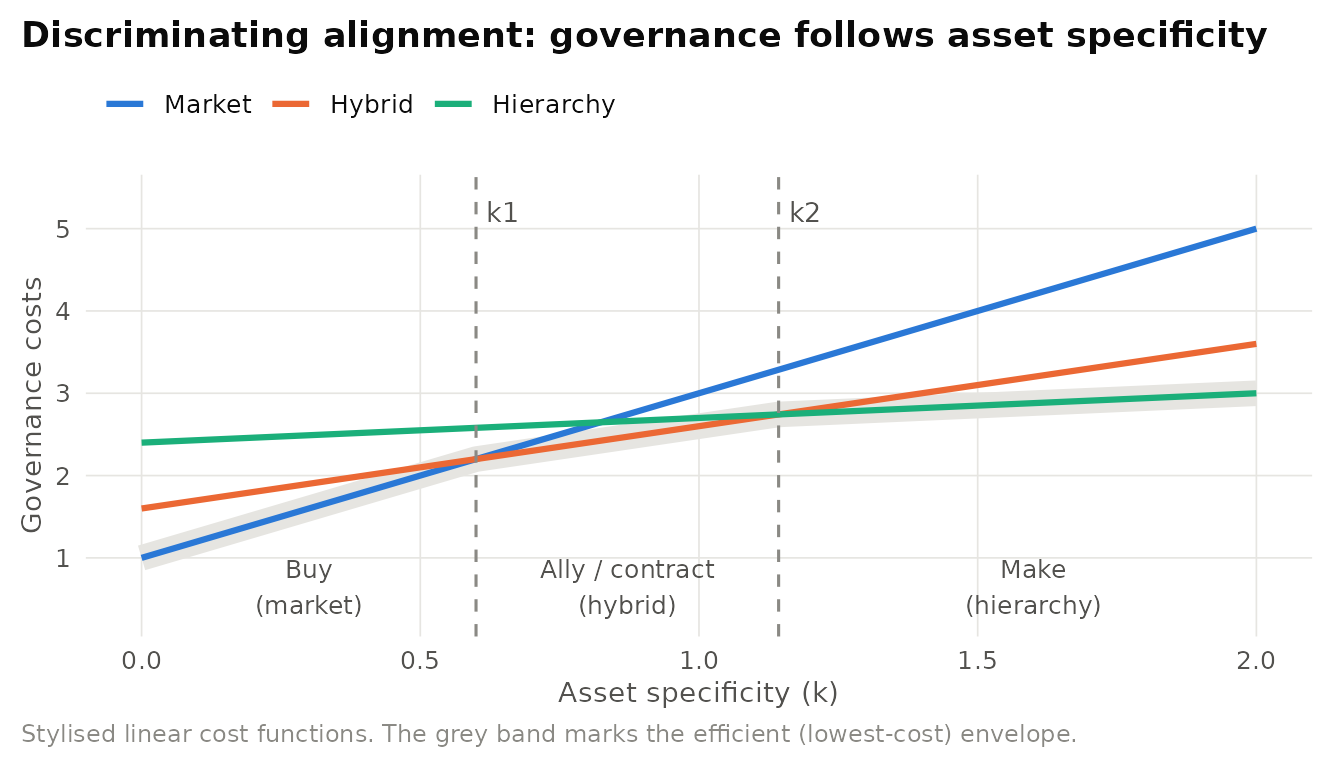
Figure 6.6: Stylised governance-cost curves after Williamson (1991). Each governance form is cheapest over a range of asset specificity. The efficient choice follows the lower envelope, switching from market to hybrid at k1 and from hybrid to hierarchy at k2. Functional forms are illustrative.
6.3.4 Evidence and extensions
TCE is one of the most extensively tested theories in the social sciences. Early studies of the automobile industry found that components requiring more specialised engineering know-how were more likely to be produced in-house (Monteverde and Teece 1982), and that make-or-buy decisions in a component division responded to supplier-market competition and volume uncertainty (Walker and Weber 1984). Reviews conclude that the evidence is broadly consistent with the theory, especially for asset specificity (Shelanski and Klein 1995), although a systematic assessment found the support uneven across constructs and noted disagreement over how key variables should be measured (R. J. David and Han 2004).
Did Fisher Body hold up General Motors? The most famous illustration of hold-up is the relationship between General Motors and Fisher Body, the supplier of closed car bodies. In 1919 GM acquired a majority stake in Fisher and signed a long-term exclusive supply contract with cost-plus pricing. In 1926 it acquired the rest of the company. B. Klein, Crawford, and Alchian (1978) argued that the contract left GM vulnerable once demand for closed bodies grew: Fisher allegedly exploited the cost-plus formula and resisted locating plants next to GM’s assembly plants, and GM integrated fully to end the hold-up. The case became the canonical textbook example of TCE.
Seven decades after his 1937 article, Coase (2000) examined the historical record and rejected this account. He argued that relations between the two firms were close, that Fisher plants were in fact built near GM plants, and that the 1926 acquisition was motivated chiefly by GM’s wish to secure the Fisher brothers’ managerial talent and to coordinate production more closely. Two further studies in the same journal issue reached related conclusions: Casadesus-Masanell and Spulber (2000) called the hold-up story a “fable”, and Freeland (2000) argued that, if anything, integration created hold-up potential by making GM dependent on the Fisher brothers’ continued cooperation. B. Klein (2000) responded by defending a refined version of the hold-up interpretation.
What is at stake? Not the logic of hold-up, which no participant disputes, but the evidential standard for using historical cases to support theory. The debate is a reminder that canonical examples deserve the same scrutiny as statistical evidence, and that the same integration decision can be consistent with transaction-cost, capability, and coordination explanations.
TCE has also been criticised on conceptual grounds. Ghoshal and Moran (1996) argued that the assumption of opportunism can become self-fulfilling: governance designed for opportunists erodes trust and invites the behaviour it seeks to prevent, a critique parallel to the one levelled at agency theory. Capability-based theories offer a different answer to the make-or-buy question: firms integrate activities in which they have superior, hard-to-imitate capabilities and buy those in which others are more capable (Jay Barney 1991, Teece, Pisano, and Shuen 1997). Contemporary research often treats transaction-cost and capability logics as complements: specificity explains why an activity is hazardous to outsource, and capabilities explain who can perform it best.
6.3.5 Applications in business
TCE is a practical decision framework. Table 6.7 applies it to common boundary decisions.
| Function | Decision | Key transaction attribute | TCE prediction |
|---|---|---|---|
| Operations | Outsource standard components or build them in-house? | Low physical asset specificity, many suppliers | Buy through competitive markets |
| Operations | Source a custom module requiring dedicated tooling | High physical and dedicated-asset specificity | Long-term contract with safeguards, or integrate |
| Marketing | Use independent distributors or a direct sales force? | Human asset specificity of product knowledge and customer relationships | Direct sales force when selling requires specialised, non-transferable knowledge |
| IT | Move commodity workloads to a public cloud. Keep core data platforms? | Low specificity for commodity computing, high for proprietary data and processes | Buy commodity capacity. Govern core systems internally or through hybrid contracts |
| HR | Hire contractors or permanent employees? | Firm-specific know-how and tacit routines | Employment (hierarchy) for firm-specific roles |
| Strategy | Acquire a key supplier or form an alliance? | Specificity combined with high uncertainty | Hybrid when coordination needs are moderate, acquisition when hold-up hazards are severe |
Outsourcing and re-integration in commercial aircraft. For the 787 Dreamliner, Boeing outsourced the design and manufacture of large structural sections to a global network of partners to a greater extent than in earlier programmes. The programme suffered extensive delays, and in 2009 Boeing acquired the South Carolina fuselage operations of one of its partners, Vought Aircraft Industries. In 2024 Boeing announced an agreement to reacquire Spirit AeroSystems, the fuselage maker it had spun off in 2005. Interpreted through TCE, large aircraft structures involve high physical and human asset specificity, substantial technological uncertainty, and intense need for coordinated adaptation: precisely the conditions under which market and hybrid governance are most exposed to hold-up and adaptation failures. Capability arguments point in the same direction: integration preserves architectural knowledge that may be lost when design work is dispersed.
Selective integration at Apple. Apple outsources most final assembly to contract manufacturers but has progressively brought chip design in-house, culminating in the transition of its Mac computers to Apple-designed processors beginning in 2020, while fabrication remains with external foundries. TCE explains the split: assembly is a large-scale but relatively codifiable activity that can be governed through long-term contracts, with the buyer at times investing in specialised equipment at suppliers’ facilities to secure capacity. Chip architecture, by contrast, is deeply interdependent with Apple’s software and product roadmap, making coordinated adaptation valuable and outsourcing hazardous.
Sample hypotheses.
- H1. The likelihood of in-house production of a component increases with the engineering effort specific to that component.
- H2. The effect of asset specificity on vertical integration is stronger under high technological uncertainty.
- H3. Alliances involving high relationship-specific investment are more likely to be structured as equity joint ventures than as contractual alliances.
Designs. Cross-sectional or panel analysis of make-or-buy choices at the transaction or component level. Contract-level studies of duration, pricing terms, and safeguards. Event studies of supplier disruptions.
Measures. Asset specificity (engineer ratings, specialised tooling, co-location, relationship-specific training), uncertainty (demand volatility, technological change), frequency (order volume and repetition), governance (make/buy, contract length, equity sharing).
Measuring governance outcomes instead of transaction attributes. A frequent error is to infer asset specificity from the fact that a firm integrated, which makes the theory circular. Measure transaction attributes independently of the governance choice, compare against feasible alternatives (remediableness), and remember that the unit of analysis is the transaction, not the firm.
6.4 Upper Echelons Theory
Core claim. Organizational outcomes, strategic choices and performance, are partly predicted by the experiences, values, and personalities of top executives, because executives act on their construed reality rather than on objective situations.
Origins. Strategic management, Hambrick and Mason (1984), building on the Carnegie School’s view of bounded rationality, updated in Hambrick (2007b), synthesised in Finkelstein, Hambrick, and Cannella (2009).
Level of analysis. Individual executive (especially the CEO), the top management team (TMT), and the firm.
Key constructs. Executive orientation (values, cognitive base, personality), observable characteristics (age, tenure, functional background, education), filtering (field of vision, selective perception, interpretation), managerial discretion, executive job demands, hubris and narcissism.
Boundary conditions. Executive characteristics matter more when managerial discretion is high and when job demands force executives to rely on mental shortcuts.
Related theories. Agency theory, Bounded rationality (Section 23.1), Heuristics and biases (Section 23.2), Glass cliff (Section 29.6).
6.4.1 Origins and core logic
For much of the twentieth century, organization theorists debated whether leaders matter. Population ecologists and institutional theorists emphasised environmental constraints, and a widely cited study found that leadership changes explained relatively little variance in company performance compared with industry and company factors (Lieberson and O’Connor 1972). Hambrick and Mason (1984) proposed a different starting point: since complex strategic decisions cannot be made through pure calculation, executives inevitably bring their own cognitive base (knowledge and assumptions) and values to bear. The organization therefore becomes, in Hambrick and Mason’s phrase, a reflection of its top managers.
Two further moves made the idea researchable. First, because executives’ cognitions are difficult to measure directly, Hambrick and Mason proposed observable demographic characteristics, age, tenure, functional track, education, socioeconomic background, as imperfect proxies. Second, they argued that the top management team, not the CEO alone, is the appropriate unit, because strategy emerges from the shared and divergent views of a dominant coalition.
The theory’s mechanism is a filtering process (Finkelstein, Hambrick, and Cannella 2009, Hambrick 2007b). An executive’s orientation limits the field of vision (which parts of the environment are scanned), shapes selective perception (which stimuli within that field are noticed), and guides interpretation (what meaning is attached to them). The resulting construed reality drives strategic choices such as innovation, diversification, acquisitions, and leverage, which in turn affect performance (Figure 6.7).
Figure 6.7: Upper echelons mechanism: executives’ psychological orientation (proxied by observable experiences) filters the strategic situation into a construed reality that shapes strategic choices and performance. Managerial discretion and executive job demands moderate the strength of the link.
6.4.2 Moderators: discretion and job demands
Hambrick and Finkelstein (1987) introduced managerial discretion, latitude of action, to reconcile the view that leaders matter with the view that environments constrain them. Discretion is high in industries with product differentiability, rapid growth, and few regulatory constraints. In organizations with slack resources and weak internal resistance, and for executives with high tolerance for ambiguity and substantial power. Executive characteristics should predict outcomes much more strongly where discretion is high. Finkelstein and Hambrick (1990) provided early support: TMT tenure was associated with persistent strategies and strategies that conformed to industry averages, and these associations were stronger in high-discretion industries. Hambrick (2007b) added executive job demands: executives facing heavier demands rely more on experience and intuition, so their backgrounds should matter more.
Table 6.8 summarises common constructs and measures.
| Construct | Typical proxy or measure | Representative prediction |
|---|---|---|
| Tenure (organizational, CEO, team) | Years in firm or position | Longer tenure -> strategic persistence and conformity to industry norms |
| Functional background | Career track (output functions such as marketing vs. throughput functions such as operations) | Background shapes which problems and opportunities are noticed |
| Education | Level and type of degree | More formal education -> greater openness to innovation |
| Age | Executive or team mean age | Younger teams -> riskier strategies and more strategic change |
| TMT heterogeneity | Dispersion of backgrounds within the team | More diverse information but potentially less cohesion |
| Overconfidence / hubris | Option-exercise behaviour, media praise, relative pay | Larger acquisition premiums, investment sensitive to internal cash |
| Narcissism | Unobtrusive indicators (prominence in annual reports, first-person pronouns, relative pay) | Bolder, more dynamic strategies and more extreme performance |
6.4.3 Evidence and extensions
Research on upper echelons has expanded from demographics to personality and psychology. In finance, Bertrand and Schoar (2003) tracked individual managers across firms and found that manager fixed effects explain a meaningful share of the variation in investment, financing, and organizational practices: strong evidence that “style” travels with the person. Quigley and Hambrick (2015) estimated that the share of performance variance attributable to CEOs has increased over recent decades, a partial answer to the early skepticism of Lieberson and O’Connor (1972).
The most vivid stream concerns CEO hubris. Roll (1986) proposed that bidding managers overestimate their ability to create value, so takeover premiums partly reflect errors of judgment. Hayward and Hambrick (1997) found that premiums paid for large acquisitions were higher when the acquiring firm had recently performed well, when the CEO had received favourable media praise, and when the CEO’s pay was high relative to other executives, indicators of hubris, and that these effects were stronger when board vigilance was weak. Shareholder losses followed. Malmendier and Tate (2005) measured overconfidence by CEOs’ reluctance to exercise in-the-money options and found that overconfident CEOs’ investment was more sensitive to internal cash flow. Chatterjee and Hambrick (2007) showed that narcissistic CEOs pursue more dynamic and grandiose strategies and generate more extreme and fluctuating performance, without being systematically better or worse.
Do demographics measure cognition? The theory’s early reliance on demographic proxies is both its engine and its Achilles’ heel. Critics note that the same demographic variable (say, tenure) can be linked to several psychological states, so demographic studies cannot identify which mechanism is at work. Hambrick (2007b) himself called for direct study of executive psychology and of the processes that link characteristics to choices. A second debate concerns endogeneity: boards select executives whose backgrounds fit the strategy they want, so an association between, for example, a CEO’s finance background and a diversification strategy may reflect selection rather than influence. Executive successions caused by deaths or illnesses, and designs that follow managers across firms (Bertrand and Schoar 2003), are among the tools used to address this problem.
Acquisition premiums and board vigilance. When a celebrated CEO proposes a large acquisition at a substantial premium, upper echelons research suggests that the board should ask whether the premium reflects analysis or confidence born of recent success and favourable press. The governance implications link this theory to agency theory: hubris is not opportunism, the CEO may sincerely believe the deal will create value, but the remedies overlap. Independent valuation advice, a board that includes directors with acquisition experience, staged commitments, and compensation tied to post-deal performance rather than deal size are all ways of filtering executive overconfidence before it becomes residual loss.
Top-team composition in a strategic pivot. Illustrative scenario: a hardware-centred firm wants to move toward software subscriptions. Upper echelons theory predicts that a TMT drawn mainly from engineering and manufacturing will notice threats and opportunities in product reliability and cost, and may under-weight signals about recurring revenue and customer success. Firms facing such pivots often deliberately change TMT composition, appointing executives from the target business model, not only for their skills but because they change what the team notices and how it interprets ambiguous evidence.
Sample hypotheses.
- H1. The positive relationship between CEO overconfidence and acquisition premiums is weaker when the board includes more directors with prior acquisition experience.
- H2. TMT functional heterogeneity is positively related to strategic change, and this effect is stronger in high-discretion industries.
- H3. CEO narcissism increases the variance, but not the mean, of firm performance.
Designs. Panel data with executive and firm fixed effects. Manager-mobility designs, exogenous CEO turnover. Text analysis of letters to shareholders and earnings calls. Surveys of executives (with low response rates as a known constraint).
Measures. Demographics from proxy statements and biographies. Psychological traits from validated unobtrusive indicators or linguistic analysis. Discretion indices at the industry level.
Ignoring discretion and selection. Upper echelons effects are contingent. Testing them in heavily regulated, low-discretion contexts and finding null effects says little about the theory, and finding an association without addressing how executives were selected says little about influence. Model discretion explicitly and use designs that separate the effect of the executive from the choice of the executive.
6.5 Chapter Summary
- Agency theory explains governance as a response to goal conflict and information asymmetry. Agency costs comprise monitoring, bonding, and residual loss (Jensen and Meckling 1976, Eisenhardt 1989a).
- Efficient incentives balance effort against risk: noisier measures and more risk-averse agents call for flatter pay-for-performance slopes, and strong incentives on measurable tasks can crowd out unmeasured ones (Holmström 1979, Holmström and Milgrom 1991).
- Outcome-based and behaviour-based contracts are substitutes whose relative efficiency depends on information systems, uncertainty, task programmability, and outcome measurability (Eisenhardt 1989a).
- Stewardship theory argues that governance should fit the manager: empowering structures outperform controls when both principal and manager choose a stewardship relationship (J. H. Davis, Schoorman, and Donaldson 1997).
- Transaction cost economics explains the boundaries of the firm: asset specificity, uncertainty, and frequency, combined with bounded rationality and opportunism, determine whether markets, hybrids, or hierarchies economize on hold-up and adaptation costs (Coase 1937, Williamson 1985, 1991).
- Canonical cases such as GM-Fisher Body remain contested (B. Klein, Crawford, and Alchian 1978, Coase 2000), a reminder to scrutinise illustrative evidence.
- Upper echelons theory shows that executives’ experiences, values, and personalities shape strategy, especially when managerial discretion is high. Hubris and narcissism are its most consequential applications (Hambrick and Mason 1984, Hambrick 2007b, Hayward and Hambrick 1997).
Table 6.9 presents the comparison of the chapter’s theories.
| Theory | Unit of analysis | View of the manager | Key mechanism | Signature prediction | Typical business use |
|---|---|---|---|---|---|
| Agency theory | Principal-agent contract | Self-interested, risk-averse agent | Incentive alignment and monitoring under information asymmetry | Outcome-based pay where outcomes are measurable, residual loss where they are not | Executive pay, sales compensation, franchising, board design |
| Stewardship theory | Principal-manager relationship | Pro-organizational steward (when chosen) | Identification, intrinsic motivation, trust | Empowerment outperforms control under mutual stewardship | Leadership structure, family firms, nonprofit governance |
| Transaction cost economics | Transaction | Boundedly rational and potentially opportunistic | Hold-up hazards from asset specificity | Integration rises with asset specificity and uncertainty | Make-or-buy, outsourcing, alliances, contract design |
| Upper echelons theory | Executive and top management team | Boundedly rational person with a distinctive orientation | Filtering of information through values and experience | Executive traits predict strategy, especially under high discretion | Executive selection, TMT composition, M&A oversight |
6.6 Discussion Questions
- Agency theory and stewardship theory make opposite predictions about combining the CEO and board-chair roles. Design a study that could distinguish between them. What moderator would you measure, and how?
- Using the linear incentive model in this chapter, explain why a hospital might pay surgeons largely by salary while a car dealership pays salespeople largely by commission. What other considerations (multitasking, ethics, teamwork) does the model omit?
- The Wells Fargo case is often described as a failure of culture rather than of incentives. Is that distinction meaningful from an agency perspective? What evidence would help adjudicate between the two accounts?
- Choose a firm that recently insourced an activity it had previously outsourced (or vice versa). Analyse the decision using asset specificity, uncertainty, and frequency. Would a capability-based explanation reach the same conclusion?
- The GM-Fisher Body debate concerns the use of historical evidence. What standards should a historical case meet before it is used as support for a theory?
- A board is evaluating a CEO’s proposal for a large acquisition. Drawing on upper echelons research and agency theory, list the questions directors should ask and the governance safeguards they should consider.
6.7 Further Reading
- Jensen and Meckling (1976): the foundational statement of agency costs and the firm as a nexus of contracts.
- Eisenhardt (1989a): the clearest introduction to agency theory for management researchers, with testable propositions on contract choice.
- Holmström and Milgrom (1991): the multitask model. Essential for understanding why strong incentives can backfire.
- J. H. Davis, Schoorman, and Donaldson (1997): the theoretical development of stewardship theory and the principal-manager choice model.
- Williamson (1991): a compact statement of discriminating alignment and the market-hybrid-hierarchy comparison.
- Coase (2000) and B. Klein (2000): read together, an instructive exchange on the historical evidence for hold-up.
- Hambrick (2007b): a short, candid update of upper echelons theory with an agenda for future research.
- Hayward and Hambrick (1997): a model empirical study linking executive psychology, governance, and acquisition outcomes.