23 Judgment and Decision Making
In the 1970s, the credit card industry lobbied hard over a question that a standard economic model would regard as trivial. If merchants were to be allowed to charge card users more than cash customers, should the price difference be called a “credit card surcharge” or a “cash discount”? The two labels describe exactly the same prices, yet the industry insisted on the second (R. Thaler 1980). Its instinct was sound. Paying a surcharge feels like a loss. Forgoing a discount feels like a missed gain, and people weigh losses more heavily than equivalent gains. The same insight explains why employees who are automatically enrolled in a retirement plan tend to stay enrolled, why a customer who has lived with a sofa for thirty days rarely returns it, and why a $50 gift card is spent differently from $50 in cash.
This chapter introduces the theories that explain how people actually judge and decide, as opposed to how an idealized rational agent would. We begin with bounded rationality, the idea that decision makers satisfice rather than optimize, and then turn to the heuristics-and-biases programme and its principal rival, fast-and-frugal heuristics. A brief overview of prospect theory (Chapter 24) (treated in full in Chapter 24) leads to two close relatives: the endowment effect and mental accounting. We then examine the cognitive architecture behind these phenomena (dual-process theory) and three theories about how subjective experience feeds into judgment: feelings-as-information, processing fluency, and the discrepancy-attribution hypothesis. We close with choice architecture, the applied science of designing decision environments, which draws on all of the preceding ideas (Table 23.1).
| Theory | Core question | Level of analysis | Key source |
|---|---|---|---|
| Bounded rationality | How do decision makers choose when information and computation are limited? | Individual / organization | Simon (1955) |
| Heuristics and biases | Which mental shortcuts do people use, and when do they mislead? | Individual | Tversky & Kahneman (1974) |
| Prospect theory | How do people evaluate risky prospects relative to a reference point? | Individual / market | Kahneman & Tversky (1979) |
| Endowment effect | Why do owners value goods more than buyers do? | Individual / dyad | Kahneman, Knetsch & Thaler (1990) |
| Mental accounting | How do people categorize, track, and evaluate money? | Individual / household | Thaler (1985, 1999) |
| Dual-process theory | How do intuitive and deliberative processes interact? | Individual | Evans & Stanovich (2013) |
| Feelings-as-information | When do feelings serve as evidence for judgments? | Individual | Schwarz & Clore (1983) |
| Processing fluency | How does the ease of processing shape liking, truth, and choice? | Individual | Reber, Schwarz & Winkielman (2004) |
| Discrepancy-attribution | Why does surprising fluency feel like familiarity? | Individual | Whittlesea & Williams (1998) |
| Choice architecture | How does the design of the choice environment shape decisions? | Individual / organization / policy | Thaler & Sunstein (2008) |
23.1 Bounded Rationality
Core claim. Real decision makers have limited information, attention, and computational capacity. Instead of maximizing expected utility, they search sequentially and stop when they find an option that meets an aspiration level : they satisfice.
Origins. Economics, political science, and cognitive science, Simon (1955) and Simon (1956), developed for organizations by Cyert and March (1963).
Level of analysis. Individual decision makers and organizations.
Key constructs. Aspiration level, satisficing, sequential search, search costs, procedural (vs. substantive) rationality, task environment.
Boundary conditions. Matters most when options are numerous, information is costly to gather, and outcomes are uncertain. Least when options are few, attributes are transparent, and computation is cheap.
Related theories. Heuristics and biases, Dual-process theory, Choice architecture, Transaction cost economics (Section 6.3).
23.1.1 Origins and intellectual history
By the early 1950s, economics had settled on a model of the decision maker as an agent with complete and consistent preferences who chooses the alternative that maximizes expected utility. Simon (1955) did not dispute that people pursue goals. He disputed that they could possibly do so in the manner the model assumed. Global rationality requires knowing all alternatives, the consequences of each, and the probabilities of those consequences, and then performing the computations needed to compare them. Simon proposed instead a “behavioral model” in which the organism has a limited set of alternatives in view, a simplified payoff function that classifies outcomes as satisfactory or unsatisfactory, and an aspiration level that adjusts with experience.
In a companion paper, Simon (1956) introduced the term satisficing and emphasized that rationality is a property of the fit between a mind and its environment. An organism foraging in a sparse environment does not need an elaborate optimization routine if the structure of the environment allows a simple rule to achieve its goals. Simon’s often-quoted image of rationality as a pair of scissors, with one blade being the structure of the task environment and the other the computational capabilities of the actor, captures this point (discussed in Gigerenzer and Gaissmaier 2011).
The idea migrated quickly into organization theory. Cyert and March (1963) modelled firms as coalitions that set aspiration levels for goals such as sales and profit, engage in problemistic search when performance falls below aspiration, and accumulate organizational slack when performance is comfortably above it. In psychology, Payne, Bettman, and Johnson (1993) showed that individuals select among decision strategies (weighted-additive rules, lexicographic rules, elimination by aspects) by trading off cognitive effort against accuracy, making the choice of strategy itself an adaptive decision.
23.1.2 Core logic and propositions
Definition 23.1 Satisficing. A decision procedure in which alternatives are examined sequentially and the first alternative whose value meets or exceeds an aspiration level is chosen. The aspiration level rises when satisfactory alternatives are easy to find and falls when they are hard to find (Simon 1955, 1956).
The theory can be summarized in four propositions:
- P1 (Limited search). Decision makers evaluate a subset of the available alternatives, and the size of that subset decreases as search costs rise.
- P2 (Aspiration-based stopping). Search stops when an alternative meets the current aspiration level, not when the best alternative has been found.
- P3 (Adaptive aspirations). Aspiration levels adjust to experience: they rise after easy success and fall after repeated failure (Simon 1955, Cyert and March 1963).
- P4 (Procedural rationality). Whether a decision rule is “good” depends on its fit with the structure of the task environment, not on its resemblance to optimization (Simon 1956, Gigerenzer and Gaissmaier 2011).
23.1.3 Mechanism
Satisficing is not merely a concession to cognitive weakness: when search is costly it can be the better policy. Figure 23.1 simulates a decision maker who inspects up to 50 options one at a time, pays a fixed cost per inspection, and stops at the first option that meets the aspiration level. The net payoff (value of the chosen option minus total search cost) peaks at an interior aspiration level, and the optimal aspiration falls as search becomes more expensive.
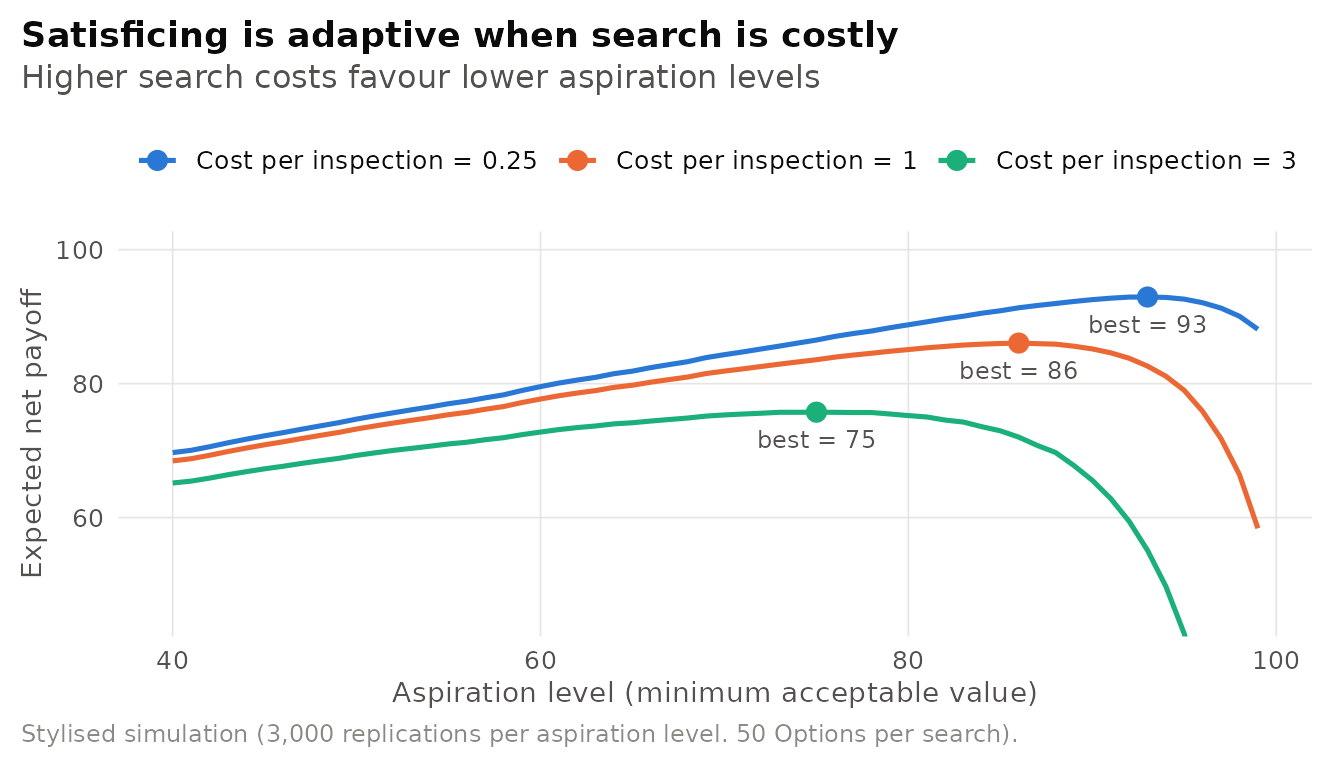
Figure 23.1: Illustrative simulation of satisficing. A decision maker inspects options sequentially (values drawn from Uniform[0, 100]) and stops at the first option meeting the aspiration level. Net payoff peaks at an interior aspiration level that falls as the cost of inspecting each option rises.
23.1.4 Evidence and extensions
Bounded rationality is less a single testable hypothesis than a research programme, and its influence is visible in at least three literatures. First, behavioural theories of the firm built on Cyert and March (1963) study how performance relative to aspirations drives search, risk taking, and organizational change. Second, research on adaptive decision making (Payne, Bettman, and Johnson 1993) documents how people shift from compensatory strategies (which trade off attributes) to non-compensatory strategies (which screen on one attribute at a time) as the number of alternatives and the time pressure increase. Third, Simon’s emphasis on the fit between mind and environment became the foundation of the ecological rationality programme of Gigerenzer and colleagues, discussed in the next section (Gigerenzer and Goldstein 1996, Gigerenzer and Gaissmaier 2011).
Procurement and hiring as satisficing problems. Purchasing managers rarely solicit bids from every possible supplier, and recruiters rarely interview every qualified applicant. Instead, organizations codify aspiration levels as qualification thresholds (“pre-approved vendor”, “minimum years of experience”) and stop searching once a candidate clears them. Bounded rationality reframes the managerial question: rather than asking whether the chosen supplier was optimal, ask whether the threshold and the search budget were well calibrated to the cost of search and the variance of quality in the market. When the variance of quality is high, a longer search pays. When it is low, fast satisficing is efficient.
Equating bounded rationality with irrationality. Simon’s argument was that decision rules should be evaluated relative to the decision maker’s constraints and environment. A study that documents a departure from expected-utility maximization has not thereby shown that people are “boundedly rational” in Simon’s sense. It must also show why the observed procedure is a sensible response to limited information or computation.
23.2 Heuristics and Biases
Core claim. People judge probabilities and frequencies by relying on a small number of heuristics. These heuristics are generally useful but produce systematic and predictable errors (biases).
Origins. Cognitive psychology, Tversky and Kahneman (1973) and Tversky and Kahneman (1974), later reformulated as attribute substitution by Kahneman (2003).
Level of analysis. Individual judgment.
Key constructs. Representativeness, availability, anchoring and adjustment, base-rate neglect, conjunction fallacy, attribute substitution.
Boundary conditions. Biases are largest when judgments are intuitive, uncertain, and made without feedback. They shrink when information is presented in natural frequencies, when incentives and expertise are aligned with accuracy, and when the task environment matches the heuristic’s assumptions.
Related theories. Bounded rationality, Dual-process theory, Anchoring effect (Section 29.9), Feelings-as-information.
23.2.1 Core logic
Tversky and Kahneman (1974) proposed that three heuristics account for a wide range of intuitive judgments under uncertainty. Each substitutes an easy question for a hard one. Table 23.2 summarizes them.
| Heuristic | Hard question | Easier substitute | Typical bias | Business illustration |
|---|---|---|---|---|
| Representativeness | How probable is it that A belongs to category B? | How similar is A to the prototype of B? | Base-rate neglect, conjunction fallacy, insensitivity to sample size | Investors infer a great company from a great story, ignoring base rates of start-up failure |
| Availability | How frequent or likely is event X? | How easily do instances of X come to mind? | Overweighting vivid, recent, or publicized events | Insurance demand rises after a widely reported disaster |
| Anchoring and adjustment | What is the value of quantity Q? | Start from a salient number and adjust (insufficiently) | Estimates biased toward arbitrary anchors | List prices and first offers anchor negotiated prices |
Representativeness produces the conjunction fallacy, in which a detailed, coherent description is judged more probable than a more general one that contains it (Tversky and Kahneman 1983). Availability treats ease of recall as evidence of frequency (Tversky and Kahneman 1973). Anchoring lets even arbitrary numbers, such as the result of a spin of a wheel of fortune, shift estimates (Tversky and Kahneman 1974). See Anchoring effect (Section 29.9).
Kahneman (2003) later unified these heuristics under a single mechanism, attribute substitution: when a target attribute is hard to assess, people answer on the basis of a related heuristic attribute that comes more readily to mind, often without noticing the substitution. The same reformulation links heuristics to the dual-process architecture discussed later in this chapter.
23.2.2 The fast-and-frugal alternative
The heuristics-and-biases programme defined good judgment by the norms of probability theory and studied heuristics mostly as sources of error. A rival programme, led by Gerd Gigerenzer, argues that heuristics should be studied as adaptive tools whose accuracy depends on the environment. Gigerenzer and Goldstein (1996) proposed the Take-the-Best algorithm for inferring which of two objects scores higher on a criterion (e.g., which of two German cities has the larger population): search cues in order of validity and stop at the first cue that discriminates. In their simulations this one-reason rule matched or exceeded the accuracy of more complex strategies such as multiple regression, while using far less information. A related recognition heuristic infers that a recognized object has the higher value, which can yield a “less-is-more” effect in which partial ignorance improves inference (D. G. Goldstein and Gigerenzer 2002) (Table 23.3).
| Dimension | Heuristics and biases | Fast-and-frugal heuristics |
|---|---|---|
| Key sources | Tversky & Kahneman (1974), Kahneman (2003) | Gigerenzer & Goldstein (1996), Gigerenzer & Gaissmaier (2011) |
| Normative benchmark | Probability theory and expected utility | Ecological rationality: success in the actual environment |
| View of heuristics | Useful but error-prone shortcuts | Adaptive tools that can outperform complex models |
| Typical method | Word problems revealing deviations from norms | Simulation and prediction in real-world data |
| Characteristic finding | Systematic biases (base-rate neglect, anchoring) | Less-is-more effects, one-reason decisions |
| Managerial lesson | De-bias decisions, use statistical aids | Match simple rules to stable, predictable environments |
Cognitive illusions or adaptive tools? The two programmes clashed directly in a 1996 exchange in Psychological Review. Gigerenzer argued that many “biases” disappear when problems are presented in frequency formats and that heuristics were too vaguely specified to be tested. Kahneman and Tversky (1996) replied that cognitive illusions are real and robust, that frequency formats reduce but do not eliminate them, and that their programme had never claimed people are generally irrational. Much of the disagreement concerns the benchmark. If the standard is coherence with probability theory, heuristics produce errors. If the standard is predictive accuracy in a particular environment, simple heuristics can be superior, especially when data are scarce and noisy (Gigerenzer and Gaissmaier 2011). A productive synthesis asks which heuristic is used, when, and in which environments it succeeds or fails.
23.2.3 Using the theory in research
Sample hypotheses.
- H1. Analysts’ earnings forecasts will be more strongly anchored on the prior consensus when uncertainty about the firm is high.
- H2. Media coverage of product recalls will increase consumers’ perceived risk of the product category more than objective recall frequency does (availability).
- H3. In stable demand environments, a simple lexicographic sourcing rule will predict supplier performance as accurately as a multi-attribute scoring model, but not in volatile environments.
Designs. Vignette and incentive-compatible experiments. Field data with exogenous anchors (e.g., random list prices, lottery numbers). Out-of-sample prediction contests comparing heuristics with statistical models.
Measures. Deviation from Bayesian or actuarial benchmarks, anchoring indices, recall ease, cue-use patterns from process tracing.
23.3 Prospect Theory in Brief
Core claim. People evaluate outcomes as gains and losses relative to a reference point. They are risk averse for gains, risk seeking for losses, and losses loom larger than gains. Probabilities are transformed into decision weights that overweight small probabilities and underweight moderate and large ones.
Origins. Psychology and economics, Kahneman and Tversky (1979), cumulative version in Tversky and Kahneman (1992), framing in Tversky and Kahneman (1981) and Kahneman and Tversky (1984).
Level of analysis. Individual choice, with aggregate implications for markets (finance, insurance, labour, pricing).
Key constructs. Reference point, value function, loss aversion, diminishing sensitivity, probability weighting, framing, editing.
Boundary conditions. Requires an identifiable reference point. Loss aversion is weaker or absent for goods held for exchange, such as money spent in routine transactions (Novemsky and Kahneman 2005).
Related theories. Prospect theory and reference-dependent preferences (full treatment) (Chapter 24), Endowment effect, Mental accounting, Choice architecture.
Expected utility theory (Section 24.1) assumes that people evaluate prospects by their effect on final wealth and weight outcomes by their probabilities. Kahneman and Tversky (1979) documented choice patterns that violate both assumptions, among them the certainty effect (outcomes that are certain are overweighted relative to outcomes that are merely probable) and the reflection effect (preferences between gambles reverse when gains are replaced by losses). Their alternative evaluates prospects with a value function defined over gains and losses, \(x\), relative to a reference point:
\[ v(x) = \begin{cases} x^{\alpha} & \text{if } x \ge 0 \\ -\lambda(-x)^{\beta} & \text{if } x < 0 \end{cases} \]
where \(\alpha, \beta < 1\) capture diminishing sensitivity and \(\lambda > 1\) captures loss aversion (Section 24.4). Tversky and Kahneman (1992) estimated \(\alpha = \beta = 0.88\) and \(\lambda = 2.25\): a loss is weighted a little more than twice as heavily as a gain of the same size (Figure 23.2). Outcomes are then weighted by an inverse-S probability weighting function, and because the reference point is malleable, logically equivalent descriptions of the same problem can produce different choices (Tversky and Kahneman 1981, Levin, Schneider, and Gaeth 1998).
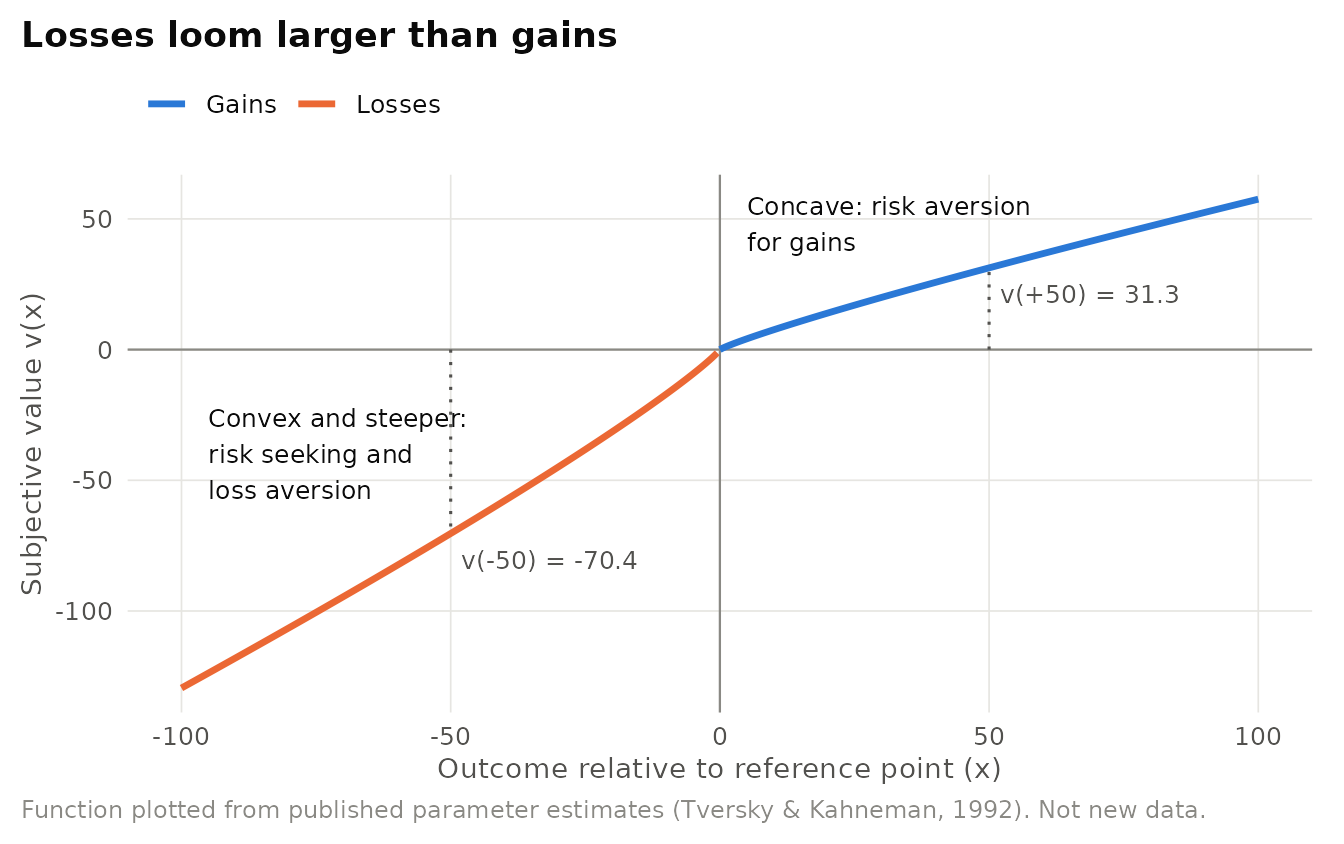
Figure 23.2: The prospect theory value function with the median parameter estimates of Tversky and Kahneman (1992): alpha = beta = 0.88 and lambda = 2.25. The function is concave for gains, convex for losses, and steeper for losses than for gains.
Prospect theory is the theoretical engine behind the two sections that follow: the endowment effect applies loss aversion to ownership, and mental accounting applies the shape of the value function to the way people group gains and losses. Because the theory is so central to the behavioural sciences, it receives a chapter of its own. Chapter 24 (Chapter 24) develops it in full: the expected utility benchmark and its paradoxes, the original and cumulative versions of the model, the debate over loss aversion, expectation-based reference points, status quo bias (Section 24.6), myopic loss aversion (Section 24.7), the disposition effect (Section 24.8), applications across business and policy, and the evidence from large-scale replications.
23.4 Endowment Effect
Core claim. People demand more to give up an object they own than they would pay to acquire the same object.
Origins. Behavioural economics, named by R. Thaler (1980), definitive experiments by Kahneman, Knetsch, and Thaler (1990), reviewed by Kahneman, Knetsch, and Thaler (1991) and Morewedge and Giblin (2015).
Level of analysis. Individual valuation, dyadic exchange (buyer-seller).
Key constructs. Willingness to accept (WTA), willingness to pay (WTP), ownership, reference price (Section 27.11), loss aversion, transaction disutility.
Boundary conditions. Weak or absent for goods held for resale or exchange (money, tokens, inventory) and among experienced traders. Sensitive to elicitation procedures (Plott and Zeiler 2005).
Related theories. Prospect theory (Chapter 24), Mental accounting, Appraisal theory (Section 25.5).
23.4.1 Core logic
In the experiments of Kahneman, Knetsch, and Thaler (1990), students in a classroom market were randomly given a coffee mug bearing the university logo. Because the mugs were assigned at random, standard theory predicts that about half of them should change hands when trading opens: the mugs should flow to the students who value them most. Instead, trading volume was far below this prediction, and the median selling price demanded by owners was roughly twice the median price buyers were willing to pay. When the same procedure was run with induced-value tokens that could be redeemed for cash, no such gap appeared, showing that the effect is not a by-product of the market institution itself.
The classic explanation is loss aversion: giving up a mug is coded as a loss, acquiring one as a gain, and losses loom larger (Kahneman, Knetsch, and Thaler 1991). Ownership shifts the reference point, so the same object is valued differently depending on which side of the transaction one is on.
23.4.2 Competing accounts
The loss-aversion explanation is not the only one. Carmon and Ariely (2000) show that buyers and sellers focus on what they would forgo: sellers attend to the object, buyers to the money. Weaver and Frederick (2012) propose a reference-price theory in which the endowment effect reflects an aversion to bad deals rather than to losing the object itself. Sellers do not want to be “suckers” who sell for less than a salient reference price, such as the market price. Buyers do not want to pay more than the object is worth to them or more than they think it usually costs. On this account the WTA-WTP gap arises from transaction disutility relative to reference prices, and it should vary with the information people have about those prices. Weaver and Frederick (2012) report evidence that the size of the gap changes with reference-price information in the ways the theory predicts, a pattern that a pure loss-aversion account does not anticipate. Figure 23.3 contrasts the two mechanisms.
Figure 23.3: Two mechanisms for the endowment effect. In the loss-aversion account, ownership shifts the reference point so that giving up the good is coded as a loss. In the reference-price account (Weaver & Frederick, 2012), owners resist transactions that would be bad deals relative to salient market prices.
Is the endowment effect an artefact? Plott and Zeiler (2005) argued that WTA-WTP gaps can be produced by subjects’ misconceptions about elicitation procedures and showed that, with extensive training, anonymity, and practice rounds, the gap for mugs could be eliminated in their experiments. Defenders reply that elaborate procedures may remove the psychological conditions (such as a sense of ownership) that produce the effect in everyday life. An integrative review by Morewedge and Giblin (2015) concludes that no single mechanism explains all findings: loss aversion, ownership-based self-association, and reference-price considerations each contribute in different settings.
23.4.3 Applications in business
The endowment effect implies that anything which creates a sense of ownership before purchase raises the customer’s valuation. Merely touching a product increases perceived ownership and valuation (Peck and Shu 2009). Free trials, test drives, configurators that let customers “build their own”, and virtual try-on tools all exploit this mechanism.
Return policies and at-home trials. Several direct-to-consumer furniture and mattress retailers popularized extended at-home trial periods with free returns. The endowment effect suggests why such policies may be less costly than they appear: once the product is in the home, the customer’s reference point shifts, and returning it is coded as giving up something owned. At the same time, the reference-price account cautions that customers who learn of a lower market price will feel they made a bad deal, which increases returns. Illustrative scenario: a retailer considering a trial extension from 30 to 100 days should test whether the gain in conversions outweighs the cost of returns, and track whether return rates vary with competitors’ price promotions, a pattern the reference-price account predicts.
Think of an item you own but rarely use. Write down the lowest price at which you would sell it today, then the highest price you would pay to buy an identical item if you did not own it. What reference prices came to mind for each answer? Which account of the endowment effect better describes your reasoning?
23.5 Mental Accounting
Core claim. People organize, label, and evaluate financial activities in separate mental accounts. Because money in different accounts is not treated as fungible, the framing and timing of gains, losses, and payments change choices.
Origins. Behavioural economics and marketing, R. Thaler (1980), R. Thaler (1985), and R. H. Thaler (1999).
Level of analysis. Individual and household, firm pricing and promotion.
Key constructs. Mental accounts and budgets, hedonic editing, acquisition vs. transaction utility, coupling of payments and consumption, choice bracketing, fungibility.
Boundary conditions. Strongest when money is labelled (gift cards, rebates, windfalls), when budgets are explicit, and when payment and consumption are separated in time.
Related theories. Prospect theory (Chapter 24), Endowment effect, Self-control (Section 20.4).
23.5.1 Core logic
R. Thaler (1985) combined prospect theory’s value function with the observation that consumers code and combine outcomes in systematic ways. Because the value function is concave for gains and convex for losses, the way outcomes are grouped affects their total subjective value. This yields four principles of hedonic editing, summarized in Table 23.4.
| Principle | Situation | Prescription | Why (value function) | Business application |
|---|---|---|---|---|
| Segregate gains | Two gains | Present them separately | Concavity: v(x) + v(y) > v(x + y) | Announce product benefits one by one, split a bonus into components |
| Integrate losses | Two losses | Combine them | Convexity: v(-x) + v(-y) < v(-(x + y)) | All-inclusive pricing, bundled fees |
| Cancel small losses | Large gain, small loss | Integrate the loss into the gain | Small loss falls on the steep part of the loss curve | Deduct fees from a refund rather than charging them separately |
| Silver lining | Large loss, small gain | Segregate the small gain | Small gain falls on the steep part of the gain curve | Cash rebates on expensive purchases |
Thaler also distinguished two kinds of utility in a purchase. Acquisition utility is the value of the good relative to its price. Transaction utility is the perceived merit of the deal itself: the difference between the price paid and a reference price. In his well-known illustration, people say they would pay more for the same beer if it were bought from a fancy resort hotel than from a run-down grocery store, because the reference price differs (R. Thaler 1985). Transaction utility links mental accounting to the reference-price account of the endowment effect (Weaver and Frederick 2012).
R. H. Thaler (1999) later organized the theory around three components: (1) how outcomes are perceived and experienced, including hedonic editing. (2) How activities are assigned to specific accounts, including budgets for categories of spending, and (3) how frequently accounts are evaluated, which relates to choice bracketing. Budgeting can lead to underconsumption when a category budget is exhausted and to overconsumption of items that are not easily categorized (Heath and Soll 1996).
23.5.2 Payment and consumption
Prelec and Loewenstein (1998) proposed that payments produce an immediate “pain of paying” and that consumers prefer to decouple payment from consumption. Prepaid vacations feel free at the time of consumption. Per-use fees spoil enjoyment. The flip side is payment depreciation: the psychological cost of a past payment fades over time. In a study of health-club members, Gourville and Soman (1998) found that attendance was highest in the months immediately following payment and declined as the payment receded, suggesting that members consumed to “use up” a salient sunk cost.
23.5.3 Applications in business
Promotions, gift cards, and labelled money. If money were fungible, a $10 coupon for a grocer would be equivalent to $10 in cash and would raise grocery spending only slightly. Using data from an online grocer, Milkman and Beshears (2009) found that coupon redemption increased grocery spending by more than fungibility would predict and shifted purchases toward items that customers did not usually buy. Gift cards, store credit, and loyalty points work similarly: they create a dedicated account whose balance feels like a windfall and is spent more freely. Thaler’s hedonic editing principles add a second lesson: rebates are an effective “silver lining” on large purchases, while fees are best integrated into a single price. Consistent with the latter point, partitioned prices (a base price plus a separate surcharge, such as shipping) can lower consumers’ recalled total cost and increase demand (Morwitz, Greenleaf, and Johnson 1998), although such practices raise transparency concerns.
Sample hypotheses.
- H1. Customers who pay for an annual membership upfront will use the service more in the first month after payment than in later months (payment depreciation).
- H2. A promotional credit labelled for a product category will increase spending in that category more than an unlabelled credit of equal value.
- H3. Consumers will prefer an all-inclusive price to a partitioned price with the same total when the surcharge is large relative to the base price.
Designs. Field experiments on promotion labels, transaction data around payment dates, scanner panels with windfalls such as rebates.
Measures. Category spending, marginal propensity to consume out of labelled vs. unlabelled funds, usage relative to payment timing.
23.6 Dual-Process Theory
Core claim. Judgment and choice reflect two qualitatively different kinds of processing: fast, autonomous Type 1 processes and slow, effortful Type 2 processes that require working memory.
Origins. Cognitive and social psychology, Stanovich and West (2000) coined the System 1 / System 2 labels, J. St. B. T. Evans and Stanovich (2013) provide the canonical defence, popularized by Kahneman (2011).
Level of analysis. Individual cognition.
Key constructs. Type 1 (intuitive) and Type 2 (reflective) processing, working memory, cognitive decoupling, default-interventionist architecture, cognitive reflection.
Boundary conditions. Type 2 intervention requires capacity, motivation, and a cue that the intuitive response may be wrong. Under time pressure, cognitive load, or low motivation, Type 1 responses dominate.
Related theories. Heuristics and biases, Elaboration likelihood model (Section 26.1), Self-control (Section 20.4).
23.6.1 Core logic
Dual-process theories hold that people have two ways of arriving at a judgment. J. St. B. T. Evans and Stanovich (2013) argue that the defining feature of Type 2 processing is its reliance on working memory, which enables cognitive decoupling: the ability to hold a representation of the world apart from reality in order to simulate hypothetical alternatives. Type 1 processes, by contrast, are autonomous: they run whenever their triggering conditions are present. Speed, consciousness, and accuracy are typical correlates rather than defining features. Table 23.5 summarizes the distinction.
| Feature | Type 1 (intuitive) | Type 2 (reflective) |
|---|---|---|
| Defining feature | Does not require working memory, autonomous | Requires working memory, cognitive decoupling and mental simulation |
| Typical correlates | Fast, high capacity, parallel, often nonconscious | Slow, capacity-limited, serial, conscious |
| Basis | Associations, experience, emotion | Rules, abstraction, hypothetical thinking |
| Relation to ability | Largely independent of cognitive ability | Correlated with cognitive ability and thinking dispositions |
| Typical output | Default response, often heuristic | Intervention that may override the default |
| Popular label | System 1 | System 2 |
The most widely used architecture is default-interventionist: Type 1 processes generate a rapid default response, which Type 2 processes may endorse, adjust, or override when there is sufficient capacity and a reason to doubt the default (Figure 23.4). A well-known individual difference measure is the Cognitive Reflection Test (Frederick 2005). Its best-known item asks: if a bat and a ball cost $1.10 in total and the bat costs $1.00 more than the ball, how much does the ball cost? The intuitive answer (10 cents) comes quickly to mind and is wrong. Reaching the correct answer (5 cents) requires noticing the error and checking.
Figure 23.4: A default-interventionist model of dual processing. Type 1 processes produce a default response. Type 2 processes intervene only when capacity, motivation, and a conflict signal are present.
23.6.2 Evidence and extensions
Experimental evidence for the role of capacity comes from cognitive load manipulations. In a classic consumer study, participants who had to memorize a seven-digit number were more likely to choose chocolate cake over fruit salad than participants memorizing a two-digit number, consistent with affective (Type 1) reactions dominating when deliberative resources are occupied (Shiv and Fedorikhin 1999). Performance on reasoning tasks also correlates with cognitive ability and thinking dispositions, a pattern Stanovich and West (2000) used to argue that normative and intuitive responses are generated by different processes.
One system, two systems, or a continuum? Critics argue that the features attributed to the two systems do not reliably co-occur and that the theory is hard to falsify (Keren and Schul 2009). Kruglanski and Gigerenzer (2011) propose that intuitive and deliberate judgments are based on common rule-following principles and differ mainly in the difficulty of applying those rules. J. St. B. T. Evans and Stanovich (2013) accept some of these criticisms (the long lists of correlated features were misleading) but maintain that a qualitative distinction defined by working memory is supported by experimental, individual-difference, and neuroscientific evidence. For applied researchers, the safest course is to avoid treating “System 1” as an explanation in itself and instead to specify and measure the process (e.g., load, time pressure, conflict detection) that is assumed to operate.
Designing for both systems. Checkout pages, investment platforms, and insurance enrolment forms are often completed quickly and under distraction. Dual-process theory suggests two design levers. When the intuitive response is usually right (e.g., reordering a familiar product), reduce friction so that Type 1 processing can operate smoothly. When the intuitive response is likely to be wrong (e.g., choosing an insurance plan on the basis of the premium alone), insert a reflection cue: a summary of expected annual costs, a comparison table, or a brief “cooling-off” confirmation step.
23.7 Feelings-as-Information Theory
Core claim. People use their momentary feelings (moods, emotions, and metacognitive experiences) as information when making judgments, asking implicitly “How do I feel about it?” The impact of a feeling depends on its perceived informational value.
Origins. Social psychology, Schwarz and Clore (1983), reviewed in Schwarz (2012), consumer applications in Pham (1998) and Pham (2004) (“the logic of feeling”). Also known as the affect-as-information hypothesis.
Level of analysis. Individual judgment.
Key constructs. Mood, integral vs. incidental affect, misattribution, discounting, perceived relevance (representativeness) of feelings, processing style.
Boundary conditions. Feelings influence judgment when they are perceived as relevant to the target. Their influence is reduced or eliminated when people attribute them to an irrelevant source.
Related theories. Processing fluency, Discrepancy-attribution hypothesis, Appraisal theory (Section 25.5), Warm glow heuristic (Section 29.2).
23.7.1 Origins and core logic
Schwarz and Clore (1983) interviewed people by telephone about their life satisfaction on sunny or rainy spring days. Respondents reported higher satisfaction with their lives as a whole on sunny days. The decisive manipulation came next: when the interviewer casually asked about the local weather before the well-being questions, the effect of the weather disappeared. Drawing attention to an irrelevant cause of one’s mood led people to discount the mood as information about their lives. The finding established a central principle: feelings are used as information unless their informational value is called into question.
Schwarz (2012) summarizes the theory in a set of postulates:
- P1. People attend to their feelings as a source of information, and different feelings convey different information (e.g., a positive mood signals a benign situation. Fear signals threat).
- P2. The impact of a feeling depends on its perceived informational value. When a feeling is attributed to a source unrelated to the target, its influence is attenuated or eliminated (misattribution and discounting).
- P3. Feelings are experienced as reactions to whatever is in the focus of attention, which is why incidental feelings are easily misread as reactions to the target.
- P4. Feelings inform processing style. Negative affect signals a problematic situation and fosters detail-oriented, systematic processing. Positive affect signals a benign situation and fosters reliance on heuristics and existing knowledge.
- P5. Feelings are more likely to be used when they seem representative of and relevant to the target (Pham 1998) and when other information is scarce or the judgment is made quickly (Greifeneder, Bless, and Pham 2011) (Figure 23.5).
Figure 23.5: The feelings-as-information mechanism. Incidental or integral feelings are consulted as information about the target. The effect disappears when the feeling is attributed to an irrelevant source.
23.7.2 Evidence and extensions
Feelings-as-information has been extended in three important directions.
- Metacognitive experiences. Not only moods but also feelings of ease or difficulty serve as information. In a classic study, participants who recalled six examples of their own assertive behaviour rated themselves as less assertive than those who recalled twelve, because recalling twelve examples felt difficult and the difficulty was taken as evidence (Schwarz et al. 1991). This ease-of-retrieval effect refines the availability heuristic.
- Risk and affect. The “risk-as-feelings” hypothesis holds that emotional reactions to risky situations often diverge from cognitive assessments and drive behaviour (Loewenstein et al. 2001). The related affect heuristic proposes that people consult an affective “pool” of positive and negative tags when judging risks and benefits (Slovic et al. 2007).
- Consumer judgment. Pham (1998) showed that consumers rely on their feelings more when their motives are experiential (consummatory) than when they are instrumental, and Pham (2004) argued that reliance on feelings follows a coherent “logic”: feelings are a fast, often valid summary of one’s preferences.
Sunshine, sports, and stock prices. If moods are misread as information, mood-altering events that are irrelevant to fundamentals should leave a trace in market prices. Across 26 stock exchanges, morning sunshine in the city of a country’s leading exchange was positively associated with daily market returns (Hirshleifer and Shumway 2003). Similarly, national stock markets have been shown to decline after the country’s team loses an important international soccer match (Edmans, García, and Norli 2007). For managers, the lesson is not to trade on the weather but to recognize that customers, investors, and employees bring incidental feelings to every judgment. Retail atmospherics, music, and service interactions affect evaluations of the product itself, partly through misattributed mood.
Confusing mood congruence with information use. Many studies show that people in good moods make more positive judgments, but this alone does not distinguish feelings-as-information from memory-based accounts in which mood primes congruent material. The diagnostic test is misattribution: if the mood effect disappears when people are led to attribute their feelings to an irrelevant source, the feeling was being used as information (Schwarz and Clore 1983, Schwarz 2012).
23.8 Processing Fluency
Core claim. The subjective ease with which information is processed is itself a cue for judgment. Fluent processing is experienced as positive and increases judgments of liking, truth, familiarity, and confidence.
Origins. Cognitive and social psychology, L. L. Jacoby et al. (1989) on fluency misattribution, Reber, Schwarz, and Winkielman (2004) on aesthetic pleasure, reviewed by Alter and Oppenheimer (2009).
Level of analysis. Individual judgment.
Key constructs. Perceptual fluency, conceptual fluency, linguistic fluency, retrieval fluency, hedonic marking of fluency, prototypicality.
Boundary conditions. Fluency effects depend on how the experience is interpreted. They are reduced when people attribute fluency to an irrelevant source and can reverse when people hold a lay theory linking difficulty to value.
Related theories. Feelings-as-information, Warm glow heuristic (Section 29.2), Mere exposure effect (Section 29.1), Beauty in averageness (Section 29.10).
23.8.1 Core logic
Reber, Schwarz, and Winkielman (2004) proposed that beauty is, in part, “in the perceiver’s processing experience.” Their account rests on four assumptions: objects differ in how fluently they can be processed. Fluency is hedonically marked, so high fluency feels good. This positive feeling is used as information when people judge their liking for the object, and the impact of fluency depends on expectations and attributions. Features that make stimuli easier to process (symmetry, figure-ground contrast, clarity, repetition, and prototypicality) should therefore increase aesthetic appreciation.
Prototypicality offers a clean test. Winkielman et al. (2006) showed that prototypical patterns are both processed more fluently and liked more, and that the fluency of processing accounts for part of the preference. Reber (2011) extends this reasoning to culturally shared taste, arguing that fluency explains why aesthetic preferences converge within groups that share perceptual experience. The same logic underlies the classic finding that averaged faces are attractive (see Beauty in averageness (Section 29.10)).
Fluency is not one thing. Alter and Oppenheimer (2009) catalogue a family of fluency experiences, summarized in Table 23.6, and argue that they have similar downstream effects regardless of source.
| Type of fluency | Source of ease | Illustrative effect |
|---|---|---|
| Perceptual | Font legibility, contrast, presentation duration | Hard-to-read instructions make a task seem more effortful (Song & Schwarz, 2008) |
| Linguistic | Pronounceability of names and words | Firms with easy-to-pronounce ticker names performed better shortly after listing (Alter & Oppenheimer, 2006) |
| Conceptual | Semantic priming, predictive contexts | Brands encountered in congruent contexts are evaluated more favourably |
| Retrieval | Ease of generating examples or arguments | Generating few reasons to choose a brand can improve evaluations more than generating many (Wanke et al., 1997) |
| Decision (preference) | Ease of forming a preference | Harder-to-read option descriptions increase choice deferral (Novemsky et al., 2007) |
| Memory (familiarity) | Prior exposure, repetition | Repeated names come to seem famous (Jacoby et al., 1989) |
23.8.2 Fluency, liking, and familiarity: the warm glow
The link between fluency and affect runs in both directions. Fluency produces positive affect, but positive affect can also be mistaken for fluency and hence for familiarity. Monin (2003) called this the warm glow heuristic: attractive faces and positive words are more likely to be judged as previously seen, because the positive feeling they evoke is taken as a sign of familiarity. The phenomenon is treated in detail in Warm glow heuristic (Section 29.2). Together, fluency and warm-glow effects explain why familiarity, liking, and perceived truth tend to travel together, and why marketers’ efforts to make brands familiar can also make them liked.
23.8.3 Applications in business
Names, fonts, and arguments. Fluency research offers several well-documented design principles. First, names matter: shares of companies with easier-to-pronounce names and ticker symbols outperformed those with harder names in the days after listing, an effect that faded over time (Alter and Oppenheimer 2006). Second, legibility matters in both directions: instructions in a hard-to-read font make an exercise routine seem harder and reduce willingness to do it (Song and Schwarz 2008), and harder-to-process product descriptions increase choice deferral (Novemsky et al. 2007). Third, asking for too much elaboration can backfire: an advertisement that asked readers to generate many reasons to choose a BMW produced less favourable evaluations than one asking for a single reason, because generating many reasons felt difficult (Wänke, Bohner, and Jurkowitsch 1997). The common thread is that customers read their processing experience as information about the product.
Find two product pages for competing products in the same category. Rate each on perceptual fluency (layout, font, contrast) and linguistic fluency (product names, jargon). Predict which page produces higher perceived quality, and identify one change that would increase fluency without removing information.
23.9 Discrepancy-Attribution Hypothesis
Core claim. A feeling of familiarity arises not from fluent processing as such, but from processing that is surprisingly fluent relative to expectations. People attribute the unexpected fluency to prior experience.
Origins. Cognitive psychology of memory, Whittlesea (1993), Whittlesea and Williams (1998), elaborated in Whittlesea and Williams (2001a) and Whittlesea and Williams (2001b).
Level of analysis. Individual memory and judgment.
Key constructs. Processing fluency, expectation, discrepancy (surprise), attribution to the past, feeling of familiarity.
Boundary conditions. The discrepancy must be attributed to the past rather than to an obvious current cause. When fluency is expected (as with a close friend), it does not produce a feeling of familiarity.
Related theories. Processing fluency, Feelings-as-information, Warm glow heuristic (Section 29.2).
23.9.1 Core logic
Why do strangers sometimes feel familiar, while close friends do not produce a “feeling of familiarity” at all? Whittlesea and Williams (1998) argued that familiarity is an inference. People continuously and implicitly evaluate the quality of their own processing against expectations generated by the context. When processing is more fluent than expected, the discrepancy calls for an explanation, and one readily available explanation is that the stimulus has been encountered before. When processing is fluent but fluency is expected, as with a friend seen in a familiar place, no discrepancy arises and no special feeling of familiarity is experienced. The classic everyday example is meeting one’s butcher on a bus: the face is processed more fluently than a stranger’s face should be, but the unusual context prevents identification, leaving a nagging feeling of familiarity.
In laboratory tests, Whittlesea and Williams (1998) found that pronounceable, word-like nonwords were especially prone to false recognition, more so than real words, because they were processed more fluently than nonwords are expected to be. Whittlesea and Williams (2001a) established that the feeling of familiarity depends on this heuristic evaluation of processing, and Whittlesea and Williams (2001b) showed that expectation and surprise play a causal role: fluent resolution of an uncertain context increases feelings of familiarity. Figure 23.6 summarizes the mechanism.
Figure 23.6: The discrepancy-attribution mechanism. Processing is continuously compared with context-based expectations. Surprisingly fluent processing is attributed to prior experience and felt as familiarity.
23.9.2 Implications
The discrepancy-attribution hypothesis sharpens the fluency account in a way that matters for practice. Fluency alone is not enough. What produces familiarity, and the warm feelings that tend to accompany it, is fluency that exceeds expectations. Three implications follow for marketing and communication:
- Context matters. A brand logo encountered in an unexpected context may feel more familiar (and be misremembered as previously seen) than the same logo in an expected context.
- Lookalikes exploit discrepancy. Copycat packaging that resembles a leading brand is processed more fluently than an unfamiliar brand should be, creating a sense of familiarity that consumers may misattribute to prior experience with the copycat itself.
- Measurement artefacts. Recognition-based advertising metrics (e.g., “Have you seen this ad?”) are vulnerable to false familiarity for ads that are simply easy to process, so recognition scores should be benchmarked against foils of equal fluency.
Sample hypotheses. H1. False recognition of a new brand name will be higher when the name follows the phonological patterns of the category than when it does not. H2. The familiarity advantage of a copycat package will be reduced when consumers are given an explicit reason for its ease of processing (e.g., told that it resembles a known brand).
Designs. Recognition memory paradigms with lures that vary in fluency. Manipulations of contextual expectation (predictive vs. non-predictive contexts). Attribution manipulations.
Measures. Hit and false-alarm rates, signal-detection parameters, subjective familiarity ratings, response times as a fluency index.
23.10 Choice Architecture and Defaults
Core claim. Because decision makers are boundedly rational, loss averse, and influenced by how options are presented, the design of the choice environment (defaults, ordering, framing, number of options, feedback) systematically shapes choices without restricting options or changing economic incentives.
Origins. Behavioural economics and decision science, R. H. Thaler and Sunstein (2008), defaults in Madrian and Shea (2001) and E. J. Johnson and Goldstein (2003), tools in E. J. Johnson et al. (2012).
Level of analysis. Individual choice, organizational and public policy design.
Key constructs. Choice architect, nudge, default, active choice, choice overload, decision aids, libertarian paternalism.
Boundary conditions. Defaults have less effect when preferences are strong and well-formed, when stakes are salient, and when the default is perceived as a manipulative or self-serving recommendation.
Related theories. Bounded rationality, Prospect theory (Chapter 24), Dual-process theory, Social norms (Section 22.5).
23.10.1 Defaults
The most powerful tool of choice architecture is the default: the option that takes effect if the decision maker does nothing. E. J. Johnson and Goldstein (2003) compared organ-donor consent across European countries and found that effective consent rates were dramatically higher in countries with an opt-out (“presumed consent”) default than in countries with an opt-in default. In an online experiment, the share of participants agreeing to be donors was roughly twice as high under an opt-out default as under an opt-in default, with a forced-choice condition producing rates close to the opt-out condition.
Three mechanisms explain default effects (Dinner et al. 2011, Jachimowicz et al. 2019):
- Effort (ease). Accepting the default requires no action. Changing it requires time and attention.
- Endorsement. Decision makers infer that the default reflects the recommendation of the choice architect.
- Endowment (reference dependence). The default becomes the reference point, so switching away from it is coded as giving something up.
A meta-analysis of default studies found that defaults have a substantial average effect on choices, with considerable variation across domains, and that effects tend to be larger in consumer domains and when defaults are perceived as endorsements (Jachimowicz et al. 2019).
Automatic enrollment in retirement plans. Madrian and Shea (2001) studied a large US firm that changed its 401(k) plan so that new employees were enrolled automatically unless they opted out. Participation among new hires rose sharply, but many automatically enrolled employees also stayed at the default contribution rate and in the default investment fund (a conservative money market fund), choices that few employees had made under the old opt-in regime. The study revealed both the power of defaults and their double edge: a default chosen for administrative convenience can lock employees into undersaving. The Save More Tomorrow programme (R. H. Thaler and Benartzi 2004) addressed this by asking employees to precommit to allocating a portion of future salary increases to savings. Because contributions rose only when pay rose, take-home pay never fell, sidestepping loss aversion. Participants’ saving rates rose several-fold over the following years. Automatic enrollment and automatic escalation have since become widespread in employer-sponsored retirement plans.
23.10.2 The toolkit of the choice architect
R. H. Thaler and Sunstein (2008) organize choice architecture around six principles, summarized in Table 23.7 together with examples from business. E. J. Johnson et al. (2012) extend the list with tools for structuring choice sets (e.g., the number of alternatives, the use of decision aids) and for describing options (e.g., translating attributes into more meaningful units).
| Principle | What it means | Underlying theory | Business example |
|---|---|---|---|
| Defaults | Pre-select the option that is best for most people | Status quo bias, endowment, endorsement | Auto-enrollment in savings plans, green-energy tariffs as default |
| Expect error | Design systems that anticipate and forgive mistakes | Bounded rationality | Undo buttons, reminders before a free trial converts |
| Give feedback | Tell people how they are doing | Learning under bounded rationality | Real-time energy or spending dashboards |
| Understand mappings | Help people translate choices into outcomes | Evaluability, attribute substitution | Total annual cost of ownership shown next to price |
| Structure complex choices | Simplify and organize large choice sets | Choice overload, satisficing | Filters, curated bundles, recommended plans |
| Incentives | Make costs and benefits salient | Prospect theory, mental accounting | Showing savings per month rather than per year |
23.10.3 Choice overload
A widely cited experiment by S. S. Iyengar and Lepper (2000) set up a tasting booth for specialty jams in an upscale grocery store, displaying either 24 or 6 jams. The extensive display attracted more passers-by, but a far smaller share of those who stopped went on to buy (roughly 3 percent versus 30 percent). Parallel laboratory studies with chocolates and essay topics found that people offered fewer options were more satisfied and more motivated. The finding gave rise to the idea of choice overload: beyond some point, additional options can reduce the likelihood of choosing and satisfaction with the choice.
Is choice overload real? A meta-analysis of 50 experiments by Scheibehenne, Greifeneder, and Todd (2010) found a mean effect of choice-set size on choice outcomes that was close to zero, with large heterogeneity across studies: some found overload, others found that more choice helped. The authors concluded that choice overload, if it exists, depends on conditions that had not been well specified. A subsequent meta-analysis by Chernev, Böckenholt, and Goodman (2015) identified such conditions, finding that larger assortments are more likely to produce overload when the choice set is complex, the decision task is difficult, consumers are uncertain about their preferences, and they aim to minimize effort. The lesson for managers is not “offer fewer options” but “make large assortments easy to navigate”, for example through categorization, recommendations, and good defaults.
How large are nudge effects? A meta-analysis of more than 200 studies reported that choice architecture interventions have a small-to-medium average effect on behaviour, with interventions that change the decision structure (such as defaults) more effective than those that only change how information is described (Mertens et al. 2022). Re-analysing the same data with corrections for publication bias, Maier et al. (2022) found no evidence for an overall nudge effect, although they did not rule out effects in particular domains or for particular types of nudge. The exchange illustrates a general lesson: effects observed in published studies, especially small ones with flexible outcome measures, overstate what organizations should expect when they scale an intervention.
Nudging for the architect rather than the chooser. The ethical justification of choice architecture, “libertarian paternalism”, requires that defaults and frames be designed to help people achieve their own goals while preserving freedom of choice (R. H. Thaler and Sunstein 2008). Using the same tools to make cancellation difficult, to enrol customers in add-ons they would not choose, or to obscure total prices exploits bounded rationality for the firm’s benefit. Such practices invite regulatory scrutiny and erode trust. They also violate the reference-based fairness norms customers apply to firms (Kahneman, Knetsch, and Thaler 1986).
23.10.4 Using the theory in research
Sample hypotheses.
- H1. Pre-selecting a premium service tier as the default will increase its uptake, and the effect will be larger among new customers than among experienced customers (preference strength as moderator).
- H2. Disclosing that a default was chosen because it is the most popular option will increase its uptake relative to an undisclosed default (endorsement mechanism).
- H3. Large assortments will reduce purchase likelihood only when products are difficult to compare on a common attribute.
Designs. Randomized field experiments that vary defaults or the number of options. Natural experiments from policy changes (e.g., auto-enrollment). Regression discontinuity around eligibility dates.
Measures. Opt-out rates, time spent on the choice, downstream outcomes (savings balances, retention, satisfaction), heterogeneity by preference strength.
23.11 Chapter Summary
- Bounded rationality replaces optimization with satisficing: decision makers search until an option meets an aspiration level, which can be adaptive when search is costly (Simon 1955).
- Heuristics substitute easy questions for hard ones. They produce systematic biases (Tversky and Kahneman 1974) but can also be ecologically rational (Gigerenzer and Goldstein 1996). The two views differ mainly in their normative benchmark.
- Prospect theory explains choices through reference dependence, loss aversion, diminishing sensitivity, and probability weighting (Kahneman and Tversky 1979, Tversky and Kahneman 1992). Framing changes choices by moving the reference point.
- The endowment effect reflects both loss aversion and an aversion to bad deals relative to reference prices (Kahneman, Knetsch, and Thaler 1990, Weaver and Frederick 2012).
- Mental accounting shows that money is not fungible: labels, budgets, and the timing of payments shape spending (R. Thaler 1985, R. H. Thaler 1999).
- Dual-process theory distinguishes autonomous Type 1 processing from working-memory-dependent Type 2 processing (J. St. B. T. Evans and Stanovich 2013).
- Feelings-as-information, processing fluency, and discrepancy-attribution explain how moods and the ease of processing are read as evidence about the world (Schwarz and Clore 1983, Reber, Schwarz, and Winkielman 2004, Whittlesea and Williams 1998).
- Choice architecture applies these insights. Defaults are its most powerful tool, but published effects of nudges and choice overload are more heterogeneous and smaller than early studies suggested (E. J. Johnson and Goldstein 2003, Scheibehenne, Greifeneder, and Todd 2010, Maier et al. 2022).
Table 23.8 presents the comparison of the chapter’s theories.
| Theory | Key mechanism | Signature prediction | Typical business use |
|---|---|---|---|
| Bounded rationality | Satisficing against aspiration levels | Search stops at the first acceptable option | Search budgets, qualification thresholds |
| Heuristics and biases | Attribute substitution | Systematic deviations from probability norms | De-biasing forecasts and evaluations |
| Fast-and-frugal heuristics | Ecological fit of simple rules | Less-is-more effects | Simple decision rules in stable environments |
| Prospect theory | Reference dependence, loss aversion, probability weighting | Risk aversion for gains, risk seeking for losses | Pricing frames, loss-framed messaging, insurance |
| Endowment effect | Ownership shifts reference point, aversion to bad deals | WTA exceeds WTP | Free trials, touch and try-on, return policies |
| Mental accounting | Non-fungible accounts, hedonic editing | Labelled money is spent differently | Gift cards, rebates, bundled pricing |
| Dual-process theory | Type 1 defaults, Type 2 intervention | Load and time pressure increase intuitive responses | Friction and reflection cues in interfaces |
| Feelings-as-information | Feelings used as evidence unless discounted | Mood effects vanish under misattribution | Atmospherics, timing of evaluations |
| Processing fluency | Ease of processing is hedonically marked | Fluent stimuli are liked and believed | Naming, design, readability |
| Discrepancy-attribution | Surprising fluency attributed to the past | False familiarity for unexpectedly fluent stimuli | Brand recognition metrics, lookalike packaging |
| Choice architecture | Defaults, structure, framing | Default options are disproportionately chosen | Enrollment, subscriptions, product configuration |
23.12 Discussion Questions
- Simon argued that rationality should be judged relative to the structure of the environment. Choose a managerial decision (e.g., hiring, supplier selection) and describe an environment in which a simple satisficing rule would outperform an elaborate scoring model, and one in which it would not.
- Gigerenzer and Kahneman disagree about whether heuristics are “biased”. What evidence would you need to decide which perspective better describes how loan officers evaluate small-business applications?
- Prospect theory requires a reference point. For a subscription business that is raising prices, list three plausible reference points customers might use and design an experiment to identify which one drives churn.
- Compare the loss-aversion and reference-price accounts of the endowment effect. What field data from a resale platform could distinguish them?
- A retailer wants to increase spending by issuing store credit instead of cash refunds. Using mental accounting, predict the effect on spending and identify the ethical issues the retailer should consider.
- Nudge meta-analyses disagree about average effects once publication bias is considered. How should an organization decide whether to scale a default change that worked in a pilot?
23.13 Further Reading
- Simon (1955): the founding statement of bounded rationality, still remarkably current in its critique of global rationality.
- Tversky and Kahneman (1974): the short Science article that launched the heuristics-and-biases programme.
- Gigerenzer and Gaissmaier (2011): a thorough review of the fast-and-frugal alternative and the concept of ecological rationality.
- Kahneman and Tversky (1979) and Tversky and Kahneman (1992): the original and cumulative versions of prospect theory. Read together to see how the theory was formalized.
- R. H. Thaler (1999): a lucid synthesis of mental accounting by its originator.
- J. St. B. T. Evans and Stanovich (2013): the most careful defence of dual-process theory, with replies to the main criticisms.
- Schwarz (2012): an authoritative overview of feelings-as-information theory by its co-founder.
- R. H. Thaler and Sunstein (2008): the book that turned choice architecture into a policy movement. Pair it with Maier et al. (2022) for a sober assessment of effect sizes.