20 Self-Regulation and Construal
Two advertisements for the same insurer run side by side. One promises that a policy will “keep everything you have worked for safe”. The other invites customers to “get more out of every journey”. The first wins easily among homeowners comparing household cover. The second performs better among people booking an overseas holiday. A retirement plan that asks employees to raise their contribution rate today attracts few takers, yet the same plan, offered as a commitment to save more after the next pay rise, is embraced. A product team that cheerfully commits to an ambitious launch twelve months away finds, as the date approaches, that every conversation is about logistics, budgets, and what can realistically be cut.
None of these puzzles is about what people want. They are about how people pursue what they want: the strategies they use, the level of abstraction at which they represent goals, and their struggles to act on long-term intentions when short-term temptations are close at hand. This chapter introduces four closely related theories of self-regulation, the processes by which people guide their thoughts, feelings, and behaviour toward desired end-states. Regulatory focus theory distinguishes two motivational systems: one oriented to advancement, one to security. Regulatory fit explains why the manner of goal pursuit can add value of its own. Construal level theory links psychological distance to abstract or concrete thinking. And theories of self-control and intertemporal choice explain why preferences reverse as rewards draw near, and what individuals and organizations can do about it. Together they form one of the most practically useful toolkits in consumer behaviour, organizational behaviour, behavioural economics, and public policy (Table 20.1).
| Theory | Core question | Level of analysis | Key source |
|---|---|---|---|
| Regulatory focus theory | Do people pursue goals by seeking gains or by guarding against losses? | Individual (chronic or situational) | Higgins (1997, 1998) |
| Regulatory fit | Why does the manner of goal pursuit change the value of what is chosen? | Individual x situation | Higgins (2000), Cesario et al. (2004) |
| Construal level theory | How does psychological distance shape mental representation and choice? | Individual | Liberman & Trope (1998), Trope & Liberman (2010) |
| Self-control and intertemporal choice | Why do people act against their own long-run interests, and how can they bind themselves? | Individual / household / organization | Thaler & Shefrin (1981), Laibson (1997) |
20.1 Regulatory Focus Theory
Core claim. People regulate behaviour through two distinct motivational systems. A promotion focus is concerned with advancement, accomplishment, and aspirations and is sensitive to the presence or absence of gains. A prevention focus is concerned with safety, duties, and responsibilities and is sensitive to the absence or presence of losses.
Origins. Social psychology. Higgins (1997) and Higgins (1998), growing out of self-discrepancy theory (Higgins 1987).
Level of analysis. Individual. Focus can be a chronic disposition or a state induced by the situation (task instructions, message framing, cultural context).
Key constructs. Promotion and prevention focus, ideals versus oughts, gains and non-gains versus non-losses and losses, eager versus vigilant strategic means, risky versus conservative response bias.
Boundary conditions. Predictions require that the outcome can be framed as an opportunity or a threat, and that people have latitude in how they pursue it. Focus effects are weaker when choices are highly constrained or when people are indifferent to the outcome.
Related theories. Regulatory fit, Prospect theory (Chapter 24), Self-determination theory (Section 19.6), Hofstede’s cultural dimensions (Section 18.2), Goal-setting theory (Section 19.4).
20.1.1 Origins and intellectual history
For most of the twentieth century, psychology explained motivation with the hedonic principle: people approach pleasure and avoid pain. Higgins (1997) argued that this principle, though true, is incomplete because it says nothing about how people approach pleasure and avoid pain. Two people may both want a promotion at work, yet one experiences the goal as a hope to be realised and the other as an obligation to be met. The first will feel cheerful on success and dejected on failure. The second will feel relieved and calm on success and anxious on failure.
The theory grew out of Higgins’s earlier self-discrepancy theory, which distinguished between the ideal self (the person one hopes to be) and the ought self (the person one believes one should be) and showed that discrepancies from each produce different emotions: dejection-related emotions for ideal discrepancies and agitation-related emotions for ought discrepancies (Higgins 1987). Regulatory focus theory generalised this insight into two self-regulatory systems that serve different survival needs: nurturance (growth, the presence of positive outcomes) and security (protection, the absence of negative outcomes) (Higgins 1997, 1998).
20.1.2 Core logic and propositions
Definition 20.1 Promotion focus. A self-regulatory state in which goals are represented as ideals, hopes, wishes, and aspirations, and outcomes are coded as gains versus non-gains.
Prevention focus. A self-regulatory state in which goals are represented as oughts, duties, obligations, and responsibilities, and outcomes are coded as non-losses versus losses.
A crucial feature of the theory is that both systems are forms of approaching a desired end-state. Prevention is not the same as avoidance: a prevention-focused employee approaches a desired state (a project delivered without errors) by guarding against mistakes. What differs is the strategic means used. Table 20.2 summarises the two systems.
| Dimension | Promotion focus | Prevention focus |
|---|---|---|
| Underlying need | Nurturance, growth, advancement | Security, safety, protection |
| Goal representation | Ideals: hopes and aspirations | Oughts: duties and obligations |
| Outcomes that matter | Gains vs. non-gains | Non-losses vs. losses |
| Preferred strategic means | Eagerness: ensure hits, avoid errors of omission | Vigilance: ensure correct rejections, avoid errors of commission |
| Response bias under uncertainty | Risky (‘yes’ bias) | Conservative (‘no’ bias) |
| Emotion after success | Cheerfulness, elation | Quiescence, relief, calm |
| Emotion after failure | Dejection, disappointment | Agitation, anxiety |
| Typical message that resonates | ‘Get energized’, ‘gain an edge’ | ‘Stay protected’, ‘avoid costly mistakes’ |
| Example product categories | Travel, education, entertainment, investment growth | Insurance, security, health screening, compliance |
The theory’s central propositions can be stated as follows:
- P1 (Two systems). Promotion and prevention are distinct self-regulatory systems that can be activated chronically or situationally. They are not the two ends of a single continuum, and an individual can be high or low on each.
- P2 (Outcome sensitivity). Promotion-focused people are more sensitive to the presence and absence of positive outcomes. Prevention-focused people are more sensitive to the absence and presence of negative outcomes (Higgins 1997).
- P3 (Strategic inclination). Promotion focus induces eager strategies, seizing opportunities, generating alternatives, and accepting the risk of false alarms. Prevention focus induces vigilant strategies, avoiding mistakes and accepting the risk of missed opportunities (Crowe and Higgins 1997).
- P4 (Emotional signature). Success and failure produce cheerfulness and dejection under promotion, and quiescence and agitation under prevention (Higgins 1997, Brockner and Higgins 2001).
- P5 (Antecedents). Chronic focus develops from socialization histories (for example, being rewarded for accomplishments versus being protected from danger) and from self-construal (Section @ref(self-construal (Section 18.4))), with independent self-views tilting toward promotion and interdependent self-views toward prevention (Higgins et al. 2001, A. Y. Lee, Aaker, and Gardner 2000).
20.1.3 Mechanism
Figure 20.1 traces the causal chain. Chronic and situational sources set the regulatory focus. Focus determines the strategic means a person prefers, and those means shape decisions and emotions.
Figure 20.1: Mechanism of regulatory focus: chronic and situational sources activate a promotion or prevention focus, which shapes the preferred strategic means (eager versus vigilant) and, through them, decisions and emotional responses.
The clearest early test of the strategic-means link comes from Crowe and Higgins (1997). They induced promotion or prevention focus by framing the same task in terms of accomplishment or of safety, and then asked participants to make recognition judgements under uncertainty. In signal-detection terms, promotion-focused participants showed a risky bias, they were more willing to say “yes, I saw it”, accepting more false alarms in order to secure hits, whereas prevention-focused participants showed a conservative bias, accepting more misses in order to avoid false alarms. The same objective task was approached with different strategies depending on how the goal was represented.
20.1.4 Evidence and extensions
The theory has been extended in several directions that matter for business research.
- Culture and self-construal. A. Y. Lee, Aaker, and Gardner (2000) found that people with a more independent self-construal regarded promotion-framed information as more important, whereas those with a more interdependent self-construal regarded prevention-framed information as more important, a pattern that also appeared in comparisons of participants from North American and East Asian cultural backgrounds. The link connects regulatory focus with the cultural dimensions discussed under Hofstede (Section 18.2).
- Persuasion. J. L. Aaker and Lee (2001) showed that appeals consistent with the reader’s self-view were better remembered and more persuasive: promotion-framed appeals (for example, emphasising energy and enjoyment) for those with an independent self-view, and prevention-framed appeals (emphasising protection against disease) for those with an interdependent self-view. The title of their article , “I” seek pleasures and “we” avoid pains, captures the result.
- Role models. Promotion-focused people are inspired by positive role models who show what success looks like, whereas prevention-focused people are more motivated by negative role models who illustrate failures to be avoided (Lockwood, Jordan, and Kunda 2002).
- Work and organizations. Brockner and Higgins (2001) brought the theory into organizational behaviour, arguing that leaders, job design, and feedback practices induce promotion or prevention states with predictable emotional consequences. A meta-analysis by Lanaj, Chang, and Johnson (2012) found that the two foci relate to different sets of work outcomes, with promotion focus more closely linked to outcomes involving initiative and innovation and prevention focus more closely linked to safety-related performance.
- Measurement. The Regulatory Focus Questionnaire (RFQ) asks people about their history of promotion and prevention success (Higgins et al. 2001). Experiments more often induce focus by asking participants to write about hopes and aspirations versus duties and obligations, or by framing task incentives as gains or losses.
Is regulatory focus distinct from neighbouring constructs? Critics have asked whether promotion and prevention are simply relabelled versions of approach and avoidance motivation, of positive and negative affectivity, or of gain and loss framing in prospect theory (Chapter 24). Defenders answer that the theory makes predictions those frameworks do not: prevention is an approach toward safety rather than avoidance. The two systems are characterised by distinct strategies (eager versus vigilant) rather than by valence alone, and the emotional signatures differ in kind, not only in sign (Higgins 1997, 1998). A second debate concerns measurement. Chronic measures and situational inductions do not always produce the same pattern, and different questionnaires capture somewhat different facets of the constructs. Researchers should state whether they theorise about chronic dispositions, momentary states, or both, and choose operationalizations accordingly.
20.1.5 Applications in business
Regulatory focus offers a practical vocabulary for segmenting customers, designing products, and writing messages. Some product categories are inherently coded as prevention goods (insurance, home security systems, antivirus software, retirement annuities), others as promotion goods (travel, education, fitness equipment marketed for performance, growth funds), and many can be positioned either way. A massage chair can be sold as a reward and a pleasure (promotion) or as protection against back injury (prevention).
Illustrative scenario: one insurer, two journeys. A mid-sized insurer sells both household cover and travel insurance through the same website. For household cover, the buyer is typically thinking about what could be lost, a house, possessions, savings, and the natural framing is protective: “Make sure a burst pipe never becomes a financial disaster.” For travel insurance, the purchase occurs in the middle of planning something the customer wants. The dominant state is promotional, and copy that speaks of making the most of the trip (“Go further, worry less, enjoy every day of it”) fits better. Regulatory focus theory predicts that tailoring headlines, imagery, and calls to action to the focus evoked by each purchase context will raise engagement and conversion relative to a single generic message. Because the prediction is about fit between message and mindset, it is directly testable with an A/B experiment that crosses message frame with purchase context.
Focus can also shift with the economic environment. A plausible, though, to our knowledge, not directly tested, application concerns financial markets: after a severe market downturn such as the collapse of technology stocks in 2000-2002, many investors may move from a promotion state (seeking upside) toward a prevention state (protecting capital), increasing the appeal of products and messages that emphasise security. This is best treated as a hypothesis to be tested, for example by examining whether prevention-framed fund advertising gains relative effectiveness after market crashes.
20.1.6 Using the theory in research
Sample hypotheses.
- H1. Consumers primed with a prevention focus will show greater preference for products with established safety certifications than consumers primed with a promotion focus.
- H2. Sales employees with a strong chronic promotion focus will generate more new leads but also more unqualified leads than employees with a strong prevention focus (eager versus vigilant strategies).
- H3. The effect of a manager’s transformational, vision-based communication on employee innovation will be mediated by employees’ situational promotion focus.
Designs. Experiments that induce focus (writing tasks about hopes versus duties. Gain versus loss incentive framing) followed by choice or performance tasks. Field experiments that vary ad copy across purchase contexts. Panel surveys that measure chronic focus with the RFQ and link it to behaviour.
Measures. Regulatory Focus Questionnaire (Higgins et al. 2001), experimental manipulation checks (e.g., ratings of how much one thought about aspirations versus responsibilities), signal-detection indices of response bias (Crowe and Higgins 1997), emotion measures distinguishing dejection from agitation.
Contexts. Advertising and message testing, insurance and financial products, health and safety behaviour, innovation and safety climates in organizations, negotiation (focus on maximising gains versus avoiding a bad deal).
Equating regulatory focus with positive versus negative framing. A loss-framed message is not automatically a prevention message, and a gain-framed message is not automatically a promotion message. Regulatory focus refers to the person’s motivational orientation and preferred strategies. Message framing is one way to induce or fit that orientation. Studies that manipulate only gain/loss wording and then interpret the results as evidence about promotion and prevention need a manipulation check showing that focus itself changed.
20.2 Regulatory Fit
Core claim. When people pursue a goal in a manner that sustains their regulatory orientation, eager means under promotion, vigilant means under prevention, they experience regulatory fit. Fit makes people “feel right” about what they are doing, strengthens engagement, and transfers value to the object of choice or to a persuasive message.
Origins. Social psychology, Higgins (2000), with experimental demonstrations in Higgins et al. (2003) and Cesario, Grant, and Higgins (2004), consumer applications in A. Y. Lee and Aaker (2004).
Level of analysis. Individual × situation (the match between a person’s orientation and the means or message they encounter).
Key constructs. Regulatory orientation, strategic means, fit versus non-fit, feeling right, engagement strength, processing fluency (Section 23.8), value transfer.
Boundary conditions. Fit effects depend on the feeling being attributed to the target. When people recognise that their positive feeling comes from an irrelevant source, the effect weakens. Fit amplifies existing evaluations rather than creating them from nothing.
Related theories. Regulatory focus, Processing fluency (Section 23.8), Feelings-as-information theory (Section 23.7), Elaboration likelihood model (Section 26.1).
20.2.1 Core logic
Classic theories of decision making locate value in outcomes: a choice is good because what it delivers is good. Higgins (2000) proposed an additional source of value: value from fit. When the way a decision is made suits the decision maker’s orientation, people feel right about the decision and value its outcome more, independently of the outcome’s hedonic properties.
The idea was tested directly in studies where participants chose between a coffee mug and a pen. Participants who made their choice using strategies that fit their orientation, thinking about what they would gain under promotion, or what they would lose under prevention, subsequently assigned more monetary value to the same chosen mug than participants whose strategies did not fit (Higgins et al. 2003). Nothing about the mug changed, only the experience of choosing did.
Cesario, Grant, and Higgins (2004) extended the logic to persuasion. When the framing of a persuasive message fitted recipients’ orientation, the message was judged more persuasive. Their account was that fit creates a subjective experience of feeling right, which recipients use as information about the message: consistent with feelings-as-information theory (Section 23.7). In line with this account, the fit effect diminished when participants were led to attribute their feelings to a source other than the message.
A. Y. Lee and Aaker (2004) offered a complementary, cognitive account in consumer research. Promotion-focused consumers are more persuaded by gain frames (emphasising the presence or absence of positive outcomes), and prevention-focused consumers are more persuaded by loss frames (emphasising the absence or presence of negative outcomes). Their studies indicated that fit increases processing fluency, the subjective ease with which a message is processed, and that fluency, in turn, helps explain more favourable attitudes. Figure 20.2 sketches the characteristic crossover pattern.
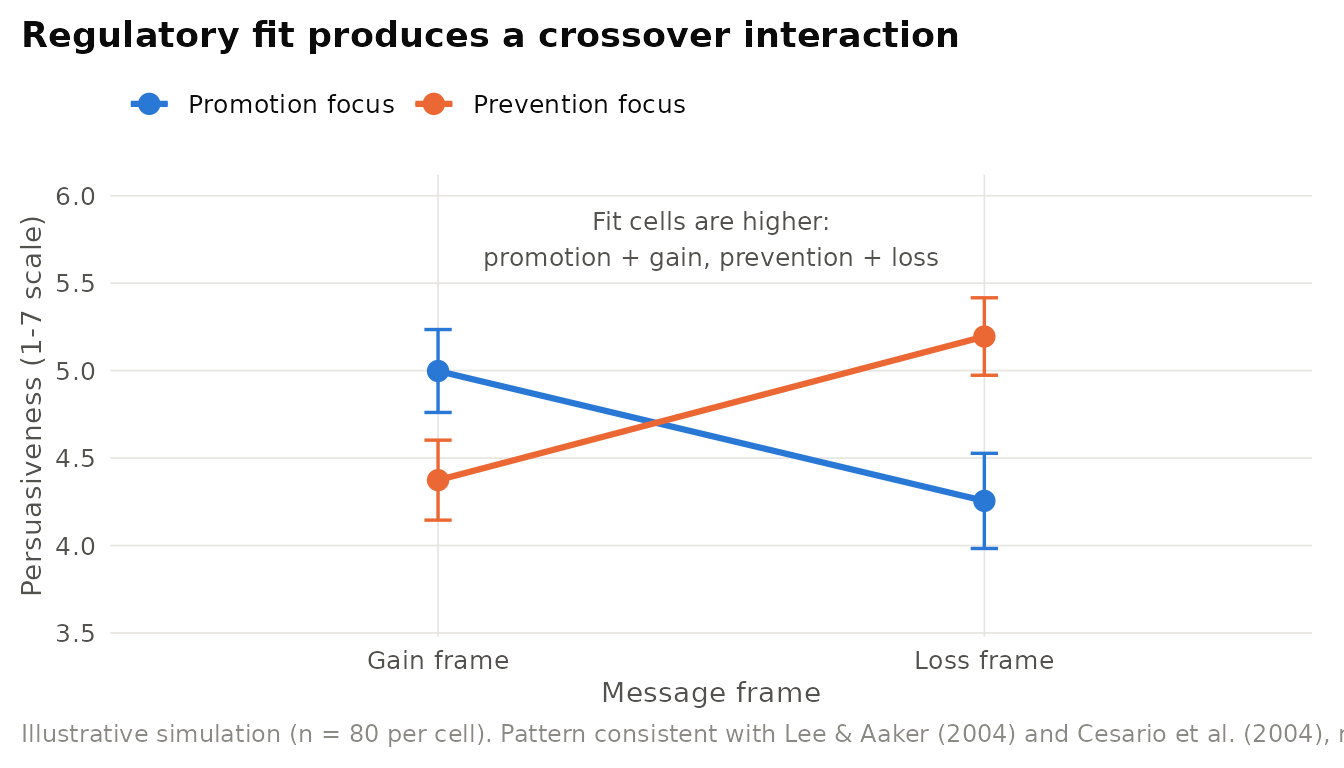
Figure 20.2: Illustrative regulatory fit interaction: persuasion is higher when the message frame matches the audience’s regulatory focus (promotion with gain frames, prevention with loss frames). Simulated data. Points are cell means with 95% confidence intervals.
20.2.2 Mechanism
Two mechanisms have been proposed and are not mutually exclusive. The experiential route holds that fit produces a feeling of rightness and stronger engagement, which is then misattributed to the target (Cesario, Grant, and Higgins 2004, Higgins 2000). The fluency route holds that fit makes information easier to process, and that ease is read as a signal of truth or liking (A. Y. Lee and Aaker 2004). Both routes predict that fit effects should be larger when people rely on feelings (low involvement, time pressure, ambiguous attributes) and smaller when they are motivated and able to scrutinise arguments: an implication that links fit to the elaboration likelihood model (Section 26.1).
20.2.3 Applications in business
Message-market fit in digital advertising. Regulatory fit gives marketers a principled reason to match how a benefit is described to the mindset in which it is encountered. A sunscreen positioned as a means to “enjoy every hour outdoors” fits a promotion state. The same product described as a way to “avoid sunburn and skin damage” fits prevention. Because many digital channels reveal the context in which an ad is viewed (a travel-planning search versus a medical-information search), firms can test fit by crossing message frame with context and comparing click-through and conversion. The theory also warns against a common practice, mixing gain and loss language in the same headline, which may dilute fit for both segments.
Take a product you know well and write two one-sentence value propositions: one that fits a promotion focus (gains, aspirations, eager means) and one that fits a prevention focus (non-losses, responsibilities, vigilant means). Identify a customer context in which each would be encountered, and specify the outcome metric you would use to test the prediction.
Testing fit without measuring or manipulating the orientation. A message effect that varies across segments is not, by itself, evidence of regulatory fit. A fit study needs both factors, orientation and means or frame, and should show the crossover interaction. Where possible, measure the proposed mechanism (feeling right, fluency, engagement) and test whether making the source of the feeling salient weakens the effect.
20.3 Construal Level Theory
Core claim. People represent psychologically distant objects and events abstractly, in terms of their central, goal-relevant features (high-level construal), and psychologically near objects and events concretely, in terms of their contextual, incidental details (low-level construal). Construal level in turn shapes prediction, evaluation, and choice.
Origins. Social psychology, temporal construal theory (Liberman and Trope 1998, Trope and Liberman 2003), generalised to all forms of psychological distance in Trope and Liberman (2010), consumer applications in Trope, Liberman, and Wakslak (2007).
Level of analysis. Individual.
Key constructs. Psychological distance (temporal, spatial, social, hypothetical), construal level, desirability versus feasibility, “why” versus “how” representations, primary versus secondary features.
Boundary conditions. Effects require that the target can be represented at more than one level of abstraction. When concrete details are themselves the goal (for example, an engineer specifying tolerances) distance may matter less.
Related theories. Self-control, Regulatory focus, Dual-process theory (Section 23.6), Mental accounting (Section 23.5).
20.3.1 Origins and intellectual history
Construal level theory (CLT) began with a narrow observation about time. People planning a holiday for next year imagine sunshine, rest, and a change of scene. People leaving for the same holiday next week think about packing, airport transfers, and whether the pet sitter has confirmed. Liberman and Trope (1998) formalised this as temporal construal: distant-future events are represented in terms of their desirability (the value of the end-state, the why of an action), whereas near-future events are represented in terms of their feasibility (the ease or difficulty of reaching it, the how). The distinction echoes action identification theory, which showed that any action can be described at a higher level (“improving my health”) or a lower level (“walking on the treadmill”) (Vallacher and Wegner 1987).
Trope and Liberman (2003) developed the temporal account into a general theory of how time affects representation and preference. Trope and Liberman (2010) then argued that time is only one of several dimensions of psychological distance, the subjective experience that something is removed from the self, here, and now, and that all of them operate through the same representational mechanism.
20.3.2 Core logic and propositions
Table 20.3 lists the four distance dimensions identified by Trope and Liberman (2010), and Table 20.4 contrasts the two levels of construal.
| Dimension | Near (low distance) | Far (high distance) | Business example |
|---|---|---|---|
| Temporal | Now, tomorrow, next week | Next year, a decade from now | Product launch next week vs. next year |
| Spatial | Here, in this office or city | There, in another country or region | Local store vs. overseas market |
| Social | Self, close friends, ingroup | Strangers, other people, outgroup | Choosing for oneself vs. for a typical customer |
| Hypothetical | Likely, real, certain | Unlikely, imagined, uncertain | Committed budget vs. contingency scenario |
| Feature | High-level construal (distant) | Low-level construal (near) |
|---|---|---|
| Representation | Abstract, schematic, decontextualised | Concrete, detailed, contextualised |
| Features emphasised | Primary, central, goal-relevant | Secondary, incidental, goal-irrelevant |
| Action identification | Why (ends, purposes) | How (means, procedures) |
| Choice criterion | Desirability of outcomes | Feasibility of execution |
| Arguments weighted | Pros (reasons for) | Cons (obstacles against) |
| Information used | Ideals, values, prototypes | Practical constraints, situational details |
| Example description | ‘Building a healthier lifestyle’ | ‘Putting trainers in my bag tonight’ |
The theory’s main propositions can be stated as follows:
- P1 (Distance-to-abstraction). As psychological distance increases, people represent targets at a higher level of construal (Trope and Liberman 2010).
- P2 (Weighting). At greater distance, choices weight high-level features (desirability, central attributes, values) more heavily and low-level features (feasibility, peripheral attributes, practical constraints) less heavily (Liberman and Trope 1998).
- P3 (Preference reversals). Because the weights change with distance, options that are attractive in principle but hard in practice are preferred from afar and abandoned up close (Trope and Liberman 2003).
- P4 (Interchangeability). Different dimensions of distance are mentally associated and have similar effects. Making one dimension distant makes others feel more distant too (Trope and Liberman 2010).
- P5 (Bidirectionality). Construal level also influences perceived distance: thinking abstractly makes events feel further away (Trope and Liberman 2010).
In a well-known demonstration, Liberman and Trope (1998) asked students to choose between an assignment that was interesting but difficult and one that was uninteresting but easy. When the assignment was due in the distant future, students showed a stronger preference for the interesting, difficult option: they weighted desirability. When it was due soon, the easy option gained ground: feasibility loomed larger.
20.3.3 Mechanism
Figure 20.3 summarises the mechanism. Distance on any dimension raises the level of construal. Construal level changes the weights attached to desirability and feasibility, and these weights drive evaluation and choice. Self-control can be seen as one important downstream outcome: abstract representations keep long-term goals in view (Fujita et al. 2006).
Figure 20.3: Mechanism of construal level theory: psychological distance raises the level of construal, which shifts weight from feasibility to desirability and changes evaluation, choice, and self-control. The dashed arrow indicates that abstract construal also makes targets feel more distant.
20.3.4 Evidence and extensions
CLT has generated a very large literature. Trope, Liberman, and Wakslak (2007) reviewed its implications for consumer psychology: distant purchase decisions are guided more by central attributes and brand values, near decisions more by price, convenience, and details of use. Fujita et al. (2006) showed that inducing high-level construal improved self-control, making people less drawn to immediate rewards and more persistent at an uncomfortable task that served a valued goal. Two meta-analyses by Soderberg et al. (2015) found a reliable effect of psychological distance on abstraction across many paradigms and all four dimensions, while also documenting considerable heterogeneity across studies.
How robust and how general is construal level theory? CLT is among the most cited theories in consumer psychology, but its breadth invites scrutiny. Critics note that many studies use small samples and a wide variety of manipulations and dependent measures, which makes it difficult to know which effects would replicate and how large they are. Meta-analytic estimates from a literature with possible publication bias must be read cautiously (Soderberg et al. 2015). A second question concerns mechanism: some findings attributed to construal level might reflect other processes that covary with distance, such as reduced uncertainty about near events, mood, or simple differences in the information available. The most persuasive studies measure construal directly, manipulate it independently of distance, and show that it mediates the effect on choice.
20.3.5 Applications in business
CLT is especially useful whenever a business must communicate about events at different distances, launches, subscriptions, pre-orders, long-term contracts, international expansion, or must reconcile ambitious plans with operational reality.
Illustrative scenario: launch messaging for distant versus near events. A consumer-electronics firm announces a new device a year before release and opens pre-orders three weeks before shipping. CLT suggests that the two moments call for different messages. At announcement, customers construe the product abstractly, so communication should emphasise why: the vision, the core benefit, the identity the product expresses. As release approaches, customers switch to how: compatibility, set-up, delivery dates, and return policies. A campaign that leads with specification sheets a year out, or with visionary slogans the week of shipping, mismatches the customer’s construal. The same logic applies to events: conferences sell the big idea months ahead and the logistics in the final weeks.
The planning fallacy in organizations. Strategic plans are made at a distance and executed up close. At the planning stage, desirability dominates and feasibility constraints are underweighted, so ambitious initiatives are approved readily. As implementation nears, the same initiatives encounter the concrete obstacles that were always there. CLT suggests two complementary remedies: deliberately bringing feasibility into early decisions (pre-mortems, concrete implementation plans, reference-class data on similar projects), and deliberately bringing desirability into late decisions (reminding teams of the purpose of the project when tactical problems threaten to derail it).
20.3.6 Using the theory in research
Sample hypotheses.
- H1. Advertisements for products available in the distant future will be more effective when they emphasise desirability attributes, and advertisements for products available immediately will be more effective when they emphasise feasibility attributes.
- H2. Managers evaluating projects for a distant foreign subsidiary (spatial distance) will weight strategic fit more and implementation cost less than managers evaluating equivalent projects for a local unit.
- H3. Inducing high-level construal will increase employees’ contributions to long-term savings plans, mediated by greater weight on future outcomes.
Designs. Laboratory experiments manipulating distance or construal directly (e.g., “why/how” ladders that ask participants to explain why or how they would pursue a goal). Field experiments varying message content by time-to-event. Archival studies of pre-order and early-booking behaviour.
Measures. Action-identification measures based on Vallacher and Wegner (1987), categorisation breadth, ratio of desirability to feasibility attributes in open-ended reasons, choices between desirable-but-difficult and easy-but-less-desirable options.
Assuming that distance always helps. High-level construal is not uniformly better. It promotes value-consistent choices and self-control, but it can also produce over-commitment, under-planning, and neglect of practical constraints. Research and managerial advice should specify which features are central to the goal: if feasibility is the central issue (for example, safety-critical operations), abstract thinking may lead people astray.
20.4 Self-Control and Intertemporal Choice
Core claim. People often prefer larger, later rewards when both options are distant but switch to smaller, sooner rewards as the sooner option becomes imminent. This dynamic inconsistency creates a conflict between a far-sighted planner and a myopic doer. Individuals and institutions respond with rules, commitment devices, and choice architecture (Section 23.10).
Origins. Behavioural economics and psychology: the planner-doer model (R. H. Thaler and Shefrin 1981), hyperbolic discounting (Ainslie 1975, Laibson 1997), delay-of-gratification research (Mischel, Shoda, and Rodriguez 1989), ego depletion (Baumeister et al. 1998), reviewed in Frederick, Loewenstein, and O’Donoghue (2002).
Level of analysis. Individual and household, with organizational and policy implications (benefit design, product design, regulation).
Key constructs. Discount function (exponential, hyperbolic, quasi-hyperbolic), present bias, preference reversal, naivete versus sophistication, willpower, commitment device, default.
Boundary conditions. Present bias is strongest for immediately available, visceral rewards (food, leisure, spending) and for outcomes whose costs are delayed. It is weaker when both options lie in the future or when the decision is automated.
Related theories. Construal level theory, Mental accounting (Section 23.5), Bounded rationality (Section 23.1), Goal-gradient hypothesis (Section 19.5).
20.4.1 Origins and intellectual history
Standard economic models assume that people discount future utility exponentially, at a constant rate per period. Exponential discounting implies time consistency: if someone prefers 110 dollars in 31 days to 100 dollars in 30 days, she should also prefer 110 dollars tomorrow to 100 dollars today. Behaviour often violates this prediction. Ainslie (1975) showed that animals and people display preference reversals consistent with a hyperbolic discount function, under which value falls steeply over short delays and gently over long ones. Laibson (1997) introduced a tractable approximation, the quasi-hyperbolic or \(\beta\)-\(\delta\) model, and showed that a present-biased consumer can benefit from illiquid assets that restrict future choices. Frederick, Loewenstein, and O’Donoghue (2002) provide the standard review of the evidence.
Definition 20.2 Exponential discounting. The value today of a reward \(A\) delivered after delay \(t\) is \(V = A\,\delta^{t}\), with \(0 < \delta < 1\). The relative value of two rewards does not depend on when they are evaluated.
Hyperbolic discounting. \(V = A / (1 + k t)\), with \(k > 0\). Value declines steeply at short delays, so the ranking of a smaller-sooner and a larger-later reward can reverse as the sooner reward approaches.
Quasi-hyperbolic (\(\beta\)-\(\delta\)) discounting. \(V = A\) if \(t = 0\) and \(V = \beta\,\delta^{t} A\) if \(t > 0\), with \(0 < \beta < 1\) capturing a special premium on the present (Laibson 1997).
Psychology and economics converged on a common picture. R. H. Thaler and Shefrin (1981) modelled the individual as an organization with two parts: a far-sighted planner concerned with lifetime utility and a series of myopic doers who live only in the present. The planner can influence the doers either by exerting costly willpower or, more efficiently, by adopting rules and institutions, pension plans, payroll deductions, illiquid savings, that change the doers’ options or incentives. O’Donoghue and Rabin (1999) added an important distinction: sophisticated agents know they are present-biased and seek commitment, whereas naive agents believe their future selves will be patient and therefore procrastinate.
20.4.2 Mechanism
Figure 20.4 shows why hyperbolic discounting produces preference reversals. A person can receive a smaller reward (50 units) at time 10 or a larger reward (100 units) at time 15. Viewed from far away, both rewards are heavily discounted and the larger, later reward is worth more. Under hyperbolic discounting, as the decision-maker approaches time 10, the value of the smaller, sooner reward rises steeply and overtakes the larger reward: the classic pattern of the dieter who orders dessert or the saver who raids the holiday fund. Under exponential discounting the two curves never cross: whatever is preferred from afar is preferred up close.
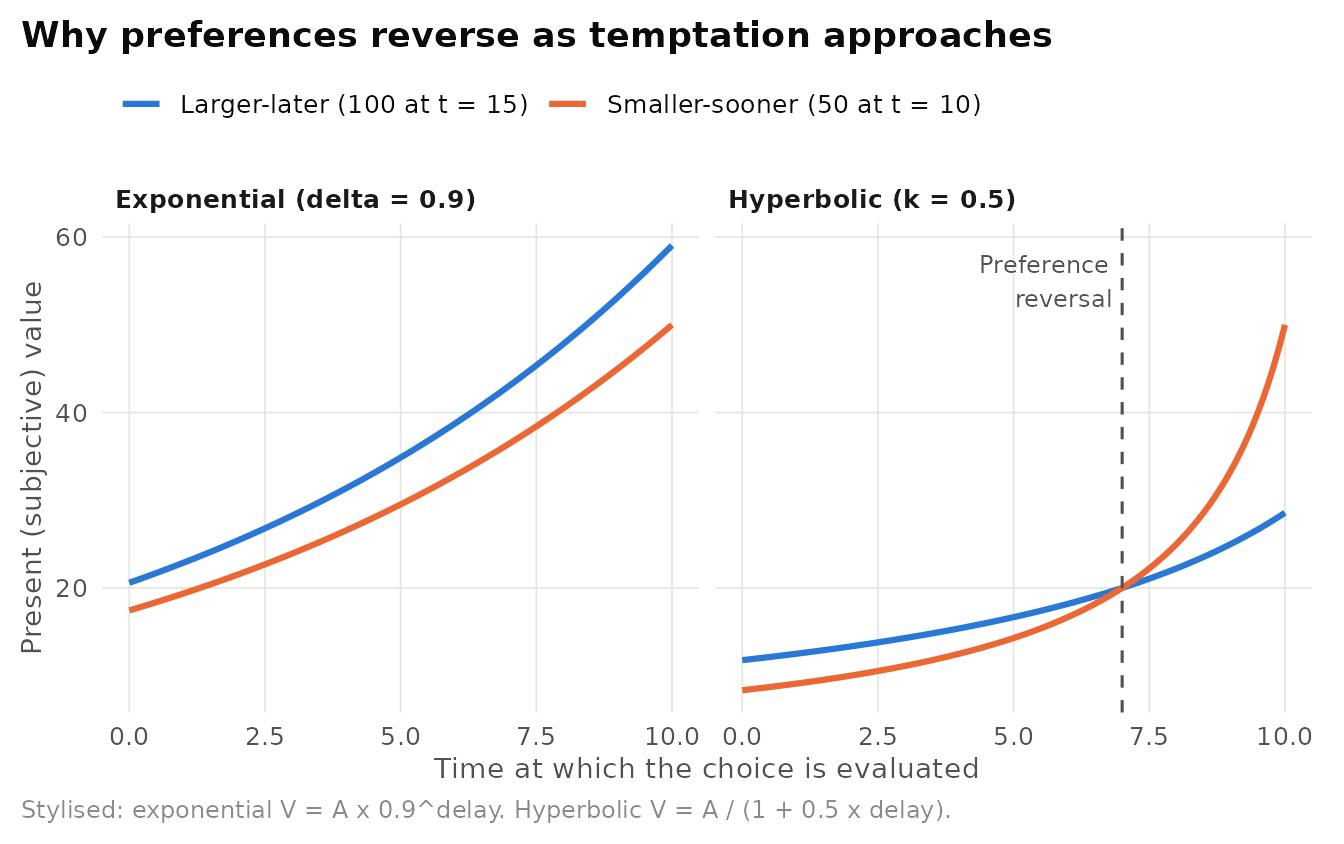
Figure 20.4: Stylised comparison of exponential and hyperbolic discounting. A smaller-sooner reward (50 units at t = 10) competes with a larger-later reward (100 units at t = 15). Under hyperbolic discounting the curves cross, producing a preference reversal as the sooner reward approaches. Under exponential discounting they do not.
Figure 20.5 places this conflict inside the planner-doer framework. Temptations act directly on the doer. The planner can intervene through costly willpower in the moment or, more reliably, through rules and commitments adopted in advance.
Figure 20.5: The planner-doer model of self-control (after Thaler & Shefrin, 1981): the far-sighted planner influences the myopic doer through costly willpower or through rules and commitment devices that change the doer’s options and incentives.
20.4.3 Evidence and extensions
Delay of gratification. In the best-known psychological research on self-control, preschool children were offered a small treat immediately or a larger treat if they could wait alone for the experimenter to return. Mischel, Shoda, and Rodriguez (1989) reported that children who waited longer tended, years later, to be rated as more cognitively and socially competent in adolescence and to have higher scholastic aptitude scores, and that the strategies children used, for example, distracting themselves or thinking about the treat in abstract rather than “hot” terms, strongly affected how long they could wait. The latter finding anticipated construal level theory: cooling the representation of a temptation makes it easier to resist.
A conceptual replication by T. W. Watts, Duncan, and Quan (2018), using a larger and more socioeconomically diverse sample, found that early delay ability was associated with later achievement, but the association was considerably smaller than in the original studies and was substantially reduced once family background, early cognitive ability, and the home environment were controlled. The replication does not show that self-control is unimportant. It shows that a single childhood test is a noisy and confounded measure of it.
Ego depletion. Baumeister et al. (1998) proposed that self-control draws on a limited resource. In their studies, participants who had to resist tempting food (eating radishes while chocolates sat in front of them) subsequently gave up sooner on unsolvable puzzles than participants who had not exercised self-control. The strength model compared self-control to a muscle that tires with use and can be strengthened with practice (Muraven and Baumeister 2000). Experience-sampling work later documented that desires, and conflicts between desires and other goals, are a pervasive part of everyday life (Hofmann et al. 2012).
The rise and fall of ego depletion. Ego depletion became one of the most replicated-seeming findings in social psychology, with hundreds of published studies. Its standing changed when Hagger et al. (2016) coordinated a preregistered replication across some two dozen laboratories with more than 2,000 participants, using a standardised depletion task and outcome measure. The pooled effect was close to zero. Defenders responded that the chosen manipulation may have been too weak and that other paradigms might show the effect. Critics replied that a literature built largely on small, flexible studies could have produced a consistent picture through publication bias alone. In parallel, Inzlicht and Schmeichel (2012) proposed a process model in which prior exertion shifts motivation and attention, away from “have-to” goals and toward “want-to” rewards, rather than depleting a fuel-like resource. For applied researchers the safest conclusion is that “willpower fatigue” should not be assumed as a mechanism without direct evidence. The episode is discussed further in the chapter section on the replication crisis (Section 3.7).
Commitment devices. If people are at least partly sophisticated about their present bias, they should value ways to bind their future selves. Field evidence supports this. When a Philippine bank offered a savings account that restricted withdrawals until a self-chosen goal or date was reached, a meaningful share of clients took it up and savings rose relative to a control group (Ashraf, Karlan, and Yin 2006). Smokers who were offered a savings account they would forfeit if they failed a nicotine test were more likely to have quit at follow-up than a control group (Giné, Karlan, and Zinman 2010). A widely cited study of self-imposed deadlines in the classroom (Ariely and Wertenbroch 2002) has been retracted by Psychological Science (2026), and we do not rely on its findings. The broader case for deadlines and precommitment rests on the theoretical work of R. H. Thaler and Shefrin (1981) and O’Donoghue and Rabin (1999) and on field evidence such as the studies above.
Paying for self-control that never materialises. Naive present bias predicts that people will choose contracts that would be optimal for a more disciplined future self. DellaVigna and Malmendier (2006) found that gym members who chose flat-rate monthly contracts attended so infrequently that they paid more per visit than they would have on a pay-per-visit basis: consistent with overconfidence about future self-control.
Table 20.5 organises the main self-control tools by the mechanism through which they work.
| Tool | Mechanism | Example | Key evidence |
|---|---|---|---|
| Defaults | Make the patient choice the path of least resistance | Automatic enrolment in a retirement plan | Madrian & Shea (2001) |
| Pre-commitment to future increases | Bind the future self when the cost is distant | Save More Tomorrow escalation | Thaler & Benartzi (2004) |
| Illiquidity / restricted access | Raise the cost of giving in to temptation | Locked savings accounts, pension rules | Laibson (1997), Ashraf et al. (2006) |
| Commitment contracts with penalties | Attach a loss to failure | Forfeitable deposit for quitting smoking | Gine et al. (2010) |
| Construal shifts | Represent the temptation abstractly | Reframing a purchase in terms of long-run goals | Fujita et al. (2006) |
| Rules and bright lines | Replace in-the-moment deliberation with a policy | Spending only from a separate account | Thaler & Shefrin (1981) |
20.4.4 Applications in business
Save More Tomorrow. R. H. Thaler and Benartzi (2004) designed a retirement-savings programme that turns each insight of this section into a design feature. Employees who were saving too little were invited to commit in advance to raising their contribution rate, with each increase timed to coincide with a future pay rise. Because the increases lay in the future, present bias worked for the plan rather than against it. Because they coincided with pay rises, take-home pay never fell, which avoided the sting of a perceived loss, and because the escalation continued automatically unless employees opted out, inertia kept them in. In the first implementation, average saving rates among participants rose from 3.5 percent to 13.6 percent over 40 months. Together with evidence on automatic enrolment (Madrian and Shea 2001), the programme helped shape the automatic-escalation features now common in employer-sponsored retirement plans.
Designing products for (and against) present bias. Many business models interact with self-control problems. Subscriptions, free trials that convert automatically, and “buy now, pay later” schemes exploit the gap between a present-biased doer and a planner who expects to cancel or repay on time. The gym contracts studied by DellaVigna and Malmendier (2006) are a canonical example. Other firms sell commitment as a product: savings apps that lock funds until a goal date, commitment-contract platforms that donate a user’s stake if a goal is missed, and employer wellness programmes with pre-committed incentives. The managerial question is ethical as well as strategic: designs that profit from customers’ predictable failures invite regulatory scrutiny and erode trust, whereas designs that help customers achieve their own long-run goals can build durable loyalty.
20.4.5 Using the theory in research
Sample hypotheses.
- H1. Offering employees the option to pre-commit future bonuses to a savings account will increase total savings more than an equivalent option to save from current pay.
- H2. Customers who select annual over monthly subscription plans will show lower usage relative to their stated intentions, and the gap will be larger for customers with stronger present bias.
- H3. Inducing high-level construal at the point of sale will reduce impulsive add-on purchases.
Designs. Field experiments with randomised access to commitment products. Choice tasks that elicit discount rates at different horizons to detect present bias. Regression discontinuity around default changes. Panel data on contract choice and subsequent usage.
Measures. Elicited \(\beta\) and \(\delta\) from intertemporal choice tasks. Demand for commitment (willingness to pay for restrictions). Trait self-control scales. Behavioural outcomes such as savings balances, attendance, completion, and cancellation.
Inferring present bias from any impatience. A high discount rate is not the same as present bias. Liquidity constraints, uncertainty about whether a future reward will be paid, and differences in the utility of money over time can all produce apparent impatience. Evidence for dynamic inconsistency requires showing that preferences change as outcomes approach, or that people demand commitment, not merely that they prefer sooner rewards.
20.5 Integrating the Theories
The four theories are best seen as complementary lenses on the same broad question: how do people translate goals into action? Regulatory focus describes the orientation with which a goal is pursued. Regulatory fit describes the added value that arises when means match that orientation. Construal level theory describes the level of abstraction at which goals and options are represented, and self-control theories describe what happens when the abstract, long-term goal collides with a concrete, immediate temptation.
The connections are more than metaphorical. Construal level provides one account of why self-control fails: near temptations are represented concretely and vividly, while the long-term goal they threaten is distant and abstract (Fujita et al. 2006). Commitment devices work in part by moving decisions to a moment when the planner, thinking abstractly, is in charge: the logic of Save More Tomorrow (R. H. Thaler and Benartzi 2004). And regulatory focus shapes which commitment devices appeal: a prevention-focused saver may respond to a message about protecting against old-age poverty, a promotion-focused saver to a message about the freedom that savings will buy. Researchers who combine these lenses can design interventions that match orientation, construal, and timing.
20.6 Chapter Summary
- Regulatory focus theory distinguishes a promotion system (ideals, gains, eager strategies) from a prevention system (oughts, non-losses, vigilant strategies) (Higgins 1997, Crowe and Higgins 1997).
- Focus has chronic and situational sources, including self-construal and culture, and it shapes persuasion, risk-taking, and emotion (A. Y. Lee, Aaker, and Gardner 2000, J. L. Aaker and Lee 2001).
- Regulatory fit adds value from the manner of goal pursuit: messages and choices feel right, are processed more fluently, and are valued more when means match orientation (Higgins 2000, Cesario, Grant, and Higgins 2004, A. Y. Lee and Aaker 2004).
- Construal level theory links psychological distance to abstraction: distant events are represented in terms of desirability and “why”, near events in terms of feasibility and “how” (Liberman and Trope 1998, Trope and Liberman 2010).
- Self-control problems arise from dynamic inconsistency. The planner-doer model and hyperbolic discounting explain preference reversals (R. H. Thaler and Shefrin 1981, Laibson 1997).
- Evidence on the marshmallow test and ego depletion has been substantially revised by large replications (T. W. Watts, Duncan, and Quan 2018, Hagger et al. 2016). Commitment devices, defaults, and pre-commitment designs such as Save More Tomorrow have stronger field support (R. H. Thaler and Benartzi 2004, Madrian and Shea 2001, Ashraf, Karlan, and Yin 2006).
Table 20.6 presents the comparison of the chapter’s theories.
| Theory | Key mechanism | Signature prediction | Typical business use | Main caution |
|---|---|---|---|---|
| Regulatory focus | Promotion vs. prevention orientation, eager vs. vigilant means | Risky vs. conservative bias, distinct emotions | Segmentation, product positioning, safety and innovation climates | Do not equate with gain/loss wording |
| Regulatory fit | Feeling right, processing fluency | Crossover interaction of orientation x frame | Message-context matching, A/B testing of copy | Requires both factors and the interaction |
| Construal level | Distance raises abstraction, desirability vs. feasibility | Preference reversals across distance | Launch timing and messaging, planning, international strategy | Heterogeneous effects, measure construal |
| Self-control and intertemporal choice | Present bias, planner vs. doer | Preference reversal as rewards approach, demand for commitment | Retirement design, subscriptions, commitment products | Impatience is not the same as present bias |
20.7 Discussion Questions
- Regulatory focus theory claims that prevention is a form of approach, not avoidance. Explain the distinction and design an experiment that could discriminate between the two interpretations.
- A bank wants to increase uptake of income-protection insurance among young professionals, a segment it believes is promotion-focused. Should it reframe the product in promotion terms or try to induce a prevention focus? Justify your answer using regulatory fit.
- Using construal level theory, explain why corporate sustainability pledges with distant target dates are easy to announce and hard to deliver. What governance mechanisms would you recommend?
- The marshmallow test and ego depletion were both revised by large replications. What features of the original research designs made the initial findings fragile, and how would you design a study on self-control today?
- Save More Tomorrow combines pre-commitment, loss aversion (Section 24.4), and inertia. Identify another domain (health, energy, learning) where the same three design principles could be combined, and specify how you would evaluate the result.
- When does designing for customers’ present bias become exploitation? Propose criteria a firm could use to distinguish helpful commitment products from harmful ones.
20.8 Further Reading
- Higgins (1997): the foundational statement of regulatory focus theory, with its argument for moving “beyond pleasure and pain”.
- Higgins (2000): introduces value from fit and explains why the manner of goal pursuit matters for decision value.
- A. Y. Lee and Aaker (2004): a clear consumer-research demonstration of regulatory fit, linking it to processing fluency and persuasion.
- Trope and Liberman (2010): the integrative review of construal level theory and the four dimensions of psychological distance.
- R. H. Thaler and Shefrin (1981): the planner-doer model, an early and still illuminating economic theory of self-control.
- Frederick, Loewenstein, and O’Donoghue (2002): the standard review of time discounting and its anomalies.
- R. H. Thaler and Benartzi (2004): a model of how behavioural theory can be turned into a working product design.
- Hagger et al. (2016): the multilab replication of ego depletion and a case study in how cumulative science corrects itself.