9 Social Exchange and Networks
Why do employees who feel valued by their employer work harder than their contracts require? Why does a supplier that could earn more by switching customers stay with a long-standing buyer, and why do job seekers so often hear about the position they eventually take from an acquaintance rather than a close friend? Why are some managers, with no formal authority, consistently the source of the ideas that senior executives adopt? Each question concerns resources that do not move through prices or hierarchies alone. They move through relationships: through chains of favours, obligations, trust, and information that link people and organizations to one another.
This chapter develops the family of theories that treat social life as exchange embedded in networks. We begin with social exchange theory, the foundational account of how reciprocity, dependence, and trust sustain relationships between two parties. We then move from the dyad to the structure in which dyads sit: network exchange theory explains how a position in a network of exchange opportunities creates power. The strength of weak ties and embeddedness arguments explain how tie strength shapes the flow of information and trust. Structural holes theory explains the advantages of brokerage, and social capital theory integrates these ideas into a view of relationships as a productive asset. We close with the commitment-trust theory of relationship marketing, which brought the exchange tradition into the study of buyer-seller relationships (Table 9.1).
| Theory | Core question | Level of analysis | Key source |
|---|---|---|---|
| Social exchange theory | Why do people and organizations sustain reciprocal relationships without contracts? | Dyad | Homans (1958), Blau (1964) |
| Network exchange theory | How does position in a network of exchange opportunities create power? | Network / position | Cook & Emerson (1978), Markovsky et al. (1988) |
| Strength of weak ties | Why do acquaintances provide novel information? | Dyad / network | Granovetter (1973) |
| Embeddedness | How do social relations shape economic action? | Dyad / interfirm network | Granovetter (1985), Uzzi (1997) |
| Structural holes | Why do brokers between groups gain information and control advantages? | Ego network | Burt (1992) |
| Social capital | How do relationships function as a resource for individuals and organizations? | Individual / group / firm | Coleman (1988), Nahapiet & Ghoshal (1998) |
| Commitment-trust theory | What makes buyer-seller relationships durable and cooperative? | Dyad (relationship) | Morgan & Hunt (1994) |
9.2 Network Exchange Theory
Core claim. Power in exchange relations depends not only on dyadic dependence but on the structure of the network of exchange opportunities: positions with many alternatives connected to partners with few alternatives can exclude others and extract favourable terms.
Origins. Experimental sociology: K. S. Cook and Emerson (1978) and K. S. Cook et al. (1983), building on Emerson (1962, 1976). The graph-theoretic approach of Markovsky, Willer, and Patton (1988) and colleagues (Willer 1999). K. S. Cook and Whitmeyer (1992) compare exchange-theoretic and network-analytic approaches to social structure.
Level of analysis. Positions within exchange networks (individuals, firms, or organizational units).
Key constructs. Negatively versus positively connected exchange relations, exclusion, alternatives, graph-theoretic power index (GPI), strong- and weak-power structures, equity and commitment.
Boundary conditions. Actors seek favourable terms. Exchange relations are negatively connected (exchange with one partner reduces exchange with another). The number of exchanges per round is limited.
Related theories. Social exchange theory, Structural holes, Resource dependence theory (Section 7.1).
9.2.1 Core logic
Network exchange theory asks what happens when Emerson’s alternatives are themselves actors embedded in a larger structure. K. S. Cook and Emerson (1978) created laboratory networks in which participants negotiated divisions of a fixed resource pool with the partners to whom they were connected. They found that positions with more and better alternatives obtained more favourable divisions, but also that concerns about equity and the development of commitment between particular partners dampened the use of power: participants who formed committed relationships often forwent better offers from others.
A key distinction is between negatively connected and positively connected relations. Two exchange relations are negatively connected if exchange in one reduces exchange in the other (a buyer who can purchase from only one of two suppliers in a period). They are positively connected if exchange in one increases exchange in the other (a supply chain in which a distributor’s purchases enable its sales). Most power predictions concern negatively connected networks, where actors with alternatives can play partners off against one another.
K. S. Cook et al. (1983) showed that in negatively connected networks, standard centrality measures do not reliably predict power. The most central position in a network may be weak if its partners themselves have attractive alternatives. Markovsky, Willer, and Patton (1988) proposed a different approach: power derives from the capacity to exclude others from exchange. Their graph-theoretic power index (GPI) counts, for each position, the number of non-intersecting paths of each length that radiate from it, adding odd-length paths (which provide alternatives) and subtracting even-length paths (which indicate that one’s alternatives have alternatives of their own). Positions with higher GPI than their partners are predicted to exercise power.
Definition 9.2 Graph-theoretic power index. For position \(i\), let \(m_k\) be the maximum number of non-intersecting paths of length \(k\) that begin at \(i\). Then \[\text{GPI}_i = m_1 - m_2 + m_3 - m_4 + \cdots = \sum_{k \ge 1} (-1)^{k+1} m_k .\] The index formalizes the intuition that a direct partner is an advantage, while a partner who has other partners is a source of competition (Markovsky, Willer, and Patton 1988).
9.2.2 Mechanism
Figure 9.2 computes the GPI for four simple networks in which each position can complete at most one exchange per round. In the 3-line, B can always exclude either A or C, so B is strong. In the 5-line, B and D are strong because each has a peripheral partner (A or E) with no alternative, whereas the central position C is weak: its partners B and D have better options. In the 4-line, all positions have equal GPI, so the theory predicts roughly equal divisions. In the star, the hub can exclude any spoke and is predicted to extract most of the surplus.
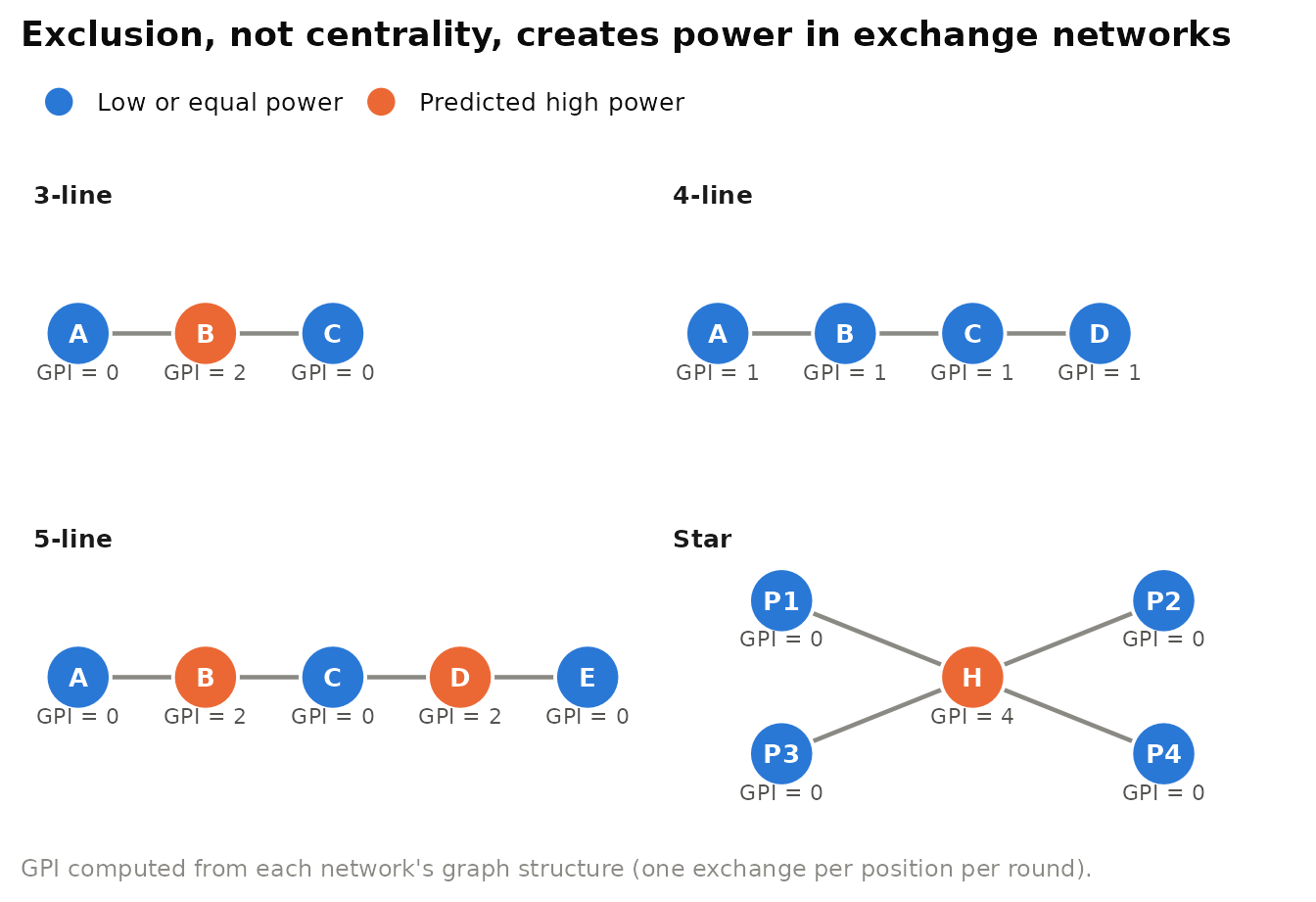
Figure 9.2: Power in four exchange networks, computed with the graph-theoretic power index (GPI) of Markovsky et al. (1988). Orange positions have higher GPI than their partners and are predicted to exercise power. Note that the central position C in the 5-line is weak.
Table 9.3 compares the GPI with two familiar centrality measures. Degree and betweenness centrality both rank the 5-line’s middle position C as at least as important as B and D, yet the GPI, and the experimental evidence that motivated it, predicts that C is weak. The contrast illustrates the central lesson of the network exchange tradition: power in negatively connected networks is about alternatives and exclusion, not connectedness per se (K. S. Cook et al. 1983, Markovsky, Willer, and Patton 1988).
| Network | Position | Degree | Betweenness (normalized) | GPI |
|---|---|---|---|---|
| 3-line | A | 1 | 0.00 | 0 |
| 3-line | B | 2 | 1.00 | 2 |
| 3-line | C | 1 | 0.00 | 0 |
| 4-line | A | 1 | 0.00 | 1 |
| 4-line | B | 2 | 0.67 | 1 |
| 4-line | C | 2 | 0.67 | 1 |
| 4-line | D | 1 | 0.00 | 1 |
| 5-line | A | 1 | 0.00 | 0 |
| 5-line | B | 2 | 0.50 | 2 |
| 5-line | C | 2 | 0.67 | 0 |
| 5-line | D | 2 | 0.50 | 2 |
| 5-line | E | 1 | 0.00 | 0 |
| Star | H | 4 | 1.00 | 4 |
| Star | P1 | 1 | 0.00 | 0 |
| Star | P2 | 1 | 0.00 | 0 |
| Star | P3 | 1 | 0.00 | 0 |
| Star | P4 | 1 | 0.00 | 0 |
9.2.3 Evidence and extensions
Subsequent work distinguished strong-power structures (such as the 3-line and the star), where some positions can be excluded without cost to the powerful, from weak-power structures, in which no position can be excluded for certain and power differences are smaller and more sensitive to actors’ strategies (Willer 1999). K. S. Cook and Whitmeyer (1992) argue that exchange theory and network analysis are complementary: exchange theory supplies a behavioural model of why actors use ties, and network analysis supplies the structural description of which ties are available. Bonacich (1987) made a related point for centrality measures more generally: being connected to well-connected others can reduce power in bargaining situations, so a centrality index should allow the contribution of a neighbour’s connections to be negative.
Sales networks and channel power. A distributor that is the only route between a group of small manufacturers and a group of small retailers occupies a strong-power position analogous to the hub of a star: it can play each manufacturer off against the others. If the manufacturers gain direct access to retailers through an online marketplace, the network shifts toward a weak-power structure, and the distributor’s margins compress even though its number of connections has not changed. Network exchange theory directs managers to ask not “how many partners do we have?” but “how many alternatives do our partners have?”
9.3 Strength of Weak Ties and Embeddedness
Core claim. Weak ties (acquaintances) are more likely than strong ties (close friends) to bridge otherwise disconnected social circles, so they are disproportionately important sources of novel information. Strong, embedded ties, by contrast, are better at conveying trust, fine-grained information, and cooperation.
Origins. Economic sociology: M. S. Granovetter (1973, 1974) on weak ties, M. Granovetter (1985) on embeddedness, Uzzi (1997) on the paradox of embeddedness.
Level of analysis. Dyadic ties and the network structures they form. Individuals and interfirm networks.
Key constructs. Tie strength, bridge and local bridge, triadic closure, novel versus redundant information, embeddedness, arm’s-length ties.
Boundary conditions. Weak ties help when the valuable resource is information that is unevenly distributed across groups and can be transmitted cheaply. When the resource requires trust, influence, or tacit knowledge, strong ties may matter more.
Related theories. Structural holes, Social capital, Diffusion of innovations (Section 10.1).
9.3.1 Origins and core logic
M. S. Granovetter (1973) defined tie strength as a combination of the time spent together, emotional intensity, mutual confiding, and reciprocal services. His argument begins from a structural regularity. If A has strong ties to both B and C, then B and C are likely to know each other too, because they spend time with A, tend to be similar to A, and would experience strain if they disliked one another. Granovetter called the configuration in which A is strongly tied to both B and C but B and C have no tie at all the forbidden triad, because it should rarely occur.
The consequence is striking. A bridge is a tie that provides the only path between two parts of a network. If strong ties tend to close triads, then a strong tie can rarely be a bridge: the two people will typically share other contacts. Bridges are therefore almost always weak ties. Because weak ties connect us to people who move in different circles, they deliver information we would not otherwise receive. Our close friends, by contrast, tend to know what we already know.
- P1 (Triadic closure). The stronger the ties between A-B and A-C, the more likely a tie between B and C.
- P2 (Bridging). Local bridges are disproportionately weak ties.
- P3 (Novel information). Information obtained through weak ties is more likely to be non-redundant than information obtained through strong ties.
- P4 (Opportunity). Individuals with more weak ties have access to a wider set of opportunities (jobs, ideas, deals).
M. S. Granovetter (1974) provided the canonical evidence in Getting a Job: among professional, technical, and managerial workers who found jobs through personal contacts, those contacts were more often people they saw occasionally or rarely than people they saw often. The nuance matters: weak ties are valuable not because weakness is good in itself, but because weak ties are more likely to be bridges.
Table 9.4 summarizes the complementary strengths of strong and weak ties.
| Dimension | Strong ties | Weak ties |
|---|---|---|
| Typical relationship | Close friends, family, long-standing partners | Acquaintances, former colleagues, occasional contacts |
| Network position | Embedded in dense clusters (closed triads) | More often bridges between clusters |
| Information | Redundant but rich, trusted, tacit | Novel but thin, codified |
| Best for | Trust, influence, transfer of complex knowledge, support | Search, discovery, job leads, new ideas |
| Business example | Key-account relationship, trusted supplier | Referral to a new market, alumni network lead |
| Key evidence | Uzzi (1997), Hansen (1999), Bian (1997) | Granovetter (1973, 1974), Rajkumar et al. (2022) |
9.3.2 Evidence and extensions
The most rigorous test to date exploited randomized variation in LinkedIn’s “People You May Know” recommendation algorithm. Rajkumar et al. (2022) analysed large-scale experiments in which the algorithm’s variants changed the mix of strong and weak ties that users formed, and linked those ties to subsequent job mobility. Because the variation in network formation was experimentally induced, the study could make causal claims that earlier observational studies could not. The headline result refines Granovetter’s thesis: the relationship between tie strength and job transmission was non-linear (an inverted U). Moderately weak ties, for example, contacts with a modest number of mutual connections, were the most helpful for job mobility, while the very weakest ties (with few or no mutual connections) and strong ties were less helpful. The value of weak ties was also greater in more digital industries. Figure 9.3 sketches the qualitative shape.
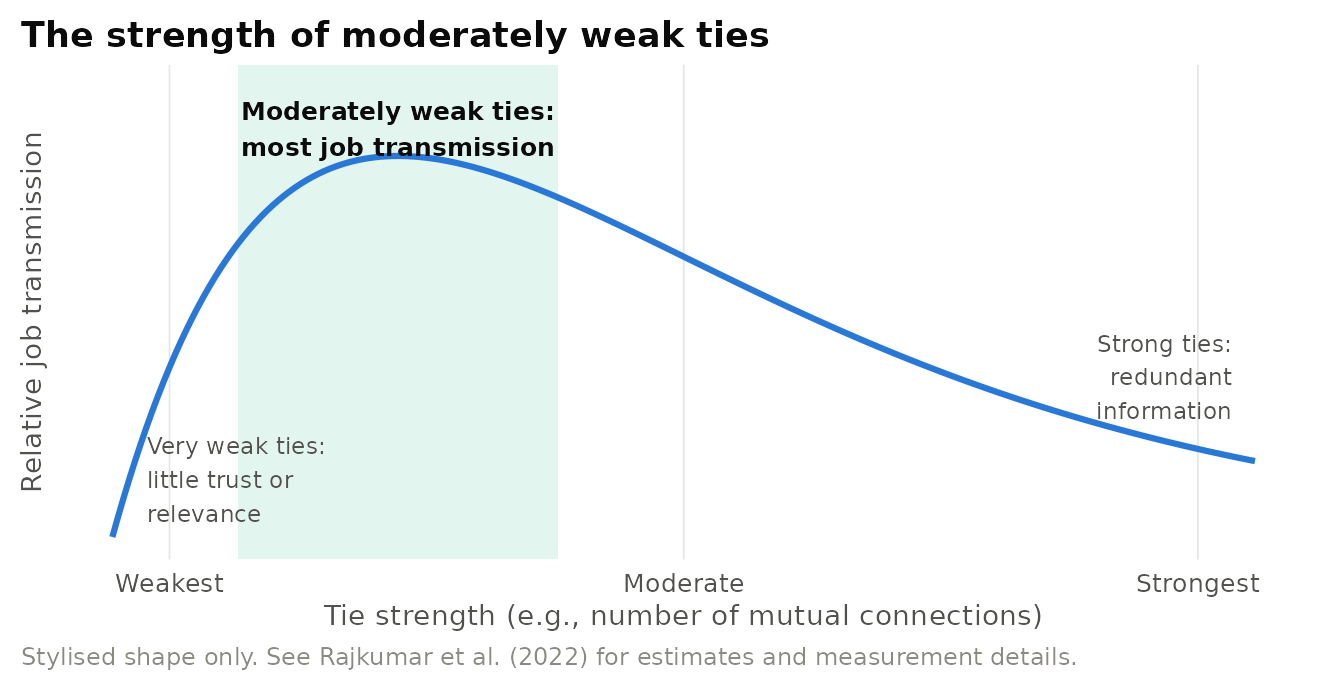
Figure 9.3: Stylised representation of the inverted-U relationship between tie strength and job transmission reported by Rajkumar et al. (2022). The curve is illustrative and does not reproduce the study’s estimates.
Several other lines of evidence qualify the weak-ties thesis. Bian (1997) found that in a Chinese labour market where jobs were allocated through personal influence, strong ties, including indirect ties reached through strong ties, were more useful, because what job seekers needed was influence rather than information. Hansen (1999) identified a search-transfer problem inside a multinational firm: weak inter-unit ties helped project teams search for useful knowledge but impeded the transfer of complex, tacit knowledge, which required strong ties. And McPherson, Smith-Lovin, and Cook (2001) documented the pervasive homophily (Section @ref(homophily (Section 30.2))) of social networks: because people tend to connect with similar others, even weak ties may carry less diversity than the theory assumes, and access to valuable weak ties is unequally distributed.
Referral hiring. Employee referral programmes institutionalize tie-based job matching. Studying a bank’s telephone customer-service centre, Fernandez, Castilla, and Moore (2000) found that referral hiring produced economic returns for the employer, partly because referrals enriched the applicant pool and improved the match between new hires and jobs. Burks et al. (2015) analysed personnel data from firms in call-centre, trucking, and high-tech industries and found that referred workers were less likely to quit and were, on balance, more profitable to the employer than non-referred workers. Referral programmes therefore exploit both tie properties: weak ties spread information about openings, while the referrer’s strong tie to the employer provides a screening and mentoring channel. A practical caution follows from homophily: referral hiring tends to reproduce the demographic composition of the existing workforce, which can conflict with diversity objectives unless it is complemented by other channels.
List the last three significant pieces of professional information you received: a job lead, a client introduction, an idea you adopted. For each, rate the tie strength to the person who gave it to you and note whether that person belongs to a different social circle from your closest colleagues. Does your experience fit the bridging argument, Bian’s influence argument, or Hansen’s search-transfer argument best?
9.3.3 Embeddedness and its paradox
M. Granovetter (1985) broadened the argument into a critique of economic theory. Economic action is neither the atomized behaviour of neoclassical models (an under-socialized view) nor the mechanical enactment of internalized norms (an over-socialized view). It is embedded in concrete, ongoing networks of personal relations. Those relations generate trust and discourage malfeasance, because actors prefer partners of known reputation and because ongoing relationships carry expectations beyond the contract. The argument was directed in part at transaction cost economics (Section 6.3), which attributed order in exchange primarily to hierarchical governance.
Uzzi (1997) studied the networks of manufacturers and contractors in the New York apparel industry and identified three features of embedded ties: trust, fine-grained information transfer, and joint problem-solving arrangements. Embedded ties let firms respond quickly to changing fashions and coordinate without costly contracting. But Uzzi also identified a paradox of embeddedness: networks made up only of embedded ties insulated firms from new information and left them vulnerable if a key partner failed. Firms that combined embedded and arm’s-length ties were more likely to survive than those at either extreme: an inverted-U relationship.
Alliance portfolios. Uzzi’s paradox has a direct analogue in alliance strategy. A firm whose partnerships are all deep, exclusive, and long-standing benefits from trust and joint problem-solving but may miss technological shifts that originate outside its circle. A firm whose partnerships are all transactional enjoys flexibility but cannot coordinate complex joint work. The relational view of strategy argues that interfirm advantage arises from relation-specific assets, knowledge-sharing routines, complementary resources, and effective governance (Dyer and Singh 1998), and that these typically require embedded ties. Portfolio design is therefore a matter of balance: a core of embedded partnerships for execution, surrounded by weaker, more diverse ties for search (Gulati 1998).
Equating “weak” with “good”. The weak-ties argument concerns bridging. A weak tie inside one’s own clique adds little, and a strong tie that happens to span two groups can be extremely valuable. Measure the structural position of ties (bridging, redundancy) rather than relying on tie strength as a proxy, and specify which resource, information, influence, trust, or tacit knowledge, the tie is supposed to carry.
9.4 Structural Holes and Brokerage
Core claim. People and organizations whose contacts are disconnected from one another, who span structural holes, gain information and control advantages, because they are positioned to see and combine non-redundant information and to broker between parties who cannot coordinate directly.
Origins. Sociology of competition: Burt (1992, 2004, 2005), building on M. S. Granovetter (1973) and on the sociology of brokerage.
Level of analysis. The ego network of an individual, team, or organization.
Key constructs. Structural hole, non-redundant contacts, network constraint, effective size, brokerage, betweenness, tertius gaudens (the third who benefits) and tertius iungens (the third who joins).
Boundary conditions. Advantages accrue when information is unevenly distributed across groups, when the broker can act on it, and when the context rewards novelty or arbitrage. In settings that require coordination, trust, or norm enforcement, closure may be more valuable.
Related theories. Weak ties, Social capital, Network exchange theory, Absorptive capacity (Section 5.2).
9.4.1 Core logic
Burt (1992) shifted attention from the strength of a tie to the structure of a person’s network. A structural hole is the absence of a tie between two of a person’s contacts: a gap between non-redundant sources of information. Contacts are redundant when they are connected to one another (cohesion) or when they connect to the same third parties (structural equivalence). A network rich in structural holes provides two kinds of benefit:
- Information benefits. Access to more diverse information, earlier (timing), and through contacts who refer the broker to opportunities (referrals).
- Control benefits. The ability to broker between parties who cannot coordinate directly: the tertius gaudens, or “third who benefits”, who plays one party against another.
Burt connects the argument to Granovetter’s: weak ties often span structural holes, but it is the hole, not the weakness of the tie, that matters.
Definition 9.3 Network constraint. Let \(p_{ij}\) be the proportion of \(i\)’s network time and energy invested in contact \(j\). Burt’s constraint index is \[c_i = \sum_{j \neq i} \Big( p_{ij} + \sum_{q \neq i, j} p_{iq}\, p_{qj} \Big)^2 ,\] which is high when \(i\)’s contacts are few and interconnected (little brokerage) and low when they are many and disconnected (much brokerage) (Burt 1992). Betweenness centrality measures the share of shortest paths between other pairs that pass through \(i\) (L. C. Freeman 1977).
9.4.2 Mechanism
Figure 9.4 illustrates the logic with a stylised network of
three tightly knit groups. Robert holds one tie into each group, and those
groups are otherwise disconnected. James is embedded in one group and connected
only to people who are connected to each other: in the spirit of the contrast
Burt draws between brokered and closed networks (Burt 2005). Both indices are
computed directly from the graph with igraph.
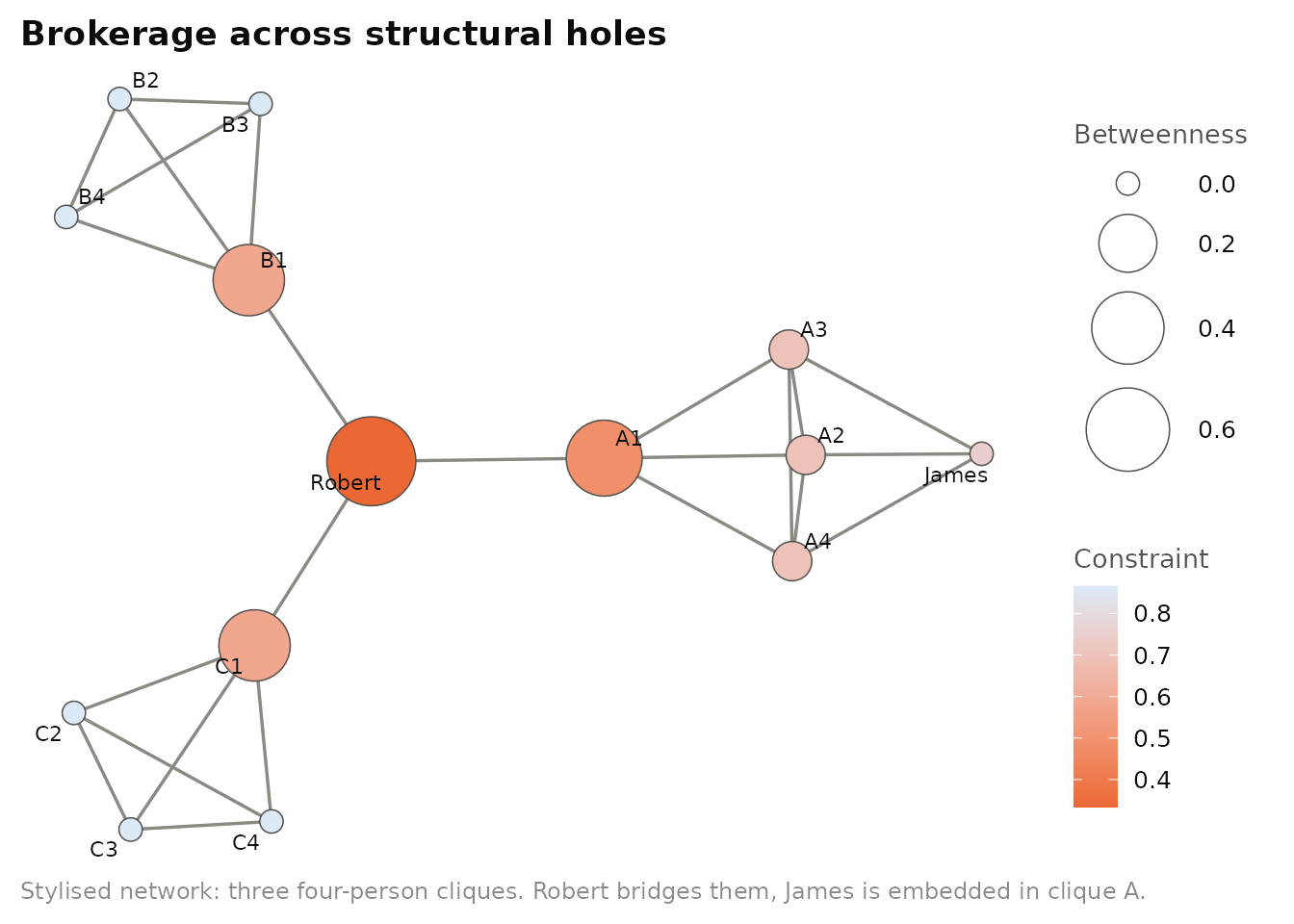
Figure 9.4: A broker spanning structural holes (stylised network). Node size shows betweenness centrality and colour shows Burt’s network constraint, both computed with igraph. Robert, who bridges three otherwise disconnected groups, has high betweenness and low constraint. James, embedded in a single closed group, has the reverse.
| Node | Degree | Betweenness (normalized) | Constraint |
|---|---|---|---|
| Robert | 3 | 0.718 | 0.333 |
| A1 | 4 | 0.462 | 0.484 |
| B1 | 4 | 0.385 | 0.583 |
| C1 | 4 | 0.385 | 0.583 |
| A2 | 4 | 0.043 | 0.701 |
| James | 3 | 0.000 | 0.750 |
| B2 | 3 | 0.000 | 0.866 |
Table 9.5 shows the numbers behind the figure. Robert has fewer contacts than James’s neighbours but the highest betweenness and the lowest constraint: every path between the three groups runs through him. James has as many contacts as Robert, but because they are all tied to one another, his constraint is high and his betweenness is close to zero. Degree alone would not distinguish their positions.
9.4.3 Evidence and extensions
Burt (2004) offered one of the most cited tests. Studying supply-chain managers in a large American electronics company, he found that managers whose networks spanned structural holes were more likely to express ideas that senior managers judged valuable, and that brokerage was associated with more favourable compensation, evaluations, and promotion. The mechanism is a vision advantage: people at the boundaries between groups are exposed to alternative ways of thinking and can translate practices from one group to another.
The brokerage argument has generated important counter-evidence and boundary conditions:
- Closure for innovation. In a longitudinal study of collaboration networks in the chemicals industry, Ahuja (2000) found that direct and indirect ties increased firms’ innovation output, but structural holes reduced it: consistent with the view that collaborative innovation requires the trust and norms that closure provides.
- Cohesion and range. Reagans and McEvily (2003) found that both network cohesion around a tie and the range of a person’s network eased knowledge transfer: cohesion increases willingness to help, while range increases the ability to convey knowledge to diverse audiences.
- Joining versus separating. Obstfeld (2005) proposed the tertius iungens orientation, brokers who introduce disconnected parties to one another rather than exploiting the gap, and found it associated with involvement in innovation in an engineering setting.
- Diversity-bandwidth trade-off. Aral and Van Alstyne (2011) showed that structurally diverse networks tend to have lower-bandwidth ties, so the novelty that brokerage provides comes at the cost of less information flow through each tie.
Brokerage or closure? The structural-holes and closure arguments make opposing predictions about the same network feature, and both have empirical support. Burt (2005) proposed a synthesis: closure within a group creates the trust and coordination needed to deliver value, while brokerage across groups creates the novelty that defines what value is. Performance is highest when a group is internally cohesive and externally well bridged. A second debate concerns selection: people with distinctive skills or personalities may both create brokerage positions and perform well, so causal claims require longitudinal or quasi-experimental designs (Borgatti et al. 2009).
Illustrative scenario: the cross-functional product manager. A product manager sits between engineering, sales, and customer-success groups that rarely talk to one another. She hears customer complaints before engineering does and can frame engineering constraints in commercial terms. Structural-holes theory predicts that she will generate more valuable ideas than single-function peers, and that her advantage would erode if the groups began to communicate directly. The firm must choose between preserving the brokerage role and closing the hole with formal coordination.
9.4.4 Using the theory in research
Sample hypotheses.
- H1. Employees with lower network constraint will generate ideas rated as more valuable by independent evaluators.
- H2. The positive effect of brokerage on idea quality will be stronger in units facing high environmental turbulence.
- H3. Firms whose alliance portfolios combine a cohesive core of partners with bridging ties to distant industries will produce more novel patents than firms with portfolios that are uniformly dense or uniformly sparse.
Designs. Sociometric surveys (“whom do you go to for advice?”). Network reconstruction from email, collaboration platform, co-authorship, patent co-invention, or alliance databases. Panel models with ego fixed effects to address selection. Randomized introductions or team assignments where feasible.
Measures. Constraint, effective size, and betweenness (Burt 1992, L. C. Freeman 1977). Brokerage roles, tie strength as frequency or duration. Outcomes
such as idea ratings, promotion, patent citations, or deal flow
(Wasserman and Faust 1994). In R, igraph computes all of these indices.
9.6 Commitment-Trust Theory of Relationship Marketing
Core claim. Successful relational exchange requires commitment and trust. They are the key mediating variables between a relationship’s antecedents (benefits, termination costs, shared values, communication, opportunism) and its outcomes (cooperation, acquiescence, reduced propensity to leave).
Origins. Marketing: R. M. Morgan and Hunt (1994), building on social exchange theory and on models of buyer-seller relationship development (Dwyer, Schurr, and Oh 1987).
Level of analysis. The relationship between exchange partners: suppliers, customers, channel members, and internal partners.
Key constructs. Relationship commitment, trust, relationship termination costs, relationship benefits, shared values, communication, opportunistic behaviour, cooperation, acquiescence, propensity to leave, functional conflict, decision-making uncertainty.
Boundary conditions. Most applicable to relational (rather than discrete) exchange, where future interaction is expected and partners are vulnerable to one another. Its predictions are weaker for low-involvement, transactional customers.
Related theories. Social exchange theory, Social capital, Transaction cost economics (Section 6.3).
9.6.1 Core logic and the KMV model
R. M. Morgan and Hunt (1994) argued that relationship marketing, establishing, developing, and maintaining successful relational exchanges, had become central to marketing, and that its success depended on two constructs. Relationship commitment is an exchange partner’s belief that an ongoing relationship is so important that it warrants maximum effort to maintain it. Trust exists when one party has confidence in an exchange partner’s reliability and integrity. They proposed that commitment and trust are key mediating variables (KMV): rather than relying on power to condition others, firms build relationships in which partners choose to cooperate. They identified ten forms of relational exchange spanning supplier, lateral (competitors, non-profit organizations, government), buyer, and internal (business units, employees, functional departments) partnerships, and tested the model with independent automobile tyre retailers’ relationships with their suppliers.
Figure 9.6 reproduces the structure of the model.
Figure 9.6: The key mediating variable (KMV) model of relationship marketing, after Morgan and Hunt (1994). Commitment and trust mediate the effects of five antecedents on five relational outcomes. Negative paths are marked with a minus sign.
The propositions embedded in the model are:
- P1. Relationship termination costs and relationship benefits increase commitment.
- P2. Shared values increase both commitment and trust.
- P3. Communication increases trust, opportunistic behaviour decreases it.
- P4. Trust increases commitment.
- P5. Commitment increases acquiescence and cooperation and decreases the propensity to leave. Trust increases cooperation and functional conflict (disagreements resolved amicably) and decreases decision-making uncertainty.
9.6.2 Evidence and extensions
The KMV model became one of the most cited frameworks in marketing, and later work refined it. Doney and Cannon (1997) analysed the processes through which industrial buyers come to trust suppliers and their salespeople, and found that trust influenced buyers’ anticipated future interaction with a supplier but did not directly determine the current supplier choice, which depended more on price and performance. Garbarino and Johnson (1999) found that for customers with weak relational orientation, overall satisfaction drove future intentions, whereas for highly relational customers, trust and commitment did: a segmentation insight with direct implications for loyalty programmes. In a meta-analysis, Palmatier et al. (2006) found that relationship-marketing efforts had larger effects on outcomes when relationships were more critical to customers, as in service offerings, channel exchanges, and business markets, and when relationships were built with an individual (such as a salesperson) rather than with the selling firm as a whole.
How much does trust explain? Commitment and trust are conceptually close to the outcomes they predict, so survey-based tests risk measuring one underlying evaluation several times. Many consumers, moreover, do not want “relationships” with brands at all (Garbarino and Johnson 1999). The theory also sits in tension with transaction cost economics (Section 6.3), which emphasizes safeguards against opportunism rather than trust. Contemporary research often treats contracts and relational governance as complements.
Toyota’s supplier network. Toyota’s relationships with its suppliers are a widely studied example of trust-based relational exchange in practice. The company organized supplier associations, provided consulting on production methods, and encouraged knowledge sharing among suppliers, creating a network in which members expected that sharing valuable know-how would be reciprocated rather than exploited (Dyer and Nobeoka 2000). The case shows all elements of the KMV model: high relationship benefits and termination costs, shared values around the Toyota Production System, frequent communication, and norms against opportunism, yielding cooperation that arm’s-length contracting would be unlikely to produce.
Sample hypotheses.
- H1. Supplier communication quality increases buyer trust, which mediates the effect of communication on buyer commitment.
- H2. The effect of trust on renewal is stronger for customers with high relational orientation than for customers with low relational orientation.
- H3. Salesperson turnover reduces customer commitment more when the relationship is anchored in a single individual than when it is anchored in multiple contacts.
Designs. Dyadic surveys with both buyer and supplier reports. CRM and contract-renewal data linked to survey measures. Panel data on salesperson departures as quasi-experimental shocks to relationships.
Measures. Commitment and trust scales (R. M. Morgan and Hunt 1994), relationship benefits and termination costs, objective outcomes such as share of wallet, retention, and contract renewals.
Measuring trust and commitment as one construct. Because the KMV model specifies distinct antecedents and outcomes for trust and commitment, collapsing them into a single “relationship quality” index loses the theory’s discriminating predictions. Demonstrate discriminant validity and test the mediating structure, including the direct effects the model does not predict.
9.7 Chapter Summary
- Social exchange theory explains relationships as the exchange of valued resources sustained by the norm of reciprocity. Unspecified obligations require and build trust (Blau 1964, Gouldner 1960, Cropanzano and Mitchell 2005).
- Power is relational: it equals the other party’s dependence, which rises with the value of what is provided and falls with the availability of alternatives (Emerson 1962).
- Network exchange theory shows that in negatively connected networks power comes from the ability to exclude, which centrality measures can miss (K. S. Cook et al. 1983, Markovsky, Willer, and Patton 1988).
- Weak ties matter because they bridge. The best causal evidence shows that moderately weak ties are the most valuable for job mobility (M. S. Granovetter 1973, Rajkumar et al. 2022).
- Embeddedness brings trust and joint problem-solving, but networks composed only of embedded ties become insular: the paradox of embeddedness (M. Granovetter 1985, Uzzi 1997).
- Brokerage across structural holes yields information and control benefits, while closure yields trust and coordination. High performance typically combines both (Burt 1992, 2005, Coleman 1988).
- Social capital has structural, relational, and cognitive dimensions and carries costs as well as benefits (Nahapiet and Ghoshal 1998, Adler and Kwon 2002, Portes 1998).
- Commitment and trust are the key mediating variables of successful relational exchange in marketing (R. M. Morgan and Hunt 1994, Palmatier et al. 2006).
Table 9.8 presents the comparison of the chapter’s theories.
| Theory | Unit of analysis | Key mechanism | Signature prediction | Typical business use |
|---|---|---|---|---|
| Social exchange | Dyad | Reciprocity, dependence | Support is repaid with effort and loyalty | Employee engagement, supplier relations |
| Network exchange | Position in network | Exclusion via alternatives | Positions whose partners lack alternatives gain power | Channel power, platform intermediation |
| Weak ties | Tie / network | Bridging to novel information | Moderately weak ties carry job and idea leads | Referral hiring, networking strategy |
| Embeddedness | Dyad / interfirm network | Trust, joint problem-solving | Mixed embedded and arm’s-length ties perform best | Supplier and alliance portfolios |
| Structural holes | Ego network | Non-redundant information, control | Brokers generate better ideas and advance faster | Boundary-spanning roles, innovation |
| Social capital | Individual to community | Closure and brokerage | Relationships yield returns and costs | Knowledge sharing, key accounts |
| Commitment-trust | Relationship | Commitment and trust as mediators | Trust and commitment drive cooperation and retention | Relationship marketing, B2B loyalty |
9.8 Discussion Questions
- Blau distinguished social from economic exchange. Is the employment relationship in a gig-economy platform an economic exchange, a social exchange, or both? What evidence would help you decide?
- Using Figure 9.2, explain why the most central position in the 5-line is predicted to be weak. Identify a real market in which a “central” intermediary has little bargaining power.
- Rajkumar et al. (2022) found that moderately weak ties were most useful for job mobility. Propose two mechanisms that could explain why the very weakest ties were less useful, and design a study to distinguish them.
- Uzzi’s paradox of embeddedness and Burt’s structural holes both imply that networks can be “too closed”. How do the two arguments differ in mechanism?
- A company wants to increase innovation by creating more boundary-spanning roles. Drawing on Burt (2004), Ahuja (2000), and Obstfeld (2005), what risks should it anticipate, and how should it measure success?
- For a B2B firm of your choice, map the antecedents of the KMV model (R. M. Morgan and Hunt 1994). Which antecedent would you invest in first, and why?
9.9 Further Reading
- Blau (1964): the classic statement of social exchange, power, and the difference between social and economic exchange.
- Cropanzano and Mitchell (2005): the most widely used management review of social exchange theory, with a clear account of its conceptual ambiguities.
- K. S. Cook and Whitmeyer (1992): a concise comparison of exchange-theoretic and network-analytic approaches to social structure.
- M. S. Granovetter (1973): the original weak-ties argument, short, elegant, and still generative.
- Rajkumar et al. (2022): a large-scale causal test of the weak-ties thesis that refines rather than overturns it.
- Uzzi (1997): a rich field study of embeddedness and its paradox in an interfirm network.
- Burt (2005): an accessible synthesis of brokerage and closure as forms of social capital.
- R. M. Morgan and Hunt (1994): the foundational commitment-trust model of relationship marketing.
9.1 Social Exchange Theory
Core claim. Social behaviour is an exchange of valued resources, material and non-material. Relationships persist when they are rewarding relative to the alternatives, and they deepen when unreciprocated benefits create obligations that are later repaid, building trust and commitment over time.
Origins. Sociology and social psychology: Homans (1958), Blau (1964), J. W. Thibaut and Kelley (1959), and Emerson (1962, 1976). The moral foundation is the norm of reciprocity (Gouldner 1960). Reviewed for management by Cropanzano and Mitchell (2005).
Level of analysis. Primarily the dyad (employee-organization, supervisor- subordinate, buyer-seller, firm-firm), extended to groups and networks.
Key constructs. Rewards and costs, comparison level for alternatives, reciprocity, dependence and power, trust, social versus economic exchange, perceived organizational support.
Boundary conditions. Actors value the resources exchanged, interact repeatedly, and can observe (at least roughly) what each party contributes. Exchange logic weakens where behaviour is governed by strong role obligations, pure altruism, or one-shot interactions with no prospect of repayment.
Related theories. Network exchange theory, Commitment-trust theory, Resource dependence theory (Section 7.1), Equity theory (Section 19.3), Agency theory (Section 6.1).
9.1.1 Origins and intellectual history
Social exchange theory emerged in the late 1950s and early 1960s from several directions at once. Homans (1958) proposed that social behaviour could be analysed as an exchange of goods, both material and non-material, approval and prestige as well as money and services, and that the behavioural regularities of small groups could be derived from elementary principles of reinforcement and cost. At almost the same moment, J. W. Thibaut and Kelley (1959) developed an interdependence framework in which each party evaluates a relationship against a comparison level (what one feels one deserves) and a comparison level for alternatives (what one could get elsewhere). A relationship can be unsatisfying yet stable if the alternatives are worse, and satisfying yet fragile if better alternatives appear.
Blau (1964) gave the theory its macro-sociological reach. He distinguished social exchange from economic exchange. Economic exchange specifies in advance what will be exchanged and is enforced by contract. Social exchange entails unspecified future obligations whose timing and form are left to the discretion of the party who owes them. Because repayment cannot be enforced, social exchange requires trust, and because it requires trust it also generates trust as obligations are honoured. Blau also showed how exchange produces power: when one party provides benefits that the other needs and cannot obtain elsewhere and cannot repay in kind, the recipient can discharge the obligation only by compliance.
Emerson (1962) formalized that last point in the power-dependence principle: the power of A over B equals the dependence of B on A, and B’s dependence increases with the value B places on what A provides and decreases with the availability of those resources outside the relationship. Power, in this view, is a property of the relation, not of an actor. Emerson also described balancing operations through which weaker parties reduce their dependence: withdrawing motivational investment, cultivating alternatives, forming coalitions, or conferring status on the stronger party. In a later review, Emerson (1976) described social exchange less as a single theory than as a frame of reference within which many theories about social interaction can be stated: a characterization that remains apt.
The moral foundation of the framework is the norm of reciprocity, which Gouldner (1960) argued is a near-universal component of moral codes. In its generic form it makes two demands: people should help those who have helped them, and people should not injure those who have helped them. The norm stabilizes social systems because it gives actors a reason to initiate exchange with strangers, the recipient of a favour is expected to repay, and because it carries the relationship across periods in which obligations are outstanding.
Definition 9.1 Social exchange. Voluntary actions of individuals that are motivated by the returns they are expected to bring and typically do bring from others (Blau 1964). Unlike economic exchange, the nature of the return is not specified in advance and cannot be bargained over or enforced.
Norm of reciprocity. A generalized moral norm prescribing that benefits be returned and that benefactors not be harmed (Gouldner 1960).
Dependence. The extent to which an actor’s valued outcomes are contingent on another actor’s behaviour, increasing in the value of the outcomes and decreasing in the availability of alternative sources (Emerson 1962).
9.1.2 Core logic and propositions
Cropanzano and Mitchell (2005) synthesize the management literature around three ideas: rules of exchange, the resources exchanged, and the relationships that emerge. The canonical sequence begins when one party (an actor) treats another favourably or unfavourably. The target reciprocates in kind, and if the exchange is successful the relationship moves from a sequence of transactions toward a high-quality relationship characterized by trust, loyalty, and mutual commitment. They also note an important conceptual ambiguity: “social exchange” has been used to refer both to a type of transaction (social rather than economic) and to a type of relationship, and research is clearer when the two meanings are kept apart.
The core propositions can be stated as follows:
Table 9.2 contrasts the two ideal types of exchange that Blau distinguished.
9.1.3 Mechanism
Figure 9.1 summarizes the mechanism. An initiating benefit, employer support, a supplier’s extra effort, a colleague’s favour, creates a felt obligation. Repayment shows that the partner can be trusted, which lowers the perceived risk of further giving and expands the relationship. The cycle can also run in reverse: mistreatment produces negative reciprocity, withdrawal, and eventually exit.
Figure 9.1: The social exchange cycle. Initiating benefits create felt obligation under the norm of reciprocity. Reciprocation builds trust, which encourages further exchange. Moderators shape the strength of each link.
9.1.4 Evidence and extensions
The most influential organizational application is organizational support theory. Eisenberger et al. (1986) proposed that employees form global beliefs about the extent to which the organization values their contributions and cares about their well-being, perceived organizational support (POS), and that they reciprocate high support with greater effort and attendance. Employees personify the organization, attributing the actions of its agents to the organization itself. In a review of the subsequent literature, Rhoades and Eisenberger (2002) found that fairness, supervisor support, and favourable rewards and job conditions were associated with POS, which was in turn associated with affective commitment, performance, and reduced withdrawal. Settoon, Bennett, and Liden (1996) showed that the exchange with the organization (POS) and the exchange with the immediate supervisor (leader-member exchange (Section 15.5)) are distinct: the former was more closely tied to organizational commitment (Section 15.10), the latter to in-role performance and citizenship behaviour.
Experimental sociology has refined the theory’s account of trust. Molm, Takahashi, and Peterson (2000) compared negotiated exchange, in which partners bargain jointly over binding terms, with reciprocal exchange, in which each gives unilaterally without knowing whether the other will return the favour. Trust was higher under reciprocal exchange: consistent with Blau’s argument that the risk of non-reciprocation is what allows partners to demonstrate trustworthiness. Lawler (2001) added an affective layer: successful exchange produces positive emotions, and when actors attribute those emotions to the relationship or group, they develop affective commitment to it.
Is social exchange theory too elastic? Almost any behaviour can be described after the fact as an “exchange” of some reward, which risks making the theory unfalsifiable. Cropanzano and Mitchell (2005) recommend precision: specify the rule of exchange (reciprocity, negotiation, or another rule), the resource exchanged, and whether the claim concerns a transaction or a relationship. A second debate pits self-interest against norms: Homans’s version rests on individual reinforcement, Gouldner’s on a moral norm, and the two diverge when repayment is unobserved or the giver cannot retaliate.
9.1.5 Applications in business
Employee reciprocity and perceived support. Organizational support theory gives HR leaders a concrete diagnostic. Actions that are discretionary, not required by law, contract, or union agreement, are especially informative to employees about the organization’s regard for them, and thus especially likely to trigger reciprocation (Rhoades and Eisenberger 2002). Flexible arrangements offered during a family emergency, investment in an employee’s development, or fair treatment in a restructuring signal that the organization values the individual. By contrast, benefits that employees attribute to external pressure generate less obligation. A practical implication is that the framing and discretion of support matter as much as its monetary value.
Illustrative scenario: dependence in a supplier relationship. A component maker that sells most of its output to one automotive assembler is highly dependent, so the assembler holds power (Emerson 1962). Emerson’s balancing operations suggest remedies: cultivating customers in adjacent industries, joining an industry consortium, or developing process know-how the assembler cannot easily replace. The same logic underlies resource dependence theory (Section 7.1) at the level of the firm.
9.1.6 Using the theory in research
Sample hypotheses.
Designs. Multi-wave employee surveys with lagged outcomes. Supervisor-rated performance to reduce common-method bias. Laboratory exchange experiments that manipulate negotiated versus reciprocal exchange. Dyadic buyer-supplier data with both sides reporting.
Measures. Survey of Perceived Organizational Support (Eisenberger et al. 1986). Leader-member exchange scales. Dependence measured as sales share and switching costs. Trust and commitment scales from relationship-marketing research (R. M. Morgan and Hunt 1994).
Contexts. Employment relationships, gig and platform work, supplier partnerships, franchise systems, professional services.
Labelling every positive association “social exchange”. A correlation between POS and performance does not by itself show reciprocation. The same pattern could arise because high performers receive more support. Establish temporal order, model the reciprocal path, and, where possible, measure felt obligation as the mediating mechanism rather than assuming it.