8 Information, Signals, and Markets
Why does a used-car dealer offer a 12-month warranty it hopes never to honour? Why do start-ups pay premium fees to be underwritten by prestigious investment banks, and why do some of the wealthiest consumers buy handbags with no visible logo? Each puzzle has the same structure. One party knows something valuable, the quality of a car, the prospects of a firm, the wealth of a buyer, and another party cannot observe it directly. The informed party therefore does something observable that the uninformed party can use to infer what is hidden.
This chapter introduces the family of theories that explain how markets, organizations, and people cope with information asymmetry. We begin with the problem itself (Akerlof’s “lemons”), then develop signaling theory, its mirror image screening theory, the biology-inspired idea of costly signaling, and two consumer-behaviour extensions: identity signaling and countersignaling. Together they form one of the most widely used theoretical toolkits in management, marketing, finance, and economics (Table 8.1).
| Theory | Core question | Level of analysis | Key source |
|---|---|---|---|
| Information asymmetry | What happens when one side of a transaction knows more? | Market / dyad | Akerlof (1970) |
| Signaling theory | How can the informed party credibly reveal hidden quality? | Dyad / market | Spence (1973) |
| Screening theory | How can the uninformed party induce disclosure? | Dyad / market | Rothschild & Stiglitz (1976) |
| Costly signaling | Why must honest signals be expensive to fake? | Individual / population | Zahavi (1975) |
| Identity signaling | Why do consumers converge or diverge in their choices? | Individual / group | Berger & Heath (2007) |
| Countersignaling | Why do the highest types sometimes refuse to signal? | Individual / market | Feltovich et al. (2002) |
8.1 Information Asymmetry
Core claim. When sellers know more about quality than buyers, buyers pay only for average quality. High-quality sellers withdraw, average quality falls, and the market can unravel.
Origins. Economics. Akerlof (1970), building on earlier work on uncertainty and insurance. Akerlof, Spence, and Stiglitz shared the 2001 Nobel Memorial Prize in Economic Sciences for analyses of markets with asymmetric information.
Level of analysis. Market and dyad (buyer-seller, investor-firm, employer-applicant).
Key constructs. Hidden information (adverse selection), hidden action (moral hazard), quality uncertainty, pooling.
Boundary conditions. Quality is unobservable before purchase, is costly to verify, and matters to the buyer. No cheap third-party verification exists.
Related theories. Signaling, Screening, Agency theory (Section 6.1), Transaction cost economics (Section 6.3).
8.1.1 Core logic
Akerlof (1970) used the market for used cars to show how hidden quality can destroy a market. Suppose half of the cars are good (“peaches”) and half are bad (“lemons”). Buyers cannot tell them apart, so they are willing to pay only the expected value of a random car. Owners of good cars find that price too low and keep their cars. The share of lemons in the market rises. Buyers anticipate this and lower their offers further. In the limit, only lemons trade. The general lesson is that adverse selection, the tendency of hidden-information markets to attract the “wrong” types, can make mutually beneficial trades disappear.
Economists distinguish two forms of asymmetry (Stiglitz 2000, Connelly et al. 2011) (Table 8.2):
| Dimension | Hidden information | Hidden action |
|---|---|---|
| Also called | Adverse selection | Moral hazard |
| What is hidden | A characteristic (quality, ability, risk type) | Behaviour after contracting (effort, care) |
| Timing | Before the transaction | After the transaction |
| Classic example | Used-car quality, applicant ability | Insured driver’s care, manager’s effort |
| Typical remedy | Signals, screens, certification, warranties | Monitoring, incentives, bonding |
| Home theory | Signaling / screening theory | Agency theory |
8.1.2 Mechanism
Figure 8.1 simulates the unravelling process. Quality is uniformly distributed, buyers value a car at 1.2 times its quality, and sellers only sell if the price is at least their car’s quality. Each round, buyers offer the expected value of the cars that remain on the market. The market shrinks round after round.
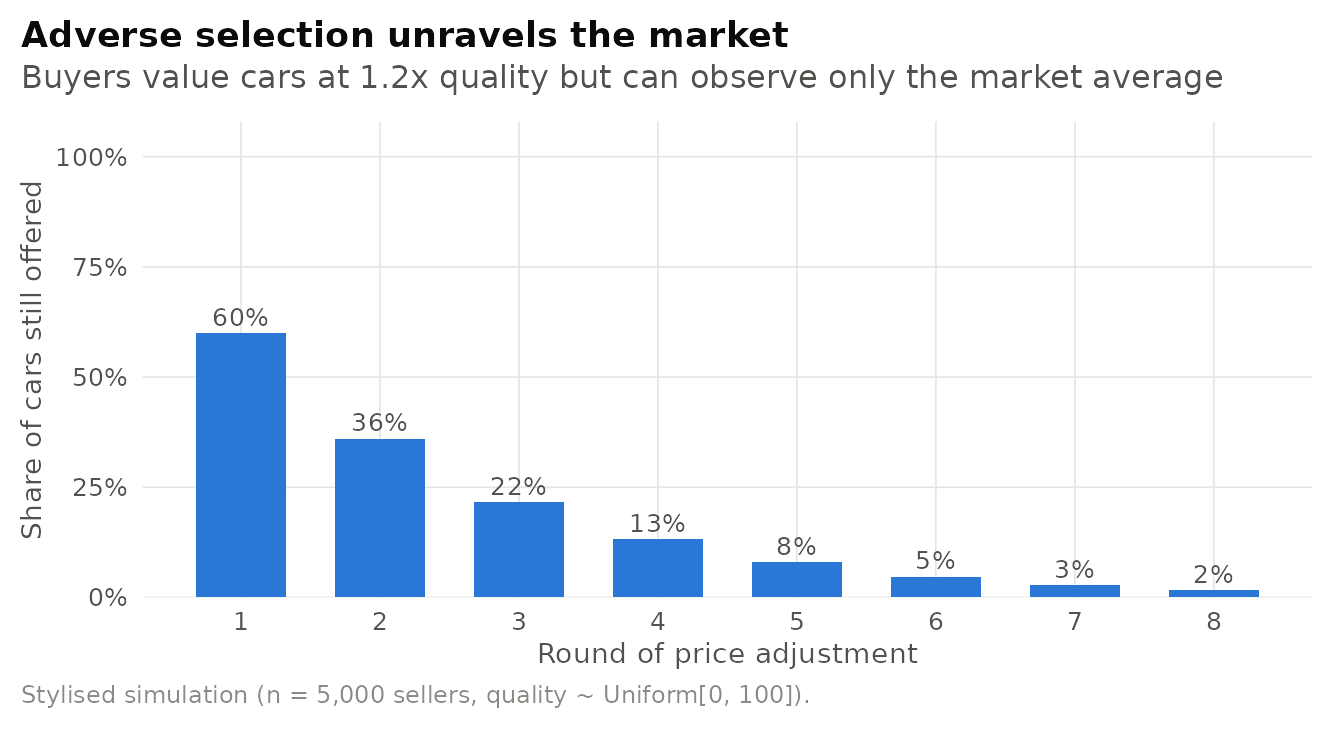
Figure 8.1: Illustrative simulation of Akerlof’s lemons problem: when buyers can only pay for average quality, the best sellers exit and the market shrinks.
8.1.3 Applications in business
Certified pre-owned programs. The used-car market is the textbook lemons market, and the industry’s best-known response is the manufacturer-backed certified pre-owned (CPO) program: a multi-point inspection plus an extended warranty. Both elements attack the asymmetry directly: inspection converts hidden information into verifiable information, and the warranty makes a low-quality car expensive for the seller to certify. Similar logic underlies home-inspection contingencies in real estate, escrow services in online marketplaces, and “satisfaction guaranteed” return policies in retailing.
Mandatory disclosure. Information can also be disclosed by regulation. When Los Angeles County required restaurants to post hygiene grade cards in their windows, health inspection scores rose and foodborne-illness hospitalizations fell (Jin and Leslie 2003). A hidden attribute (kitchen hygiene) became a visible one, and consumers and restaurants both responded. See Dranove and Jin (2010) for a review of disclosure and certification.
8.2 Signaling Theory
Core claim. An informed party (the signaler) can credibly convey unobservable quality by taking a costly, observable action that low-quality types would find too expensive to imitate.
Origins. Labour economics. Spence (1973) on education as a job-market signal. Reviewed in Spence (2002) and, for management, Connelly et al. (2011).
Level of analysis. Dyad and market: job applicant-employer, firm-investor, brand-consumer, start-up-venture capitalist.
Key constructs. Signaler, receiver, signal, signal cost, signal fit, signal observability, signal consistency, separating vs. pooling equilibrium, feedback (countersignals).
Boundary conditions. Quality is unobservable ex ante. The cost of the signal is negatively correlated with quality. Receivers can observe the signal and know (or learn) how to interpret it.
Related theories. Information asymmetry, Screening, Costly signaling, Agency theory (Section 6.1), Institutional theory (Section 7.2).
8.2.1 Origins and intellectual history
Spence (1973) asked why employers pay more to workers with more education even if education teaches nothing productive. His answer: education is a signal. If acquiring a degree is less costly, in effort, time, or psychic cost, for high-ability people, then only high-ability people will find it worthwhile to acquire it, and employers can rationally use the degree to sort applicants. The signal need not create the quality it reveals. It only needs to be harder to obtain for those who lack it.
The idea spread quickly. In finance, debt levels and dividends were modelled as signals of managers’ private information (S. A. Ross 1977, S. Bhattacharya 1979, Myers and Majluf 1984). In marketing, advertising spending, price, warranties, and brand names were analysed as signals of unobservable product quality (P. Nelson 1974, P. Milgrom and Roberts 1986, Kirmani and Wright 1989, Boulding and Kirmani 1993, Erdem and Swait 1998, Kirmani and Rao 2000). In management, signaling theory became a standard lens for IPOs, board composition, corporate social responsibility, and the hiring process (Certo 2003, Connelly et al. 2011, Bergh et al. 2014).
8.2.2 Core logic and propositions
Connelly et al. (2011) organize signaling theory around a timeline with four elements. Figure 8.2 redraws that logic.
Figure 8.2: The signaling timeline: a signaler with private information sends a signal. The receiver observes and interprets it, chooses an action, and may send feedback. Adapted from the framework in Connelly et al. (2011).
Formally, a signal is informative when it supports a separating equilibrium: different types choose different signals, so the receiver can infer type from the signal. When all types send the same signal, the equilibrium is pooling and the signal carries no information. The theory’s central propositions can be stated as follows:
- P1 (Differential cost). A signal separates types only if its cost is lower for high-quality than for low-quality signalers (the single-crossing condition).
- P2 (Observability). The more observable a signal is to receivers, the stronger its effect on receiver beliefs (Connelly et al. 2011).
- P3 (Fit). Signals are more effective when they are logically connected to the unobservable quality being signalled (e.g., a warranty fits durability. A celebrity endorsement fits less well).
- P4 (Consistency). Consistent signals across time and channels are more credible than one-off or conflicting signals.
- P5 (Receiver attention and interpretation). Signal effects depend on whether receivers attend to the signal and on how they calibrate it. Signals are socially interpreted, not mechanically decoded.
Figure 8.3 shows the single-crossing logic for Spence’s education model. Because the high-ability type’s cost line is flatter, there is a range of education levels (shaded) that high types are willing to acquire but low types are not. Any education requirement in that range separates the two types.
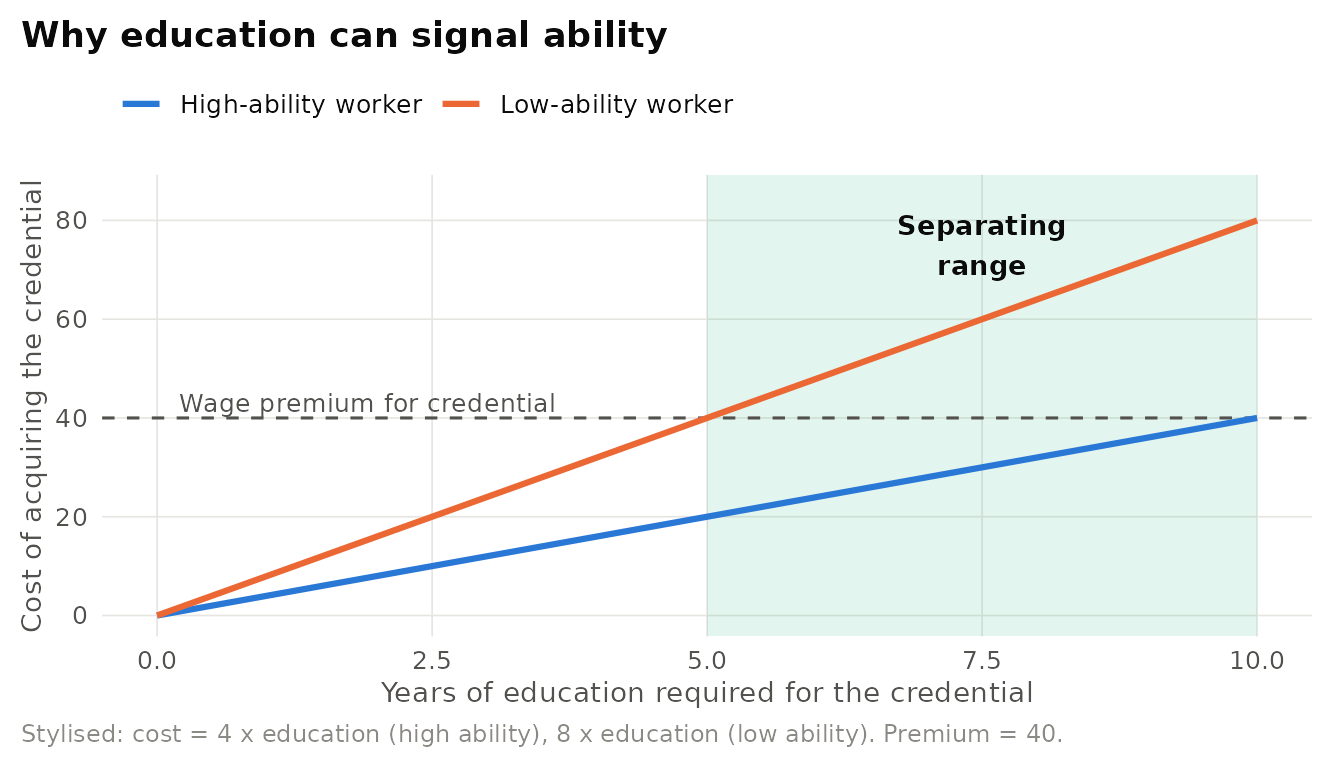
Figure 8.3: Stylised Spence model. Education costs more for low-ability workers. A credential level in the shaded range is worth acquiring for high-ability workers (wage premium exceeds cost) but not for low-ability workers, producing a separating equilibrium.
8.2.3 Characteristics of effective signals
Table 8.3 summarises the constructs that empirical studies most often operationalize.
| Element | Construct | Definition | Example operationalization |
|---|---|---|---|
| Signaler | Signaler quality | The unobservable ability of the signaler to meet receivers’ needs | Post-IPO survival, product failure rate |
| Signaler | Honesty / credibility | Whether the signaler actually has the signalled quality | Restatements, litigation, returns |
| Signal | Signal cost | Expense of producing the signal, ideally higher for low types | Advertising spend, warranty length |
| Signal | Observability | Extent to which receivers can notice the signal | Media coverage, logo size |
| Signal | Fit | Correspondence between signal and the underlying quality | Warranty to durability, patents to innovativeness |
| Signal | Consistency | Agreement among signals over time and sources | Variance in ratings, repeated certification |
| Receiver | Attention | Receiver vigilance in scanning for signals | Analyst coverage, search behaviour |
| Receiver | Interpretation | How receivers translate signals into beliefs | Price paid, valuation, choice |
| Environment | Noise / distortion | Factors that reduce signal clarity | Number of competing signals, market volatility |
8.2.4 Evidence and extensions
The empirical record is large and spans disciplines:
- Product quality. Consumers infer quality from warranties (Boulding and Kirmani 1993), perceived advertising expense (Kirmani and Wright 1989), and price-advertising combinations (P. Milgrom and Roberts 1986). Kirmani and Rao (2000) synthesise this literature and argue that “no pain, no gain”: signals work when a low-quality firm would lose money by sending them.
- Brands. Erdem and Swait (1998) conceptualise brand equity (Section 27.3) itself as a signal: a brand is a credible promise because the firm has invested in it and stands to lose that investment if it cheats.
- Capital markets. Prestigious boards and underwriters are associated with better IPO outcomes (Certo 2003). In corporate finance, issuing equity can signal that managers believe shares are overvalued, which helps explain negative stock-price reactions to equity issues (Myers and Majluf 1984).
- Management research. Bergh et al. (2014) note that many studies assume rather than test the differential-cost condition, and call for research on equilibrium: whether signals actually separate types in the population studied.
Is it really a signal? Many papers label any observable firm attribute a “signal”. Critics argue that a variable is a signal in the theoretical sense only if (a) it is chosen by the signaler, (b) its cost differs by type, and (c) it changes receiver beliefs. Without evidence on (b), a “signal” may simply be a correlate of quality, and the theory is doing little explanatory work (Bergh et al. 2014). A second debate concerns the human capital alternative: education may raise productivity and also signal it. Separating these explanations requires careful designs (e.g., sheepskin effects, natural experiments).
8.2.5 Applications in business
Signals appear in every business function. Table 8.4 maps common signals to the hidden attributes they communicate.
| Function | Signaler | Hidden attribute | Signal | Why it is costly to fake |
|---|---|---|---|---|
| Marketing | Manufacturer | Product durability | Long warranty | Low-quality products generate expensive claims |
| Marketing | New brand | Quality and staying power | Heavy launch advertising | Spend is recouped only through repeat purchase |
| Finance | IPO firm | Firm prospects | Prestigious underwriter / board | Reputational intermediaries screen and risk their name |
| Finance | Mature firm | Stable cash flows | Regular dividends | Cutting dividends later is penalised |
| HR | Job applicant | Ability and diligence | Degree, certifications | Harder to complete for lower-ability candidates |
| HR | Employer | Good workplace | Employer awards, transparent pay | Audits and employee reviews expose false claims |
| Strategy | Incumbent | Resolve to fight entry | Capacity investment | Sunk costs are lost if the firm retreats |
| Platforms | Seller | Reliability | Verified badges, long review history | Reputation takes time to build and is lost by cheating |
Venture funding and the start-up signaling stack. An early-stage start-up has little revenue history, so investors rely heavily on signals: the founders’ track records, affiliation with selective accelerators, patents, and the identity of earlier investors. Each signal is costly to obtain for a weak venture: an accelerator screens out most applicants. A top-tier lead investor stakes its reputation. A practical implication for founders is signal fit: patents are a strong signal of technical novelty but a weak signal of go-to-market ability, whereas paying pilot customers signal demand. Investors, in turn, should ask whether a signal is differentially costly: a polished pitch deck is not.
Illustrative scenario: warranty design. A mid-market appliance maker has a lower failure rate than its rivals but cannot convince retailers. Moving from a one-year to a five-year warranty is a credible signal precisely because it would bankrupt a firm with a high failure rate. A back-of-the-envelope test: expected warranty cost per unit = failure probability × repair cost × years covered. If that cost is small for the focal firm but large for imitators, the warranty separates. If every competitor can match it cheaply, the warranty will be copied and the market will pool.
8.2.6 Using the theory in research
Sample hypotheses.
- H1. Firms that offer longer warranties will receive higher consumer quality ratings, and this effect will be stronger for experience goods than for search goods.
- H2. The positive effect of underwriter prestige on IPO valuation will be weaker when analyst coverage of the industry is high (lower information asymmetry).
- H3. Signal consistency (low variance across third-party ratings) will strengthen the effect of average rating on sales.
Designs. Field data with plausibly exogenous variation in signal cost (policy changes, certification thresholds). Regression discontinuity around rating cut-offs. Lab or online experiments manipulating signal presence and cost. Structural models that estimate types and equilibria.
Measures. Signal cost (spend, warranty length, credential difficulty). Observability (media mentions, prominence), receiver response (price, choice, valuation, hiring). Information asymmetry (analyst dispersion, firm age, intangibles ratio).
Contexts. IPOs and crowdfunding, online marketplaces and reviews, hiring and credentials, ESG disclosure, product launches.
Treating every attribute as a signal. Theory requires that the signal be chosen and differentially costly. If you cannot argue, and ideally show, that low-quality signalers would find the signal more expensive, you are probably studying a correlate of quality, not a signal. State the cost structure explicitly and test for heterogeneity in signal effects across levels of information asymmetry.
8.3 Screening Theory
Core claim. When the uninformed party moves first, it can design a menu of contracts that induces informed parties to self-select, revealing their type through the option they choose.
Origins. Insurance economics, Rothschild and Stiglitz (1976), Stiglitz (2000).
Level of analysis. Dyad and market (insurer-insured, lender-borrower, employer-applicant, firm-customer).
Key constructs. Self-selection, incentive compatibility, menu of contracts, information rents.
Boundary conditions. The uninformed party can commit to a menu. Types differ in preferences or costs in a way the menu can exploit.
Related theories. Signaling, Agency theory (Section 6.1).
Signaling and screening are mirror images. In signaling, the informed party moves first. In screening, the uninformed party moves first by offering choices. An insurer that offers both a low-premium/high-deductible plan and a high-premium/low-deductible plan lets customers sort themselves: low-risk drivers prefer the high deductible because they expect few claims (Rothschild and Stiglitz 1976) (Table 8.5).
| Feature | Signaling | Screening |
|---|---|---|
| Who moves first | Informed party (signaler) | Uninformed party (screener) |
| Instrument | Costly action or credential | Menu of contracts or options |
| Revelation through | Choice of signal | Self-selection among options |
| Classic model | Spence (1973) job market | Rothschild & Stiglitz (1976) insurance |
| Business examples | Warranties, degrees, certifications | Deductibles, versioning, probation periods, freemium tiers |
Versioning and freemium. Software firms routinely screen customers by offering tiers: a free plan with limits, a professional plan, and an enterprise plan with security and compliance features. Customers with high willingness to pay self-select into higher tiers because the features they need are only available there. The design problem is incentive compatibility: each tier must be the best choice for the segment it targets, or high-value customers will “trade down”.
8.4 Costly Signaling
Core claim. Signals are honest when they are costly in a way only high-quality senders can afford: the handicap principle.
Origins. Evolutionary biology (Zahavi 1975). Anticipated in economics by Veblen’s analysis of conspicuous consumption (Veblen 1899).
Level of analysis. Individual (organism or consumer) within a population.
Key constructs. Handicap, honest signal, conspicuous consumption, status.
Related theories. Signaling, Snob effect (Section 29.5), Identity signaling.
Zahavi (1975) proposed that the peacock’s tail is an honest signal of fitness because it is a handicap: only a healthy bird can survive while carrying it. Veblen had made a parallel argument about the “leisure class”, whose conspicuous waste of time and money demonstrated wealth (Veblen 1899). In consumer research, costly signaling explains luxury consumption, charitable giving with public recognition, and expensive rituals that demonstrate commitment.
As Berger (2016) puts it, the more costly something is, the more likely it is to retain its value as a clear signal. Costs need not be monetary: they can be time (mastering an esoteric hobby), opportunity (forgoing alternatives), or knowledge (insider tastes that take years to acquire).
8.5 Identity Signaling
Core claim. Consumers diverge from others in product domains that signal identity. When outgroups adopt a taste, ingroup members abandon it to avoid signalling an undesired identity.
Origins. Consumer psychology, Berger and Heath (2007), popularised in Berger (2016).
Level of analysis. Individual consumer within social groups.
Key constructs. Identity-relevance of the domain, observability, outgroup adoption, misidentification cost.
Related theories. Optimal distinctiveness (Section 22.3), Social identity theory (Section 22.2), Snob effect (Section 29.5).
People do not diverge everywhere. Berger and Heath (2007) show that divergence is concentrated in domains seen as identity-relevant, music, clothing, hairstyles, cars, rather than in functional domains such as dish soap. Two features make a domain a good identity signal: it is observable to others, and it is chosen for its symbolic rather than functional value. When a dissimilar outgroup adopts a taste, ingroup members abandon it because continued use risks misidentification (Berger and Heath 2007, Berger 2016).
This produces a cycle that marketers know well: identity signaling causes tastes to catch on within groups and also to die out once they diffuse too broadly. Counterfeits accelerate the cycle by diluting a signal’s exclusivity, pushing early adopters toward the next thing (Berger 2016) (Figure 8.4).
Figure 8.4: Mechanism of identity signaling: outgroup adoption lowers a product’s value as an identity signal in observable, identity-relevant domains, prompting ingroup abandonment.
Managing the fashion cycle. Brands with strong identity value face a paradox: growth dilutes the signal that made them attractive. Common responses include limited editions and “drops” that ration supply, sub-brands for different segments, and pricing architecture that keeps a flagship line exclusive. Each is a way of preserving signal value while expanding reach.
8.6 Countersignaling
Core claim. High types sometimes avoid the signal that medium types use, because they are confident that other information already separates them from low types.
Origins. Economics, Feltovich, Harbaugh, and To (2002), consumer research on brand prominence, Y. J. Han, Nunes, and Drèze (2010).
Level of analysis. Individual and market.
Key constructs. Low / medium / high types, extraneous information, brand prominence, “quiet” signals.
Feltovich, Harbaugh, and To (2002) explain why the most talented students sometimes do not bother to show off, why the wealthiest dress down, and why the most secure firms forgo flashy marketing. If receivers have other, noisy information that already sets high types apart from low types, medium types still need to signal to separate themselves from low types, but high types can separate from medium types by not signaling.
Y. J. Han, Nunes, and Drèze (2010) found a consumer analogue in luxury goods. They classified consumers by wealth and need for status. Status-seeking consumers without old wealth (“parvenus”) prefer loud, prominently branded goods. Wealthy consumers with a low need for status (“patricians”) prefer quiet goods whose subtle cues are recognisable only to fellow insiders. The result is a non-monotonic relationship between price and logo prominence, sketched in Figure 8.5.
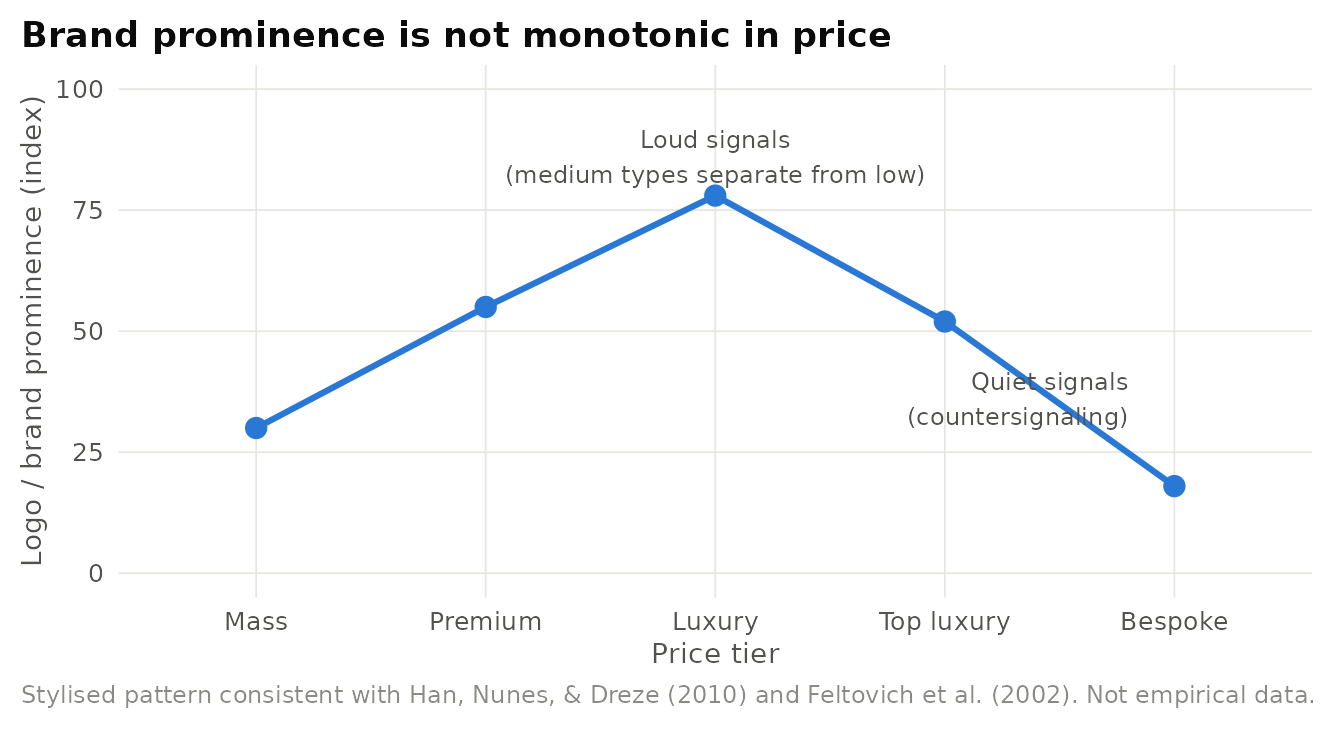
Figure 8.5: Stylised relationship between price tier and brand prominence implied by countersignaling: prominence rises with price for status-seeking buyers but falls at the very top, where quiet signals speak only to insiders.
8.7 Chapter Summary
- Information asymmetry can unravel markets through adverse selection (Akerlof 1970). Remedies include signals, screens, certification, and disclosure.
- A signal is a chosen, observable action whose cost is lower for high-quality types. Without differential cost, it cannot separate types (Spence 1973).
- Effective signals are observable, costly to fake, consistent, and fit the hidden attribute (Connelly et al. 2011).
- Screening inverts the logic: the uninformed party designs a menu so that types self-select (Rothschild and Stiglitz 1976).
- Costly signaling and identity signaling extend the theory to status and social identity. Tastes catch on and die out as signals diffuse (Berger and Heath 2007).
- Countersignaling explains why the highest types sometimes refuse to signal (Feltovich, Harbaugh, and To 2002, Y. J. Han, Nunes, and Drèze 2010).
Table 8.6 presents the comparison of the chapter’s theories.
| Theory | Who acts | Key mechanism | Signature prediction | Typical business use |
|---|---|---|---|---|
| Information asymmetry | Market | Adverse selection | High-quality sellers exit | Diagnosing market failure |
| Signaling | Informed party | Differential cost | Signals separate types | Warranties, credentials, IPO design |
| Screening | Uninformed party | Self-selection | Menus reveal types | Pricing tiers, insurance, hiring |
| Costly signaling | Signaler | Handicap | Wasteful displays are honest | Luxury, philanthropy, commitment |
| Identity signaling | Consumer | Misidentification cost | Divergence after outgroup adoption | Brand and fashion cycles |
| Countersignaling | High types | Other info already separates | Top types under-signal | Quiet luxury, understated positioning |
8.8 Discussion Questions
- Spence’s model implies that education can be valuable even if it teaches nothing. What evidence would distinguish a signaling account from a human-capital account of the college wage premium?
- Choose a product category you know well. List three signals sellers use and evaluate each on cost, observability, fit, and consistency.
- Online reviews are often described as solving the lemons problem. Under what conditions might reviews themselves become a pooling signal?
- Design a screening menu for a B2B software firm with three customer segments. How would you test whether the menu is incentive-compatible?
- When would you predict countersignaling in a labour market? Formulate a testable hypothesis.
- A firm announces an ESG certification. What would you need to show to argue that the certification is a signal rather than a correlate of firm quality?
8.9 Further Reading
- Akerlof (1970): the foundational statement of adverse selection. Short and readable.
- Spence (1973): the original signaling model, the logic behind every later application.
- Connelly et al. (2011): the standard review of signaling theory in management, with a useful construct glossary.
- Kirmani and Rao (2000): a marketing-focused review of quality signals and when they work.
- Bergh et al. (2014): a critical assessment of how management research uses (and misuses) signaling theory.
- Y. J. Han, Nunes, and Drèze (2010): an elegant demonstration of countersignaling in luxury consumption.
- Berger (2016): an accessible book on social influence and identity signaling.