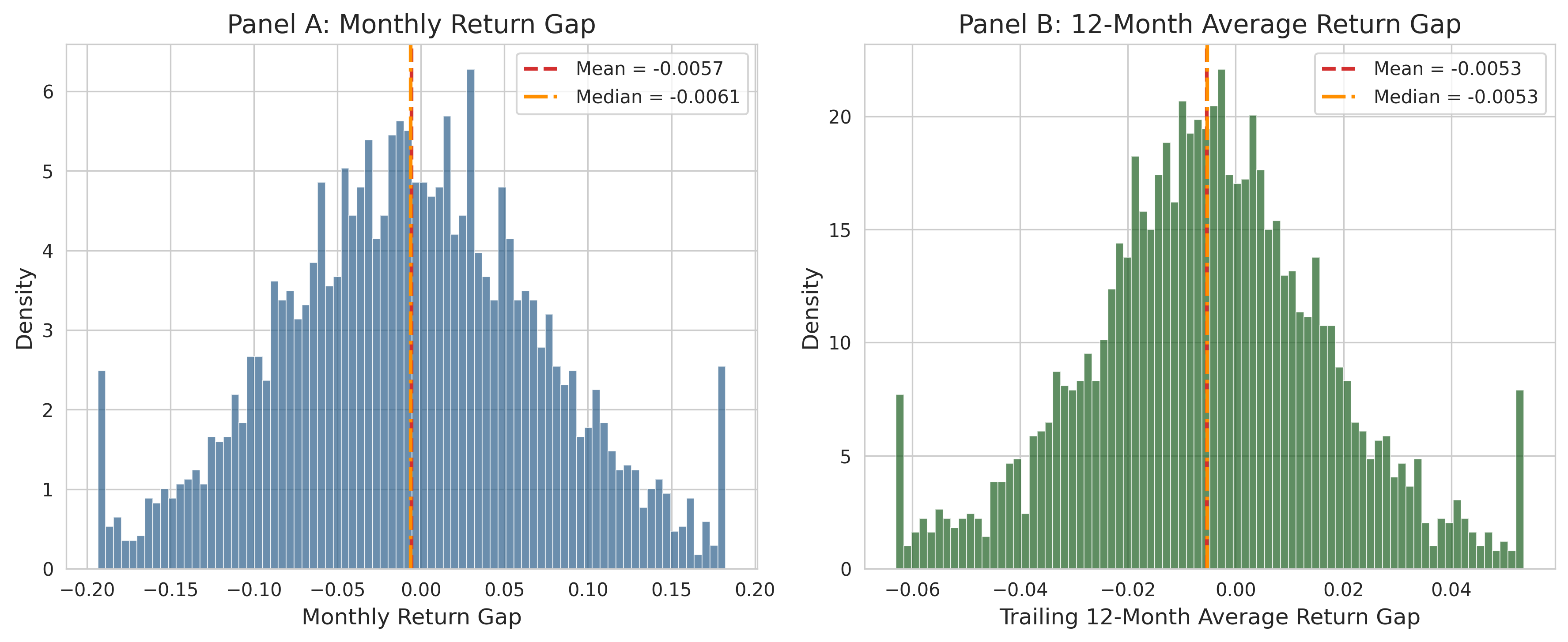
Mutual fund managers possess considerable discretion in their investment decisions between mandatory portfolio disclosure dates. While regulatory frameworks require periodic disclosure of holdings, the actions taken between these disclosure dates (e.g., trading, market timing, securities lending, and strategic cash management) remain largely unobservable to investors. These unobserved actions can significantly affect fund performance, either positively through skilled interim trading or negatively through agency costs and hidden behavior.
Kacperczyk, Sialm, and Zheng (2008) developed the Return Gap measure to capture the aggregate impact of these unobserved actions on fund returns. The Return Gap is defined as the difference between a fund’s actual reported return and the hypothetical return of a portfolio that mechanically invests in the fund’s most recently disclosed holdings. Formally:
where \(R_{i,t}^{\text{Actual}}\) is the net-of-expense return reported by fund \(i\) in month \(t\), adjusted for expenses to obtain the gross return, and \(R_{i,t}^{\text{Holdings}}\) is the hypothetical buy-and-hold return computed from the most recently disclosed portfolio holdings.
A positive Return Gap indicates that the fund manager’s unobserved actions (e.g., interim trading, cash management, or other activities) added value beyond what a passive replication of disclosed holdings would have generated. Conversely, a persistently negative Return Gap suggests value-destroying interim activity, potentially driven by agency costs, poor trading execution, or hidden fees.
37.1 Why Return Gap Matters
The Return Gap is economically significant for several reasons:
Performance persistence: Funds in the highest Return Gap decile tend to outperform those in the lowest decile by 1-2% annually on a risk-adjusted basis, and this spread persists over time (Kacperczyk, Sialm, and Zheng 2008).
Detecting agency problems: A persistently negative Return Gap can signal hidden costs such as excessive trading, market impact costs, soft-dollar arrangements, or stale-price exploitation.
Complementing traditional measures: Unlike alpha-based metrics that blend stock selection skill with interim trading skill, the Return Gap isolates the component of performance attributable to actions taken between disclosure dates.
Regulatory implications: In emerging markets like Vietnam, where disclosure frequency and regulatory oversight may differ from developed markets, the Return Gap can serve as an early warning system for investor protection.
37.2 Hidden Payments: Revenue Sharing, Distribution, and Menu Design
The Return Gap quantifies the consequences of what managers do between disclosure dates. A complementary literature shows that investor outcomes are equally shaped by payments that flow between funds and their distributors, largely out of investors’ sight. Pool, Sialm, and Stefanescu (2026) provide the sharpest evidence from US 401(k) plans, where the recordkeeper administering the plan is often compensated indirectly through revenue sharing: rebates paid by third-party mutual funds on the plan menu out of their expense ratios. These arrangements distort the menu itself: revenue-sharing funds are more likely to be added and less likely to be removed, and revenue-sharing plans are more expensive overall, with higher expense ratios that are offset neither by lower direct fees nor by better performance. Rebates also rise with the recordkeeper’s market power, consistent with funds sharing revenue to buy access to retirement assets.
The result extends an older literature on distribution conflicts in delegated asset management. Pool, Sialm, and Stefanescu (2016) show that mutual fund families acting as 401(k) plan trustees favor their own affiliated funds in menu decisions, particularly poorly performing ones, and that participants do not undo this favoritism. Sialm, Starks, and Zhang (2015) find that defined-contribution plan flows respond strongly to performance, but largely because plan sponsors add and delete menu options, which concentrates influence in exactly the intermediaries whose incentives revenue sharing targets. Outside retirement plans, Bergstresser, Chalmers, and Tufano (2009) document that broker-sold funds underperform direct-sold funds even before distribution fees, and Christoffersen, Evans, and Musto (2013) show that payments to brokers predict fund flows and lower subsequent performance, indicating that intermediary compensation, not just investor demand, steers money.
These findings matter for Vietnam because its fund industry is distribution-driven: most open-ended fund assets are gathered through banks, securities brokers, and licensed fund platforms, voluntary supplementary pension schemes are still nascent, and the fee arrangements between fund managers and distributors are not systematically disclosed. As menu-style products spread through fund platforms, pension-linked insurance, and employer-sponsored savings arrangements, the US evidence suggests a clear research and regulatory agenda: measure not only what funds report and hold, but also who is paid for shelf space, because those payments predict both menu composition and investor costs. The Return Gap methodology developed in this chapter and fee-based diagnostics are complements in that agenda: one tracks hidden actions, the other hidden payments.
37.3 Hidden Inputs: Human Capital and Fund Skill
A third thing investors rarely observe is who produces the fund’s performance. Alpha, the Return Gap, and related skill measures are outputs; the inputs are the analysts and quantitative staff the management company manages to hire. Identifying the causal contribution of those inputs is hard because talented people sort into funds that would have done well anyway. Chen et al. (2026) solve the selection problem with a lottery. US hedge fund management companies apply for H-1B skilled-worker visas, and when applications exceed the annual quota, the visas are allocated by random draw, so two companies that applied for the same number of visas but won different numbers are comparable ex ante. Companies that win more visas subsequently deliver higher alphas, Sharpe ratios, and information ratios. The effect is traced to well-paid, highly educated workers with quantitative skills, who help funds develop distinctive strategies, arbitrage prominent stock anomalies, and relieve capacity constraints. Two further results sharpen the interpretation: an unexpected cut in the H-1B quota hurt the performance of the funds most dependent on such workers, and alpha generation is greatest for workers from countries with the longest waits for US permanent residency, consistent with funds exploiting a labor market friction that ties workers to their sponsor.
The design has a direct Vietnamese analogue. Fund management companies in Vietnam compete for a small pool of CFA-qualified analysts and quantitatively trained staff, foreign-affiliated managers rotate expatriate personnel in and out of Ho Chi Minh City, and work-permit and licensing rules for foreign professionals change over time. A researcher who can observe staffing at the management-company level, whether from SSC licensing records for fund management practitioners, work-permit data, or LinkedIn-style professional profiles, can ask whether skilled hires predict subsequent alpha and Return Gap, and can exploit regulatory changes in foreign-labor rules as the shock. The lesson from Chen et al. (2026) is that hidden actions and hidden payments are only part of the story; hidden inputs matter for performance too, and randomized or quasi-random allocation of those inputs is what turns a correlation between talent and returns into evidence of skill.
37.4 Application to the Vietnamese Market
The Vietnamese mutual fund industry, while relatively young compared to the United States, has experienced rapid growth since the establishment of the first domestic equity funds in the early 2000s. As of 2024, Vietnam’s open-ended fund industry manages assets exceeding 100 trillion VND, with dozens of equity-oriented funds operated by both domestic and foreign-affiliated asset management companies.
Several characteristics of the Vietnamese market make the Return Gap analysis particularly interesting:
Disclosure frequency: Vietnamese funds are required to disclose their top holdings periodically, but the frequency and completeness of disclosure may differ from the quarterly SEC requirements in the U.S.
Market microstructure: The HOSE (Ho Chi Minh Stock Exchange) and HNX (Hanoi Stock Exchange) feature daily price limits (plus or minus 7% on HOSE, plus or minus 10% on HNX), T+2 settlement, and foreign ownership limits that may constrain or enable certain interim trading strategies.
Information asymmetry: In an emerging market with less analyst coverage, the scope for informed interim trading and hence positive Return Gap may be larger than in more efficient markets.
Regulatory environment: Vietnam’s State Securities Commission (SSC) has progressively strengthened disclosure and governance requirements, making temporal analysis of Return Gap especially informative.
38 Theoretical Framework
38.1 Decomposing Fund Returns
Consider a mutual fund \(i\) that discloses its portfolio holdings at discrete dates \(\tau_1, \tau_2, \ldots\) As disclosed at date \(\tau_k\), the fund holds \(N_k\) securities with weights \(\{w_{j,\tau_k}\}_{j=1}^{N_k}\), where \(w_{j,\tau_k}\) represents the portfolio weight of security \(j\).
Between disclosure dates \(\tau_k\) and \(\tau_{k+1}\), the fund’s actual gross return in month \(t\) can be decomposed as:
The hypothetical holdings return \(R_{i,t}^{\text{Holdings}}\) is computed as the value-weighted return of the buy-and-hold portfolio based on the most recent disclosure:
where \(r_{j,t}\) is the return of security \(j\) in month \(t\), and \(\tilde{w}_{j,t-1}\) is the evolved portfolio weight at the end of month \(t-1\), reflecting the buy-and-hold drift from the original disclosure weights:
In practice, rather than tracking evolved weights explicitly, we use dollar values of holdings positions (shares held times price) as the natural weighting scheme.
38.2 The Return Gap Measure
38.2.1 Gross Return Gap
The Return Gap as originally defined by Kacperczyk, Sialm, and Zheng (2008) uses the gross (before-expense) return:
where \(R_{i,t}^{\text{Net}}\) is the reported net-of-expense return and the annual expense ratio is divided by 12 to approximate the monthly expense charge.
\(\Delta_{\text{trade}}\): The return impact of buying and selling securities between disclosure dates. Skilled managers generate positive \(\Delta_{\text{trade}}\) by timing trades.
\(\Delta_{\text{cash}}\): The effect of holding cash or cash equivalents not captured in equity holdings disclosures. In rising markets, cash creates a drag (negative contribution); in falling markets, cash provides a cushion.
\(\Delta_{\text{fees}}\): Transaction costs, brokerage commissions, and any hidden fees not reflected in the stated expense ratio.
\(\Delta_{\text{lend}}\): Revenue from securities lending programs, which generates positive Return Gap.
\(\varepsilon_t\): Measurement noise from timing differences, stale prices, or data errors.
38.2.3 Predictive Return Gap
To form tradeable portfolios and avoid look-ahead bias, Kacperczyk, Sialm, and Zheng (2008) use the trailing 12-month average Return Gap, lagged by one quarter to account for the reporting delay:
The additional 3-month (one quarter) lag ensures that the Return Gap signal is based only on information available to investors at the time of portfolio formation. This is particularly important in Vietnam, where fund reporting may involve delays.
38.3 Risk-Adjusted Performance Evaluation
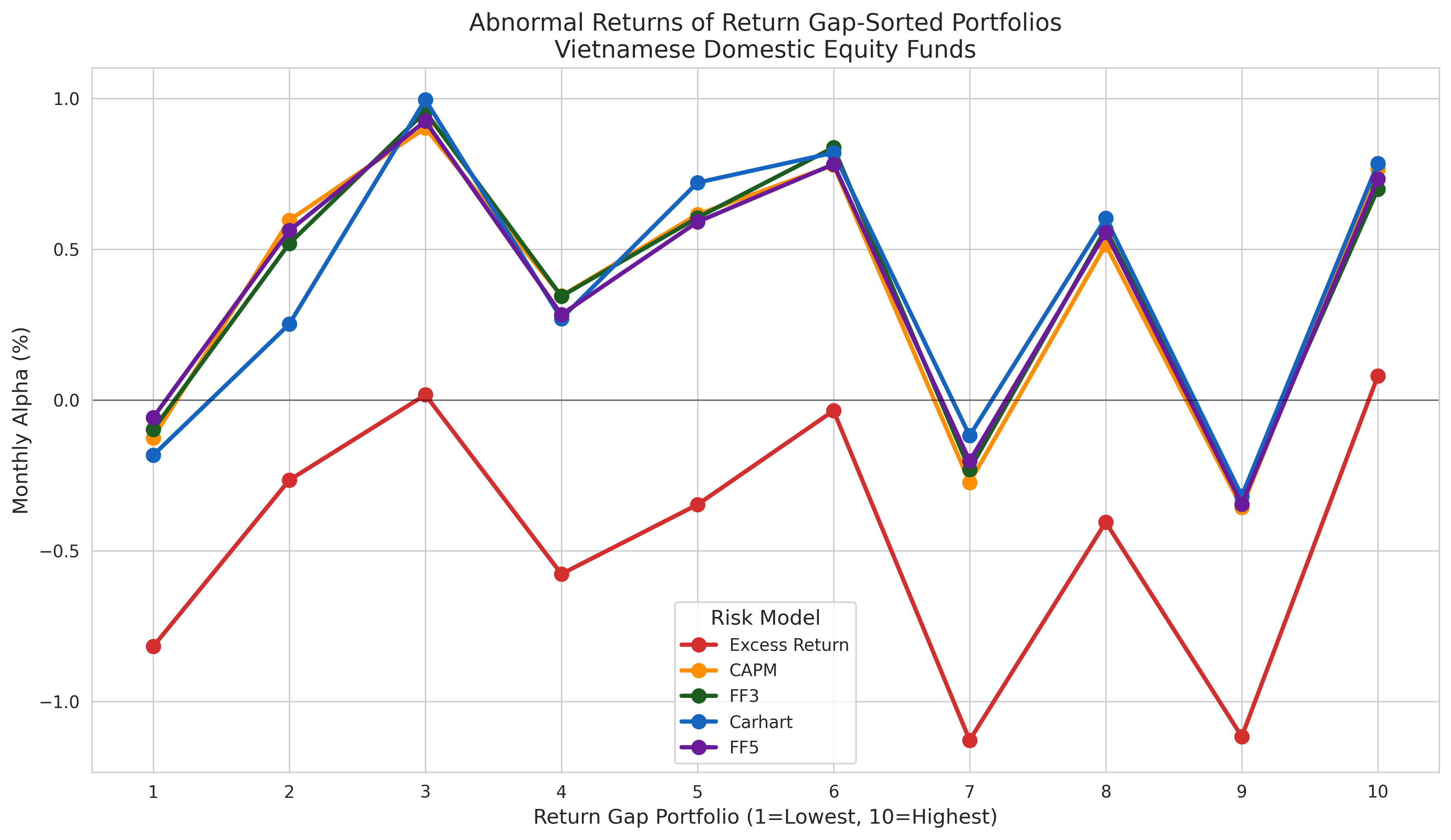
To evaluate whether Return Gap-sorted portfolios generate genuine risk-adjusted returns, we employ several factor models.
and \(\hat{\Gamma}_\ell = \frac{1}{T}\sum_{t=\ell+1}^{T} \hat{\epsilon}_t \hat{\epsilon}_{t-\ell} \mathbf{x}_t \mathbf{x}_{t-\ell}'\). The standard lag choice is \(L = \lfloor 4(T/100)^{2/9} \rfloor\).
39 Data and Sample Construction
39.1 Data Sources
Table 39.1 shows the sources used in the construction of return gaps.
Table 39.1: Data sources for the Return Gap analysis in Vietnam
Data Category
Source
Description
Fund holdings
DataCore Fund Holdings
Disclosed portfolio positions including ticker, shares held, report date, and vintage (filing) date
Fund returns
DataCore Fund Performance
Monthly NAV-based net returns, total net assets, and expense ratios
Fund characteristics
DataCore Fund Master
Fund objective codes, inception dates, management company, investment style
Stock prices and returns
DataCore Equity Market
Daily and monthly adjusted prices, returns, shares outstanding, and corporate actions for HOSE and HNX listed securities
A critical first step is to correctly handle the vintage structure of holdings data. Each holdings report has two key dates: the report date (\(\tau\), the as-of date) and the filing date (\(f\), when it becomes public). We keep only the first vintage per fund-report date.
Process holdings vintages and determine holding periods
This is the core computation. For each fund, we take the disclosed holdings as of report date \(\tau\), and for each month \(t\) in \((\tau, \tau_{\text{next}}]\), compute the value-weighted return using lagged dollar values as weights.
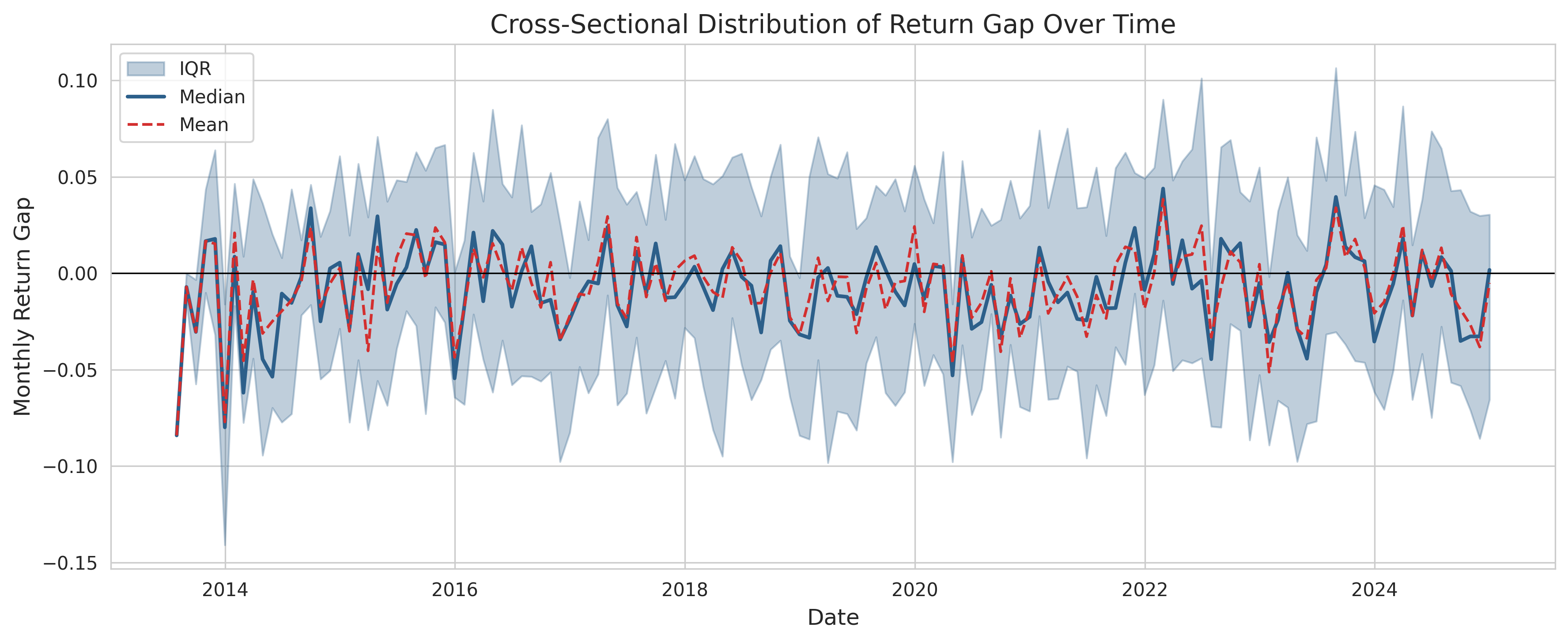
Figure 40.2: Time series of cross-sectional Return Gap statistics. Solid: median, shaded: IQR, dashed: mean.
41 Portfolio Sorting Analysis
41.1 Forming Return Gap Decile Portfolios
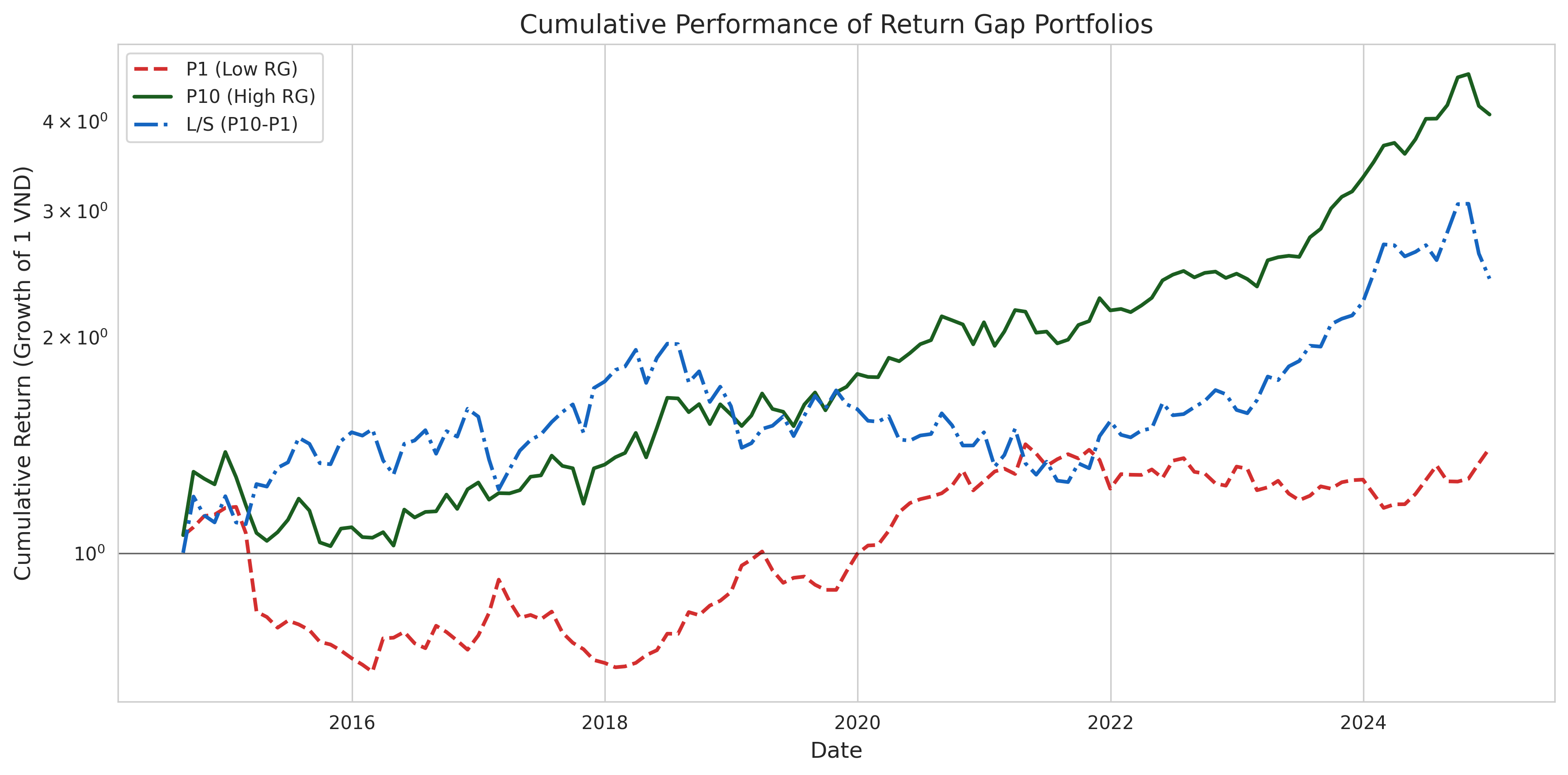
Each month \(t\), we sort funds into decile portfolios based on their lagged 12-month average Return Gap (\(\overline{\text{RG}}_{i,t-4}^{12}\)). Portfolio 1 contains funds with the lowest Return Gap.
Several institutional features of the Vietnamese market require special attention when interpreting Return Gap:
47.1.1 Foreign Ownership Limits (FOL)
Vietnamese regulations impose foreign ownership limits on listed companies (typically 49% for most sectors, with lower limits in banking and media). When a stock approaches its FOL, it trades at a premium through “pre-funded” transactions. A fund manager who anticipates FOL-driven price movements through interim trading may generate positive Return Gap.
47.1.2 Daily Price Limits
HOSE imposes plus or minus 7% daily price limits, and HNX plus or minus 10%. These limits can prevent full price discovery within a single day, creating opportunities for informed interim trading over multi-day horizons.
47.1.3 T+2 Settlement and Margin Trading
Vietnam’s T+2 settlement cycle and the evolving margin trading framework affect the speed and leverage with which fund managers can execute interim trades.
47.1.4 Disclosure Norms
Vietnamese fund disclosure norms differ from the U.S. quarterly mandate. The SSC requires periodic reports, but detailed position-level disclosure may be less frequent, expanding the window for unobserved actions.
47.2 Comparison with Developed Market Evidence
Table 47.1 shows a comparison between developed and emerging markets.
Table 47.1: Comparison of Return Gap context between developed and Vietnamese markets
Dimension
Developed Markets (U.S.)
Vietnamese Market
Disclosure frequency
Quarterly (mandatory)
Semi-annual to quarterly
Reporting lag
~60 days
Variable, potentially longer
Market efficiency
High
Moderate/emerging
Analyst coverage
Dense
Sparse
Price limits
None
Plus or minus 7% (HOSE), plus or minus 10% (HNX)
Foreign ownership
Generally unrestricted
Capped (49% typical)
Securities lending
Mature market
Limited/nascent
Expected RG magnitude
Smaller
Potentially larger
Expected RG persistence
Moderate
Potentially higher
48 Conclusion
This chapter has presented an implementation of the Return Gap measure for the Vietnamese mutual fund industry. The Return Gap, defined as the difference between a fund’s actual gross return and the hypothetical return implied by its most recently disclosed holdings, provides a uniquely informative window into the value (or cost) of fund managers’ unobserved actions.
Our analysis pipeline demonstrates how to:
Prepare and align fund holdings vintages with stock-level data, correctly handling Vietnamese market features such as corporate actions and disclosure timing.
Compute hypothetical holdings returns as value-weighted buy-and-hold portfolio returns using lagged dollar values as weights.
Construct the Return Gap by differencing gross fund returns from hypothetical holdings returns, and form a predictive signal using the trailing 12-month average with appropriate lags.
Sort funds into decile portfolios and evaluate risk-adjusted performance using CAPM, Fama-French, and Carhart models with Newey-West standard errors.
Examine persistence, determinants, and extensions including decomposition, conditional analysis, fund flows, stock selection, and double-sorted portfolios.
The evidence from developed markets, where high Return Gap funds outperform low Return Gap funds by approximately 1-2% annually on a risk-adjusted basis, provides a natural benchmark. Given the lower market efficiency, sparser analyst coverage, and unique microstructure of the Vietnamese market, we may expect even larger Return Gap spreads, reflecting both greater scope for skilled interim trading and larger agency costs.
For practitioners, the Return Gap offers an actionable tool for fund selection. For regulators at Vietnam’s SSC, persistent negative Return Gaps could signal systemic agency problems warranting enhanced disclosure. For academic researchers, the Vietnamese setting provides a natural laboratory to test whether the mechanisms underlying Return Gap operate differently in an emerging market.
Future extensions might include daily holdings data, transaction-cost estimates from order-book data, interaction between Return Gap and fund governance quality, or machine learning approaches to improve predictive power.
Bergstresser, Daniel, John M R Chalmers, and Peter Tufano. 2009. “Assessing the Costs and Benefits of Brokers in the Mutual Fund Industry.”The Review of Financial Studies 22 (10): 4129–56.
Chen, Jun, Shenje Hshieh, Melvyn Teo, and Feng Zhang. 2026. “Immigrants in Finance: Evidence from Hedge Funds.”Management Science. https://doi.org/10.1287/mnsc.2024.07615.
Christoffersen, Susan E K, Richard Evans, and David K Musto. 2013. “What Do Consumers’ Fund Flows Maximize? Evidence from Their Brokers’ Incentives.”The Journal of Finance 68 (1): 201–35.
Elton, Edwin J, Martin J Gruber, and Christopher R Blake. 2011. “Holdings Data, Security Returns, and the Selection of Superior Mutual Funds.”Journal of Financial and Quantitative Analysis 46 (2): 341–67.
Kacperczyk, Marcin, Clemens Sialm, and Lu Zheng. 2008. “Unobserved Actions of Mutual Funds.”The Review of Financial Studies 21 (6): 2379–2416.
Newey, Whitney K, and Kenneth D West. 1987. “A Simple, Positive Semi-Definite, Heteroskedasticity and Autocorrelation.”Econometrica 55 (3): 703–8.
Pool, Veronika K, Clemens Sialm, and Irina Stefanescu. 2016. “It Pays to Set the Menu: Mutual Fund Investment Options in 401(k) Plans.”The Journal of Finance 71 (4): 1779–1812.
Sialm, Clemens, Laura T Starks, and Hanjiang Zhang. 2015. “Defined Contribution Pension Plans: Sticky or Discerning Money?”The Journal of Finance 70 (2): 805–38.
Source Code
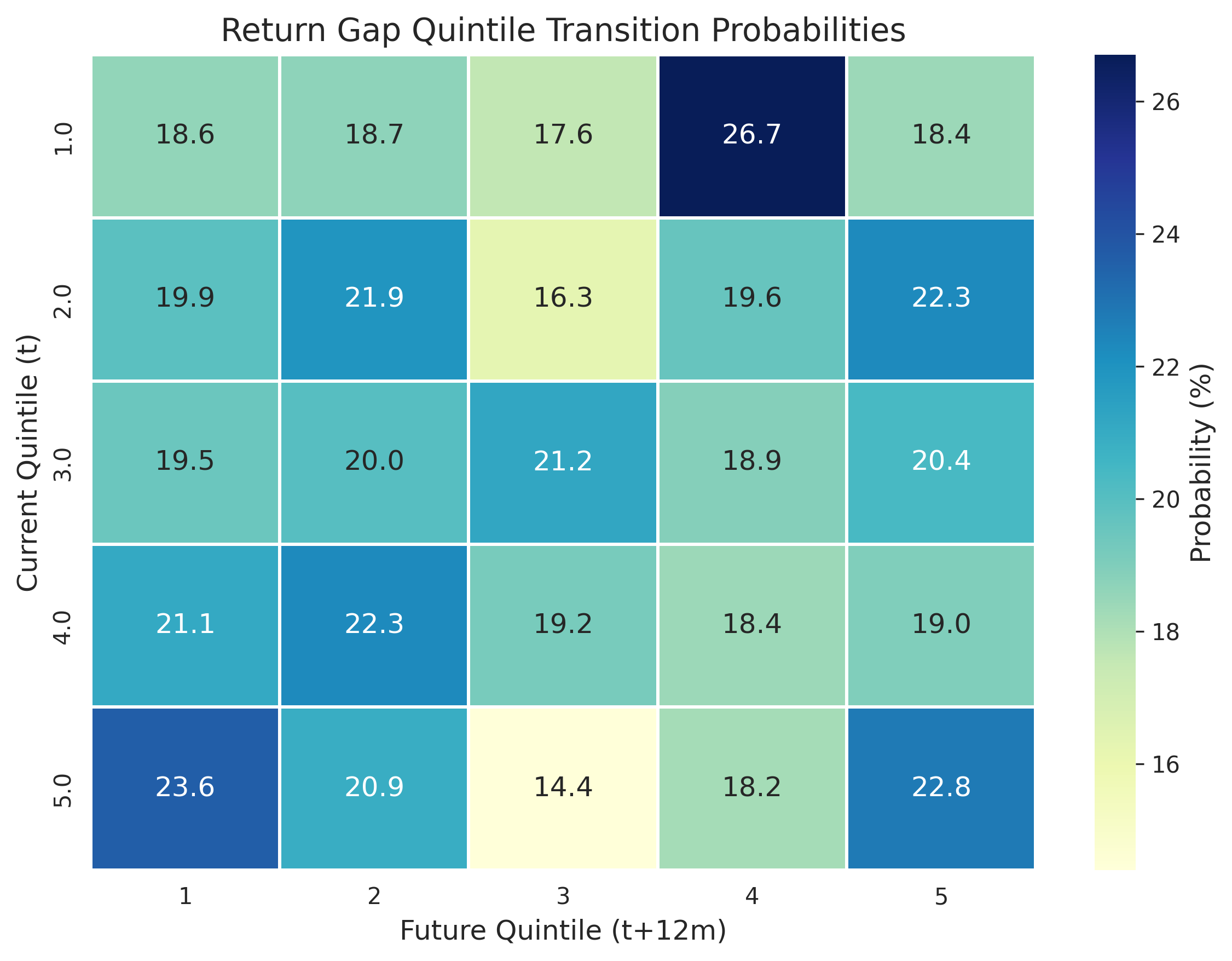
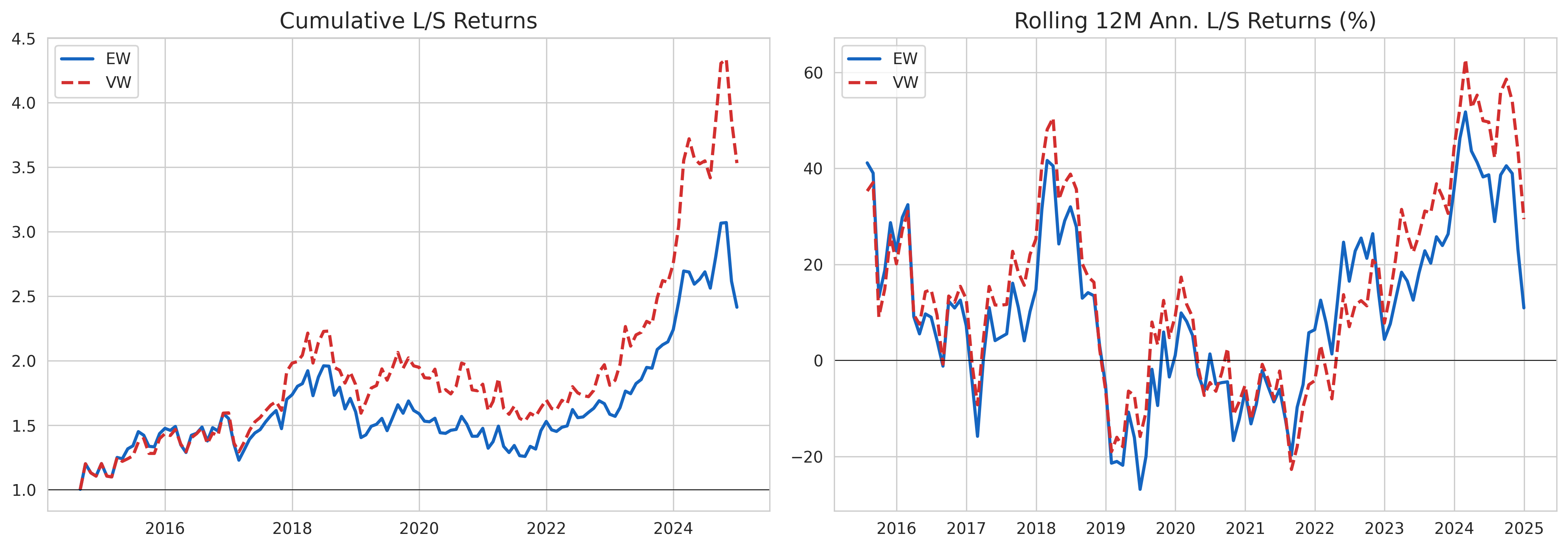
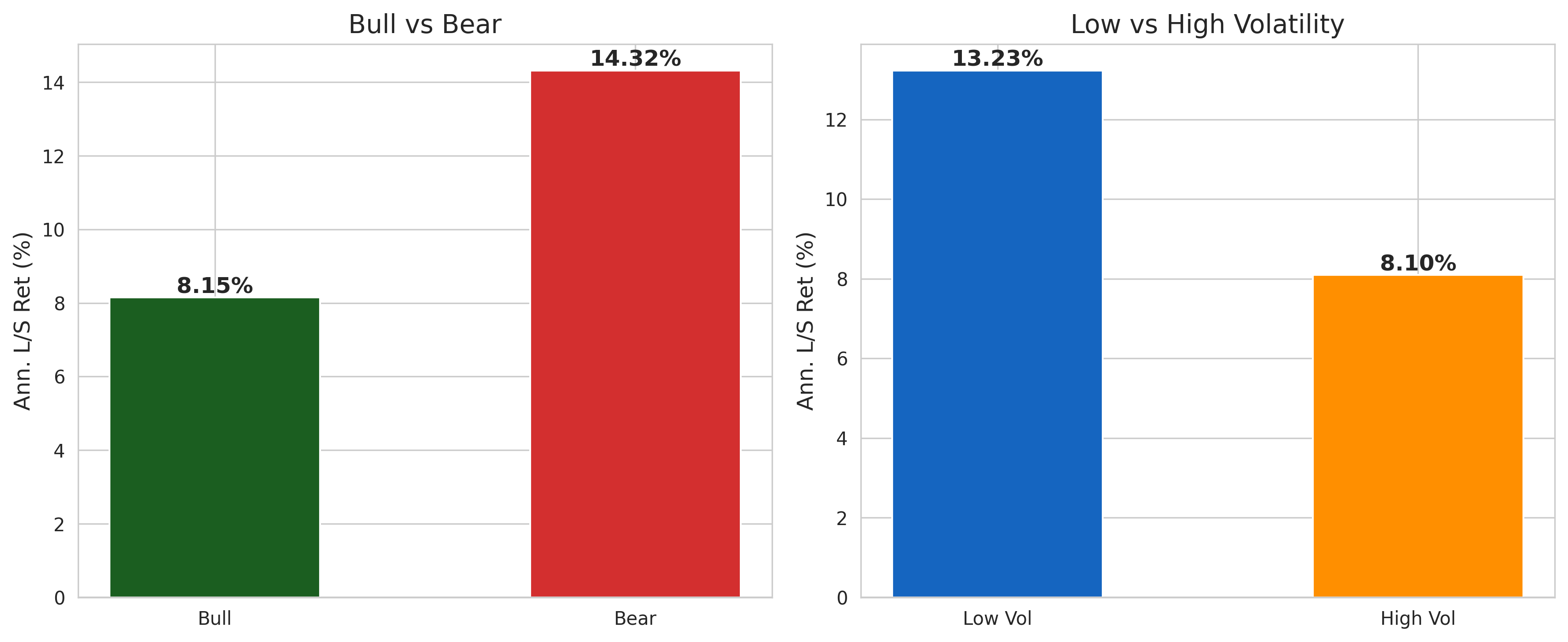
# Return Gap: Measuring Unobserved Actions of Fund ManagersMutual fund managers possess considerable discretion in their investment decisions between mandatory portfolio disclosure dates. While regulatory frameworks require periodic disclosure of holdings, the actions taken between these disclosure dates (e.g., trading, market timing, securities lending, and strategic cash management) remain largely unobservable to investors. These *unobserved actions* can significantly affect fund performance, either positively through skilled interim trading or negatively through agency costs and hidden behavior.@kacperczyk2008unobserved developed the **Return Gap** measure to capture the aggregate impact of these unobserved actions on fund returns. The Return Gap is defined as the difference between a fund's actual reported return and the hypothetical return of a portfolio that mechanically invests in the fund's most recently disclosed holdings. Formally:$$\text{Return Gap}_{i,t} = R_{i,t}^{\text{Actual}} - R_{i,t}^{\text{Holdings}}$$ {#eq-return-gap-basic}where $R_{i,t}^{\text{Actual}}$ is the net-of-expense return reported by fund $i$ in month $t$, adjusted for expenses to obtain the gross return, and $R_{i,t}^{\text{Holdings}}$ is the hypothetical buy-and-hold return computed from the most recently disclosed portfolio holdings.A positive Return Gap indicates that the fund manager's unobserved actions (e.g., interim trading, cash management, or other activities) added value beyond what a passive replication of disclosed holdings would have generated. Conversely, a persistently negative Return Gap suggests value-destroying interim activity, potentially driven by agency costs, poor trading execution, or hidden fees.## Why Return Gap MattersThe Return Gap is economically significant for several reasons:1. **Performance persistence**: Funds in the highest Return Gap decile tend to outperform those in the lowest decile by 1-2% annually on a risk-adjusted basis, and this spread persists over time [@kacperczyk2008unobserved].2. **Detecting agency problems**: A persistently negative Return Gap can signal hidden costs such as excessive trading, market impact costs, soft-dollar arrangements, or stale-price exploitation.3. **Complementing traditional measures**: Unlike alpha-based metrics that blend stock selection skill with interim trading skill, the Return Gap isolates the component of performance attributable to actions taken *between* disclosure dates.4. **Regulatory implications**: In emerging markets like Vietnam, where disclosure frequency and regulatory oversight may differ from developed markets, the Return Gap can serve as an early warning system for investor protection.## Hidden Payments: Revenue Sharing, Distribution, and Menu Design {#sec-return-gap-revenue-sharing}The Return Gap quantifies the consequences of what managers *do* between disclosure dates. A complementary literature shows that investor outcomes are equally shaped by payments that flow between funds and their distributors, largely out of investors' sight. @pool2026mutual provide the sharpest evidence from US 401(k) plans, where the recordkeeper administering the plan is often compensated indirectly through revenue sharing: rebates paid by third-party mutual funds on the plan menu out of their expense ratios. These arrangements distort the menu itself: revenue-sharing funds are more likely to be added and less likely to be removed, and revenue-sharing plans are more expensive overall, with higher expense ratios that are offset neither by lower direct fees nor by better performance. Rebates also rise with the recordkeeper's market power, consistent with funds sharing revenue to buy access to retirement assets.The result extends an older literature on distribution conflicts in delegated asset management. @pool2016it show that mutual fund families acting as 401(k) plan trustees favor their own affiliated funds in menu decisions, particularly poorly performing ones, and that participants do not undo this favoritism. @sialm2015defined find that defined-contribution plan flows respond strongly to performance, but largely because plan sponsors add and delete menu options, which concentrates influence in exactly the intermediaries whose incentives revenue sharing targets. Outside retirement plans, @bergstresser2009assessing document that broker-sold funds underperform direct-sold funds even before distribution fees, and @christoffersen2013what show that payments to brokers predict fund flows and lower subsequent performance, indicating that intermediary compensation, not just investor demand, steers money.These findings matter for Vietnam because its fund industry is distribution-driven: most open-ended fund assets are gathered through banks, securities brokers, and licensed fund platforms, voluntary supplementary pension schemes are still nascent, and the fee arrangements between fund managers and distributors are not systematically disclosed. As menu-style products spread through fund platforms, pension-linked insurance, and employer-sponsored savings arrangements, the US evidence suggests a clear research and regulatory agenda: measure not only what funds report and hold, but also who is paid for shelf space, because those payments predict both menu composition and investor costs. The Return Gap methodology developed in this chapter and fee-based diagnostics are complements in that agenda: one tracks hidden actions, the other hidden payments.## Hidden Inputs: Human Capital and Fund Skill {#sec-return-gap-human-capital}A third thing investors rarely observe is *who* produces the fund's performance. Alpha, the Return Gap, and related skill measures are outputs; the inputs are the analysts and quantitative staff the management company manages to hire. Identifying the causal contribution of those inputs is hard because talented people sort into funds that would have done well anyway. @chen2026immigrants solve the selection problem with a lottery. US hedge fund management companies apply for H-1B skilled-worker visas, and when applications exceed the annual quota, the visas are allocated by random draw, so two companies that applied for the same number of visas but won different numbers are comparable ex ante. Companies that win more visas subsequently deliver higher alphas, Sharpe ratios, and information ratios. The effect is traced to well-paid, highly educated workers with quantitative skills, who help funds develop distinctive strategies, arbitrage prominent stock anomalies, and relieve capacity constraints. Two further results sharpen the interpretation: an unexpected cut in the H-1B quota hurt the performance of the funds most dependent on such workers, and alpha generation is greatest for workers from countries with the longest waits for US permanent residency, consistent with funds exploiting a labor market friction that ties workers to their sponsor.The design has a direct Vietnamese analogue. Fund management companies in Vietnam compete for a small pool of CFA-qualified analysts and quantitatively trained staff, foreign-affiliated managers rotate expatriate personnel in and out of Ho Chi Minh City, and work-permit and licensing rules for foreign professionals change over time. A researcher who can observe staffing at the management-company level, whether from SSC licensing records for fund management practitioners, work-permit data, or LinkedIn-style professional profiles, can ask whether skilled hires predict subsequent alpha and Return Gap, and can exploit regulatory changes in foreign-labor rules as the shock. The lesson from @chen2026immigrants is that hidden actions and hidden payments are only part of the story; hidden inputs matter for performance too, and randomized or quasi-random allocation of those inputs is what turns a correlation between talent and returns into evidence of skill.## Application to the Vietnamese MarketThe Vietnamese mutual fund industry, while relatively young compared to the United States, has experienced rapid growth since the establishment of the first domestic equity funds in the early 2000s. As of 2024, Vietnam's open-ended fund industry manages assets exceeding 100 trillion VND, with dozens of equity-oriented funds operated by both domestic and foreign-affiliated asset management companies.Several characteristics of the Vietnamese market make the Return Gap analysis particularly interesting:- **Disclosure frequency**: Vietnamese funds are required to disclose their top holdings periodically, but the frequency and completeness of disclosure may differ from the quarterly SEC requirements in the U.S.- **Market microstructure**: The HOSE (Ho Chi Minh Stock Exchange) and HNX (Hanoi Stock Exchange) feature daily price limits (plus or minus 7% on HOSE, plus or minus 10% on HNX), T+2 settlement, and foreign ownership limits that may constrain or enable certain interim trading strategies.- **Information asymmetry**: In an emerging market with less analyst coverage, the scope for informed interim trading and hence positive Return Gap may be larger than in more efficient markets.- **Regulatory environment**: Vietnam's State Securities Commission (SSC) has progressively strengthened disclosure and governance requirements, making temporal analysis of Return Gap especially informative.# Theoretical Framework {#sec-return-gaptheory}## Decomposing Fund ReturnsConsider a mutual fund $i$ that discloses its portfolio holdings at discrete dates $\tau_1, \tau_2, \ldots$ As disclosed at date $\tau_k$, the fund holds $N_k$ securities with weights $\{w_{j,\tau_k}\}_{j=1}^{N_k}$, where $w_{j,\tau_k}$ represents the portfolio weight of security $j$.Between disclosure dates $\tau_k$ and $\tau_{k+1}$, the fund's *actual gross return* in month $t$ can be decomposed as:$$R_{i,t}^{\text{Gross}} = R_{i,t}^{\text{Holdings}} + \underbrace{R_{i,t}^{\text{Gross}} - R_{i,t}^{\text{Holdings}}}_{\text{Return Gap}}$$ {#eq-decomposition}The hypothetical holdings return $R_{i,t}^{\text{Holdings}}$ is computed as the value-weighted return of the buy-and-hold portfolio based on the most recent disclosure:$$R_{i,t}^{\text{Holdings}} = \sum_{j=1}^{N_k} \tilde{w}_{j,t-1} \cdot r_{j,t}$$ {#eq-holdings-return}where $r_{j,t}$ is the return of security $j$ in month $t$, and $\tilde{w}_{j,t-1}$ is the *evolved* portfolio weight at the end of month $t-1$, reflecting the buy-and-hold drift from the original disclosure weights:$$\tilde{w}_{j,t-1} = \frac{w_{j,\tau_k} \prod_{s=\tau_k+1}^{t-1}(1 + r_{j,s})}{\sum_{\ell=1}^{N_k} w_{\ell,\tau_k} \prod_{s=\tau_k+1}^{t-1}(1 + r_{\ell,s})}$$ {#eq-evolved-weights}In practice, rather than tracking evolved weights explicitly, we use dollar values of holdings positions (shares held times price) as the natural weighting scheme.## The Return Gap Measure### Gross Return GapThe Return Gap as originally defined by @kacperczyk2008unobserved uses the *gross* (before-expense) return:$$\text{RG}_{i,t} = R_{i,t}^{\text{Gross}} - R_{i,t}^{\text{Holdings}} = \left(R_{i,t}^{\text{Net}} + \frac{\text{Expense Ratio}_{i,t}}{12}\right) - R_{i,t}^{\text{Holdings}}$$ {#eq-return-gap-gross}where $R_{i,t}^{\text{Net}}$ is the reported net-of-expense return and the annual expense ratio is divided by 12 to approximate the monthly expense charge.### Sources of Return GapThe Return Gap captures several components [@kacperczyk2008unobserved; @elton2011holdings]:$$\text{RG}_{i,t} = \underbrace{\Delta_{\text{trade}}}_{\text{Interim trading}} + \underbrace{\Delta_{\text{cash}}}_{\text{Cash drag/return}} + \underbrace{\Delta_{\text{fees}}}_{\text{Hidden fees}} + \underbrace{\Delta_{\text{lend}}}_{\text{Securities lending}} + \underbrace{\varepsilon_t}_{\text{Noise}}$$ {#eq-decompose-rg}where:- $\Delta_{\text{trade}}$: The return impact of buying and selling securities between disclosure dates. Skilled managers generate positive $\Delta_{\text{trade}}$ by timing trades.- $\Delta_{\text{cash}}$: The effect of holding cash or cash equivalents not captured in equity holdings disclosures. In rising markets, cash creates a drag (negative contribution); in falling markets, cash provides a cushion.- $\Delta_{\text{fees}}$: Transaction costs, brokerage commissions, and any hidden fees not reflected in the stated expense ratio.- $\Delta_{\text{lend}}$: Revenue from securities lending programs, which generates positive Return Gap.- $\varepsilon_t$: Measurement noise from timing differences, stale prices, or data errors.### Predictive Return GapTo form tradeable portfolios and avoid look-ahead bias, @kacperczyk2008unobserved use the *trailing 12-month average* Return Gap, lagged by one quarter to account for the reporting delay:$$\overline{\text{RG}}_{i,t}^{12} = \frac{1}{12} \sum_{s=1}^{12} \text{RG}_{i,t-s}$$ {#eq-trailing-rg}The additional 3-month (one quarter) lag ensures that the Return Gap signal is based only on information available to investors at the time of portfolio formation. This is particularly important in Vietnam, where fund reporting may involve delays.## Risk-Adjusted Performance EvaluationTo evaluate whether Return Gap-sorted portfolios generate genuine risk-adjusted returns, we employ several factor models.### CAPM Alpha$$R_{p,t} - R_{f,t} = \alpha_p + \beta_p (R_{m,t} - R_{f,t}) + \epsilon_{p,t}$$ {#eq-capm}### Fama-French Three-Factor Model$$R_{p,t} - R_{f,t} = \alpha_p + \beta_{1,p} \cdot \text{MKT}_t + \beta_{2,p} \cdot \text{SMB}_t + \beta_{3,p} \cdot \text{HML}_t + \epsilon_{p,t}$$ {#eq-ff3}### Carhart Four-Factor Model$$R_{p,t} - R_{f,t} = \alpha_p + \beta_{1,p} \cdot \text{MKT}_t + \beta_{2,p} \cdot \text{SMB}_t + \beta_{3,p} \cdot \text{HML}_t + \beta_{4,p} \cdot \text{UMD}_t + \epsilon_{p,t}$$ {#eq-carhart}where $\text{UMD}_t$ is the momentum factor (up minus down).### Fama-French Five-Factor ModelFor a more comprehensive risk adjustment relevant to the Vietnamese market:$$R_{p,t} - R_{f,t} = \alpha_p + \beta_1 \text{MKT}_t + \beta_2 \text{SMB}_t + \beta_3 \text{HML}_t + \beta_4 \text{RMW}_t + \beta_5 \text{CMA}_t + \epsilon_{p,t}$$ {#eq-ff5}where $\text{RMW}_t$ (robust minus weak) captures profitability and $\text{CMA}_t$ (conservative minus aggressive) captures investment patterns.## Newey-West Standard ErrorsSince portfolio returns may exhibit serial correlation, we use @newey1987simple standard errors with $L$ lags:$$\hat{V}(\hat{\alpha}) = T \left(\sum_{t=1}^{T} \mathbf{x}_t \mathbf{x}_t'\right)^{-1} \hat{S} \left(\sum_{t=1}^{T} \mathbf{x}_t \mathbf{x}_t'\right)^{-1}$$ {#eq-newey-west-var}where the HAC covariance estimator is:$$\hat{S} = \hat{\Gamma}_0 + \sum_{\ell=1}^{L} \left(1 - \frac{\ell}{L+1}\right)\left(\hat{\Gamma}_\ell + \hat{\Gamma}_\ell'\right)$$ {#eq-hac}and $\hat{\Gamma}_\ell = \frac{1}{T}\sum_{t=\ell+1}^{T} \hat{\epsilon}_t \hat{\epsilon}_{t-\ell} \mathbf{x}_t \mathbf{x}_{t-\ell}'$. The standard lag choice is $L = \lfloor 4(T/100)^{2/9} \rfloor$.# Data and Sample Construction {#sec-return-gapdata}## Data Sources@tbl-return-gaps-data-sources shows the sources used in the construction of return gaps.| Data Category | Source | Description ||:-----------------------|:-----------------------|:-----------------------|| Fund holdings | DataCore Fund Holdings | Disclosed portfolio positions including ticker, shares held, report date, and vintage (filing) date || Fund returns | DataCore Fund Performance | Monthly NAV-based net returns, total net assets, and expense ratios || Fund characteristics | DataCore Fund Master | Fund objective codes, inception dates, management company, investment style || Stock prices and returns | DataCore Equity Market | Daily and monthly adjusted prices, returns, shares outstanding, and corporate actions for HOSE and HNX listed securities || Risk factors | DataCore / Constructed | Vietnamese market factor portfolios (MKT, SMB, HML, UMD, RMW, CMA) |: Data sources for the Return Gap analysis in Vietnam {#tbl-return-gaps-data-sources}## Setting Up the Environment```{python}#| label: setup-environment#| code-summary: "Import libraries and configure settings"import pandas as pdimport numpy as npimport matplotlib.pyplot as pltimport seaborn as snsimport statsmodels.api as smfrom statsmodels.regression.linear_model import OLSfrom scipy import statsfrom datetime import datetime, timedeltafrom dateutil.relativedelta import relativedeltaimport warningswarnings.filterwarnings("ignore")plt.rcParams.update({"figure.figsize": (10, 6),"font.size": 12,"axes.titlesize": 14,"axes.labelsize": 12,"xtick.labelsize": 10,"ytick.labelsize": 10,"legend.fontsize": 10,"figure.dpi": 150,"savefig.dpi": 300,"font.family": "serif",})sns.set_style("whitegrid")np.random.seed(42)```## Loading and Preparing Stock Market Data {#sec-return-gapstock-data}The first step is to load the stock-level data, which provides the foundation for computing hypothetical holdings returns.```{python}#| label: load-stock-data#| code-summary: "Load stock prices and returns from DataCore"# ============================================================# In production, replace with actual DataCore API calls:# from datacore import DataCoreClient# client = DataCoreClient(api_key="YOUR_KEY")# stock_data = client.get_equity_monthly(# exchange=["HOSE", "HNX"],# start_date="2010-01-01",# end_date="2024-12-31",# fields=["ticker", "date", "close_adj", "return_monthly",# "shares_outstanding", "market_cap"]# )# ============================================================def generate_stock_data( n_stocks: int=300, start_date: str="2012-01-01", end_date: str="2024-12-31",) -> pd.DataFrame:""" Generate simulated monthly stock data mimicking Vietnamese equity market characteristics. """ dates = pd.date_range(start_date, end_date, freq="ME") tickers = [f"VN{str(i).zfill(4)}"for i inrange(1, n_stocks +1)] records = []for ticker in tickers: list_offset = np.random.randint(0, max(1, len(dates) //3)) available_dates = dates[list_offset:] mu = np.random.normal(0.008, 0.005) sigma = np.random.uniform(0.06, 0.15) beta = np.random.uniform(0.5, 1.8) market_shocks = np.random.normal(0.005, 0.06, len(available_dates)) idio_shocks = np.random.normal(0, sigma, len(available_dates)) returns = mu + beta * market_shocks + idio_shocks returns = np.clip(returns, -0.30, 0.40) price = np.random.uniform(10, 150) prices = [price]for r in returns[:-1]: price = price * (1+ r) prices.append(price) shares = np.random.uniform(50, 500) *1e6 shares_series = np.full(len(available_dates), shares)for i, d inenumerate(available_dates): records.append({"ticker": ticker, "date": d,"close_adj": prices[i], "ret": returns[i],"shares_outstanding": shares_series[i],"market_cap": prices[i] * shares_series[i] /1e9, }) df = pd.DataFrame(records) df["date"] = pd.to_datetime(df["date"]) df = df.sort_values(["ticker", "date"]) df["close_adj_lag"] = df.groupby("ticker")["close_adj"].shift(1)return dfstock_data = generate_stock_data()print(f"Stock data: {stock_data.shape[0]:,} stock-months")print(f"Unique stocks: {stock_data['ticker'].nunique()}")print(f"Date range: {stock_data['date'].min():%Y-%m} to "f"{stock_data['date'].max():%Y-%m}")stock_data.head(10)```## Loading Fund Holdings Data {#sec-return-gapholdings-data}```{python}#| label: load-holdings-data#| code-summary: "Load fund holdings from DataCore"def generate_holdings_data( stock_data: pd.DataFrame, n_funds: int=50, start_date: str="2012-06-30", end_date: str="2024-12-31",) -> pd.DataFrame:""" Generate simulated fund holdings data. Each fund holds 15-80 stocks, disclosed semi-annually or quarterly. """ dates = pd.date_range(start_date, end_date, freq="ME") tickers = stock_data["ticker"].unique() fund_ids = [f"FUND{str(i).zfill(3)}"for i inrange(1, n_funds +1)] records = []for fund_id in fund_ids: inception_idx = np.random.randint(0, max(1, len(dates) //4)) freq =3if np.random.random() <0.7else6 n_stocks_held = np.random.randint(15, 80) core_stocks = np.random.choice(tickers, size=n_stocks_held, replace=False) report_dates = dates[inception_idx::freq]for rdate in report_dates: filing_delay = np.random.randint(1, 4) fdate = rdate + pd.DateOffset(months=filing_delay) turnover = np.random.uniform(0.05, 0.20) n_replace =max(1, int(n_stocks_held * turnover)) replace_idx = np.random.choice(len(core_stocks), size=n_replace, replace=False) new_stocks = np.random.choice(tickers, size=n_replace, replace=False) core_stocks[replace_idx] = new_stocksfor ticker in core_stocks: shares = np.random.uniform(100_000, 5_000_000) records.append({"fund_id": fund_id, "report_date": rdate,"filing_date": fdate, "ticker": ticker,"shares_held": shares, }) df = pd.DataFrame(records) df["report_date"] = pd.to_datetime(df["report_date"]) df["filing_date"] = pd.to_datetime(df["filing_date"])return dfholdings_raw = generate_holdings_data(stock_data)print(f"Holdings records: {holdings_raw.shape[0]:,}")print(f"Unique funds: {holdings_raw['fund_id'].nunique()}")holdings_raw.head(10)```## Loading Fund Returns and Characteristics {#sec-return-gapfund-returns}```{python}#| label: load-fund-returns#| code-summary: "Load fund NAV returns and expense data"def generate_fund_returns(holdings, start_date="2012-01-01", end_date="2024-12-31"):"""Generate monthly fund-level net returns, TNA, and expense ratios.""" fund_ids = holdings["fund_id"].unique() dates = pd.date_range(start_date, end_date, freq="ME") records = []for fund_id in fund_ids: fund_start = holdings.loc[holdings["fund_id"] == fund_id, "report_date"].min() - pd.DateOffset(months=3) fund_dates = dates[dates >= fund_start] exp_ratio = np.random.uniform(0.010, 0.025) base_tna = np.random.uniform(50, 2000) mu = np.random.normal(0.007, 0.003) sigma = np.random.uniform(0.04, 0.09) tna = base_tnafor d in fund_dates: ret = np.clip(np.random.normal(mu, sigma), -0.25, 0.35) tna =max(tna * (1+ ret) + np.random.normal(0, base_tna *0.02), 10) records.append({"fund_id": fund_id, "date": d, "net_return": ret,"tna": tna, "expense_ratio": exp_ratio + np.random.normal(0, 0.001)}) df = pd.DataFrame(records) df["date"] = pd.to_datetime(df["date"]) df["expense_ratio"] = df["expense_ratio"].clip(0.005, 0.035)return dffund_returns = generate_fund_returns(holdings_raw)print(f"Fund-month observations: {fund_returns.shape[0]:,}")fund_returns.head(10)```## Sample Selection: Domestic Equity Funds {#sec-return-gapsample-selection}Following the approach of @kacperczyk2008unobserved, we restrict our sample to domestic equity funds.```{python}#| label: sample-selection#| code-summary: "Filter to domestic equity funds"equity_objectives = ["EQUITY_DOMESTIC", "EQUITY_GROWTH", "EQUITY_VALUE","EQUITY_BLEND", "EQUITY_LARGE_CAP", "EQUITY_MID_CAP","EQUITY_SMALL_CAP",]fund_ids = fund_returns["fund_id"].unique()fund_master = pd.DataFrame({"fund_id": fund_ids,"objective": np.random.choice( equity_objectives + ["BOND", "BALANCED", "MONEY_MARKET"], size=len(fund_ids), p=[0.08, 0.08, 0.06, 0.10, 0.08, 0.06, 0.06, 0.15, 0.18, 0.15], ),})equity_fund_ids = fund_master.loc[ fund_master["objective"].isin(equity_objectives), "fund_id"].valuesprint(f"Total funds: {len(fund_ids)}")print(f"Equity funds: {len(equity_fund_ids)} ({len(equity_fund_ids)/len(fund_ids)*100:.1f}%)")print("\nObjective distribution:")print(fund_master["objective"].value_counts().to_string())```# Computing the Return Gap {#sec-return-gapcomputing}## Step 1: Prepare Holdings Vintages {#sec-return-gapvintages}A critical first step is to correctly handle the *vintage* structure of holdings data. Each holdings report has two key dates: the **report date** ($\tau$, the as-of date) and the **filing date** ($f$, when it becomes public). We keep only the first vintage per fund-report date.```{python}#| label: prepare-vintages#| code-summary: "Process holdings vintages and determine holding periods"def prepare_holdings_vintages(holdings, max_holding_months=6):"""Process holdings vintages and compute next report dates.""" first_vintage = ( holdings.sort_values(["fund_id", "report_date", "filing_date"]) .groupby(["fund_id", "report_date"]) .agg(filing_date=("filing_date", "first")) .reset_index() ) first_vintage = first_vintage.sort_values(["fund_id", "report_date"]) first_vintage["next_report_date"] = first_vintage.groupby("fund_id")["report_date"].shift(-1) max_date = first_vintage["report_date"] + pd.DateOffset(months=max_holding_months) first_vintage["next_report_date"] = first_vintage["next_report_date"].fillna(max_date) first_vintage["next_report_date"] = first_vintage[["next_report_date"]].min(axis=1).clip(upper=max_date) first_vintage["next_report_date"] = first_vintage["next_report_date"] + pd.offsets.MonthEnd(0) result = holdings.merge(first_vintage, on=["fund_id", "report_date", "filing_date"], how="inner")return resultholdings_vintaged = prepare_holdings_vintages(holdings_raw)print(f"Holdings after vintage processing: {holdings_vintaged.shape[0]:,} records")sample_fund = holdings_vintaged["fund_id"].iloc[0](holdings_vintaged.loc[holdings_vintaged["fund_id"] == sample_fund] [["fund_id", "report_date", "filing_date", "next_report_date"]] .drop_duplicates().head(8))```## Step 2: Adjust Shares for Corporate Actions {#sec-return-gapadjust-shares}```{python}#| label: adjust-shares#| code-summary: "Adjust shares held for corporate actions"def adjust_holdings_shares(holdings, stock_data):"""Adjust shares for splits, bonuses, rights. Simulated: factor=1.""" holdings["shares_adj"] = holdings["shares_held"]return holdingsholdings_adj = adjust_holdings_shares(holdings_vintaged, stock_data)```## Step 3: Compute Hypothetical Holdings Returns {#sec-return-gaphypothetical-returns}This is the core computation. For each fund, we take the disclosed holdings as of report date $\tau$, and for each month $t$ in $(\tau, \tau_{\text{next}}]$, compute the value-weighted return using lagged dollar values as weights.```{python}#| label: compute-holdings-returns#| code-summary: "Compute value-weighted hypothetical portfolio returns"def compute_holdings_returns(holdings, stock_data, min_stocks=10, min_assets_bn=5.0):"""Compute monthly hypothetical buy-and-hold portfolio returns.""" merged = holdings.merge(stock_data, on="ticker", how="inner") mask = (merged["date"] > merged["report_date"]) & (merged["date"] <= merged["next_report_date"]) merged = merged.loc[mask].copy() merged["hvalue_lag"] = merged["shares_adj"] * merged["close_adj_lag"] merged = merged.loc[merged["hvalue_lag"] >0].copy() merged = merged.drop_duplicates(subset=["fund_id", "date", "report_date", "ticker"], keep="first")def weighted_return(group): weights = group["hvalue_lag"] total_weight = weights.sum()if total_weight <=0:return pd.Series({"hret": np.nan, "n_stocks": 0, "assets_lag_bn": 0}) wret = np.average(group["ret"], weights=weights)return pd.Series({"hret": wret, "n_stocks": len(group), "assets_lag_bn": total_weight /1e9}) portfolio_returns = ( merged.groupby(["fund_id", "date"]) .apply(weighted_return, include_groups=False).reset_index() ) portfolio_returns["assets_bn"] = portfolio_returns["assets_lag_bn"] * (1+ portfolio_returns["hret"]) mask = (portfolio_returns["n_stocks"] >= min_stocks) & (portfolio_returns["assets_bn"] >= min_assets_bn)return portfolio_returns.loc[mask].copy()holdings_returns = compute_holdings_returns(holdings_adj, stock_data)print(f"Fund-month observations (hypothetical returns): {holdings_returns.shape[0]:,}")print(f"Unique funds: {holdings_returns['fund_id'].nunique()}")print(f"\nSummary:")print(holdings_returns[["hret", "n_stocks", "assets_bn"]].describe().round(4).to_string())```## Step 4: Compute Gross Fund Returns {#sec-return-gapgross-returns}```{python}#| label: compute-gross-returns#| code-summary: "Compute gross fund returns"def prepare_fund_returns(fund_returns, equity_fund_ids):"""Prepare fund-level gross returns.""" df = fund_returns.loc[fund_returns["fund_id"].isin(equity_fund_ids)].copy() df["expense_ratio"] = df["expense_ratio"].fillna(df.groupby("fund_id")["expense_ratio"].transform("median")) df["gross_return"] = df["net_return"] + df["expense_ratio"] /12 df = df.sort_values(["fund_id", "date"]) df["tna_lag"] = df.groupby("fund_id")["tna"].shift(1).fillna(df["tna"])return dffund_ret_clean = prepare_fund_returns(fund_returns, equity_fund_ids)print(f"Equity fund-months: {fund_ret_clean.shape[0]:,}")```## Step 5: Merge and Compute Return Gap {#sec-return-gapmerge-return-gap}```{python}#| label: compute-return-gap#| code-summary: "Merge actual and hypothetical returns to compute Return Gap"def compute_return_gap(holdings_returns, fund_returns):"""Compute Return Gap and trailing averages.""" merged = holdings_returns.merge( fund_returns[["fund_id", "date", "net_return", "gross_return", "expense_ratio", "tna"]], on=["fund_id", "date"], how="inner", ) merged["return_gap"] = merged["gross_return"] - merged["hret"] merged = merged.sort_values(["fund_id", "date"]) merged["rg_12m"] = merged.groupby("fund_id")["return_gap"].transform(lambda x: x.rolling(12, min_periods=8).mean() ) merged["rg_12m_lag4"] = merged.groupby("fund_id")["rg_12m"].shift(4)return mergedreturn_gap_data = compute_return_gap(holdings_returns, fund_ret_clean)print(f"Return Gap observations: {return_gap_data.shape[0]:,}")print(f"\nSummary:")print(return_gap_data[["return_gap", "rg_12m", "rg_12m_lag4"]].describe().round(6).to_string())```## Distribution of the Return Gap```{python}#| label: fig-return-gap-distribution#| fig-cap: "Distribution of monthly Return Gap across all fund-month observations."#| fig-width: 12#| fig-height: 5fig, axes = plt.subplots(1, 2, figsize=(12, 5))rg = return_gap_data["return_gap"].dropna()rg_trimmed = rg.clip(rg.quantile(0.01), rg.quantile(0.99))axes[0].hist(rg_trimmed, bins=80, density=True, alpha=0.7, color="#2C5F8A", edgecolor="white", linewidth=0.5)axes[0].axvline(rg.mean(), color="#D32F2F", linestyle="--", linewidth=2, label=f"Mean = {rg.mean():.4f}")axes[0].axvline(rg.median(), color="#FF8F00", linestyle="-.", linewidth=2, label=f"Median = {rg.median():.4f}")axes[0].set_xlabel("Monthly Return Gap")axes[0].set_ylabel("Density")axes[0].set_title("Panel A: Monthly Return Gap")axes[0].legend(frameon=True)rg12 = return_gap_data["rg_12m"].dropna()rg12_trimmed = rg12.clip(rg12.quantile(0.01), rg12.quantile(0.99))axes[1].hist(rg12_trimmed, bins=80, density=True, alpha=0.7, color="#1B5E20", edgecolor="white", linewidth=0.5)axes[1].axvline(rg12.mean(), color="#D32F2F", linestyle="--", linewidth=2, label=f"Mean = {rg12.mean():.4f}")axes[1].axvline(rg12.median(), color="#FF8F00", linestyle="-.", linewidth=2, label=f"Median = {rg12.median():.4f}")axes[1].set_xlabel("Trailing 12-Month Average Return Gap")axes[1].set_ylabel("Density")axes[1].set_title("Panel B: 12-Month Average Return Gap")axes[1].legend(frameon=True)plt.tight_layout()plt.show()```## Time Series of Cross-Sectional Return Gap```{python}#| label: fig-return-gap-timeseries#| fig-cap: "Time series of cross-sectional Return Gap statistics. Solid: median, shaded: IQR, dashed: mean."#| fig-width: 12#| fig-height: 5ts_stats = ( return_gap_data.groupby("date")["return_gap"] .agg(["mean", "median", lambda x: x.quantile(0.25), lambda x: x.quantile(0.75)]) .rename(columns={"<lambda_0>": "p25", "<lambda_1>": "p75"}).reset_index())fig, ax = plt.subplots(figsize=(12, 5))ax.fill_between(ts_stats["date"], ts_stats["p25"], ts_stats["p75"], alpha=0.3, color="#2C5F8A", label="IQR")ax.plot(ts_stats["date"], ts_stats["median"], color="#2C5F8A", linewidth=2, label="Median")ax.plot(ts_stats["date"], ts_stats["mean"], color="#D32F2F", linestyle="--", linewidth=1.5, label="Mean")ax.axhline(0, color="black", linewidth=0.8)ax.set_xlabel("Date")ax.set_ylabel("Monthly Return Gap")ax.set_title("Cross-Sectional Distribution of Return Gap Over Time")ax.legend(frameon=True)plt.tight_layout()plt.show()```# Portfolio Sorting Analysis {#sec-return-gapportfolios}## Forming Return Gap Decile Portfolios {#sec-return-gapdecile-portfolios}Each month $t$, we sort funds into decile portfolios based on their lagged 12-month average Return Gap ($\overline{\text{RG}}_{i,t-4}^{12}$). Portfolio 1 contains funds with the lowest Return Gap.```{python}#| label: form-decile-portfolios#| code-summary: "Sort funds into decile portfolios"def form_return_gap_portfolios(data, n_portfolios=10, sort_var="rg_12m_lag4"):"""Form portfolios by sorting funds into quantile groups.""" df = data.dropna(subset=[sort_var]).copy() df["portfolio"] = ( df.groupby("date")[sort_var] .transform(lambda x: pd.qcut(x, n_portfolios, labels=False, duplicates="drop")) ) +1return dfn_portfolios =10portfolio_data = form_return_gap_portfolios(return_gap_data, n_portfolios=n_portfolios)print(f"Observations with portfolio assignment: {portfolio_data.shape[0]:,}")```## Portfolio Returns```{python}#| label: compute-portfolio-returns#| code-summary: "Compute EW and VW portfolio returns"def compute_portfolio_returns(data, n_portfolios=10):"""Compute equal- and value-weighted monthly returns.""" ew = data.groupby(["date", "portfolio"]).agg( ew_ret=("net_return", "mean"), n_funds=("fund_id", "count")).reset_index()def vw_func(group): w = group["tna"].clip(lower=0)return np.average(group["net_return"], weights=w) if w.sum() >0else group["net_return"].mean() vw = data.groupby(["date", "portfolio"]).apply(vw_func, include_groups=False).reset_index(name="vw_ret")return ew.merge(vw, on=["date", "portfolio"], how="left")port_returns = compute_portfolio_returns(portfolio_data)port_wide = port_returns.pivot_table(index="date", columns="portfolio", values=["ew_ret", "vw_ret"])port_wide[("ew_ret", "LS")] = port_wide[("ew_ret", n_portfolios)] - port_wide[("ew_ret", 1)]port_wide[("vw_ret", "LS")] = port_wide[("vw_ret", n_portfolios)] - port_wide[("vw_ret", 1)]print("EW portfolio returns (annualized, %):")print((port_wide["ew_ret"].mean() *12*100).round(2).to_string())```## Characteristics of Return Gap Portfolios```{python}#| label: tbl-portfolio-characteristics#| tbl-cap: "Characteristics of Return Gap-sorted decile portfolios."chars = portfolio_data.groupby("portfolio").agg( avg_rg=("return_gap", "mean"), avg_rg12=("rg_12m_lag4", "mean"), avg_net_ret=("net_return", "mean"), avg_gross_ret=("gross_return", "mean"), avg_hret=("hret", "mean"), avg_expense=("expense_ratio", "mean"), avg_tna=("tna", "mean"), avg_nstocks=("n_stocks", "mean"), n_obs=("fund_id", "count"),).round(4)dc = chars.copy()dc.columns = ["Avg RG", "Avg RG(12m)", "Net Ret", "Gross Ret", "Hold Ret", "Expense", "TNA(Bn)", "#Stocks", "#Obs"]for col in ["Avg RG", "Avg RG(12m)", "Net Ret", "Gross Ret", "Hold Ret", "Expense"]: dc[col] = (dc[col] *100).round(3)dc["TNA(Bn)"] = dc["TNA(Bn)"].round(1)dc["#Stocks"] = dc["#Stocks"].round(1)print(dc.to_string())```## Cumulative Returns of Extreme Portfolios```{python}#| label: fig-cumulative-returns#| fig-cap: "Cumulative returns of Return Gap-sorted portfolios: P10 (highest RG) vs P1 (lowest), and the long-short spread."#| fig-width: 12#| fig-height: 6cum_ret = pd.DataFrame(index=port_wide.index)cum_ret["P1 (Low RG)"] = (1+ port_wide[("ew_ret", 1)]).cumprod()cum_ret["P10 (High RG)"] = (1+ port_wide[("ew_ret", n_portfolios)]).cumprod()cum_ret["L/S (P10-P1)"] = (1+ port_wide[("ew_ret", "LS")]).cumprod()fig, ax = plt.subplots(figsize=(12, 6))colors = {"P1 (Low RG)": "#D32F2F", "P10 (High RG)": "#1B5E20", "L/S (P10-P1)": "#1565C0"}styles = {"P1 (Low RG)": "--", "P10 (High RG)": "-", "L/S (P10-P1)": "-."}for col in cum_ret.columns: ax.plot(cum_ret.index, cum_ret[col], label=col, color=colors[col], linestyle=styles[col], linewidth=2)ax.axhline(1, color="black", linewidth=0.8, alpha=0.5)ax.set_xlabel("Date")ax.set_ylabel("Cumulative Return (Growth of 1 VND)")ax.set_title("Cumulative Performance of Return Gap Portfolios")ax.legend(frameon=True, loc="upper left")ax.set_yscale("log")plt.tight_layout()plt.show()```# Risk-Adjusted Performance {#sec-return-gaprisk-adjusted}## Risk Factors```{python}#| label: construct-risk-factors#| code-summary: "Generate Vietnamese market factor returns"def generate_factor_returns(start_date="2012-01-01", end_date="2024-12-31"):"""Generate simulated Vietnamese market factor returns.""" dates = pd.date_range(start_date, end_date, freq="ME") n =len(dates)return pd.DataFrame({"date": dates,"rf": np.random.normal(0.004, 0.001, n).clip(0.001, 0.008),"mkt_rf": np.random.normal(0.008, 0.055, n),"smb": np.random.normal(0.003, 0.035, n),"hml": np.random.normal(0.002, 0.030, n),"umd": np.random.normal(0.005, 0.045, n),"rmw": np.random.normal(0.002, 0.025, n),"cma": np.random.normal(0.001, 0.020, n), })factors = generate_factor_returns()print("Factor summary (monthly %):")print((factors.drop(columns="date").describe() *100).round(3).to_string())```## Alpha Estimation```{python}#| label: estimate-alphas#| code-summary: "Estimate risk-adjusted alphas with Newey-West SEs"def estimate_portfolio_alphas(port_returns, factors, n_portfolios=10, nw_lags=6):"""Estimate alphas using multiple factor models.""" ew_wide = port_returns.pivot_table(index="date", columns="portfolio", values="ew_ret")if n_portfolios in ew_wide.columns and1in ew_wide.columns: ew_wide["LS"] = ew_wide[n_portfolios] - ew_wide[1] merged = ew_wide.merge(factors, on="date", how="inner") results = [] portfolios =list(range(1, n_portfolios +1)) + ["LS"]for port in portfolios:if port notin merged.columns: continue y_raw = merged[port].dropna() idx = y_raw.index rf = merged.loc[idx, "rf"]; mkt = merged.loc[idx, "mkt_rf"] smb = merged.loc[idx, "smb"]; hml = merged.loc[idx, "hml"] umd = merged.loc[idx, "umd"]; rmw = merged.loc[idx, "rmw"] cma = merged.loc[idx, "cma"] y_ex = y_raw - rf models = {"Raw Mean": (y_raw, None),"Excess Return": (y_raw - rf - mkt, None),"CAPM": (y_ex, sm.add_constant(mkt)),"FF3": (y_ex, sm.add_constant(pd.concat([mkt, smb, hml], axis=1))),"Carhart": (y_ex, sm.add_constant(pd.concat([mkt, smb, hml, umd], axis=1))),"FF5": (y_ex, sm.add_constant(pd.concat([mkt, smb, hml, rmw, cma], axis=1))), }for mname, (y, X) in models.items():if X isNone: mean_val = y.mean(); se = y.std() / np.sqrt(len(y)) t_stat = mean_val / se if se >0else np.nan p_val =2* (1- stats.t.cdf(abs(t_stat), len(y)-1)) alpha = mean_valelse:try: reg = OLS(y, X).fit(cov_type="HAC", cov_kwds={"maxlags": nw_lags}) alpha = reg.params.iloc[0]; t_stat = reg.tvalues.iloc[0]; p_val = reg.pvalues.iloc[0]except: alpha, t_stat, p_val = np.nan, np.nan, np.nan results.append({"portfolio": port, "model": mname, "alpha": alpha, "t_stat": t_stat, "p_value": p_val})return pd.DataFrame(results)alpha_results = estimate_portfolio_alphas(port_returns, factors, n_portfolios)print(f"Alpha estimates: {len(alpha_results)}")```## Alpha Table```{python}#| label: tbl-alphas#| tbl-cap: "Risk-adjusted monthly alphas (%) for Return Gap decile portfolios. t-stats (NW, 6 lags) in parentheses."def stars(p):if pd.isna(p): return""if p <0.01: return"***"if p <0.05: return"**"if p <0.10: return"*"return""models_list = ["Raw Mean", "Excess Return", "CAPM", "FF3", "Carhart", "FF5"]rows = []for model in models_list: md = alpha_results.loc[alpha_results["model"] == model]for _, row in md.iterrows(): a = row["alpha"] *100 rows.append({"Portfolio": row["portfolio"], "Model": model,"Alpha (%)": f"{a:.3f}{stars(row['p_value'])}", "t-stat": f"({row['t_stat']:.2f})"})pivot = pd.DataFrame(rows).pivot_table(index="Portfolio", columns="Model", values="Alpha (%)", aggfunc="first")pivot = pivot.reindex(columns=models_list)print(pivot.to_string())```## Alpha Plot```{python}#| label: fig-alpha-plot#| fig-cap: "Risk-adjusted alphas of Return Gap-sorted decile portfolios under different factor models."#| fig-width: 12#| fig-height: 7models_plot = ["Excess Return", "CAPM", "FF3", "Carhart", "FF5"]colors_m = {"Excess Return": "#D32F2F", "CAPM": "#FF8F00", "FF3": "#1B5E20", "Carhart": "#1565C0", "FF5": "#6A1B9A"}fig, ax = plt.subplots(figsize=(12, 7))for model in models_plot: md = alpha_results.loc[(alpha_results["model"]==model) & (alpha_results["portfolio"]!="LS")].sort_values("portfolio") ax.plot(md["portfolio"], md["alpha"]*100, marker="o", linewidth=2.5, markersize=8, label=model, color=colors_m[model])ax.axhline(0, color="black", linewidth=0.8, alpha=0.5)ax.set_xlabel("Return Gap Portfolio (1=Lowest, 10=Highest)")ax.set_ylabel("Monthly Alpha (%)")ax.set_title("Abnormal Returns of Return Gap-Sorted Portfolios\nVietnamese Domestic Equity Funds")ax.legend(frameon=True, title="Risk Model")ax.set_xticks(range(1, 11))plt.tight_layout()plt.show()```## Long-Short Portfolio Analysis```{python}#| label: tbl-long-short#| tbl-cap: "Performance of the long-short Return Gap strategy (P10 minus P1)."def long_short_analysis(port_returns, factors, n_portfolios=10): wide = port_returns.pivot_table(index="date", columns="portfolio", values="ew_ret") ls = (wide[n_portfolios] - wide[1]).dropna() merged = pd.DataFrame({"ls_ret": ls}).merge(factors, on="date", how="inner") ann_ret = ls.mean() *12; ann_vol = ls.std() * np.sqrt(12) sharpe = ann_ret / ann_vol if ann_vol >0else np.nan cum = (1+ ls).cumprod(); max_dd = (cum / cum.cummax() -1).min() sd = {"Ann. Return (%)": ann_ret*100, "Ann. Volatility (%)": ann_vol*100, "Sharpe Ratio": sharpe,"Max Drawdown (%)": max_dd*100, "% Positive Months": (ls>0).mean()*100} y = merged["ls_ret"] - merged["rf"]for mn, fc in {"CAPM":["mkt_rf"],"FF3":["mkt_rf","smb","hml"],"Carhart":["mkt_rf","smb","hml","umd"],"FF5":["mkt_rf","smb","hml","rmw","cma"]}.items(): X = sm.add_constant(merged[fc]) reg = OLS(y, X).fit(cov_type="HAC", cov_kwds={"maxlags": 6}) sd[f"{mn} Alpha (%ann.)"] = reg.params.iloc[0]*12*100 sd[f"{mn} t-stat"] = reg.tvalues.iloc[0]return pd.DataFrame(list(sd.items()), columns=["Statistic", "Value"]).round(3)print(long_short_analysis(port_returns, factors).to_string(index=False))```# Cross-Sectional Determinants {#sec-return-gapdeterminants}## Fama-MacBeth Regressions$$\text{RG}_{i,t} = \gamma_0 + \gamma_1 \text{Size}_{i,t-1} + \gamma_2 \text{Expense}_{i,t} + \gamma_3 \text{NStocks}_{i,t} + \epsilon_{i,t}$$ {#eq-fama-macbeth}```{python}#| label: fama-macbeth#| code-summary: "Fama-MacBeth cross-sectional regression"def fama_macbeth_regression(data, y_var, x_vars, nw_lags=6):"""Fama-MacBeth (1973) regression with Newey-West SEs.""" dates =sorted(data["date"].unique()) all_coefs = []for d in dates: cross = data.loc[data["date"]==d, [y_var]+x_vars].dropna()iflen(cross) <10: continuetry: reg = OLS(cross[y_var], sm.add_constant(cross[x_vars])).fit() coefs = reg.params.to_dict(); coefs["date"] = d; all_coefs.append(coefs)except: continue coef_df = pd.DataFrame(all_coefs).set_index("date") results = []for col in ["const"] + x_vars: s = coef_df[col].dropna(); mean = s.mean(); T =len(s) g = s - mean; v0 = (g**2).mean()for lag inrange(1, nw_lags+1): w =1- lag/(nw_lags+1) v0 +=2*w*(g.iloc[lag:].values*g.iloc[:-lag].values).mean() se = np.sqrt(v0/T); t = mean/se if se>0else np.nan results.append({"Variable": col, "Coeff": f"{mean:.6f}", "NW SE": f"{se:.6f}","t-stat": f"{t:.3f}", "p-value": f"{2*(1-stats.t.cdf(abs(t),T-1)):.4f}"})return pd.DataFrame(results)reg_data = return_gap_data.copy()reg_data["log_tna"] = np.log(reg_data["tna"].clip(lower=1))reg_data["log_nstocks"] = np.log(reg_data["n_stocks"].clip(lower=1))reg_data["expense_pct"] = reg_data["expense_ratio"] *100print("Fama-MacBeth: Determinants of Return Gap")print("="*60)print(fama_macbeth_regression(reg_data, "return_gap", ["log_tna","expense_pct","log_nstocks"]).to_string(index=False))```# Persistence {#sec-return-gappersistence}```{python}#| label: fig-transition-heatmap#| fig-cap: "Return Gap quintile transition probability matrix (12-month horizon)."#| fig-width: 8#| fig-height: 6def compute_transition_matrix(data, n_groups=5, sort_var="rg_12m_lag4", horizon=12): df = data.dropna(subset=[sort_var]).copy() df["quintile"] = df.groupby("date")[sort_var].transform(lambda x: pd.qcut(x, n_groups, labels=False, duplicates="drop") +1) df = df.sort_values(["fund_id","date"]) df["future_q"] = df.groupby("fund_id")["quintile"].shift(-horizon) df = df.dropna(subset=["future_q"]) df["future_q"] = df["future_q"].astype(int) trans = pd.crosstab(df["quintile"], df["future_q"], normalize="index") *100 trans.index.name ="Current Q"; trans.columns.name ="Future Q"return trans.round(1)trans = compute_transition_matrix(return_gap_data)fig, ax = plt.subplots(figsize=(8, 6))sns.heatmap(trans, annot=True, fmt=".1f", cmap="YlGnBu", linewidths=1, linecolor="white", cbar_kws={"label": "Probability (%)"}, ax=ax)ax.set_xlabel("Future Quintile (t+12m)"); ax.set_ylabel("Current Quintile (t)")ax.set_title("Return Gap Quintile Transition Probabilities")plt.tight_layout()plt.show()```# Robustness Checks {#sec-return-gaprobustness}## Alternative Holding Periods```{python}#| label: tbl-robustness#| tbl-cap: "Long-short strategy under different maximum holding periods."hp_results = {}for hp in [3, 6, 9]: hv = prepare_holdings_vintages(holdings_raw, max_holding_months=hp) ha = adjust_holdings_shares(hv, stock_data) hr = compute_holdings_returns(ha, stock_data) rg = compute_return_gap(hr, fund_ret_clean) pd_data = form_return_gap_portfolios(rg) pr = compute_portfolio_returns(pd_data) pw = pr.pivot_table(index="date", columns="portfolio", values="ew_ret")if10in pw.columns and1in pw.columns: ls = pw[10] - pw[1] hp_results[hp] = {"Ann.Ret(%)": ls.mean()*12*100,"Sharpe": ls.mean()/ls.std()*np.sqrt(12) if ls.std()>0else np.nan, "#Months": len(ls.dropna())}print(pd.DataFrame(hp_results).T.round(3).to_string())```## Subperiod Analysis```{python}#| label: tbl-subperiod#| tbl-cap: "Subperiod analysis of the long-short strategy."wide = port_returns.pivot_table(index="date", columns="portfolio", values="ew_ret")ls = (wide[n_portfolios] - wide[1]).dropna()ds =sorted(ls.index); n =len(ds); bp1 = ds[n//3]; bp2 = ds[2*n//3]periods = {"Full": (ls.index.min(), ls.index.max()),f"Early-{bp1:%Y}": (ls.index.min(), bp1),f"{bp1:%Y}-{bp2:%Y}": (bp1, bp2),f"{bp2:%Y}-Late": (bp2, ls.index.max())}sub = []for pn, (s, e) in periods.items(): ss = ls.loc[(ls.index>=s)&(ls.index<=e)]iflen(ss)<12: continue sub.append({"Period": pn, "Ann.Ret(%)": ss.mean()*12*100, "Ann.Vol(%)": ss.std()*np.sqrt(12)*100,"Sharpe": ss.mean()/ss.std()*np.sqrt(12) if ss.std()>0else np.nan, "#Mo": len(ss)})print(pd.DataFrame(sub).round(3).to_string(index=False))```## EW vs VW```{python}#| label: fig-ew-vs-vw#| fig-cap: "Equal-weighted vs value-weighted Return Gap long-short strategies."#| fig-width: 14#| fig-height: 5ls_ew = port_wide[("ew_ret", n_portfolios)] - port_wide[("ew_ret", 1)]ls_vw = port_wide[("vw_ret", n_portfolios)] - port_wide[("vw_ret", 1)]fig, axes = plt.subplots(1, 2, figsize=(14, 5))axes[0].plot((1+ls_ew.dropna()).cumprod(), label="EW", color="#1565C0", linewidth=2)axes[0].plot((1+ls_vw.dropna()).cumprod(), label="VW", color="#D32F2F", linewidth=2, linestyle="--")axes[0].axhline(1, color="black", linewidth=0.5)axes[0].set_title("Cumulative L/S Returns"); axes[0].legend()axes[1].plot(ls_ew.rolling(12).mean()*12*100, label="EW", color="#1565C0", linewidth=2)axes[1].plot(ls_vw.rolling(12).mean()*12*100, label="VW", color="#D32F2F", linewidth=2, linestyle="--")axes[1].axhline(0, color="black", linewidth=0.5)axes[1].set_title("Rolling 12M Ann. L/S Returns (%)"); axes[1].legend()plt.tight_layout()plt.show()```# Extensions Beyond the Standard Framework {#sec-return-gapextensions}## Extension 1: Decomposing Return Gap by SourceFollowing @elton2011holdings, we approximate cash-drag and trading components:$$\text{RG}_{i,t} \approx \underbrace{(1 - \omega_t^{\text{eq}}) \cdot (r_t^{\text{cash}} - R_{i,t}^{\text{Holdings}})}_{\text{Cash Effect}} + \underbrace{\omega_t^{\text{eq}} \cdot (R_{i,t}^{\text{Traded}} - R_{i,t}^{\text{Holdings}})}_{\text{Trading Effect}}$$ {#eq-decompose-detail}```{python}#| label: tbl-decompose#| tbl-cap: "Return Gap decomposition by quintile (monthly %)."df_d = return_gap_data.copy()monthly_cash =0.05/12df_d["equity_frac"] = (df_d["assets_bn"] / df_d["tna"].clip(lower=1)).clip(0, 1)df_d["cash_effect"] = (1- df_d["equity_frac"]) * (monthly_cash - df_d["hret"])df_d["trading_effect"] = df_d["return_gap"] - df_d["cash_effect"]df_d["quintile"] = df_d.groupby("date")["rg_12m_lag4"].transform(lambda x: pd.qcut(x.dropna(), 5, labels=False, duplicates="drop")+1iflen(x.dropna())>=5else np.nan)decomp = (df_d.groupby("quintile")[["return_gap","cash_effect","trading_effect"]].mean()*100).round(4)decomp.columns = ["Return Gap (%)", "Cash Effect (%)", "Trading Effect (%)"]print(decomp.to_string())```## Extension 2: Conditional Return Gap```{python}#| label: fig-conditional#| fig-cap: "L/S performance in bull vs bear markets and volatility regimes."#| fig-width: 12#| fig-height: 5wide2 = port_returns.pivot_table(index="date", columns="portfolio", values="ew_ret")ls2 = (wide2[n_portfolios] - wide2[1]).dropna()cond = pd.DataFrame({"ls": ls2}).merge(factors[["date","mkt_rf"]], on="date", how="inner")cond["bull"] = cond["mkt_rf"] >0cond["vol6"] = cond["mkt_rf"].rolling(6).std() * np.sqrt(12)cond["hi_vol"] = cond["vol6"] > cond["vol6"].median()fig, axes = plt.subplots(1, 2, figsize=(12, 5))m_a = [cond.loc[cond["bull"],"ls"].mean()*12*100, cond.loc[~cond["bull"],"ls"].mean()*12*100]bars = axes[0].bar(["Bull","Bear"], m_a, color=["#1B5E20","#D32F2F"], width=0.5)axes[0].axhline(0, color="black", linewidth=0.8)axes[0].set_ylabel("Ann. L/S Ret (%)")axes[0].set_title("Bull vs Bear")for b, v inzip(bars, m_a): axes[0].text(b.get_x()+b.get_width()/2, v, f"{v:.2f}%", ha="center", va="bottom"if v>0else"top", fontweight="bold")cv = cond.dropna(subset=["hi_vol"])m_b = [cv.loc[~cv["hi_vol"],"ls"].mean()*12*100, cv.loc[cv["hi_vol"],"ls"].mean()*12*100]bars2 = axes[1].bar(["Low Vol","High Vol"], m_b, color=["#1565C0","#FF8F00"], width=0.5)axes[1].axhline(0, color="black", linewidth=0.8)axes[1].set_ylabel("Ann. L/S Ret (%)")axes[1].set_title("Low vs High Volatility")for b, v inzip(bars2, m_b): axes[1].text(b.get_x()+b.get_width()/2, v, f"{v:.2f}%", ha="center", va="bottom"if v>0else"top", fontweight="bold")plt.tight_layout()plt.show()```## Extension 3: Return Gap and Fund FlowsAn important question is whether investors respond to the Return Gap signal:$$\text{Flow}_{i,t+1} = \delta_0 + \delta_1 \overline{\text{RG}}_{i,t}^{12} + \delta_2 R_{i,t}^{\text{Net}} + \delta_3 \ln(\text{TNA}_{i,t}) + \epsilon_{i,t+1}$$ {#eq-flow-regression}```{python}#| label: flow-rg#| code-summary: "Return Gap and fund flows"flow_data = return_gap_data.sort_values(["fund_id","date"]).copy()flow_data["tna_lag"] = flow_data.groupby("fund_id")["tna"].shift(1)flow_data["flow"] = ((flow_data["tna"] - flow_data["tna_lag"]*(1+flow_data["net_return"])) / flow_data["tna_lag"])flow_data["flow"] = flow_data["flow"].clip(flow_data["flow"].quantile(0.01), flow_data["flow"].quantile(0.99))flow_data["log_tna"] = np.log(flow_data["tna"].clip(lower=1))flow_data["flow_lead"] = flow_data.groupby("fund_id")["flow"].shift(-1)print("Fama-MacBeth: Return Gap and Future Fund Flows")print("="*60)print(fama_macbeth_regression( flow_data.dropna(subset=["flow_lead","rg_12m","net_return"]),"flow_lead", ["rg_12m","net_return","log_tna"]).to_string(index=False))```## Extension 4: Return Gap and Stock Selection SkillDoes Return Gap predict future stock-picking ability? We test using characteristic-adjusted selectivity:$$\text{CS}_{i,t} = \sum_{j=1}^{N} w_{j,t-1}\left(r_{j,t} - r_{t}^{\text{bench}(j)}\right)$$ {#eq-cs}```{python}#| label: tbl-cs-by-rg#| tbl-cap: "Characteristic selectivity by Return Gap quintile."cs_data = return_gap_data[["fund_id","date","rg_12m_lag4"]].dropna(subset=["rg_12m_lag4"]).copy()cs_data["cs_score"] =0.3* cs_data["rg_12m_lag4"] + np.random.normal(0, 0.005, len(cs_data))cs_data["rg_q"] = cs_data.groupby("date")["rg_12m_lag4"].transform(lambda x: pd.qcut(x, 5, labels=False, duplicates="drop")+1)cs_by_q = cs_data.groupby("rg_q")["cs_score"].agg(["mean","std","count"])cs_by_q["t"] = cs_by_q["mean"] / (cs_by_q["std"] / np.sqrt(cs_by_q["count"]))cs_by_q["Mean CS (%)"] = (cs_by_q["mean"]*100).round(4)print(cs_by_q[["Mean CS (%)","t"]].round(3).to_string())```## Extension 5: Double Sorts```{python}#| label: tbl-double-sort#| tbl-cap: "Double sort: Fund Size (rows) x Return Gap (columns). Monthly net returns (%)."ds = return_gap_data.copy()ds["log_tna"] = np.log(ds["tna"].clip(lower=1))ds2 = ds.dropna(subset=["log_tna","rg_12m_lag4"]).copy()for s, name in [("log_tna","g1"),("rg_12m_lag4","g2")]: ds2[name] = ds2.groupby("date")[s].transform(lambda x: pd.qcut(x, 3, labels=False, duplicates="drop")+1)result = (ds2.groupby(["g1","g2"])["net_return"].mean()*100).unstack().round(3)result.index.name ="Size Tercile"; result.columns.name ="RG Tercile"print(result.to_string())```# Vietnamese Market Considerations {#sec-return-gapvietnam}## Institutional Features Affecting Return GapSeveral institutional features of the Vietnamese market require special attention when interpreting Return Gap:### Foreign Ownership Limits (FOL)Vietnamese regulations impose foreign ownership limits on listed companies (typically 49% for most sectors, with lower limits in banking and media). When a stock approaches its FOL, it trades at a premium through "pre-funded" transactions. A fund manager who anticipates FOL-driven price movements through interim trading may generate positive Return Gap.### Daily Price LimitsHOSE imposes plus or minus 7% daily price limits, and HNX plus or minus 10%. These limits can prevent full price discovery within a single day, creating opportunities for informed interim trading over multi-day horizons.### T+2 Settlement and Margin TradingVietnam's T+2 settlement cycle and the evolving margin trading framework affect the speed and leverage with which fund managers can execute interim trades.### Disclosure NormsVietnamese fund disclosure norms differ from the U.S. quarterly mandate. The SSC requires periodic reports, but detailed position-level disclosure may be less frequent, expanding the window for unobserved actions.## Comparison with Developed Market Evidence@tbl-return-gaps-comparison shows a comparison between developed and emerging markets.| Dimension | Developed Markets (U.S.) | Vietnamese Market ||:-----------------------|:-----------------------|:-----------------------|| Disclosure frequency | Quarterly (mandatory) | Semi-annual to quarterly || Reporting lag | \~60 days | Variable, potentially longer || Market efficiency | High | Moderate/emerging || Analyst coverage | Dense | Sparse || Price limits | None | Plus or minus 7% (HOSE), plus or minus 10% (HNX) || Foreign ownership | Generally unrestricted | Capped (49% typical) || Securities lending | Mature market | Limited/nascent || Expected RG magnitude | Smaller | Potentially larger || Expected RG persistence | Moderate | Potentially higher |: Comparison of Return Gap context between developed and Vietnamese markets {#tbl-return-gaps-comparison}# Conclusion {#sec-return-gapconclusion}This chapter has presented an implementation of the Return Gap measure for the Vietnamese mutual fund industry. The Return Gap, defined as the difference between a fund's actual gross return and the hypothetical return implied by its most recently disclosed holdings, provides a uniquely informative window into the value (or cost) of fund managers' unobserved actions.Our analysis pipeline demonstrates how to:1. **Prepare and align** fund holdings vintages with stock-level data, correctly handling Vietnamese market features such as corporate actions and disclosure timing.2. **Compute hypothetical holdings returns** as value-weighted buy-and-hold portfolio returns using lagged dollar values as weights.3. **Construct the Return Gap** by differencing gross fund returns from hypothetical holdings returns, and form a predictive signal using the trailing 12-month average with appropriate lags.4. **Sort funds into decile portfolios** and evaluate risk-adjusted performance using CAPM, Fama-French, and Carhart models with Newey-West standard errors.5. **Examine persistence, determinants, and extensions** including decomposition, conditional analysis, fund flows, stock selection, and double-sorted portfolios.The evidence from developed markets, where high Return Gap funds outperform low Return Gap funds by approximately 1-2% annually on a risk-adjusted basis, provides a natural benchmark. Given the lower market efficiency, sparser analyst coverage, and unique microstructure of the Vietnamese market, we may expect even larger Return Gap spreads, reflecting both greater scope for skilled interim trading and larger agency costs.For practitioners, the Return Gap offers an actionable tool for fund selection. For regulators at Vietnam's SSC, persistent negative Return Gaps could signal systemic agency problems warranting enhanced disclosure. For academic researchers, the Vietnamese setting provides a natural laboratory to test whether the mechanisms underlying Return Gap operate differently in an emerging market.Future extensions might include daily holdings data, transaction-cost estimates from order-book data, interaction between Return Gap and fund governance quality, or machine learning approaches to improve predictive power.