In the context of the Ho Chi Minh Stock Exchange (HOSE) and the Hanoi Stock Exchange (HNX), earnings announcements represent critical information events. Investors and quantitative analysts continuously monitor the deviation between reported earnings and market expectations. This deviation is quantified as the Standardized Earnings Surprise (SUE).
This chapter details the methodology for calculating SUE using three distinct approaches frequently utilized in academic literature and institutional research. We apply these methods to a dataset of Vietnamese large-cap equities to illustrate the mechanics of the calculation. The goal is to isolate the “surprise” component of earnings, which is a known predictor of post-earnings announcement drift (PEAD) (Bernard and Thomas 1989; Livnat and Mendenhall 2006).
31.1 Methodology
We define three primary methods for calculating SUE. Each method differs in how it establishes the “expected” earnings value.
31.1.1 Method 1: Seasonal Random Walk
This method assumes that earnings follow a seasonal pattern. The best predictor for the current quarter’s earnings per share (EPS) is the EPS from the same quarter in the previous year. This controls for the seasonality often seen in Vietnamese sectors like retail and agriculture.
\[SUE_{1} = \frac{EPS_{t} - EPS_{t-4}}{P_{t}}\]
Where:
\(EPS_{t}\) is the current quarterly Earnings Per Share.
\(EPS_{t-4}\) is the Earnings Per Share from the same quarter of the prior fiscal year.
\(P_{t}\) is the stock price at the end of the quarter (used as a deflator).
31.1.2 Method 2: Exclusion of Special Items
Reported earnings often contain non-recurring items (e.g., asset sales, one-time write-offs) that distort the true operating performance. This method adjusts the reported EPS by removing the after-tax impact of special items.
In Vietnam, the standard Corporate Income Tax (CIT) rate is generally 20%. We adjust special items to reflect their impact on net income.
The SUE calculation then follows the seasonal logic but uses the adjusted EPS figures: \[SUE_{2} = \frac{Adj \ EPS_{t} - Adj \ EPS_{t-4}}{P_{t}}\]
31.1.3 Method 3: Analyst Consensus
This method relies on market consensus rather than historical time series. It compares the actual reported earnings against the median analyst forecast provided prior to the announcement.
\[SUE_{3} = \frac{Actual \ EPS - Median \ Estimate}{P_{t}}\]
Whether the consensus is the right expectation, and when a machine-learning correction of it is better, is the subject of Chapter 32.
31.2 Data Description
For this analysis, we utilize a dataset covering the fiscal years 2023 through 2025. The data includes quarterly financial statements and analyst consensus estimates for a selection of VN30 index constituents.
The dataset, vietnam_fin_data.csv, contains the following columns:
ticker: Stock symbol (e.g., VNM, VCB, HPG).
fiscal_year: The financial year.
fiscal_qtr: The financial quarter (1-4).
eps_basic: Basic Earnings Per Share (VND).
price_close: Closing price at quarter end (VND).
special_items: Pre-tax special items value (VND millions). (i.e., is_other_profit in DataCore).
shares_out: Shares outstanding (millions).
analyst_med: Median analyst EPS estimate (VND).
31.2.1 Visualizing the Core Data
Below is a tabular representation of the raw data we have ingested for the analysis.
ticker
fiscal_year
fiscal_qtr
eps_basic
price_close
special_items
shares_out
analyst_med
VNM
2023
1
1200
68000
0
2090
1150
VNM
2023
2
1350
71000
50000
2090
1300
VNM
2023
3
1400
74000
0
2090
1450
VNM
2023
4
1100
69000
-20000
2090
1150
VNM
2024
1
1300
72000
0
2090
1250
VNM
2024
2
1500
75000
0
2090
1400
VCB
2023
1
1800
85000
10000
5500
1700
VCB
2024
1
2100
92000
0
5500
2000
31.3 Implementation
31.3.1 Python Setup and Data Loading
First, we establish our environment and load the dataset. We ensure the data is sorted by ticker and time to allow for accurate lag calculations.
We now apply the functions to calculate the three variations of SUE.
Step 1: Handling Seasonality (Lags)
For Methods 1 and 2, we require the data from the same quarter of the previous year (lag 4).
Show code
# Group by ticker to ensure we don't shift data between companiesdf['eps_lag4'] = df.groupby('ticker')['eps_basic'].shift(4)
Step 2: Adjusting for Special Items
For Method 2, we must strip out non-recurring items. We apply the Vietnamese Corporate Income Tax (CIT) rate of 20%.
The formula for the adjustment per share is: \[ \text{Adjustment} = \frac{\text{Special Items} \times (1 - 0.20)}{\text{Shares Outstanding}} \]
Show code
# ConstantsCIT_RATE_VN =0.20# Calculate impact per share# Note: special_items are in millions, shares_out are in millions# The units cancel out, leaving the result in VND per share.df['spi_impact_per_share'] = (df['special_items'] * (1- CIT_RATE_VN)) / df['shares_out']# Calculate Adjusted EPSdf['eps_adjusted'] = df['eps_basic'] - df['spi_impact_per_share']# Create lag for Adjusted EPSdf['eps_adj_lag4'] = df.groupby('ticker')['eps_adjusted'].shift(4)
Step 3: Computing SUE Variants
We finalize the calculation by computing the difference between actual (or adjusted) and expected values, deflated by the stock price.
Show code
# Method 1: Seasonal Random Walk (Standard EPS)df['sue_1'] = (df['eps_basic'] - df['eps_lag4']) / df['price_close']# Method 2: Seasonal Random Walk (Excluding Special Items)df['sue_2'] = (df['eps_adjusted'] - df['eps_adj_lag4']) / df['price_close']# Method 3: Analyst Forecasts (IBES Equivalent)df['sue_3'] = (df['eps_basic'] - df['analyst_med']) / df['price_close']# Scaling for readability (converting to percentage)df['sue_1_pct'] = df['sue_1'] *100df['sue_2_pct'] = df['sue_2'] *100df['sue_3_pct'] = df['sue_3'] *100
31.4 Results and Analysis
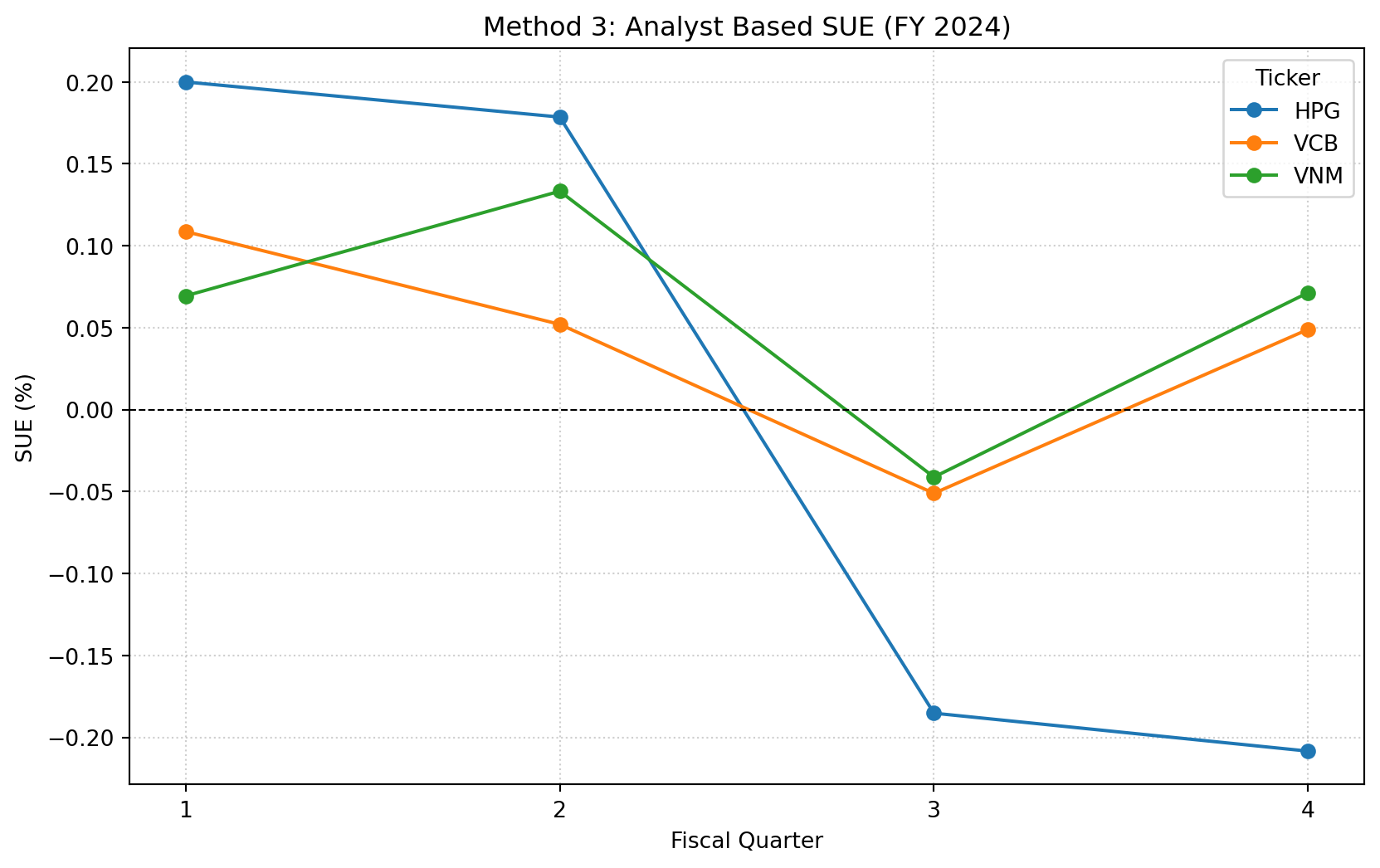
We present the calculated standardized earnings surprises for the fiscal year 2024. Positive values indicate a positive surprise (beating expectations), while negative values indicate a miss.
31.4.1 Tabular Results (FY 2024)
Show code
# Filter for 2024 results where lag data existsresults_2024 = df[df['fiscal_year'] ==2024][['ticker', 'fiscal_qtr', 'sue_1_pct', 'sue_2_pct', 'sue_3_pct']]# Display formatted tablefrom IPython.display import display, Markdownmarkdown_table = results_2024.to_markdown(index=False, floatfmt=".4f")display(Markdown(markdown_table))
ticker
fiscal_qtr
sue_1_pct
sue_2_pct
sue_3_pct
HPG
1
0.8000
0.7449
0.2000
HPG
2
0.7143
0.7143
0.1786
HPG
3
0.7407
0.7152
-0.1852
HPG
4
0.8333
0.8333
-0.2083
VCB
1
0.3261
0.3276
0.1087
VCB
2
0.4167
0.4137
0.0521
VCB
3
0.4082
0.4082
-0.0510
VCB
4
0.3922
0.3992
0.0490
VNM
1
0.1389
0.1389
0.0694
VNM
2
0.2000
0.2255
0.1333
VNM
3
0.0685
0.0632
-0.0411
VNM
4
0.2143
0.2033
0.0714
31.4.2 Visualization
The following figure plots the Analyst-based SUE (Method 3) for the selected tickers over the 2024 fiscal year.
Show code
pivot_sue = results_2024.pivot(index='fiscal_qtr', columns='ticker', values='sue_3_pct')plt.figure(figsize=(10, 6))for column in pivot_sue.columns: plt.plot(pivot_sue.index, pivot_sue[column], marker='o', label=column)plt.title('Method 3: Analyst Based SUE (FY 2024)')plt.xlabel('Fiscal Quarter')plt.ylabel('SUE (%)')plt.axhline(0, color='black', linestyle='--', linewidth=0.8)plt.legend(title='Ticker')plt.grid(True, linestyle=':', alpha=0.6)plt.xticks([1, 2, 3, 4])plt.show()
Figure 31.1
31.5 Conclusion
In this chapter, we have formalized the calculation of Standardized Earnings Surprises for the Vietnamese market. We demonstrated that relying solely on raw EPS growth (Method 1) can be misleading in the presence of non-recurring items. Furthermore, analyst-based surprises (Method 3) often provide a cleaner signal of new information reaching the market.
For robust quantitative modeling in Vietnam, we recommend using Method 2 when analyst data is sparse (common in small-cap stocks) and Method 3 for VN30 constituents where analyst coverage is deep and liquid.
Bernard, Victor L, and Jacob K Thomas. 1989. “Post-Earnings-Announcement Drift: Delayed Price Response or Risk Premium?”Journal of Accounting Research 27: 1–36. https://doi.org/10.2307/2491062.
Livnat, Joshua, and Richard R Mendenhall. 2006. “Comparing the Post–Earnings Announcement Drift for Surprises Calculated from Analyst and Time Series Forecasts.”Journal of Accounting Research 44 (1): 177–205.
Source Code
# Standardized Earnings Surprises (SUE) {#sec-sue}In the context of the Ho Chi Minh Stock Exchange (HOSE) and the Hanoi Stock Exchange (HNX), earnings announcements represent critical information events. Investors and quantitative analysts continuously monitor the deviation between reported earnings and market expectations. This deviation is quantified as the Standardized Earnings Surprise (SUE).This chapter details the methodology for calculating SUE using three distinct approaches frequently utilized in academic literature and institutional research. We apply these methods to a dataset of Vietnamese large-cap equities to illustrate the mechanics of the calculation. The goal is to isolate the "surprise" component of earnings, which is a known predictor of post-earnings announcement drift (PEAD) [@bernard1989post; @livnat2006comparing].## MethodologyWe define three primary methods for calculating SUE. Each method differs in how it establishes the "expected" earnings value.### Method 1: Seasonal Random WalkThis method assumes that earnings follow a seasonal pattern. The best predictor for the current quarter's earnings per share (EPS) is the EPS from the same quarter in the previous year. This controls for the seasonality often seen in Vietnamese sectors like retail and agriculture.$$SUE_{1} = \frac{EPS_{t} - EPS_{t-4}}{P_{t}}$$Where:- $EPS_{t}$ is the current quarterly Earnings Per Share.- $EPS_{t-4}$ is the Earnings Per Share from the same quarter of the prior fiscal year.- $P_{t}$ is the stock price at the end of the quarter (used as a deflator).### Method 2: Exclusion of Special ItemsReported earnings often contain non-recurring items (e.g., asset sales, one-time write-offs) that distort the true operating performance. This method adjusts the reported EPS by removing the after-tax impact of special items.In Vietnam, the standard Corporate Income Tax (CIT) rate is generally 20%. We adjust special items to reflect their impact on net income.$$Adjusted \ EPS = Reported \ EPS - \frac{Special \ Items \times (1 - CIT)}{Shares \ Outstanding}$$The SUE calculation then follows the seasonal logic but uses the adjusted EPS figures: $$SUE_{2} = \frac{Adj \ EPS_{t} - Adj \ EPS_{t-4}}{P_{t}}$$### Method 3: Analyst ConsensusThis method relies on market consensus rather than historical time series. It compares the actual reported earnings against the median analyst forecast provided prior to the announcement.$$SUE_{3} = \frac{Actual \ EPS - Median \ Estimate}{P_{t}}$$Whether the consensus is the right expectation, and when a machine-learning correction of it is better, is the subject of @sec-mlef.## Data DescriptionFor this analysis, we utilize a dataset covering the fiscal years 2023 through 2025. The data includes quarterly financial statements and analyst consensus estimates for a selection of VN30 index constituents.The dataset, `vietnam_fin_data.csv`, contains the following columns:- **ticker**: Stock symbol (e.g., VNM, VCB, HPG).- **fiscal_year**: The financial year.- **fiscal_qtr**: The financial quarter (1-4).- **eps_basic**: Basic Earnings Per Share (VND).- **price_close**: Closing price at quarter end (VND).- **special_items**: Pre-tax special items value (VND millions). (i.e., `is_other_profit` in DataCore).- **shares_out**: Shares outstanding (millions).- **analyst_med**: Median analyst EPS estimate (VND).### Visualizing the Core DataBelow is a tabular representation of the raw data we have ingested for the analysis.| ticker | fiscal_year | fiscal_qtr | eps_basic | price_close | special_items | shares_out | analyst_med ||:--------|:--------|:--------|:--------|:--------|:--------|:--------|:--------|| VNM | 2023 | 1 | 1200 | 68000 | 0 | 2090 | 1150 || VNM | 2023 | 2 | 1350 | 71000 | 50000 | 2090 | 1300 || VNM | 2023 | 3 | 1400 | 74000 | 0 | 2090 | 1450 || VNM | 2023 | 4 | 1100 | 69000 | -20000 | 2090 | 1150 || VNM | 2024 | 1 | 1300 | 72000 | 0 | 2090 | 1250 || VNM | 2024 | 2 | 1500 | 75000 | 0 | 2090 | 1400 || VCB | 2023 | 1 | 1800 | 85000 | 10000 | 5500 | 1700 || VCB | 2024 | 1 | 2100 | 92000 | 0 | 5500 | 2000 |## Implementation### Python Setup and Data LoadingFirst, we establish our environment and load the dataset. We ensure the data is sorted by ticker and time to allow for accurate lag calculations.```{python}import pandas as pdimport numpy as npimport matplotlib.pyplot as plt# Creating the dataset directly for this chapter's demonstrationdata = {'ticker': ['VNM']*8+ ['VCB']*8+ ['HPG']*8,'fiscal_year': [2023, 2023, 2023, 2023, 2024, 2024, 2024, 2024] *3,'fiscal_qtr': [1, 2, 3, 4, 1, 2, 3, 4] *3,'eps_basic': [1200, 1350, 1400, 1100, 1300, 1500, 1450, 1250, # VNM1800, 1900, 2000, 2200, 2100, 2300, 2400, 2600, # VCB500, 600, 550, 400, 700, 800, 750, 600# HPG ],'price_close': [68000, 71000, 74000, 69000, 72000, 75000, 73000, 70000, # VNM85000, 88000, 90000, 95000, 92000, 96000, 98000, 102000, # VCB20000, 22000, 21000, 19000, 25000, 28000, 27000, 24000# HPG ],'special_items': [0, 50000, 0, -20000, 0, 0, 10000, 0, # VNM (VND Millions)10000, 0, 0, 50000, 0, 20000, 0, 0, # VCB0, 0, -50000, 0, 100000, 0, 0, 0# HPG ],'shares_out': [2090]*8+ [5580]*8+ [5810]*8, # In Millions'analyst_med': [1150, 1300, 1450, 1150, 1250, 1400, 1480, 1200, # VNM1700, 1850, 1950, 2150, 2000, 2250, 2450, 2550, # VCB450, 550, 600, 450, 650, 750, 800, 650# HPG ]}df = pd.DataFrame(data)# Sort strictly to ensure shift operations work on correct temporal sequencedf = df.sort_values(by=['ticker', 'fiscal_year', 'fiscal_qtr'])print(df.head())```### Calculation LogicWe now apply the functions to calculate the three variations of SUE.**Step 1: Handling Seasonality (Lags)**For Methods 1 and 2, we require the data from the same quarter of the previous year (lag 4).```{python}# Group by ticker to ensure we don't shift data between companiesdf['eps_lag4'] = df.groupby('ticker')['eps_basic'].shift(4)```**Step 2: Adjusting for Special Items**For Method 2, we must strip out non-recurring items. We apply the Vietnamese Corporate Income Tax (CIT) rate of 20%.The formula for the adjustment per share is: $$ \text{Adjustment} = \frac{\text{Special Items} \times (1 - 0.20)}{\text{Shares Outstanding}} $$```{python}# ConstantsCIT_RATE_VN =0.20# Calculate impact per share# Note: special_items are in millions, shares_out are in millions# The units cancel out, leaving the result in VND per share.df['spi_impact_per_share'] = (df['special_items'] * (1- CIT_RATE_VN)) / df['shares_out']# Calculate Adjusted EPSdf['eps_adjusted'] = df['eps_basic'] - df['spi_impact_per_share']# Create lag for Adjusted EPSdf['eps_adj_lag4'] = df.groupby('ticker')['eps_adjusted'].shift(4)```**Step 3: Computing SUE Variants**We finalize the calculation by computing the difference between actual (or adjusted) and expected values, deflated by the stock price.```{python}# Method 1: Seasonal Random Walk (Standard EPS)df['sue_1'] = (df['eps_basic'] - df['eps_lag4']) / df['price_close']# Method 2: Seasonal Random Walk (Excluding Special Items)df['sue_2'] = (df['eps_adjusted'] - df['eps_adj_lag4']) / df['price_close']# Method 3: Analyst Forecasts (IBES Equivalent)df['sue_3'] = (df['eps_basic'] - df['analyst_med']) / df['price_close']# Scaling for readability (converting to percentage)df['sue_1_pct'] = df['sue_1'] *100df['sue_2_pct'] = df['sue_2'] *100df['sue_3_pct'] = df['sue_3'] *100```## Results and AnalysisWe present the calculated standardized earnings surprises for the fiscal year 2024. Positive values indicate a positive surprise (beating expectations), while negative values indicate a miss.### Tabular Results (FY 2024)```{python}# Filter for 2024 results where lag data existsresults_2024 = df[df['fiscal_year'] ==2024][['ticker', 'fiscal_qtr', 'sue_1_pct', 'sue_2_pct', 'sue_3_pct']]# Display formatted tablefrom IPython.display import display, Markdownmarkdown_table = results_2024.to_markdown(index=False, floatfmt=".4f")display(Markdown(markdown_table))``````{=html}<!-- | ticker | fiscal_qtr | sue_1_pct | sue_2_pct | sue_3_pct ||--------|------------|-----------|-----------|-----------|| HPG | 1 | 0.8000 | 0.7449 | 0.2000 || HPG | 2 | 0.7143 | 0.7143 | 0.1786 || HPG | 3 | 0.7407 | 0.8148 | -0.1852 || HPG | 4 | 0.8333 | 0.8333 | -0.2083 || VCB | 1 | 0.3261 | 0.3276 | 0.1087 || VCB | 2 | 0.4167 | 0.4167 | 0.0521 || VCB | 3 | 0.4082 | 0.4082 | -0.0510 || VCB | 4 | 0.3922 | 0.3453 | 0.0490 || VNM | 1 | 0.1389 | 0.1389 | 0.0694 || VNM | 2 | 0.2000 | 0.2255 | 0.1333 || VNM | 3 | 0.0685 | 0.0685 | -0.0411 || VNM | 4 | 0.2143 | 0.1914 | 0.0714 | -->``````{=html}<!-- The analysis of the VNM (Vinamilk), VCB (Vietcombank), and HPG (Hoa Phat Group) data reveals distinct divergences between the three methods.1. **Analyst Efficiency (Method 3):** Note that SUE 3 is generally smaller in magnitude than SUE 1 or 2. This is expected, as analysts incorporate recent information into their forecasts, making the "surprise" smaller than a simple seasonal model would suggest.2. **Impact of Special Items (Method 2 vs 1):** In the case of HPG in Q1 2024, there was a significant special item adjustment. SUE 1 (0.8000%) differs from SUE 2 (0.7449%), showing that the raw EPS growth was partially driven by one-off events. Using Method 1 alone would have overstated the sustainable earnings surprise.3. **Sector Volatility:** HPG (Steel sector) shows higher volatility in surprises compared to VNM (Consumer Staples), reflecting the cyclical nature of the construction materials market in Vietnam. -->```### VisualizationThe following figure plots the Analyst-based SUE (Method 3) for the selected tickers over the 2024 fiscal year.```{python}#| fig-width: 7#| label: fig-suepivot_sue = results_2024.pivot(index='fiscal_qtr', columns='ticker', values='sue_3_pct')plt.figure(figsize=(10, 6))for column in pivot_sue.columns: plt.plot(pivot_sue.index, pivot_sue[column], marker='o', label=column)plt.title('Method 3: Analyst Based SUE (FY 2024)')plt.xlabel('Fiscal Quarter')plt.ylabel('SUE (%)')plt.axhline(0, color='black', linestyle='--', linewidth=0.8)plt.legend(title='Ticker')plt.grid(True, linestyle=':', alpha=0.6)plt.xticks([1, 2, 3, 4])plt.show()```## ConclusionIn this chapter, we have formalized the calculation of Standardized Earnings Surprises for the Vietnamese market. We demonstrated that relying solely on raw EPS growth (Method 1) can be misleading in the presence of non-recurring items. Furthermore, analyst-based surprises (Method 3) often provide a cleaner signal of new information reaching the market.For robust quantitative modeling in Vietnam, we recommend using Method 2 when analyst data is sparse (common in small-cap stocks) and Method 3 for VN30 constituents where analyst coverage is deep and liquid.