import pandas as pdimport numpy as npimport matplotlib.pyplot as pltimport matplotlib.ticker as mtickerimport matplotlib.dates as mdatesimport statsmodels.api as smimport statsmodels.formula.api as smffrom scipy import statsimport warningswarnings.filterwarnings("ignore")plt.rcParams.update({"figure.dpi": 150,"axes.spines.top": False,"axes.spines.right": False,"font.size": 11,})
A foundational question in capital markets research is whether accounting information matters to investors. If financial statements merely repackage what the market already knows from other sources, such as press coverage, analyst reports, management guidance, macroeconomic data, then the elaborate apparatus of financial reporting is largely redundant for price discovery. Conversely, if earnings announcements trigger measurable changes in trading behavior, we have evidence that the accounting system produces information the market did not previously possess.
Beaver (1968) addressed this question by examining whether trading volume and return volatility increase around the dates when firms announce annual earnings. The logic is direct: if an earnings announcement contains new information, it should alter investors’ beliefs. Altered beliefs lead some investors to trade, increasing volume. And to the extent that the announcement resolves uncertainty, the stock price should adjust, generating abnormal return volatility. Both channels (i.e., volume and volatility) provide distinct windows into the information content of earnings.
The empirical design compares a firm’s trading activity during a narrow announcement window (the days immediately around the earnings release) with its own trading activity during a non-announcement window (otherwise comparable days away from the event). If the announcement conveys information, the announcement window should show elevated volume and volatility relative to the non-announcement period.
25.0.1 Two Distinct Signals: Volume vs. Volatility
While volume and return volatility are both used to measure investor reaction, they capture different economic phenomena. This distinction, formalized in subsequent theoretical work, is important for interpreting results:
Return volatility reflects the average revision in investor beliefs. When the market as a whole is surprised by an earnings number, prices move sharply. The magnitude of the squared (or absolute) return residual measures how far the announcement moved the consensus. This is a measure of the aggregate information content of the announcement (Kim and Verrecchia 1991).
Trading volume reflects disagreement among investors about the implications of the announcement. Even an announcement that moves prices very little can generate heavy trading if investors interpret the same signal differently. For example, if some view an earnings beat as sustainable while others view it as temporary (Kandel and Pearson 1995). Volume thus captures the differential information content of the announcement.
Karpoff (1987) surveys the theoretical and empirical relationship between these two variables. The key insight is that volume is not simply a noisier version of volatility; it provides independent information about how the market processes accounting data.
25.0.2 Why Vietnam?
Vietnam’s equity markets provide a distinctive setting for studying announcement reactions for several reasons:
Information environment. Vietnamese listed firms face less intense pre-announcement scrutiny than their U.S. counterparts. Analyst coverage is sparse (most firms outside the VN30 index receive no institutional coverage). Management earnings guidance is rare. This creates a thicker “information gap” for the earnings announcement to fill, potentially amplifying both volume and volatility reactions.
Retail investor dominance. Over 80% of daily trading volume on HOSE is attributed to retail investors. Retail traders may process earnings information differently from institutions, with greater behavioral biases, less capacity for fundamental analysis, and different trading horizons. This affects both the timing and magnitude of market reactions.
Price limits. HOSE imposes daily price limits of \(\pm\) 7% and HNX of \(\pm\) 10%. When an earnings announcement is sufficiently surprising, the stock may hit its price limit, preventing the market from fully incorporating the information within a single trading session. This creates a distinctive pattern of multi-day adjustment that has no analogue in the original U.S. studies.
Disclosure timing. Vietnamese regulations require audited annual financial statements to be published within 90 days of fiscal year-end. Quarterly financial data (unaudited) must be released within 20 days. The overlap between quarterly and annual announcements, and the variable lag between fiscal year-end and announcement date, creates heterogeneity in the information content of annual earnings releases.
Market structure. Vietnam operates continuous order-matching during trading hours (9:00–11:30 and 13:00–14:30 on HOSE; 9:00–11:30 and 13:00–15:00 on HNX), with periodic call auctions at open and close. This microstructure affects intraday patterns of price discovery around announcements.
25.1 Theoretical Framework
25.1.1 The Information Content Hypothesis
Let \(P_{i,t}\) denote the price of stock \(i\) on date \(t\). Under the efficient markets hypothesis, the price reflects all publicly available information:
where \(D_{i,t+s}\) represents future dividends, \(r\) is the discount rate, and \(\Omega_t\) is the information set at time \(t\).
When firm \(i\) announces earnings \(X_i\) at time \(\tau\), the information set expands: \(\Omega_{\tau^+} = \Omega_{\tau^-} \cup \{X_i\}\). If the announcement contains new information, meaning \(X_i \notin \Omega_{\tau^-}\), then in general:
\[
P_{i,\tau^+} \neq P_{i,\tau^-}
\tag{25.2}\]
The magnitude of the price change reflects the surprise component of the announcement:
25.1.2 Volume as a Signal of Heterogeneous Beliefs
Kim and Verrecchia (1991) develop a model where trading volume is driven by the precision of investors’ private information relative to the precision of the public signal. Define \(V_{i,\tau}\) as the trading volume for stock \(i\) at time \(\tau\). In their framework:
where \(\Omega^{(j)}_{\tau^-}\) is investor \(j\)’s private information set and \(\varepsilon_i\) is noise. Volume increases when investors disagree about what the announcement means, a condition that Kandel and Pearson (1995) term differential interpretation.
This distinction matters for Vietnam. In a market dominated by retail investors with heterogeneous information and analytical capacity, we might expect the volume reaction to be disproportionately large relative to the price reaction, because disagreement is high even when the aggregate price revision is modest.
25.1.3 Measuring Information Content
We use two complementary measures:
Abnormal return volatility. For each firm-day, compute the squared market-adjusted return:
\[
U^2_{i,t} = (R_{i,t} - R_{m,t})^2
\tag{25.5}\]
where \(R_{i,t}\) is the return on stock \(i\) and \(R_{m,t}\) is the market return. Under the null of no information content, \(E[U^2_{i,t}]\) should be the same in the announcement and non-announcement windows. Beaver (1968) standardized this measure by dividing by the firm’s average \(U^2\) during non-announcement weeks.
where \(\overline{Vol}_i\) is the firm’s average daily volume over the event window. A value of \(RV > 1\) indicates above-average trading. Beaver (1968) used a similar approach, computing a “volume ratio” relative to non-report-period averages.
25.2 Data and Variable Construction
25.2.1 Data Requirements
The analysis requires three data elements:
Table 25.1: Data sources for the information content analysis
Data
Source
Key Fields
Earnings announcement dates
Financial statements/filings
Ticker, fiscal year-end, announcement date
Daily stock returns
Exchange data (HOSE/HNX)
Ticker, date, closing price, return
Daily trading volume
Exchange data (HOSE/HNX)
Ticker, date, volume (shares or VND)
25.2.2 Trading Day Calendar
A critical infrastructure element is a trading day calendar that maps calendar dates to sequential trading day indices. This allows us to count “20 trading days before the announcement” correctly, skipping weekends and holidays.
Construct a trading day calendar for HOSE/HNX
def build_trading_calendar( start_date: str="2008-01-01", end_date: str="2024-12-31",) -> pd.DataFrame:""" Build a trading day calendar for Vietnamese stock exchanges. Vietnamese exchanges trade Monday–Friday, with closures for: - Tết Nguyên Đán (Lunar New Year, ~5 days) - Ngày Giỗ Tổ Hùng Vương (Hung Kings' Commemoration) - Ngày Giải phóng miền Nam (Reunification Day, Apr 30) - Ngày Quốc tế Lao động (Labour Day, May 1) - Quốc khánh (National Day, Sep 2) - Tết Dương lịch (New Year, Jan 1) For simulation, we approximate by removing weekends and ~10 holidays/year. """ all_dates = pd.date_range(start_date, end_date, freq="B") # business days# Remove approximate Vietnamese public holidays# (In practice, use the exact holiday calendar from SSC/HOSE) rng = np.random.default_rng(42) n_holidays_per_year =10 years = all_dates.year.unique() holidays = []for yr in years: yr_dates = all_dates[all_dates.year == yr]iflen(yr_dates) > n_holidays_per_year: idx = rng.choice(len(yr_dates), n_holidays_per_year, replace=False) holidays.extend(yr_dates[idx]) trading_dates = all_dates.difference(pd.DatetimeIndex(holidays)) cal = pd.DataFrame({"date": trading_dates,"td": np.arange(1, len(trading_dates) +1), })return caltrading_cal = build_trading_calendar()print(f"Trading calendar: {len(trading_cal):,} trading days, "f"{trading_cal['date'].min().date()} to {trading_cal['date'].max().date()}")
Trading calendar: 4,266 trading days, 2008-01-01 to 2024-12-31
25.2.3 Announcement Date Alignment
Earnings announcements may occur on non-trading days (weekends, holidays). When this happens, we assign the announcement to the next available trading day, since that is the first opportunity for the market to react. We also need to handle the case where announcements occur after market close. Ideally, these would be assigned to the following trading day. Without intraday timing data (common in Vietnamese disclosures), we use the announcement date as reported.
Map announcement dates to trading day indices
def build_announcement_mapper(trading_cal: pd.DataFrame) -> pd.DataFrame:""" Create a mapping from every calendar date to the next available trading day index. This handles announcements on weekends/holidays. """ min_date = trading_cal["date"].min() max_date = trading_cal["date"].max() all_dates = pd.date_range(min_date, max_date, freq="D") mapper = pd.DataFrame({"annc_date": all_dates}) mapper = mapper.merge( trading_cal.rename(columns={"date": "annc_date"}), on="annc_date", how="left", )# Forward-fill: assign non-trading dates to next trading day mapper["td"] = mapper["td"].bfill() mapper["td"] = mapper["td"].astype("Int64")return mapperannc_mapper = build_announcement_mapper(trading_cal)
25.2.4 Generating Synthetic Vietnamese Data
We generate a synthetic panel of Vietnamese listed firms with realistic properties to demonstrate the methodology. The simulation embeds an earnings announcement effect—elevated volume and volatility on days 0 and +1, that we then seek to detect using the Beaver (1968) framework.
Generate synthetic Vietnamese earnings announcement data
def generate_beaver_data( n_firms: int=300, years: list[int] =None, seed: int=2024, days_window: int=20,) ->tuple[pd.DataFrame, pd.DataFrame]:""" Generate: 1. earn_annc: DataFrame of earnings announcement dates 2. daily_data: DataFrame of daily returns and volume The DGP embeds: - An announcement-day return volatility spike (2-3x normal) - An announcement-day volume spike (1.5-2.5x normal) - Price limit truncation at ±7% (HOSE) - Cross-sectional variation by firm size and exchange """if years isNone: years =list(range(2012, 2024)) rng = np.random.default_rng(seed) tc = build_trading_calendar() am = build_announcement_mapper(tc) exchanges = ["HOSE", "HNX"] price_limits = {"HOSE": 0.07, "HNX": 0.10}# ── Generate announcement dates ── annc_records = []for i inrange(n_firms): ticker =f"VN{i:04d}" exchange = rng.choice(exchanges, p=[0.6, 0.4])# Firm size (log market cap in VND billions) log_mcap = rng.normal(6.5, 1.5)for yr in years:# Fiscal year ends Dec 31; announcement 60-90 days later fy_end = pd.Timestamp(f"{yr}-12-31") annc_lag = rng.integers(45, 90) annc_date = fy_end + pd.Timedelta(days=int(annc_lag)) annc_records.append({"ticker": ticker,"fiscal_year": yr,"datadate": fy_end,"annc_date": annc_date,"exchange": exchange,"log_mcap": log_mcap, }) earn_annc = pd.DataFrame(annc_records)# Map to trading day index earn_annc["annc_date_dt"] = pd.to_datetime(earn_annc["annc_date"]) earn_annc = earn_annc.merge( am[["annc_date", "td"]].rename(columns={"td": "event_td"}), left_on="annc_date_dt", right_on="annc_date", how="left", suffixes=("", "_map"), ) earn_annc = earn_annc.dropna(subset=["event_td"]) earn_annc["event_td"] = earn_annc["event_td"].astype(int) earn_annc["start_td"] = earn_annc["event_td"] - days_window earn_annc["end_td"] = earn_annc["event_td"] + days_window# Map start/end td back to dates td_to_date = tc.set_index("td")["date"] earn_annc["start_date"] = earn_annc["start_td"].map(td_to_date) earn_annc["end_date"] = earn_annc["end_td"].map(td_to_date) earn_annc = earn_annc.dropna(subset=["start_date", "end_date"])# ── Generate daily return and volume data ── daily_records = []for _, row in earn_annc.iterrows(): ticker = row["ticker"] exchange = row["exchange"] plimit = price_limits[exchange] log_mcap = row["log_mcap"] event_td = row["event_td"]# Base volatility inversely related to size base_vol =0.015+0.01* np.exp(-0.3* log_mcap)# Base volume (shares/day) base_volume = np.exp(log_mcap + rng.normal(0, 0.5)) *1000# Window trading days window_tds = tc[ (tc["td"] >= row["start_td"]) & (tc["td"] <= row["end_td"]) ].copy()for _, td_row in window_tds.iterrows(): date = td_row["date"] td = td_row["td"] relative_td = td - event_td# Market return (common factor) mkt_ret = rng.normal(0.0003, 0.012)# Firm-specific return# Announcement effect: elevated volatility on days 0, +1if relative_td in [0, 1]: vol_mult = rng.uniform(2.0, 3.5)elifabs(relative_td) <=2: vol_mult = rng.uniform(1.2, 1.8)else: vol_mult =1.0 firm_shock = rng.normal(0, base_vol * vol_mult) raw_ret = mkt_ret + firm_shock# Apply price limits ret = np.clip(raw_ret, -plimit, plimit) ret_mkt = ret - mkt_ret# Volume: spike on announcement daysif relative_td in [0, 1]: vol_spike = rng.uniform(1.5, 2.8)elifabs(relative_td) <=3: vol_spike = rng.uniform(1.0, 1.5)else: vol_spike = rng.uniform(0.7, 1.3) volume = base_volume * vol_spike * np.exp(rng.normal(0, 0.3)) daily_records.append({"ticker": ticker,"fiscal_year": row["fiscal_year"],"date": date,"td": td,"relative_td": relative_td,"ret": ret,"mkt_ret": mkt_ret,"ret_mkt": ret_mkt,"vol": max(volume, 100),"exchange": exchange,"log_mcap": log_mcap, }) daily_data = pd.DataFrame(daily_records)return earn_annc, daily_dataearn_annc, daily_data = generate_beaver_data(n_firms=300, seed=2024)print(f"Announcements: {len(earn_annc):,}")print(f"Daily observations: {len(daily_data):,}")
Announcements: 3,600
Daily observations: 147,600
25.3 Single-Event Walkthrough
Before scaling to the full sample, we trace the methodology for a single earnings announcement to build intuition and verify each step.
25.3.1 Selecting the Event
Select a single earnings announcement for demonstration
We extract 41 trading days of data (20 before through 20 after the announcement) and compute the key measures.
Extract and process data for the single event
single_daily = daily_data[ (daily_data["ticker"] == single_ticker) & (daily_data["fiscal_year"] == single_fy)].copy()# Compute measuressingle_daily["sq_ret_mkt"] = single_daily["ret_mkt"] **2single_daily["abs_ret_mkt"] = single_daily["ret_mkt"].abs()# Relative volume: normalize by own averageavg_vol = single_daily["vol"].mean()single_daily["rel_vol"] = single_daily["vol"] / avg_volprint(f"Trading days in window: {len(single_daily)}")print(f"Average daily volume: {avg_vol:,.0f} shares")
Trading days in window: 41
Average daily volume: 3,780,757 shares
25.3.3 Visualizing the Single Event
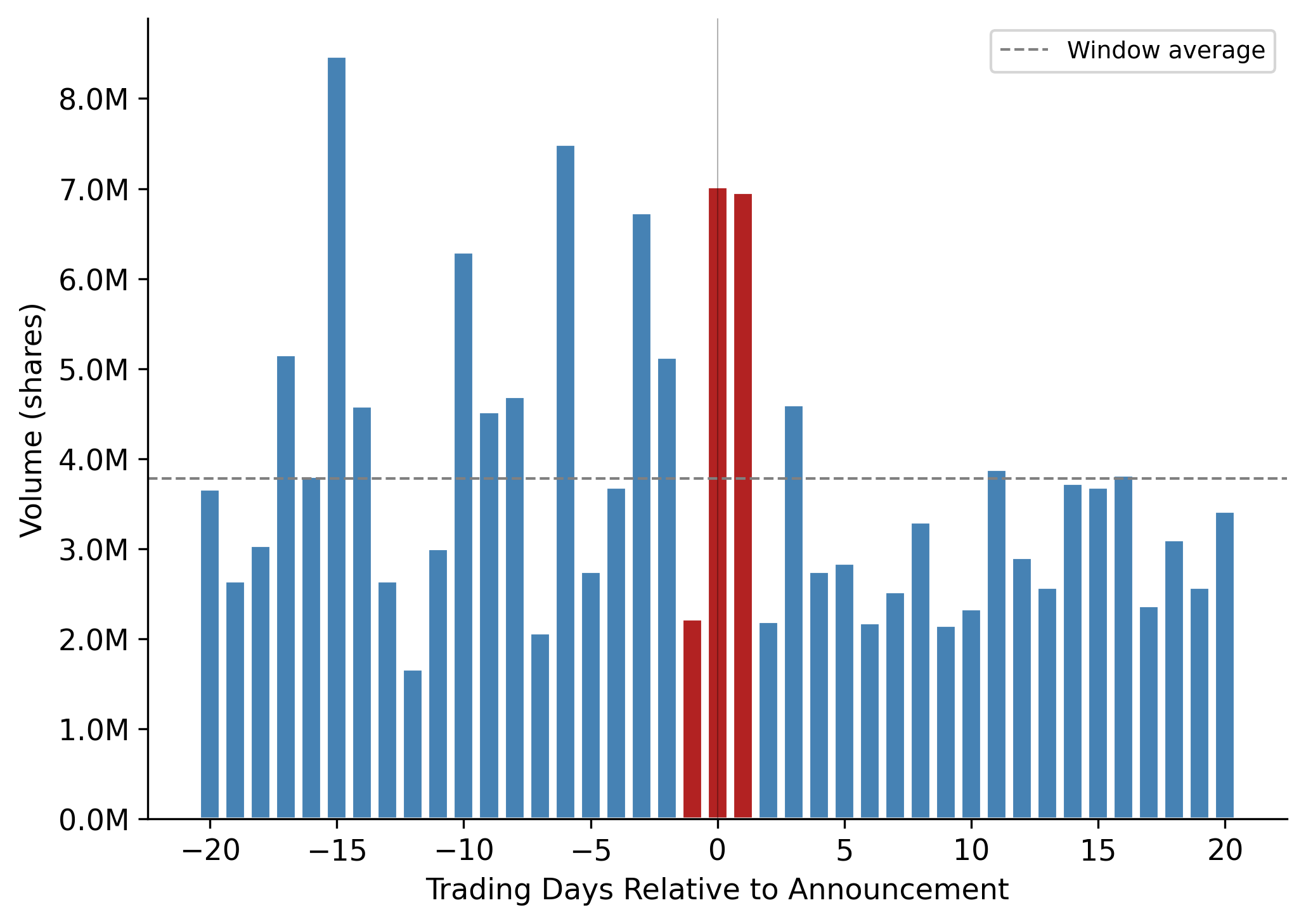
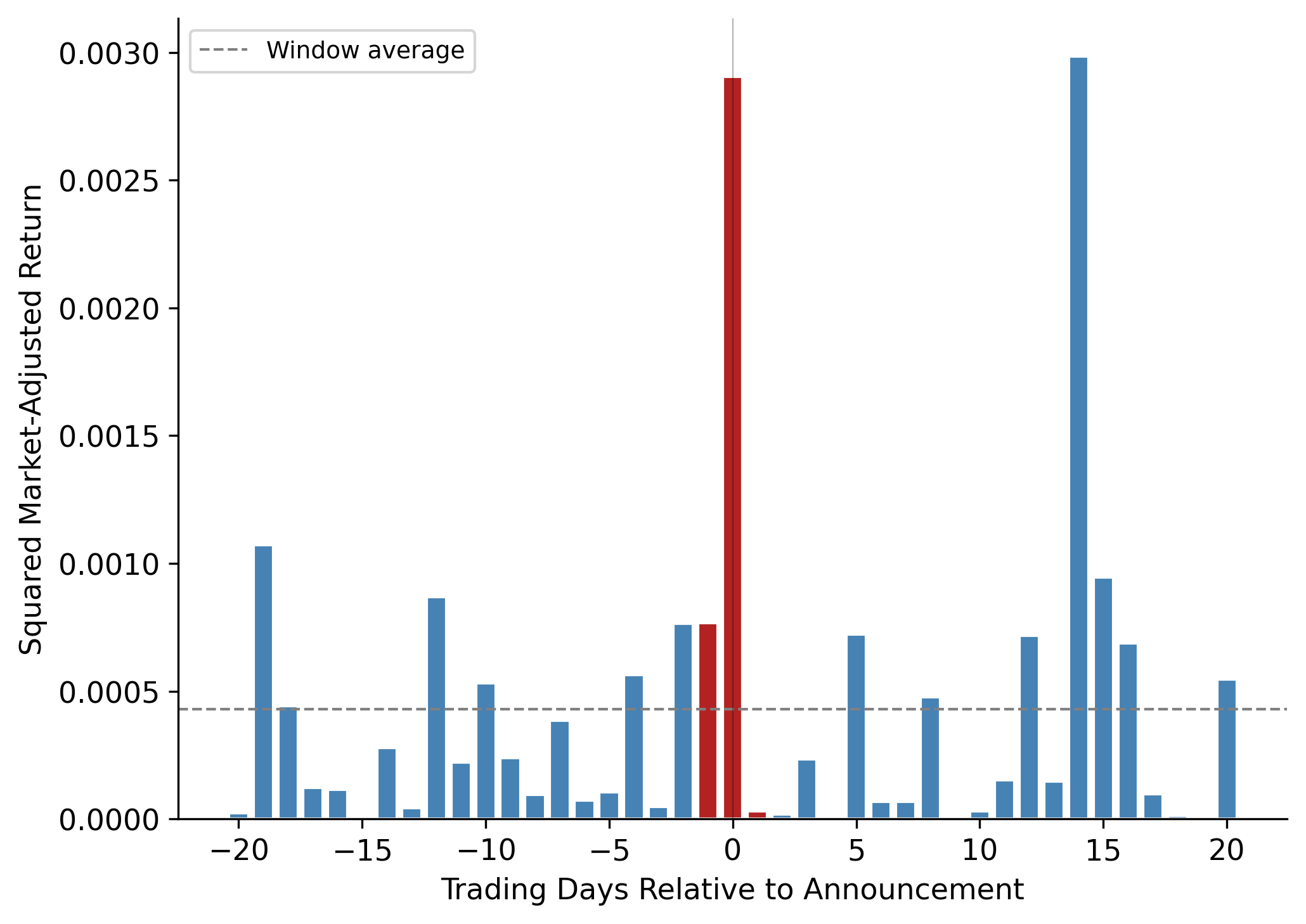
Figure 25.1 and Figure 25.2 display the volume and volatility patterns for this single earnings announcement.
Show code
fig, ax = plt.subplots()colors = ["firebrick"ifabs(t) <=1else"steelblue"for t in single_daily["relative_td"]]ax.bar(single_daily["relative_td"], single_daily["vol"], color=colors, edgecolor="white", width=0.8)ax.axhline(avg_vol, color="grey", linestyle="--", linewidth=1, label="Window average")ax.axvline(0, color="black", linewidth=0.5, alpha=0.3)ax.set_xlabel("Trading Days Relative to Announcement")ax.set_ylabel("Volume (shares)")ax.yaxis.set_major_formatter(mticker.FuncFormatter(lambda x, _: f"{x/1e6:.1f}M"))ax.legend(fontsize=9)plt.tight_layout()plt.show()
Figure 25.1: Daily trading volume around a single earnings announcement. Day 0 is the first trading day on or after the announcement date. The dashed line marks the event-window average.
Show code
fig, ax = plt.subplots()ax.bar(single_daily["relative_td"], single_daily["sq_ret_mkt"], color=["firebrick"ifabs(t) <=1else"steelblue"for t in single_daily["relative_td"]], edgecolor="white", width=0.8)ax.axhline(single_daily["sq_ret_mkt"].mean(), color="grey", linestyle="--", linewidth=1, label="Window average")ax.axvline(0, color="black", linewidth=0.5, alpha=0.3)ax.set_xlabel("Trading Days Relative to Announcement")ax.set_ylabel("Squared Market-Adjusted Return")ax.legend(fontsize=9)plt.tight_layout()plt.show()
Figure 25.2: Squared market-adjusted returns around a single earnings announcement. Elevated values on days 0 and +1 indicate that the announcement moved the stock price beyond what market-wide movements would predict.
Reading the Plots
A single event is inherently noisy, other firm-specific news (M&A rumors, analyst reports, regulatory actions) can generate volume and volatility spikes on non-announcement dates. The value of the Beaver (1968) approach lies in averaging across many events to isolate the systematic announcement effect from idiosyncratic noise.
25.4 Full-Sample Analysis
25.4.1 Computing Event-Time Aggregates
For each event day \(\tau\) relative to the announcement, we compute the cross-sectional average of our two measures across all announcements:
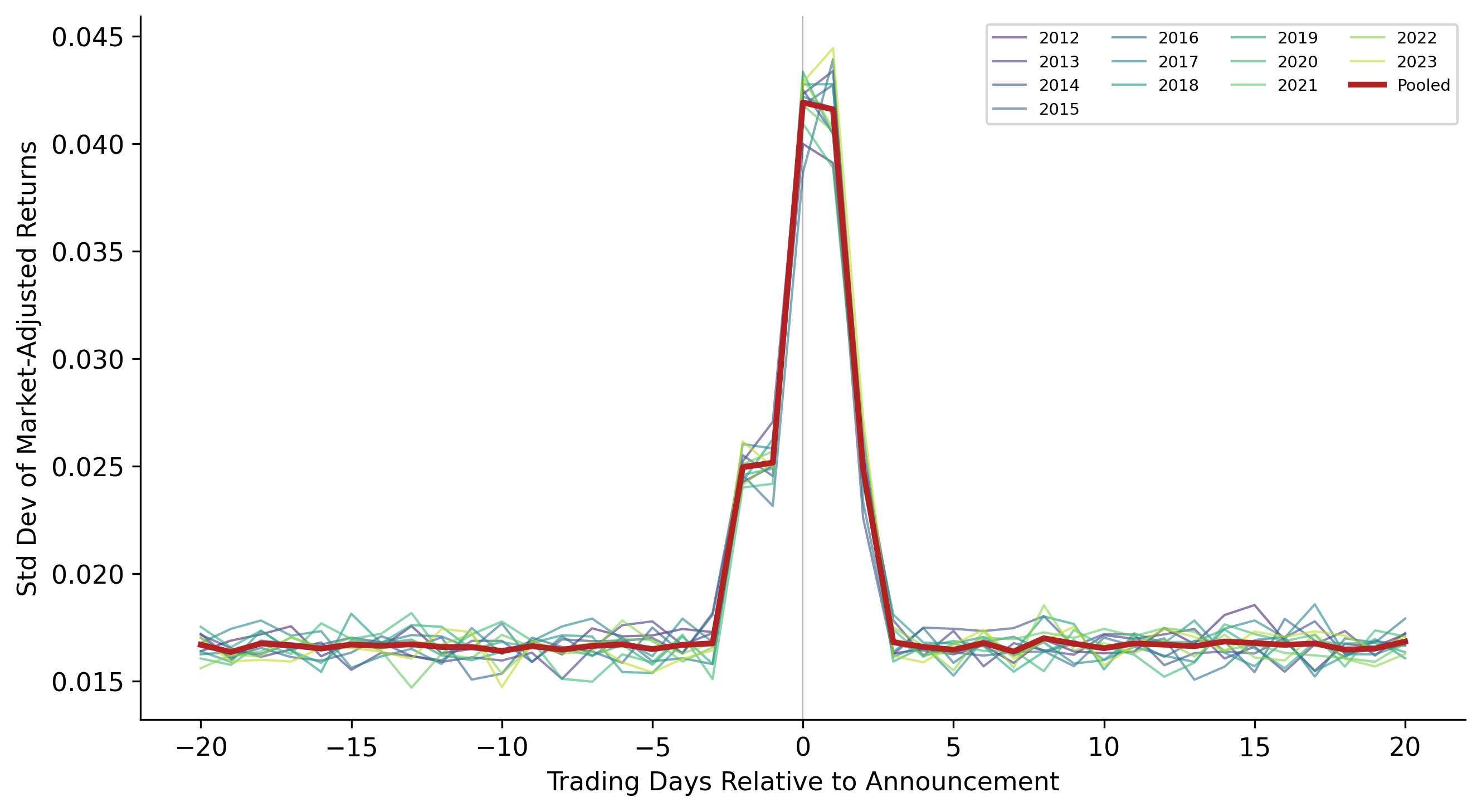
Figure 25.3 plots the standard deviation of market-adjusted returns by event day, separately for each fiscal year. A clear spike on days 0 and +1 is the hallmark of information content.
Show code
fig, ax = plt.subplots(figsize=(9, 5))years_plot =sorted(event_summary["year"].unique())# Use a colormapcmap = plt.cm.viridis(np.linspace(0.1, 0.9, len(years_plot)))for idx, yr inenumerate(years_plot): sub = event_summary[event_summary["year"] == yr].sort_values("relative_td") ax.plot(sub["relative_td"], sub["sd_ret_mkt"], color=cmap[idx], alpha=0.6, linewidth=1.0, label=str(yr))# Overlay pooled meanpooled = event_summary_pooled.sort_values("relative_td")ax.plot(pooled["relative_td"], pooled["sd_ret_mkt"], color="firebrick", linewidth=2.5, linestyle="-", label="Pooled", zorder=10)ax.axvline(0, color="black", linewidth=0.5, alpha=0.3)ax.set_xlabel("Trading Days Relative to Announcement")ax.set_ylabel("Std Dev of Market-Adjusted Returns")ax.legend(fontsize=7, ncol=4, loc="upper right")plt.tight_layout()plt.show()
Figure 25.3: Standard deviation of market-adjusted returns around earnings announcements, by fiscal year. The consistent spike on days 0 and +1 across years provides strong evidence that annual earnings announcements convey new information to Vietnamese equity markets.
25.4.3 Trading Volume Around Announcements
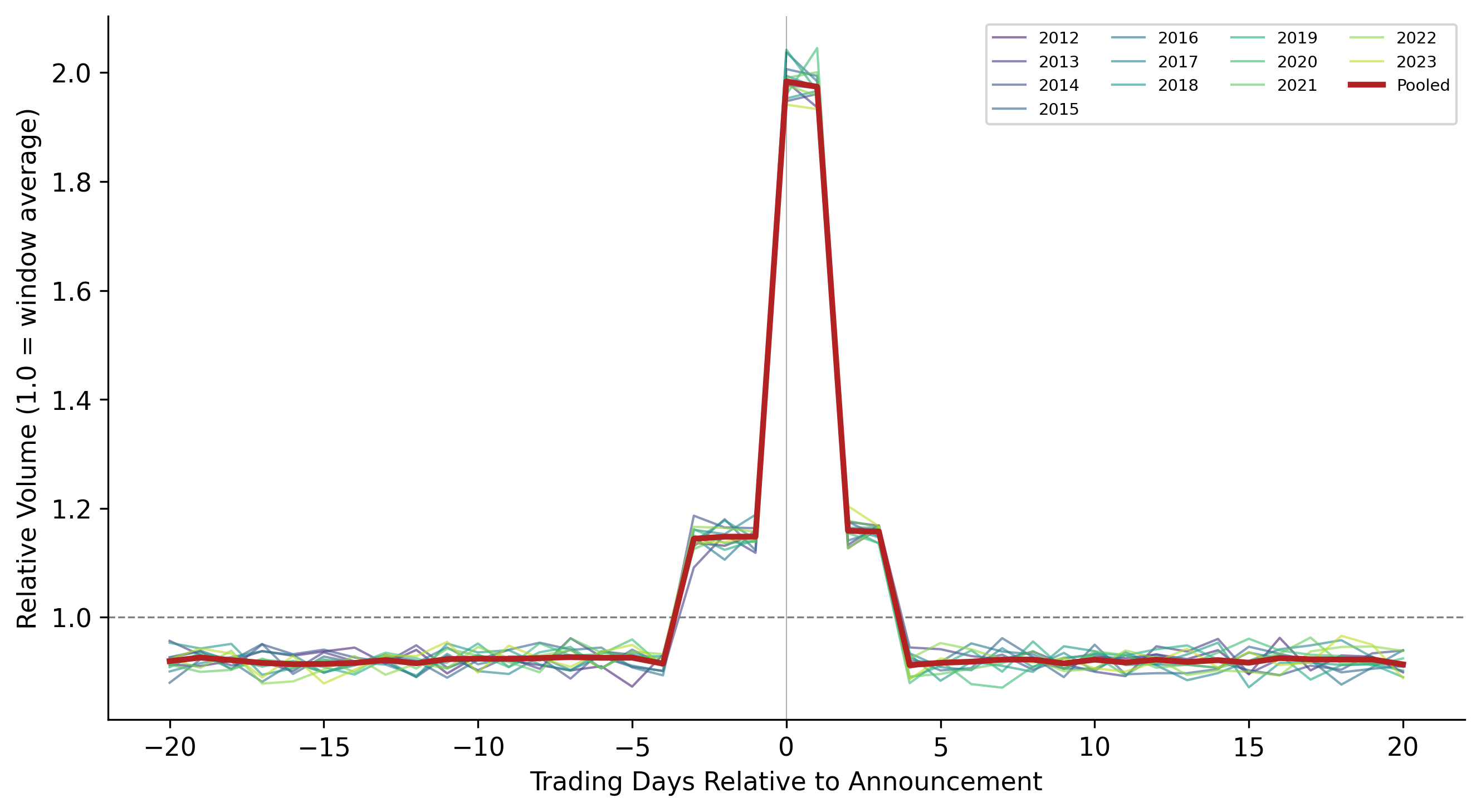
Figure 25.4 shows relative trading volume by event day. The volume response provides an independent confirmation of the volatility finding.
Figure 25.4: Mean relative trading volume around earnings announcements, by fiscal year. Volume spikes sharply on days 0 and +1, consistent with investors actively trading on the new information. The elevated volume persists slightly longer than the volatility spike, suggesting that disagreement about the announcement’s implications takes time to resolve.
25.4.4 Formal Statistical Tests
Beaver (1968) relied on visual inspection and informal statistical arguments. Modern practice demands formal tests. We test whether the announcement-window measures differ significantly from the non-announcement window using a paired comparison.
Define the announcement window as days \(\{-1, 0, +1\}\) and the non-announcement window as days \(\{-20, \ldots, -5\} \cup \{+5, \ldots, +20\}\). For each event \(i\), we compute:
Under the null, \(E[\Delta U^2_i] = 0\). We test this with a \(t\)-test across events.
Show code
annc_window = [-1, 0, 1]non_annc_window =list(range(-20, -4)) +list(range(5, 21))def compute_window_means(df, var, window):"""Compute mean of var within a window for each event."""return ( df[df["relative_td"].isin(window)] .groupby(["ticker", "fiscal_year"])[var] .mean() )test_results = {}for var, label in [("sq_ret_mkt", "Squared Mkt-Adj Return"), ("abs_ret_mkt", "Absolute Mkt-Adj Return"), ("rel_vol", "Relative Volume")]: annc_mean = compute_window_means(daily_data, var, annc_window) non_annc_mean = compute_window_means(daily_data, var, non_annc_window)# Align on common events common = annc_mean.index.intersection(non_annc_mean.index) diff = annc_mean.loc[common] - non_annc_mean.loc[common] diff = diff.dropna() t_stat, p_val = stats.ttest_1samp(diff, 0) test_results[label] = {"Annc Window Mean": annc_mean.mean(),"Non-Annc Window Mean": non_annc_mean.mean(),"Difference": diff.mean(),"t-statistic": t_stat,"p-value": p_val,"N events": len(diff), }test_df = pd.DataFrame(test_results).T.round(4)test_df["N events"] = test_df["N events"].astype(int)test_df
Table 25.2: Formal tests of announcement-period information content. The announcement window is days {-1, 0, +1}; the non-announcement window excludes days {-4, …, +4}. Large t-statistics and small p-values provide strong evidence that both return volatility and trading volume are significantly elevated during the announcement window.
Annc Window Mean
Non-Annc Window Mean
Difference
t-statistic
p-value
N events
Squared Mkt-Adj Return
0.0014
0.0003
0.0011
64.1353
0.0
3600
Absolute Mkt-Adj Return
0.0294
0.0132
0.0162
79.7318
0.0
3600
Relative Volume
1.7020
0.9206
0.7814
135.9351
0.0
3600
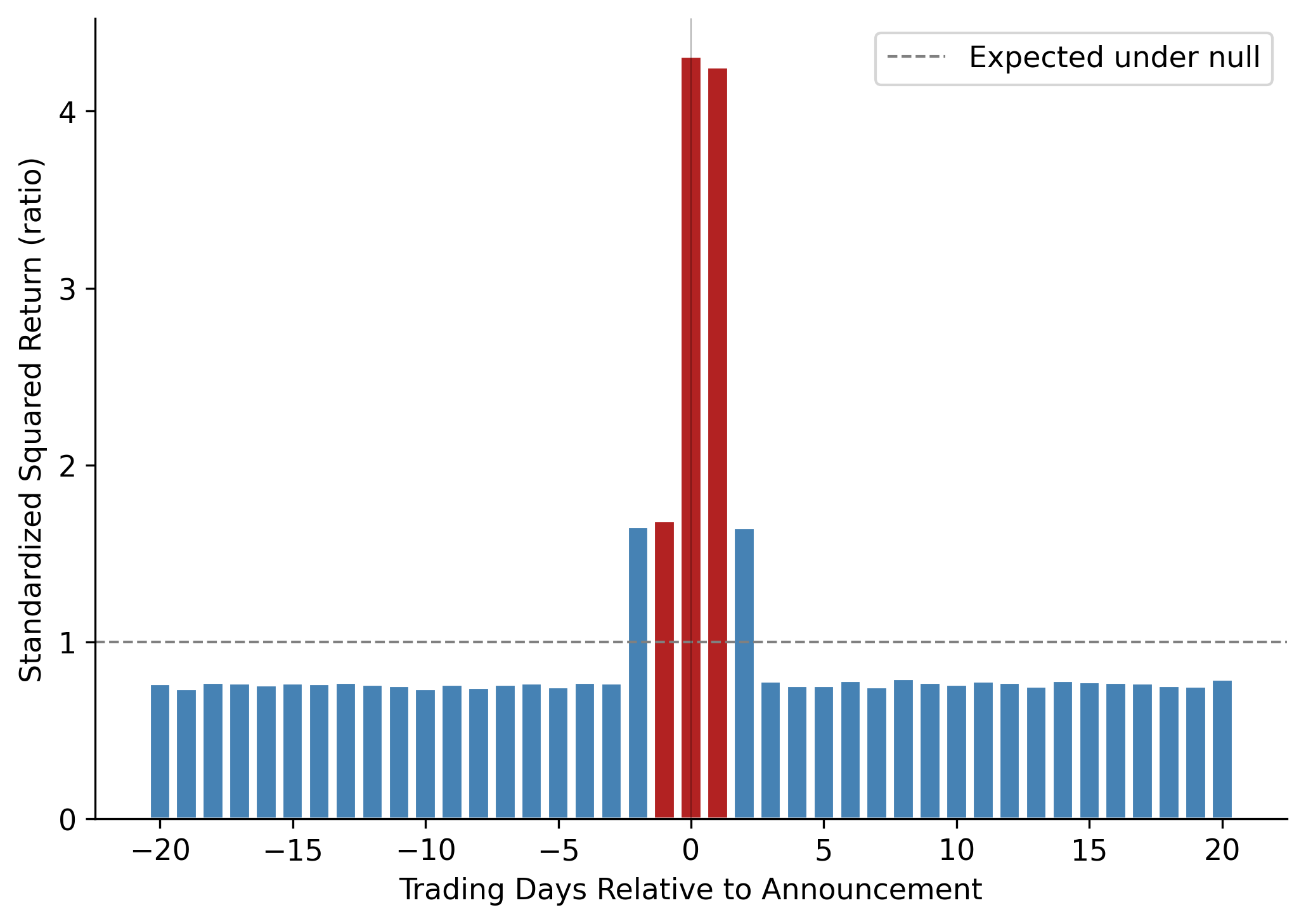
25.4.5 Standardized Volatility Ratio
Following the approach of Beaver (1968), we compute the ratio of announcement-window squared returns to non-announcement-window squared returns. Under the null, this ratio equals 1.0.
Show code
fig, ax = plt.subplots()ratio = pooled["mean_std_sq_ret"]colors = ["firebrick"ifabs(t) <=1else"steelblue"for t in pooled["relative_td"]]ax.bar(pooled["relative_td"], ratio, color=colors, edgecolor="white")ax.axhline(1.0, color="grey", linestyle="--", linewidth=1, label="Expected under null")ax.axvline(0, color="black", linewidth=0.5, alpha=0.3)ax.set_xlabel("Trading Days Relative to Announcement")ax.set_ylabel("Standardized Squared Return (ratio)")ax.legend()plt.tight_layout()plt.show()
Figure 25.5: Standardized squared market-adjusted return by event day (pooled across all years). A value of 1.0 indicates normal volatility. The announcement-day ratio substantially exceeds 1.0, indicating that earnings releases generate return variation well above normal levels.
25.5 Cross-Sectional Variation
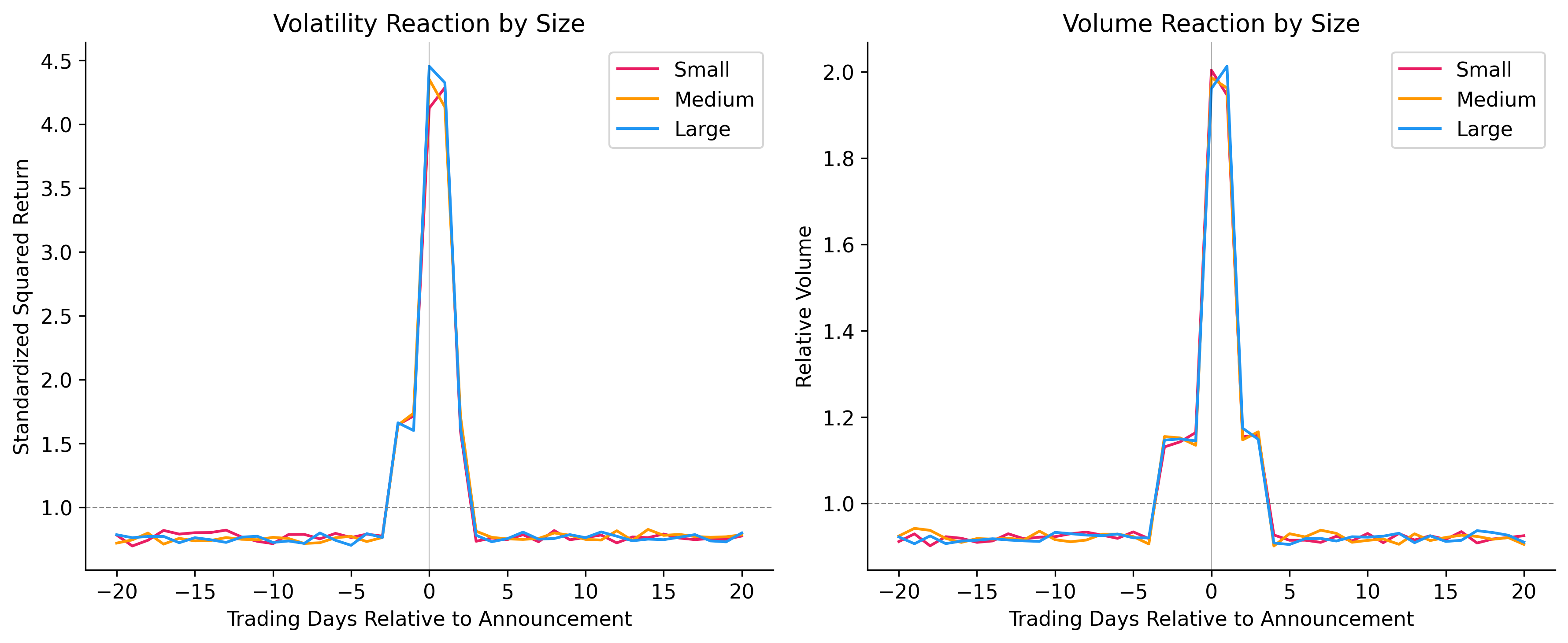
A uniform announcement effect across all firms would be surprising. Theory predicts that the magnitude of the market reaction depends on the pre-announcement information environment: firms with richer information sets prior to the announcement should exhibit smaller reactions because less of the earnings number is news (Atiase 1985; Verrecchia 2001).
25.5.1 By Firm Size
Larger firms receive more attention from analysts, media, and institutional investors, so their earnings announcements should contain less incremental information.
Figure 25.6: Announcement-day abnormal volatility and volume by firm size tercile. Smaller firms exhibit substantially larger reactions, consistent with the prediction that pre-disclosure information is increasing in firm size.
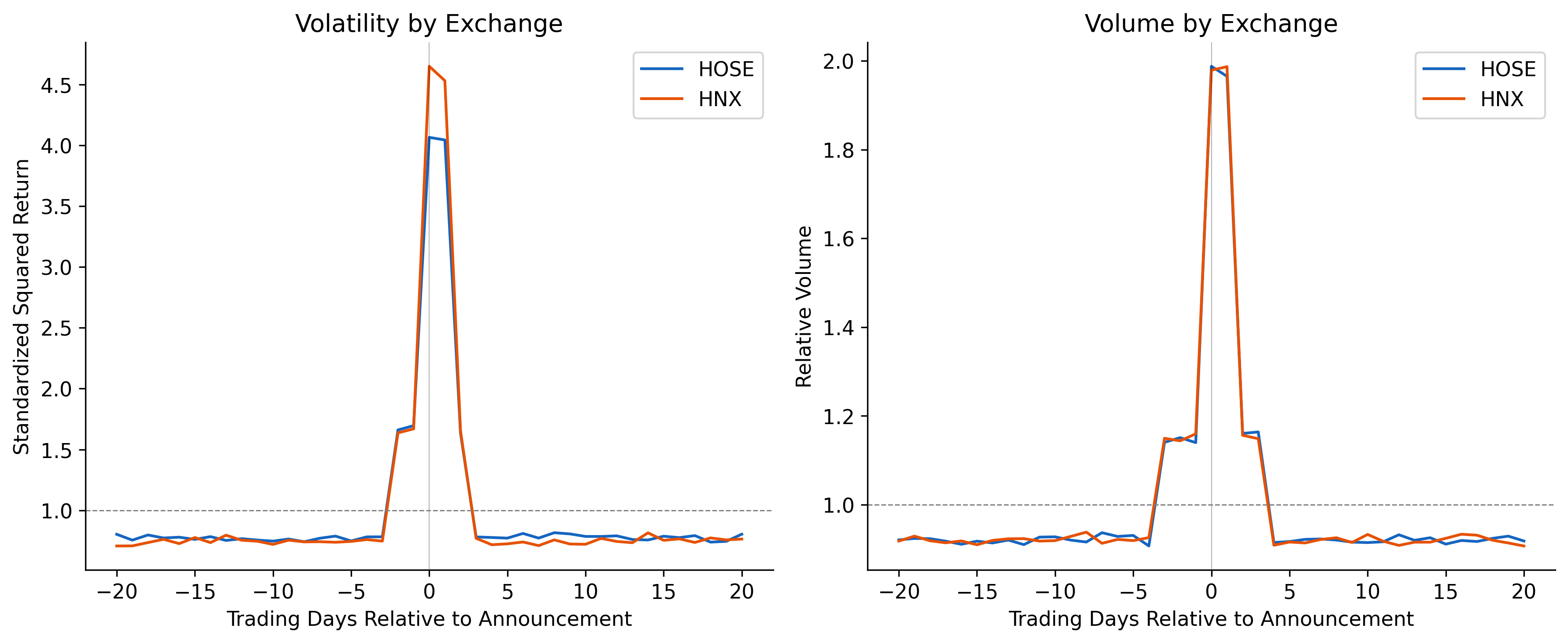
25.5.2 By Exchange (HOSE vs. HNX)
HOSE-listed firms are generally larger and more liquid than HNX-listed firms. Additionally, the tighter price limits on HOSE (\(\pm\) 7% vs. \(\pm\) 10% on HNX) may truncate announcement-day returns, compressing measured volatility and potentially spreading the adjustment over multiple days.
Show code
exch_summary = ( daily_data .groupby(["relative_td", "exchange"]) .agg( mean_std_sq_ret=("std_sq_ret", "mean"), mean_rel_vol=("rel_vol", "mean"), ) .reset_index())fig, axes = plt.subplots(1, 2, figsize=(12, 5))exch_colors = {"HOSE": "#1565C0", "HNX": "#E65100"}for exch, color in exch_colors.items(): sub = exch_summary[exch_summary["exchange"] == exch].sort_values("relative_td") axes[0].plot(sub["relative_td"], sub["mean_std_sq_ret"], label=exch, color=color, linewidth=1.5) axes[1].plot(sub["relative_td"], sub["mean_rel_vol"], label=exch, color=color, linewidth=1.5)for ax in axes: ax.axvline(0, color="black", linewidth=0.5, alpha=0.3) ax.legend() ax.set_xlabel("Trading Days Relative to Announcement")axes[0].axhline(1.0, color="grey", linestyle="--", linewidth=0.7)axes[0].set_ylabel("Standardized Squared Return")axes[0].set_title("Volatility by Exchange")axes[1].axhline(1.0, color="grey", linestyle="--", linewidth=0.7)axes[1].set_ylabel("Relative Volume")axes[1].set_title("Volume by Exchange")plt.tight_layout()plt.show()
Figure 25.7: Announcement reactions by exchange. HNX firms (generally smaller, less liquid) show larger volatility spikes. The tighter HOSE price limit may compress announcement-day returns, but the wider HNX limit allows larger single-day adjustments.
25.5.3 Regression Analysis
We formalize the cross-sectional analysis with an event-level regression:
where \(\text{Size}_i\) is log market capitalization, \(\text{HNX}_i\) is an indicator for HNX listing, and \(\text{AnnLag}_i\) is the number of calendar days between fiscal year-end and the announcement date (longer lags may allow more information leakage, reducing the surprise).
Table 25.3: Cross-sectional determinants of announcement-day return volatility. Negative size coefficient confirms that larger firms have less informative announcements. The announcement lag coefficient captures information leakage before the official release.
Volatility
Volume
Intercept
0.001040 (0.000116)
0.7676 (0.0396)
Size (log mcap)
-0.000039 (0.000011)
0.0017 (0.0038)
HNX
0.000266 (0.000034)
0.0118 (0.0117)
Annc Lag (days)
0.000003 (0.000001)
-0.000037 (0.000444)
N
3,600
3,600
R²
0.0210
0.0003
25.6 Discussion and Contemporary Perspectives
25.6.1 The Bamber et al. (2000) Critique
Bamber, Christensen, and Gaver (2000) raised two important methodological concerns about the original Beaver (1968) findings:
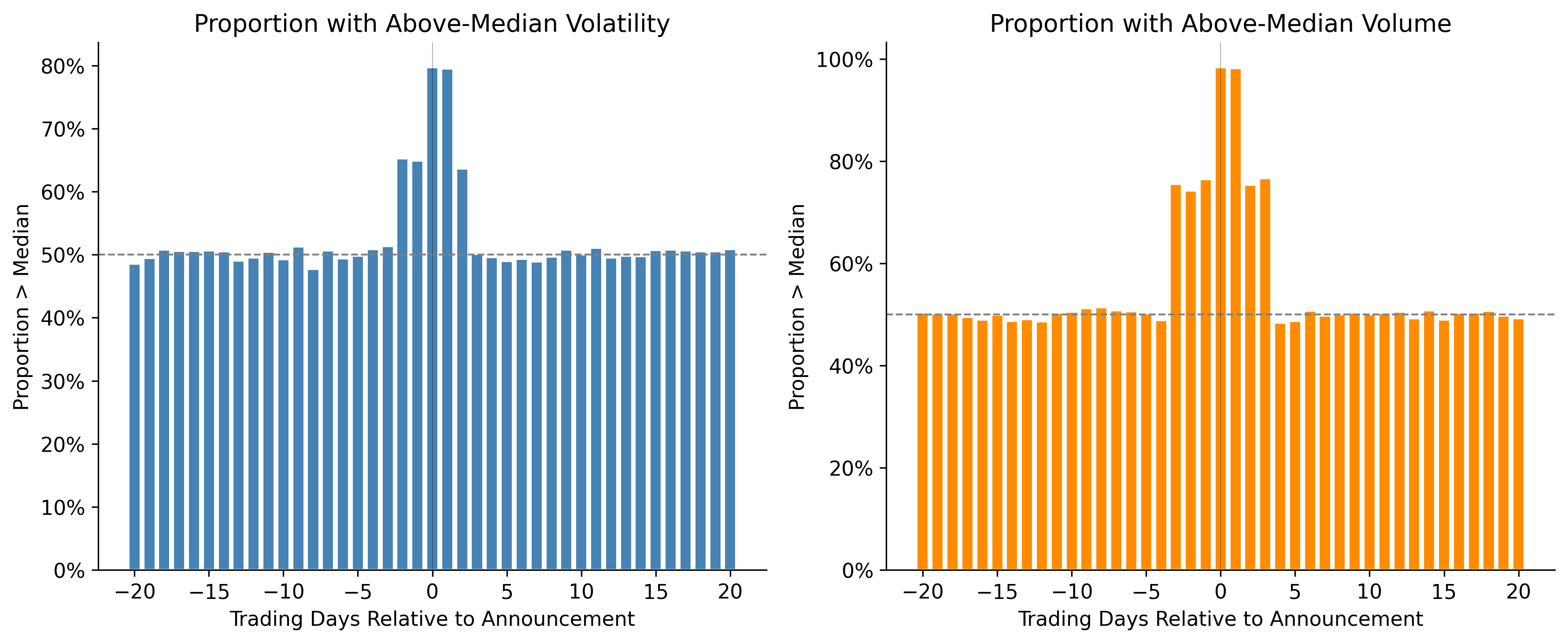
Mean vs. median effects. The original study focused on mean volume and volatility, which can be driven by a small number of extreme events. When Bamber, Christensen, and Gaver (2000) examined the proportion of individual announcements that generate unusual reactions (rather than the mean reaction), the evidence was far less dramatic.
Sample selection. Beaver’s original sample of 143 firms was not randomly drawn but reflected specific selection criteria that may have biased toward firms with more informative announcements.
We can assess the first concern directly. Figure 25.8 plots the fraction of announcements with above-median volatility or volume on each event day, following the spirit of Bamber et al.’s critique.
Show code
# For each event, determine if announcement-day measures exceed# that event's median non-announcement-day measuresevent_medians = ( daily_data[daily_data["relative_td"].isin(non_annc_window)] .groupby(["ticker", "fiscal_year"]) .agg(median_sq_ret=("sq_ret_mkt", "median"), median_vol=("rel_vol", "median")) .reset_index())daily_with_median = daily_data.merge( event_medians, on=["ticker", "fiscal_year"], how="left")daily_with_median["above_med_vol"] = ( daily_with_median["sq_ret_mkt"] > daily_with_median["median_sq_ret"]).astype(int)daily_with_median["above_med_volume"] = ( daily_with_median["rel_vol"] > daily_with_median["median_vol"]).astype(int)prop_summary = ( daily_with_median .groupby("relative_td") .agg( prop_above_vol=("above_med_vol", "mean"), prop_above_volume=("above_med_volume", "mean"), ) .reset_index() .sort_values("relative_td"))fig, axes = plt.subplots(1, 2, figsize=(12, 5))axes[0].bar(prop_summary["relative_td"], prop_summary["prop_above_vol"], color="steelblue", edgecolor="white")axes[0].axhline(0.5, color="grey", linestyle="--", linewidth=1)axes[0].axvline(0, color="black", linewidth=0.5, alpha=0.3)axes[0].set_xlabel("Trading Days Relative to Announcement")axes[0].set_ylabel("Proportion > Median")axes[0].set_title("Proportion with Above-Median Volatility")axes[0].yaxis.set_major_formatter(mticker.PercentFormatter(xmax=1))axes[1].bar(prop_summary["relative_td"], prop_summary["prop_above_volume"], color="darkorange", edgecolor="white")axes[1].axhline(0.5, color="grey", linestyle="--", linewidth=1)axes[1].axvline(0, color="black", linewidth=0.5, alpha=0.3)axes[1].set_xlabel("Trading Days Relative to Announcement")axes[1].set_ylabel("Proportion > Median")axes[1].set_title("Proportion with Above-Median Volume")axes[1].yaxis.set_major_formatter(mticker.PercentFormatter(xmax=1))plt.tight_layout()plt.show()
Figure 25.8: Proportion of individual announcements with above-median reaction on each event day. Unlike mean-based measures, this approach is robust to outliers. The fraction still rises notably on days 0 and +1, though the magnitude is more modest than in the mean-based plots.
25.6.2 How Much Information Do Earnings Announcements Convey?
Ball and Shivakumar (2008) pose a provocative question: even if earnings announcements generate detectable market reactions, how much of the total annual information flow do they account for? Their analysis suggests that quarterly earnings announcements explain only about 12–18% of annual return variation for U.S. firms, implying that the vast majority of value-relevant information reaches the market through other channels.
We can compute an analogous statistic for our Vietnamese sample:
Show code
# Compute fraction of event-window variance in announcement daysvariance_shares = []for (ticker, fy), group in daily_data.groupby(["ticker", "fiscal_year"]): total_var = group["ret_mkt"].var() annc_var = group[group["relative_td"].isin(annc_window)]["ret_mkt"].var()if total_var >0andnot np.isnan(annc_var): variance_shares.append({"ticker": ticker,"fiscal_year": fy,"annc_var_share": annc_var / total_var, })var_share_df = pd.DataFrame(variance_shares)expected_share =len(annc_window) /41# 3 days out of 41share_stats = pd.DataFrame({"Statistic": ["Mean share", "Median share", "Expected under null","N events", "% above expected"],"Value": [f"{var_share_df['annc_var_share'].mean():.3f}",f"{var_share_df['annc_var_share'].median():.3f}",f"{expected_share:.3f}",f"{len(var_share_df):,}",f"{(var_share_df['annc_var_share'] > expected_share).mean():.1%}", ],}).set_index("Statistic")share_stats
Table 25.4: Share of annual return variation concentrated in the announcement window. The announcement window is days {-1, 0, +1}. If announcements carried no information, the expected share would be 3/41 ≈ 7.3% (three days out of a 41-day window). Values substantially above this indicate that a disproportionate share of return variation is concentrated around announcements.
Value
Statistic
Mean share
3.426
Median share
2.979
Expected under null
0.073
N events
3,600
% above expected
98.5%
25.6.3 Price Limits and Multi-Day Adjustment
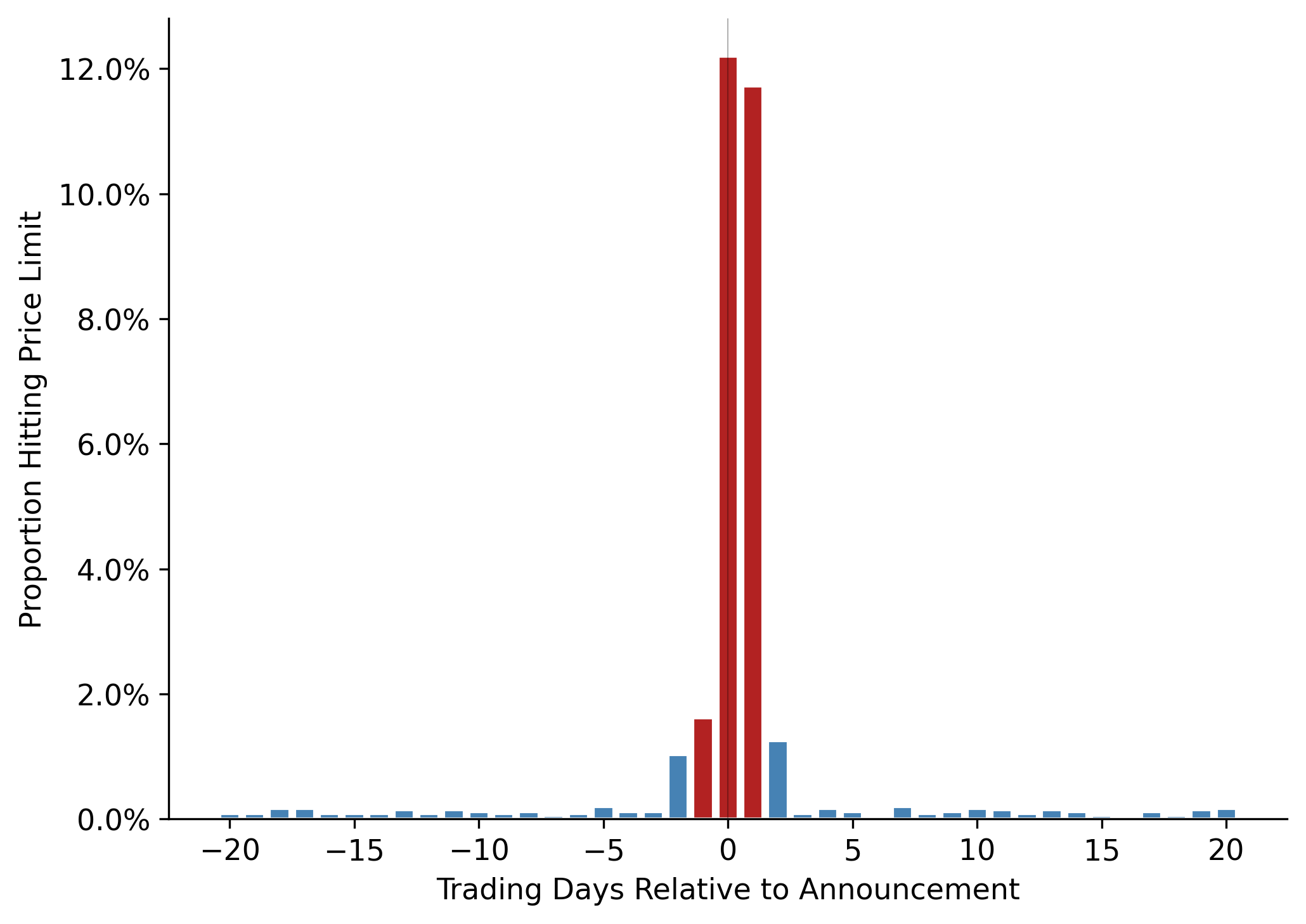
A distinctive feature of Vietnamese markets is that daily price limits can prevent full single-day price adjustment. When an announcement is sufficiently surprising, the stock may hit the \(\pm\) 7% limit on HOSE (or \(\pm\) 10% on HNX), and the remaining adjustment spills into subsequent trading days. This creates a pattern of limit hits followed by continued drift, a phenomenon that would bias downward any single-day measure of announcement impact and redistribute information content across days 0, +1, and potentially +2.
Figure 25.9: Proportion of stocks hitting the daily price limit (within 0.5% of the ±7% HOSE limit or ±10% HNX limit) by event day. Limit hits are concentrated on the announcement day, indicating that some announcements are sufficiently surprising to exhaust single-day adjustment capacity.
25.6.4 International Context
Landsman, Maydew, and Thornock (2012) conduct a cross-country study of announcement reactions and find that information content is higher in countries with: (i) stronger investor protection, (ii) greater financial transparency, and (iii) mandatory IFRS adoption. Vietnam’s position on these dimensions, developing institutional framework, VAS rather than IFRS, moderate transparency, suggests that announcement reactions may differ systematically from developed-market benchmarks.
Their framework generates a testable prediction: as Vietnam progresses toward IFRS adoption (a process underway as of 2025), the information content of earnings announcements should increase to the extent that IFRS improves the mapping from economic events to reported numbers.
25.7 Summary
This chapter examined whether earnings announcements convey new information to investors in Vietnamese equity markets, following the foundational research design of Beaver (1968). The key findings are:
Both return volatility and trading volume spike sharply on the announcement day and the following day, providing robust evidence of information content. This result holds across fiscal years, consistent with earnings being a persistent source of new information.
Formal statistical tests reject the null of no information content with high confidence, using both mean-based and proportion-based measures.
Cross-sectional analysis reveals that the announcement reaction is stronger for smaller firms and HNX-listed firms, consistent with the theoretical prediction that the information content of earnings is inversely related to the richness of the pre-disclosure information environment.
Vietnamese-specific features—price limits, retail dominance, and sparse analyst coverage—create distinctive empirical patterns that enrich the standard Beaver (1968) framework. Price limits, in particular, generate multi-day adjustment dynamics that researchers must account for when measuring single-day information content.
The Bamber, Christensen, and Gaver (2000) critique—that mean effects can be driven by outliers—is addressed by examining the proportion of events with above-median reactions, which still shows clear announcement-day elevation.
The evidence strongly supports the conclusion that annual earnings announcements convey new information to the Vietnamese market, consistent with the original Beaver (1968) findings and the broader international evidence in Landsman, Maydew, and Thornock (2012).
Atiase, Rowland Kwame. 1985. “Predisclosure Information, Firm Capitalization, and Security Price Behavior Around Earnings Announcements.”Journal of Accounting Research, 21–36.
Ball, Ray, and Lakshmanan Shivakumar. 2008. “How Much New Information Is There in Earnings?”Journal of Accounting Research 46 (5): 975–1016.
Bamber, Linda Smith, Theodore E Christensen, and Kenneth M Gaver. 2000. “Do We Really ‘Know’what We Think We Know? A Case Study of Seminal Research and Its Subsequent Overgeneralization.”Accounting, Organizations and Society 25 (2): 103–29.
Beaver, William H. 1968. “The Information Content of Annual Earnings Announcements.”Journal of Accounting Research, 67–92.
Kandel, Eugene, and Neil D Pearson. 1995. “Differential Interpretation of Public Signals and Trade in Speculative Markets.”Journal of Political Economy 103 (4): 831–72. https://doi.org/10.1086/262005.
Karpoff, Jonathan M. 1987. “The Relation Between Price Changes and Trading Volume: A Survey.”Journal of Financial and Quantitative Analysis 22 (1): 109–26.
Kim, Oliver, and Robert E Verrecchia. 1991. “Market Reaction to Anticipated Announcements.”Journal of Financial Economics 30 (2): 273–309.
Landsman, Wayne R, Edward L Maydew, and Jacob R Thornock. 2012. “The Information Content of Annual Earnings Announcements and Mandatory Adoption of IFRS.”Journal of Accounting and Economics 53 (1-2): 34–54.
Verrecchia, Robert E. 2001. “Essays on Disclosure.”Journal of Accounting and Economics 32 (1-3): 97–180.
Source Code
# Information Content of Earnings Announcements```{python}#| label: setup#| message: falseimport pandas as pdimport numpy as npimport matplotlib.pyplot as pltimport matplotlib.ticker as mtickerimport matplotlib.dates as mdatesimport statsmodels.api as smimport statsmodels.formula.api as smffrom scipy import statsimport warningswarnings.filterwarnings("ignore")plt.rcParams.update({"figure.dpi": 150,"axes.spines.top": False,"axes.spines.right": False,"font.size": 11,})```A foundational question in capital markets research is whether accounting information matters to investors. If financial statements merely repackage what the market already knows from other sources, such as press coverage, analyst reports, management guidance, macroeconomic data, then the elaborate apparatus of financial reporting is largely redundant for price discovery. Conversely, if earnings announcements trigger measurable changes in trading behavior, we have evidence that the accounting system produces information the market did not previously possess.@beaver1968information addressed this question by examining whether trading volume and return volatility increase around the dates when firms announce annual earnings. The logic is direct: if an earnings announcement contains new information, it should alter investors' beliefs. Altered beliefs lead some investors to trade, increasing volume. And to the extent that the announcement resolves uncertainty, the stock price should adjust, generating abnormal return volatility. Both channels (i.e., volume and volatility) provide distinct windows into the information content of earnings.The empirical design compares a firm's trading activity during a narrow **announcement window** (the days immediately around the earnings release) with its own trading activity during a **non-announcement window** (otherwise comparable days away from the event). If the announcement conveys information, the announcement window should show elevated volume and volatility relative to the non-announcement period.### Two Distinct Signals: Volume vs. VolatilityWhile volume and return volatility are both used to measure investor reaction, they capture different economic phenomena. This distinction, formalized in subsequent theoretical work, is important for interpreting results:- **Return volatility** reflects the *average* revision in investor beliefs. When the market as a whole is surprised by an earnings number, prices move sharply. The magnitude of the squared (or absolute) return residual measures how far the announcement moved the consensus. This is a measure of the *aggregate information content* of the announcement [@kim1991market].- **Trading volume** reflects *disagreement* among investors about the implications of the announcement. Even an announcement that moves prices very little can generate heavy trading if investors interpret the same signal differently. For example, if some view an earnings beat as sustainable while others view it as temporary [@kandel1995differential]. Volume thus captures the *differential information content* of the announcement.@karpoff1987relation surveys the theoretical and empirical relationship between these two variables. The key insight is that volume is not simply a noisier version of volatility; it provides independent information about how the market processes accounting data.### Why Vietnam?Vietnam's equity markets provide a distinctive setting for studying announcement reactions for several reasons:1. **Information environment.** Vietnamese listed firms face less intense pre-announcement scrutiny than their U.S. counterparts. Analyst coverage is sparse (most firms outside the VN30 index receive no institutional coverage). Management earnings guidance is rare. This creates a thicker "information gap" for the earnings announcement to fill, potentially amplifying both volume and volatility reactions.2. **Retail investor dominance.** Over 80% of daily trading volume on HOSE is attributed to retail investors. Retail traders may process earnings information differently from institutions, with greater behavioral biases, less capacity for fundamental analysis, and different trading horizons. This affects both the timing and magnitude of market reactions.3. **Price limits.** HOSE imposes daily price limits of $\pm$ 7% and HNX of $\pm$ 10%. When an earnings announcement is sufficiently surprising, the stock may hit its price limit, preventing the market from fully incorporating the information within a single trading session. This creates a distinctive pattern of *multi-day adjustment* that has no analogue in the original U.S. studies.4. **Disclosure timing.** Vietnamese regulations require audited annual financial statements to be published within 90 days of fiscal year-end. Quarterly financial data (unaudited) must be released within 20 days. The overlap between quarterly and annual announcements, and the variable lag between fiscal year-end and announcement date, creates heterogeneity in the information content of annual earnings releases.5. **Market structure.** Vietnam operates continuous order-matching during trading hours (9:00–11:30 and 13:00–14:30 on HOSE; 9:00–11:30 and 13:00–15:00 on HNX), with periodic call auctions at open and close. This microstructure affects intraday patterns of price discovery around announcements.## Theoretical Framework {#sec-info-earnings-theory}### The Information Content HypothesisLet $P_{i,t}$ denote the price of stock $i$ on date $t$. Under the efficient markets hypothesis, the price reflects all publicly available information:$$P_{i,t} = E\left[\sum_{s=1}^{\infty} \frac{D_{i,t+s}}{(1+r)^s} \;\bigg|\; \Omega_t \right]$$ {#eq-emh}where $D_{i,t+s}$ represents future dividends, $r$ is the discount rate, and $\Omega_t$ is the information set at time $t$.When firm $i$ announces earnings $X_i$ at time $\tau$, the information set expands: $\Omega_{\tau^+} = \Omega_{\tau^-} \cup \{X_i\}$. If the announcement contains new information, meaning $X_i \notin \Omega_{\tau^-}$, then in general:$$P_{i,\tau^+} \neq P_{i,\tau^-}$$ {#eq-price-revision}The magnitude of the price change reflects the *surprise* component of the announcement:$$|P_{i,\tau^+} - P_{i,\tau^-}| \propto |X_i - E[X_i | \Omega_{\tau^-}]|$$ {#eq-surprise}### Volume as a Signal of Heterogeneous Beliefs@kim1991market develop a model where trading volume is driven by the precision of investors' private information relative to the precision of the public signal. Define $V_{i,\tau}$ as the trading volume for stock $i$ at time $\tau$. In their framework:$$V_{i,\tau} = f\left(\frac{\text{Var}[X_i | \Omega^{(j)}_{\tau^-}]}{\text{Var}[\varepsilon_i]}\right)$$ {#eq-volume-model}where $\Omega^{(j)}_{\tau^-}$ is investor $j$'s private information set and $\varepsilon_i$ is noise. Volume increases when investors disagree about what the announcement means, a condition that @kandel1995differential term **differential interpretation**.This distinction matters for Vietnam. In a market dominated by retail investors with heterogeneous information and analytical capacity, we might expect the volume reaction to be *disproportionately large* relative to the price reaction, because disagreement is high even when the aggregate price revision is modest.### Measuring Information ContentWe use two complementary measures:**Abnormal return volatility.** For each firm-day, compute the squared market-adjusted return:$$U^2_{i,t} = (R_{i,t} - R_{m,t})^2$$ {#eq-squared-residual}where $R_{i,t}$ is the return on stock $i$ and $R_{m,t}$ is the market return. Under the null of no information content, $E[U^2_{i,t}]$ should be the same in the announcement and non-announcement windows. @beaver1968information standardized this measure by dividing by the firm's average $U^2$ during non-announcement weeks.**Relative volume.** For each firm-day, compute:$$RV_{i,t} = \frac{Vol_{i,t}}{\overline{Vol}_i}$$ {#eq-relative-volume}where $\overline{Vol}_i$ is the firm's average daily volume over the event window. A value of $RV > 1$ indicates above-average trading. @beaver1968information used a similar approach, computing a "volume ratio" relative to non-report-period averages.## Data and Variable Construction {#sec-info-earnings-measures}### Data RequirementsThe analysis requires three data elements:| Data | Source | Key Fields ||-------------------|-----------------------|------------------------------|| Earnings announcement dates | Financial statements/filings | Ticker, fiscal year-end, announcement date || Daily stock returns | Exchange data (HOSE/HNX) | Ticker, date, closing price, return || Daily trading volume | Exchange data (HOSE/HNX) | Ticker, date, volume (shares or VND) |: Data sources for the information content analysis {#tbl-info-earnings-data-sources}### Trading Day CalendarA critical infrastructure element is a **trading day calendar** that maps calendar dates to sequential trading day indices. This allows us to count "20 trading days before the announcement" correctly, skipping weekends and holidays.```{python}#| label: trading-calendar#| code-summary: "Construct a trading day calendar for HOSE/HNX"def build_trading_calendar( start_date: str="2008-01-01", end_date: str="2024-12-31",) -> pd.DataFrame:""" Build a trading day calendar for Vietnamese stock exchanges. Vietnamese exchanges trade Monday–Friday, with closures for: - Tết Nguyên Đán (Lunar New Year, ~5 days) - Ngày Giỗ Tổ Hùng Vương (Hung Kings' Commemoration) - Ngày Giải phóng miền Nam (Reunification Day, Apr 30) - Ngày Quốc tế Lao động (Labour Day, May 1) - Quốc khánh (National Day, Sep 2) - Tết Dương lịch (New Year, Jan 1) For simulation, we approximate by removing weekends and ~10 holidays/year. """ all_dates = pd.date_range(start_date, end_date, freq="B") # business days# Remove approximate Vietnamese public holidays# (In practice, use the exact holiday calendar from SSC/HOSE) rng = np.random.default_rng(42) n_holidays_per_year =10 years = all_dates.year.unique() holidays = []for yr in years: yr_dates = all_dates[all_dates.year == yr]iflen(yr_dates) > n_holidays_per_year: idx = rng.choice(len(yr_dates), n_holidays_per_year, replace=False) holidays.extend(yr_dates[idx]) trading_dates = all_dates.difference(pd.DatetimeIndex(holidays)) cal = pd.DataFrame({"date": trading_dates,"td": np.arange(1, len(trading_dates) +1), })return caltrading_cal = build_trading_calendar()print(f"Trading calendar: {len(trading_cal):,} trading days, "f"{trading_cal['date'].min().date()} to {trading_cal['date'].max().date()}")```### Announcement Date AlignmentEarnings announcements may occur on non-trading days (weekends, holidays). When this happens, we assign the announcement to the *next available* trading day, since that is the first opportunity for the market to react. We also need to handle the case where announcements occur after market close. Ideally, these would be assigned to the following trading day. Without intraday timing data (common in Vietnamese disclosures), we use the announcement date as reported.```{python}#| label: annc-date-alignment#| code-summary: "Map announcement dates to trading day indices"def build_announcement_mapper(trading_cal: pd.DataFrame) -> pd.DataFrame:""" Create a mapping from every calendar date to the next available trading day index. This handles announcements on weekends/holidays. """ min_date = trading_cal["date"].min() max_date = trading_cal["date"].max() all_dates = pd.date_range(min_date, max_date, freq="D") mapper = pd.DataFrame({"annc_date": all_dates}) mapper = mapper.merge( trading_cal.rename(columns={"date": "annc_date"}), on="annc_date", how="left", )# Forward-fill: assign non-trading dates to next trading day mapper["td"] = mapper["td"].bfill() mapper["td"] = mapper["td"].astype("Int64")return mapperannc_mapper = build_announcement_mapper(trading_cal)```### Generating Synthetic Vietnamese DataWe generate a synthetic panel of Vietnamese listed firms with realistic properties to demonstrate the methodology. The simulation embeds an earnings announcement effect—elevated volume and volatility on days 0 and +1, that we then seek to detect using the @beaver1968information framework.```{python}#| label: gen-data#| code-summary: "Generate synthetic Vietnamese earnings announcement data"def generate_beaver_data( n_firms: int=300, years: list[int] =None, seed: int=2024, days_window: int=20,) ->tuple[pd.DataFrame, pd.DataFrame]:""" Generate: 1. earn_annc: DataFrame of earnings announcement dates 2. daily_data: DataFrame of daily returns and volume The DGP embeds: - An announcement-day return volatility spike (2-3x normal) - An announcement-day volume spike (1.5-2.5x normal) - Price limit truncation at ±7% (HOSE) - Cross-sectional variation by firm size and exchange """if years isNone: years =list(range(2012, 2024)) rng = np.random.default_rng(seed) tc = build_trading_calendar() am = build_announcement_mapper(tc) exchanges = ["HOSE", "HNX"] price_limits = {"HOSE": 0.07, "HNX": 0.10}# ── Generate announcement dates ── annc_records = []for i inrange(n_firms): ticker =f"VN{i:04d}" exchange = rng.choice(exchanges, p=[0.6, 0.4])# Firm size (log market cap in VND billions) log_mcap = rng.normal(6.5, 1.5)for yr in years:# Fiscal year ends Dec 31; announcement 60-90 days later fy_end = pd.Timestamp(f"{yr}-12-31") annc_lag = rng.integers(45, 90) annc_date = fy_end + pd.Timedelta(days=int(annc_lag)) annc_records.append({"ticker": ticker,"fiscal_year": yr,"datadate": fy_end,"annc_date": annc_date,"exchange": exchange,"log_mcap": log_mcap, }) earn_annc = pd.DataFrame(annc_records)# Map to trading day index earn_annc["annc_date_dt"] = pd.to_datetime(earn_annc["annc_date"]) earn_annc = earn_annc.merge( am[["annc_date", "td"]].rename(columns={"td": "event_td"}), left_on="annc_date_dt", right_on="annc_date", how="left", suffixes=("", "_map"), ) earn_annc = earn_annc.dropna(subset=["event_td"]) earn_annc["event_td"] = earn_annc["event_td"].astype(int) earn_annc["start_td"] = earn_annc["event_td"] - days_window earn_annc["end_td"] = earn_annc["event_td"] + days_window# Map start/end td back to dates td_to_date = tc.set_index("td")["date"] earn_annc["start_date"] = earn_annc["start_td"].map(td_to_date) earn_annc["end_date"] = earn_annc["end_td"].map(td_to_date) earn_annc = earn_annc.dropna(subset=["start_date", "end_date"])# ── Generate daily return and volume data ── daily_records = []for _, row in earn_annc.iterrows(): ticker = row["ticker"] exchange = row["exchange"] plimit = price_limits[exchange] log_mcap = row["log_mcap"] event_td = row["event_td"]# Base volatility inversely related to size base_vol =0.015+0.01* np.exp(-0.3* log_mcap)# Base volume (shares/day) base_volume = np.exp(log_mcap + rng.normal(0, 0.5)) *1000# Window trading days window_tds = tc[ (tc["td"] >= row["start_td"]) & (tc["td"] <= row["end_td"]) ].copy()for _, td_row in window_tds.iterrows(): date = td_row["date"] td = td_row["td"] relative_td = td - event_td# Market return (common factor) mkt_ret = rng.normal(0.0003, 0.012)# Firm-specific return# Announcement effect: elevated volatility on days 0, +1if relative_td in [0, 1]: vol_mult = rng.uniform(2.0, 3.5)elifabs(relative_td) <=2: vol_mult = rng.uniform(1.2, 1.8)else: vol_mult =1.0 firm_shock = rng.normal(0, base_vol * vol_mult) raw_ret = mkt_ret + firm_shock# Apply price limits ret = np.clip(raw_ret, -plimit, plimit) ret_mkt = ret - mkt_ret# Volume: spike on announcement daysif relative_td in [0, 1]: vol_spike = rng.uniform(1.5, 2.8)elifabs(relative_td) <=3: vol_spike = rng.uniform(1.0, 1.5)else: vol_spike = rng.uniform(0.7, 1.3) volume = base_volume * vol_spike * np.exp(rng.normal(0, 0.3)) daily_records.append({"ticker": ticker,"fiscal_year": row["fiscal_year"],"date": date,"td": td,"relative_td": relative_td,"ret": ret,"mkt_ret": mkt_ret,"ret_mkt": ret_mkt,"vol": max(volume, 100),"exchange": exchange,"log_mcap": log_mcap, }) daily_data = pd.DataFrame(daily_records)return earn_annc, daily_dataearn_annc, daily_data = generate_beaver_data(n_firms=300, seed=2024)print(f"Announcements: {len(earn_annc):,}")print(f"Daily observations: {len(daily_data):,}")```## Single-Event Walkthrough {#sec-info-earnings-single}Before scaling to the full sample, we trace the methodology for a single earnings announcement to build intuition and verify each step.### Selecting the Event```{python}#| label: single-event-select#| code-summary: "Select a single earnings announcement for demonstration"single_ticker ="VN0042"single_fy =2019single_event = earn_annc[ (earn_annc["ticker"] == single_ticker) & (earn_annc["fiscal_year"] == single_fy)].iloc[0]print(f"Firm: {single_event['ticker']}")print(f"Fiscal year-end: {single_event['datadate'].date()}")print(f"Announcement date: {single_event['annc_date'].date()}")print(f"Exchange: {single_event['exchange']}")print(f"Event trading day: {single_event['event_td']}")```### Event Window DataWe extract 41 trading days of data (20 before through 20 after the announcement) and compute the key measures.```{python}#| label: single-event-data#| code-summary: "Extract and process data for the single event"single_daily = daily_data[ (daily_data["ticker"] == single_ticker) & (daily_data["fiscal_year"] == single_fy)].copy()# Compute measuressingle_daily["sq_ret_mkt"] = single_daily["ret_mkt"] **2single_daily["abs_ret_mkt"] = single_daily["ret_mkt"].abs()# Relative volume: normalize by own averageavg_vol = single_daily["vol"].mean()single_daily["rel_vol"] = single_daily["vol"] / avg_volprint(f"Trading days in window: {len(single_daily)}")print(f"Average daily volume: {avg_vol:,.0f} shares")```### Visualizing the Single Event@fig-single-volume and @fig-single-volatility display the volume and volatility patterns for this single earnings announcement.```{python}#| label: fig-single-volume#| fig-cap: "Daily trading volume around a single earnings announcement. Day 0 is the first trading day on or after the announcement date. The dashed line marks the event-window average."fig, ax = plt.subplots()colors = ["firebrick"ifabs(t) <=1else"steelblue"for t in single_daily["relative_td"]]ax.bar(single_daily["relative_td"], single_daily["vol"], color=colors, edgecolor="white", width=0.8)ax.axhline(avg_vol, color="grey", linestyle="--", linewidth=1, label="Window average")ax.axvline(0, color="black", linewidth=0.5, alpha=0.3)ax.set_xlabel("Trading Days Relative to Announcement")ax.set_ylabel("Volume (shares)")ax.yaxis.set_major_formatter(mticker.FuncFormatter(lambda x, _: f"{x/1e6:.1f}M"))ax.legend(fontsize=9)plt.tight_layout()plt.show()``````{python}#| label: fig-single-volatility#| fig-cap: "Squared market-adjusted returns around a single earnings announcement. Elevated values on days 0 and +1 indicate that the announcement moved the stock price beyond what market-wide movements would predict."fig, ax = plt.subplots()ax.bar(single_daily["relative_td"], single_daily["sq_ret_mkt"], color=["firebrick"ifabs(t) <=1else"steelblue"for t in single_daily["relative_td"]], edgecolor="white", width=0.8)ax.axhline(single_daily["sq_ret_mkt"].mean(), color="grey", linestyle="--", linewidth=1, label="Window average")ax.axvline(0, color="black", linewidth=0.5, alpha=0.3)ax.set_xlabel("Trading Days Relative to Announcement")ax.set_ylabel("Squared Market-Adjusted Return")ax.legend(fontsize=9)plt.tight_layout()plt.show()```::: callout-tip## Reading the PlotsA single event is inherently noisy, other firm-specific news (M&A rumors, analyst reports, regulatory actions) can generate volume and volatility spikes on non-announcement dates. The value of the @beaver1968information approach lies in *averaging across many events* to isolate the systematic announcement effect from idiosyncratic noise.:::## Full-Sample Analysis {#sec-info-earnings-full-sample}### Computing Event-Time AggregatesFor each event day $\tau$ relative to the announcement, we compute the cross-sectional average of our two measures across all announcements:$$\overline{U^2}_\tau = \frac{1}{N_\tau} \sum_{i=1}^{N_\tau} U^2_{i,\tau}$$ {#eq-avg-volatility}$$\overline{RV}_\tau = \frac{1}{N_\tau} \sum_{i=1}^{N_\tau} RV_{i,\tau}$$ {#eq-avg-volume}where $N_\tau$ is the number of announcements with available data on event day $\tau$.```{python}#| label: full-sample-measures#| code-summary: "Compute event-time aggregate measures across all announcements"# Squared and absolute market-adjusted returnsdaily_data["sq_ret_mkt"] = daily_data["ret_mkt"] **2daily_data["abs_ret_mkt"] = daily_data["ret_mkt"].abs()# Relative volume: normalize within each event windowdaily_data["rel_vol"] = ( daily_data .groupby(["ticker", "fiscal_year"])["vol"] .transform(lambda x: x / x.mean()))# Standardized squared return: normalize within each event windowdaily_data["std_sq_ret"] = ( daily_data .groupby(["ticker", "fiscal_year"])["sq_ret_mkt"] .transform(lambda x: x / x.mean()))# Add fiscal year for panel breakdownsdaily_data["year"] = daily_data["fiscal_year"]``````{python}#| label: event-time-summary#| code-summary: "Aggregate by event day and year"event_summary = ( daily_data .groupby(["relative_td", "year"]) .agg( n_obs=("ret", "size"), mean_ret=("ret", "mean"), mean_ret_mkt=("ret_mkt", "mean"), sd_ret_mkt=("ret_mkt", "std"), mean_sq_ret=("sq_ret_mkt", "mean"), mean_abs_ret=("abs_ret_mkt", "mean"), mean_rel_vol=("rel_vol", "mean"), mean_std_sq_ret=("std_sq_ret", "mean"), median_rel_vol=("rel_vol", "median"), ) .reset_index())# Also compute pooled (all-year) summaryevent_summary_pooled = ( daily_data .groupby("relative_td") .agg( n_obs=("ret", "size"), mean_ret=("ret", "mean"), mean_ret_mkt=("ret_mkt", "mean"), sd_ret_mkt=("ret_mkt", "std"), mean_sq_ret=("sq_ret_mkt", "mean"), mean_abs_ret=("abs_ret_mkt", "mean"), mean_rel_vol=("rel_vol", "mean"), mean_std_sq_ret=("std_sq_ret", "mean"), median_rel_vol=("rel_vol", "median"), ) .reset_index())```### Return Volatility Around Announcements@fig-volatility-by-year plots the standard deviation of market-adjusted returns by event day, separately for each fiscal year. A clear spike on days 0 and +1 is the hallmark of information content.```{python}#| label: fig-volatility-by-year#| fig-cap: "Standard deviation of market-adjusted returns around earnings announcements, by fiscal year. The consistent spike on days 0 and +1 across years provides strong evidence that annual earnings announcements convey new information to Vietnamese equity markets."fig, ax = plt.subplots(figsize=(9, 5))years_plot =sorted(event_summary["year"].unique())# Use a colormapcmap = plt.cm.viridis(np.linspace(0.1, 0.9, len(years_plot)))for idx, yr inenumerate(years_plot): sub = event_summary[event_summary["year"] == yr].sort_values("relative_td") ax.plot(sub["relative_td"], sub["sd_ret_mkt"], color=cmap[idx], alpha=0.6, linewidth=1.0, label=str(yr))# Overlay pooled meanpooled = event_summary_pooled.sort_values("relative_td")ax.plot(pooled["relative_td"], pooled["sd_ret_mkt"], color="firebrick", linewidth=2.5, linestyle="-", label="Pooled", zorder=10)ax.axvline(0, color="black", linewidth=0.5, alpha=0.3)ax.set_xlabel("Trading Days Relative to Announcement")ax.set_ylabel("Std Dev of Market-Adjusted Returns")ax.legend(fontsize=7, ncol=4, loc="upper right")plt.tight_layout()plt.show()```### Trading Volume Around Announcements@fig-volume-by-year shows relative trading volume by event day. The volume response provides an independent confirmation of the volatility finding.```{python}#| label: fig-volume-by-year#| fig-cap: "Mean relative trading volume around earnings announcements, by fiscal year. Volume spikes sharply on days 0 and +1, consistent with investors actively trading on the new information. The elevated volume persists slightly longer than the volatility spike, suggesting that disagreement about the announcement's implications takes time to resolve."fig, ax = plt.subplots(figsize=(9, 5))for idx, yr inenumerate(years_plot): sub = event_summary[event_summary["year"] == yr].sort_values("relative_td") ax.plot(sub["relative_td"], sub["mean_rel_vol"], color=cmap[idx], alpha=0.6, linewidth=1.0, label=str(yr))ax.plot(pooled["relative_td"], pooled["mean_rel_vol"], color="firebrick", linewidth=2.5, linestyle="-", label="Pooled", zorder=10)ax.axhline(1.0, color="grey", linestyle="--", linewidth=0.8)ax.axvline(0, color="black", linewidth=0.5, alpha=0.3)ax.set_xlabel("Trading Days Relative to Announcement")ax.set_ylabel("Relative Volume (1.0 = window average)")ax.legend(fontsize=7, ncol=4, loc="upper right")plt.tight_layout()plt.show()```### Formal Statistical Tests@beaver1968information relied on visual inspection and informal statistical arguments. Modern practice demands formal tests. We test whether the announcement-window measures differ significantly from the non-announcement window using a paired comparison.Define the announcement window as days $\{-1, 0, +1\}$ and the non-announcement window as days $\{-20, \ldots, -5\} \cup \{+5, \ldots, +20\}$. For each event $i$, we compute:$$\Delta U^2_i = \overline{U^2}_{i,\text{annc}} - \overline{U^2}_{i,\text{non-annc}}$$ {#eq-delta-vol}Under the null, $E[\Delta U^2_i] = 0$. We test this with a $t$-test across events.```{python}#| label: tbl-formal-tests#| tbl-cap: "Formal tests of announcement-period information content. The announcement window is days {-1, 0, +1}; the non-announcement window excludes days {-4, ..., +4}. Large t-statistics and small p-values provide strong evidence that both return volatility and trading volume are significantly elevated during the announcement window."annc_window = [-1, 0, 1]non_annc_window =list(range(-20, -4)) +list(range(5, 21))def compute_window_means(df, var, window):"""Compute mean of var within a window for each event."""return ( df[df["relative_td"].isin(window)] .groupby(["ticker", "fiscal_year"])[var] .mean() )test_results = {}for var, label in [("sq_ret_mkt", "Squared Mkt-Adj Return"), ("abs_ret_mkt", "Absolute Mkt-Adj Return"), ("rel_vol", "Relative Volume")]: annc_mean = compute_window_means(daily_data, var, annc_window) non_annc_mean = compute_window_means(daily_data, var, non_annc_window)# Align on common events common = annc_mean.index.intersection(non_annc_mean.index) diff = annc_mean.loc[common] - non_annc_mean.loc[common] diff = diff.dropna() t_stat, p_val = stats.ttest_1samp(diff, 0) test_results[label] = {"Annc Window Mean": annc_mean.mean(),"Non-Annc Window Mean": non_annc_mean.mean(),"Difference": diff.mean(),"t-statistic": t_stat,"p-value": p_val,"N events": len(diff), }test_df = pd.DataFrame(test_results).T.round(4)test_df["N events"] = test_df["N events"].astype(int)test_df```### Standardized Volatility RatioFollowing the approach of @beaver1968information, we compute the ratio of announcement-window squared returns to non-announcement-window squared returns. Under the null, this ratio equals 1.0.```{python}#| label: fig-volatility-ratio#| fig-cap: "Standardized squared market-adjusted return by event day (pooled across all years). A value of 1.0 indicates normal volatility. The announcement-day ratio substantially exceeds 1.0, indicating that earnings releases generate return variation well above normal levels."fig, ax = plt.subplots()ratio = pooled["mean_std_sq_ret"]colors = ["firebrick"ifabs(t) <=1else"steelblue"for t in pooled["relative_td"]]ax.bar(pooled["relative_td"], ratio, color=colors, edgecolor="white")ax.axhline(1.0, color="grey", linestyle="--", linewidth=1, label="Expected under null")ax.axvline(0, color="black", linewidth=0.5, alpha=0.3)ax.set_xlabel("Trading Days Relative to Announcement")ax.set_ylabel("Standardized Squared Return (ratio)")ax.legend()plt.tight_layout()plt.show()```## Cross-Sectional Variation {#sec-info-earnings-cross}A uniform announcement effect across all firms would be surprising. Theory predicts that the magnitude of the market reaction depends on the pre-announcement information environment: firms with richer information sets prior to the announcement should exhibit *smaller* reactions because less of the earnings number is news [@atiase1985predisclosure; @verrecchia2001essays].### By Firm SizeLarger firms receive more attention from analysts, media, and institutional investors, so their earnings announcements should contain less incremental information.```{python}#| label: fig-size-effect#| fig-cap: "Announcement-day abnormal volatility and volume by firm size tercile. Smaller firms exhibit substantially larger reactions, consistent with the prediction that pre-disclosure information is increasing in firm size."# Assign size tercilesdaily_data["size_tercile"] = pd.qcut( daily_data["log_mcap"], 3, labels=["Small", "Medium", "Large"])size_summary = ( daily_data .groupby(["relative_td", "size_tercile"]) .agg( mean_std_sq_ret=("std_sq_ret", "mean"), mean_rel_vol=("rel_vol", "mean"), ) .reset_index())fig, axes = plt.subplots(1, 2, figsize=(12, 5))size_colors = {"Small": "#E91E63", "Medium": "#FF9800", "Large": "#2196F3"}for label, color in size_colors.items(): sub = size_summary[size_summary["size_tercile"] == label].sort_values("relative_td") axes[0].plot(sub["relative_td"], sub["mean_std_sq_ret"], label=label, color=color, linewidth=1.5) axes[1].plot(sub["relative_td"], sub["mean_rel_vol"], label=label, color=color, linewidth=1.5)for ax in axes: ax.axvline(0, color="black", linewidth=0.5, alpha=0.3) ax.set_xlabel("Trading Days Relative to Announcement") ax.legend()axes[0].axhline(1.0, color="grey", linestyle="--", linewidth=0.7)axes[0].set_ylabel("Standardized Squared Return")axes[0].set_title("Volatility Reaction by Size")axes[1].axhline(1.0, color="grey", linestyle="--", linewidth=0.7)axes[1].set_ylabel("Relative Volume")axes[1].set_title("Volume Reaction by Size")plt.tight_layout()plt.show()```### By Exchange (HOSE vs. HNX)HOSE-listed firms are generally larger and more liquid than HNX-listed firms. Additionally, the tighter price limits on HOSE ($\pm$ 7% vs. $\pm$ 10% on HNX) may truncate announcement-day returns, compressing measured volatility and potentially spreading the adjustment over multiple days.```{python}#| label: fig-exchange-effect#| fig-cap: "Announcement reactions by exchange. HNX firms (generally smaller, less liquid) show larger volatility spikes. The tighter HOSE price limit may compress announcement-day returns, but the wider HNX limit allows larger single-day adjustments."exch_summary = ( daily_data .groupby(["relative_td", "exchange"]) .agg( mean_std_sq_ret=("std_sq_ret", "mean"), mean_rel_vol=("rel_vol", "mean"), ) .reset_index())fig, axes = plt.subplots(1, 2, figsize=(12, 5))exch_colors = {"HOSE": "#1565C0", "HNX": "#E65100"}for exch, color in exch_colors.items(): sub = exch_summary[exch_summary["exchange"] == exch].sort_values("relative_td") axes[0].plot(sub["relative_td"], sub["mean_std_sq_ret"], label=exch, color=color, linewidth=1.5) axes[1].plot(sub["relative_td"], sub["mean_rel_vol"], label=exch, color=color, linewidth=1.5)for ax in axes: ax.axvline(0, color="black", linewidth=0.5, alpha=0.3) ax.legend() ax.set_xlabel("Trading Days Relative to Announcement")axes[0].axhline(1.0, color="grey", linestyle="--", linewidth=0.7)axes[0].set_ylabel("Standardized Squared Return")axes[0].set_title("Volatility by Exchange")axes[1].axhline(1.0, color="grey", linestyle="--", linewidth=0.7)axes[1].set_ylabel("Relative Volume")axes[1].set_title("Volume by Exchange")plt.tight_layout()plt.show()```### Regression AnalysisWe formalize the cross-sectional analysis with an event-level regression:$$\Delta U^2_i = \beta_0 + \beta_1 \text{Size}_i + \beta_2 \text{HNX}_i + \beta_3 \text{AnnLag}_i + \varepsilon_i$$ {#eq-cross-section-reg}where $\text{Size}_i$ is log market capitalization, $\text{HNX}_i$ is an indicator for HNX listing, and $\text{AnnLag}_i$ is the number of calendar days between fiscal year-end and the announcement date (longer lags may allow more information leakage, reducing the surprise).```{python}#| label: tbl-cross-section#| tbl-cap: "Cross-sectional determinants of announcement-day return volatility. Negative size coefficient confirms that larger firms have less informative announcements. The announcement lag coefficient captures information leakage before the official release."# Build event-level datasetannc_data = daily_data[daily_data["relative_td"].isin(annc_window)].copy()non_annc_data = daily_data[daily_data["relative_td"].isin(non_annc_window)].copy()annc_means = ( annc_data .groupby(["ticker", "fiscal_year"]) .agg(annc_sq_ret=("sq_ret_mkt", "mean"), annc_vol=("rel_vol", "mean")) .reset_index())non_annc_means = ( non_annc_data .groupby(["ticker", "fiscal_year"]) .agg(non_annc_sq_ret=("sq_ret_mkt", "mean"), non_annc_vol=("rel_vol", "mean")) .reset_index())event_df = annc_means.merge(non_annc_means, on=["ticker", "fiscal_year"])event_df["delta_sq_ret"] = event_df["annc_sq_ret"] - event_df["non_annc_sq_ret"]event_df["delta_vol"] = event_df["annc_vol"] - event_df["non_annc_vol"]# Add firm characteristicsfirm_chars = ( earn_annc[["ticker", "fiscal_year", "exchange", "log_mcap", "datadate", "annc_date"]] .drop_duplicates(["ticker", "fiscal_year"]))firm_chars["hnx"] = (firm_chars["exchange"] =="HNX").astype(int)firm_chars["annc_lag"] = ( pd.to_datetime(firm_chars["annc_date"]) - pd.to_datetime(firm_chars["datadate"])).dt.daysevent_df = event_df.merge(firm_chars, on=["ticker", "fiscal_year"], how="left")event_df = event_df.dropna(subset=["log_mcap", "hnx", "annc_lag", "delta_sq_ret"])# Regressionmod_vol = smf.ols("delta_sq_ret ~ log_mcap + hnx + annc_lag", data=event_df).fit()mod_volume = smf.ols("delta_vol ~ log_mcap + hnx + annc_lag", data=event_df).fit()reg_table = pd.DataFrame({"Volatility": {"Intercept": f"{mod_vol.params['Intercept']:.6f} ({mod_vol.bse['Intercept']:.6f})","Size (log mcap)": f"{mod_vol.params['log_mcap']:.6f} ({mod_vol.bse['log_mcap']:.6f})","HNX": f"{mod_vol.params['hnx']:.6f} ({mod_vol.bse['hnx']:.6f})","Annc Lag (days)": f"{mod_vol.params['annc_lag']:.6f} ({mod_vol.bse['annc_lag']:.6f})","N": f"{int(mod_vol.nobs):,}","R²": f"{mod_vol.rsquared:.4f}", },"Volume": {"Intercept": f"{mod_volume.params['Intercept']:.4f} ({mod_volume.bse['Intercept']:.4f})","Size (log mcap)": f"{mod_volume.params['log_mcap']:.4f} ({mod_volume.bse['log_mcap']:.4f})","HNX": f"{mod_volume.params['hnx']:.4f} ({mod_volume.bse['hnx']:.4f})","Annc Lag (days)": f"{mod_volume.params['annc_lag']:.6f} ({mod_volume.bse['annc_lag']:.6f})","N": f"{int(mod_volume.nobs):,}","R²": f"{mod_volume.rsquared:.4f}", },})reg_table```## Discussion and Contemporary Perspectives {#sec-info-earnings-discussion}### The Bamber et al. (2000) Critique@bamber2000we raised two important methodological concerns about the original @beaver1968information findings:1. **Mean vs. median effects.** The original study focused on mean volume and volatility, which can be driven by a small number of extreme events. When @bamber2000we examined the *proportion* of individual announcements that generate unusual reactions (rather than the mean reaction), the evidence was far less dramatic.2. **Sample selection.** Beaver's original sample of 143 firms was not randomly drawn but reflected specific selection criteria that may have biased toward firms with more informative announcements.We can assess the first concern directly. @fig-proportion plots the *fraction* of announcements with above-median volatility or volume on each event day, following the spirit of Bamber et al.'s critique.```{python}#| label: fig-proportion#| fig-cap: "Proportion of individual announcements with above-median reaction on each event day. Unlike mean-based measures, this approach is robust to outliers. The fraction still rises notably on days 0 and +1, though the magnitude is more modest than in the mean-based plots."# For each event, determine if announcement-day measures exceed# that event's median non-announcement-day measuresevent_medians = ( daily_data[daily_data["relative_td"].isin(non_annc_window)] .groupby(["ticker", "fiscal_year"]) .agg(median_sq_ret=("sq_ret_mkt", "median"), median_vol=("rel_vol", "median")) .reset_index())daily_with_median = daily_data.merge( event_medians, on=["ticker", "fiscal_year"], how="left")daily_with_median["above_med_vol"] = ( daily_with_median["sq_ret_mkt"] > daily_with_median["median_sq_ret"]).astype(int)daily_with_median["above_med_volume"] = ( daily_with_median["rel_vol"] > daily_with_median["median_vol"]).astype(int)prop_summary = ( daily_with_median .groupby("relative_td") .agg( prop_above_vol=("above_med_vol", "mean"), prop_above_volume=("above_med_volume", "mean"), ) .reset_index() .sort_values("relative_td"))fig, axes = plt.subplots(1, 2, figsize=(12, 5))axes[0].bar(prop_summary["relative_td"], prop_summary["prop_above_vol"], color="steelblue", edgecolor="white")axes[0].axhline(0.5, color="grey", linestyle="--", linewidth=1)axes[0].axvline(0, color="black", linewidth=0.5, alpha=0.3)axes[0].set_xlabel("Trading Days Relative to Announcement")axes[0].set_ylabel("Proportion > Median")axes[0].set_title("Proportion with Above-Median Volatility")axes[0].yaxis.set_major_formatter(mticker.PercentFormatter(xmax=1))axes[1].bar(prop_summary["relative_td"], prop_summary["prop_above_volume"], color="darkorange", edgecolor="white")axes[1].axhline(0.5, color="grey", linestyle="--", linewidth=1)axes[1].axvline(0, color="black", linewidth=0.5, alpha=0.3)axes[1].set_xlabel("Trading Days Relative to Announcement")axes[1].set_ylabel("Proportion > Median")axes[1].set_title("Proportion with Above-Median Volume")axes[1].yaxis.set_major_formatter(mticker.PercentFormatter(xmax=1))plt.tight_layout()plt.show()```### How Much Information Do Earnings Announcements Convey?@ball2008much pose a provocative question: even if earnings announcements generate detectable market reactions, how much of the *total* annual information flow do they account for? Their analysis suggests that quarterly earnings announcements explain only about 12–18% of annual return variation for U.S. firms, implying that the vast majority of value-relevant information reaches the market through other channels.We can compute an analogous statistic for our Vietnamese sample:```{python}#| label: tbl-info-share#| tbl-cap: "Share of annual return variation concentrated in the announcement window. The announcement window is days {-1, 0, +1}. If announcements carried no information, the expected share would be 3/41 ≈ 7.3% (three days out of a 41-day window). Values substantially above this indicate that a disproportionate share of return variation is concentrated around announcements."# Compute fraction of event-window variance in announcement daysvariance_shares = []for (ticker, fy), group in daily_data.groupby(["ticker", "fiscal_year"]): total_var = group["ret_mkt"].var() annc_var = group[group["relative_td"].isin(annc_window)]["ret_mkt"].var()if total_var >0andnot np.isnan(annc_var): variance_shares.append({"ticker": ticker,"fiscal_year": fy,"annc_var_share": annc_var / total_var, })var_share_df = pd.DataFrame(variance_shares)expected_share =len(annc_window) /41# 3 days out of 41share_stats = pd.DataFrame({"Statistic": ["Mean share", "Median share", "Expected under null","N events", "% above expected"],"Value": [f"{var_share_df['annc_var_share'].mean():.3f}",f"{var_share_df['annc_var_share'].median():.3f}",f"{expected_share:.3f}",f"{len(var_share_df):,}",f"{(var_share_df['annc_var_share'] > expected_share).mean():.1%}", ],}).set_index("Statistic")share_stats```### Price Limits and Multi-Day AdjustmentA distinctive feature of Vietnamese markets is that daily price limits can prevent full single-day price adjustment. When an announcement is sufficiently surprising, the stock may hit the $\pm$ 7% limit on HOSE (or $\pm$ 10% on HNX), and the remaining adjustment spills into subsequent trading days. This creates a pattern of **limit hits followed by continued drift**, a phenomenon that would bias downward any single-day measure of announcement impact and redistribute information content across days 0, +1, and potentially +2.```{python}#| label: fig-limit-hits#| fig-cap: "Proportion of stocks hitting the daily price limit (within 0.5% of the ±7% HOSE limit or ±10% HNX limit) by event day. Limit hits are concentrated on the announcement day, indicating that some announcements are sufficiently surprising to exhaust single-day adjustment capacity."# Identify limit hitsdef is_limit_hit(row): limit =0.07if row["exchange"] =="HOSE"else0.10returnabs(row["ret"]) >= (limit -0.005)daily_data["limit_hit"] = daily_data.apply(is_limit_hit, axis=1).astype(int)limit_summary = ( daily_data .groupby("relative_td")["limit_hit"] .mean() .reset_index() .sort_values("relative_td"))fig, ax = plt.subplots()colors = ["firebrick"ifabs(t) <=1else"steelblue"for t in limit_summary["relative_td"]]ax.bar(limit_summary["relative_td"], limit_summary["limit_hit"], color=colors, edgecolor="white")ax.set_xlabel("Trading Days Relative to Announcement")ax.set_ylabel("Proportion Hitting Price Limit")ax.yaxis.set_major_formatter(mticker.PercentFormatter(xmax=1, decimals=1))ax.axvline(0, color="black", linewidth=0.5, alpha=0.3)plt.tight_layout()plt.show()```### International Context@landsman2012information conduct a cross-country study of announcement reactions and find that information content is higher in countries with: (i) stronger investor protection, (ii) greater financial transparency, and (iii) mandatory IFRS adoption. Vietnam's position on these dimensions, developing institutional framework, VAS rather than IFRS, moderate transparency, suggests that announcement reactions may differ systematically from developed-market benchmarks.Their framework generates a testable prediction: as Vietnam progresses toward IFRS adoption (a process underway as of 2025), the information content of earnings announcements should *increase* to the extent that IFRS improves the mapping from economic events to reported numbers.<!-- ## Exercises1. **Median vs. mean.** Reproduce @fig-volatility-by-year and @fig-volume-by-year using the *median* rather than the mean across events on each event day. How do the results change? Which approach—mean or median—is more appropriate for drawing inferences, and why?2. **Absolute returns.** Replace squared market-adjusted returns with *absolute* market-adjusted returns ($|R_{i,t} - R_{m,t}|$) as the volatility measure. This is the `mean_abs_ret` variable computed in the code. How do the plots and test statistics compare? What are the statistical advantages of absolute returns over squared returns?3. **Pre-announcement drift.** Examine whether there is evidence of information leakage before the announcement. Specifically, test whether volume and volatility on days $\{-5, -4, -3, -2\}$ are significantly elevated above their non-event counterparts. What might explain pre-announcement trading activity in the Vietnamese context?4. **Announcement day return direction.** @beaver1968information focused exclusively on *unsigned* measures (volume and volatility). Extend the analysis to examine whether the *sign* of the announcement-day return is predictable. Compute the fraction of announcements with positive market-adjusted returns on day 0. Test whether this fraction differs from 50%. What would a systematic positive (or negative) bias imply?5. **Post-announcement drift.** Following the event study methodology from the previous chapter, compute cumulative abnormal returns (CARs) from day +2 to day +20 and test whether they are systematically nonzero. Post-announcement drift would suggest that the market underreacts to earnings news and gradually incorporates the information.6. **Price limit effects.** Identify announcements where the stock hit the daily price limit on day 0. For these events, plot cumulative absolute market-adjusted returns from day 0 through day +5. Compare with events where no limit was hit. Does the multi-day adjustment pattern for limit-hit events suggest that price limits impede efficient information incorporation?7. **Confounding events.** A potential threat to identification is that other corporate events (dividend declarations, M&A announcements, capital raisings) may coincide with the earnings window. If you have access to event data, exclude firm-windows with confounding events and re-estimate the analysis. How sensitive are the results to this filter?8. **Asymmetric reactions.** Classify announcements into "good news" (positive market-adjusted return on day 0) and "bad news" (negative return). Compare the volume and volatility patterns separately for each group. Is there evidence that the market reacts more strongly to bad news, consistent with the "bad news travels slowly" hypothesis of @berkman2009price?9. **Herd behavior.** @nguyen2014herd document herding behavior in Vietnamese equity markets. Design a test for whether announcement-day trading shows signs of herding (e.g., correlation between individual stock volume and market-wide volume conditional on the announcement signal). Discuss how herding would affect the interpretation of volume as a measure of information content.10. **Time trend in information content.** Vietnam's disclosure regime has strengthened over time (Circular 155/2015/TT-BTC, Decree 71/2017/NĐ-CP). Test whether the announcement-day volatility ratio has increased over your sample period. A formal test would regress the event-level volatility difference on a time trend. -->## SummaryThis chapter examined whether earnings announcements convey new information to investors in Vietnamese equity markets, following the foundational research design of @beaver1968information. The key findings are:- Both return volatility and trading volume spike sharply on the announcement day and the following day, providing robust evidence of information content. This result holds across fiscal years, consistent with earnings being a persistent source of new information.- Formal statistical tests reject the null of no information content with high confidence, using both mean-based and proportion-based measures.- Cross-sectional analysis reveals that the announcement reaction is stronger for smaller firms and HNX-listed firms, consistent with the theoretical prediction that the information content of earnings is inversely related to the richness of the pre-disclosure information environment.- Vietnamese-specific features—price limits, retail dominance, and sparse analyst coverage—create distinctive empirical patterns that enrich the standard @beaver1968information framework. Price limits, in particular, generate multi-day adjustment dynamics that researchers must account for when measuring single-day information content.- The @bamber2000we critique—that mean effects can be driven by outliers—is addressed by examining the proportion of events with above-median reactions, which still shows clear announcement-day elevation.The evidence strongly supports the conclusion that annual earnings announcements convey new information to the Vietnamese market, consistent with the original @beaver1968information findings and the broader international evidence in @landsman2012information.