Hiện mã
import pandas as pd
import numpy as np
import sqlite3
from datetime import datetime
from itertools import product

from plotnine import *
from mizani.formatters import comma_format, percent_format
from scipy import statsĐộng lượng là một trong những hiện tượng bất thường vững chắc và phổ biến nhất trong kinh tế học tài chính. Những cổ phiếu có kết quả tốt trong ba đến mười hai tháng trước đó có xu hướng tiếp tục có kết quả tốt trong ba đến mười hai tháng tiếp theo, còn những cổ phiếu có kết quả kém có xu hướng tiếp tục kém. Mô thức này, được Jegadeesh và Titman (1993) ghi nhận lần đầu, đã được lặp lại trên hầu như mọi thị trường cổ phiếu, loại tài sản và giai đoạn được khảo sát, qua đó có vị trí trung tâm trong hệ thống kiến thức nền tảng của định giá tài sản thực nghiệm.
Trong chương này, chúng ta triển khai các chiến lược động lượng theo phương pháp của Jegadeesh và Titman (1993). Chúng ta xây dựng các danh mục động lượng dựa trên lợi nhuận tích lũy trong quá khứ, đánh giá hiệu quả của chúng qua các tổ hợp khác nhau của thời kỳ hình thành và thời kỳ nắm giữ, và xem xét liệu phần bù động lượng có tồn tại trên thị trường cổ phiếu Việt Nam hay không.
Hiệu ứng động lượng là xu hướng các tài sản có lợi nhuận gần đây cao tiếp tục tạo ra lợi nhuận cao, và các tài sản có lợi nhuận gần đây thấp tiếp tục tạo ra lợi nhuận thấp. Chính thức hơn, nếu chúng ta định nghĩa lợi nhuận tích lũy của cổ phiếu \(i\) trong \(J\) tháng gần nhất là
\[ R_{i,t-J:t-1} = \prod_{s=t-J}^{t-1} (1 + r_{i,s}) - 1 \tag{18.1}\]
thì động lượng dự báo một mối quan hệ chéo dương giữa \(R_{i,t-J:t-1}\) và lợi nhuận tương lai \(r_{i,t}\). Nghĩa là, các cổ phiếu thuộc thập phân vị cao nhất về lợi nhuận quá khứ (cổ phiếu thắng) sẽ vượt trội các cổ phiếu thuộc thập phân vị thấp nhất (cổ phiếu thua) trong các tháng tiếp theo.
Khung của Jegadeesh và Titman (1993) tham số hóa các chiến lược động lượng theo hai chiều chính:
Do đó, một chiến lược được đặc trưng bởi cặp \((J, K)\). Chẳng hạn, chiến lược \((6, 6)\) xếp hạng cổ phiếu dựa trên lợi nhuận tích lũy trong 6 tháng gần nhất và nắm giữ các danh mục thu được trong 6 tháng.
Một chi tiết triển khai then chốt trong Jegadeesh và Titman (1993) là việc sử dụng các danh mục chồng lấn. Trong mỗi tháng \(t\), một bộ danh mục mới được hình thành dựa trên lợi nhuận \(J\) tháng gần nhất. Tuy nhiên, các danh mục hình thành vào các tháng \(t-1\), \(t-2\), \(\ldots\), \(t-K+1\) vẫn nằm trong thời kỳ nắm giữ và do đó vẫn còn hoạt động. Lợi nhuận của chiến lược động lượng trong tháng \(t\) vì vậy là trung bình trọng số bằng nhau của tất cả \(K\) nhóm (cohort) đang hoạt động:
\[ r_{p,t} = \frac{1}{K} \sum_{k=0}^{K-1} r_{p,t}^{(t-k)} \tag{18.2}\]
trong đó \(r_{p,t}^{(t-k)}\) ký hiệu lợi nhuận trong tháng \(t\) của danh mục được hình thành vào tháng \(t-k\). Cách tiếp cận danh mục chồng lấn này phục vụ hai mục đích. Thứ nhất, nó giảm tác động của bất kỳ ngày hình thành đơn lẻ nào lên hiệu quả của chiến lược. Thứ hai, nó tạo ra một chuỗi lợi nhuận hằng tháng có thể phân tích bằng các phương pháp chuỗi thời gian chuẩn, ngay cả khi thời kỳ nắm giữ \(K\) vượt quá một tháng.
Tài liệu học thuật đưa ra hai nhóm giải thích rộng cho hiệu ứng động lượng.
Hành vi của động lượng ở các thị trường mới nổi khác đáng kể so với các thị trường phát triển, và việc hiểu những khác biệt này là thiết yếu để diễn giải kết quả của thị trường Việt Nam.
Rouwenhorst (1998) cung cấp bằng chứng sớm rằng lợi nhuận động lượng tồn tại ở các thị trường châu Âu. Chan, Hameed, và Tong (2000) mở rộng phân tích sang các thị trường cổ phiếu quốc tế và thấy rằng lợi nhuận động lượng hiện diện ở hầu hết các thị trường phát triển nhưng yếu hơn hoặc không có ở một số thị trường châu Á. Chui, Titman, và Wei (2010) đưa ra một giải thích văn hóa, ghi nhận rằng lợi nhuận động lượng có quan hệ dương với mức độ chủ nghĩa cá nhân của một quốc gia theo đo lường của Hofstede (2001). Các quốc gia có văn hóa tập thể, trong đó có nhiều nước ở Đông Á và Đông Nam Á, có xu hướng thể hiện hiệu ứng động lượng yếu hơn.
Một số đặc điểm vi cấu trúc thị trường phổ biến ở các thị trường mới nổi có thể làm suy yếu động lượng:
Những cân nhắc này là lý do để chúng ta phân tích thực nghiệm một cách cẩn thận xem động lượng có biểu hiện trên cổ phiếu Việt Nam hay không và ở mức độ nào.
Chúng ta bắt đầu bằng việc nạp các gói Python cần thiết. Các gói cốt lõi gồm pandas để xử lý dữ liệu, numpy cho các phép toán số và sqlite3 để kết nối cơ sở dữ liệu. Chúng ta cũng nhập plotnine để tạo các hình ảnh chất lượng xuất bản và scipy cho các kiểm định thống kê.
import pandas as pd
import numpy as np
import sqlite3
from datetime import datetime
from itertools import product
from plotnine import *
from mizani.formatters import comma_format, percent_format
from scipy import statsChúng ta kết nối với cơ sở dữ liệu SQLite, nơi lưu trữ các bộ dữ liệu đã làm sạch được chuẩn bị ở các chương trước.
tidy_finance = sqlite3.connect(
    database="data/tidy_finance_python.sqlite"
)Chúng ta nạp dữ liệu giá cổ phiếu hằng tháng từ cơ sở dữ liệu. Bảng prices_monthly chứa lợi nhuận đã điều chỉnh, vốn hóa thị trường và các biến khác của tất cả cổ phiếu niêm yết trên HOSE và HNX.
prices_monthly = pd.read_sql_query(
    # can add "exchange" variable
    sql="""
        SELECT symbol, date, ret, ret_excess, mktcap, mktcap_lag, risk_free
        FROM prices_monthly
    """,
    con=tidy_finance,
    parse_dates={"date"}
).dropna()

print(f"Total monthly observations: {len(prices_monthly):,}")
print(f"Unique stocks: {prices_monthly['symbol'].nunique():,}")
print(f"Date range: {prices_monthly['date'].min().date()} "
      f"to {prices_monthly['date'].max().date()}")
Total monthly observations: 165,499
Unique stocks: 1,457
Date range: 2010-02-28 to 2023-12-31Trước khi xây dựng danh mục, chúng ta xem xét các biến chính trong bộ dữ liệu. Bảng 18.1 trình bày thống kê mô tả của các biến chính dùng để xây dựng danh mục động lượng.
summary_stats = (prices_monthly
    [["ret", "ret_excess", "mktcap"]]
    .describe()
    .T
    .round(4)
)
summary_stats| count | mean | std | min | 25% | 50% | 75% | max | |
|---|---|---|---|---|---|---|---|---|
| ret | 165499.0 | 0.0042 | 0.1862 | -0.9900 | -0.0703 | 0.0000 | 0.0553 | 12.7500 |
| ret_excess | 165499.0 | 0.0008 | 0.1862 | -0.9933 | -0.0736 | -0.0033 | 0.0519 | 12.7467 |
| mktcap | 165499.0 | 2183.1646 | 13983.9977 | 0.3536 | 60.3728 | 180.6224 | 660.0000 | 463886.6454 |
Chúng ta cũng xem xét phân phối chéo của các cổ phiếu theo thời gian, điều này quan trọng để hiểu liệu chúng ta có đủ độ rộng để xây dựng các danh mục thập phân vị hay không.
stock_counts = (prices_monthly
    .groupby("date")["symbol"]
    .nunique()
    .reset_index()
    .rename(columns={"symbol": "n_stocks"})
)

plot_stock_counts = (
    ggplot(stock_counts, aes(x="date", y="n_stocks")) +
    geom_line(color="#1f77b4") +
    labs(
        x="", y="Number of stocks",
        title="Cross-Sectional Breadth Over Time"
    ) +
    theme_minimal() +
    theme(figure_size=(10, 5))
)
plot_stock_counts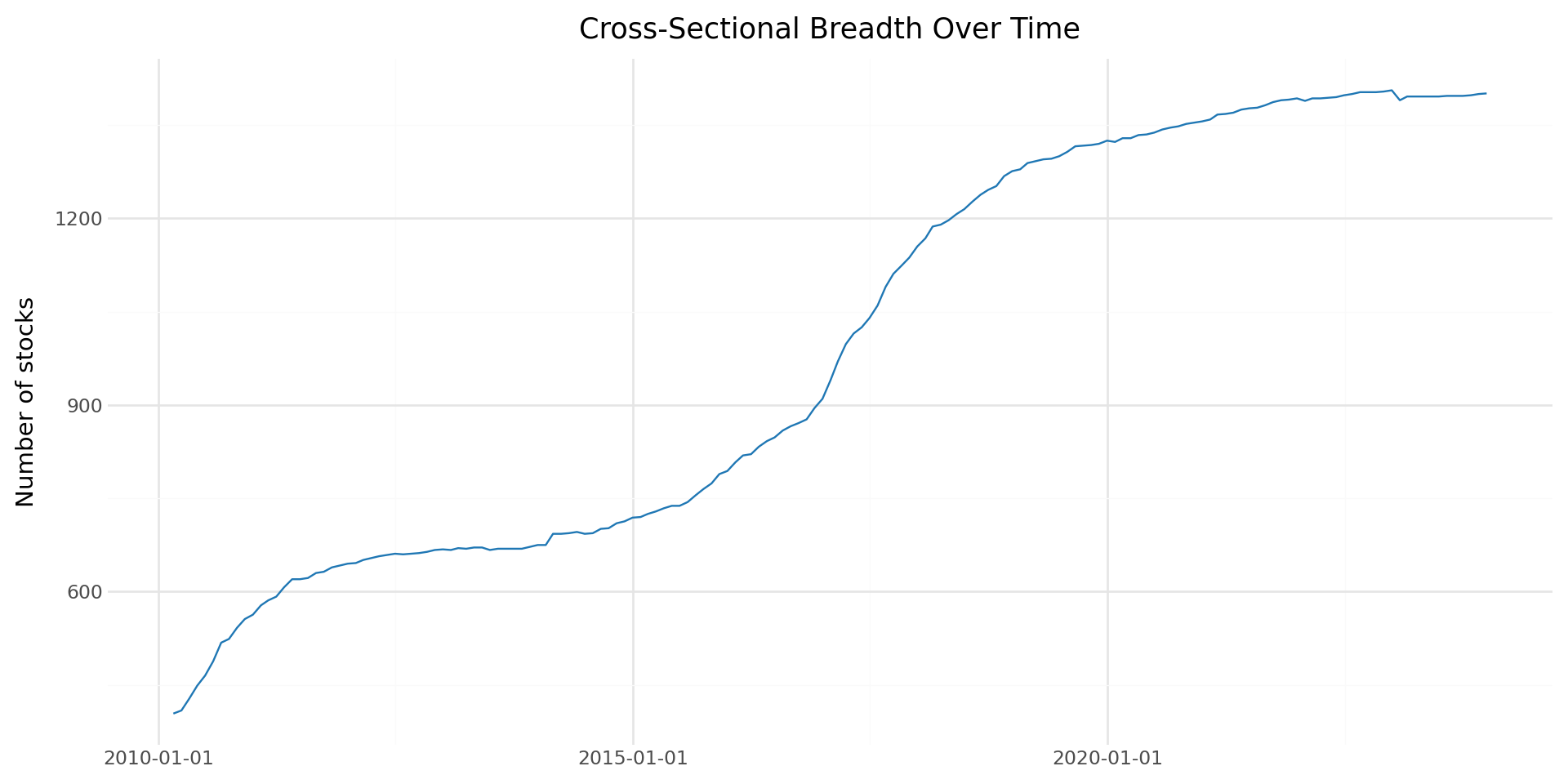
Chúng ta cũng nạp lợi nhuận các nhân tố Fama-French để đánh giá hiệu quả điều chỉnh theo rủi ro. Các nhân tố này đã được xây dựng ở các chương trước.
factors_ff3_monthly = pd.read_sql_query(
    sql="SELECT date, mkt_excess, smb, hml, risk_free FROM factors_ff3_monthly",
    con=tidy_finance,
    parse_dates={"date"}
)

print(f"Factor observations: {len(factors_ff3_monthly):,}")
print(f"Date range: {factors_ff3_monthly['date'].min().date()} "
      f"to {factors_ff3_monthly['date'].max().date()}")
Factor observations: 150
Date range: 2011-07-31 to 2023-12-31Các chiến lược động lượng đòi hỏi lịch sử lợi nhuận liên tục trong thời kỳ hình thành. Chúng ta áp dụng một số bộ lọc để bảo đảm chất lượng dữ liệu:
# Filter for stocks with positive market cap and non-missing returns
prices_clean = (prices_monthly
    .dropna(subset=["ret", "mktcap"])
    .query("mktcap > 0")
    .sort_values(["symbol", "date"])
    .reset_index(drop=True)
)

print(f"Observations after filtering: {len(prices_clean):,}")
print(f"Stocks after filtering: {prices_clean['symbol'].nunique():,}")
Observations after filtering: 165,499
Stocks after filtering: 1,457Bước đầu tiên trong việc xây dựng các danh mục động lượng là tính lợi nhuận tích lũy trong thời kỳ hình thành. Với thời kỳ hình thành \(J\) tháng, chúng ta tính lợi nhuận tích lũy của mỗi cổ phiếu \(i\) tại cuối tháng \(t\) như quy định trong Phương trình 35.7.
Chúng ta triển khai bằng một tích trượt (rolling product) của các lợi nhuận gộp. Một chi tiết quan trọng là chúng ta yêu cầu lợi nhuận không bị thiếu trong cả \(J\) tháng của cửa sổ hình thành. Nếu thiếu bất kỳ lợi nhuận hằng tháng nào, lợi nhuận tích lũy được đặt là thiếu, và cổ phiếu bị loại khỏi việc hình thành danh mục trong tháng đó.
def compute_formation_returns(data, J):
    """
    Compute J-month cumulative returns for momentum portfolio formation.

    Parameters
    ----------
    data : pd.DataFrame
        Panel data with columns 'symbol', 'date', 'ret'.
    J : int
        Formation period length in months (typically 3-12).

    Returns
    -------
    pd.DataFrame
        Original data augmented with 'cum_return' column.
    """
    df = data.sort_values(["symbol", "date"]).copy()

    # Compute rolling J-month cumulative return
    # Using gross returns: (1+r1)*(1+r2)*...*(1+rJ) - 1
    df["gross_ret"] = 1 + df["ret"]

    df["cum_return"] = (
        df.groupby("symbol")["gross_ret"]
        .rolling(window=J, min_periods=J)
        .apply(np.prod, raw=True)
        .reset_index(level=0, drop=True)
        - 1
    )

    df = df.drop(columns=["gross_ret"])

    return df
Hãy áp dụng hàm này cho trường hợp cơ sở với \(J = 6\) tháng:
J = 6  # Formation period: 6 months

prices_with_cumret = compute_formation_returns(prices_clean, J)

# Check the result
print(f"Observations with valid {J}-month cumulative returns: "
      f"{prices_with_cumret['cum_return'].notna().sum():,}")
print(f"\nCumulative return distribution:")
print(prices_with_cumret["cum_return"].describe().round(4))
Observations with valid 6-month cumulative returns: 158,227
Cumulative return distribution:
count 158227.0000
mean 0.0171
std 0.5053
min -0.9999
25% -0.2196
50% -0.0400
75% 0.1404
max 35.7136
Name: cum_return, dtype: float64Mỗi tháng, chúng ta phân loại tất cả cổ phiếu có lợi nhuận tích lũy hợp lệ vào các danh mục thập phân vị dựa trên kết quả \(J\) tháng gần nhất. Danh mục 1 chứa thập phân vị thấp nhất (cổ phiếu thua) và danh mục 10 chứa thập phân vị cao nhất (cổ phiếu thắng).
def assign_momentum_portfolios(data, n_portfolios=10):
    """
    Assign stocks to momentum portfolios based on formation-period returns.

    For each cross-section (month), stocks are sorted into
    n_portfolios quantile groups according to their cumulative return.

    Portfolio 1 = lowest past returns (Losers)
    Portfolio n_portfolios = highest past returns (Winners)

    This implementation uses `groupby().transform()` rather than
    `groupby().apply()` to preserve the original DataFrame structure
    and avoid index mutation issues.

    Parameters
    ----------
    data : pd.DataFrame
        Panel data containing at minimum:
        - 'symbol' : stock identifier
        - 'date' : formation month
        - 'cum_return' : cumulative return over formation window

    n_portfolios : int, optional
        Number of portfolios to form (default = 10 for deciles).

    Returns
    -------
    pd.DataFrame
        Original data augmented with:
        - 'momr' : integer momentum rank (1 to n_portfolios)
    """

    # Drop observations without formation-period returns
    # These cannot be ranked into portfolios
    df = data.dropna(subset=["cum_return"]).copy()

    def safe_qcut(x):
        """
        Assign quantile portfolio labels within a single cross-section.

        Uses pd.qcut to create approximately equal-sized portfolios.
        If too few unique return values exist (which can happen in
        small markets or illiquid samples), fall back to rank-based
        binning to ensure portfolios are still formed.
        """
        try:
            # Standard quantile sorting
            return pd.qcut(
                x,
                q=n_portfolios,
                labels=range(1, n_portfolios + 1),
                duplicates="drop"  # prevents crash if quantile edges duplicate
            )
        except ValueError:
            # Fallback: rank then evenly cut into bins
            return pd.cut(
                x.rank(method="first"),
                bins=n_portfolios,
                labels=range(1, n_portfolios + 1)
            )

    # Cross-sectional portfolio assignment:
    # For each month, compute portfolio ranks based on cum_return.
    # transform ensures:
    # - original row order preserved
    # - no index mutation
    # - no loss of 'date' column
    df["momr"] = (
        df.groupby("date")["cum_return"]
          .transform(safe_qcut)
          .astype(int)
    )

return dfportfolios = assign_momentum_portfolios(prices_with_cumret)
print(f"Stocks assigned to portfolios: {len(portfolios):,}")
print(f"\nPortfolio distribution (should be approximately equal):")
print(portfolios.groupby("momr")["symbol"].count().to_frame("count"))Stocks assigned to portfolios: 158,227
Portfolio distribution (should be approximately equal):
count
momr
1 15894
2 15815
3 16021
4 15759
5 15738
6 16568
7 15288
8 15582
9 15697
10 15865Sau khi hình thành danh mục vào cuối tháng \(t\), chúng ta nắm giữ chúng từ đầu tháng \(t+1\) đến cuối tháng \(t+K\). Khoảng cách một tháng giữa thời kỳ hình thành và thời điểm bắt đầu thời kỳ nắm giữ là chuẩn trong tài liệu và tránh hiệu ứng đảo chiều ngắn hạn đã được ghi nhận rõ ở chân trời một tháng (Jegadeesh 1990).
K = 6  # Holding period: 6 months

portfolios_with_dates = portfolios.copy()
portfolios_with_dates = portfolios_with_dates.rename(
    columns={"date": "form_date"}
)

# Define holding period start and end dates
portfolios_with_dates["hdate1"] = (
    portfolios_with_dates["form_date"] + pd.offsets.MonthBegin(1)
)
portfolios_with_dates["hdate2"] = (
    portfolios_with_dates["form_date"] + pd.offsets.MonthEnd(K)
)

print(portfolios_with_dates[
    ["symbol", "form_date", "cum_return", "momr", "hdate1", "hdate2"]
].head(10))
symbol form_date cum_return momr hdate1 hdate2
5 A32 2019-04-30 -0.061599 4 2019-05-01 2019-10-31
6 A32 2019-05-31 -0.213675 2 2019-06-01 2019-11-30
7 A32 2019-06-30 -0.308720 2 2019-07-01 2019-12-31
8 A32 2019-07-31 -0.249936 2 2019-08-01 2020-01-31
9 A32 2019-08-31 0.061986 8 2019-09-01 2020-02-29
10 A32 2019-09-30 0.030751 8 2019-10-01 2020-03-31
11 A32 2019-10-31 0.030751 8 2019-11-01 2020-04-30
12 A32 2019-11-30 0.032486 8 2019-12-01 2020-05-31
13 A32 2019-12-31 0.180073 9 2020-01-01 2020-06-30
14 A32 2020-01-31 0.412322 10 2020-02-01 2020-07-31Bây giờ chúng ta tính lợi nhuận của từng danh mục trong thời kỳ nắm giữ. Với mỗi tổ hợp cổ phiếu-ngày hình thành, chúng ta ghép vào các lợi nhuận thực tế đạt được trong cửa sổ nắm giữ. Điều này tạo ra một bảng dữ liệu (panel) lợi nhuận cổ phiếu được đánh chỉ mục theo ngày hình thành, ngày nắm giữ và thứ hạng danh mục động lượng.
# Merge: for each portfolio assignment, get all returns during holding period
portfolio_returns = portfolios_with_dates.merge(
    prices_clean[["symbol", "date", "ret"]].rename(
        columns={"ret": "hret", "date": "hdate"}
    ),
    on="symbol",
    how="inner"
)

# Keep only returns within the holding period
portfolio_returns = portfolio_returns.query(
    "hdate >= hdate1 and hdate <= hdate2"
)

print(f"Portfolio-holding period observations: {len(portfolio_returns):,}")
Portfolio-holding period observations: 918,072Phương pháp của Jegadeesh và Titman (1993) dùng các danh mục trọng số bằng nhau. Với mỗi tháng nắm giữ, mỗi thập phân vị động lượng có \(K\) nhóm đang hoạt động (mỗi nhóm hình thành vào một trong \(K\) tháng gần nhất). Trước tiên chúng ta tính lợi nhuận trọng số bằng nhau trong mỗi nhóm, sau đó lấy trung bình giữa các nhóm để có lợi nhuận danh mục hằng tháng cuối cùng.
# Step 1: Average return within each cohort (form_date × momr × hdate)
cohort_returns = (portfolio_returns
    .groupby(["hdate", "momr", "form_date"])
    .agg(cohort_ret=("hret", "mean"))
    .reset_index()
)

# Step 2: Average across cohorts for each momentum portfolio × month
ewret = (cohort_returns
    .groupby(["hdate", "momr"])
    .agg(
        ewret=("cohort_ret", "mean"),
        ewret_std=("cohort_ret", "std"),
        n_cohorts=("cohort_ret", "count")
    )
    .reset_index()
    .rename(columns={"hdate": "date"})
)

print(f"Monthly portfolio return observations: {len(ewret):,}")
print(f"Date range: {ewret['date'].min().date()} to {ewret['date'].max().date()}")
Monthly portfolio return observations: 1,610
Date range: 2010-08-31 to 2023-12-31Chúng ta nên kiểm tra rằng mỗi tháng có số nhóm đang hoạt động đúng như kỳ vọng. Khi chiến lược đã chạy ít nhất \(K\) tháng, mỗi thập phân vị động lượng phải có đúng \(K\) nhóm đang hoạt động.
cohort_check = (ewret
    .groupby("date")["n_cohorts"]
    .mean()
    .reset_index()
    .rename(columns={"n_cohorts": "avg_cohorts"})
)

plot_cohorts = (
    ggplot(cohort_check, aes(x="date", y="avg_cohorts")) +
    geom_line(color="#1f77b4") +
    geom_hline(yintercept=K, linetype="dashed", color="red") +
    labs(
        x="", y="Average number of cohorts",
        title=f"Active Cohorts per Portfolio (K={K})"
    ) +
    theme_minimal() +
    theme(figure_size=(10, 4))
)
plot_cohorts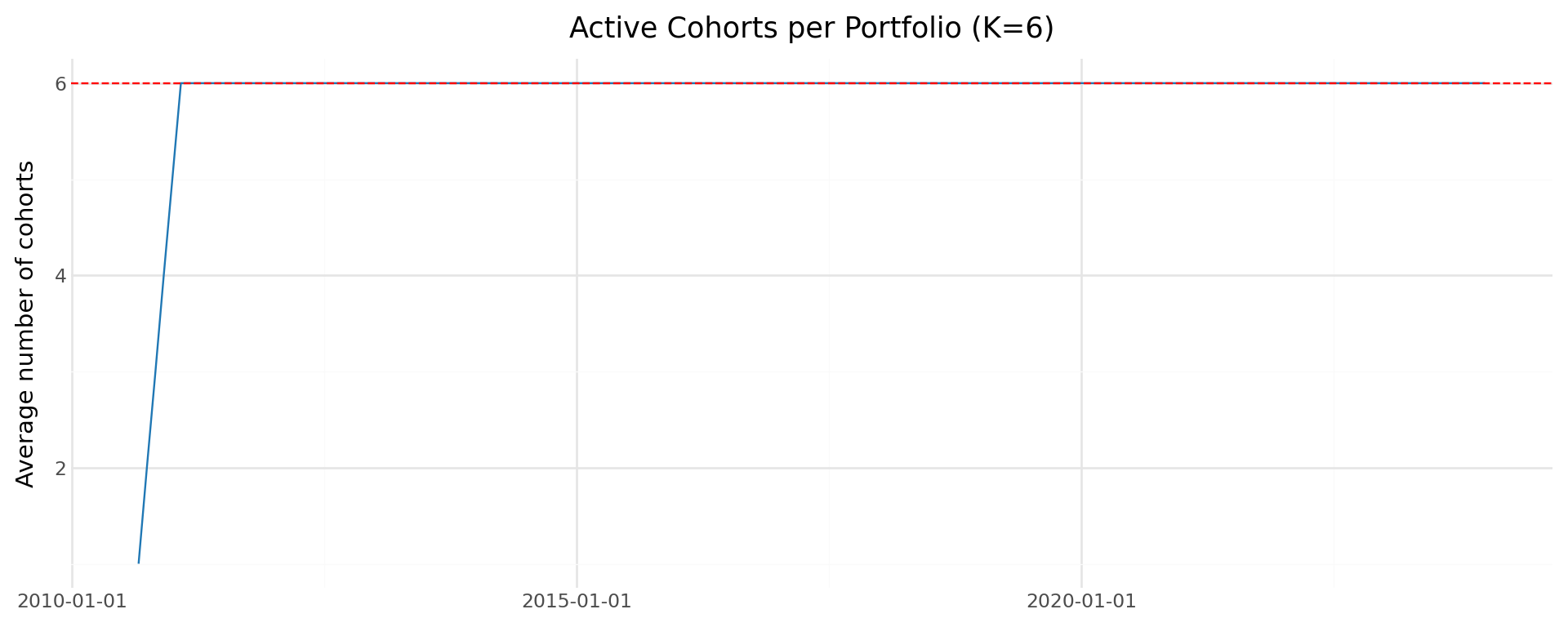
Bây giờ chúng ta xem xét lợi nhuận hằng tháng trung bình của từng danh mục thập phân vị động lượng. Bảng 18.2 trình bày giá trị trung bình, thống kê \(t\) và giá trị \(p\) cho mỗi danh mục trong mười danh mục.
def compute_portfolio_stats(group):
    """Compute mean, t-stat, and p-value for a return series."""
    n = len(group)
    mean_ret = group.mean()
    std_ret = group.std()
    t_stat = mean_ret / (std_ret / np.sqrt(n)) if std_ret > 0 else np.nan
    p_val = 2 * (1 - stats.t.cdf(abs(t_stat), df=n-1)) if not np.isnan(t_stat) else np.nan
    return pd.Series({
        "N": n,
        "Mean (%)": mean_ret * 100,
        "Std (%)": std_ret * 100,
        "t-stat": t_stat,
        "p-value": p_val
    })

momentum_stats = (ewret
    .groupby("momr")["ewret"]
    .apply(compute_portfolio_stats)
    .unstack()
    .round(4)
)

momentum_stats| N | Mean (%) | Std (%) | t-stat | p-value | |
|---|---|---|---|---|---|
| momr | |||||
| 1 | 161.0 | 1.4190 | 6.5319 | 2.7565 | 0.0065 |
| 2 | 161.0 | 0.6602 | 5.9895 | 1.3985 | 0.1639 |
| 3 | 161.0 | 0.3658 | 5.5080 | 0.8427 | 0.4007 |
| 4 | 161.0 | 0.1623 | 5.0085 | 0.4112 | 0.6815 |
| 5 | 161.0 | 0.0111 | 4.7561 | 0.0297 | 0.9763 |
| 6 | 161.0 | 0.0408 | 4.6864 | 0.1104 | 0.9122 |
| 7 | 161.0 | -0.0674 | 4.8881 | -0.1749 | 0.8614 |
| 8 | 161.0 | -0.2066 | 4.9208 | -0.5329 | 0.5949 |
| 9 | 161.0 | -0.2228 | 5.3013 | -0.5332 | 0.5946 |
| 10 | 161.0 | -0.6812 | 5.7131 | -1.5130 | 0.1323 |
Phép kiểm tra then chốt của hiệu ứng động lượng là liệu chênh lệch giữa cổ phiếu thắng và cổ phiếu thua, tức danh mục động lượng mua–bán khống (long–short), có tạo ra lợi nhuận dương có ý nghĩa thống kê hay không. Chúng ta xây dựng danh mục chênh lệch này bằng cách mua thập phân vị cao nhất (danh mục 10) và bán khống thập phân vị thấp nhất (danh mục 1).
# Pivot to wide format
ewret_wide = ewret.pivot(
    index="date", columns="momr", values="ewret"
).reset_index()

ewret_wide.columns = ["date"] + [f"port{i}" for i in range(1, 11)]

# Compute long-short return
ewret_wide["winners"] = ewret_wide["port10"]
ewret_wide["losers"] = ewret_wide["port1"]
ewret_wide["long_short"] = ewret_wide["winners"] - ewret_wide["losers"]ls_stats = pd.DataFrame()
for col in ["winners", "losers", "long_short"]:
series = ewret_wide[col].dropna()
n = len(series)
mean_val = series.mean()
std_val = series.std()
t_val = mean_val / (std_val / np.sqrt(n))
p_val = 2 * (1 - stats.t.cdf(abs(t_val), df=n-1))
ls_stats[col] = [n, mean_val * 100, std_val * 100, t_val, p_val]
ls_stats.index = ["N", "Mean (%)", "Std (%)", "t-stat", "p-value"]
ls_stats.columns = ["Winners", "Losers", "Long-Short"]
ls_stats = ls_stats.round(4)
ls_stats| Winners | Losers | Long-Short | |
|---|---|---|---|
| N | 161.0000 | 161.0000 | 161.0000 |
| Mean (%) | -0.6812 | 1.4190 | -2.1002 |
| Std (%) | 5.7131 | 6.5319 | 4.8969 |
| t-stat | -1.5130 | 2.7565 | -5.4420 |
| p-value | 0.1323 | 0.0065 | 0.0000 |
Diễn biến theo chuỗi thời gian của lợi nhuận tích lũy cung cấp bằng chứng trực quan về hiệu quả của chiến lược động lượng. Hình 18.3 cho thấy lợi nhuận tích lũy của các danh mục thắng và thua, trong khi Hình 18.4 cho thấy lợi nhuận tích lũy của chiến lược động lượng mua–bán khống.
# Compute cumulative returns
ewret_wide = ewret_wide.sort_values("date").reset_index(drop=True)

for col in ["winners", "losers", "long_short"]:
ewret_wide[f"cumret_{col}"] = (1 + ewret_wide[col]).cumprod() - 1cumret_plot_data = (ewret_wide
[["date", "cumret_winners", "cumret_losers"]]
.melt(id_vars="date", var_name="portfolio", value_name="cumret")
)
cumret_plot_data["portfolio"] = cumret_plot_data["portfolio"].map({
"cumret_winners": "Winners (P10)",
"cumret_losers": "Losers (P1)"
})
plot_cumret = (
ggplot(cumret_plot_data,
aes(x="date", y="cumret", color="portfolio")) +
geom_line(size=1) +
scale_y_continuous(labels=percent_format()) +
scale_color_manual(values=["#d62728", "#1f77b4"]) +
labs(
x="", y="Cumulative return",
color="Portfolio",
title="Cumulative Returns: Winners vs. Losers"
) +
theme_minimal() +
theme(
figure_size=(10, 6),
legend_position="bottom"
)
)
plot_cumret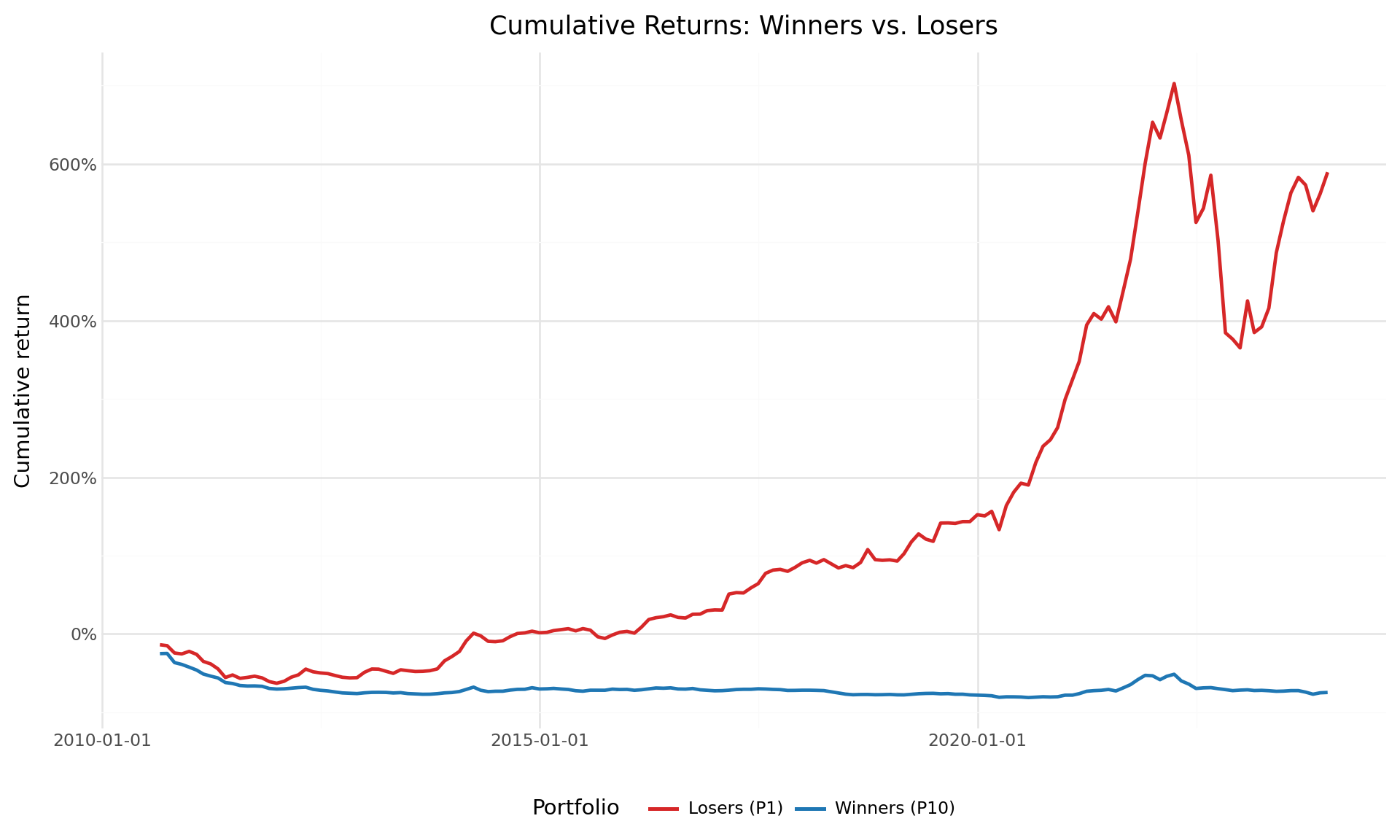
plot_ls = (
    ggplot(ewret_wide, aes(x="date", y="cumret_long_short")) +
    geom_line(size=1, color="#2ca02c") +
    geom_hline(yintercept=0, linetype="dashed", color="gray") +
    scale_y_continuous(labels=percent_format()) +
    labs(
        x="", y="Cumulative return",
        title="Cumulative Return: Long-Short Momentum Strategy"
    ) +
    theme_minimal() +
    theme(figure_size=(10, 6))
)
plot_ls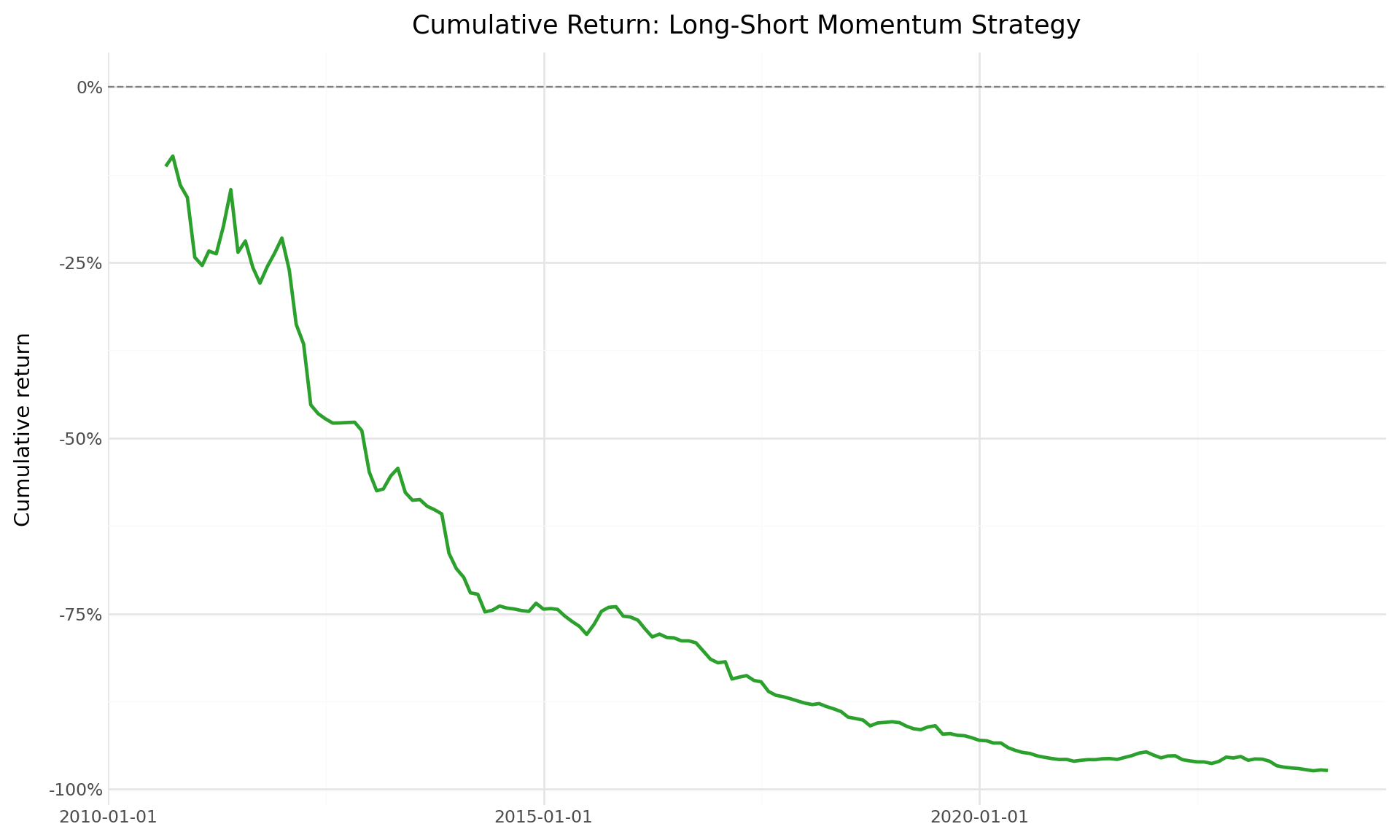
Ngoài giá trị trung bình, toàn bộ phân phối của lợi nhuận mua–bán khống hằng tháng cho thấy hồ sơ rủi ro của chiến lược động lượng. Hình 39.1 thể hiện biểu đồ tần suất của lợi nhuận hằng tháng.
mean_ls = ewret_wide["long_short"].mean()

plot_dist = (
    ggplot(ewret_wide, aes(x="long_short")) +
    geom_histogram(bins=50, fill="#1f77b4", alpha=0.7) +
    geom_vline(xintercept=mean_ls, linetype="dashed", color="red") +
    scale_x_continuous(labels=percent_format()) +
    labs(
        x="Monthly long-short return",
        y="Frequency",
        title="Distribution of Monthly Momentum Returns"
    ) +
    theme_minimal() +
    theme(figure_size=(10, 5))
)
plot_dist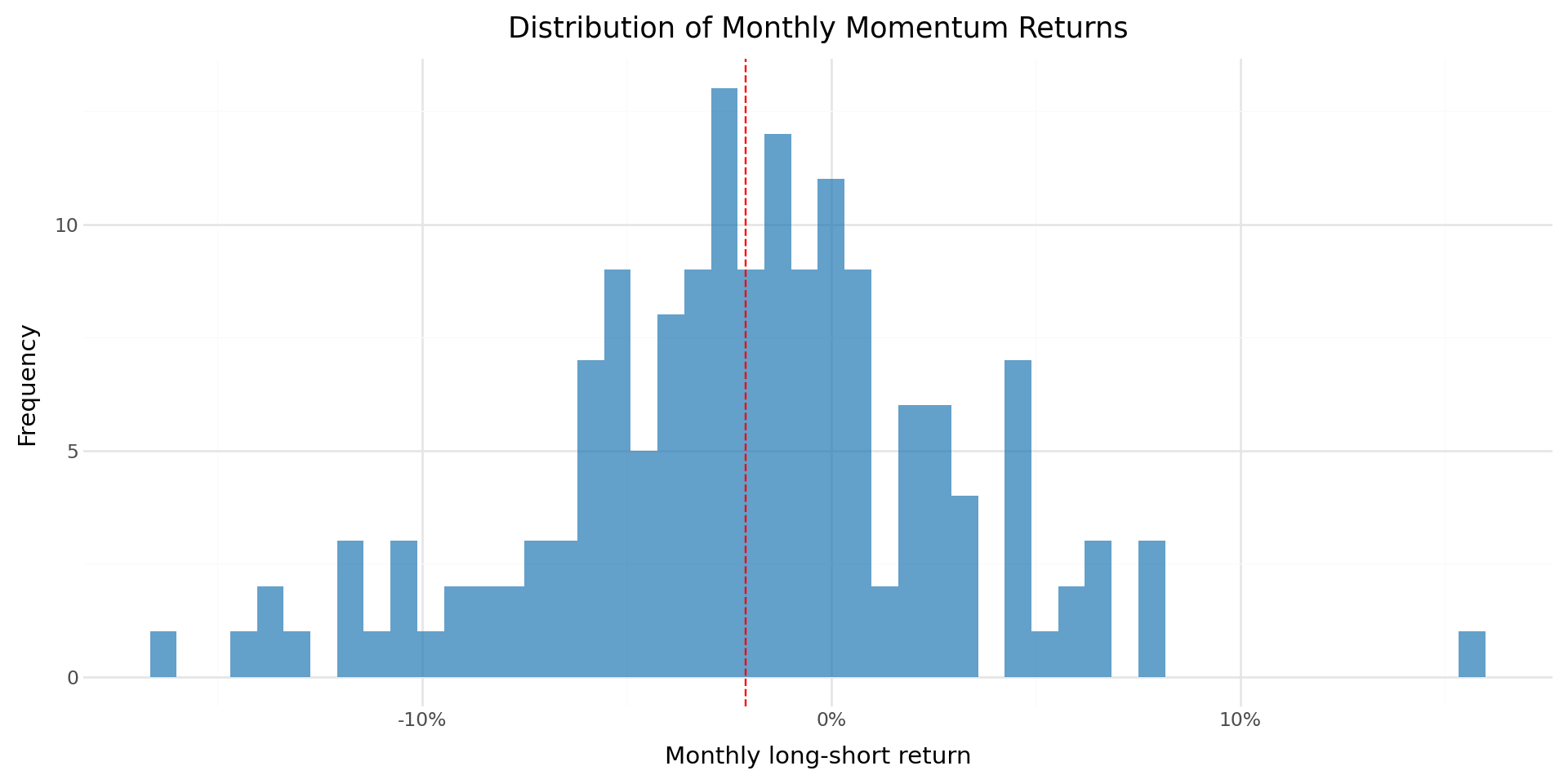
Jegadeesh và Titman (1993) đánh giá các chiến lược động lượng trên một lưới toàn diện gồm các thời kỳ hình thành \(J \in \{3, 6, 9, 12\}\) và các thời kỳ nắm giữ \(K \in \{3, 6, 9, 12\}\). Điều này tạo ra 16 đặc tả chiến lược khác nhau, cho phép chúng ta đánh giá độ vững của hiệu ứng động lượng qua các chân trời khác nhau.
Bây giờ chúng ta triển khai một hàm tính toàn bộ chiến lược động lượng cho bất kỳ cặp \((J, K)\) nào, gói các bước đã phát triển ở trên thành một quy trình duy nhất có thể tái sử dụng.
from joblib import Parallel, delayed
import time

def momentum_strategy(data, J, K, n_portfolios=10):
    """
    Implement the full Jegadeesh-Titman momentum strategy.

    Parameters
    ----------
    data : pd.DataFrame
        Panel of stock returns with columns: symbol, date, ret.
    J : int
        Formation period in months.
    K : int
        Holding period in months.
    n_portfolios : int
        Number of portfolios (default: 10 for deciles).

    Returns
    -------
    pd.DataFrame
        Monthly returns for each momentum portfolio and the long-short spread.
    """
    # Step 1: Compute formation period cumulative returns
    df = data.sort_values(["symbol", "date"]).copy()
    df["gross_ret"] = 1 + df["ret"]
    df["cum_return"] = (
        df.groupby("symbol")["gross_ret"]
        .rolling(window=J, min_periods=J)
        .apply(np.prod, raw=True)
        .reset_index(level=0, drop=True)
        - 1
    )
    df = df.drop(columns=["gross_ret"]).dropna(subset=["cum_return"])

    # Step 2: Assign to momentum portfolios using transform
    df["momr"] = df.groupby("date", observed=True)["cum_return"].transform(
        lambda x: pd.qcut(
            x,
            q=n_portfolios,
            labels=range(1, n_portfolios + 1),
            duplicates="drop"
        )
    ).astype('Int64')

    # If any NaNs in momr, fill with rank-based assignment
    mask = df["momr"].isna()
    if mask.any():
        df.loc[mask, "momr"] = df.loc[mask].groupby("date")["cum_return"].transform(
            lambda x: pd.qcut(
                x.rank(method="first"),
                q=min(n_portfolios, len(x.unique())),
                labels=False,
                duplicates="drop"
            )
        ).astype('Int64') + 1

    # Step 3: Define holding period dates
    df = df.rename(columns={"date": "form_date"})
    df["hdate1"] = df["form_date"] + pd.offsets.MonthBegin(1)
    df["hdate2"] = df["form_date"] + pd.offsets.MonthEnd(K)

    # Step 4: Merge with holding period returns
    port_ret = df[["symbol", "form_date", "momr", "hdate1", "hdate2"]].merge(
        data[["symbol", "date", "ret"]].rename(
            columns={"ret": "hret", "date": "hdate"}
        ),
        on="symbol",
        how="inner"
    )

    # Use boolean indexing
    port_ret = port_ret[
        (port_ret["hdate"] >= port_ret["hdate1"]) &
        (port_ret["hdate"] <= port_ret["hdate2"])
    ]

    # Step 5: Compute equally weighted returns (two-stage averaging)
    cohort_ret = (port_ret
        .groupby(["hdate", "momr", "form_date"])
        .agg(cohort_ret=("hret", "mean"))
        .reset_index()
    )

    monthly_ret = (cohort_ret
        .groupby(["hdate", "momr"])
        .agg(ewret=("cohort_ret", "mean"))
        .reset_index()
        .rename(columns={"hdate": "date"})
    )

    # Step 6: Compute long-short spread
    wide = monthly_ret.pivot(
        index="date", columns="momr", values="ewret"
    ).reset_index()

    # Handle variable number of portfolios
    n_cols = len(wide.columns) - 1
    wide.columns = ["date"] + [f"port{i}" for i in range(1, n_cols + 1)]
    wide["winners"] = wide[f"port{n_cols}"]
    wide["losers"] = wide["port1"]
    wide["long_short"] = wide["winners"] - wide["losers"]

return monthly_ret, wideBây giờ chúng ta chạy chiến lược động lượng cho cả 16 tổ hợp \((J, K)\). Việc này tốn nhiều tính toán, nên chúng ta lưu các thống kê tóm tắt chính của mỗi đặc tả.
J_values = [3, 6, 9, 12]
K_values = [3, 6, 9, 12]

results_grid = []

for J_val, K_val in product(J_values, K_values):
    print(f"Computing J={J_val}, K={K_val}...", end=" ")

    try:
        _, wide_result = momentum_strategy(prices_clean, J_val, K_val)

        for portfolio_name in ["winners", "losers", "long_short"]:
            series = wide_result[portfolio_name].dropna()
            n = len(series)
            mean_ret = series.mean()
            std_ret = series.std()
            t_stat = mean_ret / (std_ret / np.sqrt(n)) if std_ret > 0 else np.nan
            p_val = (2 * (1 - stats.t.cdf(abs(t_stat), df=n-1))
                     if not np.isnan(t_stat) else np.nan)

            results_grid.append({
                "J": J_val,
                "K": K_val,
                "portfolio": portfolio_name,
                "n_months": n,
                "mean_ret": mean_ret,
                "std_ret": std_ret,
                "t_stat": t_stat,
                "p_value": p_val
            })

        print("Done.")
    except Exception as e:
        print(f"Error: {e}")

results_df = pd.DataFrame(results_grid)def compute_single_strategy(data, J, K):
"""
Compute statistics for a single (J, K) strategy.
Returns a list of result dicts, one per portfolio.
"""
try:
_, wide_result = momentum_strategy(data, J, K)
results = []
for portfolio_name in ["winners", "losers", "long_short"]:
series = wide_result[portfolio_name].dropna()
n = len(series)
mean_ret = series.mean()
std_ret = series.std()
t_stat = mean_ret / (std_ret / np.sqrt(n)) if std_ret > 0 else np.nan
p_val = (2 * (1 - stats.t.cdf(abs(t_stat), df=n-1))
if not np.isnan(t_stat) else np.nan)
results.append({
"J": J,
"K": K,
"portfolio": portfolio_name,
"n_months": n,
"mean_ret": mean_ret,
"std_ret": std_ret,
"t_stat": t_stat,
"p_value": p_val
})
return results
except Exception as e:
print(f"Error in J={J}, K={K}: {e}")
return []J_values = [3, 6, 9, 12]
K_values = [3, 6, 9, 12]
# Create list of (J, K) pairs
params = list(product(J_values, K_values))
print(f"Running {len(params)} momentum strategies in parallel with 4 cores...")
start_time = time.time()
# Parallel execution with 4 workers
results_list = Parallel(n_jobs=4, verbose=10)(
delayed(compute_single_strategy)(prices_clean, J, K)
for J, K in params
)
# Flatten results
results_grid = [item for sublist in results_list for item in sublist]
results_df = pd.DataFrame(results_grid)
elapsed = time.time() - start_time
print(f"\nCompleted in {elapsed:.2f} seconds")Running 16 momentum strategies in parallel with 4 cores...[Parallel(n_jobs=4)]: Using backend LokyBackend with 4 concurrent workers.
[Parallel(n_jobs=4)]: Done 5 tasks | elapsed: 8.4s
[Parallel(n_jobs=4)]: Done 11 out of 16 | elapsed: 14.4s remaining: 6.5s
[Parallel(n_jobs=4)]: Done 13 out of 16 | elapsed: 18.7s remaining: 4.3s
Completed in 19.68 seconds[Parallel(n_jobs=4)]: Done 16 out of 16 | elapsed: 19.6s finished# Summary statistics
print("\nResults Summary by Formation Period:")
print(results_df.groupby("J").agg({
"mean_ret": "mean",
"std_ret": "mean",
"t_stat": ["mean", lambda x: (x.abs() > 1.96).sum()],
"n_months": "first"
}).round(6))
Results Summary by Formation Period:
    mean_ret   std_ret    t_stat            n_months
        mean      mean      mean <lambda_0>    first
J
6  -0.004661  0.055672 -1.517507          9      161
9  -0.003265  0.056520 -1.071904          9      158
12 -0.002759 0.058194 -0.931273 9 155Bảng 18.4 trình bày lợi nhuận hằng tháng trung bình của danh mục cổ phiếu thắng (danh mục 10) qua tất cả các tổ hợp \((J, K)\).
winners_grid = (results_df
    .query("portfolio == 'winners'")
    .assign(
        display=lambda x: (
            x["mean_ret"].apply(lambda v: f"{v*100:.2f}") +
            "\n(" + x["t_stat"].apply(lambda v: f"{v:.2f}") + ")"
        )
    )
    .pivot(index="J", columns="K", values="display")
)
winners_grid.columns = [f"K={k}" for k in winners_grid.columns]
winners_grid.index = [f"J={j}" for j in winners_grid.index]
winners_grid| K=3 | K=6 | K=9 | K=12 | |
|---|---|---|---|---|
| J=6 | -1.18\n(-2.65) | -0.68\n(-1.51) | -0.55\n(-1.23) | -0.39\n(-0.87) |
| J=9 | -1.00\n(-2.36) | -0.51\n(-1.22) | -0.28\n(-0.68) | -0.16\n(-0.39) |
| J=12 | -0.88\n(-2.09) | -0.39\n(-0.91) | -0.24\n(-0.56) | -0.14\n(-0.34) |
Bảng 18.5 trình bày kết quả tương ứng cho danh mục cổ phiếu thua.
losers_grid = (results_df
    .query("portfolio == 'losers'")
    .assign(
        display=lambda x: (
            x["mean_ret"].apply(lambda v: f"{v*100:.2f}") +
            "\n(" + x["t_stat"].apply(lambda v: f"{v:.2f}") + ")"
        )
    )
    .pivot(index="J", columns="K", values="display")
)
losers_grid.columns = [f"K={k}" for k in losers_grid.columns]
losers_grid.index = [f"J={j}" for j in losers_grid.index]
losers_grid| K=3 | K=6 | K=9 | K=12 | |
|---|---|---|---|---|
| J=6 | 1.87\n(3.49) | 1.42\n(2.76) | 1.10\n(2.19) | 0.99\n(1.99) |
| J=9 | 1.94\n(3.51) | 1.38\n(2.56) | 1.21\n(2.31) | 1.15\n(2.22) |
| J=12 | 1.57\n(2.71) | 1.29\n(2.28) | 1.19\n(2.13) | 1.15\n(2.09) |
Bảng 18.6 trình bày kết quả quan trọng nhất: lợi nhuận hằng tháng trung bình của danh mục động lượng mua–bán khống qua tất cả các đặc tả.
ls_grid = (results_df
    .query("portfolio == 'long_short'")
    .assign(
        display=lambda x: (
            x["mean_ret"].apply(lambda v: f"{v*100:.2f}") +
            "\n(" + x["t_stat"].apply(lambda v: f"{v:.2f}") + ")"
        )
    )
    .pivot(index="J", columns="K", values="display")
)
ls_grid.columns = [f"K={k}" for k in ls_grid.columns]
ls_grid.index = [f"J={j}" for j in ls_grid.index]
ls_grid| K=3 | K=6 | K=9 | K=12 | |
|---|---|---|---|---|
| J=6 | -3.04\n(-7.38) | -2.10\n(-5.44) | -1.65\n(-4.94) | -1.37\n(-4.61) |
| J=9 | -2.94\n(-6.41) | -1.89\n(-4.55) | -1.49\n(-3.98) | -1.31\n(-3.87) |
| J=12 | -2.45\n(-5.42) | -1.68\n(-3.92) | -1.43\n(-3.60) | -1.30\n(-3.55) |
Hình 18.6 cung cấp bản tóm tắt trực quan về phần bù động lượng mua–bán khống qua tất cả các tổ hợp \((J, K)\).
ls_heatmap_data = (results_df
    .query("portfolio == 'long_short'")
    .assign(
        mean_pct=lambda x: x["mean_ret"] * 100,
        significant=lambda x: x["p_value"] < 0.05,
        label=lambda x: x.apply(
            lambda row: f"{row['mean_ret']*100:.2f}{'*' if row['p_value'] < 0.05 else ''}",
            axis=1
        )
    )
)

plot_heatmap = (
    ggplot(ls_heatmap_data,
           aes(x="K.astype(str)", y="J.astype(str)", fill="mean_pct")) +
    geom_tile(color="white", size=2) +
    geom_text(aes(label="label"), size=10, color="white") +
    scale_fill_gradient2(
        low="#d62728", mid="#f7f7f7", high="#1f77b4", midpoint=0,
        name="Monthly\nReturn (%)"
    ) +
    labs(
        x="Holding Period (K months)",
        y="Formation Period (J months)",
        title="Momentum Premium Across J×K Specifications"
    ) +
    theme_minimal() +
    theme(figure_size=(8, 6))
)
plot_heatmap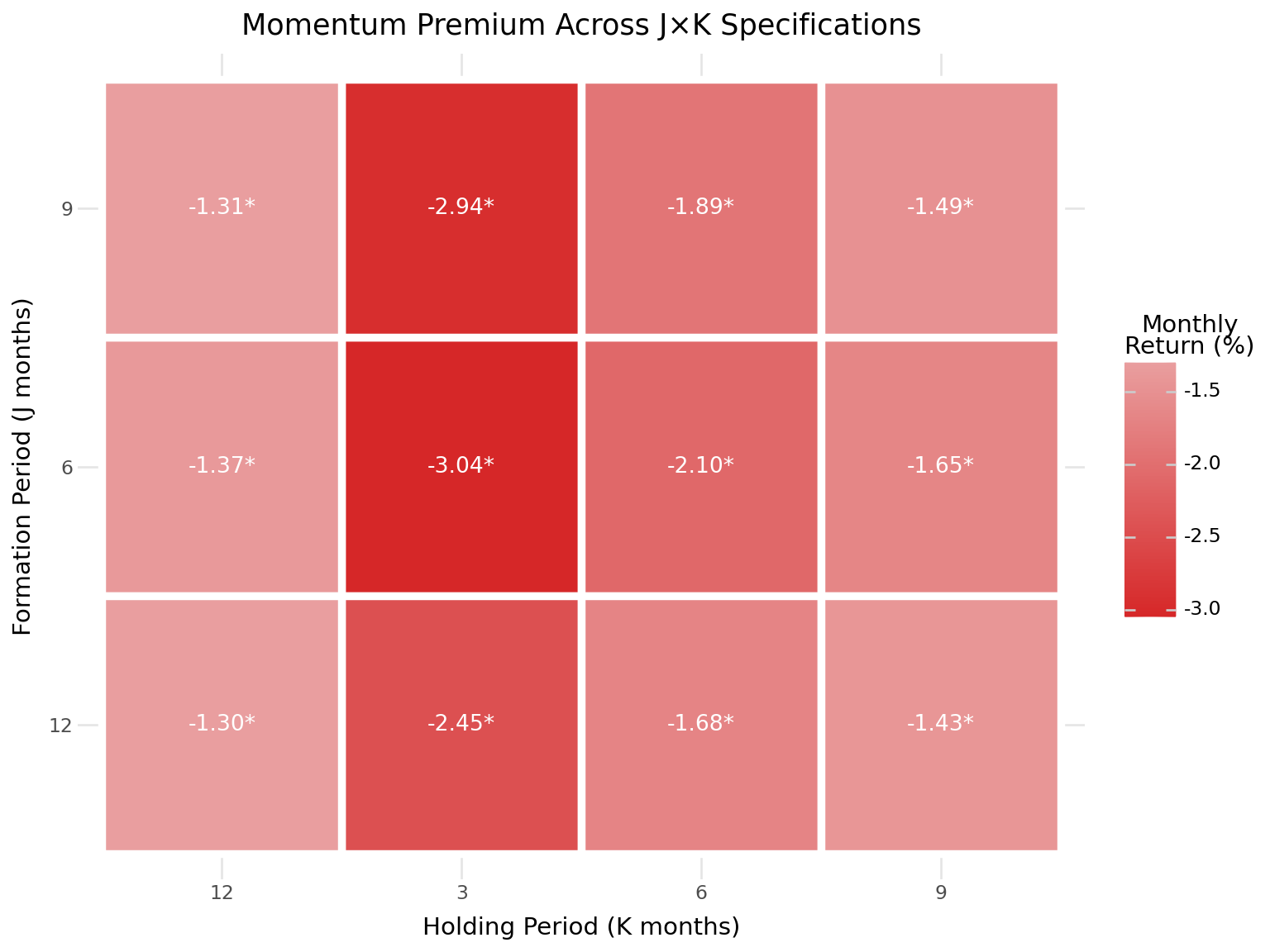
Một câu hỏi tự nhiên là liệu phần bù động lượng có được giải thích bởi mức độ phơi nhiễm với nhân tố thị trường hay không. Chúng ta ước lượng alpha CAPM của danh mục động lượng mua–bán khống bằng cách hồi quy lợi nhuận của nó theo lợi nhuận vượt mức của thị trường:
\[ r_{\text{WML},t} = \alpha + \beta \cdot r_{\text{MKT},t} + \epsilon_t \tag{18.3}\]
# Merge momentum returns with factor data (baseline J=6, K=6)
ewret_factors = (ewret_wide
    [["date", "winners", "losers", "long_short"]]
    .merge(factors_ff3_monthly, on="date", how="inner")
)

# CAPM regression for long-short portfolio
from statsmodels.formula.api import ols as ols_formula
import statsmodels.api as sm

X_capm = sm.add_constant(ewret_factors["mkt_excess"])
y_ls = ewret_factors["long_short"]

capm_model = sm.OLS(y_ls, X_capm).fit(cov_type="HAC", cov_kwds={"maxlags": 6})

print("CAPM Regression: Long-Short Momentum Returns")
print("=" * 60)
print(f"Alpha (monthly):  {capm_model.params['const']*100:.4f}% "
      f"(t={capm_model.tvalues['const']:.2f})")
print(f"Market Beta:      {capm_model.params['mkt_excess']:.4f} "
      f"(t={capm_model.tvalues['mkt_excess']:.2f})")
print(f"R-squared:        {capm_model.rsquared:.4f}")
print(f"N observations:   {capm_model.nobs:.0f}")
CAPM Regression: Long-Short Momentum Returns
============================================================
Alpha (monthly): -2.2703% (t=-5.05)
Market Beta: -0.1779 (t=-1.75)
R-squared: 0.0470
N observations: 150Chúng ta mở rộng việc điều chỉnh rủi ro sang mô hình ba nhân tố Fama-French, gồm các nhân tố quy mô (SMB) và giá trị (HML) bên cạnh nhân tố thị trường:
\[ r_{\text{WML},t} = \alpha + \beta_1 \cdot r_{\text{MKT},t} + \beta_2 \cdot \text{SMB}_t + \beta_3 \cdot \text{HML}_t + \epsilon_t \tag{18.4}\]
X_ff3 = sm.add_constant(
    ewret_factors[["mkt_excess", "smb", "hml"]]
)
y_ls = ewret_factors["long_short"]

ff3_model = sm.OLS(y_ls, X_ff3).fit(cov_type="HAC", cov_kwds={"maxlags": 6})

# Display results as a clean table
ff3_results = pd.DataFrame({
    "Coefficient": ff3_model.params,
    "Std Error": ff3_model.bse,
    "t-stat": ff3_model.tvalues,
    "p-value": ff3_model.pvalues
}).round(4)

ff3_results.index = ["Alpha", "MKT", "SMB", "HML"]
ff3_results| Coefficient | Std Error | t-stat | p-value | |
|---|---|---|---|---|
| Alpha | -0.0234 | 0.0041 | -5.7189 | 0.0000 |
| MKT | -0.1269 | 0.1558 | -0.8145 | 0.4154 |
| SMB | 0.1123 | 0.1882 | 0.5969 | 0.5506 |
| HML | 0.0716 | 0.1414 | 0.5065 | 0.6125 |
print(f"\nR-squared: {ff3_model.rsquared:.4f}")
print(f"Adjusted R-squared: {ff3_model.rsquared_adj:.4f}")
print(f"Alpha (annualized): {ff3_model.params['const'] * 12 * 100:.2f}%")
R-squared: 0.0553
Adjusted R-squared: 0.0359
Alpha (annualized): -28.02%Các hệ số tải nhân tố từ hồi quy ba nhân tố cho thấy đặc điểm rủi ro của chiến lược động lượng trên thị trường Việt Nam. Một số mô thức thường được quan sát:
Beta thị trường: Các danh mục động lượng thường có mức phơi nhiễm thị trường vừa phải. Ở Hoa Kỳ, Grundy và Martin (2001) ghi nhận rằng beta thị trường của danh mục mua–bán khống nhìn chung gần bằng không nhưng biến thiên mạnh theo thời gian, tăng vọt khi thị trường đảo chiều.
Phơi nhiễm quy mô (SMB): Các chiến lược động lượng thường có hệ số tải dương trên nhân tố quy mô, phản ánh xu hướng các cổ phiếu nhỏ hơn thể hiện mô thức động lượng mạnh hơn.
Phơi nhiễm giá trị (HML): Danh mục động lượng mua–bán khống thường có hệ số tải âm trên HML, cho thấy cổ phiếu thắng có xu hướng là cổ phiếu tăng trưởng còn cổ phiếu thua có xu hướng là cổ phiếu giá trị. Điều này tạo ra sự đối nghịch tự nhiên giữa các chiến lược động lượng và giá trị.
Một phát hiện quan trọng trong tài liệu về động lượng là lợi nhuận động lượng thay đổi theo điều kiện thị trường. Cooper, Gutierrez Jr, và Hameed (2004) ghi nhận rằng các chiến lược động lượng hoạt động tốt sau khi thị trường tăng (thị trường UP) nhưng chịu thua lỗ nặng sau khi thị trường giảm (thị trường DOWN). Sự bất đối xứng này đặc biệt liên quan đến các thị trường mới nổi, vốn trải qua các trạng thái thị trường cực đoan hơn.
Chúng ta định nghĩa các trạng thái thị trường dựa trên lợi nhuận thị trường tích lũy trong 12 tháng trước đó:
\[ \text{Market State}_t = \begin{cases} \text{UP} & \text{if } \prod_{s=t-12}^{t-1}(1 + r_{m,s}) - 1 > 0 \\ \text{DOWN} & \text{otherwise} \end{cases} \tag{18.5}\]
# Compute 12-month lagged market return
market_returns = factors_ff3_monthly[["date", "mkt_excess"]].copy()
market_returns = market_returns.sort_values("date")
market_returns["mkt_cum_12m"] = (
    (1 + market_returns["mkt_excess"])
    .rolling(window=12, min_periods=12)
    .apply(np.prod, raw=True)
    - 1
)
market_returns["market_state"] = np.where(
    market_returns["mkt_cum_12m"] > 0, "UP", "DOWN"
)

# Merge with momentum returns
ewret_states = ewret_wide[["date", "long_short"]].merge(
    market_returns[["date", "market_state"]], on="date", how="inner"
).dropna()state_stats = []
for state in ["UP", "DOWN"]:
subset = ewret_states.query(f"market_state == '{state}'")["long_short"]
n = len(subset)
mean_ret = subset.mean()
std_ret = subset.std()
t_stat = mean_ret / (std_ret / np.sqrt(n)) if std_ret > 0 else np.nan
p_val = 2 * (1 - stats.t.cdf(abs(t_stat), df=n-1)) if not np.isnan(t_stat) else np.nan
state_stats.append({
"Market State": state,
"N Months": n,
"Mean (%)": mean_ret * 100,
"Std (%)": std_ret * 100,
"t-stat": t_stat,
"p-value": p_val
})
state_stats_df = pd.DataFrame(state_stats).round(4)
state_stats_df| Market State | N Months | Mean (%) | Std (%) | t-stat | p-value | |
|---|---|---|---|---|---|---|
| 0 | UP | 39 | -1.1972 | 4.5814 | -1.6320 | 0.1109 |
| 1 | DOWN | 111 | -2.4050 | 4.8669 | -5.2063 | 0.0000 |
plot_states = (
    ggplot(ewret_states, aes(x="market_state", y="long_short",
                              fill="market_state")) +
    geom_boxplot(alpha=0.7) +
    geom_hline(yintercept=0, linetype="dashed", color="gray") +
    scale_y_continuous(labels=percent_format()) +
    scale_fill_manual(values={"UP": "#1f77b4", "DOWN": "#d62728"}) +
    labs(
        x="Market State (Prior 12-Month Return)",
        y="Monthly Long-Short Return",
        title="Momentum Returns by Market State"
    ) +
    theme_minimal() +
    theme(
        figure_size=(8, 6),
        legend_position="none"
    )
)
plot_states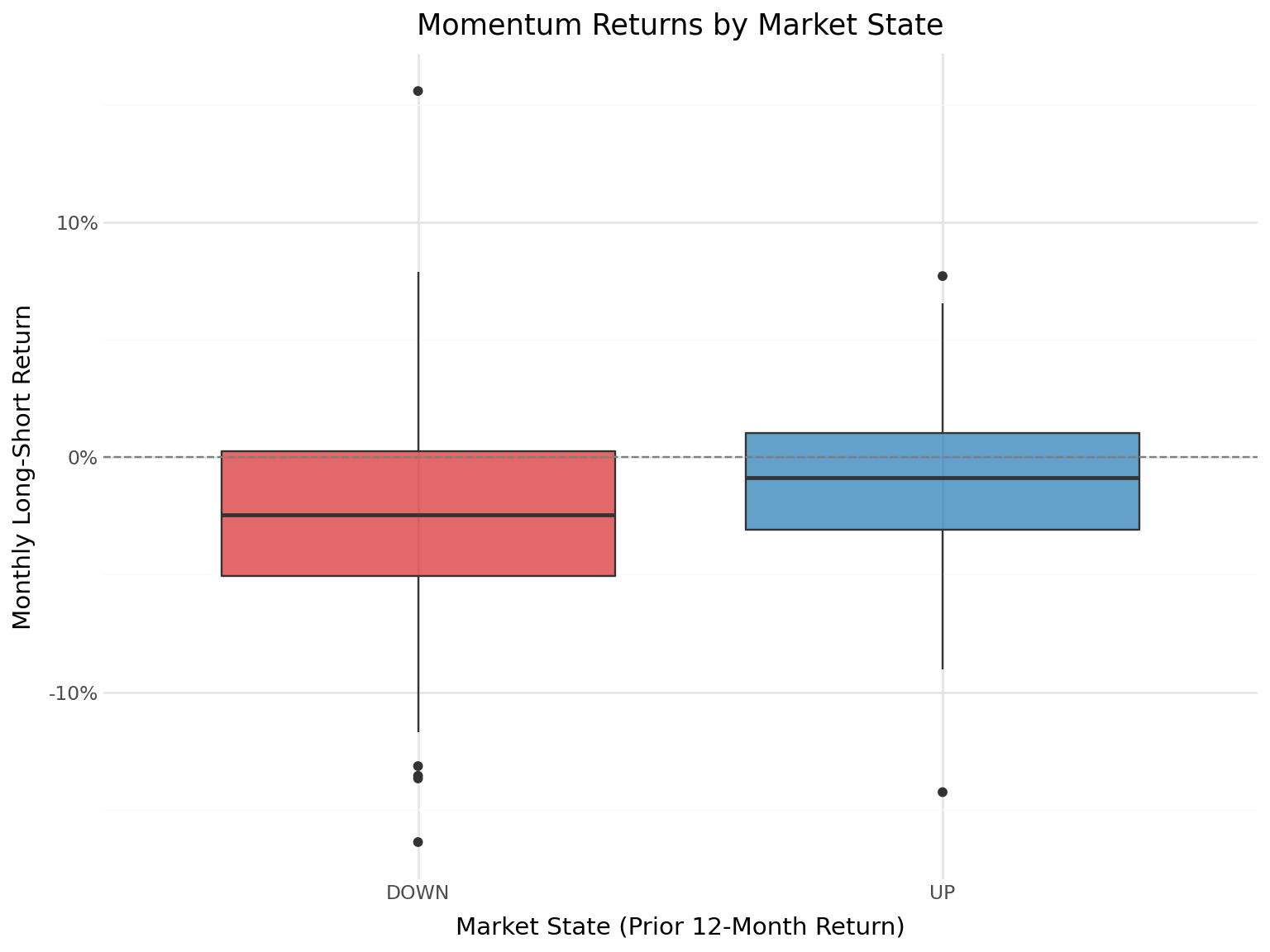
Một trong những đặc điểm rủi ro quan trọng nhất của các chiến lược động lượng là tính dễ bị thua lỗ đột ngột, nghiêm trọng, được gọi là sụp đổ động lượng. Daniel và Moskowitz (2016) ghi nhận rằng các chiến lược động lượng chịu những khoản thua lỗ hiếm gặp nhưng cực đoan, thường xảy ra trong các đợt thị trường hồi phục sau thị trường giá xuống. Các đợt sụp đổ này xảy ra vì danh mục cổ phiếu thua, vốn là vị thế bán khống, chứa nhiều cổ phiếu beta cao, những cổ phiếu tăng vọt khi thị trường đảo chiều.
Chúng ta xác định các đợt sụt giảm tồi tệ nhất của chiến lược động lượng và xem xét bối cảnh thị trường của chúng.
worst_months = (ewret_wide
    [["date", "long_short", "winners", "losers"]]
    .merge(factors_ff3_monthly[["date", "mkt_excess"]], on="date", how="left")
    .sort_values("long_short")
    .head(10)
    .assign(
        long_short_pct=lambda x: (x["long_short"] * 100).round(2),
        winners_pct=lambda x: (x["winners"] * 100).round(2),
        losers_pct=lambda x: (x["losers"] * 100).round(2),
        mkt_pct=lambda x: (x["mkt_excess"] * 100).round(2)
    )
    [["date", "long_short_pct", "winners_pct", "losers_pct", "mkt_pct"]]
    .rename(columns={
        "date": "Date",
        "long_short_pct": "L/S (%)",
        "winners_pct": "Winners (%)",
        "losers_pct": "Losers (%)",
        "mkt_pct": "Market (%)"
    })
)
worst_months| Date | L/S (%) | Winners (%) | Losers (%) | Market (%) | |
|---|---|---|---|---|---|
| 153 | 2023-05-31 | -16.39 | -2.69 | 13.70 | 2.78 |
| 39 | 2013-11-30 | -14.26 | 4.24 | 18.50 | 2.57 |
| 20 | 2012-04-30 | -13.68 | 1.51 | 15.19 | 4.88 |
| 78 | 2017-02-28 | -13.56 | 2.10 | 15.67 | 1.49 |
| 107 | 2019-07-31 | -13.15 | -2.46 | 10.69 | 1.61 |
| 140 | 2022-04-30 | -11.71 | -17.57 | -5.87 | -11.19 |
| 149 | 2023-01-31 | -11.53 | 1.37 | 12.90 | 6.96 |
| 28 | 2012-12-31 | -11.52 | 4.03 | 15.54 | -1.61 |
| 0 | 2010-08-31 | -11.31 | -25.03 | -13.72 | NaN |
| 10 | 2011-06-30 | -10.44 | -3.15 | 7.29 | NaN |
Mức sụt giảm tối đa đo mức giảm từ đỉnh xuống đáy tồi tệ nhất mà chiến lược đã trải qua. Chỉ số này đặc biệt hữu ích đối với những người thực hành khi đánh giá rủi ro của các chiến lược động lượng.
# Compute running maximum and drawdown
ewret_wide["cum_wealth"] = (1 + ewret_wide["long_short"]).cumprod()
ewret_wide["running_max"] = ewret_wide["cum_wealth"].cummax()
ewret_wide["drawdown"] = (
    ewret_wide["cum_wealth"] / ewret_wide["running_max"] - 1
)

max_dd = ewret_wide["drawdown"].min()
max_dd_date = ewret_wide.loc[ewret_wide["drawdown"].idxmin(), "date"]

print(f"Maximum drawdown: {max_dd*100:.2f}%")
print(f"Date of maximum drawdown: {max_dd_date.date()}")
Maximum drawdown: -97.08%
Date of maximum drawdown: 2023-10-31plot_dd = (
ggplot(ewret_wide, aes(x="date", y="drawdown")) +
geom_area(fill="#d62728", alpha=0.5) +
geom_line(color="#d62728", size=0.5) +
scale_y_continuous(labels=percent_format()) +
labs(
x="", y="Drawdown",
title="Momentum Strategy Drawdown"
) +
theme_minimal() +
theme(figure_size=(10, 5))
)
plot_dd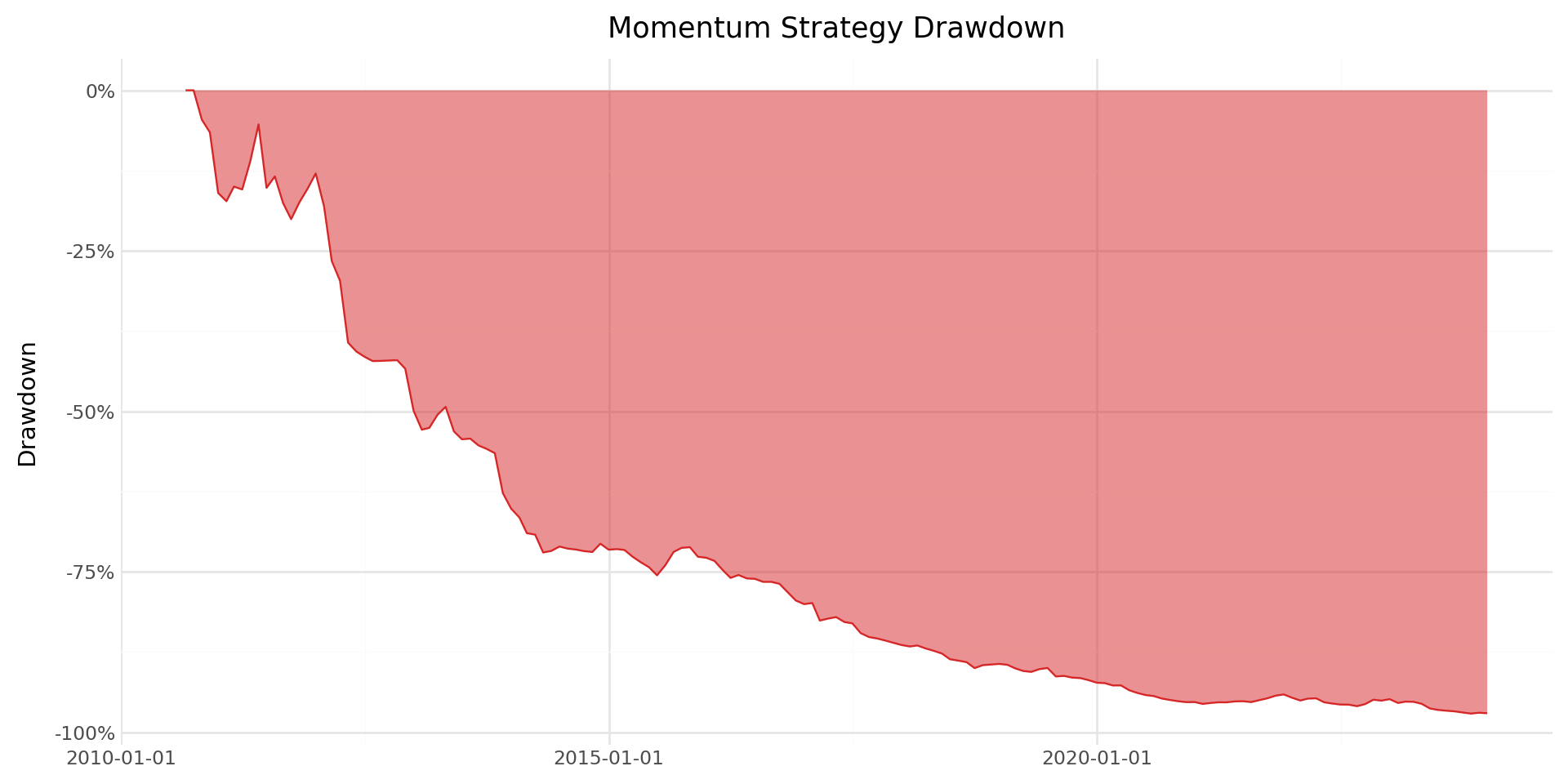
Cách triển khai cơ sở của Jegadeesh và Titman (1993) dùng các danh mục trọng số bằng nhau. Tuy nhiên, lợi nhuận trọng số bằng nhau có thể bị chi phối bởi các cổ phiếu nhỏ, kém thanh khoản, vốn khó giao dịch trong thực tế. Các danh mục trọng số theo vốn hóa, trong đó đóng góp của mỗi cổ phiếu tỷ lệ với vốn hóa thị trường, cung cấp một chuẩn so sánh có thể đầu tư hơn và đại diện tốt hơn cho lợi nhuận mà các nhà đầu tư lớn thực sự có thể đạt được.
def momentum_strategy_vw(data, J, K, n_portfolios=10):
    """
    Value-weighted momentum strategy implementation.

    Same as the equally-weighted version but uses lagged market
    capitalization as weights when computing portfolio returns.

    Parameters
    ----------
    data : pd.DataFrame
        Panel with columns: symbol, date, ret, mktcap_lag.
    J : int
        Formation period in months.
    K : int
        Holding period in months.
    n_portfolios : int
        Number of portfolios.

    Returns
    -------
    pd.DataFrame
        Monthly value-weighted portfolio returns.
    """
    # Step 1: Formation period returns
    df = data.sort_values(["symbol", "date"]).copy()
    df["gross_ret"] = 1 + df["ret"]
    df["cum_return"] = (
        df.groupby("symbol")["gross_ret"]
        .rolling(window=J, min_periods=J)
        .apply(np.prod, raw=True)
        .reset_index(level=0, drop=True)
        - 1
    )
    df = df.drop(columns=["gross_ret"]).dropna(subset=["cum_return"])

    # Step 2: Portfolio assignment using transform (fast)
    df["momr"] = df.groupby("date", observed=True)["cum_return"].transform(
        lambda x: pd.qcut(
            x,
            q=n_portfolios,
            labels=range(1, n_portfolios + 1),
            duplicates="drop"
        )
    ).astype('Int64')

    # Fill NaNs with rank-based assignment
    mask = df["momr"].isna()
    if mask.any():
        df.loc[mask, "momr"] = df.loc[mask].groupby("date")["cum_return"].transform(
            lambda x: pd.qcut(
                x.rank(method="first"),
                q=min(n_portfolios, len(x.unique())),
                labels=False,
                duplicates="drop"
            )
        ).astype('Int64') + 1

    # Step 3: Holding period
    df = df.rename(columns={"date": "form_date"})
    df["hdate1"] = df["form_date"] + pd.offsets.MonthBegin(1)
    df["hdate2"] = df["form_date"] + pd.offsets.MonthEnd(K)

    # Step 4: Merge with holding period returns AND weights
    port_ret = df[
        ["symbol", "form_date", "momr", "hdate1", "hdate2"]
    ].merge(
        data[["symbol", "date", "ret", "mktcap_lag"]].rename(
            columns={"ret": "hret", "date": "hdate"}
        ),
        on="symbol",
        how="inner"
    )

    # Use boolean indexing instead of query (faster)
    port_ret = port_ret[
        (port_ret["hdate"] >= port_ret["hdate1"]) &
        (port_ret["hdate"] <= port_ret["hdate2"])
    ]
    port_ret = port_ret.dropna(subset=["mktcap_lag"])
    port_ret = port_ret[port_ret["mktcap_lag"] > 0]

    # Step 5: Value-weighted returns within each cohort
    def vw_mean(group):
        weights = group["mktcap_lag"]
        if weights.sum() == 0:
            return np.nan
        return np.average(group["hret"], weights=weights)

    cohort_ret = (port_ret
        .groupby(["hdate", "momr", "form_date"])
        .apply(vw_mean, include_groups=False)
        .reset_index(name="cohort_ret")
    )

    monthly_ret = (cohort_ret
        .groupby(["hdate", "momr"])
        .agg(vwret=("cohort_ret", "mean"))
        .reset_index()
        .rename(columns={"hdate": "date"})
    )

    # Step 6: Long-short
    wide = monthly_ret.pivot(
        index="date", columns="momr", values="vwret"
    ).reset_index()

    # Handle variable number of portfolios
    n_cols = len(wide.columns) - 1
    wide.columns = ["date"] + [f"port{i}" for i in range(1, n_cols + 1)]
    wide["winners"] = wide[f"port{n_cols}"]
    wide["losers"] = wide["port1"]
    wide["long_short"] = wide["winners"] - wide["losers"]

return monthly_ret, wide# Run value-weighted J=6, K=6 strategy
_, vw_results = momentum_strategy_vw(prices_clean, J=6, K=6)
print("Value-Weighted Momentum Strategy (J=6, K=6)")
print("=" * 50)
print("\nPortfolio Statistics:")
print(vw_results[["winners", "losers", "long_short"]].describe().round(4))Value-Weighted Momentum Strategy (J=6, K=6)
==================================================
Portfolio Statistics:
winners losers long_short
count 161.0000 161.0000 161.0000
mean -0.0129 0.0006 -0.0135
std 0.0763 0.0713 0.0653
min -0.2519 -0.2178 -0.3813
25% -0.0540 -0.0397 -0.0465
50% -0.0067 0.0010 -0.0126
75% 0.0354 0.0443 0.0173
max 0.1765 0.2498 0.2498comparison = []
for scheme, df in [("EW", ewret_wide), ("VW", vw_results)]:
for col in ["winners", "losers", "long_short"]:
series = df[col].dropna()
n = len(series)
mean_ret = series.mean()
std_ret = series.std()
t_stat = mean_ret / (std_ret / np.sqrt(n))
p_val = 2 * (1 - stats.t.cdf(abs(t_stat), df=n-1))
comparison.append({
"Weighting": scheme,
"Portfolio": col.replace("_", " ").title(),
"Mean (%)": round(mean_ret * 100, 4),
"Std (%)": round(std_ret * 100, 4),
"t-stat": round(t_stat, 2),
"p-value": round(p_val, 4)
})
pd.DataFrame(comparison)| Weighting | Portfolio | Mean (%) | Std (%) | t-stat | p-value | |
|---|---|---|---|---|---|---|
| 0 | EW | Winners | -0.6812 | 5.7131 | -1.51 | 0.1323 |
| 1 | EW | Losers | 1.4190 | 6.5319 | 2.76 | 0.0065 |
| 2 | EW | Long Short | -2.1002 | 4.8969 | -5.44 | 0.0000 |
| 3 | VW | Winners | -1.2943 | 7.6274 | -2.15 | 0.0328 |
| 4 | VW | Losers | 0.0589 | 7.1275 | 0.10 | 0.9166 |
| 5 | VW | Long Short | -1.3533 | 6.5312 | -2.63 | 0.0094 |
vw_results = vw_results.sort_values("date")
vw_results["cumret_ls_vw"] = (1 + vw_results["long_short"]).cumprod() - 1

ew_data = (ewret_wide[["date", "long_short"]]
    .rename(columns={"long_short": "cumret"})
    .assign(scheme="Equally Weighted")
)
ew_data["cumret"] = (1 + ew_data["cumret"]).cumprod() - 1

vw_data = (vw_results[["date", "cumret_ls_vw"]]
    .rename(columns={"cumret_ls_vw": "cumret"})
    .assign(scheme="Value Weighted")
)

ew_vs_vw = pd.concat([ew_data, vw_data], ignore_index=True)

plot_ew_vw = (
    ggplot(ew_vs_vw, aes(x="date", y="cumret", color="scheme")) +
    geom_line(size=1) +
    scale_y_continuous(labels=percent_format()) +
    scale_color_manual(values=["#1f77b4", "#ff7f0e"]) +
    labs(
        x="", y="Cumulative return",
        color="Weighting Scheme",
        title="EW vs. VW Momentum Long-Short Strategy"
    ) +
    theme_minimal() +
    theme(
        figure_size=(10, 6),
        legend_position="bottom"
    )
)
plot_ew_vw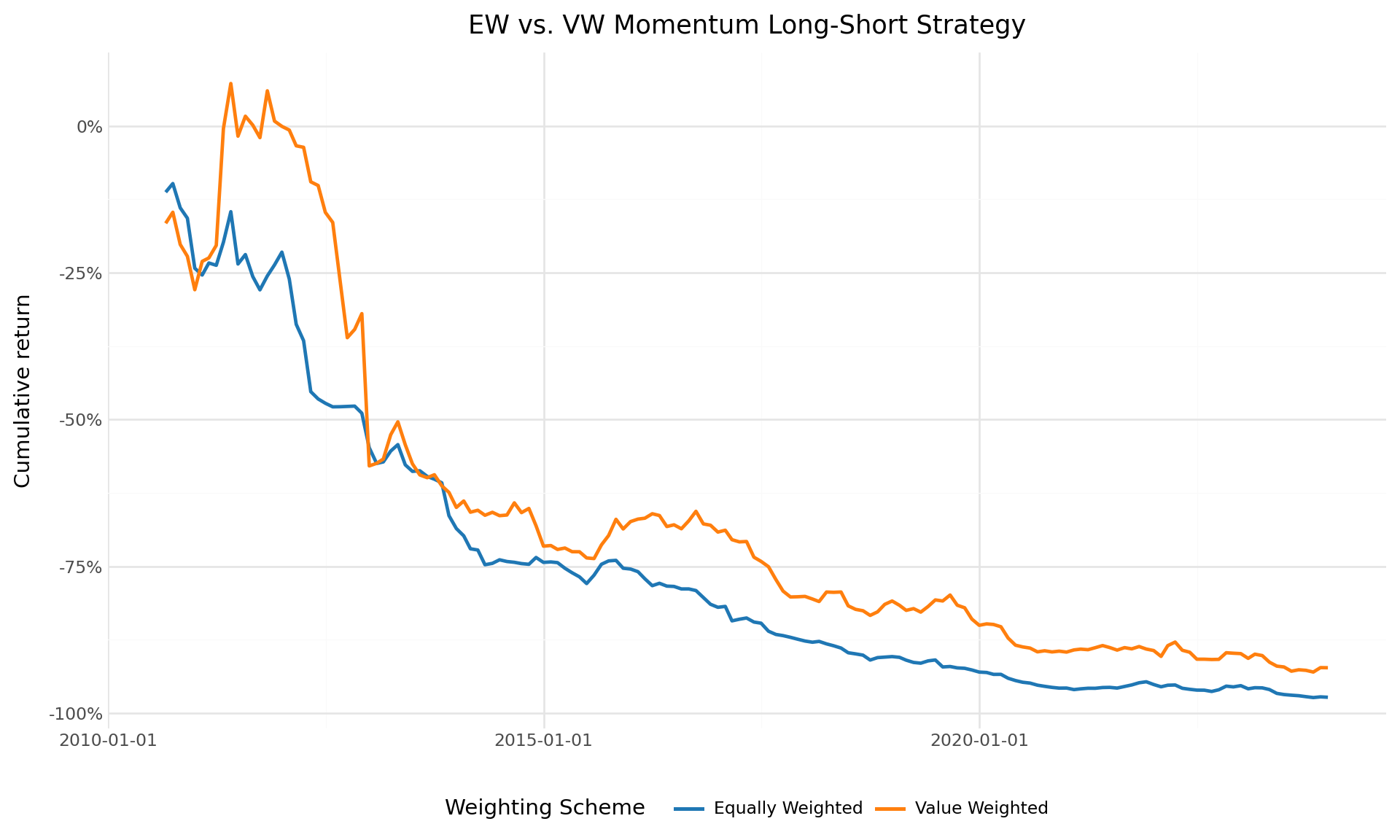
Trong khi các chiến lược động lượng thường được đánh giá ở tần suất hằng tháng theo Jegadeesh và Titman (1993), việc phân tích các mô thức lợi nhuận hằng ngày cung cấp thêm hiểu biết về động lực của lợi nhuận động lượng. Dữ liệu hằng ngày cho phép chúng ta xem lợi nhuận động lượng tích lũy ra sao trong thời kỳ nắm giữ, đo độ biến động trong tháng của chiến lược và tính các thước đo rủi ro chính xác hơn.
prices_daily = pd.read_sql_query(
    sql=("SELECT symbol, date, ret, ret_excess, mktcap_lag "
         "FROM prices_daily"),
    con=tidy_finance,
    parse_dates={"date"}
)

print(f"Daily observations: {len(prices_daily):,}")
print(f"Unique stocks: {prices_daily['symbol'].nunique():,}")
print(f"Date range: {prices_daily['date'].min().date()} "
      f"to {prices_daily['date'].max().date()}")
Daily observations: 3,462,157
Unique stocks: 1,459
Date range: 2010-01-05 to 2023-12-29Thay vì hình thành các danh mục động lượng ở tần suất hằng ngày (đòi hỏi tái cân bằng hằng ngày và không khả thi), chúng ta dùng việc gán danh mục hằng tháng và theo dõi lợi nhuận hằng ngày của chúng. Điều này cho ta chuỗi lợi nhuận hằng ngày của chiến lược động lượng hằng tháng.
# # # Use the monthly portfolio assignments from the J=6 baseline
monthly_assignments = portfolios_with_dates[
    ["symbol", "form_date", "momr", "hdate1", "hdate2"]
].copy()

# Merge with daily returns
daily_mom_returns = monthly_assignments.merge(
    prices_daily[["symbol", "date", "ret"]].rename(
        columns={"ret": "dret", "date": "ddate"}
    ),
    on="symbol",
    how="inner"
)

# Use boolean indexing instead of query
daily_mom_returns = daily_mom_returns[
    (daily_mom_returns["ddate"] >= daily_mom_returns["hdate1"]) &
    (daily_mom_returns["ddate"] <= daily_mom_returns["hdate2"])
]

print(f"Daily portfolio return observations: {len(daily_mom_returns):,}")
Daily portfolio return observations: 19,112,536# Compute daily equally weighted portfolio returns
# Stage 1: Average within each cohort
daily_cohort_ret = (daily_mom_returns
.groupby(["ddate", "momr", "form_date"])
.agg(cohort_ret=("dret", "mean"))
.reset_index()
)
# Stage 2: Average across cohorts
daily_ewret = (daily_cohort_ret
.groupby(["ddate", "momr"])
.agg(ewret=("cohort_ret", "mean"))
.reset_index()
.rename(columns={"ddate": "date"})
)
# Compute daily long-short returns
daily_wide = daily_ewret.pivot(
index="date", columns="momr", values="ewret"
).reset_index()
daily_wide.columns = ["date"] + [f"port{i}" for i in range(1, 11)]
daily_wide["winners"] = daily_wide["port10"]
daily_wide["losers"] = daily_wide["port1"]
daily_wide["long_short"] = daily_wide["winners"] - daily_wide["losers"]
print(f"Daily long-short return observations: {len(daily_wide):,}")Daily long-short return observations: 3,352daily_wide = daily_wide.sort_values("date")
daily_wide["cumret_ls"] = (1 + daily_wide["long_short"]).cumprod() - 1
plot_daily_cumret = (
ggplot(daily_wide, aes(x="date", y="cumret_ls")) +
geom_line(size=0.5, color="#2ca02c") +
geom_hline(yintercept=0, linetype="dashed", color="gray") +
scale_y_continuous(labels=percent_format()) +
labs(
x="", y="Cumulative return",
title="Daily Cumulative Return: Momentum Long-Short Strategy"
) +
theme_minimal() +
theme(figure_size=(10, 6))
)
plot_daily_cumret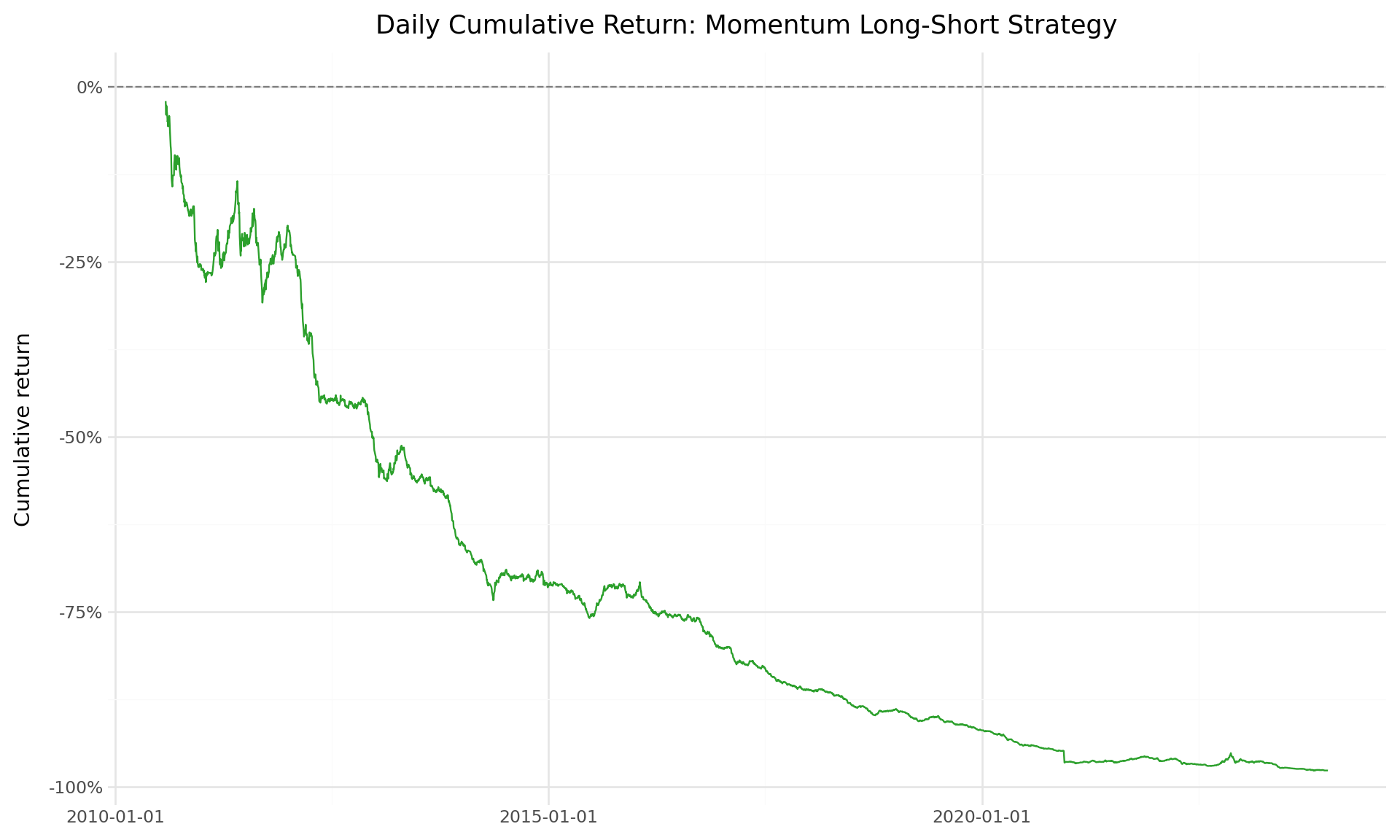
Dữ liệu hằng ngày cho phép ước lượng chính xác hơn các thước đo rủi ro nhờ lấy mẫu ở tần suất cao hơn.
daily_ls = daily_wide["long_short"].dropna()

# Annualized metrics
ann_mean = daily_ls.mean() * 252
ann_vol = daily_ls.std() * np.sqrt(252)
sharpe = ann_mean / ann_vol if ann_vol > 0 else np.nan

# Drawdown
daily_wealth = (1 + daily_ls).cumprod()
daily_running_max = daily_wealth.cummax()
daily_dd = (daily_wealth / daily_running_max - 1).min()

# Higher moments
skew = daily_ls.skew()
kurt = daily_ls.kurtosis()

# VaR and CVaR
var_95 = daily_ls.quantile(0.05)
cvar_95 = daily_ls[daily_ls <= var_95].mean()

risk_metrics = pd.DataFrame({
    "Metric": [
        "Annualized Mean Return",
        "Annualized Volatility",
        "Sharpe Ratio",
        "Maximum Drawdown",
        "Skewness",
        "Excess Kurtosis",
        "Daily VaR (5%)",
        "Daily CVaR (5%)"
    ],
    "Value": [
        f"{ann_mean*100:.2f}%",
        f"{ann_vol*100:.2f}%",
        f"{sharpe:.2f}",
        f"{daily_dd*100:.2f}%",
        f"{skew:.2f}",
        f"{kurt:.2f}",
        f"{var_95*100:.2f}%",
        f"{cvar_95*100:.2f}%"
    ]
})
risk_metrics| Metric | Value | |
|---|---|---|
| 0 | Annualized Mean Return | -26.90% |
| 1 | Annualized Volatility | 15.01% |
| 2 | Sharpe Ratio | -1.79 |
| 3 | Maximum Drawdown | -97.62% |
| 4 | Skewness | -11.23 |
| 5 | Excess Kurtosis | 378.11 |
| 6 | Daily VaR (5%) | -1.33% |
| 7 | Daily CVaR (5%) | -2.10% |
Dùng lợi nhuận hằng ngày, chúng ta có thể tính biến động thực hiện hằng tháng của chiến lược động lượng và xem xét nó thay đổi ra sao theo thời gian.
daily_wide["year_month"] = daily_wide["date"].dt.to_period("M")

realized_vol = (daily_wide
    .groupby("year_month")["long_short"]
    .std()
    .reset_index()
    .rename(columns={"long_short": "realized_vol"})
)
realized_vol["date"] = realized_vol["year_month"].dt.to_timestamp()
realized_vol["realized_vol_ann"] = realized_vol["realized_vol"] * np.sqrt(252)

plot_rvol = (
    ggplot(realized_vol, aes(x="date", y="realized_vol_ann")) +
    geom_line(color="#d62728", size=0.8) +
    scale_y_continuous(labels=percent_format()) +
    labs(
        x="", y="Annualized Realized Volatility",
        title="Realized Volatility of Momentum Strategy"
    ) +
    theme_minimal() +
    theme(figure_size=(10, 5))
)
plot_rvol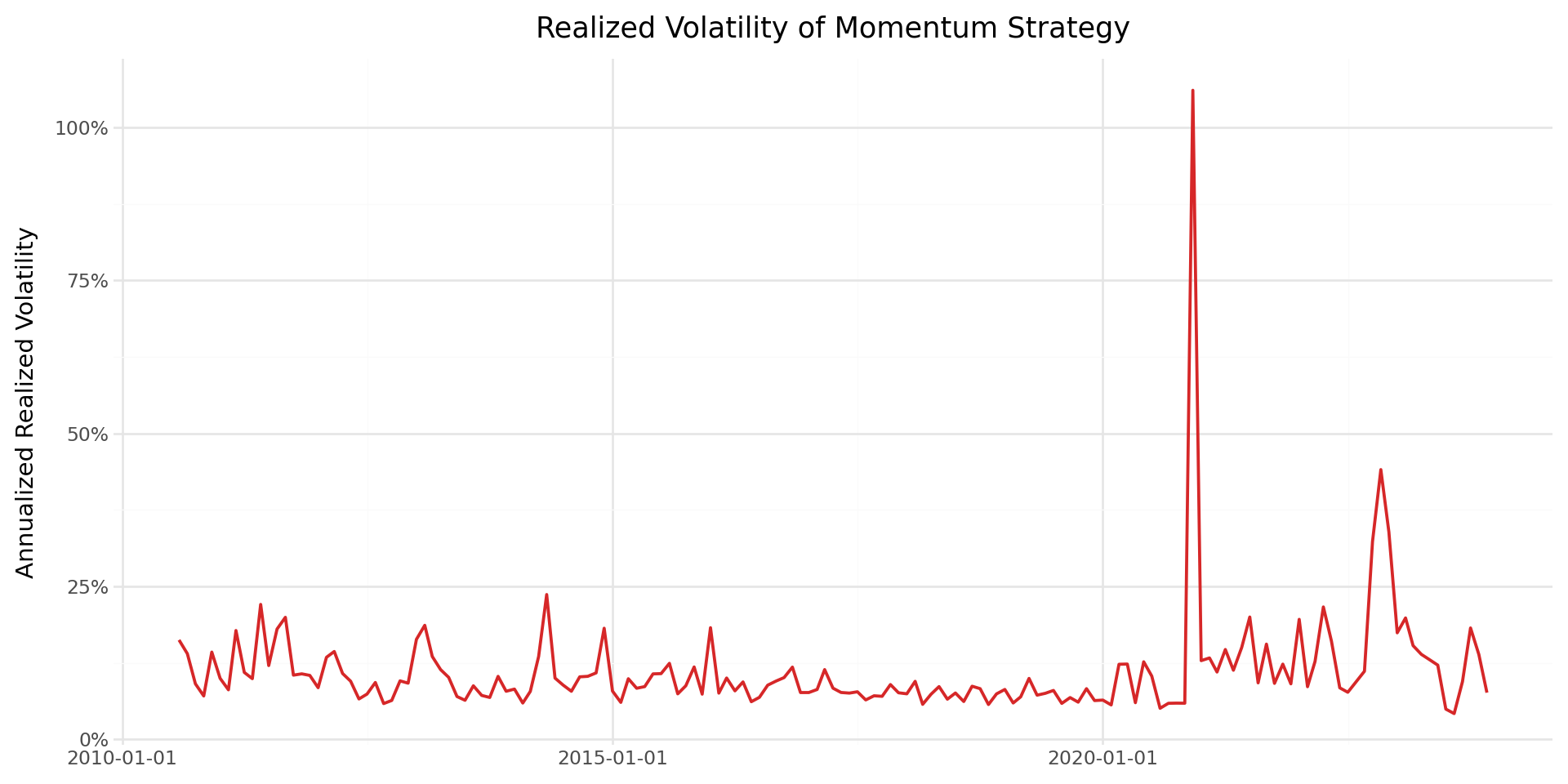
Chúng ta lưu lợi nhuận danh mục động lượng vào cơ sở dữ liệu để dùng trong các chương sau, gồm xây dựng mô hình nhân tố và tối ưu hóa danh mục.
# Save monthly equally weighted momentum portfolio returns
ewret_to_save = ewret[["date", "momr", "ewret"]].copy()
ewret_to_save.to_sql(
    name="momentum_portfolios_monthly",
    con=tidy_finance,
    if_exists="replace",
    index=False
)
print(f"Saved {len(ewret_to_save):,} monthly momentum portfolio observations.")

# Save the long-short return series
momentum_factor = ewret_wide[["date", "long_short"]].dropna().copy()
momentum_factor = momentum_factor.rename(columns={"long_short": "wml"})
momentum_factor.to_sql(
    name="momentum_factor_monthly",
    con=tidy_finance,
    if_exists="replace",
    index=False
)
print(f"Saved {len(momentum_factor):,} monthly WML factor observations.")

# Save the daily long-short return series
daily_momentum_factor = daily_wide[["date", "long_short"]].dropna().copy()
daily_momentum_factor = daily_momentum_factor.rename(
    columns={"long_short": "wml"}
)
daily_momentum_factor.to_sql(
    name="momentum_factor_daily",
    con=tidy_finance,
    if_exists="replace",
    index=False
)
print(f"Saved {len(daily_momentum_factor):,} daily WML factor observations.")
Saved 1,610 monthly momentum portfolio observations.
Saved 161 monthly WML factor observations.
Saved 3,352 daily WML factor observations.Các chiến lược động lượng kéo theo tỷ lệ vòng quay danh mục đáng kể, vì cổ phiếu ra vào các danh mục thập phân vị cực đoan mỗi tháng. Korajczyk và Sadka (2004) xem xét liệu lợi nhuận động lượng có còn sau chi phí giao dịch hay không và thấy rằng khả năng sinh lời giảm đáng kể đối với các nhà đầu tư tổ chức lớn, dù các danh mục nhỏ hơn vẫn có thể thu được lợi nhuận đáng kể.
Trên thị trường Việt Nam, chi phí giao dịch gồm:
Cách triển khai cơ sở của chúng ta giả định rằng các danh mục có thể được hình thành và tái cân bằng tức thời vào cuối mỗi tháng. Trên thực tế, có một độ trễ giữa việc quan sát lợi nhuận của thời kỳ hình thành và việc thực hiện các giao dịch danh mục. Khoảng cách một tháng giữa thời kỳ hình thành và thời điểm bắt đầu thời kỳ nắm giữ (Jegadeesh (1990)) phần nào giải quyết mối lo này, nhưng người thực hành nên cân nhắc thêm các độ trễ triển khai khác.
Bộ dữ liệu của chúng ta từ DataCore gồm cả cổ phiếu đang giao dịch lẫn cổ phiếu đã hủy niêm yết, giúp giảm thiên kiến sống sót. Tuy nhiên, cách xử lý các cổ phiếu hủy niêm yết có thể ảnh hưởng đến kết quả động lượng. Các cổ phiếu bị hủy niêm yết trong thời kỳ nắm giữ có thể tạo ra lợi nhuận cực đoan (dương khi bị thâu tóm và âm khi thất bại). Chúng ta giữ lại lợi nhuận của cổ phiếu hủy niêm yết như được báo cáo trong cơ sở dữ liệu, nhất quán với cách xử lý trong Jegadeesh và Titman (1993).
Thị trường chứng khoán Việt Nam có lịch sử tương đối ngắn so với thị trường Hoa Kỳ được nghiên cứu trong Jegadeesh và Titman (1993). Mẫu của chúng ta kéo dài khoảng hai thập kỷ, so với gần ba thập kỷ trong nghiên cứu gốc. Giai đoạn mẫu ngắn hơn này kéo theo khoảng tin cậy rộng hơn và độ nhạy lớn hơn với các giai đoạn cụ thể (như cuộc khủng hoảng tài chính 2007–2009, vốn tác động nặng nề đến cổ phiếu Việt Nam). Cần diễn giải kết quả với lưu ý này.
Chương này đã trình bày cách triển khai và phân tích các chiến lược động lượng trên thị trường cổ phiếu Việt Nam, theo phương pháp của Jegadeesh và Titman (1993). Các phát hiện chính và đóng góp về phương pháp là:
Phương pháp: Chúng ta đã triển khai đầy đủ phương pháp danh mục chồng lấn của Jegadeesh và Titman (1993), gồm quy trình lấy trung bình hai giai đoạn (trong nhóm, rồi giữa các nhóm) để xử lý \(K\) danh mục đang hoạt động trong mỗi tháng.
Kết quả cơ sở: Chiến lược \(J=6\), \(K=6\) cung cấp một chuẩn so sánh tự nhiên. Chênh lệch giữa danh mục thắng và thua cho thấy động lượng chéo có tồn tại trên cổ phiếu Việt Nam hay không.
Độ vững qua các chân trời: Bằng việc tính toàn bộ lưới \(J \times K\) với \(J, K \in \{3, 6, 9, 12\}\), chúng ta đã đánh giá liệu phần bù động lượng có vững trước lựa chọn thời kỳ hình thành và nắm giữ hay không, theo cách tiếp cận trong Bảng 1 của Jegadeesh và Titman (1993).
Điều chỉnh rủi ro: Alpha CAPM và alpha ba nhân tố Fama-French đo xem phần bù động lượng có được giải thích bởi các nhân tố rủi ro chuẩn hay không, dựa trên phân tích của Fama và French (1996), trong đó các tác giả cho thấy mô hình ba nhân tố của họ không giải thích được động lượng.
Sự phụ thuộc vào trạng thái thị trường: Theo Cooper, Gutierrez Jr, và Hameed (2004), chúng ta đã xem xét liệu lợi nhuận động lượng có thay đổi theo điều kiện thị trường hay không, điều đặc biệt liên quan ở các thị trường mới nổi có chu kỳ bùng nổ–suy thoái rõ rệt.
Trọng số theo vốn hóa: Việc so sánh các chiến lược trọng số bằng nhau và trọng số theo vốn hóa giải quyết khả năng triển khai thực tế và tách riêng vai trò của quy mô doanh nghiệp trong việc tạo ra lợi nhuận động lượng.
Phân tích theo ngày: Bằng việc theo dõi các danh mục động lượng ở tần suất hằng ngày, chúng ta đã tính các thước đo rủi ro chính xác gồm biến động thực hiện, sụt giảm tối đa, VaR và CVaR, cung cấp hồ sơ rủi ro đầy đủ của chiến lược.
Bối cảnh thị trường mới nổi: Xuyên suốt phân tích, chúng ta đã nhấn mạnh các đặc điểm riêng của thị trường Việt Nam—giới hạn biên độ giao dịch, hạn chế sở hữu nước ngoài, lịch sử mẫu ngắn hơn và chi phí giao dịch cao hơn—ảnh hưởng đến cách diễn giải và tính khả thi thực tế của các chiến lược động lượng.