Hiện mã
import pandas as pd
import numpy as np
import sqlite3
from datetime import datetime
from io import BytesIO

from plotnine import *
from mizani.formatters import comma_format, percent_formatChương này giới thiệu Datacore, nền tảng dữ liệu của Việt Nam phục vụ nghiên cứu học thuật, doanh nghiệp và chính phủ. Datacore cung cấp các bộ dữ liệu tài chính và kinh tế toàn diện, bao gồm dữ liệu giao dịch lịch sử, dữ liệu cơ bản của doanh nghiệp và các chỉ báo kinh tế vĩ mô, vốn thiết yếu cho nghiên cứu tài chính có thể tái lập. Chúng ta sử dụng Datacore làm nguồn dữ liệu chính xuyên suốt cuốn sách này.
Độc giả có thể truy cập dữ liệu dùng trong cuốn sách này qua một số kênh:
Đăng ký theo tổ chức: Nhiều trường đại học và viện nghiên cứu đăng ký sử dụng Datacore. Hãy hỏi thư viện hoặc phòng quản lý nghiên cứu của bạn để biết thông tin truy cập. Nếu tổ chức của bạn chưa đăng ký, hãy cân nhắc đề nghị thông qua quy trình mua sắm học liệu của thư viện—Datacore có mức giá ưu đãi cho tổ chức sử dụng vào mục đích học thuật.
Bộ dữ liệu demo: Datacore cung cấp bộ dữ liệu demo cho phép bạn chạy các ví dụ mã nguồn trong cuốn sách này với dữ liệu mẫu.
Chương được tổ chức như sau. Trước tiên, chúng ta thiết lập kết nối đến hạ tầng lưu trữ đám mây của Datacore. Sau đó, chúng ta tải xuống và chuẩn bị dữ liệu cơ bản của doanh nghiệp, bao gồm các khoản mục bảng cân đối kế toán, các biến báo cáo kết quả kinh doanh và các chỉ số dẫn xuất thiết yếu cho nghiên cứu định giá tài sản. Tiếp theo, chúng ta thu thập và xử lý dữ liệu giá cổ phiếu, tính lợi nhuận, vốn hóa thị trường và lợi nhuận vượt mức. Cuối cùng, chúng ta hợp nhất các bộ dữ liệu này và cung cấp thống kê mô tả đặc trưng cho thị trường cổ phiếu Việt Nam.
Chúng ta bắt đầu bằng việc nạp các gói Python được dùng xuyên suốt chương này. Các gói cốt lõi gồm pandas để xử lý dữ liệu, numpy cho các phép tính số và sqlite3 để quản lý cơ sở dữ liệu cục bộ. Chúng ta cũng nhập các thư viện trực quan hóa để tạo các hình đạt chất lượng xuất bản.
import pandas as pd
import numpy as np
import sqlite3
from datetime import datetime
from io import BytesIO
from plotnine import *
from mizani.formatters import comma_format, percent_formatChúng ta thiết lập kết nối đến cơ sở dữ liệu SQLite cục bộ, nơi đóng vai trò kho lưu trữ trung tâm cho toàn bộ dữ liệu đã xử lý. Cơ sở dữ liệu này đã được giới thiệu ở chương trước và sẽ lưu các bộ dữ liệu đã làm sạch để dùng trong các phân tích tiếp theo.
tidy_finance = sqlite3.connect(database="data/tidy_finance_python.sqlite")Chúng ta xác định khoảng thời gian thu thập dữ liệu. Thị trường chứng khoán Việt Nam bắt đầu hoạt động vào tháng 7 năm 2000 với việc thành lập Sở Giao dịch Chứng khoán TP. Hồ Chí Minh (HOSE), do đó giai đoạn mẫu của chúng ta bắt đầu từ năm 2000 và kéo dài đến cuối năm 2024.
start_date = "2000-01-01"
end_date = "2024-12-31"Datacore cung cấp dữ liệu thông qua hệ thống lưu trữ đối tượng trên nền tảng đám mây được xây dựng trên MinIO, một hạ tầng lưu trữ tương thích S3. Kiến trúc này cho phép truy cập dữ liệu lớn bằng lập trình một cách hiệu quả, không bị các hạn chế của kết nối cơ sở dữ liệu truyền thống. Để truy cập dữ liệu, bạn cần thông tin xác thực do Datacore cấp khi đăng ký: một URL điểm cuối (endpoint), khóa truy cập (access key) và khóa bí mật (secret key).
Lớp (class) sau đây thiết lập kết nối đến hệ thống lưu trữ của Datacore. Thông tin xác thực được lưu dưới dạng biến môi trường để bảo mật, theo các thông lệ tốt nhất về quản lý thông tin xác thực trong môi trường tính toán phục vụ nghiên cứu.
import os
import boto3
from botocore.client import Config

class DatacoreConnection:
    """
    Connection handler for Datacore's MinIO-based storage system.

    This class manages authentication and provides methods for
    accessing financial datasets stored in Datacore's cloud infrastructure.

    Attributes
    ----------
    s3 : boto3.client
        S3-compatible client for interacting with Datacore storage
    """

    def __init__(self):
        """Initialize connection using environment variables."""
        self.MINIO_ENDPOINT = os.environ["MINIO_ENDPOINT"]
        self.MINIO_ACCESS_KEY = os.environ["MINIO_ACCESS_KEY"]
        self.MINIO_SECRET_KEY = os.environ["MINIO_SECRET_KEY"]
        self.REGION = os.getenv("MINIO_REGION", "us-east-1")

        self.s3 = boto3.client(
            "s3",
            endpoint_url=self.MINIO_ENDPOINT,
            aws_access_key_id=self.MINIO_ACCESS_KEY,
            aws_secret_access_key=self.MINIO_SECRET_KEY,
            region_name=self.REGION,
            config=Config(signature_version="s3v4"),
        )

    def test_connection(self):
        """Verify connection by listing available buckets."""
        response = self.s3.list_buckets()
        print("Connected successfully. Available buckets:")
        for bucket in response.get("Buckets", []):
            print(f"  - {bucket['Name']}")

    def list_objects(self, bucket_name, prefix=""):
        """List objects in a bucket with optional prefix filter."""
        response = self.s3.list_objects_v2(
            Bucket=bucket_name,
            Prefix=prefix
        )
        return [obj["Key"] for obj in response.get("Contents", [])]

    def read_excel(self, bucket_name, key):
        """Read an Excel file from Datacore storage."""
        obj = self.s3.get_object(Bucket=bucket_name, Key=key)
        return pd.read_excel(BytesIO(obj["Body"].read()))

    def read_csv(self, bucket_name, key, **kwargs):
        """Read a CSV file from Datacore storage."""
        obj = self.s3.get_object(Bucket=bucket_name, Key=key)
        return pd.read_csv(BytesIO(obj["Body"].read()), **kwargs)
Sau khi định nghĩa lớp kết nối, chúng ta có thể thiết lập kết nối và kiểm tra quyền truy cập vào các kho dữ liệu của Datacore.
# Initialize connection
conn = DatacoreConnection()
conn.test_connection()

# Get bucket name from environment
bucket_name = os.environ["MINIO_BUCKET"]
Connected successfully. Available buckets:
- dsteam-data
- rawbctcDữ liệu kế toán doanh nghiệp là thiết yếu cho các phân tích danh mục đầu tư, xây dựng nhân tố và các nghiên cứu định giá. Datacore lưu trữ dữ liệu cơ bản toàn diện của các công ty niêm yết Việt Nam, bao gồm báo cáo tài chính năm và quý được lập theo Chuẩn mực Kế toán Việt Nam (VAS).
Trước khi xử lý dữ liệu, điều quan trọng là phải hiểu cấu trúc của báo cáo tài chính Việt Nam. Các công ty Việt Nam tuân theo VAS, vốn có nhiều điểm tương đồng với Chuẩn mực Báo cáo Tài chính Quốc tế (IFRS) nhưng cũng có những khác biệt đáng chú ý:
Năm tài chính: Hầu hết các công ty Việt Nam dùng năm tài chính theo năm dương lịch kết thúc vào ngày 31 tháng 12, dù một số công ty (đặc biệt trong lĩnh vực bán lẻ và nông nghiệp) dùng thời điểm kết thúc năm tài chính khác.
Tần suất báo cáo: Các công ty niêm yết phải công bố báo cáo tài chính quý trong vòng 20 ngày kể từ khi kết thúc quý và báo cáo năm đã kiểm toán trong vòng 90 ngày kể từ khi kết thúc năm tài chính.
Biểu mẫu đặc thù theo ngành: Các công ty trong lĩnh vực ngân hàng, bảo hiểm và chứng khoán tuân theo các biểu mẫu báo cáo chuyên biệt, khác với biểu mẫu chuẩn của các ngành công nghiệp.
Tiền tệ: Mọi số liệu được báo cáo bằng đồng Việt Nam (VND). Do giá trị danh nghĩa lớn (từ hàng triệu đến hàng nghìn tỷ VND), chúng ta thường quy đổi số liệu sang đơn vị triệu hoặc tỷ để dễ đọc.
Datacore tổ chức dữ liệu cơ bản trong các tệp Excel được chia theo giai đoạn thời gian để truy cập hiệu quả. Chúng ta tải xuống và nối các tệp này để tạo một bộ dữ liệu toàn diện bao phủ giai đoạn mẫu.
# Define paths to fundamentals data files
fundamentals_paths = [
    "fundamental_annual_1767674486317/fundamental_annual_1.xlsx",
    "fundamental_annual_1767674486317/fundamental_annual_2.xlsx",
    "fundamental_annual_1767674486317/fundamental_annual_3.xlsx",
]

# Download and combine all files
fundamentals_list = []
for path in fundamentals_paths:
    df_temp = conn.read_excel(bucket_name, path)
    fundamentals_list.append(df_temp)
    print(f"Downloaded: {path} ({len(df_temp):,} rows)")

df_fundamentals_raw = pd.concat(fundamentals_list, ignore_index=True)
print(f"\nTotal observations: {len(df_fundamentals_raw):,}")
/home/mikenguyen/project/tidyfinance/.venv/lib/python3.13/site-packages/openpyxl/styles/stylesheet.py:237: UserWarning: Workbook contains no default style, apply openpyxl's defaultDownloaded: fundamental_annual_1767674486317/fundamental_annual_1.xlsx (10,000 rows)/home/mikenguyen/project/tidyfinance/.venv/lib/python3.13/site-packages/openpyxl/styles/stylesheet.py:237: UserWarning: Workbook contains no default style, apply openpyxl's defaultDownloaded: fundamental_annual_1767674486317/fundamental_annual_2.xlsx (10,000 rows)/home/mikenguyen/project/tidyfinance/.venv/lib/python3.13/site-packages/openpyxl/styles/stylesheet.py:237: UserWarning: Workbook contains no default style, apply openpyxl's defaultDownloaded: fundamental_annual_1767674486317/fundamental_annual_3.xlsx (2,821 rows)
Total observations: 22,821Dữ liệu cơ bản thô cần một số bước làm sạch để bảo đảm tính nhất quán và khả năng sử dụng. Chúng ta chuẩn hóa tên biến, xử lý giá trị thiếu và tạo các biến dẫn xuất thường dùng trong nghiên cứu định giá tài sản.
def clean_fundamentals(df):
    """
    Clean and standardize company fundamentals data.

    Parameters
    ----------
    df : pd.DataFrame
        Raw fundamentals data from Datacore

    Returns
    -------
    pd.DataFrame
        Cleaned fundamentals with standardized column names
    """
    df = df.copy()

    # Standardize identifiers
    df["symbol"] = df["symbol"].astype(str).str.upper().str.strip()
    df["year"] = pd.to_numeric(df["year"], errors="coerce").astype("Int64")

    # Drop rows with missing identifiers
    df = df.dropna(subset=["symbol", "year"])

    # Define columns that should be numeric
    numeric_columns = [
        "total_asset", "total_equity", "total_liabilities",
        "total_current_asset", "total_current_liabilities",
        "is_net_revenue", "is_cogs", "is_manage_expense",
        "is_interest_expense", "is_eat", "is_net_business_profit",
        "na_tax_deferred", "nl_tax_deferred", "e_preferred_stock",
        "capex", "total_cfo", "ca_cce", "ca_total_inventory",
        "ca_acc_receiv", "cfo_interest_expense", "basic_eps",
        "is_shareholders_eat", "cl_loan", "cl_finlease",
        "cl_due_long_debt", "nl_loan", "nl_finlease",
        "is_cos_of_sales", "e_equity"
    ]

    for col in numeric_columns:
        if col in df.columns:
            df[col] = pd.to_numeric(df[col], errors="coerce")

    # Handle duplicates: keep row with most non-missing values
    df["_completeness"] = df.notna().sum(axis=1)
    df = (df
        .sort_values(["symbol", "year", "_completeness"])
        .drop_duplicates(subset=["symbol", "year"], keep="last")
        .drop(columns="_completeness")
        .reset_index(drop=True)
    )

    return df

df_fundamentals = clean_fundamentals(df_fundamentals_raw)
print(f"After cleaning: {len(df_fundamentals):,} firm-year observations")
print(f"Unique firms: {df_fundamentals['symbol'].nunique():,}")
After cleaning: 21,232 firm-year observations
Unique firms: 1,554Để thuận tiện so sánh với các nghiên cứu quốc tế và bảo đảm tương thích với các phương pháp định giá tài sản chuẩn, chúng ta tạo các biến theo quy ước đã được thiết lập trong tài liệu học thuật. Chúng ta ánh xạ các khoản mục báo cáo tài chính Việt Nam sang các khoản mục tương đương của Compustat khi có thể.
def create_standard_variables(df):
    """
    Create standardized financial variables for asset pricing research.

    This function maps Vietnamese financial statement items to standard
    variable names used in the academic finance literature, following
    conventions from Fama and French (1992, 1993, 2015).

    Parameters
    ----------
    df : pd.DataFrame
        Cleaned fundamentals data

    Returns
    -------
    pd.DataFrame
        Fundamentals with standardized variables added
    """
    df = df.copy()

    # Fiscal date (assume December year-end)
    df["datadate"] = pd.to_datetime(df["year"].astype(str) + "-12-31")

    # === Balance Sheet Items ===
    df["at"] = df["total_asset"]                    # Total assets
    df["lt"] = df["total_liabilities"]              # Total liabilities
    df["seq"] = df["total_equity"]                  # Stockholders' equity
    df["act"] = df["total_current_asset"]           # Current assets
    df["lct"] = df["total_current_liabilities"]     # Current liabilities

    # Common equity (fallback to total equity if not available)
    df["ceq"] = df.get("e_equity", df["seq"])

    # === Deferred Taxes ===
    df["txditc"] = df.get("na_tax_deferred", 0).fillna(0)  # Deferred tax assets
    df["txdb"] = df.get("nl_tax_deferred", 0).fillna(0)    # Deferred tax liab.
    df["itcb"] = 0  # Investment tax credit (rare in Vietnam)

    # === Preferred Stock ===
    pref = df.get("e_preferred_stock", 0)
    if isinstance(pref, pd.Series):
        pref = pref.fillna(0)
    df["pstk"] = pref
    df["pstkrv"] = pref  # Redemption value
    df["pstkl"] = pref   # Liquidating value

    # === Income Statement Items ===
    df["sale"] = df["is_net_revenue"]                        # Net sales/revenue
    df["cogs"] = df.get("is_cogs", 0).fillna(0)              # Cost of goods sold
    df["xsga"] = df.get("is_manage_expense", 0).fillna(0)    # SG&A expenses
    df["xint"] = df.get("is_interest_expense", 0).fillna(0)  # Interest expense
    df["ni"] = df.get("is_eat", np.nan)                      # Net income
    df["oibdp"] = df.get("is_net_business_profit", np.nan)   # Operating income

    # === Cash Flow Items ===
    df["oancf"] = df.get("total_cfo", np.nan)  # Operating cash flow
    df["capx"] = df.get("capex", np.nan)       # Capital expenditures

    return df

df_fundamentals = create_standard_variables(df_fundamentals)Vốn chủ sở hữu sổ sách là biến then chốt cho các chiến lược đầu tư giá trị và việc xây dựng các danh mục nhân tố HML (High Minus Low). Chúng ta theo định nghĩa trong thư viện dữ liệu của Kenneth French, có tính đến thuế hoãn lại và cổ phiếu ưu đãi.
def compute_book_equity(df):
    """
    Compute book equity following Fama-French conventions.

    Book equity = Stockholders' equity
                  + Deferred taxes and investment tax credit
                  - Preferred stock

    Negative or zero book equity is set to missing, as book-to-market
    ratios are undefined for such firms.

    Parameters
    ----------
    df : pd.DataFrame
        Fundamentals with standardized variables

    Returns
    -------
    pd.DataFrame
        Fundamentals with book equity (be) added
    """
    df = df.copy()

    # Primary measure: stockholders' equity
    # Fallback 1: common equity + preferred stock
    # Fallback 2: total assets - total liabilities
    seq_measure = (df["seq"]
        .combine_first(df["ceq"] + df["pstk"])
        .combine_first(df["at"] - df["lt"])
    )

    # Add deferred taxes
    deferred_taxes = (df["txditc"]
        .combine_first(df["txdb"] + df["itcb"])
        .fillna(0)
    )

    # Subtract preferred stock (use redemption value as primary)
    preferred = (df["pstkrv"]
        .combine_first(df["pstkl"])
        .combine_first(df["pstk"])
        .fillna(0)
    )

    # Book equity calculation
    df["be"] = seq_measure + deferred_taxes - preferred

    # Set non-positive book equity to missing
    df["be"] = df["be"].where(df["be"] > 0, np.nan)

    return df

df_fundamentals = compute_book_equity(df_fundamentals)

# Summary statistics for book equity
print("Book Equity Summary Statistics (in million VND):")
print(df_fundamentals["be"].describe().round(2))
Book Equity Summary Statistics (in million VND):
count 2.023500e+04
mean 1.031884e+12
std 4.705269e+12
min 4.404402e+07
25% 7.267610e+10
50% 1.803885e+11
75% 5.304653e+11
max 1.836314e+14
Name: be, dtype: float64Khả năng sinh lời hoạt động, do Fama và French (2015) đưa ra, đo lường lợi nhuận của doanh nghiệp so với vốn chủ sở hữu sổ sách của doanh nghiệp đó. Các doanh nghiệp có khả năng sinh lời hoạt động cao hơn thường có lợi nhuận kỳ vọng cao hơn.
def compute_profitability(df):
    """
    Compute operating profitability following Fama-French (2015).

    Operating profitability = (Revenue - COGS - SG&A - Interest) / Book Equity

    Parameters
    ----------
    df : pd.DataFrame
        Fundamentals with book equity computed

    Returns
    -------
    pd.DataFrame
        Fundamentals with operating profitability (op) added
    """
    df = df.copy()

    # Operating profit before taxes
    operating_profit = (
        df["sale"]
        - df["cogs"].fillna(0)
        - df["xsga"].fillna(0)
        - df["xint"].fillna(0)
    )

    # Scale by book equity
    df["op"] = operating_profit / df["be"]

    # Winsorize extreme values (outside 1st and 99th percentiles)
    lower = df["op"].quantile(0.01)
    upper = df["op"].quantile(0.99)
    df["op"] = df["op"].clip(lower=lower, upper=upper)

    return df

df_fundamentals = compute_profitability(df_fundamentals)Mức đầu tư, được đo bằng tăng trưởng tài sản, phản ánh hành vi đầu tư của doanh nghiệp. Fama và French (2015) ghi nhận rằng các doanh nghiệp có tăng trưởng tài sản cao (đầu tư mạnh tay) thường có lợi nhuận tương lai thấp hơn.
def compute_investment(df):
    """
    Compute investment (asset growth) following Fama-French (2015).

    Investment = (Total Assets_t / Total Assets_{t-1}) - 1

    Parameters
    ----------
    df : pd.DataFrame
        Fundamentals data

    Returns
    -------
    pd.DataFrame
        Fundamentals with investment (inv) added
    """
    df = df.copy()

    # Create lagged assets
    df_lag = (df[["symbol", "year", "at"]]
        .assign(year=lambda x: x["year"] + 1)
        .rename(columns={"at": "at_lag"})
    )

    # Merge lagged values
    df = df.merge(df_lag, on=["symbol", "year"], how="left")

    # Compute investment (asset growth)
    df["inv"] = df["at"] / df["at_lag"] - 1

    # Set to missing if lagged assets non-positive
    df["inv"] = df["inv"].where(df["at_lag"] > 0, np.nan)

    return df

df_fundamentals = compute_investment(df_fundamentals)Trong báo cáo tài chính Việt Nam, tổng nợ phải trả bao gồm các khoản mục không chịu lãi như phải trả người bán và các khoản thuế phải nộp. Để phân tích đòn bẩy, chúng ta tính tổng nợ chịu lãi bằng cách cộng gộp các nghĩa vụ vay và thuê tài chính.
def compute_total_debt(df):
    """
    Compute total interest-bearing debt.

    Total Debt = Short-term loans + Finance leases (current)
                 + Current portion of long-term debt
                 + Long-term loans + Finance leases (non-current)

    Parameters
    ----------
    df : pd.DataFrame
        Fundamentals data

    Returns
    -------
    pd.DataFrame
        Fundamentals with total_debt added
    """
    df = df.copy()

    df["total_debt"] = (
        df.get("cl_loan", 0).fillna(0) +           # Short-term bank loans
        df.get("cl_finlease", 0).fillna(0) +       # Current finance leases
        df.get("cl_due_long_debt", 0).fillna(0) +  # Current portion LT debt
        df.get("nl_loan", 0).fillna(0) +           # Long-term bank loans
        df.get("nl_finlease", 0).fillna(0)         # Non-current finance leases
    )

    return df

df_fundamentals = compute_total_debt(df_fundamentals)Chúng ta áp dụng các bộ lọc chuẩn để bảo đảm chất lượng dữ liệu: yêu cầu tài sản dương, doanh thu không âm và có đủ các biến cốt lõi cần cho việc xây dựng danh mục.
# Keep only observations with required variables
required_vars = ["at", "lt", "seq", "sale"]
comp_vn = df_fundamentals.dropna(subset=required_vars)

# Apply quality filters
comp_vn = comp_vn.query("at > 0")      # Positive assets
comp_vn = comp_vn.query("sale >= 0")   # Non-negative sales

# Keep last observation per firm-year (in case of restatements)
comp_vn = (comp_vn
    .sort_values("datadate")
    .groupby(["symbol", "year"])
    .tail(1)
    .reset_index(drop=True)
)

# Diagnostic summary
print(f"Final sample: {len(comp_vn):,} firm-year observations")
print(f"Unique firms: {comp_vn['symbol'].nunique():,}")
print(f"Sample period: {comp_vn['year'].min()} - {comp_vn['year'].max()}")
Final sample: 20,091 firm-year observations
Unique firms: 1,502
Sample period: 1998 - 2023Chúng ta lưu dữ liệu cơ bản đã chuẩn bị vào cơ sở dữ liệu SQLite cục bộ để dùng trong các chương sau.
comp_vn.to_sql(
    name="comp_vn",
    con=tidy_finance,
    if_exists="replace",
    index=False
)

print("Company fundamentals saved to database.")
Company fundamentals saved to database.Dữ liệu giá cổ phiếu là nền tảng của các phân tích dựa trên lợi nhuận trong tài chính thực nghiệm. Datacore cung cấp dữ liệu giá lịch sử toàn diện cho mọi chứng khoán giao dịch trên HOSE, HNX và UPCoM, bao gồm giá điều chỉnh có tính đến các sự kiện doanh nghiệp.
Chúng ta tải dữ liệu giá lịch sử từ hệ thống lưu trữ của Datacore. Dữ liệu gồm các quan sát hằng ngày với giá mở cửa, cao nhất, thấp nhất, đóng cửa, khối lượng giao dịch và các hệ số điều chỉnh.
# Download historical price data
prices_raw = conn.read_csv(
    bucket_name,
    "historycal_price/dataset_historical_price.csv",
    low_memory=False
)

print(f"Downloaded {len(prices_raw):,} daily price observations")
print(f"Date range: {prices_raw['date'].min()} to {prices_raw['date'].max()}")
Downloaded 4,307,791 daily price observations
Date range: 2010-01-04 to 2025-05-12Chúng ta làm sạch dữ liệu giá và tính giá điều chỉnh có tính đến chia tách cổ phiếu, cổ tức bằng cổ phiếu và các sự kiện doanh nghiệp khác.
def process_price_data(df):
    """
    Process raw price data from Datacore.
    """
    df = df.copy()

    # Parse dates
    df["date"] = pd.to_datetime(df["date"])

    # Standardize column names
    df = df.rename(columns={
        "open_price": "open",
        "high_price": "high",
        "low_price": "low",
        "close_price": "close",
        "vol_total": "volume"
    })

    # Compute adjusted close price
    df["adjusted_close"] = df["close"] * df["adj_ratio"]

    # Standardize symbol
    df["symbol"] = df["symbol"].astype(str).str.upper().str.strip()

    # Sort for return calculation
    df = df.sort_values(["symbol", "date"])

    # Add year and month
    df["year"] = df["date"].dt.year
    df["month"] = df["date"].dt.month

    return df

prices = process_price_data(prices_raw)Vốn hóa thị trường được tính bằng tích của giá và số cổ phiếu đang lưu hành. Vì Datacore cung cấp thu nhập trên mỗi cổ phiếu và lợi nhuận ròng, chúng ta có thể suy ra số cổ phiếu đang lưu hành từ các biến này.
def compute_shares_outstanding(fundamentals_df):
    """
    Compute shares outstanding from fundamentals.
    """
    shares = fundamentals_df.copy()
    shares["shrout"] = shares["is_shareholders_eat"] / shares["basic_eps"]
    shares = shares[["symbol", "year", "shrout"]].dropna()

    return shares

shares_outstanding = compute_shares_outstanding(df_fundamentals)def add_market_cap(df, shares_df):
"""
Add market capitalization to price data.
"""
df = df.merge(shares_df, on=["symbol", "year"], how="left")
# Compute market cap (in million VND)
df["mktcap"] = (df["close"] * df["shrout"]) / 1_000_000
# Set zero or negative market cap to missing
df["mktcap"] = df["mktcap"].where(df["mktcap"] > 0, np.nan)
return df
prices = add_market_cap(prices, shares_outstanding)Chúng ta tính lợi nhuận bằng giá đóng cửa điều chỉnh để bảo đảm lợi nhuận phản ánh đúng tổng lợi nhuận của cổ đông, bao gồm cổ tức và các sự kiện doanh nghiệp.
def create_daily_dataset(df, annual_rf=0.04):
    """
    Create daily price dataset with returns and excess returns.
    """
    df = df.copy()

    # Sort by symbol and date (critical for correct return calculation)
    df = df.sort_values(["symbol", "date"]).reset_index(drop=True)

    # Remove duplicate dates within each symbol (keep last observation)
    df = df.drop_duplicates(subset=["symbol", "date"], keep="last")

    # Compute daily returns
    df["ret"] = df.groupby("symbol")["adjusted_close"].pct_change()

    # Cap extreme negative returns
    df["ret"] = df["ret"].clip(lower=-0.99)

    # Daily risk-free rate (assuming 252 trading days)
    df["risk_free"] = annual_rf / 252

    # Excess returns
    df["ret_excess"] = df["ret"] - df["risk_free"]
    df["ret_excess"] = df["ret_excess"].clip(lower=-1.0)

    # Lagged market cap
    df["mktcap_lag"] = df.groupby("symbol")["mktcap"].shift(1)

    return df

prices_daily = create_daily_dataset(prices)from joblib import Parallel, delayed
import os
def process_daily_symbol(symbol_df, annual_rf=0.04):
"""
Process a single symbol's daily data.
"""
df = symbol_df.copy()
# Sort by date (critical for correct return calculation)
df = df.sort_values("date").reset_index(drop=True)
# Remove duplicate dates (keep last observation if duplicates exist)
df = df.drop_duplicates(subset=["date"], keep="last")
# Compute daily returns
df["ret"] = df["adjusted_close"].pct_change()
# Replace infinite values with NaN
df["ret"] = df["ret"].replace([np.inf, -np.inf], np.nan)
# Cap extreme negative returns
df["ret"] = df["ret"].clip(lower=-0.99)
# Daily risk-free rate
df["risk_free"] = annual_rf / 252
# Excess returns
df["ret_excess"] = df["ret"] - df["risk_free"]
df["ret_excess"] = df["ret_excess"].clip(lower=-1.0)
# Lagged market cap
df["mktcap_lag"] = df["mktcap"].shift(1)
return df
def create_daily_dataset_parallel(df, annual_rf=0.04):
"""
Create daily price dataset using parallel processing.
"""
# Ensure data is sorted before splitting
df = df.sort_values(["symbol", "date"])
# Split by symbol
symbol_groups = [group for _, group in df.groupby("symbol")]
n_jobs = max(1, os.cpu_count() - 1)
print(f"Processing {len(symbol_groups):,} symbols using {n_jobs} cores...")
results = Parallel(n_jobs=n_jobs, verbose=1)(
delayed(process_daily_symbol)(group, annual_rf)
for group in symbol_groups
)
return pd.concat(results, ignore_index=True)
prices_daily = create_daily_dataset_parallel(prices)
# Quick validation
print("\nValidation checks:")
print(f"Any duplicate (symbol, date): {prices_daily.duplicated(subset=['symbol', 'date']).sum()}")
print(f"Sample of non-zero returns:")
print(prices_daily[prices_daily["ret"] != 0][["symbol", "date", "adjusted_close", "ret"]].head(10))
prices_daily.query("symbol == 'FPT'")[["symbol", "date", "adjusted_close", "ret"]].head(3)Processing 1,837 symbols using 87 cores...[Parallel(n_jobs=87)]: Using backend LokyBackend with 87 concurrent workers.
[Parallel(n_jobs=87)]: Done 26 tasks | elapsed: 7.8s
[Parallel(n_jobs=87)]: Done 276 tasks | elapsed: 10.5s
[Parallel(n_jobs=87)]: Done 626 tasks | elapsed: 11.7s
[Parallel(n_jobs=87)]: Done 1076 tasks | elapsed: 13.6s
[Parallel(n_jobs=87)]: Done 1626 tasks | elapsed: 16.0s
[Parallel(n_jobs=87)]: Done 1837 out of 1837 | elapsed: 16.6s finished
Validation checks:
Any duplicate (symbol, date): 0
Sample of non-zero returns:
   symbol       date  adjusted_close       ret
0     A32 2018-10-23       44.574418       NaN
27    A32 2018-11-29       55.072640  0.235521
30    A32 2018-12-04       48.188560 -0.125000
43    A32 2018-12-21       51.974804  0.078571
49    A32 2019-01-02       55.072640  0.059603
53    A32 2019-01-08       50.030370 -0.091557
74    A32 2019-02-13       44.289180 -0.114754
75    A32 2019-02-14       41.008500 -0.074074
78    A32 2019-02-19       36.087480 -0.120000
91 A32 2019-03-08 41.336568 0.145455| symbol | date | adjusted_close | ret | |
|---|---|---|---|---|
| 1146076 | FPT | 2010-01-04 | 1170.9885 | NaN |
| 1146077 | FPT | 2010-01-05 | 1170.9885 | 0.000000 |
| 1146078 | FPT | 2010-01-06 | 1149.6978 | -0.018182 |
# Select columns
daily_columns = [
    "symbol", "date", "year", "month",
    "open", "high", "low", "close", "volume",
    "adjusted_close", "shrout", "mktcap", "mktcap_lag",
    "ret", "risk_free", "ret_excess"
]
prices_daily = prices_daily[daily_columns]

# Remove observations with missing essential variables
prices_daily = prices_daily.dropna(subset=["ret_excess", "mktcap", "mktcap_lag"])

print("Daily Return Summary Statistics:")
print(prices_daily["ret"].describe().round(4))
print(f"\nFinal daily sample: {len(prices_daily):,} observations")
Daily Return Summary Statistics:
count 3.462157e+06
mean 3.000000e-04
std 4.480000e-02
min -9.900000e-01
25% -4.900000e-03
50% 0.000000e+00
75% 4.000000e-03
max 3.250000e+01
Name: ret, dtype: float64
Final daily sample: 3,462,157 observationsĐối với lợi nhuận hằng tháng, chúng ta tính lợi nhuận trực tiếp từ giá điều chỉnh cuối tháng thay vì ghép lãi các lợi nhuận hằng ngày. Cách này tránh sai số ghép lãi do các ngày bị thiếu và là cách tiếp cận chuẩn trong tài chính thực nghiệm.
def create_monthly_dataset(df, annual_rf=0.04):
    """
    Create monthly price dataset with returns computed from
    month-end to month-end adjusted prices.
    """
    df = df.copy()

    # Sort by symbol and date (critical for correct return calculation)
    df = df.sort_values(["symbol", "date"]).reset_index(drop=True)

    # Remove duplicate dates within each symbol (keep last observation)
    df = df.drop_duplicates(subset=["symbol", "date"], keep="last")

    # Get month-end observations
    monthly = (df
        .groupby("symbol")
        .resample("ME", on="date")
        .agg({
            "open": "first",           # First day open
            "high": "max",             # Monthly high
            "low": "min",              # Monthly low
            "close": "last",           # Last day close
            "volume": "sum",           # Total monthly volume
            "adjusted_close": "last",  # Month-end adjusted price
            "shrout": "last",          # Month-end shares outstanding
            "mktcap": "last",          # Month-end market cap
            "year": "last",
            "month": "last"
        })
        .reset_index()
    )

    # Remove duplicate (symbol, date) after resampling (safety check)
    monthly = monthly.drop_duplicates(subset=["symbol", "date"], keep="last")

    # Sort again after resampling
    monthly = monthly.sort_values(["symbol", "date"]).reset_index(drop=True)

    # Compute monthly returns from month-end to month-end adjusted prices
    monthly["ret"] = monthly.groupby("symbol")["adjusted_close"].pct_change()

    # Cap extreme returns
    monthly["ret"] = monthly["ret"].clip(lower=-0.99)

    # Monthly risk-free rate
    monthly["risk_free"] = annual_rf / 12

    # Excess returns
    monthly["ret_excess"] = monthly["ret"] - monthly["risk_free"]
    monthly["ret_excess"] = monthly["ret_excess"].clip(lower=-1.0)

    # Lagged market cap for portfolio weighting
    monthly["mktcap_lag"] = monthly.groupby("symbol")["mktcap"].shift(1)

    return monthly

prices_monthly = create_monthly_dataset(prices)from joblib import Parallel, delayed
import os
def process_monthly_symbol(symbol_df, annual_rf=0.04):
"""
Process a single symbol's data to monthly frequency.
"""
df = symbol_df.copy()
# Sort by date (critical for correct return calculation)
df = df.sort_values("date").reset_index(drop=True)
# Remove duplicate dates (keep last observation if duplicates exist)
df = df.drop_duplicates(subset=["date"], keep="last")
# Set date as index for resampling
df = df.set_index("date")
# Resample to monthly
monthly = df.resample("ME").agg({
"symbol": "last",
"open": "first",
"high": "max",
"low": "min",
"close": "last",
"volume": "sum",
"adjusted_close": "last",
"shrout": "last",
"mktcap": "last",
"year": "last",
"month": "last"
}).reset_index()
# Remove rows where symbol is NaN (months with no trading)
monthly = monthly.dropna(subset=["symbol"])
# Sort by date
monthly = monthly.sort_values("date").reset_index(drop=True)
# Compute monthly returns
monthly["ret"] = monthly["adjusted_close"].pct_change()
# Replace infinite values with NaN
monthly["ret"] = monthly["ret"].replace([np.inf, -np.inf], np.nan)
# Cap extreme returns
monthly["ret"] = monthly["ret"].clip(lower=-0.99)
# Monthly risk-free rate
monthly["risk_free"] = annual_rf / 12
# Excess returns
monthly["ret_excess"] = monthly["ret"] - monthly["risk_free"]
monthly["ret_excess"] = monthly["ret_excess"].clip(lower=-1.0)
# Lagged market cap
monthly["mktcap_lag"] = monthly["mktcap"].shift(1)
return monthly
def create_monthly_dataset_parallel(df, annual_rf=0.04):
"""
Create monthly price dataset using parallel processing.
"""
# Ensure data is sorted before splitting
df = df.sort_values(["symbol", "date"])
# Split by symbol
symbol_groups = [group for _, group in df.groupby("symbol")]
n_jobs = max(1, os.cpu_count() - 1)
print(f"Processing {len(symbol_groups):,} symbols using {n_jobs} cores...")
results = Parallel(n_jobs=n_jobs, verbose=1)(
delayed(process_monthly_symbol)(group, annual_rf)
for group in symbol_groups
)
return pd.concat(results, ignore_index=True)
prices_monthly = create_monthly_dataset_parallel(prices)
# Validation checks
print("\nValidation checks:")
print(f"Any duplicate (symbol, date): {prices_monthly.duplicated(subset=['symbol', 'date']).sum()}")
print(f"\nSample of non-zero returns:")
print(prices_monthly[prices_monthly["ret"] != 0][["symbol", "date", "adjusted_close", "ret"]].head(10))
prices_monthly.query("symbol == 'FPT'")[["symbol", "date", "adjusted_close", "ret"]].head(3)Processing 1,837 symbols using 87 cores...[Parallel(n_jobs=87)]: Using backend LokyBackend with 87 concurrent workers.
[Parallel(n_jobs=87)]: Done 26 tasks | elapsed: 0.2s
[Parallel(n_jobs=87)]: Done 378 tasks | elapsed: 1.8s
[Parallel(n_jobs=87)]: Done 1078 tasks | elapsed: 4.5s
[Parallel(n_jobs=87)]: Done 1664 out of 1837 | elapsed: 7.0s remaining: 0.7s
[Parallel(n_jobs=87)]: Done 1837 out of 1837 | elapsed: 7.7s finished
Validation checks:
Any duplicate (symbol, date): 0

Sample of non-zero returns:
   symbol       date  adjusted_close       ret
0     A32 2018-10-31       44.574418       NaN
1     A32 2018-11-30       55.072640  0.235521
2     A32 2018-12-31       51.974804 -0.056250
3     A32 2019-01-31       50.030370 -0.037411
4     A32 2019-02-28       36.087480 -0.278689
5     A32 2019-03-31       41.828670  0.159091
7     A32 2019-05-31       43.304976  0.035294
8     A32 2019-06-30       35.929125 -0.170323
9     A32 2019-07-31       37.525975  0.044444
10 A32 2019-08-31 38.324400 0.021277| symbol | date | adjusted_close | ret | |
|---|---|---|---|---|
| 55963 | FPT | 2010-01-31 | 1092.9226 | NaN |
| 55964 | FPT | 2010-02-28 | 1107.1164 | 0.012987 |
| 55965 | FPT | 2010-03-31 | 1185.1823 | 0.070513 |
# Select columns (same structure as daily)
monthly_columns = [
    "symbol", "date", "year", "month",
    "open", "high", "low", "close", "volume",
    "adjusted_close", "shrout", "mktcap", "mktcap_lag",
    "ret", "risk_free", "ret_excess"
]
prices_monthly = prices_monthly[monthly_columns]

# Remove observations with missing essential variables
prices_monthly = prices_monthly.dropna(subset=["ret_excess", "mktcap", "mktcap_lag"])

print("Monthly Return Summary Statistics:")
print(prices_monthly["ret"].describe().round(4))
print(f"\nFinal monthly sample: {len(prices_monthly):,} observations")
Monthly Return Summary Statistics:
count 165499.0000
mean 0.0042
std 0.1862
min -0.9900
25% -0.0703
50% 0.0000
75% 0.0553
max 12.7500
Name: ret, dtype: float64
Final monthly sample: 165,499 observationsprices_daily.to_sql(
name="prices_daily",
con=tidy_finance,
if_exists="replace",
index=False
)
print("Daily price data saved to database.")
prices_monthly.to_sql(
name="prices_monthly",
con=tidy_finance,
if_exists="replace",
index=False
)
print("Monthly price data saved to database.")Trước khi chuyển sang các phân tích định giá tài sản, chúng ta xem xét đặc điểm của mẫu để hiểu quá trình phát triển và thành phần của thị trường cổ phiếu Việt Nam.
Trước hết, chúng ta xem xét số lượng chứng khoán niêm yết đã tăng như thế nào theo thời gian.
securities_over_time = (prices_monthly
    .groupby("date")
    .agg(
        n_securities=("symbol", "nunique"),
        total_mktcap=("mktcap", "sum")
    )
    .reset_index()
)securities_figure = (
ggplot(securities_over_time, aes(x="date", y="n_securities"))
+ geom_line(color="steelblue", size=1)
+ labs(
x="",
y="Number of Securities",
title="Growth of Vietnamese Stock Market"
)
+ scale_x_datetime(date_breaks="2 years", date_labels="%Y")
+ scale_y_continuous(labels=comma_format())
+ theme_minimal()
)
securities_figure.show()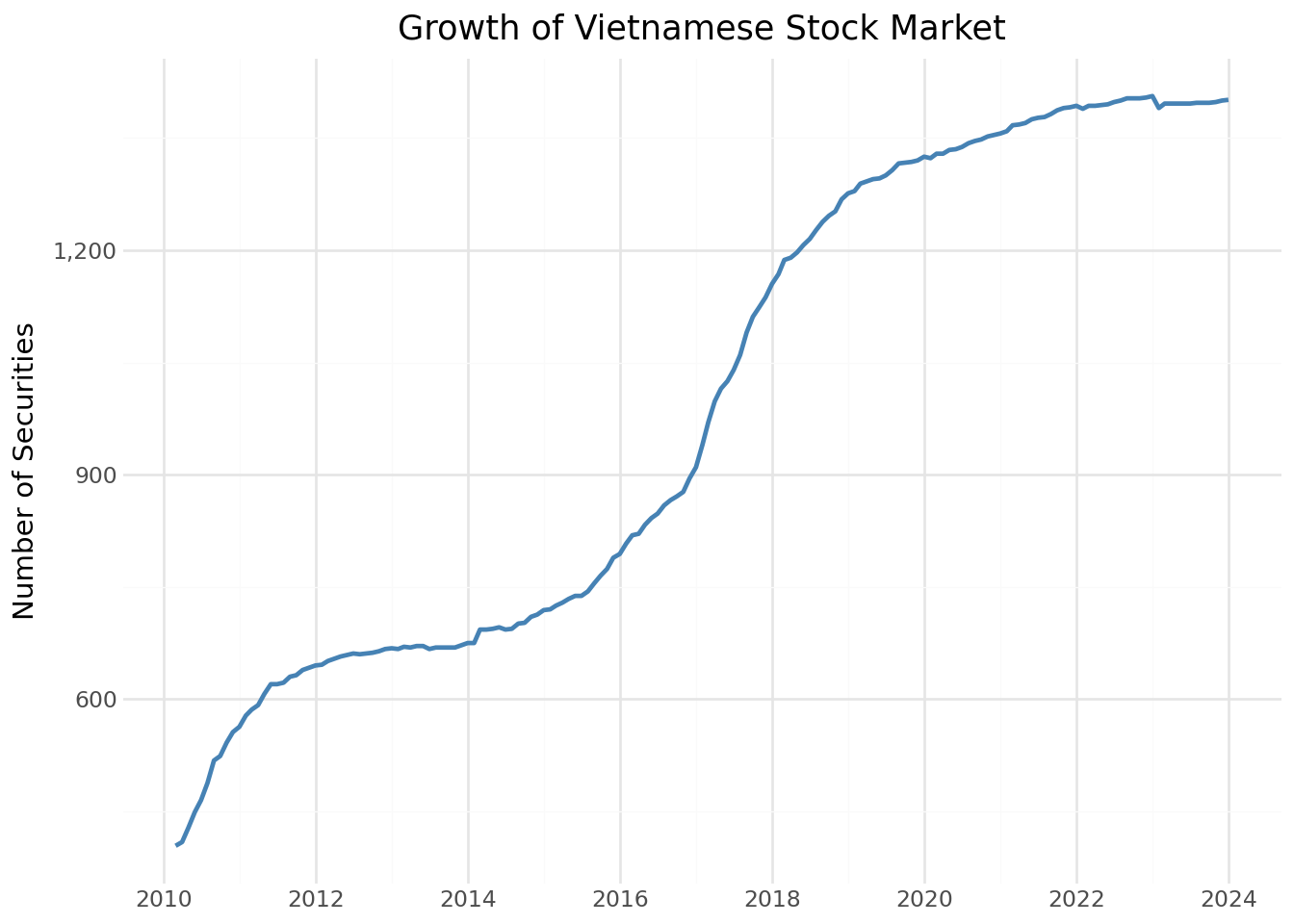
Tổng vốn hóa thị trường phản ánh quy mô và mức độ phát triển chung của thị trường cổ phiếu Việt Nam.
mktcap_figure = (
    ggplot(securities_over_time, aes(x="date", y="total_mktcap / 1000"))
    + geom_line(color="darkgreen", size=1)
    + labs(
        x="",
        y="Market Cap (Trillion VND)",
        title="Total Market Capitalization of Vietnamese Equities"
    )
    + scale_x_datetime(date_breaks="2 years", date_labels="%Y")
    + scale_y_continuous(labels=comma_format())
    + theme_minimal()
)
mktcap_figure.show()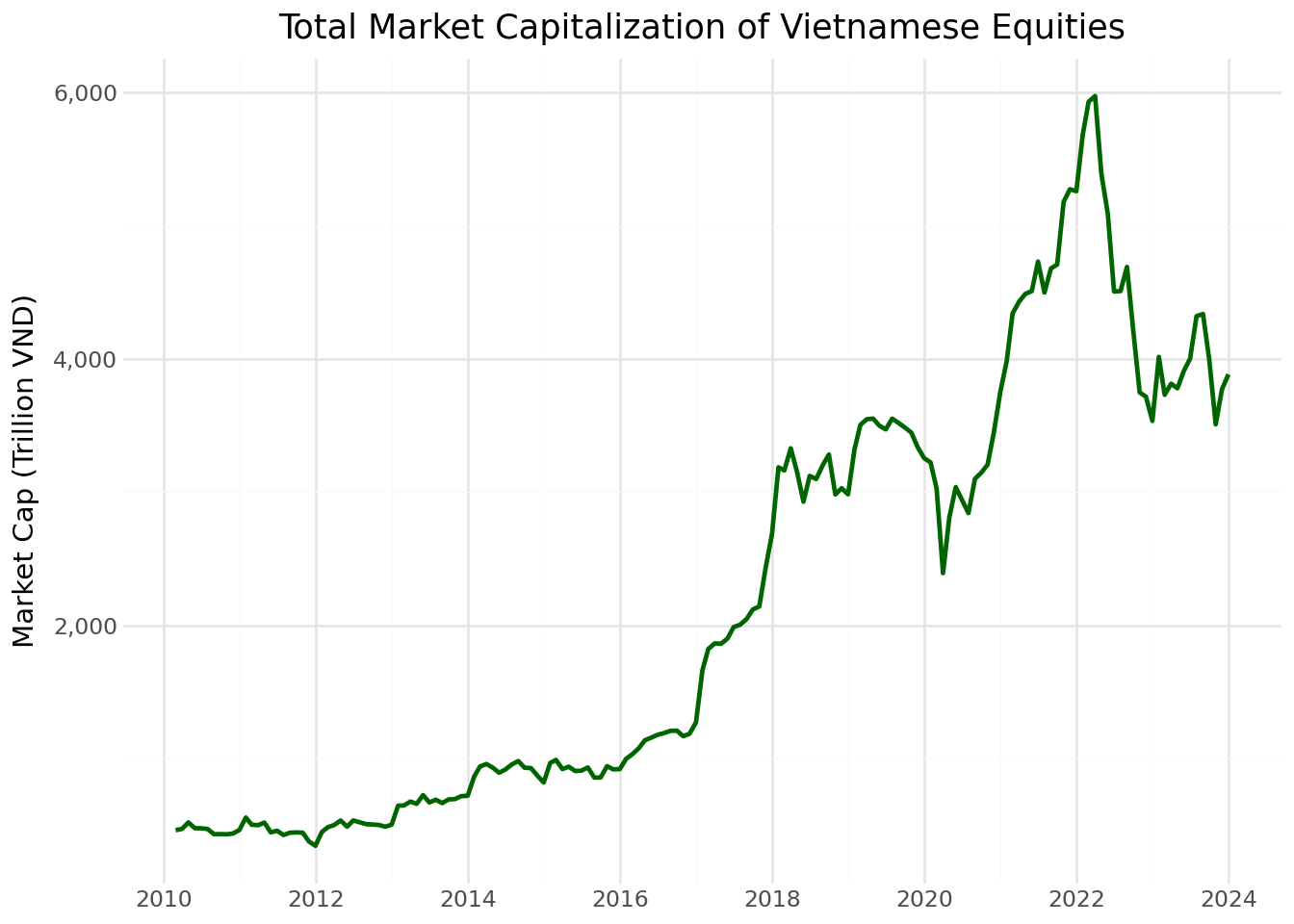
Việc tìm hiểu phân phối của lợi nhuận hằng tháng giúp phát hiện các vấn đề tiềm ẩn về chất lượng dữ liệu và mô tả rủi ro thị trường.
return_distribution = (
    ggplot(prices_monthly, aes(x="ret_excess"))
    + geom_histogram(
        binwidth=0.02,
        fill="steelblue",
        color="white",
        alpha=0.7
    )
    + labs(
        x="Monthly Excess Return",
        y="Frequency",
        title="Distribution of Monthly Excess Returns"
    )
    + scale_x_continuous(limits=(-0.5, 0.5))
    + theme_minimal()
)
return_distribution.show()
/home/mikenguyen/project/tidyfinance/.venv/lib/python3.13/site-packages/plotnine/layer.py:293: PlotnineWarning: stat_bin : Removed 3264 rows containing non-finite values.
/home/mikenguyen/project/tidyfinance/.venv/lib/python3.13/site-packages/plotnine/layer.py:374: PlotnineWarning: geom_histogram : Removed 2 rows containing missing values.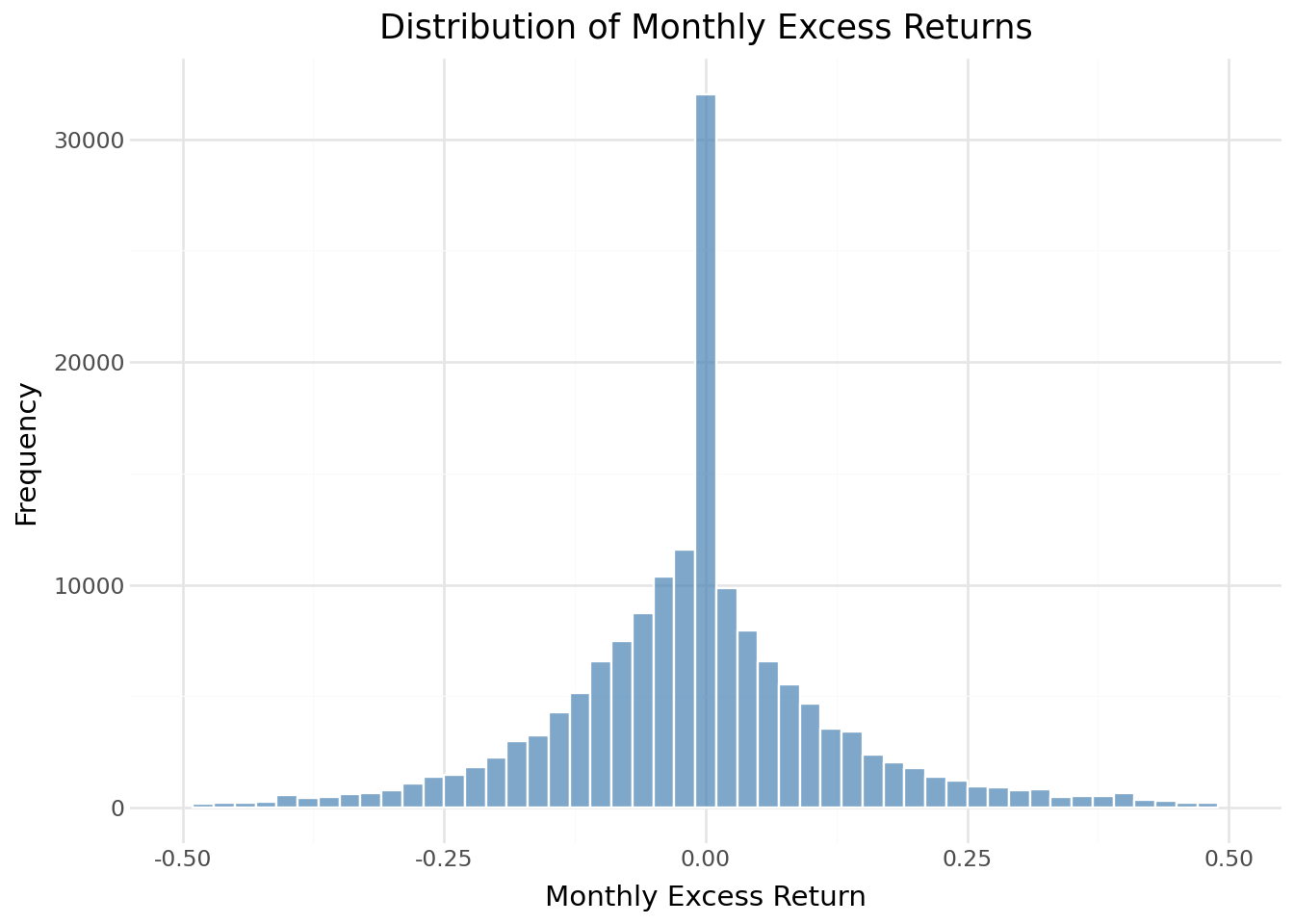
Vốn chủ sở hữu sổ sách là thiết yếu để xây dựng các danh mục giá trị. Chúng ta xem xét tỷ lệ mẫu có sẵn dữ liệu vốn chủ sở hữu sổ sách theo thời gian.
# Merge prices with fundamentals
coverage_data = (prices_monthly
    .assign(year=lambda x: x["date"].dt.year)
    .groupby(["symbol", "year"])
    .tail(1)
    .merge(comp_vn[["symbol", "year", "be"]],
           on=["symbol", "year"],
           how="left")
)

# Compute coverage by year
be_coverage = (coverage_data
    .groupby("year")
    .apply(lambda x: pd.Series({
        "share_with_be": x["be"].notna().mean()
    }))
    .reset_index()
)

coverage_figure = (
    ggplot(be_coverage, aes(x="year", y="share_with_be"))
    + geom_line(color="darkorange", size=1)
    + geom_point(color="darkorange", size=2)
    + labs(
        x="Year",
        y="Share with Book Equity",
        title="Coverage of Book Equity Data"
    )
    + scale_y_continuous(labels=percent_format(), limits=(0, 1))
    + theme_minimal()
)
coverage_figure.show()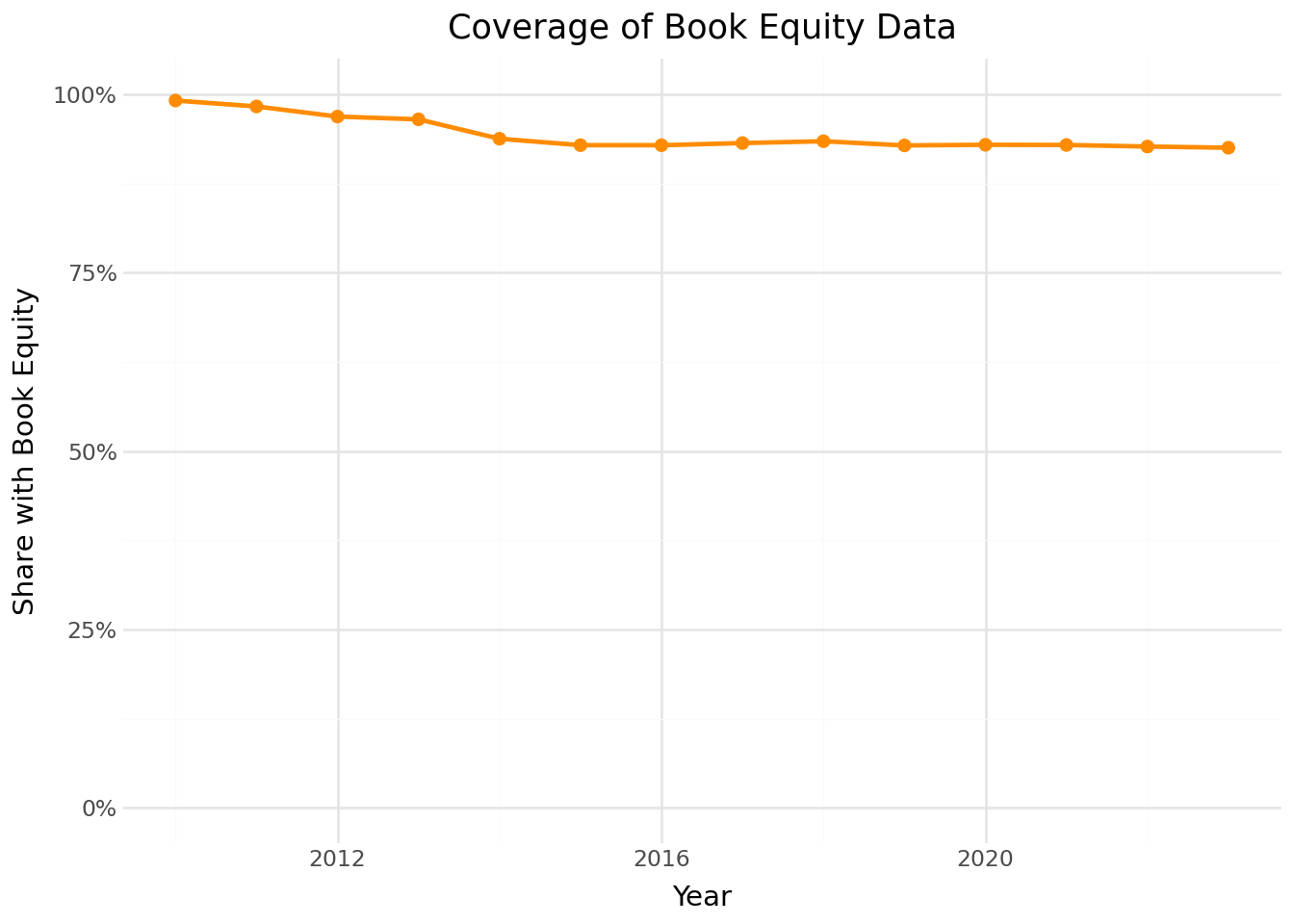
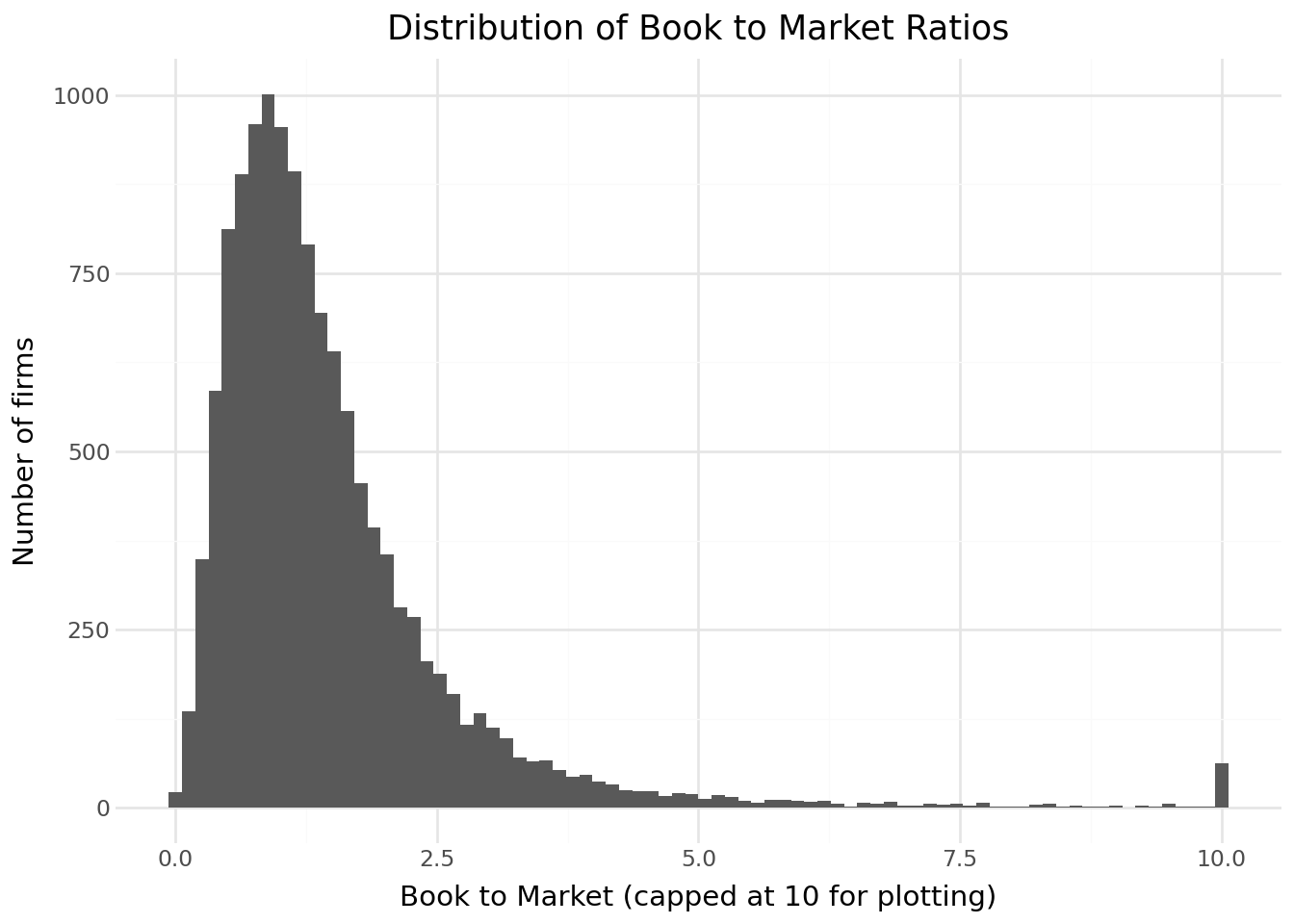
Bước cuối cùng liên kết dữ liệu giá với dữ liệu cơ bản bằng mã cổ phiếu làm định danh chung. Bộ dữ liệu hợp nhất này là cơ sở để xây dựng các danh mục được phân loại theo đặc điểm doanh nghiệp.
# Example: Create merged dataset for end-of-June each year
merged_data = (prices_monthly
    .query("month == 6")
    .merge(
        comp_vn[["symbol", "year", "be", "op", "inv", "at"]],
        on=["symbol", "year"],
        how="left",
        suffixes=("", "_fundamental")
    )
)

# Convert BE from VND to BILLION VND
merged_data["be"] = merged_data["be"] / 1e9

# Compute book-to-market ratio
merged_data["bm"] = merged_data["be"] / merged_data["mktcap"]

merged_data.loc[
    (merged_data["bm"] <= 0) |
    (merged_data["bm"] > 20),
    "bm"
] = pd.NA


merged_data["bm"].describe(percentiles=[.01, .1, .5, .9, .99])

print(f"Merged observations: {len(merged_data):,}")
print(f"With book-to-market: {merged_data['bm'].notna().sum():,}")
merged_data.head(3)
merged_data.describe()
merged_data
Merged observations: 13,756
With book-to-market: 12,859| symbol | date | year | month | open | high | low | close | volume | adjusted_close | ... | mktcap | mktcap_lag | ret | risk_free | ret_excess | be | op | inv | at | bm | |
|---|---|---|---|---|---|---|---|---|---|---|---|---|---|---|---|---|---|---|---|---|---|
| 0 | A32 | 2019-06-30 | 2019.0 | 6.0 | 26.4 | 26.4 | 21.0 | 22.5 | 3700 | 35.929125 | ... | 153.000 | 179.52 | -0.170323 | 0.003333 | -0.173657 | 223.612748 | 0.232362 | -0.072329 | 4.349303e+11 | 1.461521 |
| 1 | A32 | 2020-06-30 | 2020.0 | 6.0 | 25.0 | 26.3 | 24.5 | 26.3 | 7500 | 38.811173 | ... | 178.840 | 187.00 | -0.067977 | 0.003333 | -0.071311 | 242.216943 | 0.195565 | 0.122698 | 4.882955e+11 | 1.354378 |
| 2 | A32 | 2021-06-30 | 2021.0 | 6.0 | 30.2 | 37.0 | 29.5 | 32.0 | 78400 | 45.363520 | ... | 217.600 | 214.20 | 0.015873 | 0.003333 | 0.012540 | 238.385190 | 0.157723 | 0.081581 | 5.281309e+11 | 1.095520 |
| 3 | A32 | 2022-06-30 | 2022.0 | 6.0 | 30.9 | 35.5 | 25.0 | 35.3 | 15200 | 47.503210 | ... | 240.040 | 210.12 | 0.142395 | 0.003333 | 0.139061 | 215.399735 | 0.172085 | 0.036584 | 5.474523e+11 | 0.897349 |
| 4 | A32 | 2023-06-30 | 2023.0 | 6.0 | 30.1 | 33.5 | 29.2 | 29.4 | 2400 | 35.064204 | ... | 199.920 | 204.68 | -0.023256 | 0.003333 | -0.026589 | 222.024135 | 0.174658 | -0.076752 | 5.054342e+11 | 1.110565 |
| ... | ... | ... | ... | ... | ... | ... | ... | ... | ... | ... | ... | ... | ... | ... | ... | ... | ... | ... | ... | ... | ... |
| 13751 | YTC | 2019-06-30 | 2019.0 | 6.0 | 70.0 | 79.9 | 70.0 | 79.9 | 38900 | 171.451817 | ... | 246.092 | 215.60 | 0.141429 | 0.003333 | 0.138095 | 59.901389 | 0.738190 | -0.021758 | 7.521980e+11 | 0.243411 |
| 13752 | YTC | 2020-06-30 | 2020.0 | 6.0 | 88.5 | 88.5 | 77.0 | 87.0 | 150640 | 180.966960 | ... | 267.960 | 272.58 | -0.016949 | 0.003333 | -0.020282 | 13.459082 | -0.458548 | 0.323501 | 9.955348e+11 | 0.050228 |
| 13753 | YTC | 2021-06-30 | 2021.0 | 6.0 | 76.0 | 115.5 | 61.0 | 61.0 | 34100 | 126.884880 | ... | 187.880 | 234.08 | -0.197368 | 0.003333 | -0.200702 | 21.746595 | 0.539521 | -0.215694 | 7.808035e+11 | 0.115747 |
| 13754 | YTC | 2022-06-30 | 2022.0 | 6.0 | 68.0 | 68.0 | 65.0 | 65.5 | 200 | 136.245240 | ... | 201.740 | 209.44 | -0.036765 | 0.003333 | -0.040098 | 32.403055 | 0.483088 | 0.182911 | 9.236206e+11 | 0.160618 |
| 13755 | YTC | 2023-06-30 | 2023.0 | 6.0 | 59.0 | 59.0 | 59.0 | 59.0 | 49545 | 122.724720 | ... | 181.720 | 181.72 | 0.000000 | 0.003333 | -0.003333 | 38.976624 | 0.450157 | 0.017930 | 9.401815e+11 | 0.214487 |
13756 rows × 21 columns
from plotnine import *
import numpy as np

bm_plot_data = (
    merged_data[["bm"]]
      .dropna()
      .assign(bm_plot=lambda x: x["bm"].clip(upper=10))
)

(
    ggplot(bm_plot_data, aes(x="bm_plot")) +
    geom_histogram(bins=80) +
    labs(
        title="Distribution of Book to Market Ratios",
        x="Book to Market (capped at 10 for plotting)",
        y="Number of firms"
    ) +
    theme_minimal()
)
size_plot_data = (
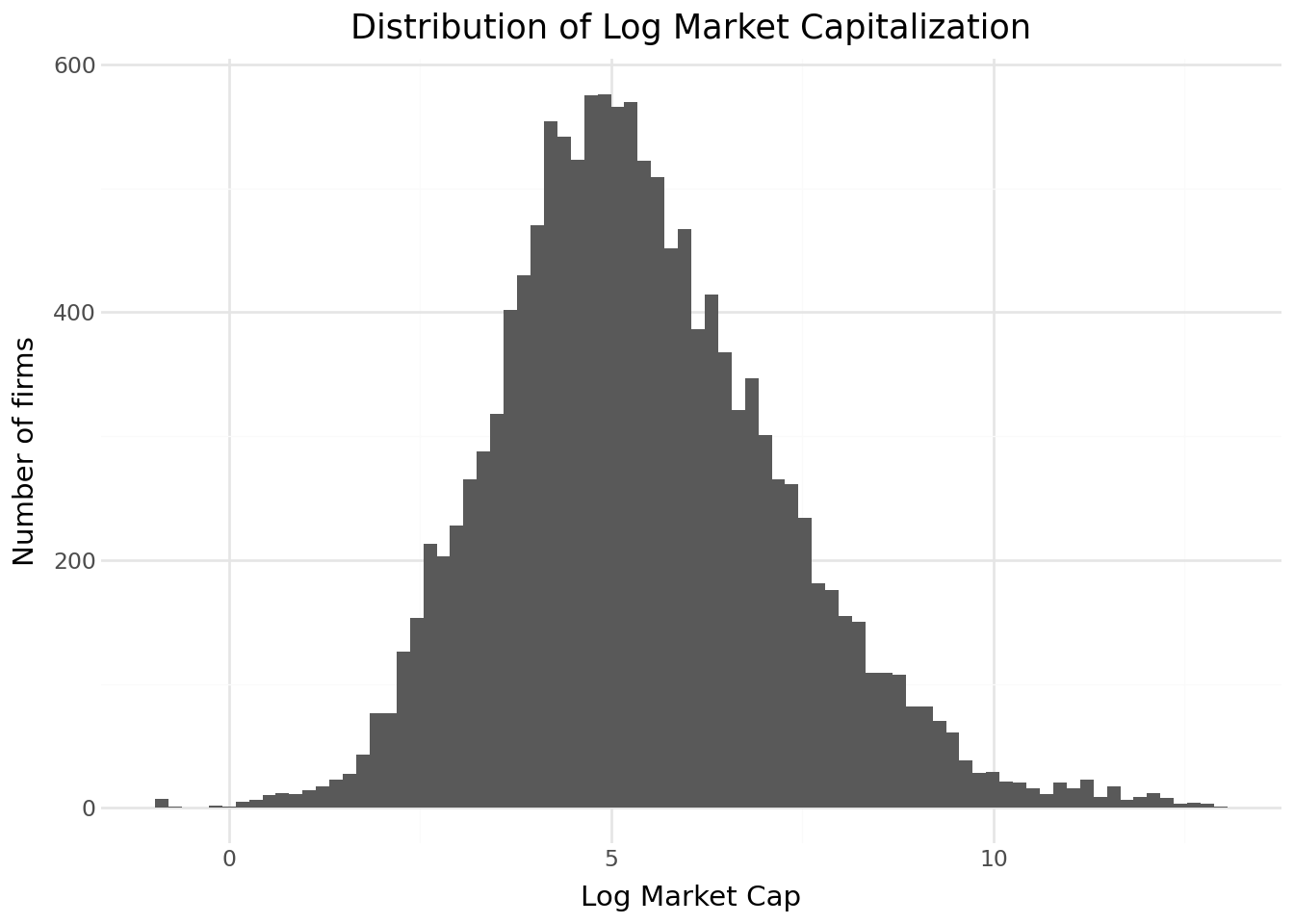
    merged_data[["mktcap_lag"]]
      .dropna()
      .assign(log_size=lambda x: np.log(x["mktcap_lag"]))
)

(
    ggplot(size_plot_data, aes(x="log_size")) +
    geom_histogram(bins=80) +
    labs(
        title="Distribution of Log Market Capitalization",
        x="Log Market Cap",
        y="Number of firms"
    ) +
    theme_minimal()
)
scatter_data = (
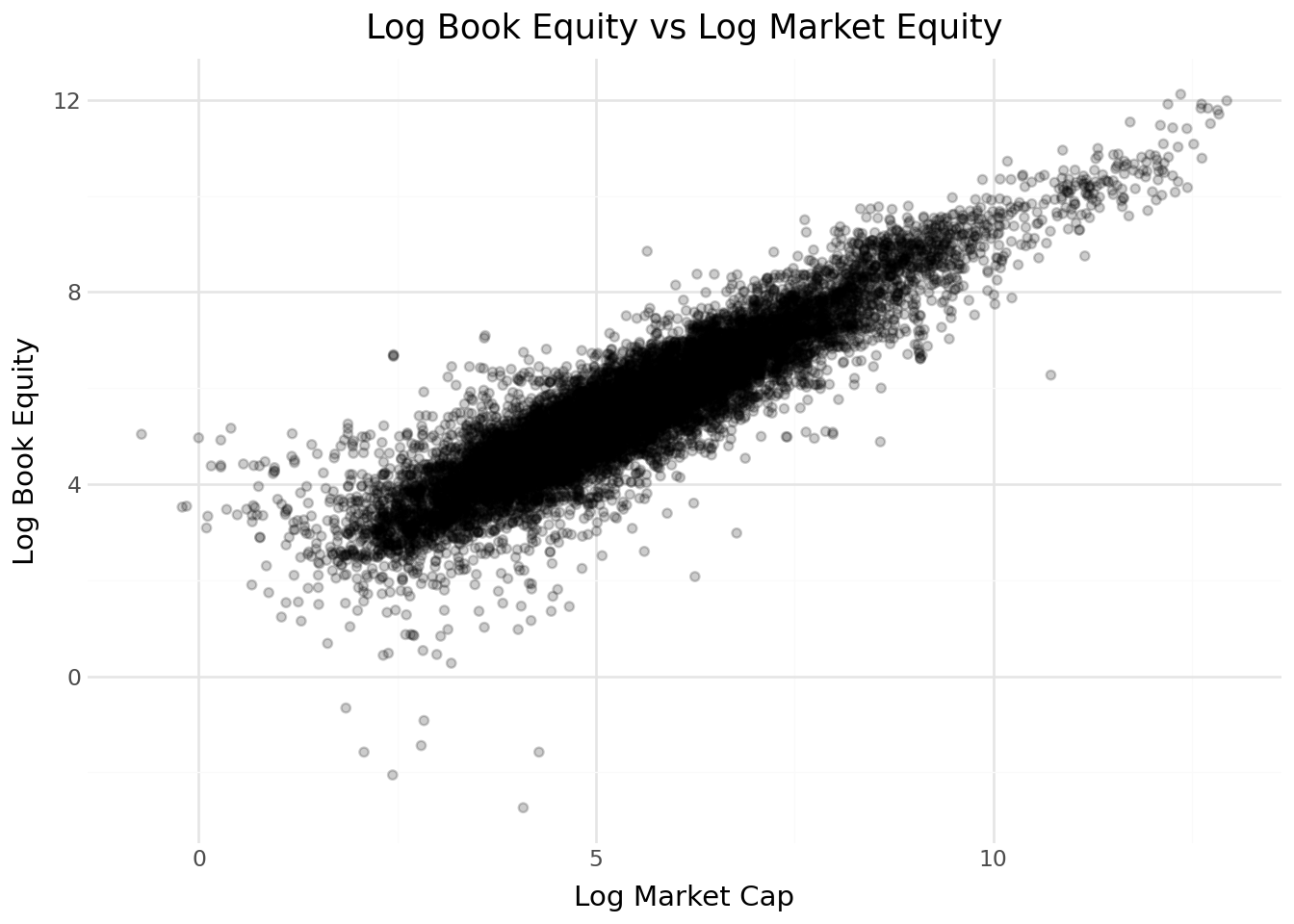
    merged_data[["be", "mktcap_lag"]]
      .dropna()
      .assign(
          log_be=lambda x: np.log(x["be"]),
          log_me=lambda x: np.log(x["mktcap_lag"])
      )
)

(
    ggplot(scatter_data, aes(x="log_me", y="log_be")) +
    geom_point(alpha=0.2) +
    labs(
        title="Log Book Equity vs Log Market Equity",
        x="Log Market Cap",
        y="Log Book Equity"
    ) +
    theme_minimal()
)
Datacore cung cấp quyền truy cập thống nhất vào dữ liệu tài chính Việt Nam thông qua hạ tầng hiện đại trên nền tảng đám mây, loại bỏ nhu cầu tổng hợp dữ liệu từ nhiều nguồn phân mảnh.
Dữ liệu cơ bản của doanh nghiệp từ Datacore bao gồm bảng cân đối kế toán, báo cáo kết quả kinh doanh và dữ liệu lưu chuyển tiền tệ toàn diện được lập theo Chuẩn mực Kế toán Việt Nam, mà chúng ta ánh xạ sang các biến chuẩn dùng trong nghiên cứu quốc tế.
Cách tính vốn chủ sở hữu sổ sách theo phương pháp Fama-French, có tính đến thuế hoãn lại và cổ phiếu ưu đãi để bảo đảm khả năng so sánh với các nghiên cứu dựa trên dữ liệu Hoa Kỳ.
Dữ liệu giá cổ phiếu bao gồm các hệ số điều chỉnh cho sự kiện doanh nghiệp, cho phép tính lợi nhuận chính xác trên các kỳ hạn dài.
Tần suất hằng tháng là chuẩn trong nghiên cứu định giá tài sản, giúp giảm nhiễu mà vẫn giữ đủ số quan sát cho suy luận thống kê.
Xấp xỉ lãi suất phi rủi ro dùng lợi suất trái phiếu chính phủ Việt Nam làm biến đại diện, do thiếu một chuỗi lãi suất ngắn hạn chuẩn hóa tương đương tín phiếu Kho bạc Hoa Kỳ.
Kiểm định chất lượng dữ liệu thông qua thống kê mô tả và trực quan hóa giúp phát hiện các vấn đề tiềm ẩn trước khi thực hiện các phân tích chính thức.
Xử lý theo lô cho phép xử lý hiệu quả các bộ dữ liệu hằng ngày lớn mà nếu không sẽ vượt quá giới hạn bộ nhớ.