Causal Mediation Analysis with ACME and ADE Estimation
mediation_analysis.RdPerforms causal mediation analysis to decompose the total treatment effect into the Average Causal Mediation Effect (ACME / indirect effect) and the Average Direct Effect (ADE). Wraps mediation package functionality with enhanced output and visualization.
Usage
mediation_analysis(
  data,
  outcome,
  treatment,
  mediator,
  covariates = NULL,
  treat_mediator_interaction = FALSE,
  family_mediator = "gaussian",
  family_outcome = "gaussian",
  sims = 1000,
  conf_level = 0.95,
  seed = 42,
  plot = TRUE
)
Arguments
- data
A data frame.
- outcome
Character. Name of the outcome variable.
- treatment
Character. Name of the binary treatment variable.
- mediator
Character. Name of the mediator variable.
- covariates
Character vector. Additional covariates in both models. Default
NULL.- treat_mediator_interaction
Logical. Whether to include a treatment × mediator interaction in the outcome model. Default
FALSE.- family_mediator
Character. GLM family for the mediator model. Default
"gaussian". Use"binomial"for binary mediators.- family_outcome
Character. GLM family for the outcome model. Default
"gaussian".- sims
Integer. Number of quasi-Bayesian Monte Carlo simulations. Default
1000.- conf_level
Numeric. Confidence level for CIs. Default
0.95.- seed
Integer. Random seed. Default
42.- plot
Logical. If
TRUE(default), produce a decomposition plot.
Value
A list with:
- acme
Numeric. Average Causal Mediation Effect (indirect effect).
- ade
Numeric. Average Direct Effect.
- total
Numeric. Total treatment effect.
- prop_mediated
Numeric. Proportion of effect mediated.
- summary_df
Data frame with ACME, ADE, Total, and their CIs.
- mediation_obj
The
mediateobject (if mediation is available).- plot
ggplot2 decomposition bar chart.
Details
This function implements the approach from Imai et al. (2010) via the mediation package. When mediation is not available, a simple product-of-coefficients (Baron-Kenny) approach is used.
The sequential ignorability assumption (no unmeasured confounding of
mediator-outcome relationship) is required for causal interpretation.
Use sensitivity_plot() or the sens.analysis output from
the mediation package to assess robustness.
References
Imai, K., Keele, L., & Tingley, D. (2010). A general approach to causal mediation analysis. Psychological Methods, 15(4), 309–334.
Baron, R. M., & Kenny, D. A. (1986). The moderator-mediator variable distinction in social psychological research. Journal of Personality and Social Psychology, 51(6), 1173–1182.
Examples
set.seed(123)
n <- 200
df <- data.frame(
  treat = rbinom(n, 1, 0.5),
  X     = rnorm(n)
)
df$mediator <- 0.5 * df$treat + 0.3 * df$X + rnorm(n, 0, 0.5)
df$outcome  <- 0.3 * df$mediator + 0.2 * df$treat + rnorm(n)

result <- mediation_analysis(
  data      = df,
  outcome   = "outcome",
  treatment = "treat",
  mediator  = "mediator"
)
#> Registered S3 method overwritten by 'lme4':
#>   method           from
#>   na.action.merMod car
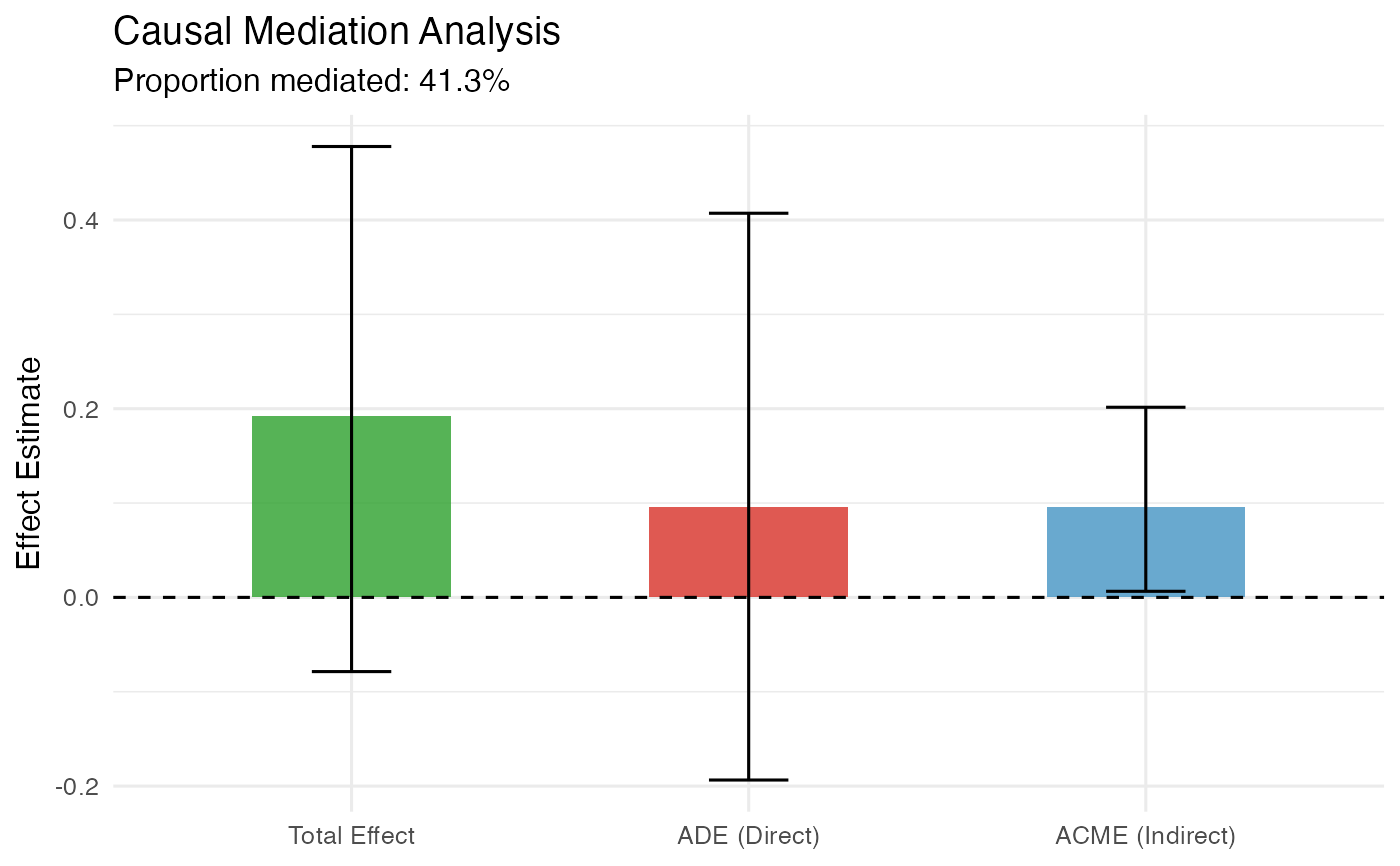
result$summary_df
#>            effect   estimate     ci_lower  ci_upper
#> 1 ACME (Indirect) 0.09632680  0.006451494 0.2015267
#> 2    ADE (Direct) 0.09566813 -0.193571221 0.4071730
#> 3    Total Effect 0.19199493 -0.078644711 0.4779045
result$plot